
Data Mining Lecture 4 Course Syllabus Course topics
Data Mining Lecture 4

Course Syllabus • Course topics: • Data Management and Data Collection Techniques for Data Mining Applications (Week 3 -Week 4) – Data Warehouses: Gathering Raw Data from Relational Databases and transforming into Information. – Information Extraction and Data Processing Techniques – Data Marts: The need for building highly specialized data storages for data mining applications • Case Study 1: Working and experiencing on the properties of The Retail Banking Data Mart (Week 4 – Assignment 1)
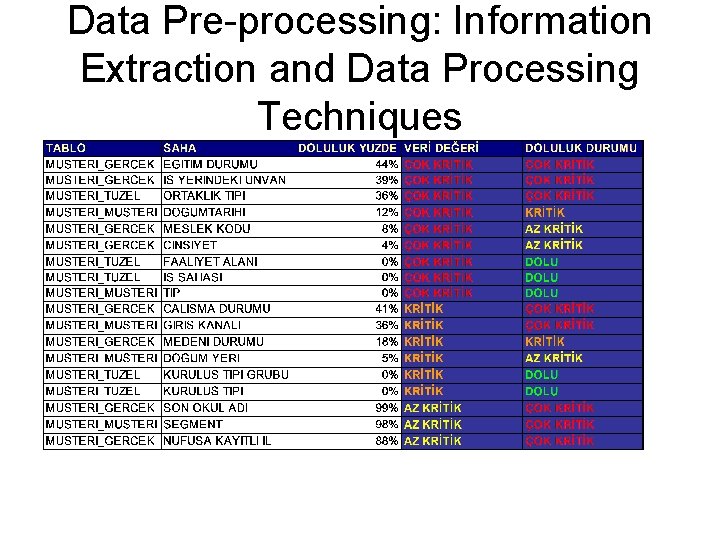
Data Pre-processing: Information Extraction and Data Processing Techniques • Why we should do pre-processing ? • pre-processing takes %80 of the time • Real world data is not perfect (dirty) – missing values (no data entrance) • • eg. %35 of Education Field is incomplete eg. %20 of Birth Date is incomplete eg. %45 of Work Title is incomplete eg. %60 of Income is incomplete
Data Pre-processing: Information Extraction and Data Processing Techniques
Data Pre-processing: Information Extraction and Data Processing Techniques
Data Pre-processing: Information Extraction and Data Processing Techniques
Data Pre-processing: Information Extraction and Data Processing Techniques – erraneous (noisy) • eg. Birth Date > current date or Birth Date <1850 (approx. %10 of the data) • eg. permissible values Education Field (C: college U: university H: high school D: doctorate M: master S : secondary school P: primary school I : illegitimate) but X, Q, Y, T values may seen (approx. %10 of the data) • Income field is negative (approx. %15 of the data)
Data Pre-processing: Information Extraction and Data Processing Techniques – inconsistent- discrepancies in codes or names • eg. Birth Date =’ 01/01/1955’, 54 (same info but different forms) • eg. Education Field coded (C: college U: university H: high school D: doctorate M: master S : secondary school P: primary school I : illegitimate) (5: college 3: university 4: high school 1: doctorate 2: master 6 : secondary school 7: primary school 8 : illegitimate) • Income field continuous (3200 K) or interval based (3000 -4000 K)
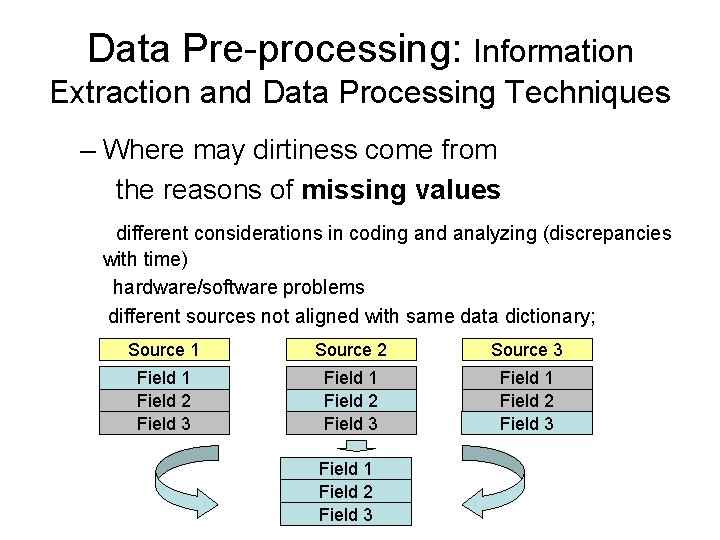
Data Pre-processing: Information Extraction and Data Processing Techniques – Where may dirtiness come from the reasons of missing values different considerations in coding and analyzing (discrepancies with time) hardware/software problems different sources not aligned with same data dictionary; Source 1 Source 2 Source 3 Field 1 Field 2 Field 3
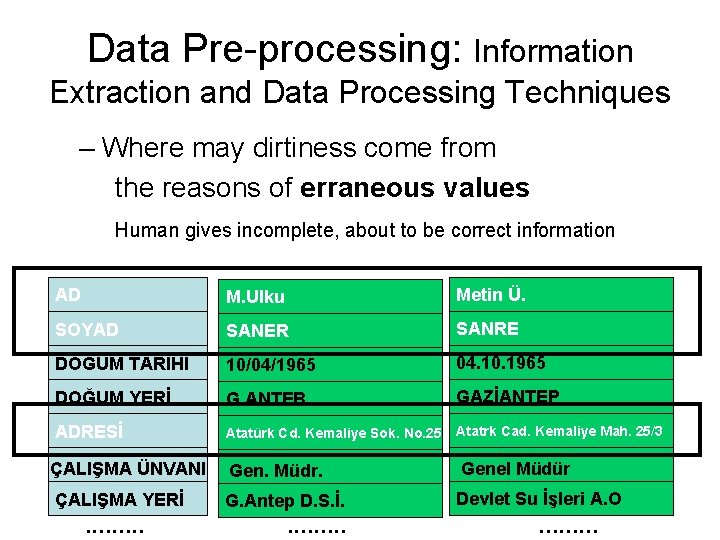
Data Pre-processing: Information Extraction and Data Processing Techniques – Where may dirtiness come from the reasons of erraneous values Human gives incomplete, about to be correct information AD M. Ulku Metin Ü. SOYAD SANER SANRE DOĞUM TARİHİ 10/04/1965 04. 10. 1965 DOĞUM YERİ G. ANTEB GAZİANTEP ADRESİ Atatürk Cd. Kemaliye Sok. No. 25 Atatrk Cad. Kemaliye Mah. 25/3 ÇALIŞMA ÜNVANI ÇALIŞMA YERİ . . Gen. Müdr. Genel Müdür G. Antep D. S. İ. Devlet Su İşleri A. O . . . .
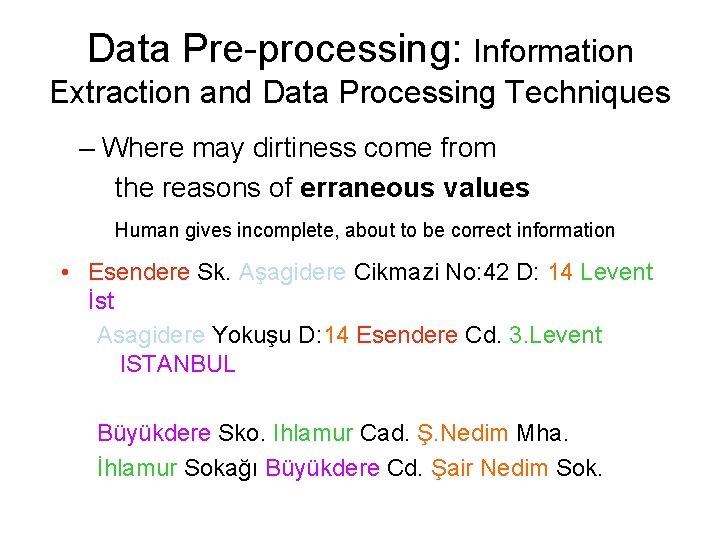
Data Pre-processing: Information Extraction and Data Processing Techniques – Where may dirtiness come from the reasons of erraneous values Human gives incomplete, about to be correct information • Esendere Sk. Aşagidere Cikmazi No: 42 D: 14 Levent İst Asagidere Yokuşu D: 14 Esendere Cd. 3. Levent ISTANBUL Büyükdere Sko. Ihlamur Cad. Ş. Nedim Mha. İhlamur Sokağı Büyükdere Cd. Şair Nedim Sok.
Data Pre-processing: Information Extraction and Data Processing Techniques – Where may dirtiness come from the reasons of erraneous values insufficient , incapable data collection instruments • partial matching, • fuzzy understanding, • syntactic- semantic enrichment continuous flow of data may cause data entrance faults error or disruption in data transmission
Data Pre-processing: Information Extraction and Data Processing Techniques – Where may dirtiness come from the reasons of inconsistent values • insufficient lookup mappings • incapable transformation infrastructures • different data sources hard to prevent needs highly specialized synchronization and automation infrastructure also we should care duplicate data (Redundancy)
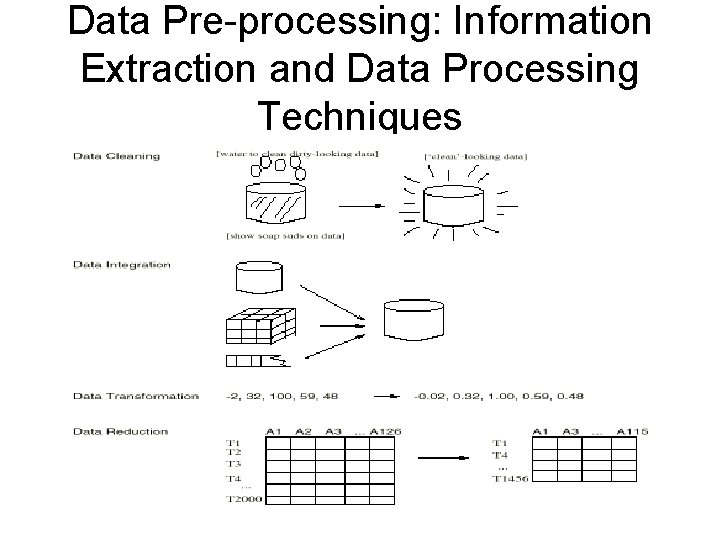
Data Pre-processing: Information Extraction and Data Processing Techniques – Why pre-processing so important Data quality brings successful data mining The Only Way to extract information from Data Major tasks in Data Pre-processing: • Data cleaning • Data integration • Data transformation • Data reduction • Data discretization
Data Pre-processing: Information Extraction and Data Processing Techniques
Data Pre-processing: Information Extraction and Data Processing Techniques Major tasks in Data Cleaning: – Fill in missing values – Identify outliers and smooth out noisy data – Correct inconsistent data – Resolve redundancy caused by data integration
Data Pre-processing: Information Extraction and Data Processing Techniques Major tasks in Data Cleaning: – Fill in missing values – Identify outliers and smooth out noisy data – Correct inconsistent data – Resolve redundancy caused by data integration
Data Pre-processing: Information Extraction and Data Processing Techniques How to handle missing data – simply do not accept it – fill it manually – fill it automatically: » a global constant : e. g. , “unknown”, a new class? ! » the attribute mean for all samples belonging to the same class: smarter » the most probable value: inference-based such as Bayesian formula or decision tree
Data Pre-processing: Information Extraction and Data Processing Techniques How to handle noisy data – Binning (discretization) method: » first sort data and partition into (equi-depth) bins then one can smooth by bin means, smooth by bin median, smooth by bin boundaries, etc. » use data distribution and domain knowledge – Clustering » detect and remove outliers – Combined computer and human inspection » detect suspicious values and check by human (e. g. , deal with possible outliers) – Regression » smooth by fitting the data into regression functions – Model the data and infer the most probable values (difficult)
Data Pre-processing: Information Extraction and Data Processing Techniques Binning • Equal-width (distance) partitioning: – divides the range into N intervals of equal size: uniform grid – if A and B are the lowest and highest values of the attribute, the width of intervals will be: W = (B –A)/N. – The most straightforward, but outliers may dominate presentation – Skewed data is not handled well. • Equal-depth (frequency) partitioning: – Divides the range into N intervals, each containing approximately same number of samples – Good data scaling – Managing categorical attributes can be tricky.
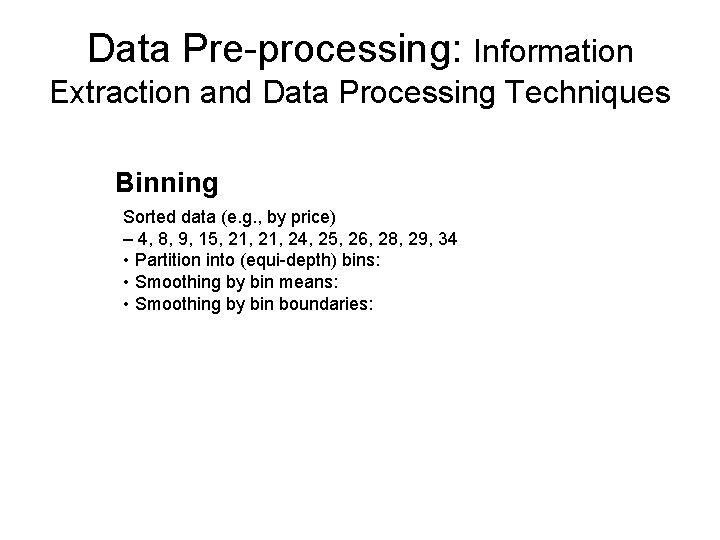
Data Pre-processing: Information Extraction and Data Processing Techniques Binning Sorted data (e. g. , by price) – 4, 8, 9, 15, 21, 24, 25, 26, 28, 29, 34 • Partition into (equi-depth) bins: • Smoothing by bin means: • Smoothing by bin boundaries:
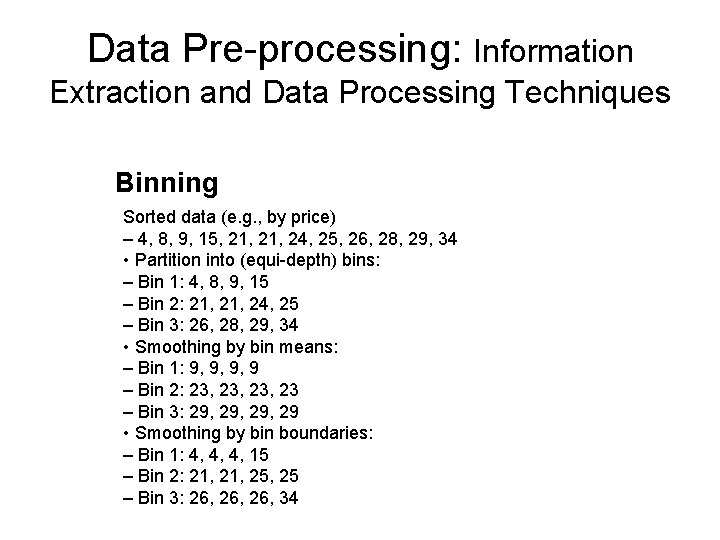
Data Pre-processing: Information Extraction and Data Processing Techniques Binning Sorted data (e. g. , by price) – 4, 8, 9, 15, 21, 24, 25, 26, 28, 29, 34 • Partition into (equi-depth) bins: – Bin 1: 4, 8, 9, 15 – Bin 2: 21, 24, 25 – Bin 3: 26, 28, 29, 34 • Smoothing by bin means: – Bin 1: 9, 9, 9, 9 – Bin 2: 23, 23, 23 – Bin 3: 29, 29, 29 • Smoothing by bin boundaries: – Bin 1: 4, 4, 4, 15 – Bin 2: 21, 25, 25 – Bin 3: 26, 26, 34
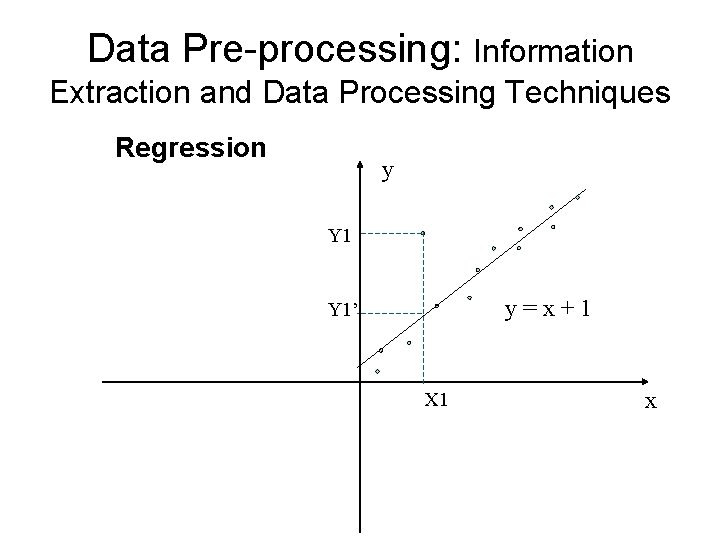
Data Pre-processing: Information Extraction and Data Processing Techniques Regression y Y 1 y=x+1 Y 1’ X 1 x
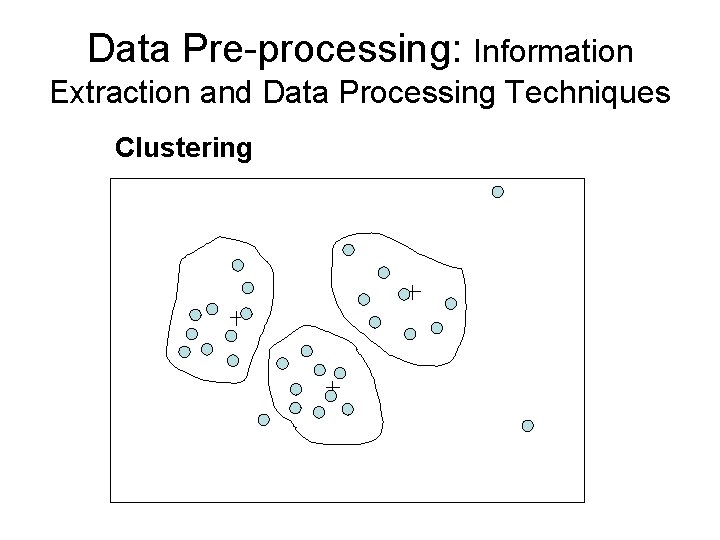
Data Pre-processing: Information Extraction and Data Processing Techniques Clustering
Data Pre-processing: Information Extraction and Data Processing Techniques How to handle inconsistent data – systematic conversion, “transformation” – dynamic and interactive control mechanishms – redundancy detection and intelligent mapping
Data Pre-processing: Information Extraction and Data Processing Techniques Transformation – Smoothing: remove noise from data – Aggregation: summarization, data cube construction – Generalization: concept hierarchy climbing – Normalization: scaled to fall within a small, specified range min-max normalization » z-score normalization » normalization by decimal scaling – Attribute/feature construction: New attributes constructed from the given ones
Data Pre-processing: Information Extraction and Data Processing Techniques Transformation – Smoothing: remove noise from data – Aggregation: summarization, data cube construction – Generalization: concept hierarchy climbing – Normalization: scaled to fall within a small, specified range min-max normalization » z-score normalization » normalization by decimal scaling – Attribute/feature construction: New attributes constructed from the given ones
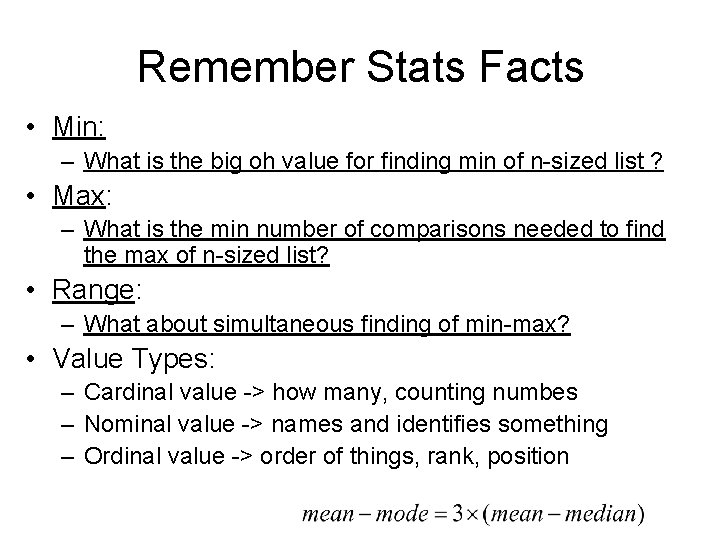
Remember Stats Facts • Min: – What is the big oh value for finding min of n-sized list ? • Max: – What is the min number of comparisons needed to find the max of n-sized list? • Range: – What about simultaneous finding of min-max? • Value Types: – Cardinal value -> how many, counting numbes – Nominal value -> names and identifies something – Ordinal value -> order of things, rank, position
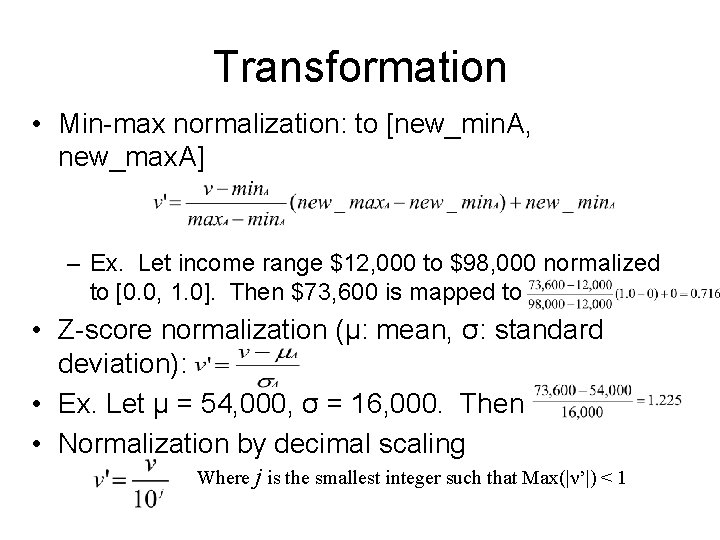
Transformation • Min-max normalization: to [new_min. A, new_max. A] – Ex. Let income range $12, 000 to $98, 000 normalized to [0. 0, 1. 0]. Then $73, 600 is mapped to • Z-score normalization (μ: mean, σ: standard deviation): • Ex. Let μ = 54, 000, σ = 16, 000. Then • Normalization by decimal scaling Where j is the smallest integer such that Max(|ν’|) < 1
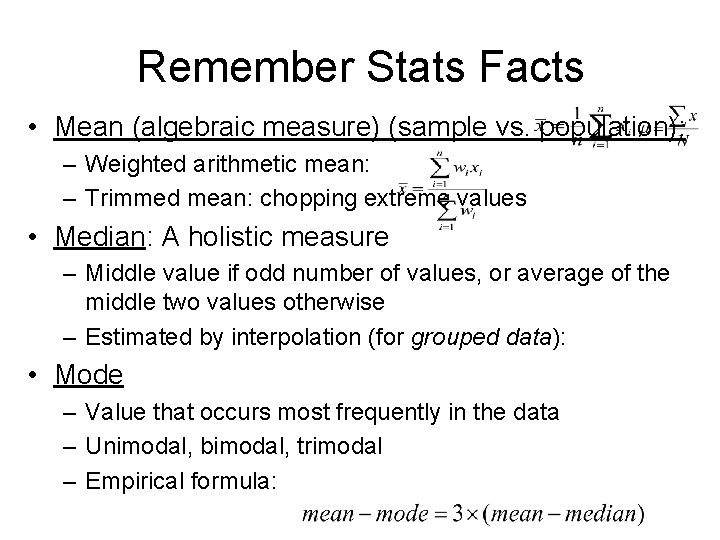
Remember Stats Facts • Mean (algebraic measure) (sample vs. population): – Weighted arithmetic mean: – Trimmed mean: chopping extreme values • Median: A holistic measure – Middle value if odd number of values, or average of the middle two values otherwise – Estimated by interpolation (for grouped data): • Mode – Value that occurs most frequently in the data – Unimodal, bimodal, trimodal – Empirical formula:

Week 4 -End • read – Course Text Book Chapter 2
- Slides: 31