
DATA MINING LECTURE 2 What is data What

![Representation • Adjacency list • Not so easy to maintain 2 1: [2, 3]](https://slidetodoc.com/presentation_image_h2/38ccd4261ee9e097be39047262327ef9/image-23.jpg "Representation • Adjacency list • Not so easy to maintain 2 1: [2, 3]")
- Slides: 25
DATA MINING LECTURE 2 What is data?
What is Data Mining? • Data mining is the use of efficient techniques for the analysis of very large collections of data and the extraction of useful and possibly unexpected patterns in data. • “Data mining is the analysis of (often large) observational data sets to find unsuspected relationships and to summarize the data in novel ways that are both understandable and useful to the data analyst” (Hand, Mannila, Smyth) • “Data mining is the discovery of models for data” (Rajaraman, Ullman) • We can have the following types of models • Models that explain the data (e. g. , a single function) • Models that predict the future data instances. • Models that summarize the data • Models the extract the most prominent features of the data.
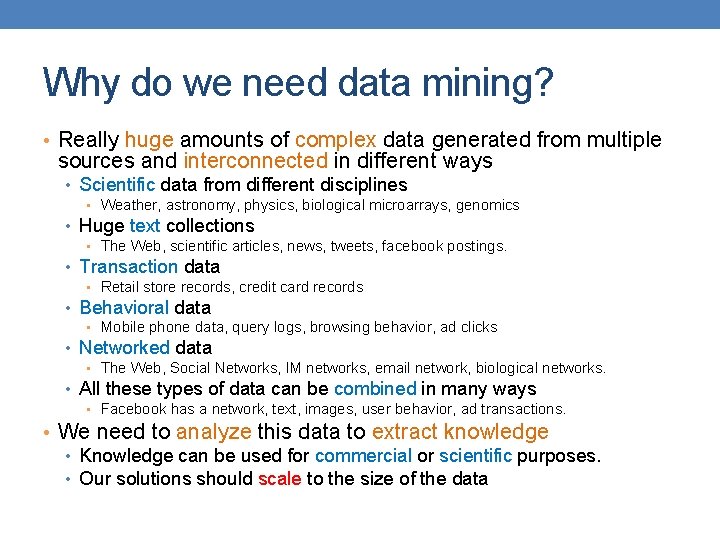
Why do we need data mining? • Really huge amounts of complex data generated from multiple sources and interconnected in different ways • Scientific data from different disciplines • Weather, astronomy, physics, biological microarrays, genomics • Huge text collections • The Web, scientific articles, news, tweets, facebook postings. • Transaction data • Retail store records, credit card records • Behavioral data • Mobile phone data, query logs, browsing behavior, ad clicks • Networked data • The Web, Social Networks, IM networks, email network, biological networks. • All these types of data can be combined in many ways • Facebook has a network, text, images, user behavior, ad transactions. • We need to analyze this data to extract knowledge • Knowledge can be used for commercial or scientific purposes. • Our solutions should scale to the size of the data
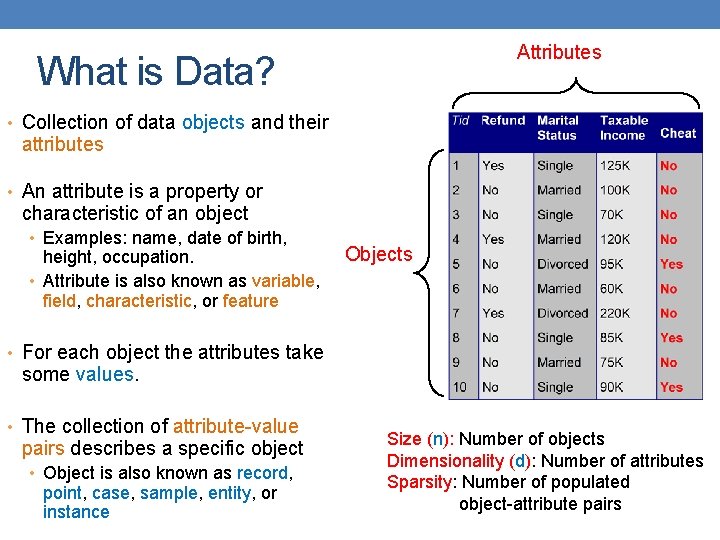
Attributes What is Data? • Collection of data objects and their attributes • An attribute is a property or characteristic of an object • Examples: name, date of birth, height, occupation. • Attribute is also known as variable, field, characteristic, or feature Objects • For each object the attributes take some values. • The collection of attribute-value pairs describes a specific object • Object is also known as record, point, case, sample, entity, or instance Size (n): Number of objects Dimensionality (d): Number of attributes Sparsity: Number of populated object-attribute pairs
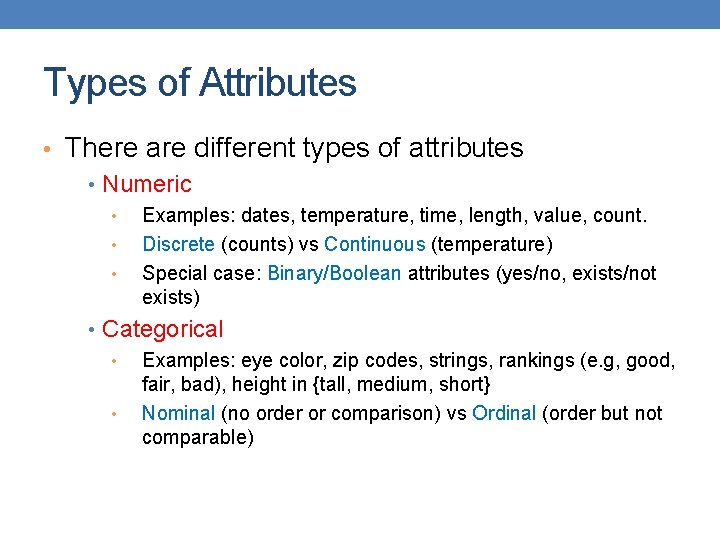
Types of Attributes • There are different types of attributes • Numeric • • • Examples: dates, temperature, time, length, value, count. Discrete (counts) vs Continuous (temperature) Special case: Binary/Boolean attributes (yes/no, exists/not exists) • Categorical • Examples: eye color, zip codes, strings, rankings (e. g, good, fair, bad), height in {tall, medium, short} • Nominal (no order or comparison) vs Ordinal (order but not comparable)
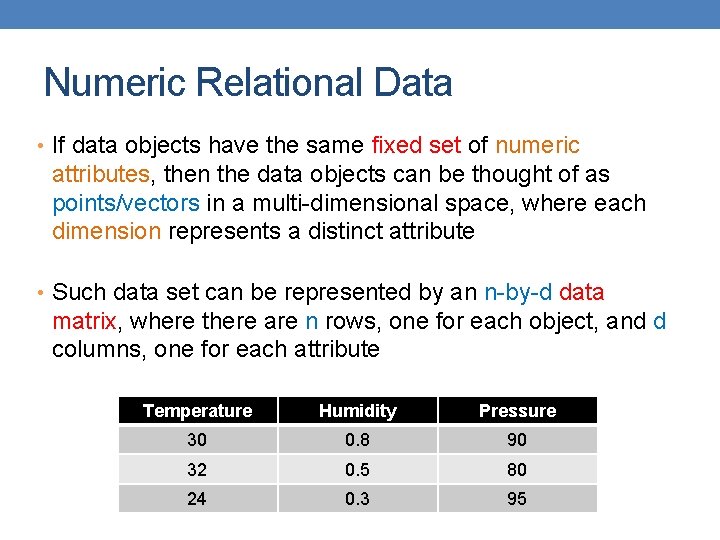
Numeric Relational Data • If data objects have the same fixed set of numeric attributes, then the data objects can be thought of as points/vectors in a multi-dimensional space, where each dimension represents a distinct attribute • Such data set can be represented by an n-by-d data matrix, where there are n rows, one for each object, and d columns, one for each attribute Temperature Humidity Pressure 30 0. 8 90 32 0. 5 80 24 0. 3 95
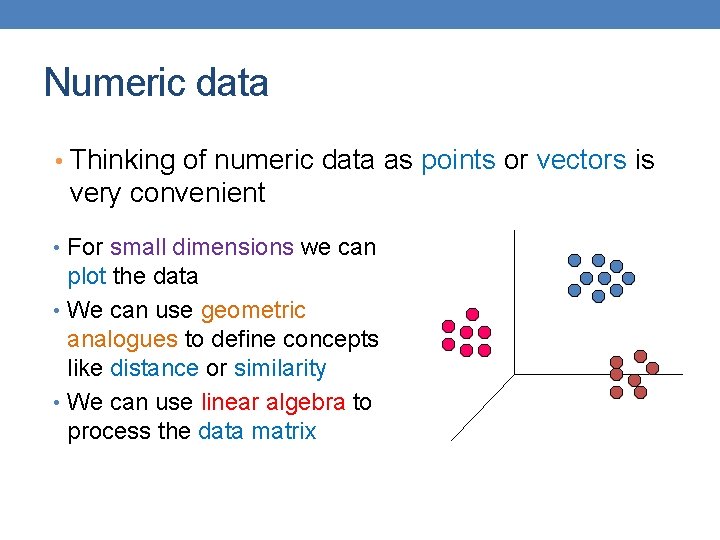
Numeric data • Thinking of numeric data as points or vectors is very convenient • For small dimensions we can plot the data • We can use geometric analogues to define concepts like distance or similarity • We can use linear algebra to process the data matrix
Categorical Relational Data • Data that consists of a collection of records, each of which consists of a fixed set of categorical attributes ID Number Zip Code Marital Status Income Bracket 1129842 45221 Single High 2342345 45223 Married Low 1234542 45221 Divorced High 1243535 45224 Single Medium
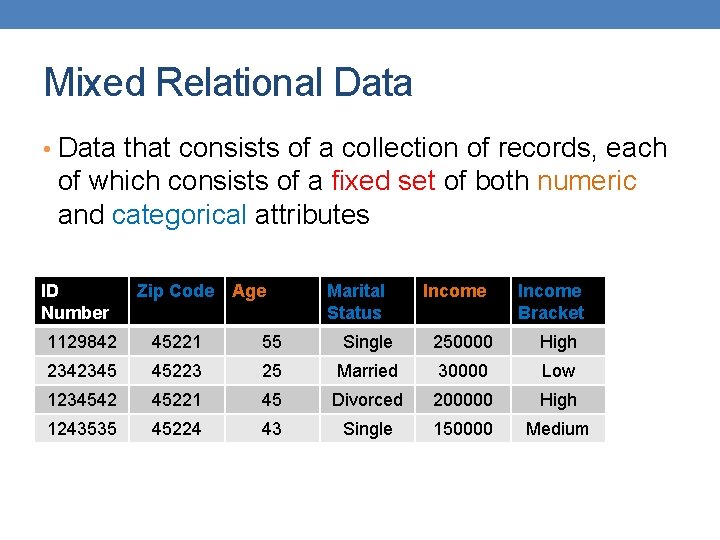
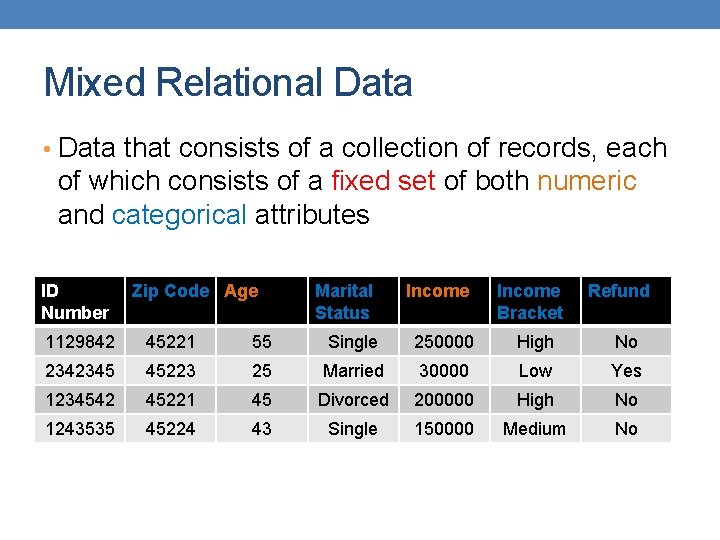
Mixed Relational Data • Data that consists of a collection of records, each of which consists of a fixed set of both numeric and categorical attributes ID Number Zip Code Age Marital Status Income Bracket 1129842 45221 55 Single 250000 High 2342345 45223 25 Married 30000 Low 1234542 45221 45 Divorced 200000 High 1243535 45224 43 Single 150000 Medium
Mixed Relational Data • Data that consists of a collection of records, each of which consists of a fixed set of both numeric and categorical attributes ID Number Zip Code Age Marital Status Income Bracket Refund 1129842 45221 55 Single 250000 High No 2342345 45223 25 Married 30000 Low Yes 1234542 45221 45 Divorced 200000 High No 1243535 45224 43 Single 150000 Medium No
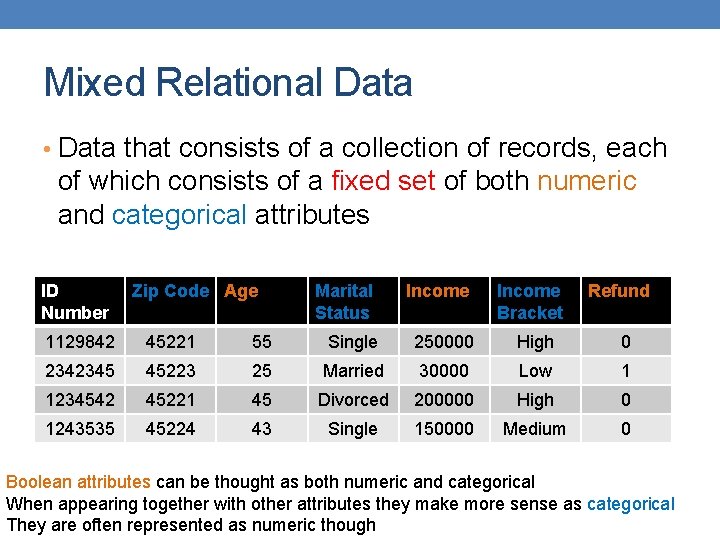
Mixed Relational Data • Data that consists of a collection of records, each of which consists of a fixed set of both numeric and categorical attributes ID Number Zip Code Age Marital Status Income Bracket Refund 1129842 45221 55 Single 250000 High 0 2342345 45223 25 Married 30000 Low 1 1234542 45221 45 Divorced 200000 High 0 1243535 45224 43 Single 150000 Medium 0 Boolean attributes can be thought as both numeric and categorical When appearing together with other attributes they make more sense as categorical They are often represented as numeric though
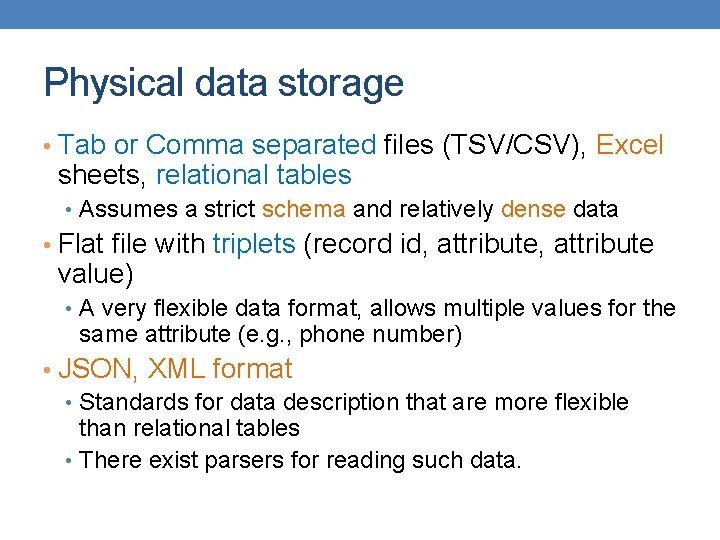
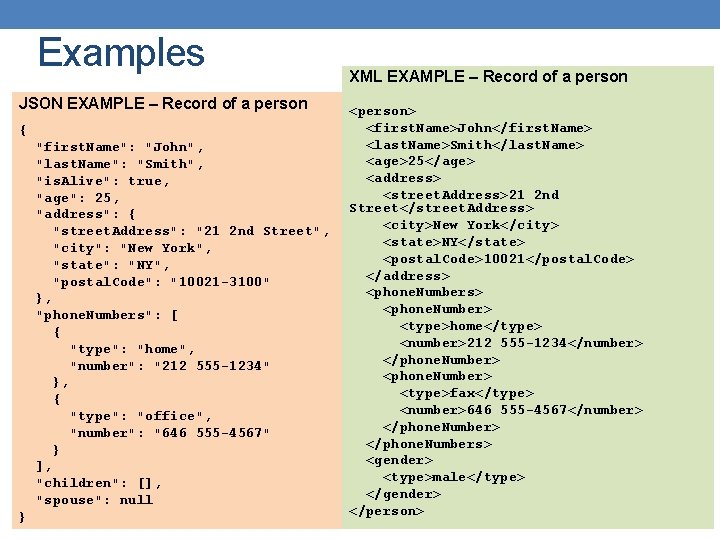
Physical data storage • Tab or Comma separated files (TSV/CSV), Excel sheets, relational tables • Assumes a strict schema and relatively dense data • Flat file with triplets (record id, attribute value) • A very flexible data format, allows multiple values for the same attribute (e. g. , phone number) • JSON, XML format • Standards for data description that are more flexible than relational tables • There exist parsers for reading such data.
Examples JSON EXAMPLE – Record of a person { "first. Name": "John", "last. Name": "Smith", "is. Alive": true, "age": 25, "address": { "street. Address": "21 2 nd Street", "city": "New York", "state": "NY", "postal. Code": "10021 -3100" }, "phone. Numbers": [ { "type": "home", "number": "212 555 -1234" }, { "type": "office", "number": "646 555 -4567" } ], "children": [], "spouse": null } XML EXAMPLE – Record of a person <person> <first. Name>John</first. Name> <last. Name>Smith</last. Name> <age>25</age> <address> <street. Address>21 2 nd Street</street. Address> <city>New York</city> <state>NY</state> <postal. Code>10021</postal. Code> </address> <phone. Number> <type>home</type> <number>212 555 -1234</number> </phone. Number> <type>fax</type> <number>646 555 -4567</number> </phone. Numbers> <gender> <type>male</type> </gender> </person>
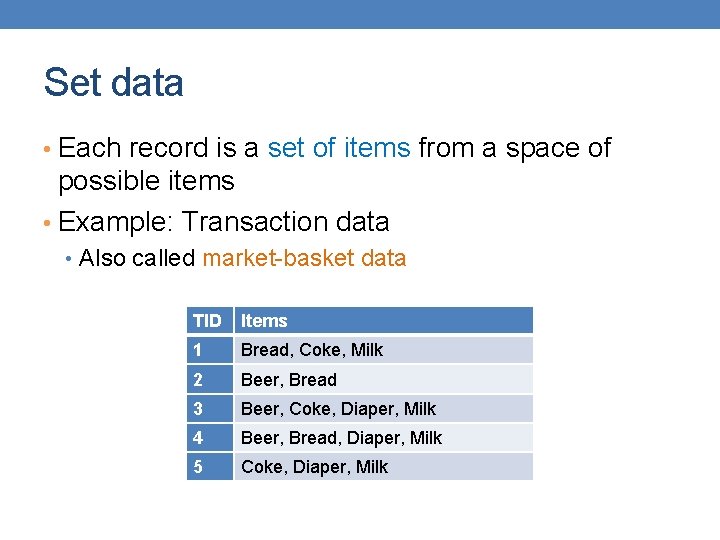
Set data • Each record is a set of items from a space of possible items • Example: Transaction data • Also called market-basket data TID Items 1 Bread, Coke, Milk 2 Beer, Bread 3 Beer, Coke, Diaper, Milk 4 Beer, Bread, Diaper, Milk 5 Coke, Diaper, Milk
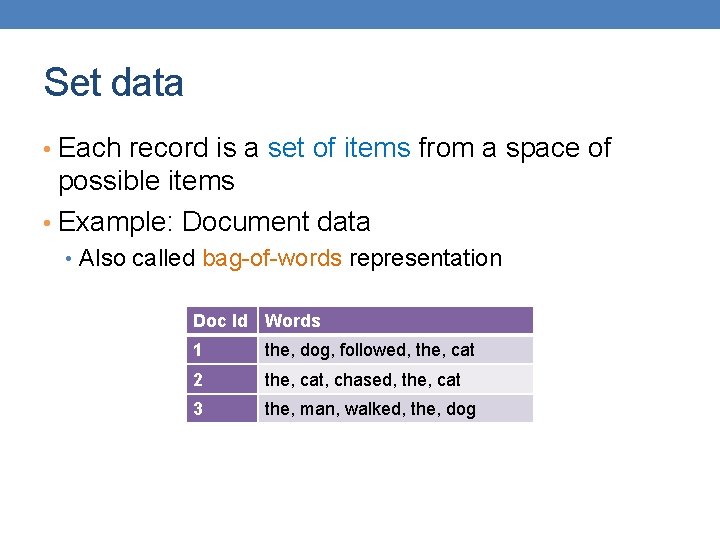
Set data • Each record is a set of items from a space of possible items • Example: Document data • Also called bag-of-words representation Doc Id Words 1 the, dog, followed, the, cat 2 the, cat, chased, the, cat 3 the, man, walked, the, dog
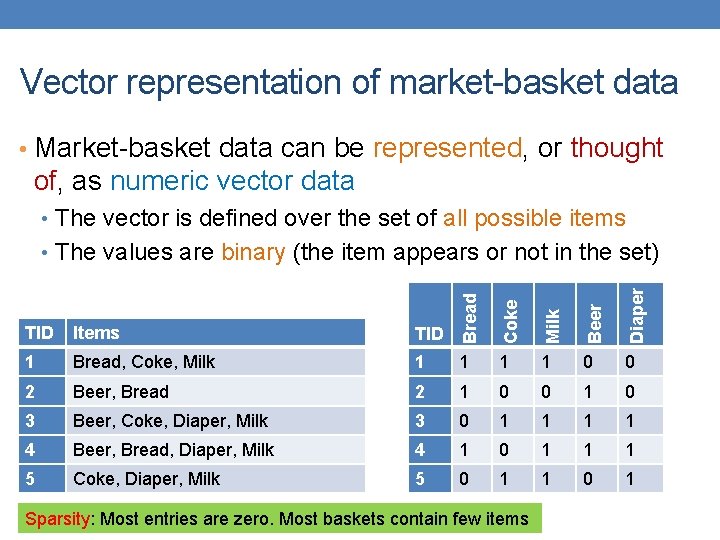
Vector representation of market-basket data • Market-basket data can be represented, or thought of, as numeric vector data • The vector is defined over the set of all possible items TID Items TID Bread Coke Milk Beer Diaper • The values are binary (the item appears or not in the set) 1 Bread, Coke, Milk 1 1 0 0 2 Beer, Bread 2 1 0 0 1 0 3 Beer, Coke, Diaper, Milk 3 0 1 1 4 Beer, Bread, Diaper, Milk 4 1 0 1 1 1 5 Coke, Diaper, Milk 5 0 1 1 0 1 Sparsity: Most entries are zero. Most baskets contain few items
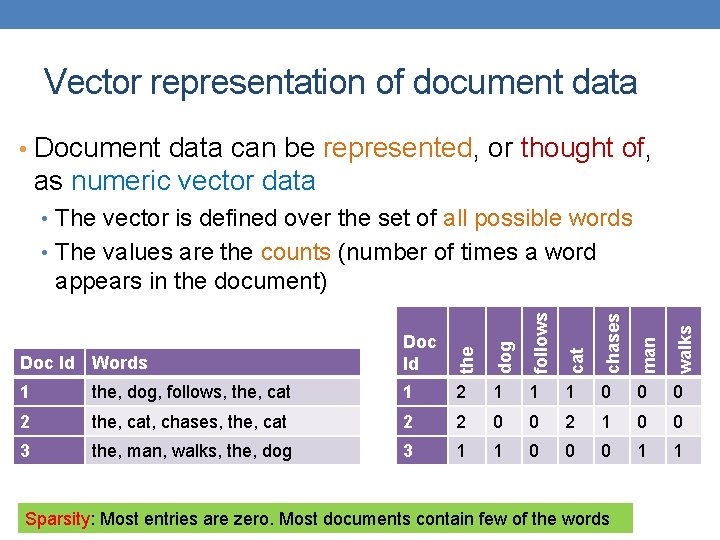
Vector representation of document data • Document data can be represented, or thought of, as numeric vector data • The vector is defined over the set of all possible words • The values are the counts (number of times a word Doc Id Words Doc Id the dog follows cat chases man walks appears in the document) 1 the, dog, follows, the, cat 1 2 1 1 1 0 0 0 2 the, cat, chases, the, cat 2 2 0 0 2 1 0 0 3 the, man, walks, the, dog 3 1 1 0 0 0 1 1 Sparsity: Most entries are zero. Most documents contain few of the words
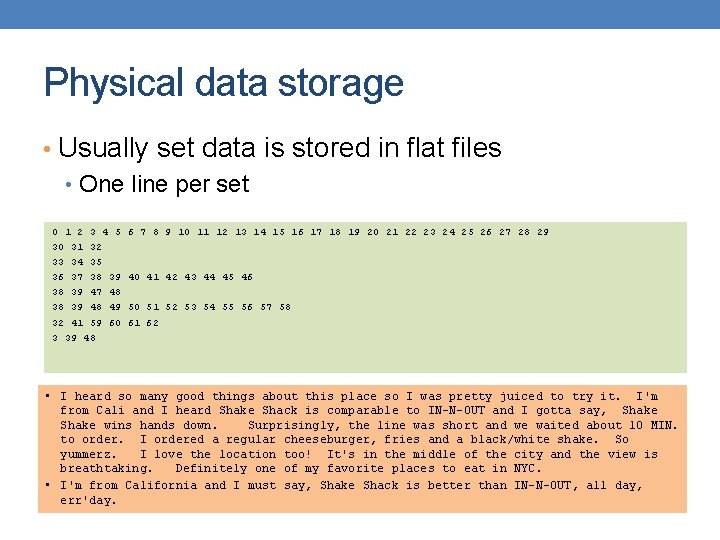
Physical data storage • Usually set data is stored in flat files • One line per set 0 1 2 3 4 5 30 31 32 33 34 35 36 37 38 39 47 48 38 39 48 49 32 41 59 60 3 39 48 6 7 8 9 10 11 12 13 14 15 16 17 18 19 20 21 22 23 24 25 26 27 28 29 40 41 42 43 44 45 46 50 51 52 53 54 55 56 57 58 61 62 • I heard so many good things about this place so I was pretty juiced to try it. I'm from Cali and I heard Shake Shack is comparable to IN-N-OUT and I gotta say, Shake wins hands down. Surprisingly, the line was short and we waited about 10 MIN. to order. I ordered a regular cheeseburger, fries and a black/white shake. So yummerz. I love the location too! It's in the middle of the city and the view is breathtaking. Definitely one of my favorite places to eat in NYC. • I'm from California and I must say, Shake Shack is better than IN-N-OUT, all day, err'day.
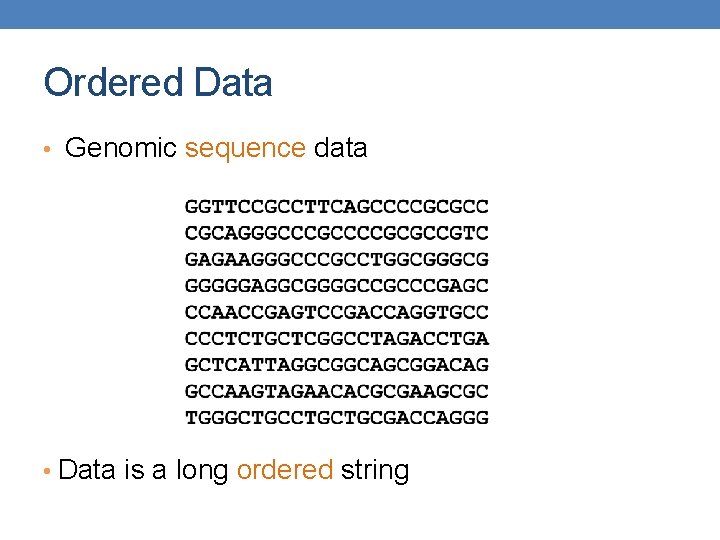
Ordered Data • Genomic sequence data • Data is a long ordered string
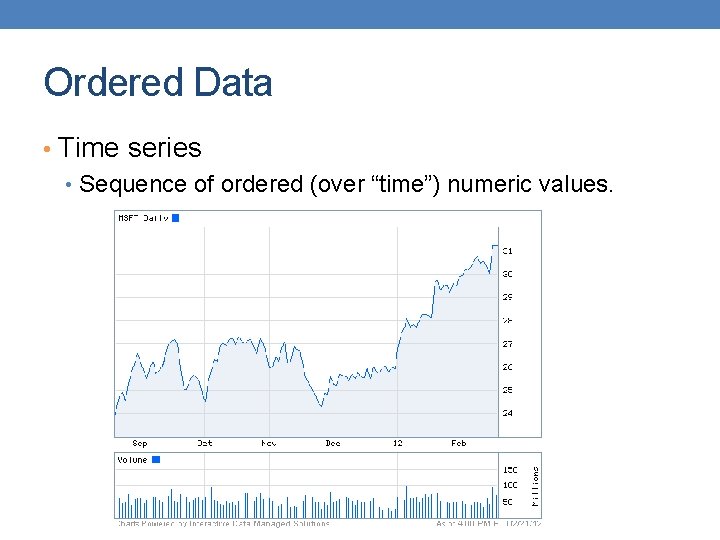
Ordered Data • Time series • Sequence of ordered (over “time”) numeric values.
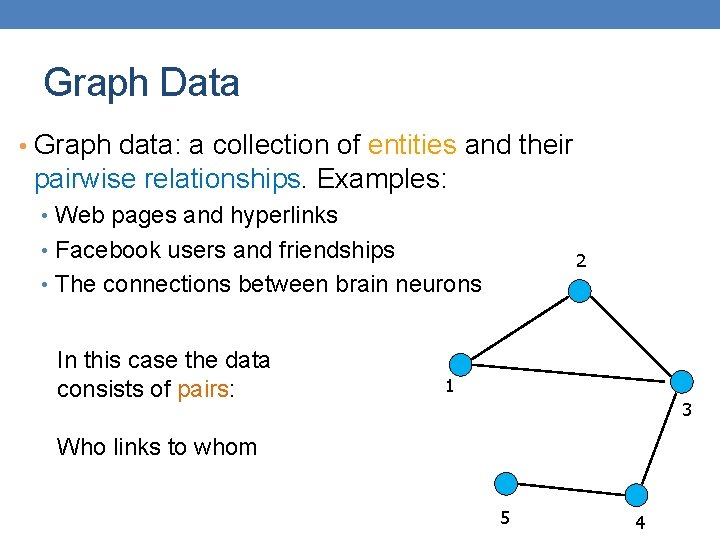
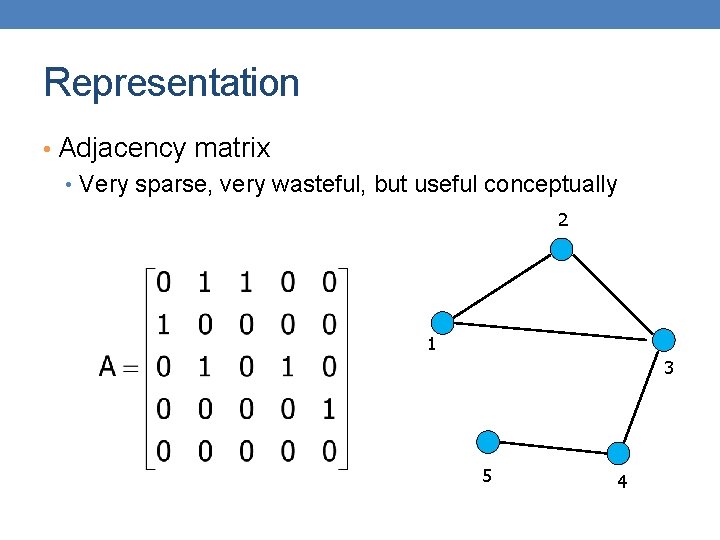
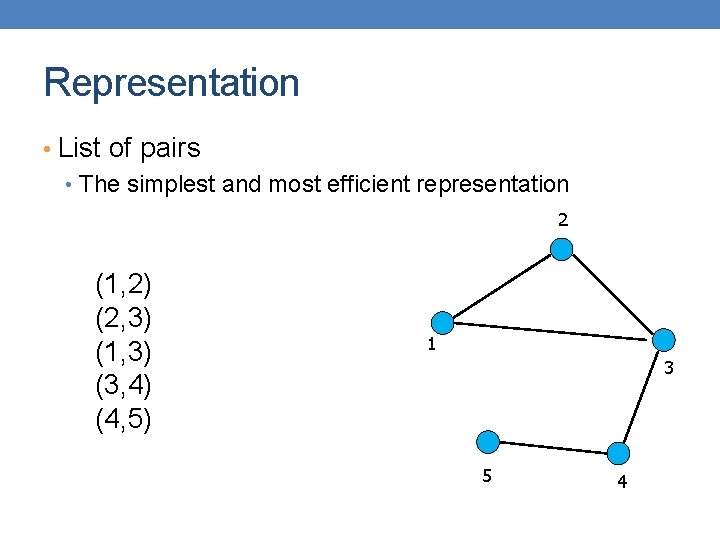
Graph Data • Graph data: a collection of entities and their pairwise relationships. Examples: • Web pages and hyperlinks • Facebook users and friendships 2 • The connections between brain neurons In this case the data consists of pairs: 1 3 Who links to whom 5 4
Representation • Adjacency matrix • Very sparse, very wasteful, but useful conceptually 2 1 3 5 4
Representation • Adjacency list • Not so easy to maintain 2 1: [2, 3] 2: [1, 3] 3: [1, 2, 4] 4: [3, 5] 5: [4] 1 3 5 4
Representation • List of pairs • The simplest and most efficient representation 2 (1, 2) (2, 3) (1, 3) (3, 4) (4, 5) 1 3 5 4
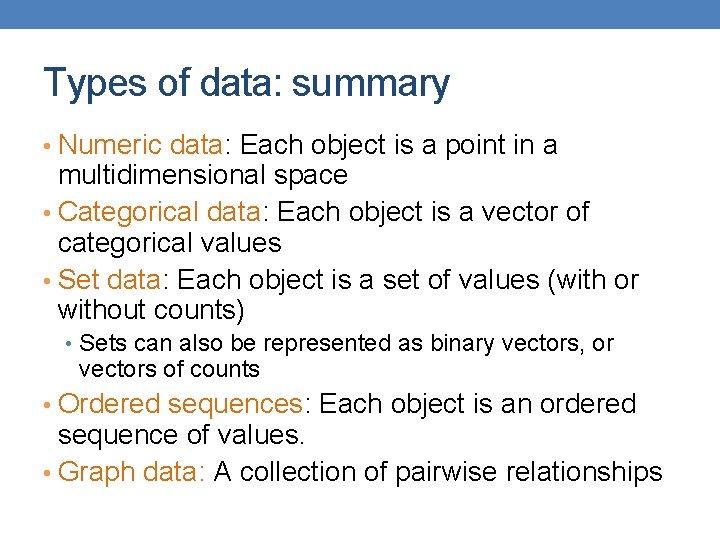
Types of data: summary • Numeric data: Each object is a point in a multidimensional space • Categorical data: Each object is a vector of categorical values • Set data: Each object is a set of values (with or without counts) • Sets can also be represented as binary vectors, or vectors of counts • Ordered sequences: Each object is an ordered sequence of values. • Graph data: A collection of pairwise relationships