
DATA MINING LECTURE 13 Pagerank Absorbing Random Walks
DATA MINING LECTURE 13 Pagerank, Absorbing Random Walks Coverage Problems

PAGERANK
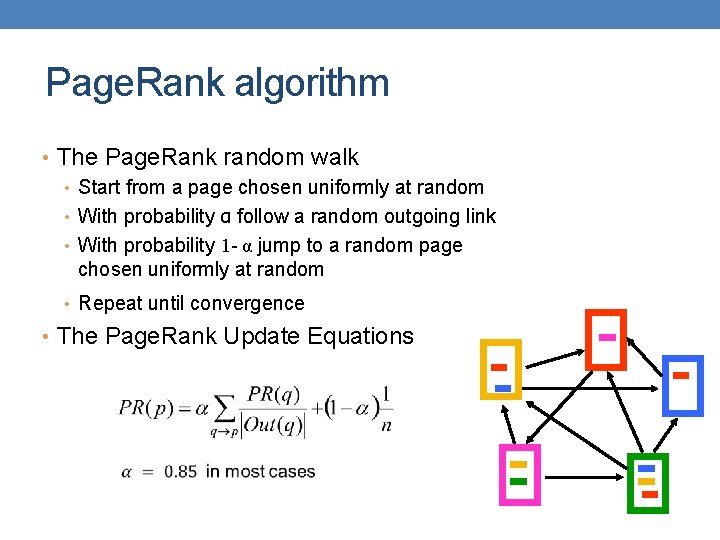
Page. Rank algorithm • The Page. Rank random walk • Start from a page chosen uniformly at random • With probability α follow a random outgoing link • With probability 1 - α jump to a random page chosen uniformly at random • Repeat until convergence • The Page. Rank Update Equations
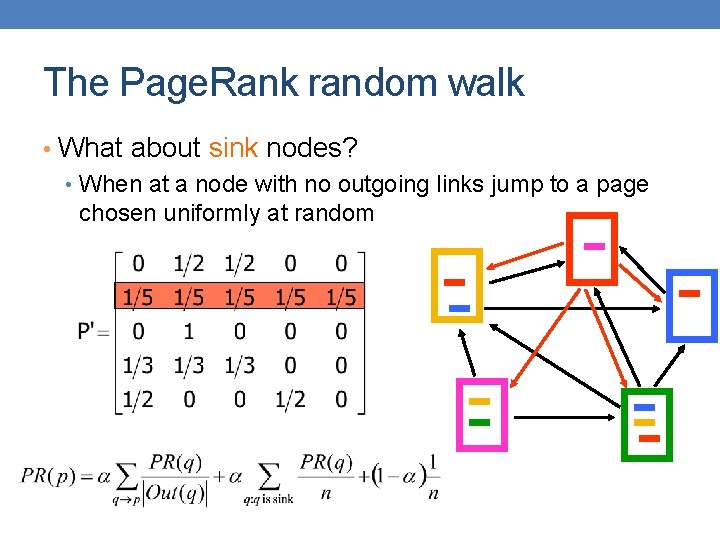
The Page. Rank random walk • What about sink nodes? • When at a node with no outgoing links jump to a page chosen uniformly at random
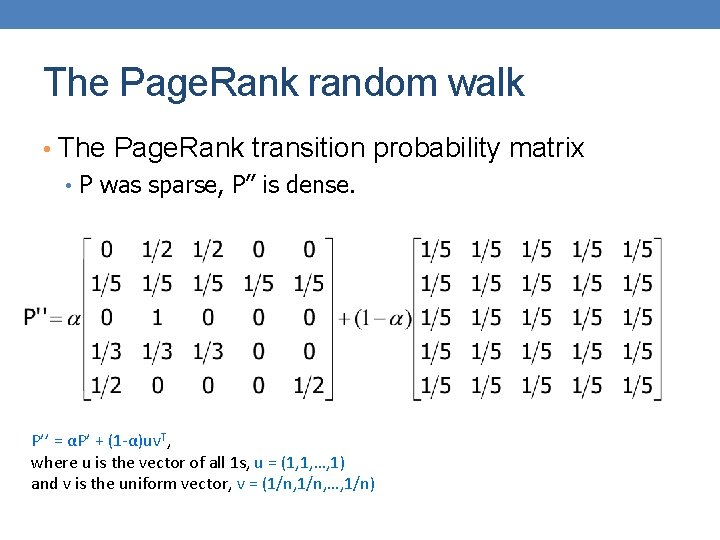
The Page. Rank random walk • The Page. Rank transition probability matrix • P was sparse, P’’ is dense. P’’ = αP’ + (1 -α)uv. T, where u is the vector of all 1 s, u = (1, 1, …, 1) and v is the uniform vector, v = (1/n, …, 1/n)
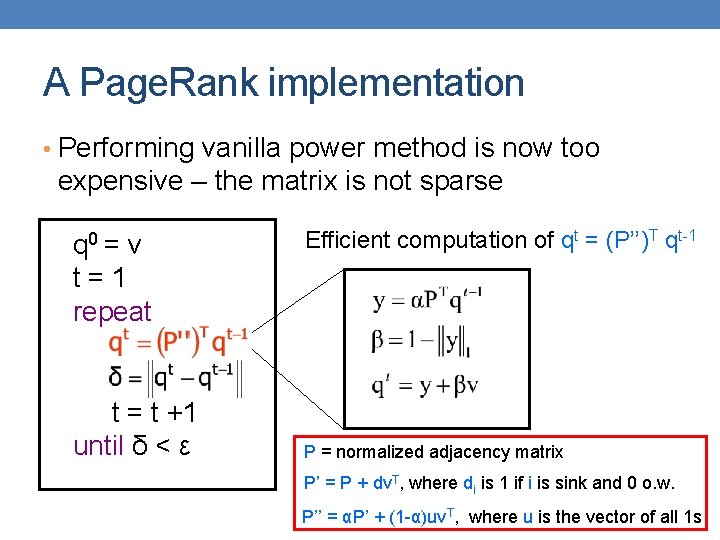
A Page. Rank implementation • Performing vanilla power method is now too expensive – the matrix is not sparse q 0 = v t=1 repeat t = t +1 until δ < ε Efficient computation of qt = (P’’)T qt-1 P = normalized adjacency matrix P’ = P + dv. T, where di is 1 if i is sink and 0 o. w. P’’ = αP’ + (1 -α)uv. T, where u is the vector of all 1 s
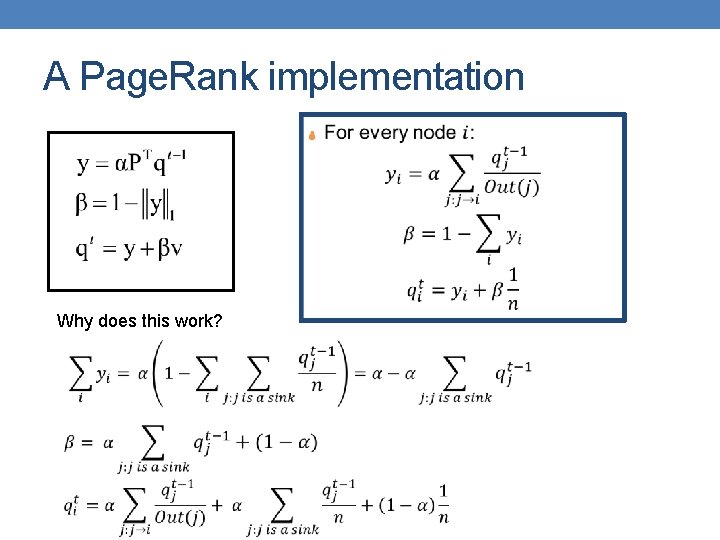
A Page. Rank implementation • Why does this work?
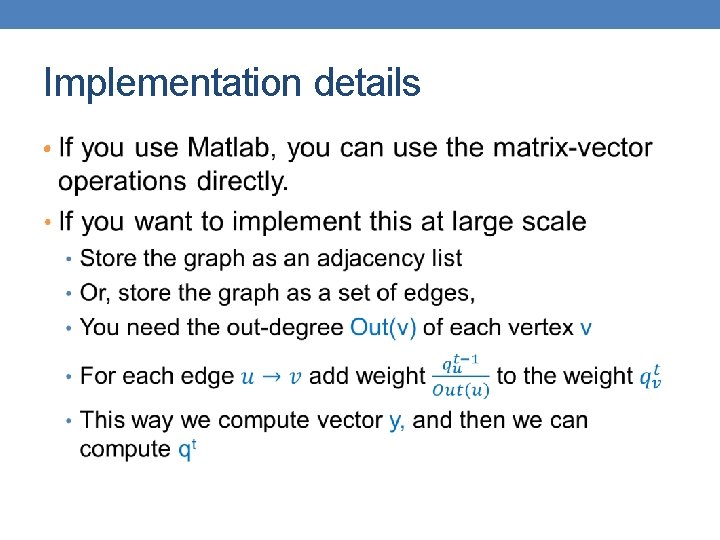
Implementation details •

ABSORBING RANDOM WALKS
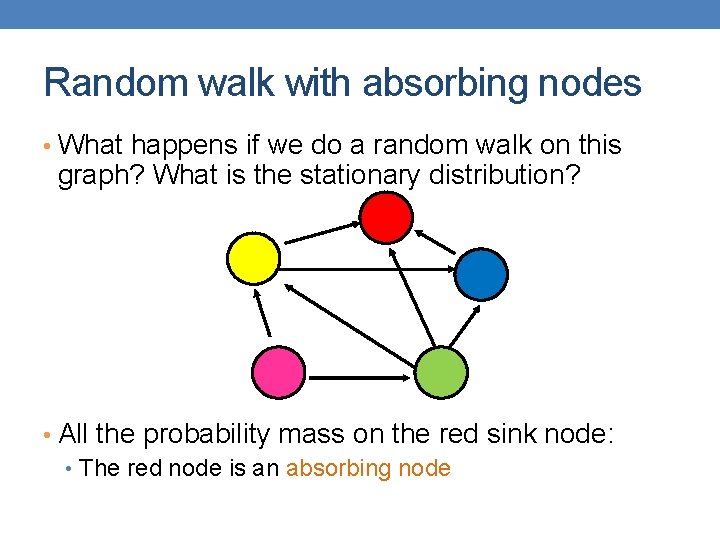
Random walk with absorbing nodes • What happens if we do a random walk on this graph? What is the stationary distribution? • All the probability mass on the red sink node: • The red node is an absorbing node
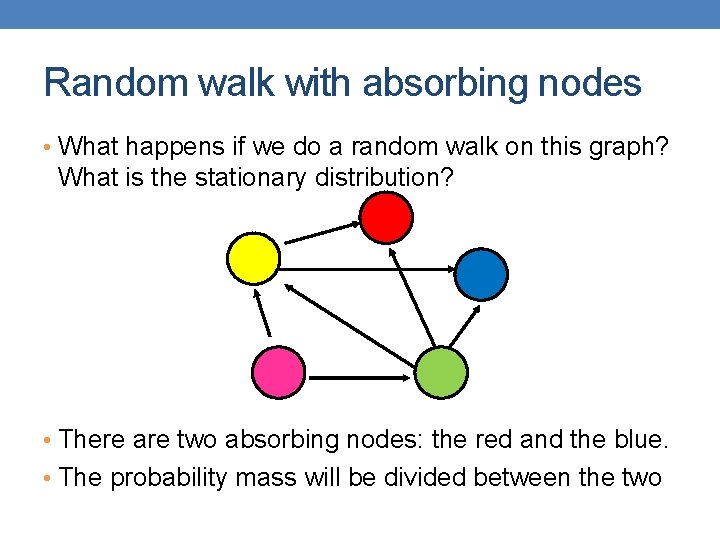
Random walk with absorbing nodes • What happens if we do a random walk on this graph? What is the stationary distribution? • There are two absorbing nodes: the red and the blue. • The probability mass will be divided between the two
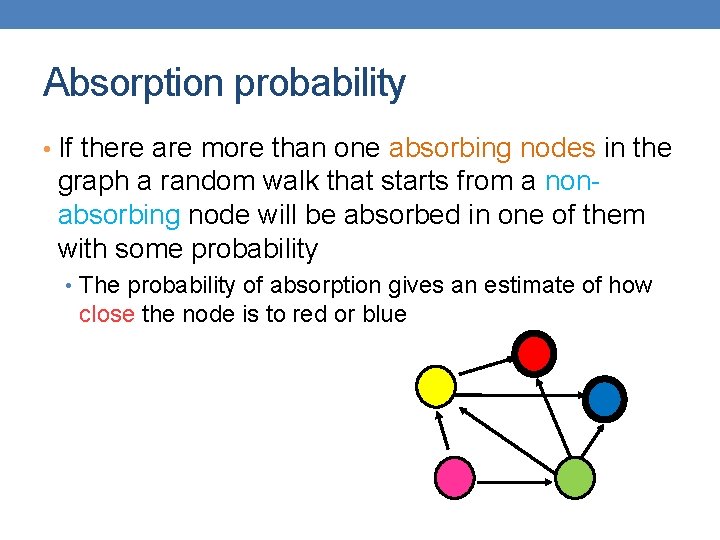
Absorption probability • If there are more than one absorbing nodes in the graph a random walk that starts from a nonabsorbing node will be absorbed in one of them with some probability • The probability of absorption gives an estimate of how close the node is to red or blue
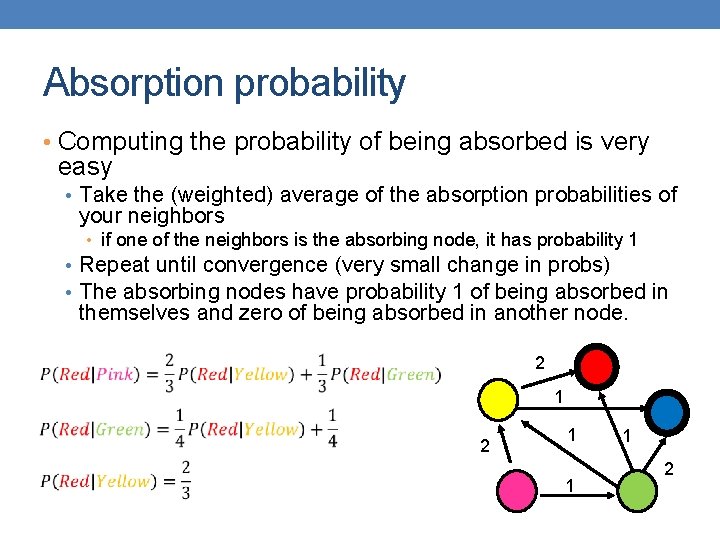
Absorption probability • Computing the probability of being absorbed is very easy • Take the (weighted) average of the absorption probabilities of your neighbors • if one of the neighbors is the absorbing node, it has probability 1 • Repeat until convergence (very small change in probs) • The absorbing nodes have probability 1 of being absorbed in themselves and zero of being absorbed in another node. 2 1 1 1 2
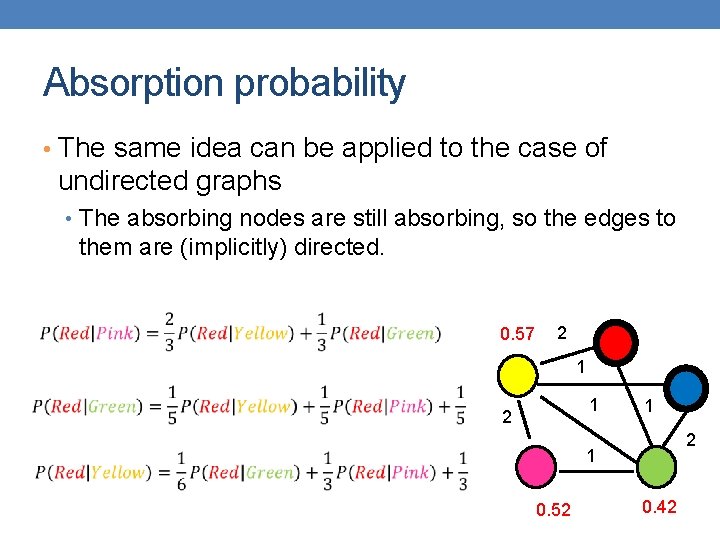
Absorption probability • The same idea can be applied to the case of undirected graphs • The absorbing nodes are still absorbing, so the edges to them are (implicitly) directed. 0. 57 2 1 1 2 1 0. 52 0. 42
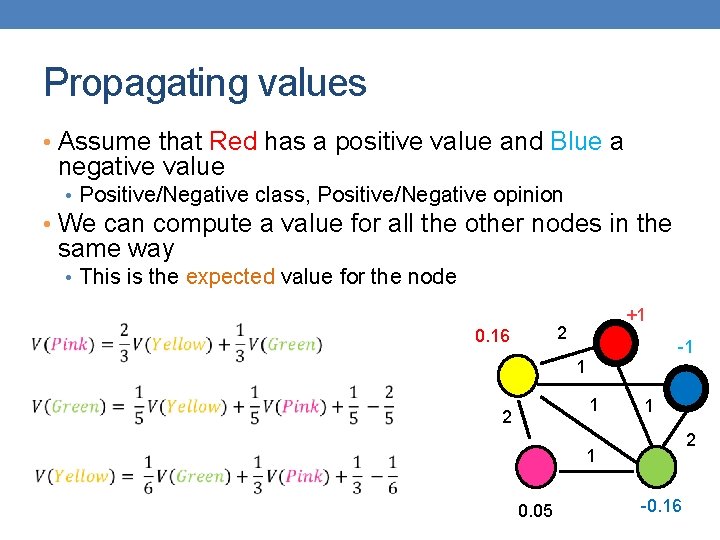
Propagating values • Assume that Red has a positive value and Blue a negative value • Positive/Negative class, Positive/Negative opinion • We can compute a value for all the other nodes in the same way • This is the expected value for the node +1 2 0. 16 -1 1 1 2 1 0. 05 -0. 16
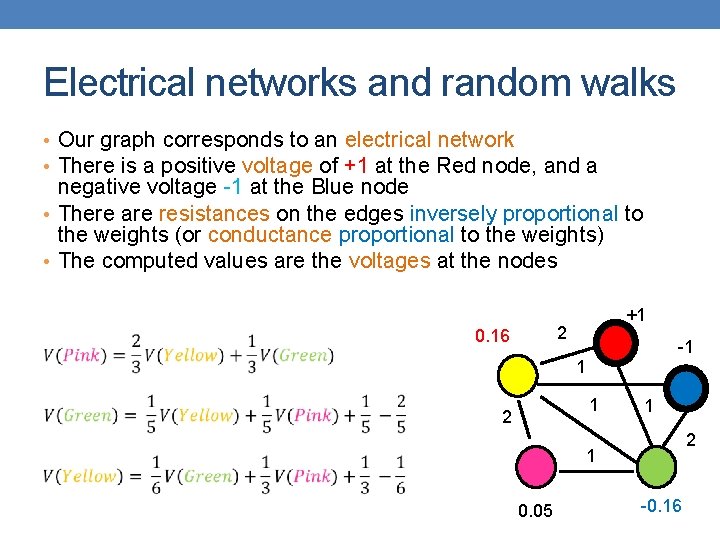
Electrical networks and random walks • Our graph corresponds to an electrical network • There is a positive voltage of +1 at the Red node, and a negative voltage -1 at the Blue node • There are resistances on the edges inversely proportional to the weights (or conductance proportional to the weights) • The computed values are the voltages at the nodes +1 2 0. 16 -1 1 1 2 1 0. 05 -0. 16
Transductive learning • If we have a graph of relationships and some labels on these edges we can propagate them to the remaining nodes • E. g. , a social network where some people are tagged as spammers • E. g. , the movie-actor graph where some movies are tagged as action or comedy. • This is a form of semi-supervised learning • We make use of the unlabeled data, and the relationships • It is also called transductive learning because it does not produce a model, but just labels the unlabeled data that is at hand. • Contrast to inductive learning that learns a model and can label any new example
Implementation details •

COVERAGE
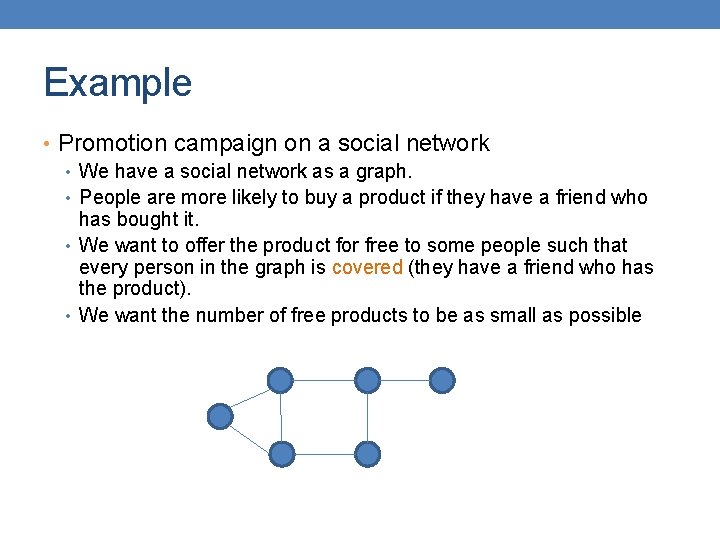
Example • Promotion campaign on a social network • We have a social network as a graph. • People are more likely to buy a product if they have a friend who has bought it. • We want to offer the product for free to some people such that every person in the graph is covered (they have a friend who has the product). • We want the number of free products to be as small as possible
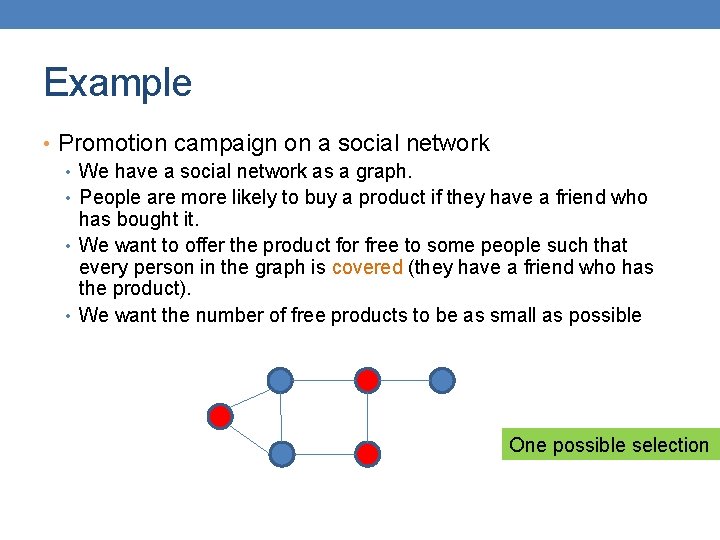
Example • Promotion campaign on a social network • We have a social network as a graph. • People are more likely to buy a product if they have a friend who has bought it. • We want to offer the product for free to some people such that every person in the graph is covered (they have a friend who has the product). • We want the number of free products to be as small as possible One possible selection
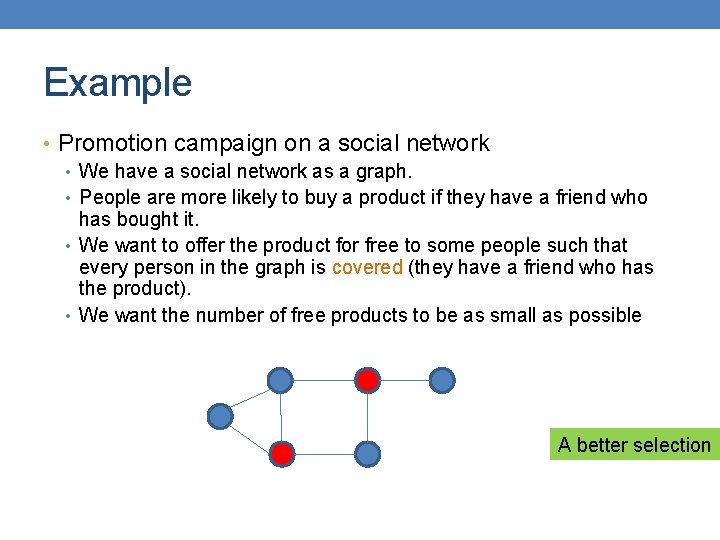
Example • Promotion campaign on a social network • We have a social network as a graph. • People are more likely to buy a product if they have a friend who has bought it. • We want to offer the product for free to some people such that every person in the graph is covered (they have a friend who has the product). • We want the number of free products to be as small as possible A better selection
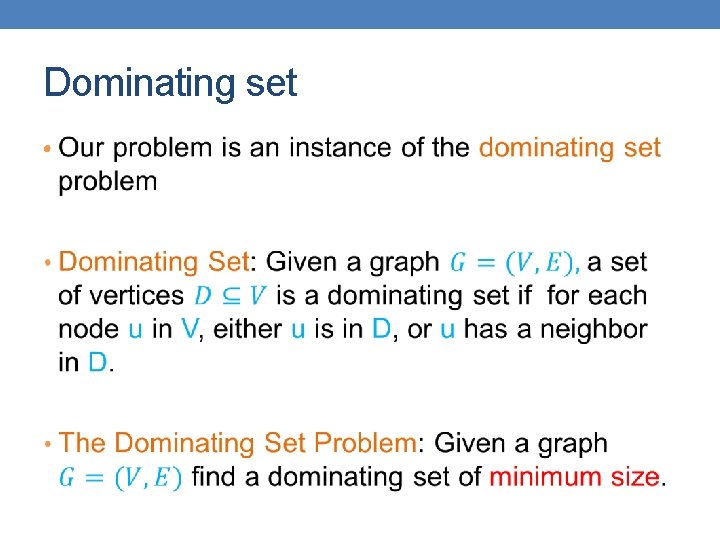
Dominating set •
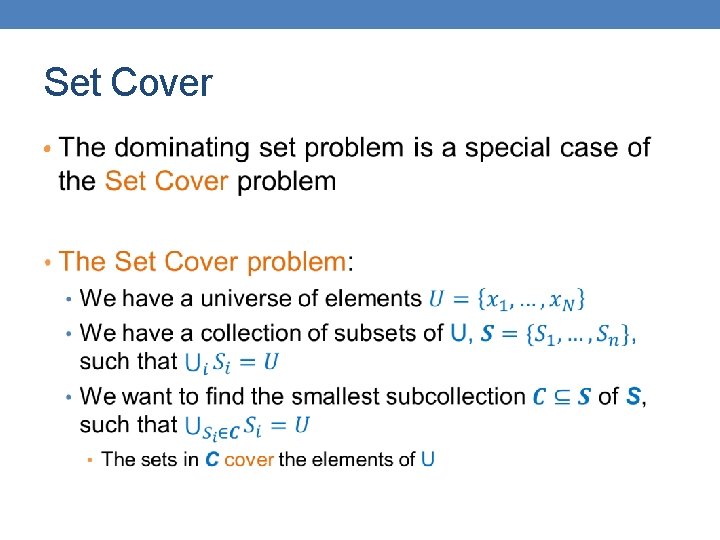
Set Cover •
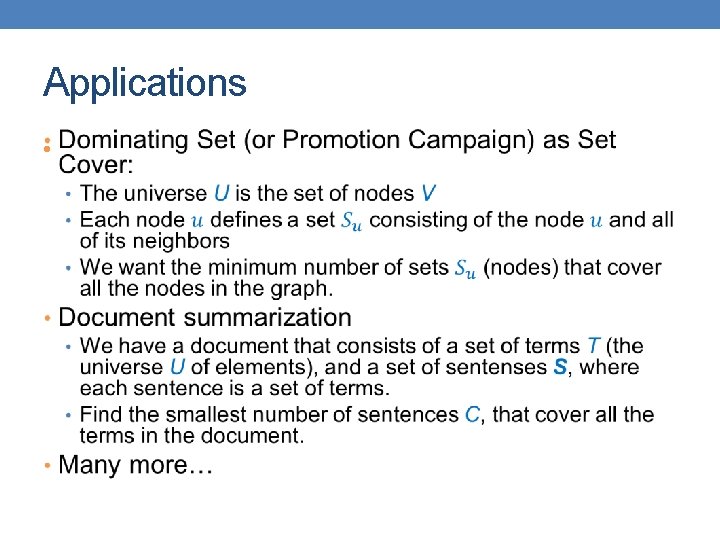
Applications •
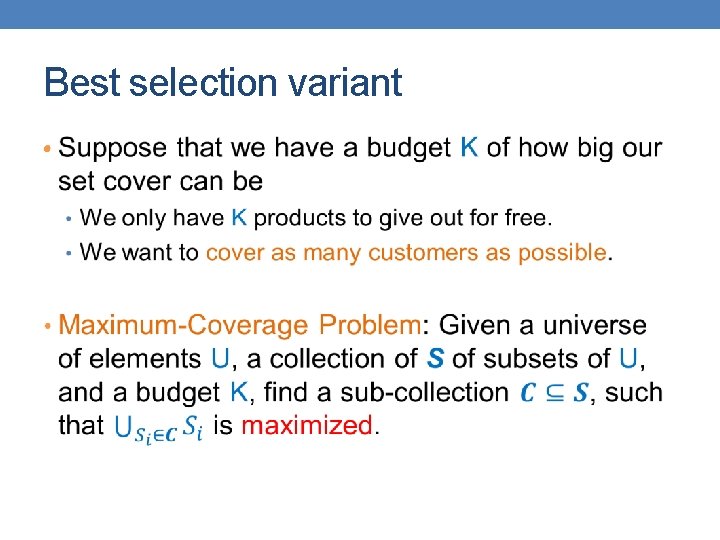
Best selection variant •
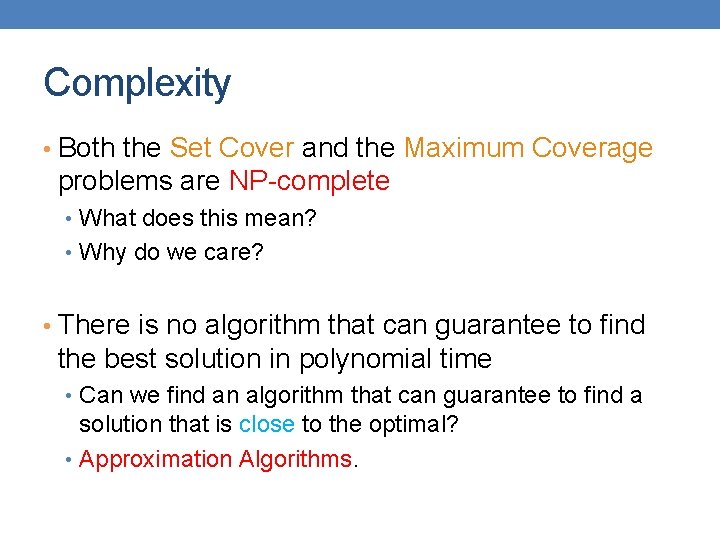
Complexity • Both the Set Cover and the Maximum Coverage problems are NP-complete • What does this mean? • Why do we care? • There is no algorithm that can guarantee to find the best solution in polynomial time • Can we find an algorithm that can guarantee to find a solution that is close to the optimal? • Approximation Algorithms.
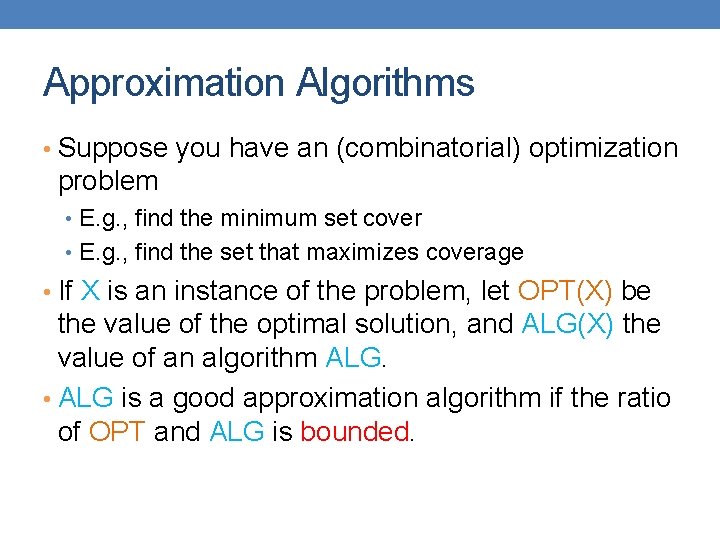
Approximation Algorithms • Suppose you have an (combinatorial) optimization problem • E. g. , find the minimum set cover • E. g. , find the set that maximizes coverage • If X is an instance of the problem, let OPT(X) be the value of the optimal solution, and ALG(X) the value of an algorithm ALG. • ALG is a good approximation algorithm if the ratio of OPT and ALG is bounded.
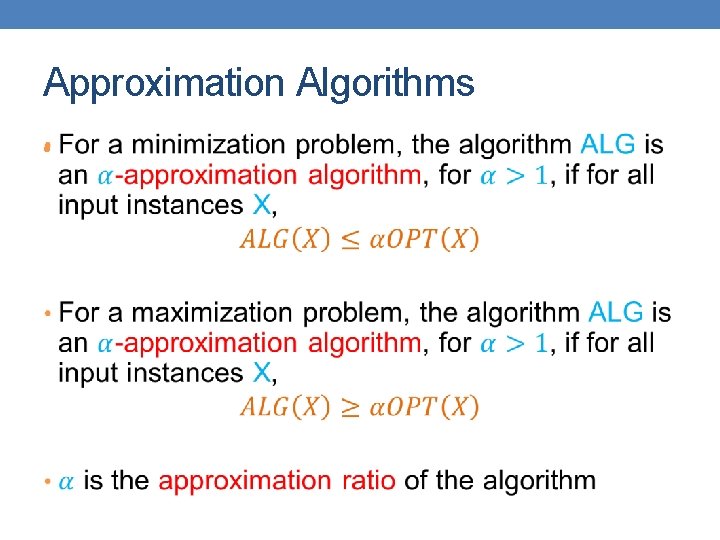
Approximation Algorithms •
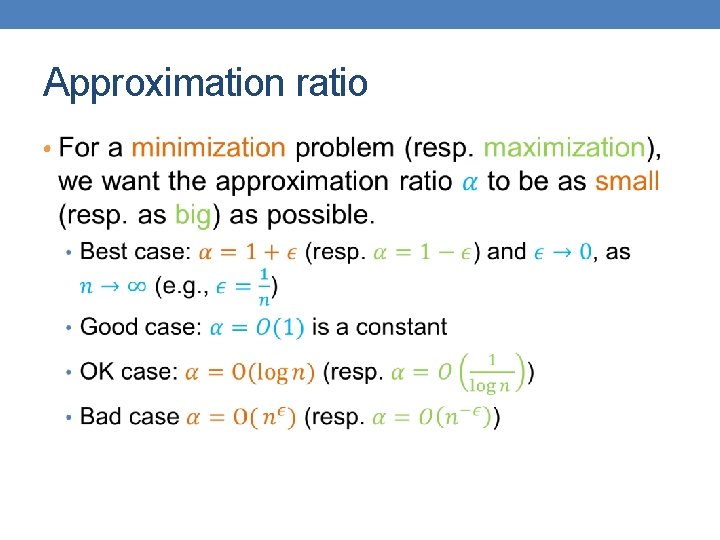
Approximation ratio •
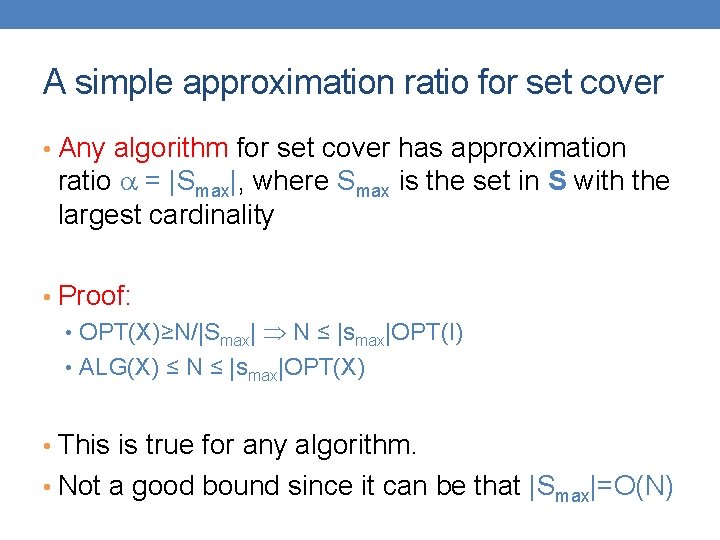
A simple approximation ratio for set cover • Any algorithm for set cover has approximation ratio = |Smax|, where Smax is the set in S with the largest cardinality • Proof: • OPT(X)≥N/|Smax| N ≤ |smax|OPT(I) • ALG(X) ≤ N ≤ |smax|OPT(X) • This is true for any algorithm. • Not a good bound since it can be that |Smax|=O(N)
An algorithm for Set Cover • What is the most natural algorithm for Set Cover? • Greedy: each time add to the collection C the set Si from S that covers the most of the remaining elements.
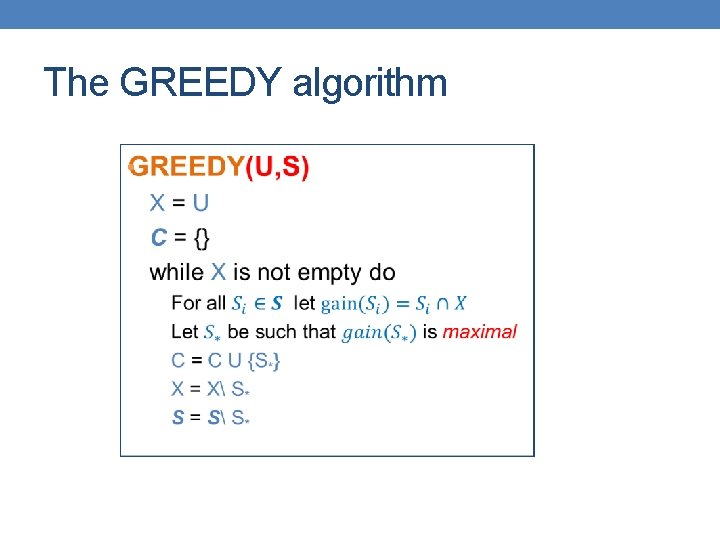
The GREEDY algorithm •
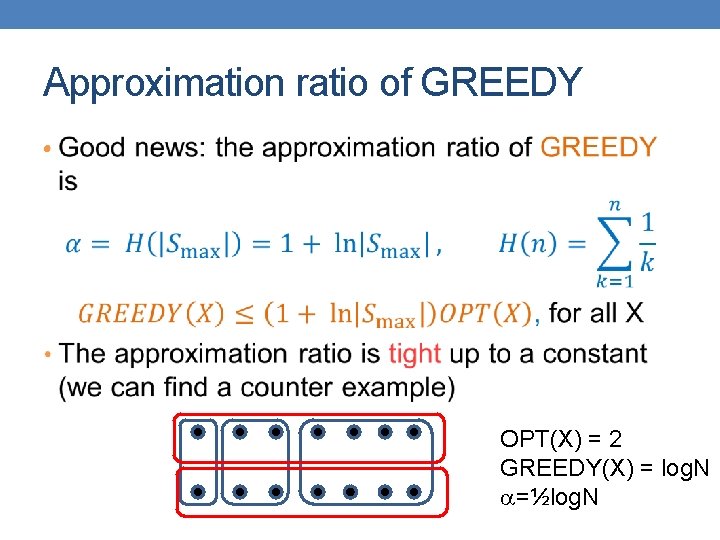
Approximation ratio of GREEDY • OPT(X) = 2 GREEDY(X) = log. N =½log. N
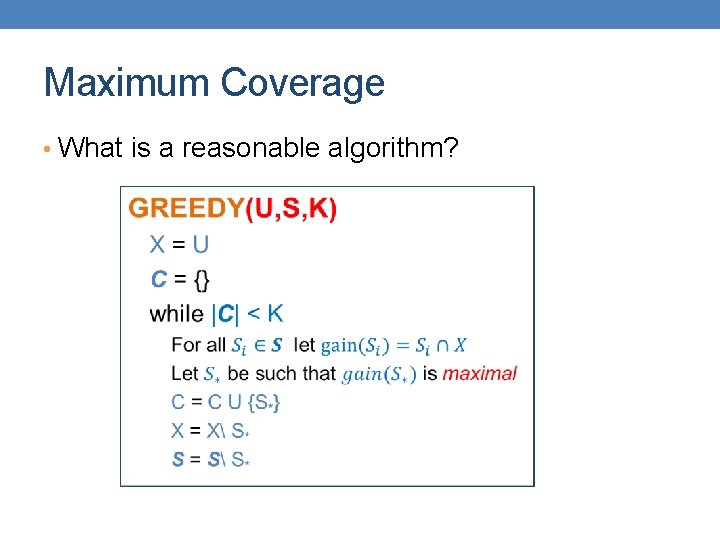
Maximum Coverage • What is a reasonable algorithm?
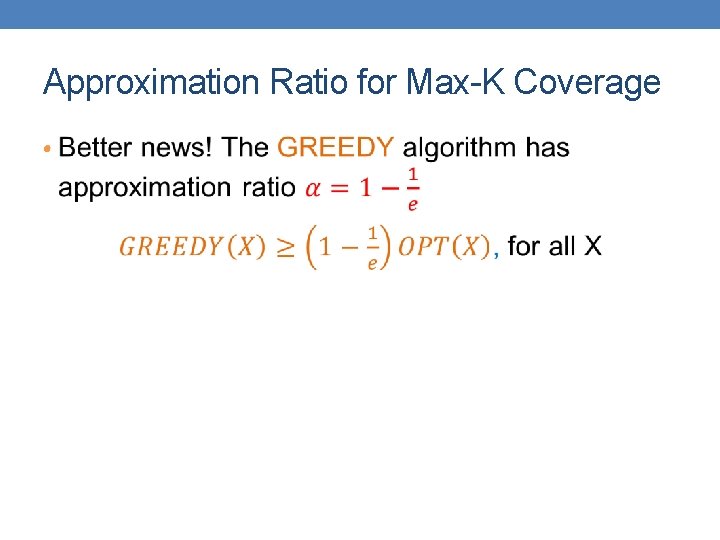
Approximation Ratio for Max-K Coverage •
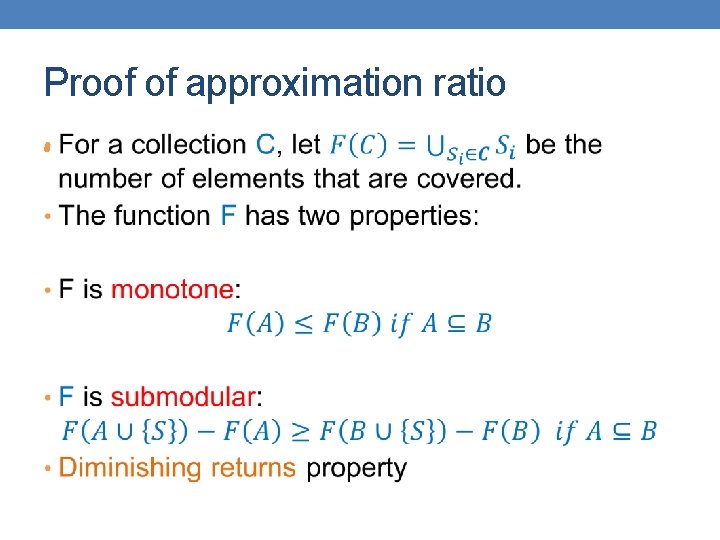
Proof of approximation ratio •
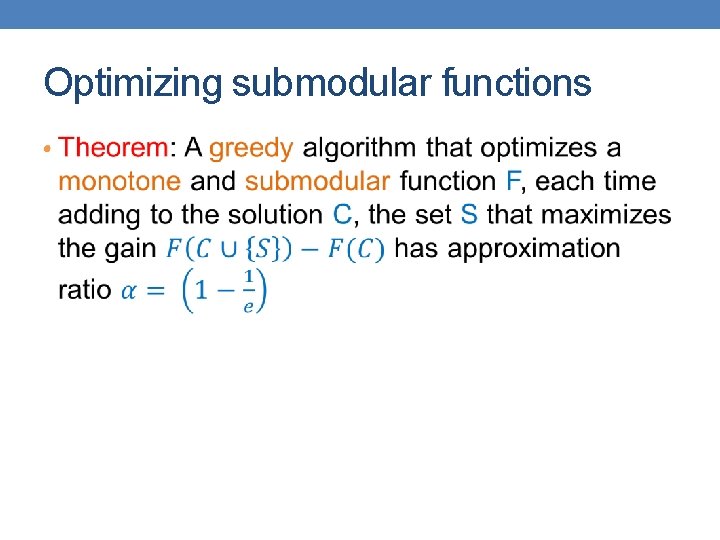
Optimizing submodular functions •
Other variants of Set Cover • Hitting Set: select a set of elements so that you hit all the sets (the same as the set cover, reversing the roles) • Vertex Cover: Select a subset of vertices such that you cover all edges (an endpoint of each edge is in the set) • There is a 2 -approximation algorithm • Edge Cover: Select a set of edges that cover all vertices (there is one edge that has endpoint the vertex) • There is a polynomial algorithm
Parting thoughts • In this class you saw a set of tools for analyzing data • Association Rules • Sketching • Clustering • Classification • Signular Value Decomposition • Random Walks • Coverage • All these are useful when trying to make sense of the data. A lot more variants exist.
- Slides: 40