
DATA MINING LECTURE 10 Classification Basic Concepts Decision
DATA MINING LECTURE 10 Classification Basic Concepts Decision Trees Evaluation Nearest-Neighbor Classifier
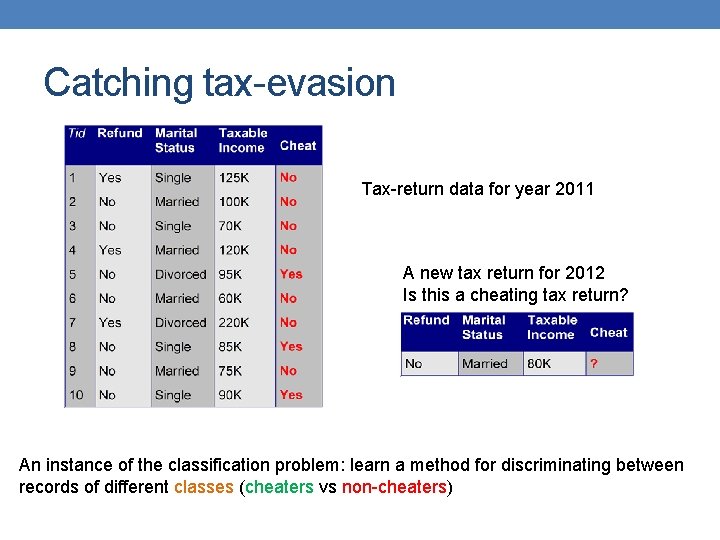
Catching tax-evasion Tax-return data for year 2011 A new tax return for 2012 Is this a cheating tax return? An instance of the classification problem: learn a method for discriminating between records of different classes (cheaters vs non-cheaters)
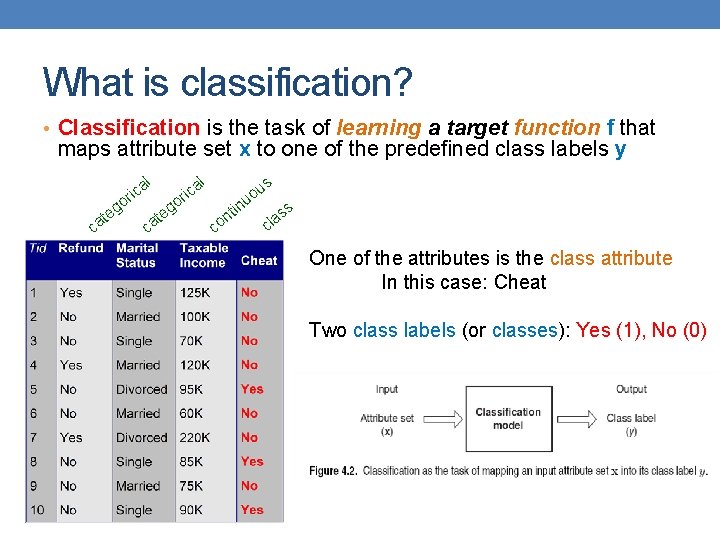
What is classification? • Classification is the task of learning a target function f that maps attribute set x to one of the predefined class labels y l l us ir ca o u go go in t ss e e t t n a l c ca ca co One of the attributes is the class attribute In this case: Cheat Two class labels (or classes): Yes (1), No (0)
Why classification? • The target function f is known as a classification model • Descriptive modeling: Explanatory tool to distinguish between objects of different classes (e. g. , understand why people cheat on their taxes) • Predictive modeling: Predict a class of a previously unseen record
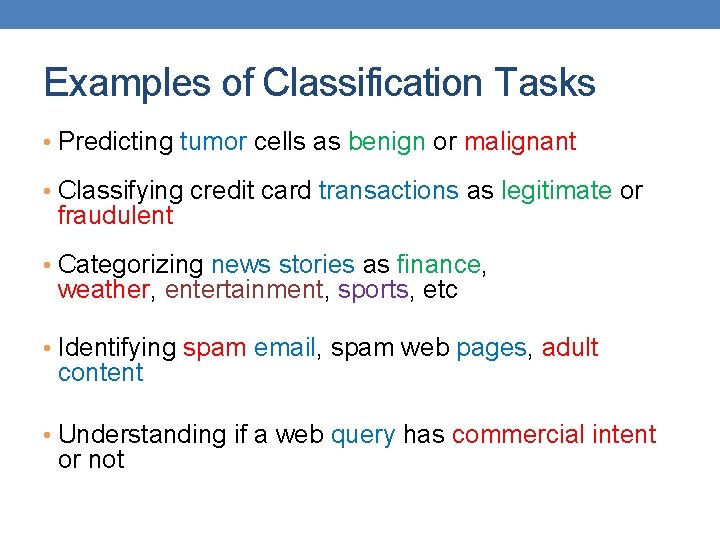
Examples of Classification Tasks • Predicting tumor cells as benign or malignant • Classifying credit card transactions as legitimate or fraudulent • Categorizing news stories as finance, weather, entertainment, sports, etc • Identifying spam email, spam web pages, adult content • Understanding if a web query has commercial intent or not
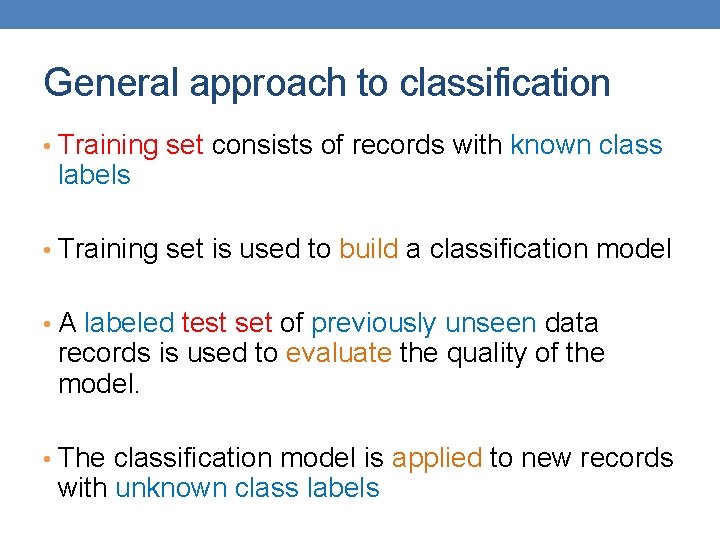
General approach to classification • Training set consists of records with known class labels • Training set is used to build a classification model • A labeled test set of previously unseen data records is used to evaluate the quality of the model. • The classification model is applied to new records with unknown class labels
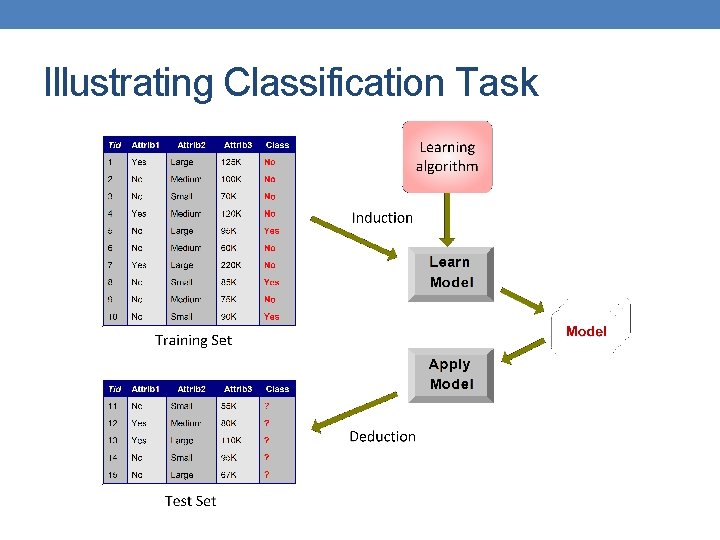
Illustrating Classification Task
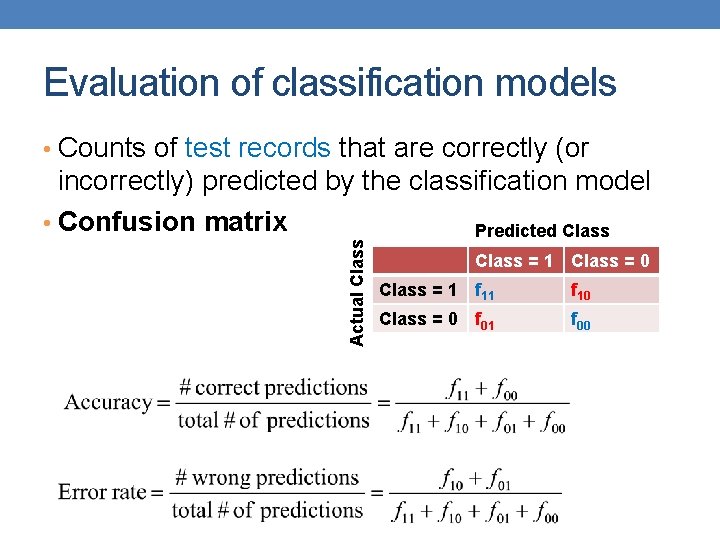
Evaluation of classification models • Counts of test records that are correctly (or Actual Class incorrectly) predicted by the classification model • Confusion matrix Predicted Class = 1 Class = 0 Class = 1 f 10 Class = 0 f 01 f 00
Classification Techniques • Decision Tree based Methods • Rule-based Methods • Memory based reasoning • Neural Networks • Naïve Bayes and Bayesian Belief Networks • Support Vector Machines
Classification Techniques • Decision Tree based Methods • Rule-based Methods • Memory based reasoning • Neural Networks • Naïve Bayes and Bayesian Belief Networks • Support Vector Machines

Decision Trees • Decision tree • A flow-chart-like tree structure • Internal node denotes a test on an attribute • Branch represents an outcome of the test • Leaf nodes represent class labels or class distribution
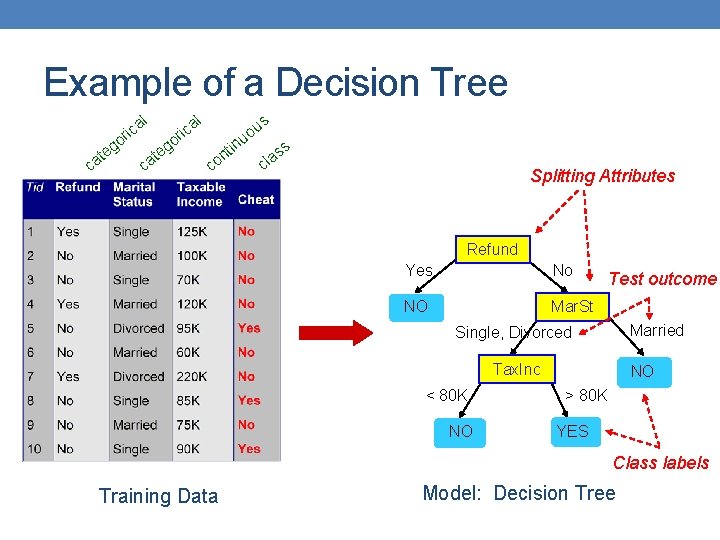
Example of a Decision Tree l l us ir ca o u go go in t ss e e t t n a l a a o c c Splitting Attributes Refund Yes No NO Mar. St Test outcome Married Single, Divorced Tax. Inc < 80 K NO NO > 80 K YES Class labels Training Data Model: Decision Tree
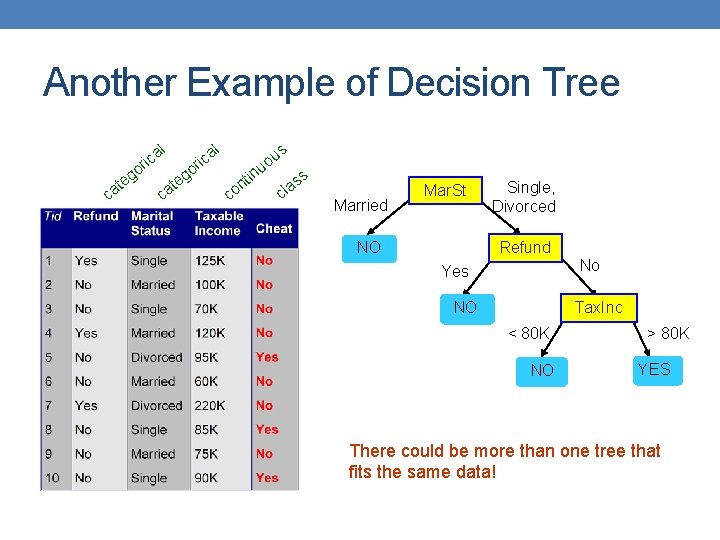
Another Example of Decision Tree l l a ric o eg t ca c e at ica r go s nt o c in u uo ss cla Married Mar. St NO Single, Divorced Refund No Yes NO Tax. Inc < 80 K NO > 80 K YES There could be more than one tree that fits the same data!
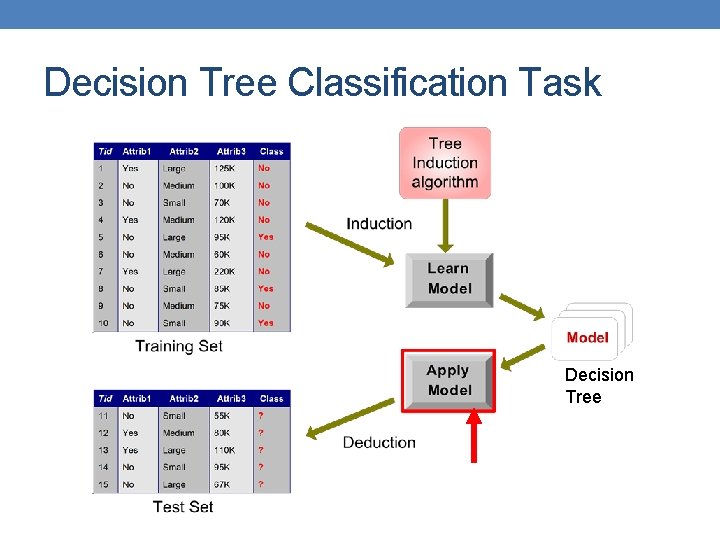
Decision Tree Classification Task Decision Tree
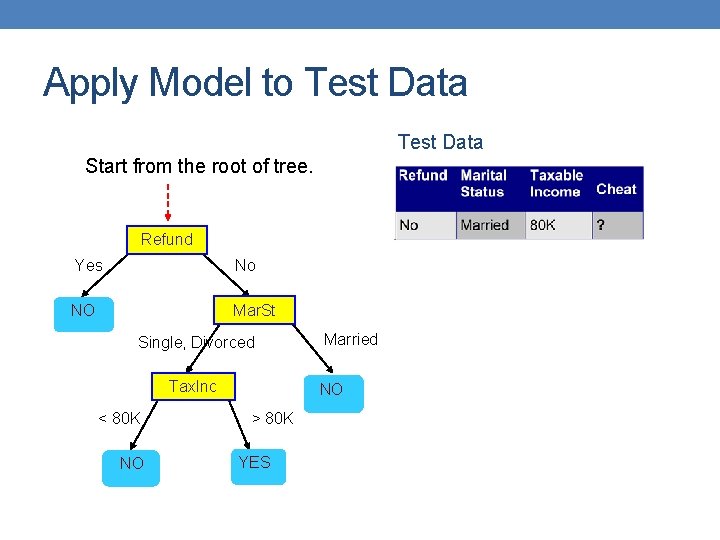
Apply Model to Test Data Start from the root of tree. Refund Yes No NO Mar. St Single, Divorced Tax. Inc < 80 K NO Married NO > 80 K YES
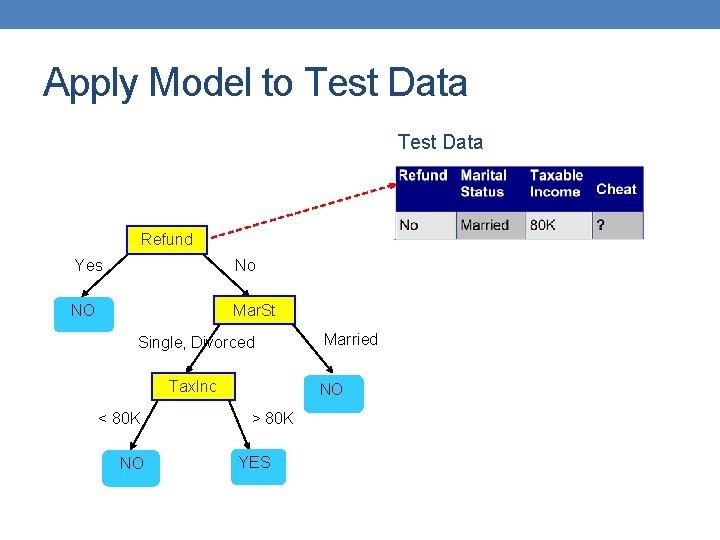
Apply Model to Test Data Refund Yes No NO Mar. St Single, Divorced Tax. Inc < 80 K NO Married NO > 80 K YES
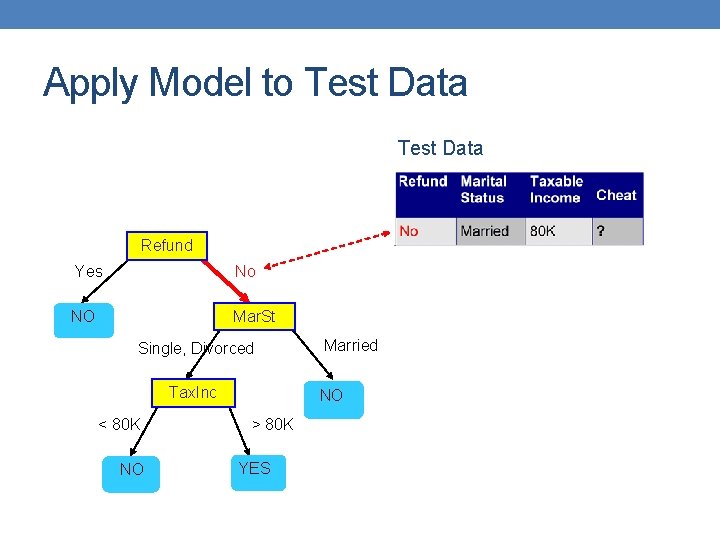
Apply Model to Test Data Refund Yes No NO Mar. St Single, Divorced Tax. Inc < 80 K NO Married NO > 80 K YES
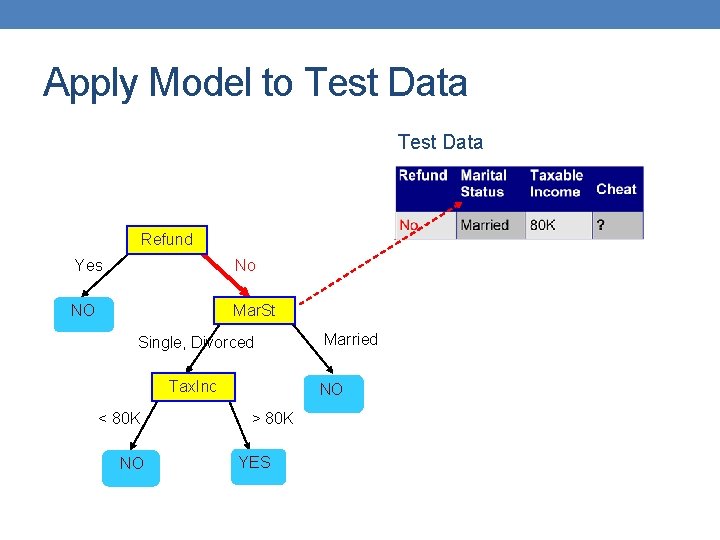
Apply Model to Test Data Refund Yes No NO Mar. St Single, Divorced Tax. Inc < 80 K NO Married NO > 80 K YES
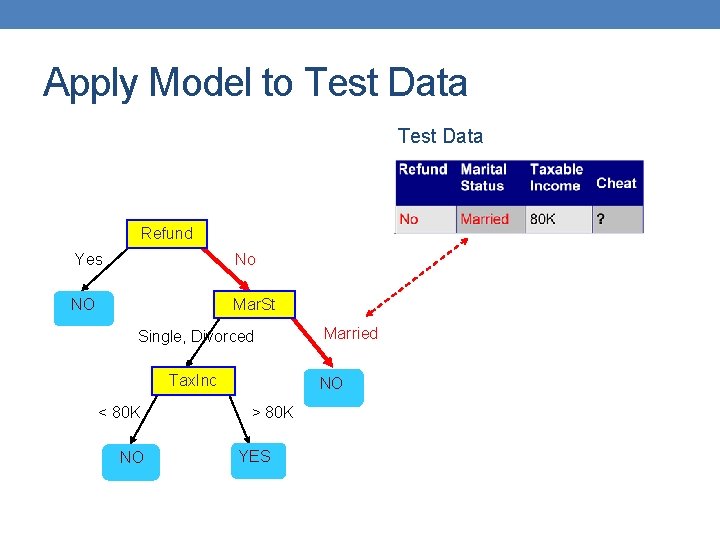
Apply Model to Test Data Refund Yes No NO Mar. St Single, Divorced Tax. Inc < 80 K NO Married NO > 80 K YES
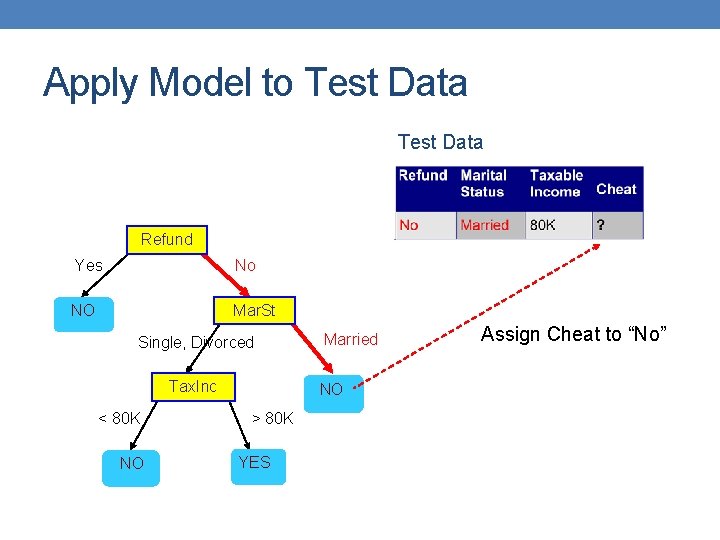
Apply Model to Test Data Refund Yes No NO Mar. St Single, Divorced Tax. Inc < 80 K NO Married NO > 80 K YES Assign Cheat to “No”

Decision Tree Classification Task Decision Tree
Tree Induction • Finding the best decision tree is NP-hard • Greedy strategy. • Split the records based on an attribute test that optimizes certain criterion. • Many Algorithms: • Hunt’s Algorithm (one of the earliest) • CART • ID 3, C 4. 5 • SLIQ, SPRINT
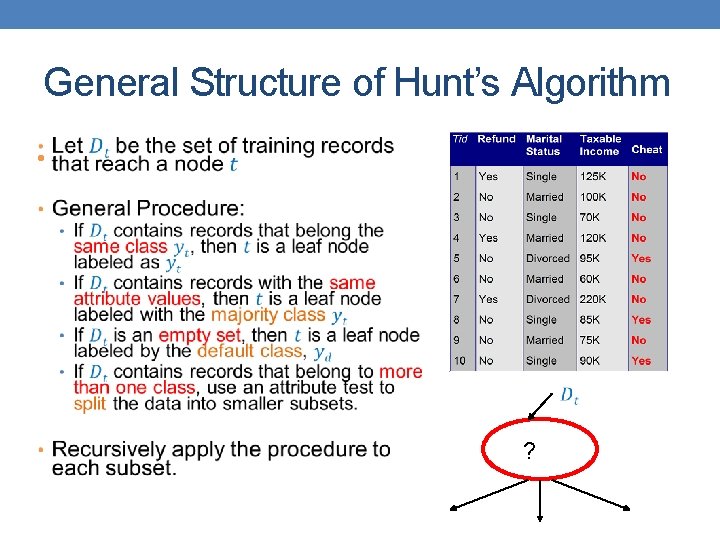
General Structure of Hunt’s Algorithm • ?
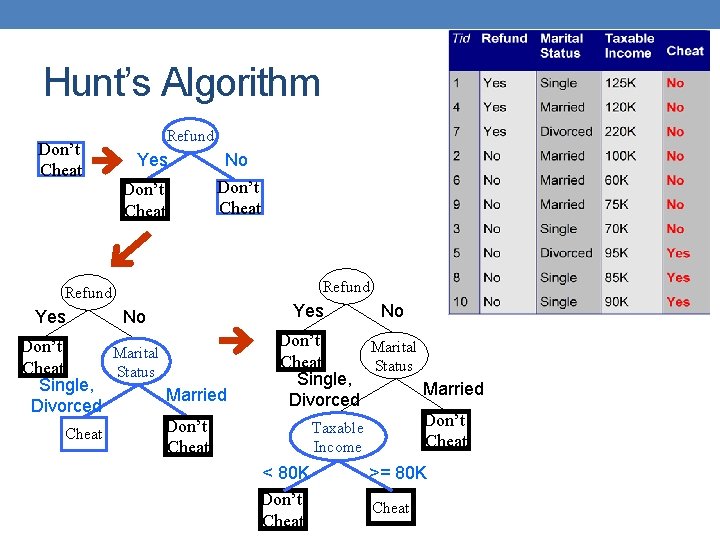
Hunt’s Algorithm Don’t Cheat Refund Yes Don’t Cheat No Don’t Cheat Refund Yes No Don’t Marital Cheat Status Single, Married Divorced Don’t Cheat Yes No Don’t Marital Cheat Status Single, Married Divorced Don’t Taxable Cheat Income < 80 K Don’t Cheat >= 80 K Cheat
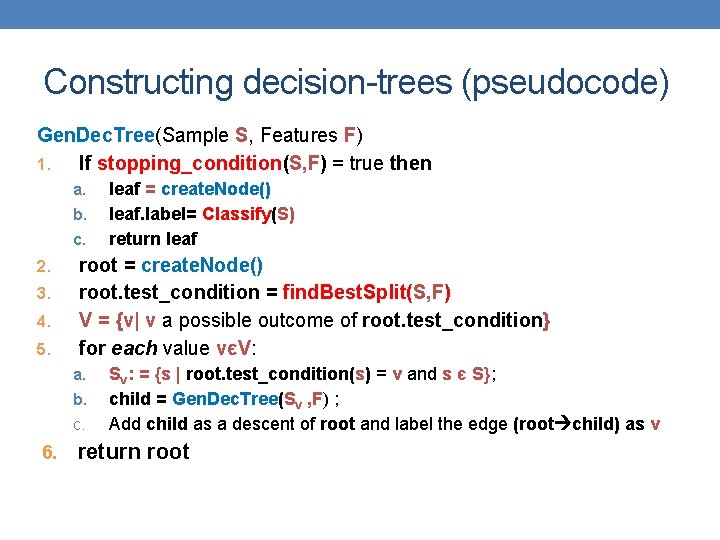
Constructing decision-trees (pseudocode) Gen. Dec. Tree(Sample S, Features F) 1. If stopping_condition(S, F) = true then a. b. c. 2. 3. 4. 5. root = create. Node() root. test_condition = find. Best. Split(S, F) V = {v| v a possible outcome of root. test_condition} for each value vєV: a. b. c. 6. leaf = create. Node() leaf. label= Classify(S) return leaf Sv: = {s | root. test_condition(s) = v and s є S}; child = Gen. Dec. Tree(Sv , F) ; Add child as a descent of root and label the edge (root child) as v return root

Tree Induction • Issues • How to Classify a leaf node • Assign the majority class • If leaf is empty, assign the default class – the class that has the highest popularity. • Determine how to split the records • How to specify the attribute test condition? • How to determine the best split? • Determine when to stop splitting
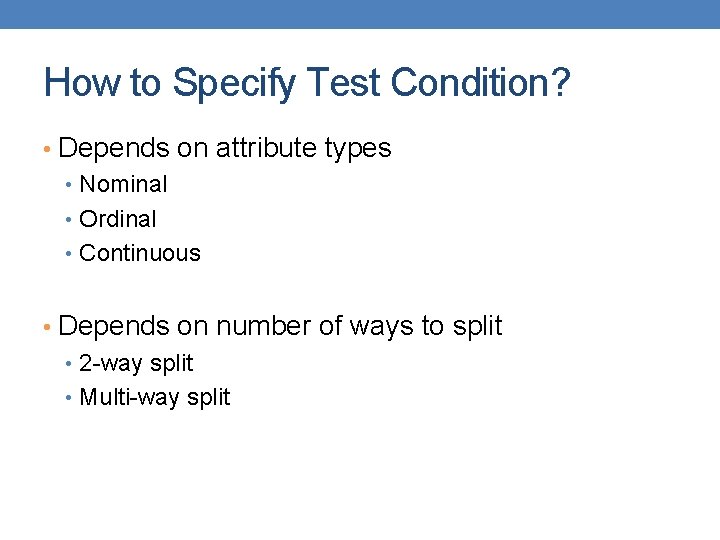
How to Specify Test Condition? • Depends on attribute types • Nominal • Ordinal • Continuous • Depends on number of ways to split • 2 -way split • Multi-way split
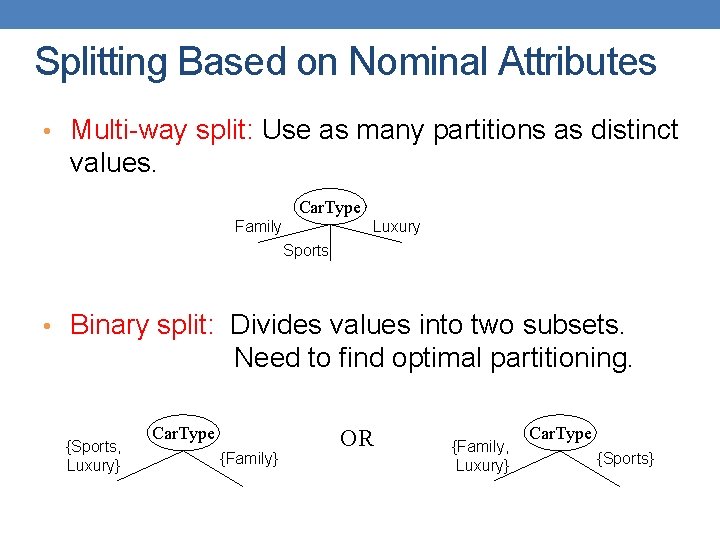
Splitting Based on Nominal Attributes • Multi-way split: Use as many partitions as distinct values. Car. Type Family Luxury Sports • Binary split: Divides values into two subsets. Need to find optimal partitioning. {Sports, Luxury} Car. Type {Family} OR {Family, Luxury} Car. Type {Sports}
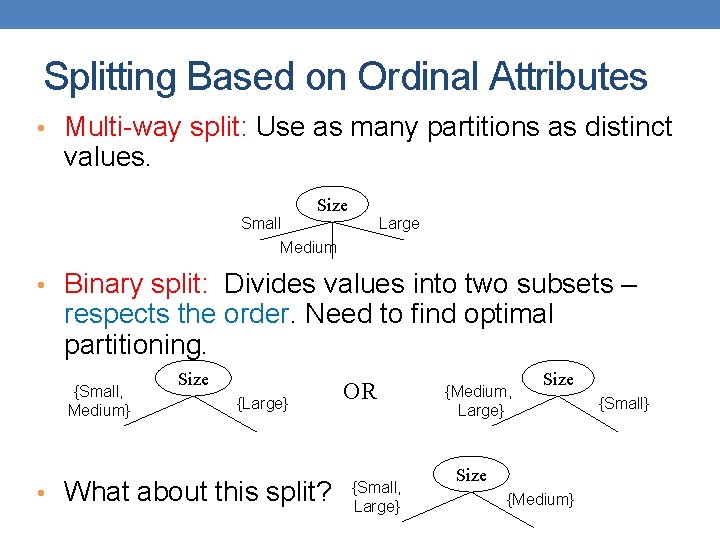
Splitting Based on Ordinal Attributes • Multi-way split: Use as many partitions as distinct values. Size Small Large Medium • Binary split: Divides values into two subsets – respects the order. Need to find optimal partitioning. {Small, Medium} Size {Large} • What about this split? OR {Small, Large} {Medium, Large} Size {Medium} {Small}
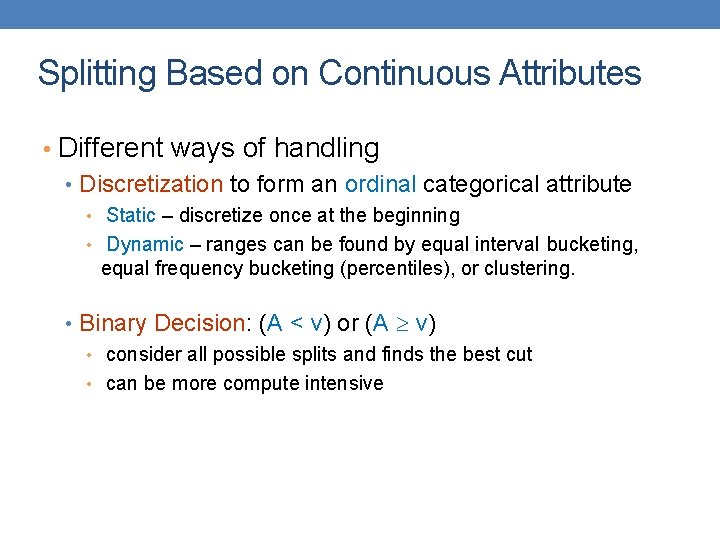
Splitting Based on Continuous Attributes • Different ways of handling • Discretization to form an ordinal categorical attribute • Static – discretize once at the beginning • Dynamic – ranges can be found by equal interval bucketing, equal frequency bucketing (percentiles), or clustering. • Binary Decision: (A < v) or (A v) • consider all possible splits and finds the best cut • can be more compute intensive
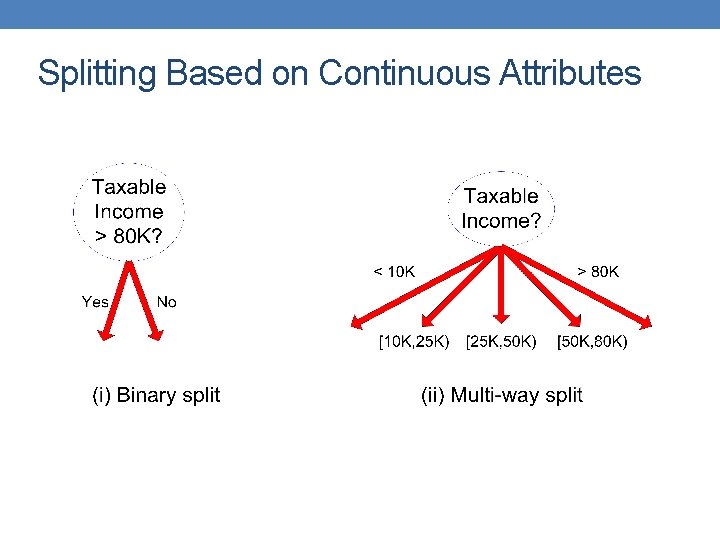
Splitting Based on Continuous Attributes
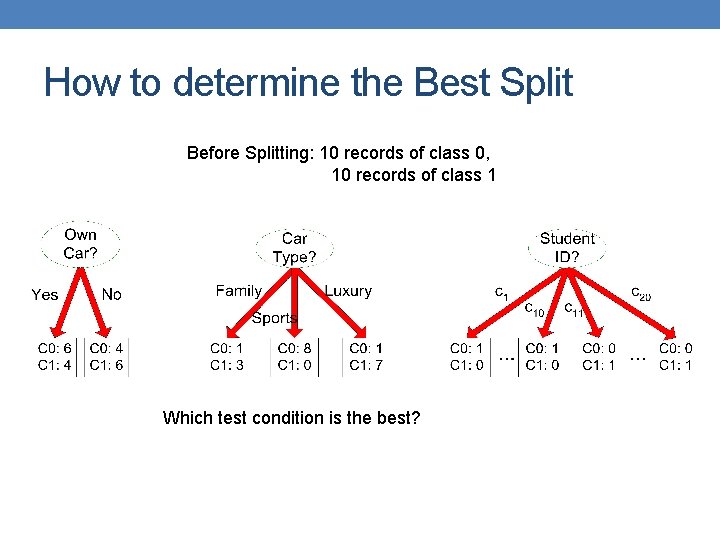
How to determine the Best Split Before Splitting: 10 records of class 0, 10 records of class 1 Which test condition is the best?
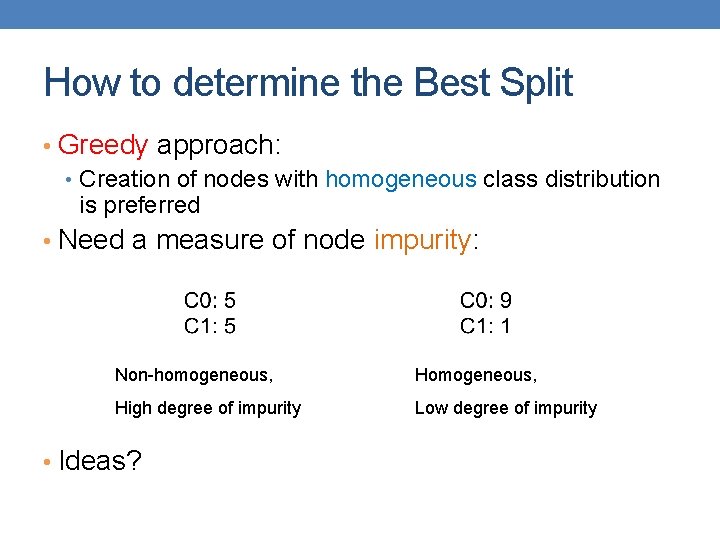
How to determine the Best Split • Greedy approach: • Creation of nodes with homogeneous class distribution is preferred • Need a measure of node impurity: Non-homogeneous, High degree of impurity Low degree of impurity • Ideas?
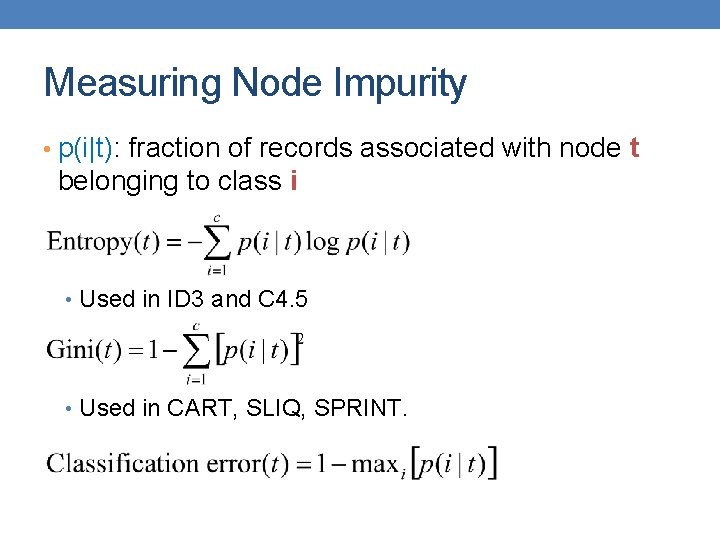
Measuring Node Impurity • p(i|t): fraction of records associated with node t belonging to class i • Used in ID 3 and C 4. 5 • Used in CART, SLIQ, SPRINT.
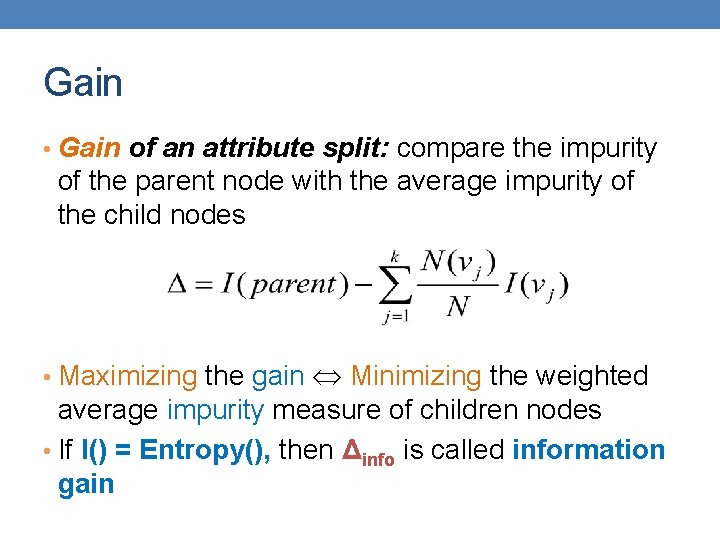
Gain • Gain of an attribute split: compare the impurity of the parent node with the average impurity of the child nodes • Maximizing the gain Minimizing the weighted average impurity measure of children nodes • If I() = Entropy(), then Δinfo is called information gain
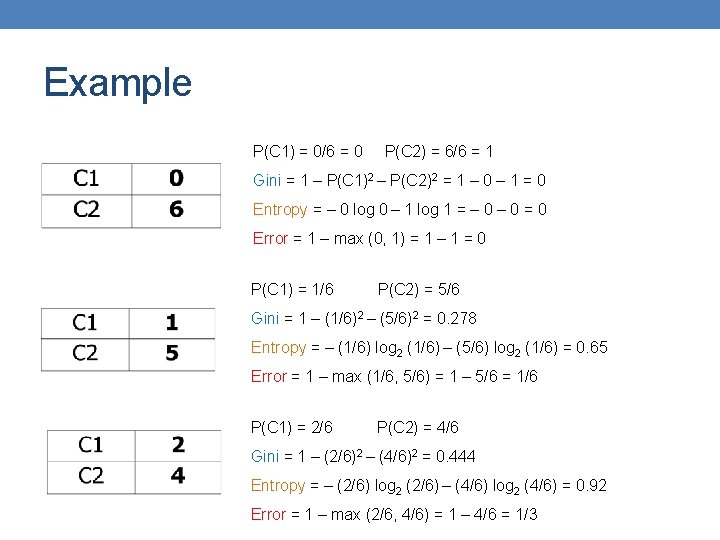
Example P(C 1) = 0/6 = 0 P(C 2) = 6/6 = 1 Gini = 1 – P(C 1)2 – P(C 2)2 = 1 – 0 – 1 = 0 Entropy = – 0 log 0 – 1 log 1 = – 0 = 0 Error = 1 – max (0, 1) = 1 – 1 = 0 P(C 1) = 1/6 P(C 2) = 5/6 Gini = 1 – (1/6)2 – (5/6)2 = 0. 278 Entropy = – (1/6) log 2 (1/6) – (5/6) log 2 (1/6) = 0. 65 Error = 1 – max (1/6, 5/6) = 1 – 5/6 = 1/6 P(C 1) = 2/6 P(C 2) = 4/6 Gini = 1 – (2/6)2 – (4/6)2 = 0. 444 Entropy = – (2/6) log 2 (2/6) – (4/6) log 2 (4/6) = 0. 92 Error = 1 – max (2/6, 4/6) = 1 – 4/6 = 1/3
Impurity measures • All of the impurity measures take value zero (minimum) for the case of a pure node where a single value has probability 1 • All of the impurity measures take maximum value when the class distribution in a node is uniform.
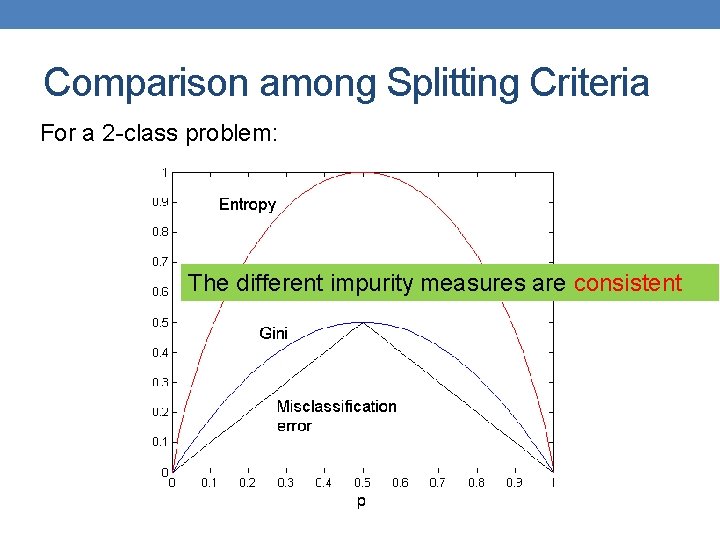
Comparison among Splitting Criteria For a 2 -class problem: The different impurity measures are consistent
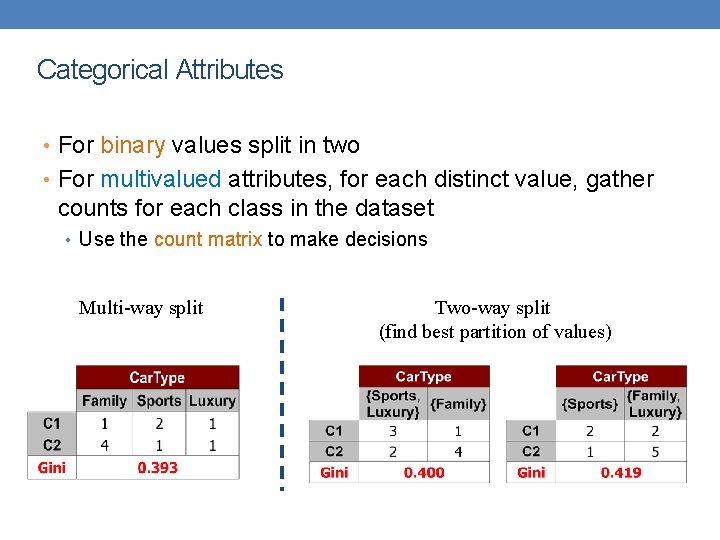
Categorical Attributes • For binary values split in two • For multivalued attributes, for each distinct value, gather counts for each class in the dataset • Use the count matrix to make decisions Multi-way split Two-way split (find best partition of values)
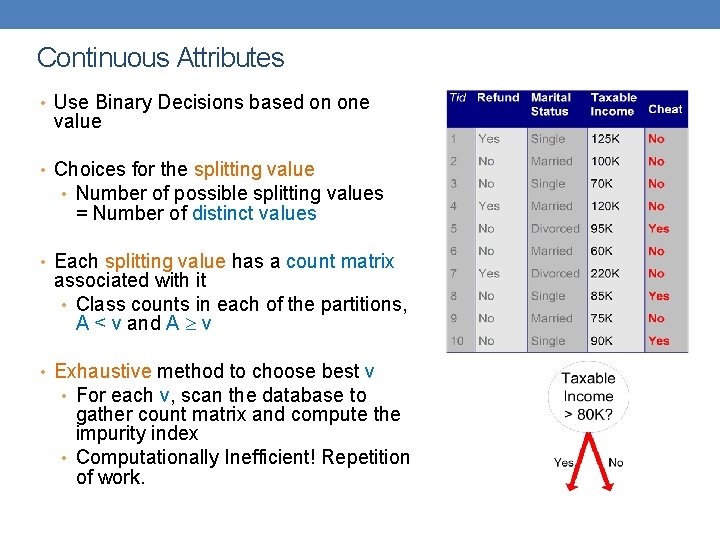
Continuous Attributes • Use Binary Decisions based on one value • Choices for the splitting value • Number of possible splitting values = Number of distinct values • Each splitting value has a count matrix associated with it • Class counts in each of the partitions, A < v and A v • Exhaustive method to choose best v • For each v, scan the database to gather count matrix and compute the impurity index • Computationally Inefficient! Repetition of work.
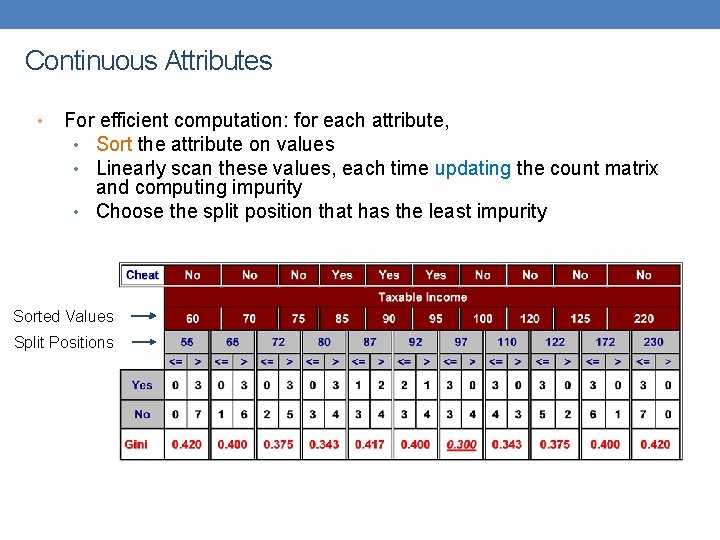
Continuous Attributes • For efficient computation: for each attribute, • Sort the attribute on values • Linearly scan these values, each time updating the count matrix and computing impurity • Choose the split position that has the least impurity Sorted Values Split Positions
Splitting based on impurity • Impurity measures favor attributes with large number of values • A test condition with large number of outcomes may not be desirable • # of records in each partition is too small to make predictions
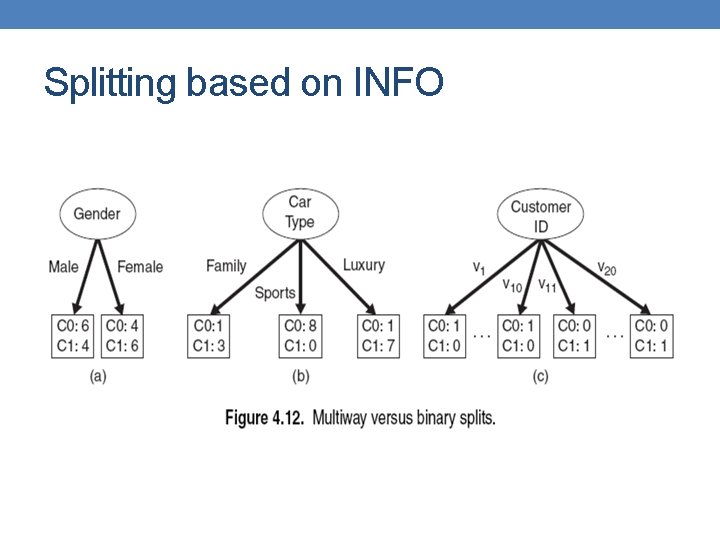
Splitting based on INFO
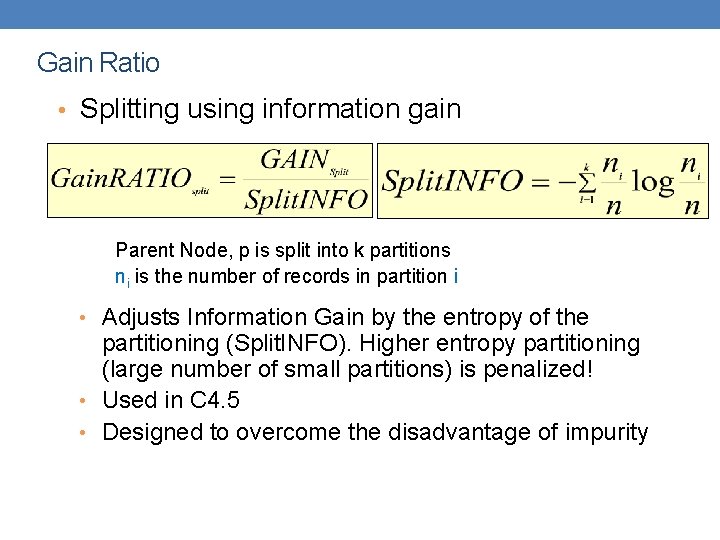
Gain Ratio • Splitting using information gain Parent Node, p is split into k partitions ni is the number of records in partition i • Adjusts Information Gain by the entropy of the partitioning (Split. INFO). Higher entropy partitioning (large number of small partitions) is penalized! • Used in C 4. 5 • Designed to overcome the disadvantage of impurity
Stopping Criteria for Tree Induction • Stop expanding a node when all the records belong to the same class • Stop expanding a node when all the records have similar attribute values • Early termination (to be discussed later)
Decision Tree Based Classification • Advantages: • Inexpensive to construct • Extremely fast at classifying unknown records • Easy to interpret for small-sized trees • Accuracy is comparable to other classification techniques for many simple data sets
Example: C 4. 5 • Simple depth-first construction. • Uses Information Gain • Sorts Continuous Attributes at each node. • Needs entire data to fit in memory. • Unsuitable for Large Datasets. • Needs out-of-core sorting. • You can download the software from: http: //www. cse. unsw. edu. au/~quinlan/c 4. 5 r 8. tar. gz
Other Issues • Data Fragmentation • Expressiveness
Data Fragmentation • Number of instances gets smaller as you traverse down the tree • Number of instances at the leaf nodes could be too small to make any statistically significant decision • You can introduce a lower bound on the number of items per leaf node in the stopping criterion.
Expressiveness • A classifier defines a function that discriminates between two (or more) classes. • The expressiveness of a classifier is the class of functions that it can model, and the kind of data that it can separate • When we have discrete (or binary) values, we are interested in the class of boolean functions that can be modeled • If the data-points are real vectors we talk about the decision boundary that the classifier can model
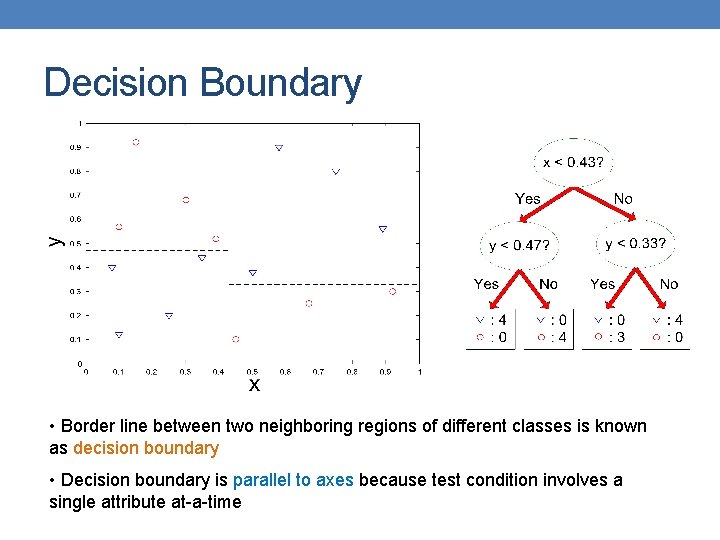
Decision Boundary • Border line between two neighboring regions of different classes is known as decision boundary • Decision boundary is parallel to axes because test condition involves a single attribute at-a-time

Expressiveness • Decision tree provides expressive representation for learning discrete-valued function • But they do not generalize well to certain types of Boolean functions • Example: parity function: • Class = 1 if there is an even number of Boolean attributes with truth value = True • Class = 0 if there is an odd number of Boolean attributes with truth value = True • For accurate modeling, must have a complete tree • Less expressive for modeling continuous variables • Particularly when test condition involves only a single attribute at-a-time
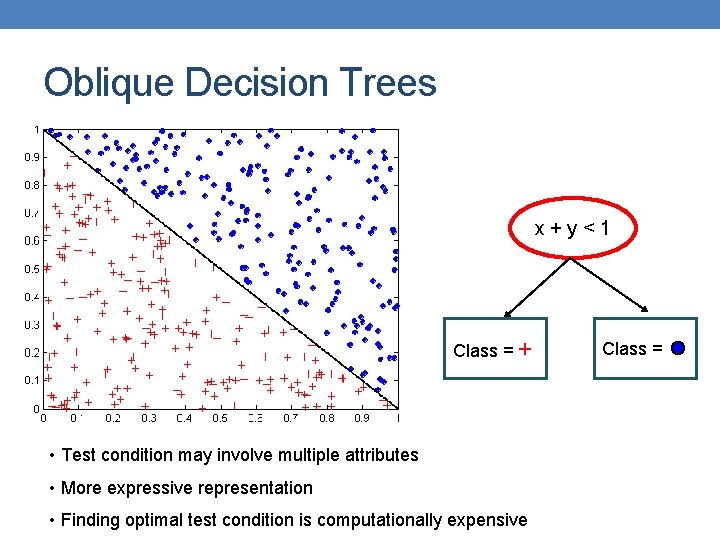
Oblique Decision Trees x+y<1 Class = + • Test condition may involve multiple attributes • More expressive representation • Finding optimal test condition is computationally expensive Class =
Practical Issues of Classification • Underfitting and Overfitting • Evaluation
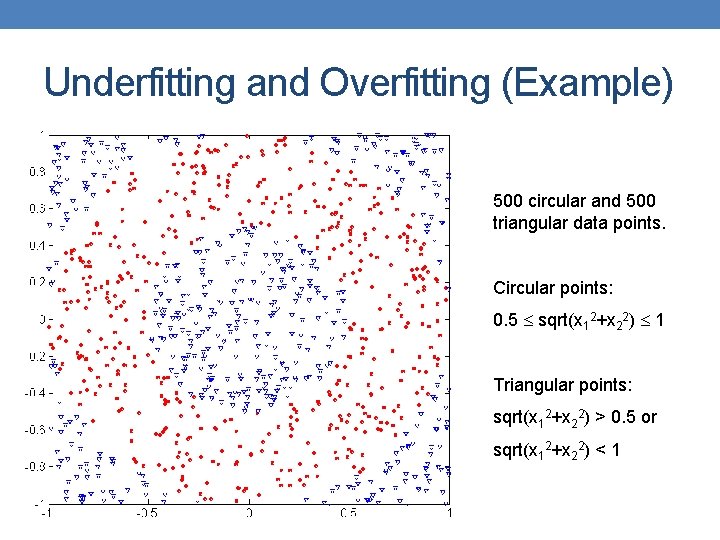
Underfitting and Overfitting (Example) 500 circular and 500 triangular data points. Circular points: 0. 5 sqrt(x 12+x 22) 1 Triangular points: sqrt(x 12+x 22) > 0. 5 or sqrt(x 12+x 22) < 1
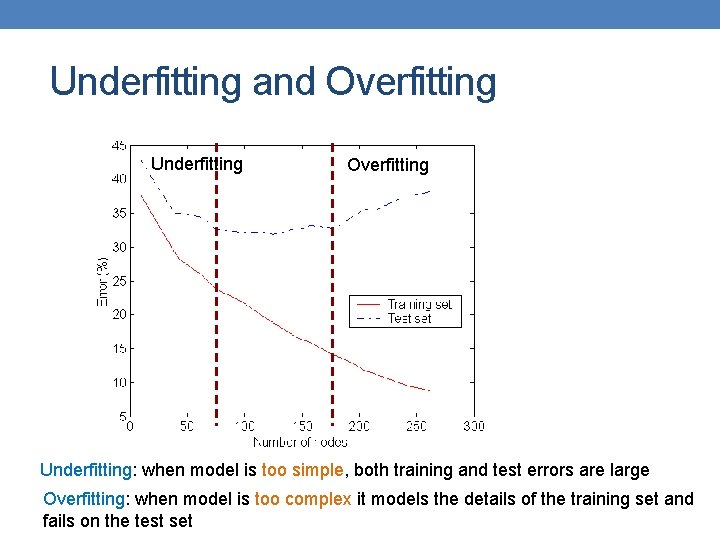
Underfitting and Overfitting Underfitting: when model is too simple, both training and test errors are large Overfitting: when model is too complex it models the details of the training set and fails on the test set
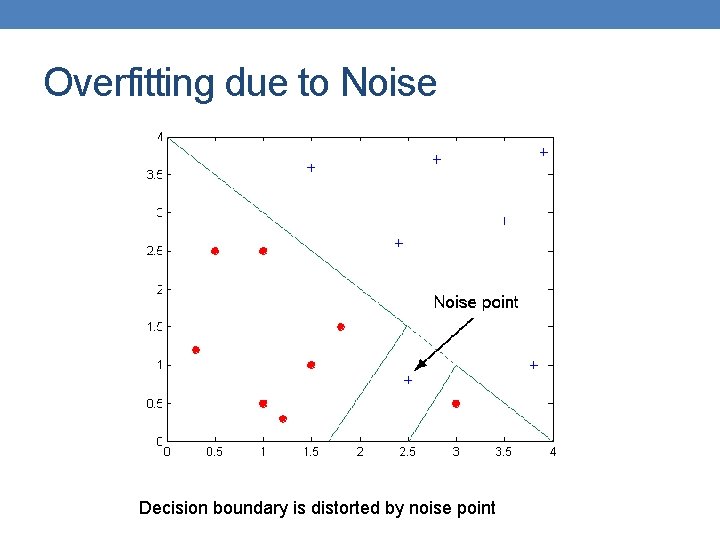
Overfitting due to Noise Decision boundary is distorted by noise point
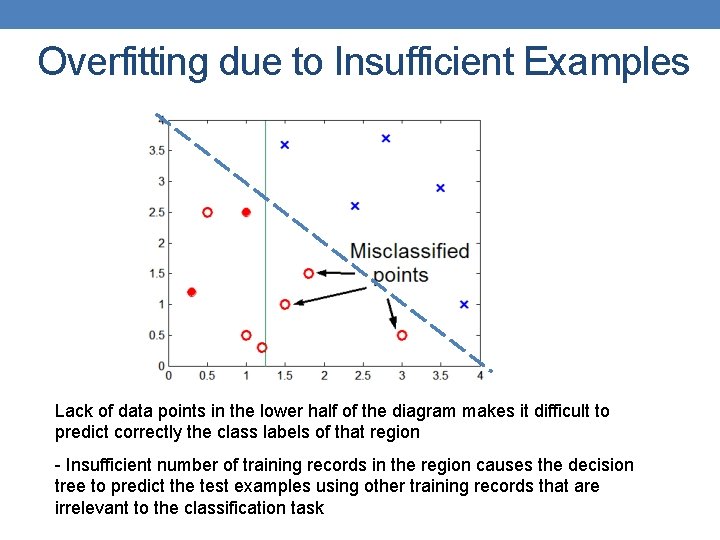
Overfitting due to Insufficient Examples Lack of data points in the lower half of the diagram makes it difficult to predict correctly the class labels of that region - Insufficient number of training records in the region causes the decision tree to predict the test examples using other training records that are irrelevant to the classification task
Notes on Overfitting • Overfitting results in decision trees that are more complex than necessary • Training error no longer provides a good estimate of how well the tree will perform on previously unseen records • The model does not generalize well • Need new ways for estimating errors
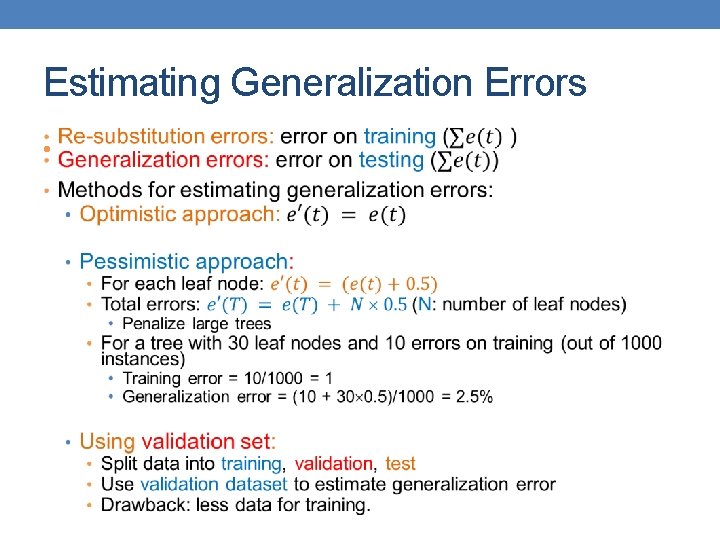
Estimating Generalization Errors •
Occam’s Razor • Given two models of similar generalization errors, one should prefer the simpler model over the more complex model • For complex models, there is a greater chance that it was fitted accidentally by errors in data • Therefore, one should include model complexity when evaluating a model
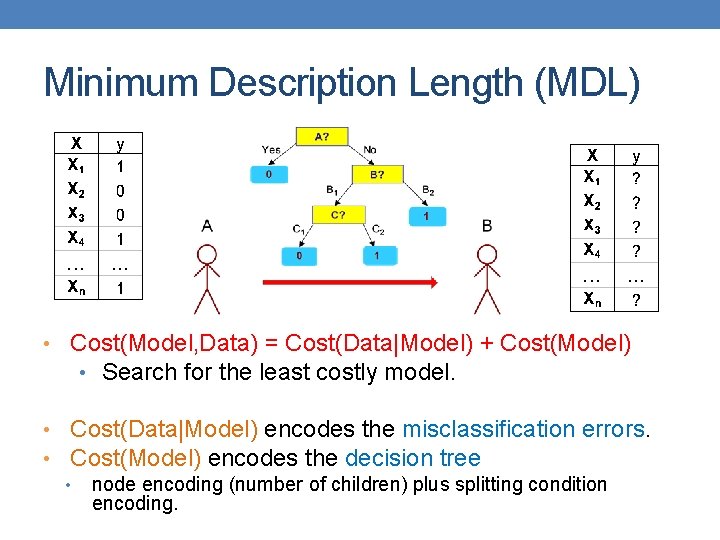
Minimum Description Length (MDL) • Cost(Model, Data) = Cost(Data|Model) + Cost(Model) • Search for the least costly model. • Cost(Data|Model) encodes the misclassification errors. • Cost(Model) encodes the decision tree • node encoding (number of children) plus splitting condition encoding.
How to Address Overfitting • Pre-Pruning (Early Stopping Rule) • Stop the algorithm before it becomes a fully-grown tree • Typical stopping conditions for a node: • Stop if all instances belong to the same class • Stop if all the attribute values are the same • More restrictive conditions: • Stop if number of instances is less than some user-specified threshold • Stop if class distribution of instances are independent of the available features (e. g. , using 2 test) • Stop if expanding the current node does not improve impurity measures (e. g. , Gini or information gain).
How to Address Overfitting… • Post-pruning • Grow decision tree to its entirety • Trim the nodes of the decision tree in a bottom-up fashion • If generalization error improves after trimming, replace sub-tree by a leaf node. • Class label of leaf node is determined from majority class of instances in the sub-tree • Can use MDL for post-pruning
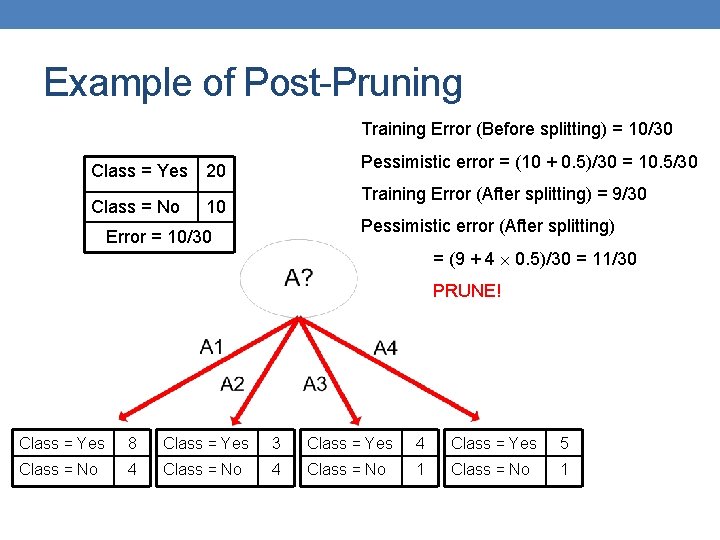
Example of Post-Pruning Training Error (Before splitting) = 10/30 Class = Yes Class = No Pessimistic error = (10 + 0. 5)/30 = 10. 5/30 20 Training Error (After splitting) = 9/30 10 Pessimistic error (After splitting) Error = 10/30 = (9 + 4 0. 5)/30 = 11/30 PRUNE! Class = Yes 8 Class = Yes 3 Class = Yes 4 Class = Yes 5 Class = No 4 Class = No 1
Model Evaluation • Metrics for Performance Evaluation • How to evaluate the performance of a model? • Methods for Performance Evaluation • How to obtain reliable estimates? • Methods for Model Comparison • How to compare the relative performance among competing models?
Model Evaluation • Metrics for Performance Evaluation • How to evaluate the performance of a model? • Methods for Performance Evaluation • How to obtain reliable estimates? • Methods for Model Comparison • How to compare the relative performance among competing models?
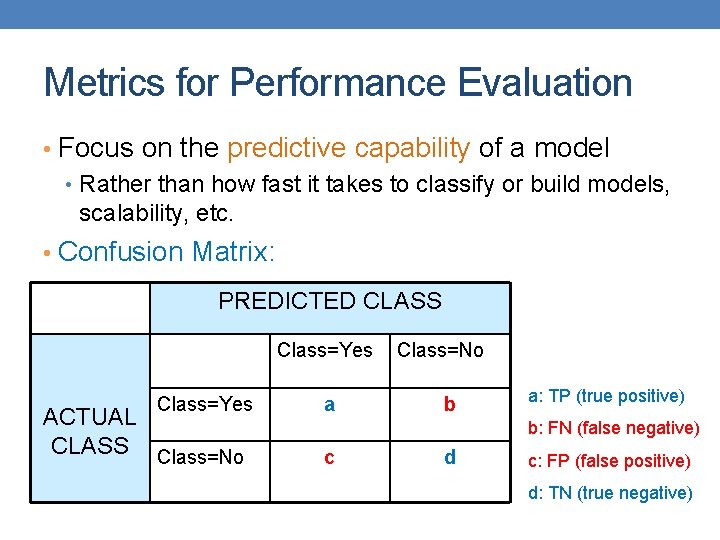
Metrics for Performance Evaluation • Focus on the predictive capability of a model • Rather than how fast it takes to classify or build models, scalability, etc. • Confusion Matrix: PREDICTED CLASS Class=Yes ACTUAL CLASS Class=No a Class=No b a: TP (true positive) b: FN (false negative) c d c: FP (false positive) d: TN (true negative)
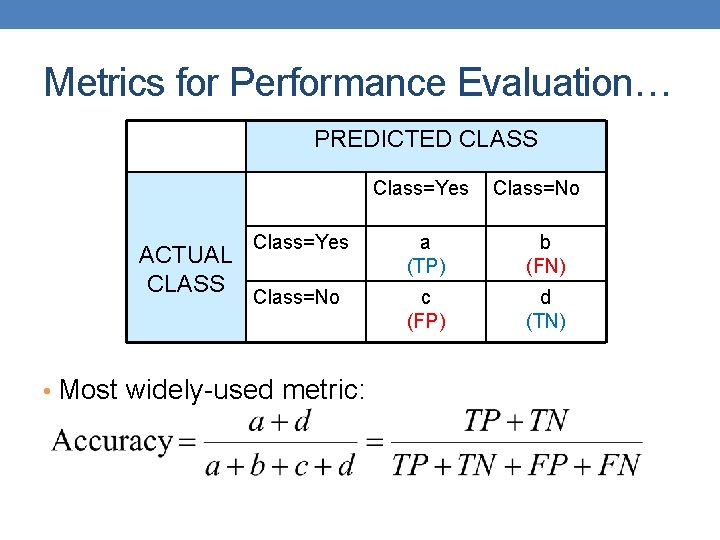
Metrics for Performance Evaluation… PREDICTED CLASS Class=Yes ACTUAL CLASS Class=No Class=Yes a (TP) b (FN) Class=No c (FP) d (TN) • Most widely-used metric:
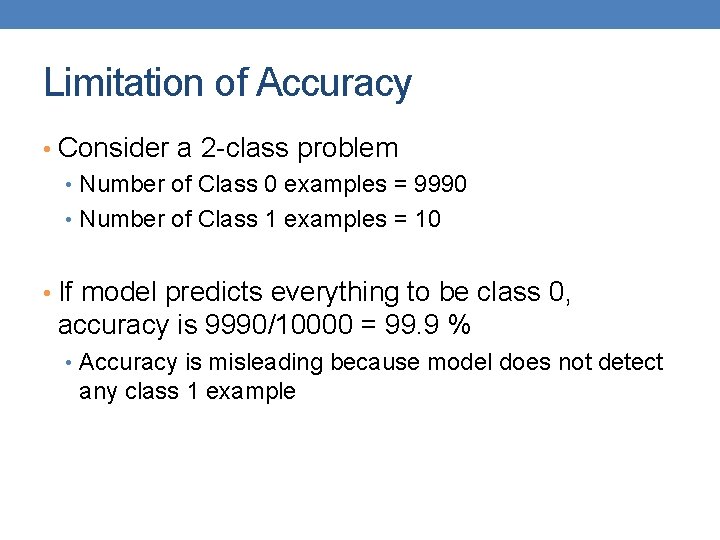
Limitation of Accuracy • Consider a 2 -class problem • Number of Class 0 examples = 9990 • Number of Class 1 examples = 10 • If model predicts everything to be class 0, accuracy is 9990/10000 = 99. 9 % • Accuracy is misleading because model does not detect any class 1 example
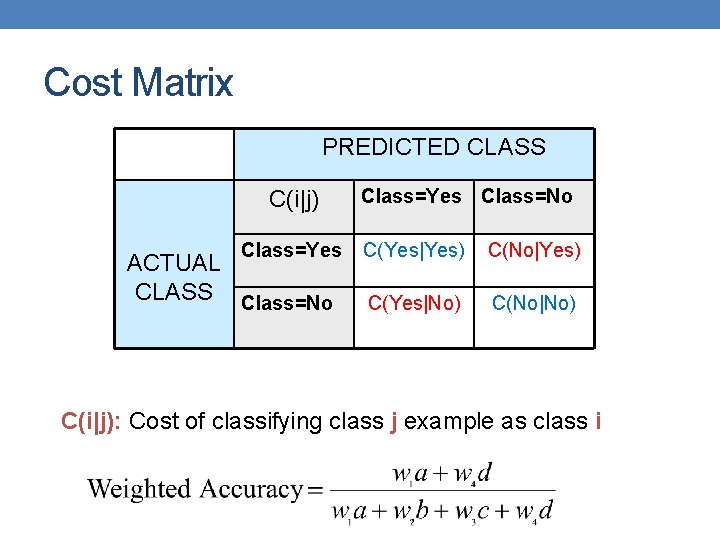
Cost Matrix PREDICTED CLASS C(i|j) Class=Yes ACTUAL CLASS Class=No Class=Yes Class=No C(Yes|Yes) C(No|Yes) C(Yes|No) C(No|No) C(i|j): Cost of classifying class j example as class i
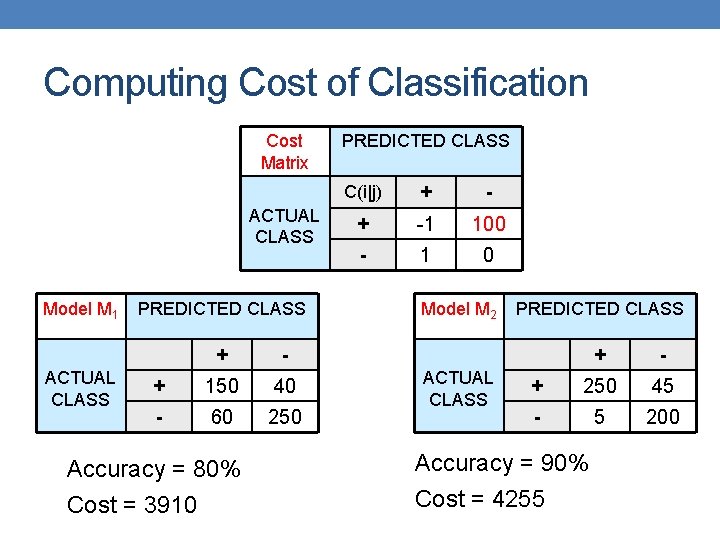
Computing Cost of Classification Cost Matrix ACTUAL CLASS Model M 1 ACTUAL CLASS PREDICTED CLASS + - + 150 40 - 60 250 Accuracy = 80% Cost = 3910 PREDICTED CLASS C(i|j) + -1 100 - 1 0 Model M 2 ACTUAL CLASS PREDICTED CLASS + - + 250 45 - 5 200 Accuracy = 90% Cost = 4255

Cost vs Accuracy Count PREDICTED CLASS Class=Yes ACTUAL CLASS Class=No Class=Yes a b Class=No c d Accuracy is proportional to cost if 1. C(Yes|No)=C(No|Yes) = q 2. C(Yes|Yes)=C(No|No) = p N=a+b+c+d Accuracy = (a + d)/N Cost PREDICTED CLASS Class=Yes ACTUAL CLASS Class=No p q Class=No q p Cost = p (a + d) + q (b + c) = p (a + d) + q (N – a – d) = q N – (q – p)(a + d) = N [q – (q-p) Accuracy]
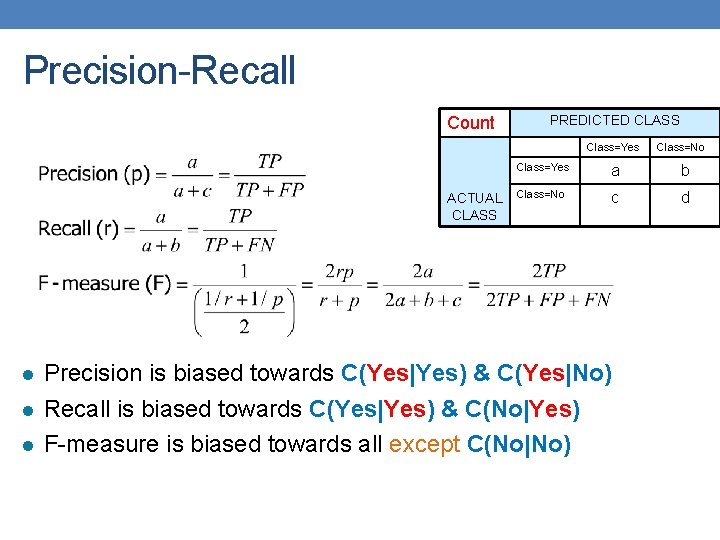
Precision-Recall Count PREDICTED CLASS Class=Yes ACTUAL CLASS l l l Class=No Class=Yes a b Class=No c d Precision is biased towards C(Yes|Yes) & C(Yes|No) Recall is biased towards C(Yes|Yes) & C(No|Yes) F-measure is biased towards all except C(No|No)
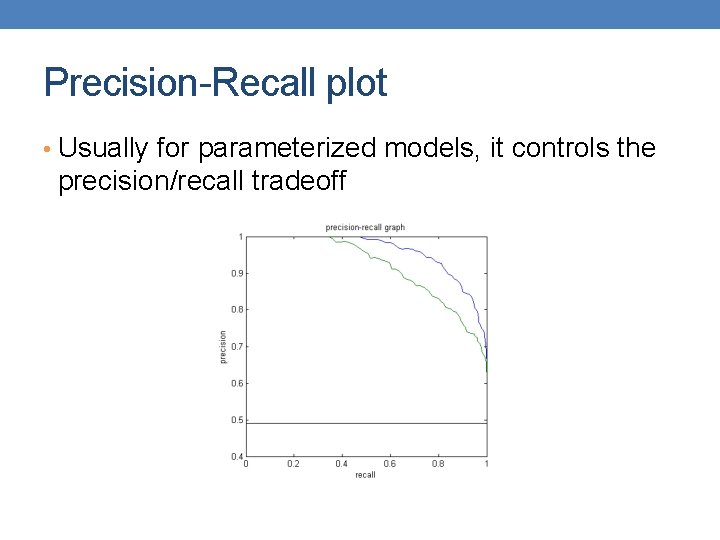
Precision-Recall plot • Usually for parameterized models, it controls the precision/recall tradeoff
Model Evaluation • Metrics for Performance Evaluation • How to evaluate the performance of a model? • Methods for Performance Evaluation • How to obtain reliable estimates? • Methods for Model Comparison • How to compare the relative performance among competing models?
Methods for Performance Evaluation • How to obtain a reliable estimate of performance? • Performance of a model may depend on other factors besides the learning algorithm: • Class distribution • Cost of misclassification • Size of training and test sets
Methods of Estimation • Holdout • Reserve 2/3 for training and 1/3 for testing • Random subsampling • One sample may be biased -- Repeated holdout • Cross validation • Partition data into k disjoint subsets • k-fold: train on k-1 partitions, test on the remaining one • Leave-one-out: k=n • Guarantees that each record is used the same number of times for training and testing • Bootstrap • Sampling with replacement • ~63% of records used for training, ~27% for testing
Dealing with class Imbalance • If the class we are interested in is very rare, then the classifier will ignore it. • The class imbalance problem • Solution • We can modify the optimization criterion by using a cost sensitive metric • We can balance the class distribution • Sample from the larger class so that the size of the two classes is the same • Replicate the data of the class of interest so that the classes are balanced • Over-fitting issues
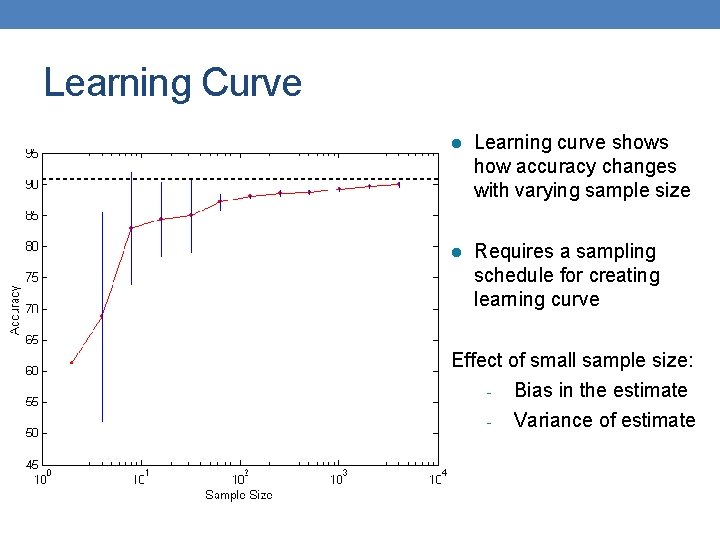
Learning Curve l Learning curve shows how accuracy changes with varying sample size l Requires a sampling schedule for creating learning curve Effect of small sample size: - Bias in the estimate - Variance of estimate
Model Evaluation • Metrics for Performance Evaluation • How to evaluate the performance of a model? • Methods for Performance Evaluation • How to obtain reliable estimates? • Methods for Model Comparison • How to compare the relative performance among competing models?
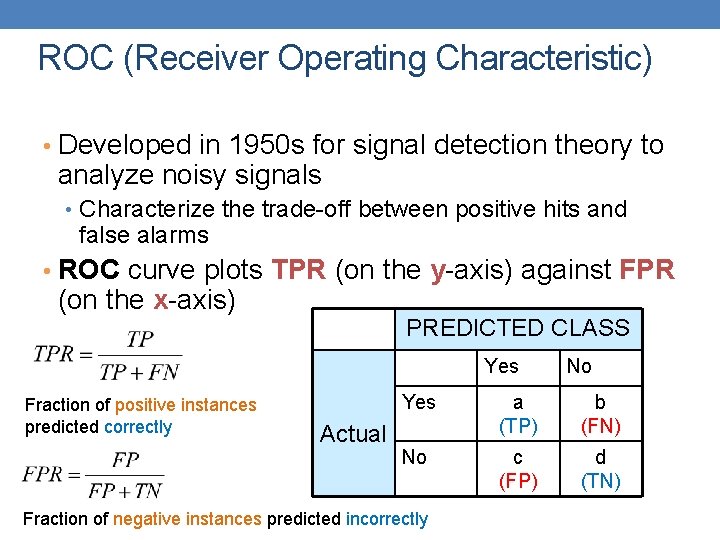
ROC (Receiver Operating Characteristic) • Developed in 1950 s for signal detection theory to analyze noisy signals • Characterize the trade-off between positive hits and false alarms • ROC curve plots TPR (on the y-axis) against FPR (on the x-axis) PREDICTED CLASS Yes Fraction of positive instances predicted correctly Actual No Yes a (TP) b (FN) No c (FP) d (TN) Fraction of negative instances predicted incorrectly
ROC (Receiver Operating Characteristic) • Performance of a classifier represented as a point on the ROC curve • Changing some parameter of the algorithm, sample distribution or cost matrix changes the location of the point
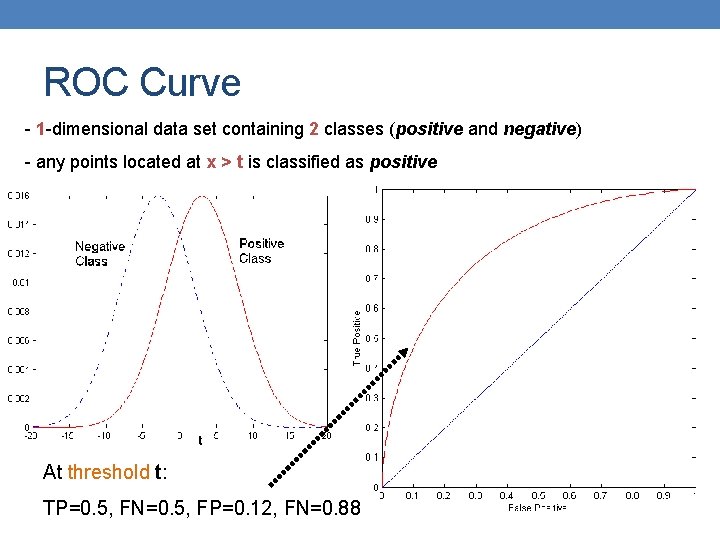
ROC Curve - 1 -dimensional data set containing 2 classes (positive and negative) - any points located at x > t is classified as positive At threshold t: TP=0. 5, FN=0. 5, FP=0. 12, FN=0. 88
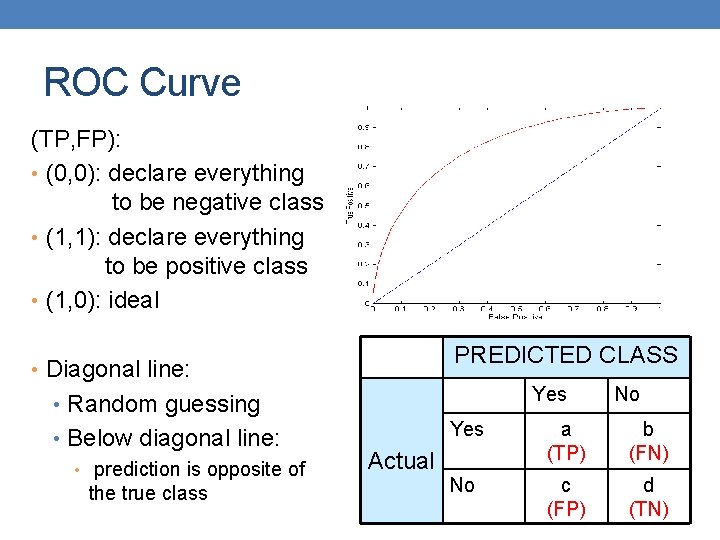
ROC Curve (TP, FP): • (0, 0): declare everything to be negative class • (1, 1): declare everything to be positive class • (1, 0): ideal PREDICTED CLASS • Diagonal line: Yes • Random guessing • Below diagonal line: • prediction is opposite of the true class Actual No Yes a (TP) b (FN) No c (FP) d (TN)
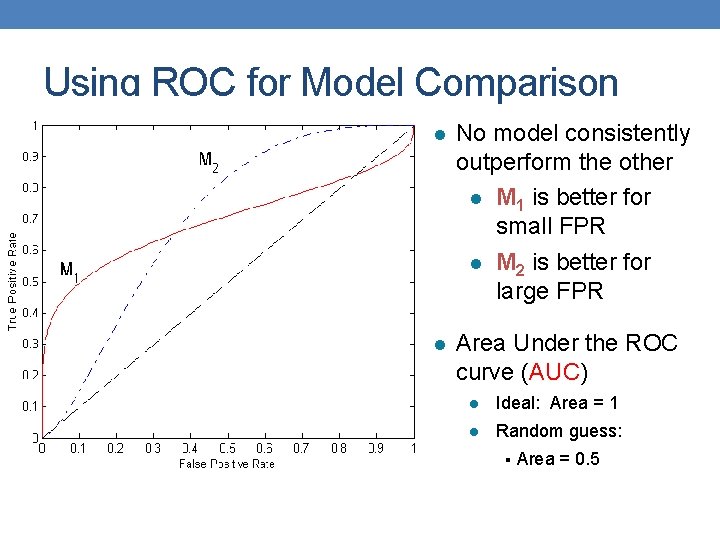
Using ROC for Model Comparison l No model consistently outperform the other l M 1 is better for small FPR l M 2 is better for large FPR l Area Under the ROC curve (AUC) l Ideal: Area = 1 l Random guess: § Area = 0. 5
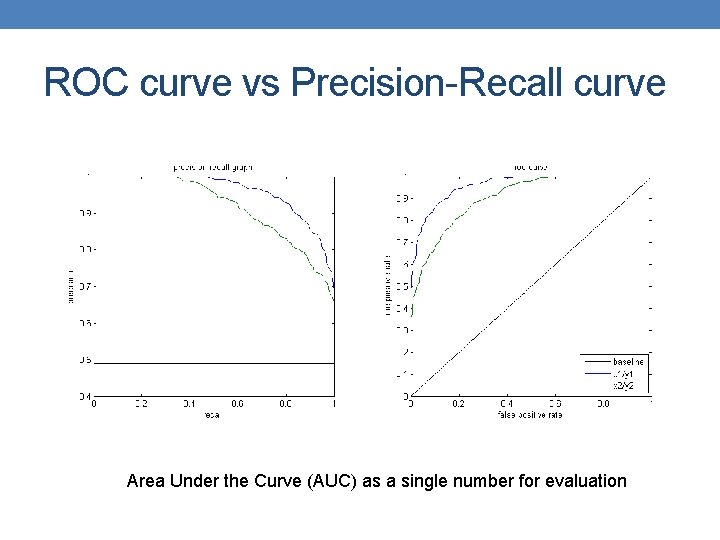
ROC curve vs Precision-Recall curve Area Under the Curve (AUC) as a single number for evaluation

NEAREST NEIGHBOR CLASSIFICATION
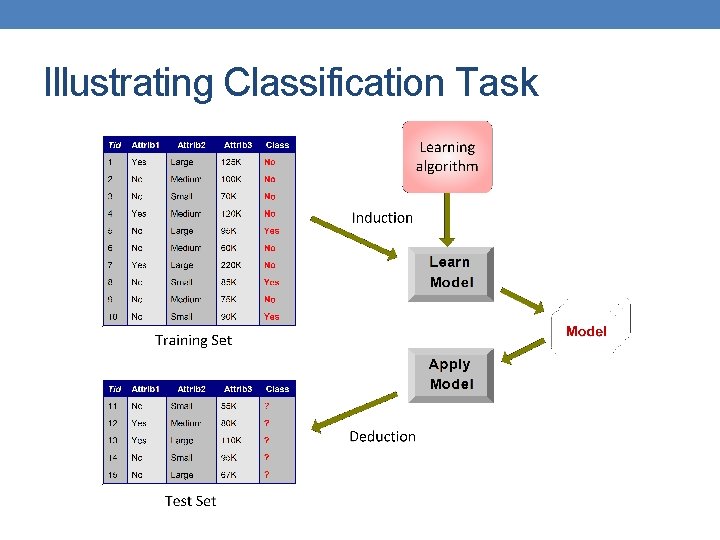
Illustrating Classification Task
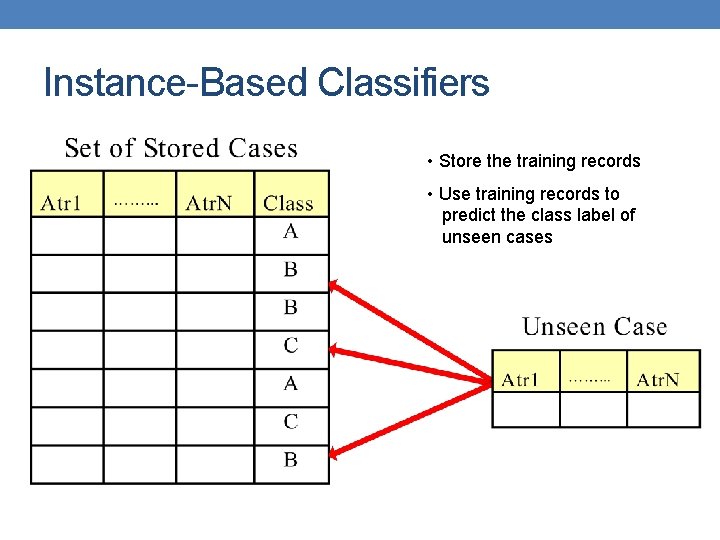
Instance-Based Classifiers • Store the training records • Use training records to predict the class label of unseen cases
Instance Based Classifiers • Examples: • Rote-learner • Memorizes entire training data and performs classification only if attributes of record match one of the training examples exactly • Nearest neighbor classifier • Uses k “closest” points (nearest neighbors) for performing classification
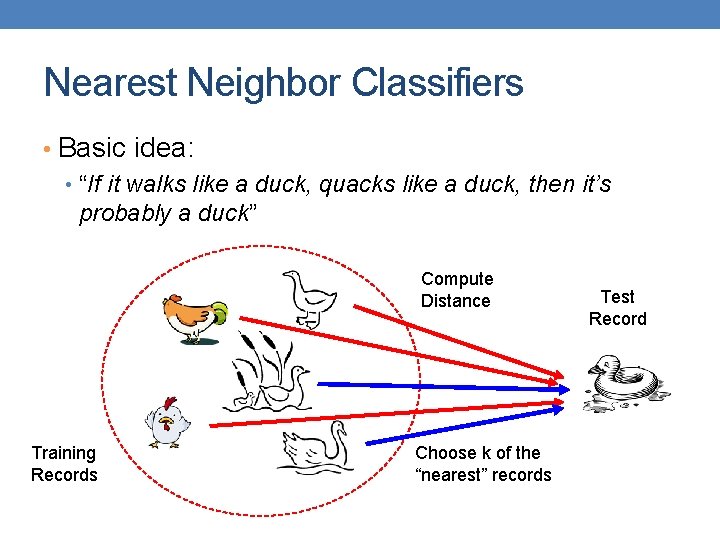
Nearest Neighbor Classifiers • Basic idea: • “If it walks like a duck, quacks like a duck, then it’s probably a duck” Compute Distance Training Records Choose k of the “nearest” records Test Record
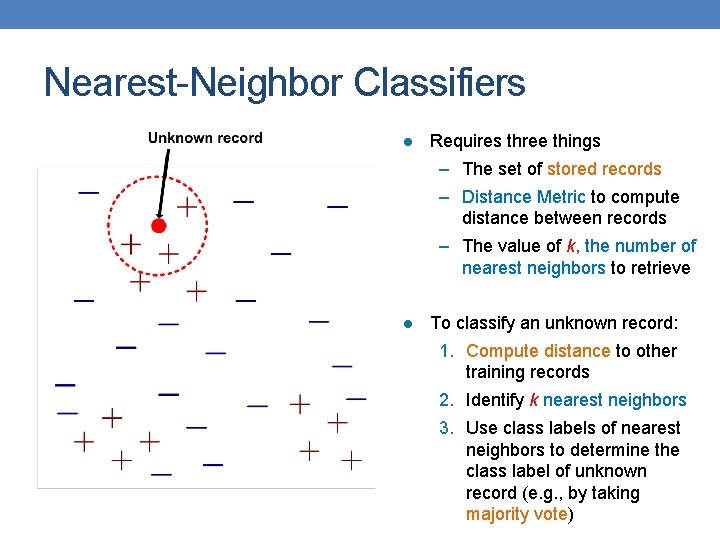
Nearest-Neighbor Classifiers l Requires three things – The set of stored records – Distance Metric to compute distance between records – The value of k, the number of nearest neighbors to retrieve l To classify an unknown record: 1. Compute distance to other training records 2. Identify k nearest neighbors 3. Use class labels of nearest neighbors to determine the class label of unknown record (e. g. , by taking majority vote)
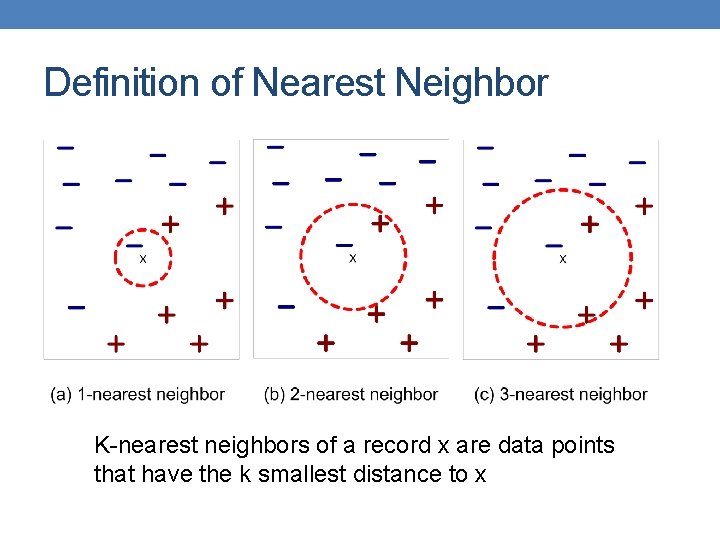
Definition of Nearest Neighbor K-nearest neighbors of a record x are data points that have the k smallest distance to x
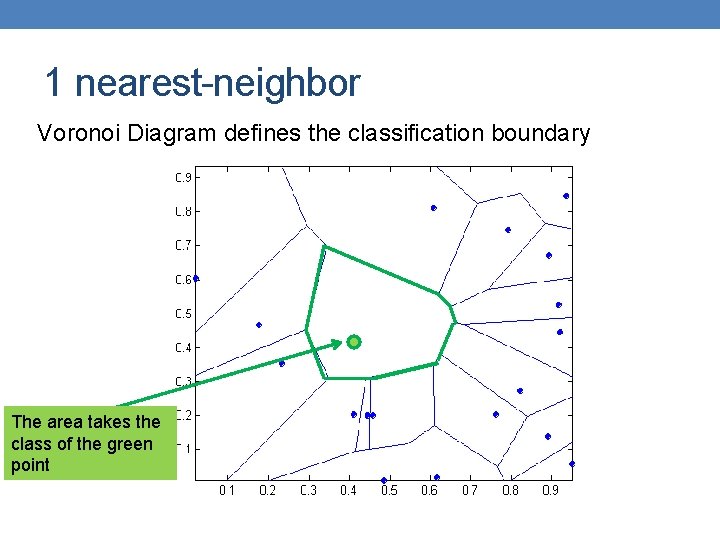
1 nearest-neighbor Voronoi Diagram defines the classification boundary The area takes the class of the green point
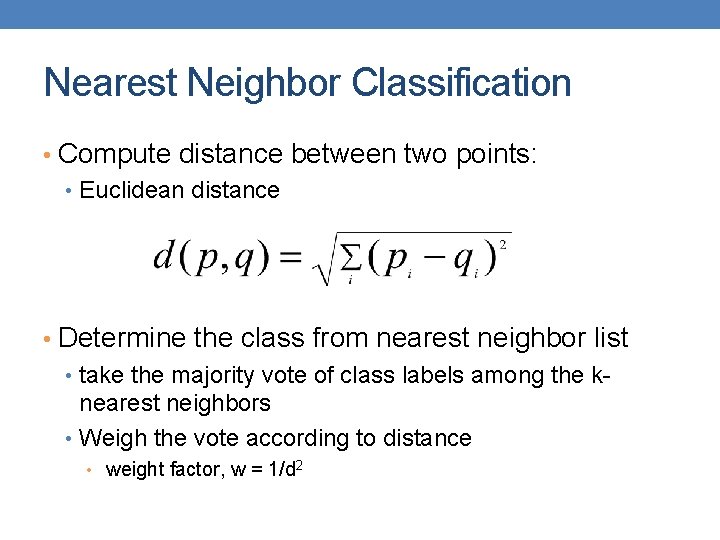
Nearest Neighbor Classification • Compute distance between two points: • Euclidean distance • Determine the class from nearest neighbor list • take the majority vote of class labels among the knearest neighbors • Weigh the vote according to distance • weight factor, w = 1/d 2
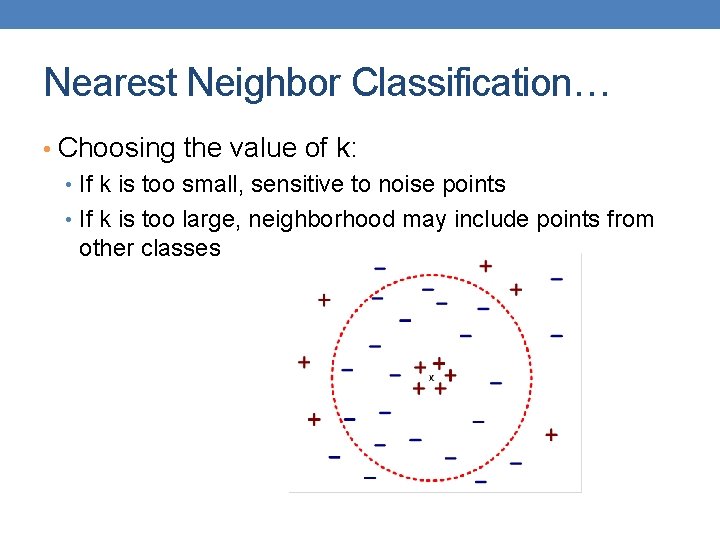
Nearest Neighbor Classification… • Choosing the value of k: • If k is too small, sensitive to noise points • If k is too large, neighborhood may include points from other classes
Nearest Neighbor Classification… • Scaling issues • Attributes may have to be scaled to prevent distance measures from being dominated by one of the attributes • Example: • height of a person may vary from 1. 5 m to 1. 8 m • weight of a person may vary from 90 lb to 300 lb • income of a person may vary from $10 K to $1 M
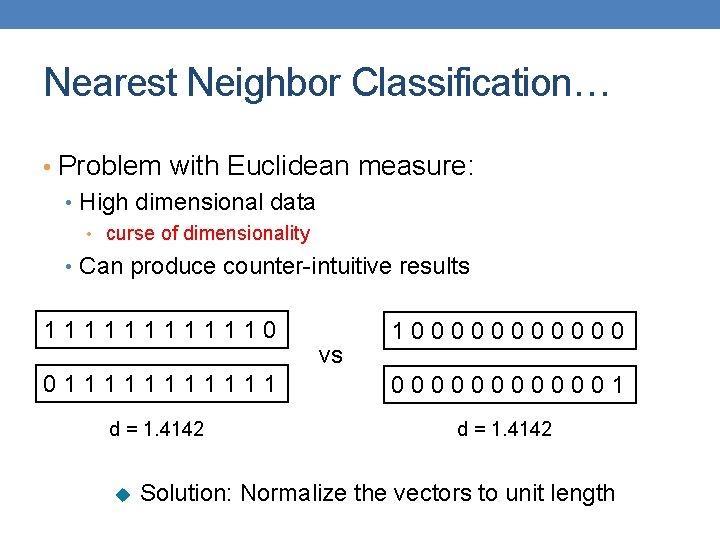
Nearest Neighbor Classification… • Problem with Euclidean measure: • High dimensional data • curse of dimensionality • Can produce counter-intuitive results 1111110 vs 1000000 0111111 0000001 d = 1. 4142 u Solution: Normalize the vectors to unit length
Nearest neighbor Classification… • k-NN classifiers are lazy learners • It does not build models explicitly • Unlike eager learners such as decision trees • Classifying unknown records are relatively expensive • Naïve algorithm: O(n) • Need for structures to retrieve nearest neighbors fast. • The Nearest Neighbor Search problem.
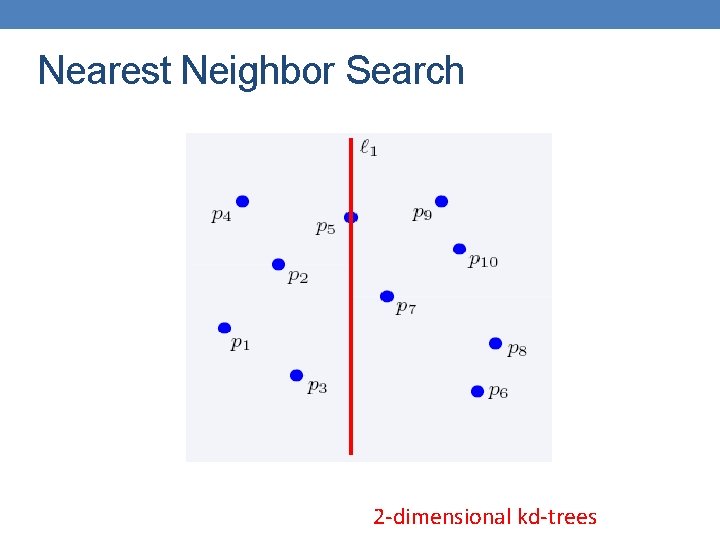
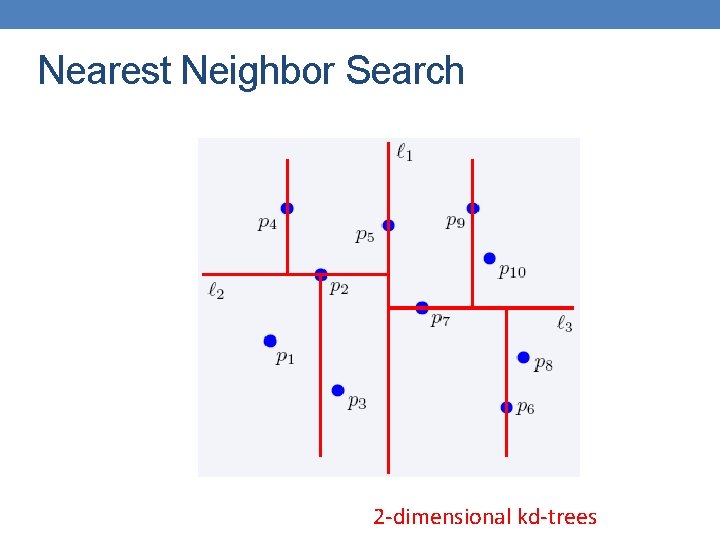
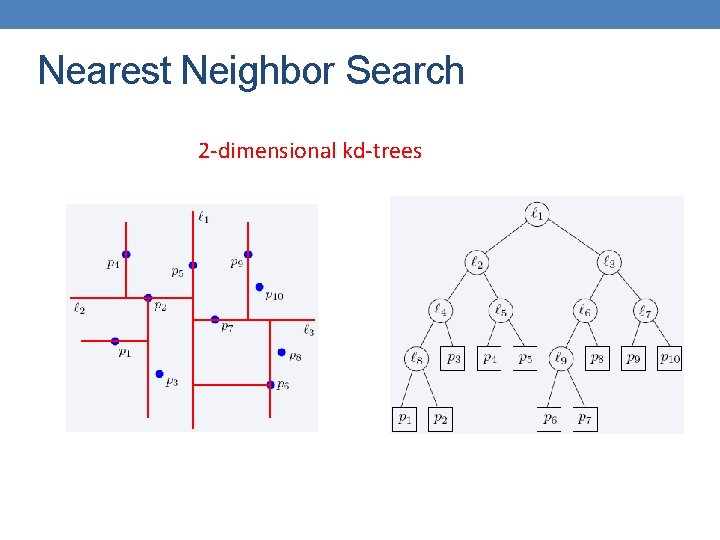
Nearest Neighbor Search • Two-dimensional kd-trees • A data structure for answering nearest neighbor queries in R 2 • kd-tree construction algorithm • Select the x or y dimension (alternating between the two) • Partition the space into two with a line passing from the median point • Repeat recursively in the two partitions as long as there are enough points
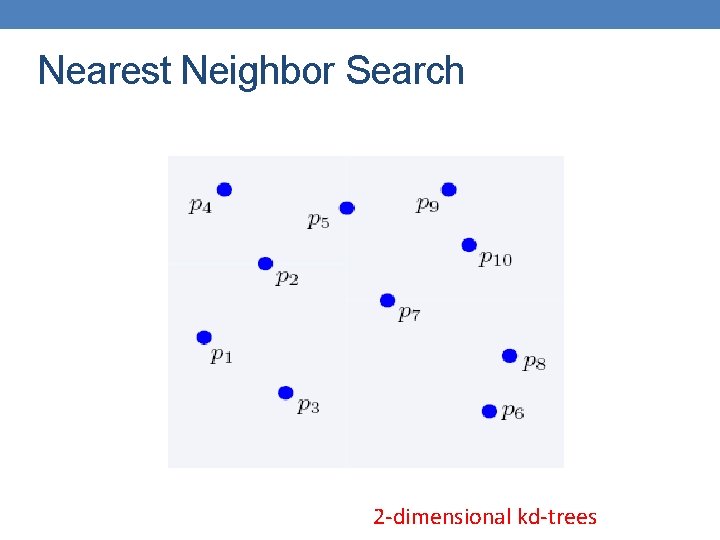
Nearest Neighbor Search 2 -dimensional kd-trees
Nearest Neighbor Search 2 -dimensional kd-trees

Nearest Neighbor Search 2 -dimensional kd-trees
Nearest Neighbor Search 2 -dimensional kd-trees

Nearest Neighbor Search 2 -dimensional kd-trees
Nearest Neighbor Search 2 -dimensional kd-trees
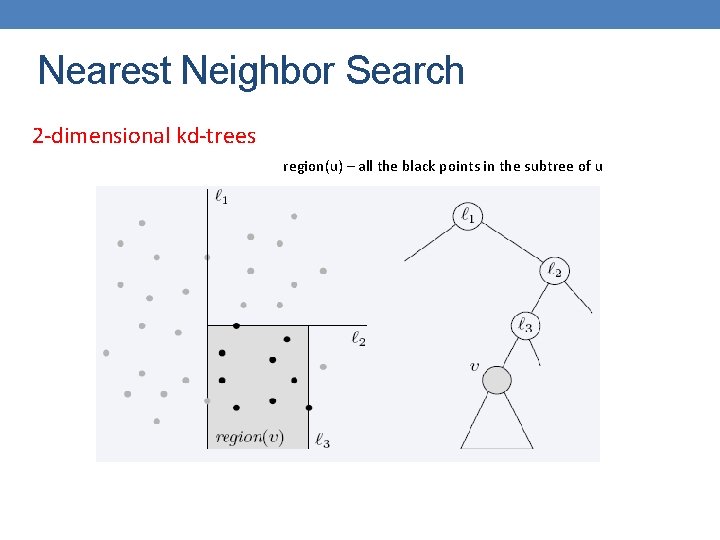
Nearest Neighbor Search 2 -dimensional kd-trees region(u) – all the black points in the subtree of u
Nearest Neighbor Search 2 -dimensional kd-trees § A binary tree: § Size O(n) § Depth O(logn) § Construction time O(nlogn) § Query time: worst case O(n), but for many cases O(logn) Generalizes to d dimensions § Example of Binary Space Partitioning
- Slides: 109