
Data Mining Lect 1 Introduction based on Han

Data Mining : Lect 1: Introduction ( based on Han, Kimber and Pei’s book Data Mining 1 q Why Data Mining? q What Is Data Mining? q A Multi-Dimensional View of Data Mining q What Kinds of Data Can Be Mined? q What Kinds of Patterns Can Be Mined? q What Kinds of Technologies Are Used? q What Kinds of Applications Are Targeted? q Major Issues in Data Mining q A Brief History of Data Mining and Data Mining Society q Summary
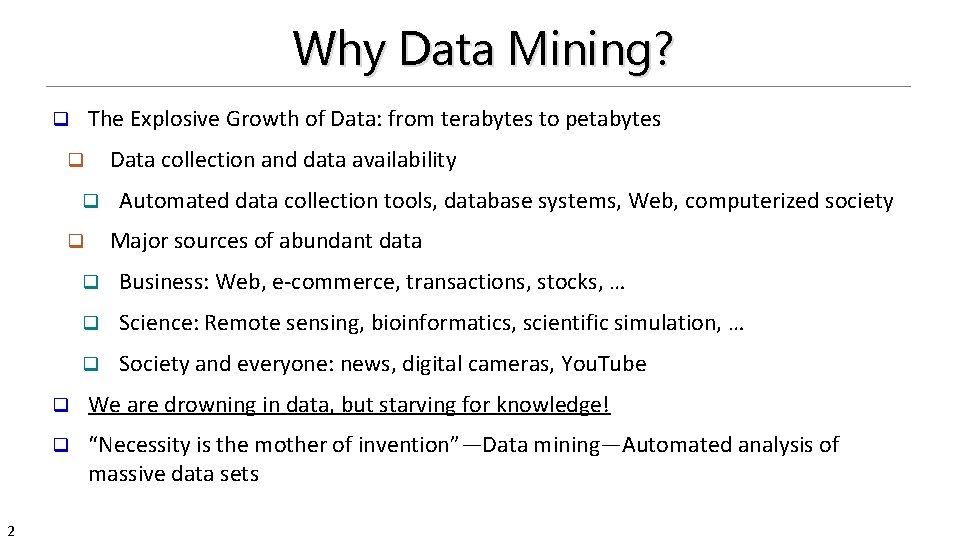
Why Data Mining? The Explosive Growth of Data: from terabytes to petabytes q Data collection and data availability q q Major sources of abundant data q 2 Automated data collection tools, database systems, Web, computerized society q Business: Web, e-commerce, transactions, stocks, … q Science: Remote sensing, bioinformatics, scientific simulation, … q Society and everyone: news, digital cameras, You. Tube q We are drowning in data, but starving for knowledge! q “Necessity is the mother of invention”—Data mining—Automated analysis of massive data sets
Lect 1. Introduction 3 q Why Data Mining? q What Is Data Mining? q A Multi-Dimensional View of Data Mining q What Kinds of Data Can Be Mined? q What Kinds of Patterns Can Be Mined? q What Kinds of Technologies Are Used? q What Kinds of Applications Are Targeted? q Major Issues in Data Mining q A Brief History of Data Mining and Data Mining Society q Summary
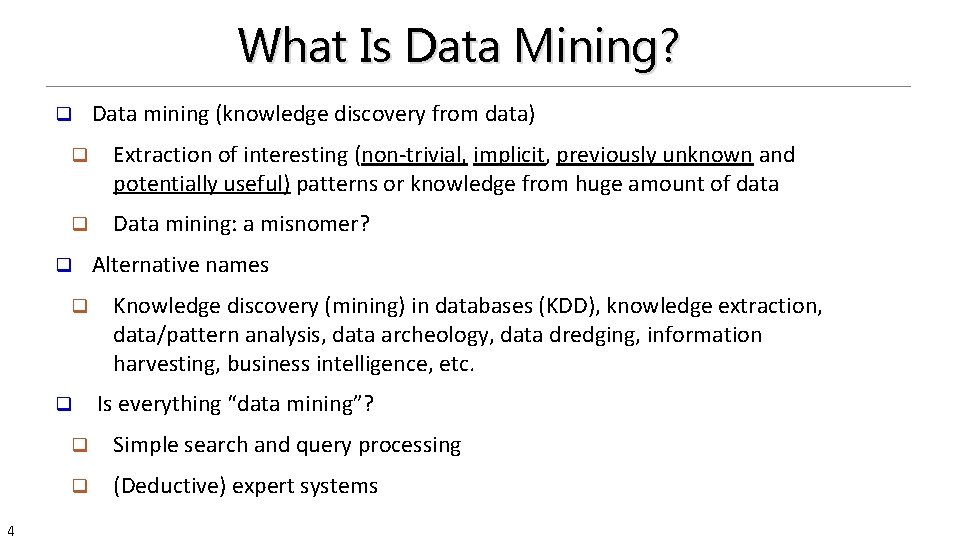
What Is Data Mining? q q Extraction of interesting (non-trivial, implicit, previously unknown and potentially useful) patterns or knowledge from huge amount of data q Data mining: a misnomer? q q q 4 Data mining (knowledge discovery from data) Alternative names Knowledge discovery (mining) in databases (KDD), knowledge extraction, data/pattern analysis, data archeology, data dredging, information harvesting, business intelligence, etc. Is everything “data mining”? q Simple search and query processing q (Deductive) expert systems
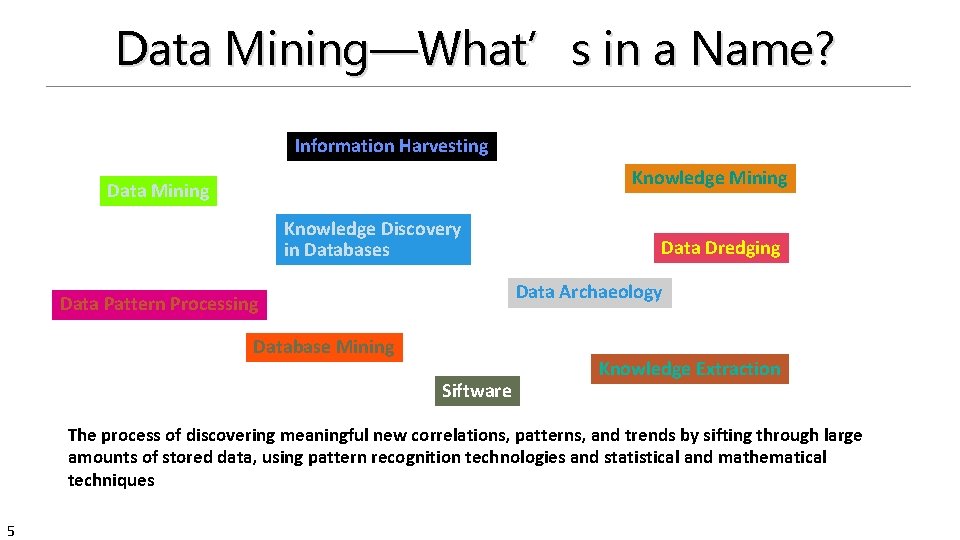
Data Mining—What’s in a Name? Information Harvesting Knowledge Mining Data Mining Knowledge Discovery in Databases Data Dredging Data Archaeology Data Pattern Processing Database Mining Siftware Knowledge Extraction The process of discovering meaningful new correlations, patterns, and trends by sifting through large amounts of stored data, using pattern recognition technologies and statistical and mathematical techniques 5

Some typical topics to be covered 1. Introduction: What is data mining? What makes it a new and unique discipline? q Relationship between Data Warehousing, On-line Analytical Processing, and Data Mining q Data mining tasks - Clustering, Classification, Rule learning, etc. 5. Regression q Neural Networks q 2. Task identification q Data preparation/cleansing q Introduction to WEKA 3. Association Rule mining Problem Description q Algorithms q 4. q 6. Classification Bayesian q Tree-based approaches q Clustering Distance-based approaches q Density-based approaches q Neural-Networks, etc. q Data mining process q Prediction Anomaly Detection Part II: Current Research 8. Sequence Mining 9. Time Series 10. Text Mining 11. Multi-Relational Data Mining 12. Suggested topics, project presentations, etc. 7. 6 6
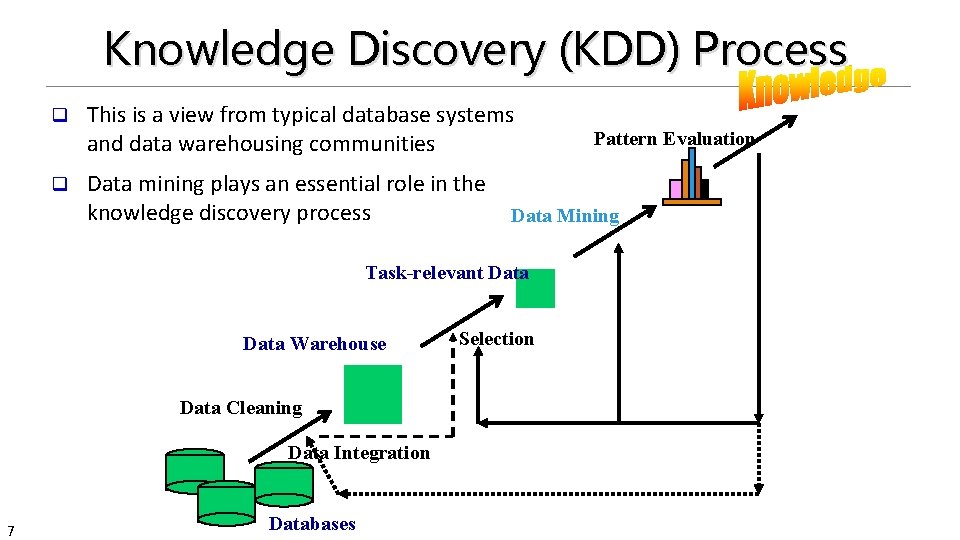
Knowledge Discovery (KDD) Process q q This is a view from typical database systems and data warehousing communities Data mining plays an essential role in the knowledge discovery process Data Mining Task-relevant Data Warehouse Data Cleaning Data Integration 7 Pattern Evaluation Databases Selection
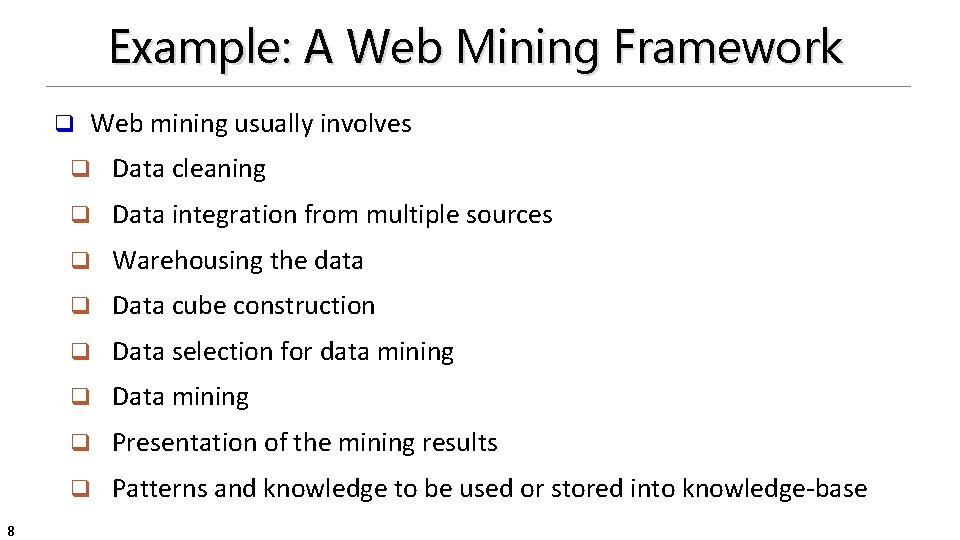
Example: A Web Mining Framework q 8 Web mining usually involves q Data cleaning q Data integration from multiple sources q Warehousing the data q Data cube construction q Data selection for data mining q Data mining q Presentation of the mining results q Patterns and knowledge to be used or stored into knowledge-base
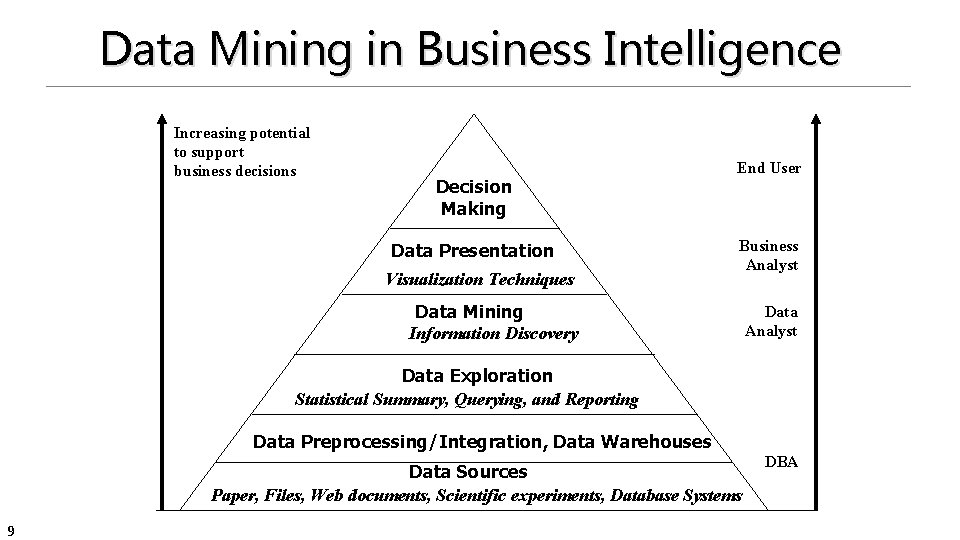
Data Mining in Business Intelligence Increasing potential to support business decisions Decision Making Data Presentation Visualization Techniques End User Business Analyst Data Mining Information Discovery Data Analyst Data Exploration Statistical Summary, Querying, and Reporting Data Preprocessing/Integration, Data Warehouses Data Sources Paper, Files, Web documents, Scientific experiments, Database Systems 9 DBA
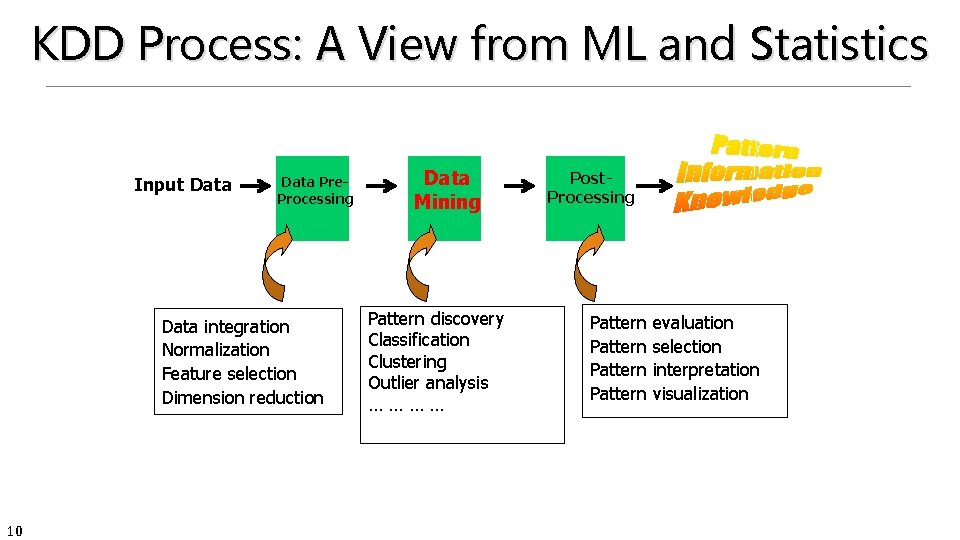
KDD Process: A View from ML and Statistics Input Data Pre. Processing Data integration Normalization Feature selection Dimension reduction 10 Data Mining Pattern discovery Classification Clustering Outlier analysis ………… Post. Processing Pattern evaluation selection interpretation visualization
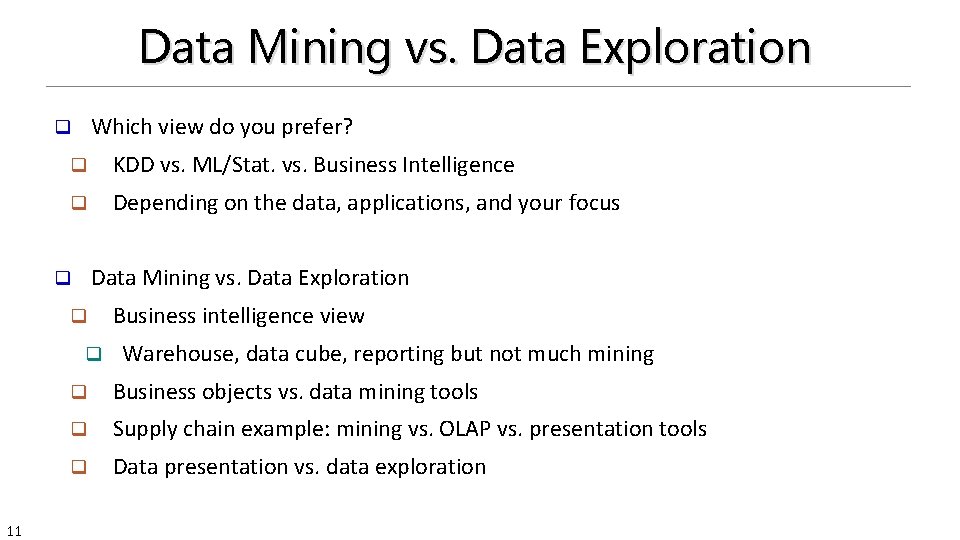
Data Mining vs. Data Exploration Which view do you prefer? q q KDD vs. ML/Stat. vs. Business Intelligence q Depending on the data, applications, and your focus Data Mining vs. Data Exploration q q q 11 Business intelligence view Warehouse, data cube, reporting but not much mining q Business objects vs. data mining tools q Supply chain example: mining vs. OLAP vs. presentation tools q Data presentation vs. data exploration
Lect 1. Introduction 12 q Why Data Mining? q What Is Data Mining? q A Multi-Dimensional View of Data Mining q What Kinds of Data Can Be Mined? q What Kinds of Patterns Can Be Mined? q What Kinds of Technologies Are Used? q What Kinds of Applications Are Targeted? q Major Issues in Data Mining q A Brief History of Data Mining and Data Mining Society q Summary
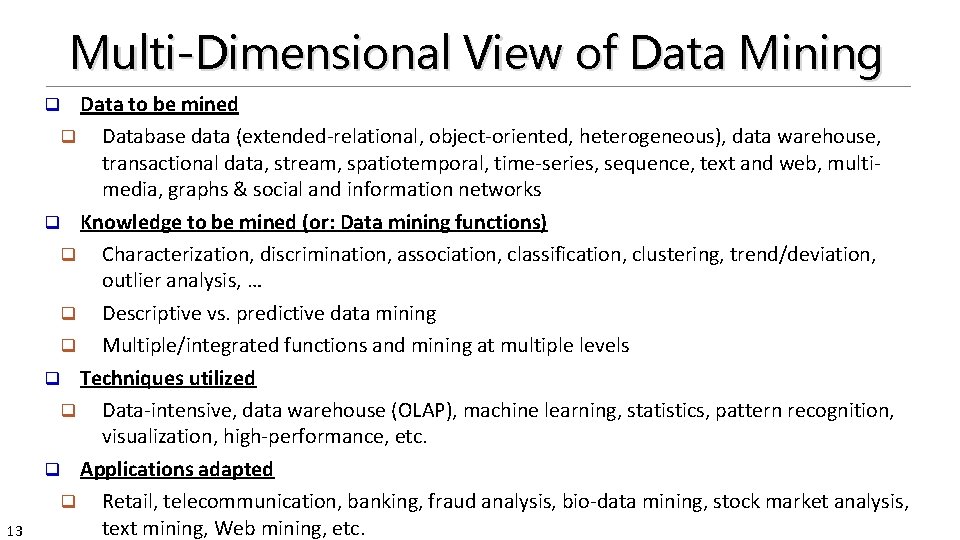
Multi-Dimensional View of Data Mining Data to be mined q Database data (extended-relational, object-oriented, heterogeneous), data warehouse, transactional data, stream, spatiotemporal, time-series, sequence, text and web, multimedia, graphs & social and information networks q Knowledge to be mined (or: Data mining functions) q Characterization, discrimination, association, classification, clustering, trend/deviation, outlier analysis, … q Descriptive vs. predictive data mining q Multiple/integrated functions and mining at multiple levels q Techniques utilized q Data-intensive, data warehouse (OLAP), machine learning, statistics, pattern recognition, visualization, high-performance, etc. q Applications adapted q Retail, telecommunication, banking, fraud analysis, bio-data mining, stock market analysis, text mining, Web mining, etc. q 13
Lect 1. Introduction 14 q Why Data Mining? q What Is Data Mining? q A Multi-Dimensional View of Data Mining q What Kinds of Data Can Be Mined? q What Kinds of Patterns Can Be Mined? q What Kinds of Technologies Are Used? q What Kinds of Applications Are Targeted? q Major Issues in Data Mining q A Brief History of Data Mining and Data Mining Society q Summary
Data Mining: On What Kinds of Data? q q Relational database, data warehouse, transactional database q Object-relational databases, Heterogeneous databases and legacy databases q 15 Database-oriented data sets and applications Advanced data sets and advanced applications q Data streams and sensor data q Time-series data, temporal data, sequence data (incl. bio-sequences) q Structure data, graphs, social networks and information networks q Spatial data and spatiotemporal data q Multimedia database q Text databases q The World-Wide Web

Lect 1. Introduction 16 q Why Data Mining? q What Is Data Mining? q A Multi-Dimensional View of Data Mining q What Kinds of Data Can Be Mined? q What Kinds of Patterns Can Be Mined? q What Kinds of Technologies Are Used? q What Kinds of Applications Are Targeted? q Major Issues in Data Mining q A Brief History of Data Mining and Data Mining Society q Summary
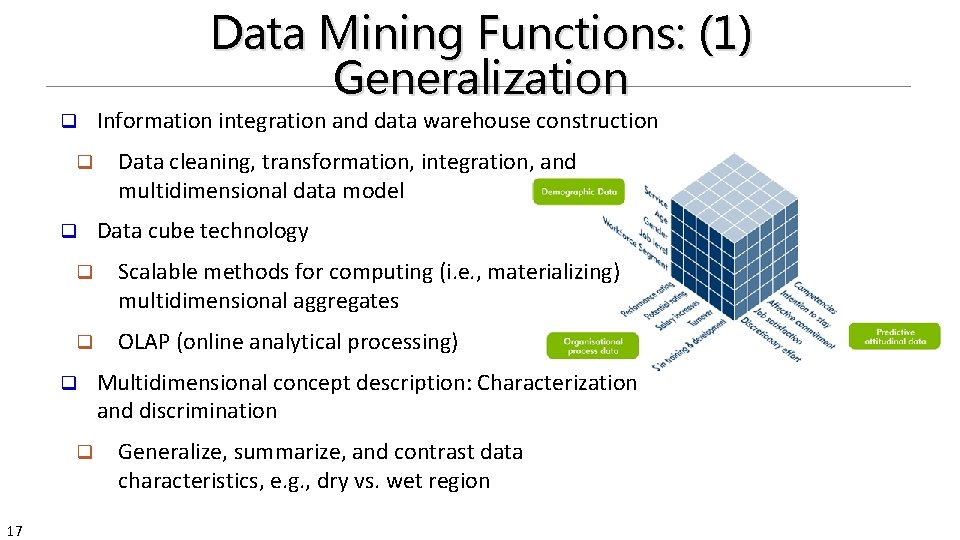
Data Mining Functions: (1) Generalization q q q Data cleaning, transformation, integration, and multidimensional data model Data cube technology q Scalable methods for computing (i. e. , materializing) multidimensional aggregates q OLAP (online analytical processing) q q 17 Information integration and data warehouse construction Multidimensional concept description: Characterization and discrimination Generalize, summarize, and contrast data characteristics, e. g. , dry vs. wet region
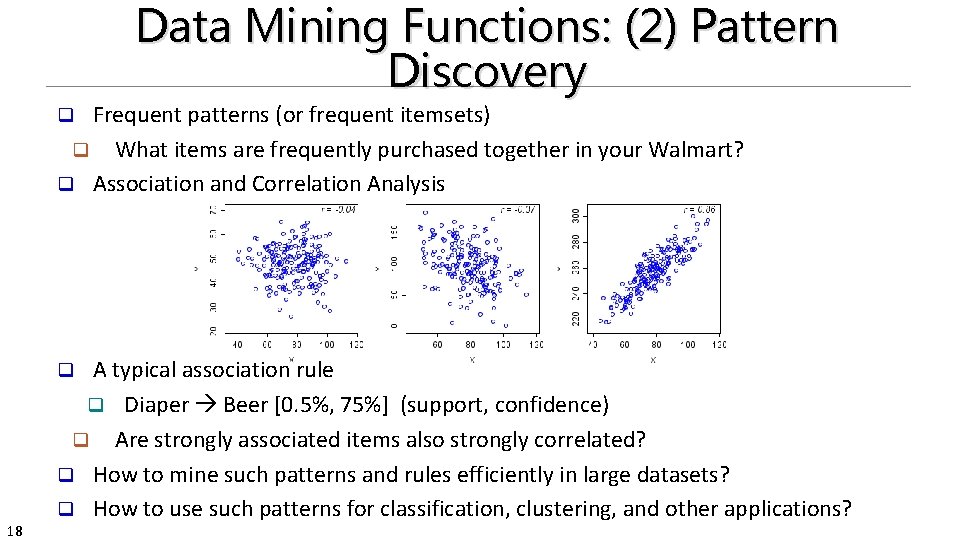
Data Mining Functions: (2) Pattern Discovery Frequent patterns (or frequent itemsets) q What items are frequently purchased together in your Walmart? q Association and Correlation Analysis q A typical association rule q Diaper Beer [0. 5%, 75%] (support, confidence) q Are strongly associated items also strongly correlated? q How to mine such patterns and rules efficiently in large datasets? q How to use such patterns for classification, clustering, and other applications? q 18
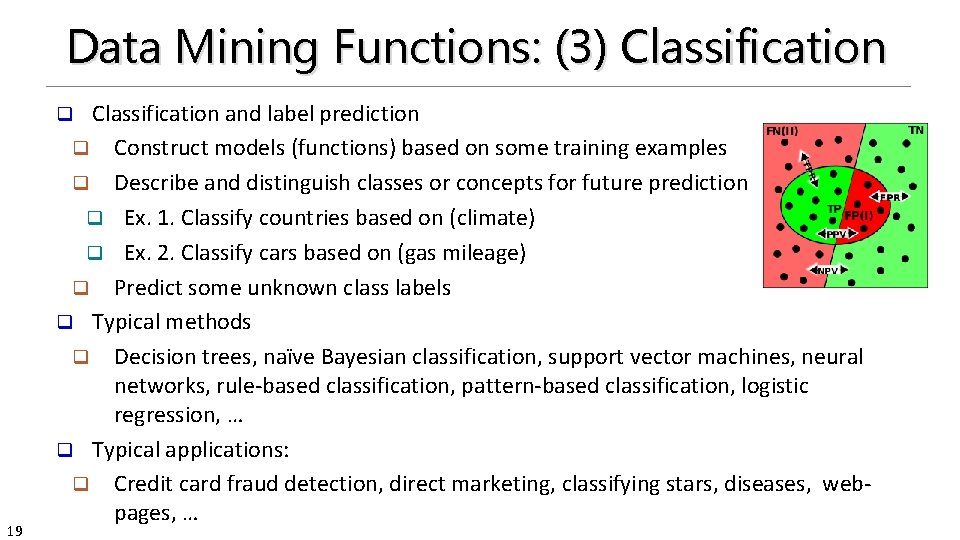
Data Mining Functions: (3) Classification and label prediction q Construct models (functions) based on some training examples q Describe and distinguish classes or concepts for future prediction q Ex. 1. Classify countries based on (climate) q Ex. 2. Classify cars based on (gas mileage) q Predict some unknown class labels q Typical methods q Decision trees, naïve Bayesian classification, support vector machines, neural networks, rule-based classification, pattern-based classification, logistic regression, … q Typical applications: q Credit card fraud detection, direct marketing, classifying stars, diseases, webpages, … q 19
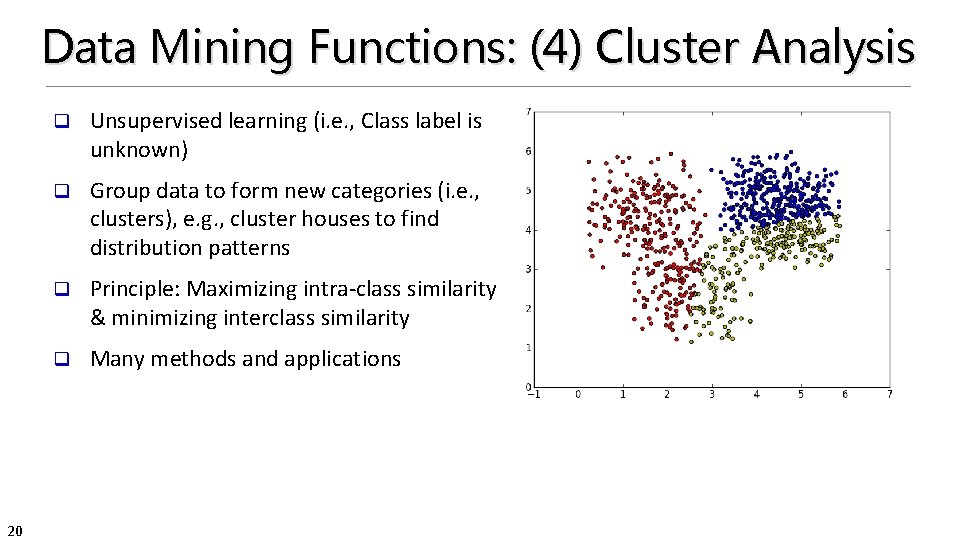
Data Mining Functions: (4) Cluster Analysis 20 q Unsupervised learning (i. e. , Class label is unknown) q Group data to form new categories (i. e. , clusters), e. g. , cluster houses to find distribution patterns q Principle: Maximizing intra-class similarity & minimizing interclass similarity q Many methods and applications
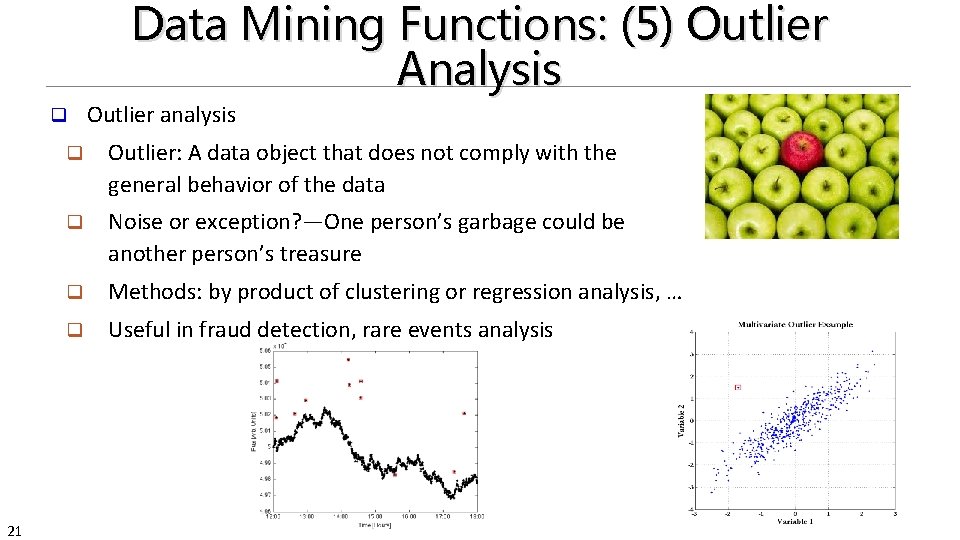
Data Mining Functions: (5) Outlier Analysis q 21 Outlier analysis q Outlier: A data object that does not comply with the general behavior of the data q Noise or exception? ―One person’s garbage could be another person’s treasure q Methods: by product of clustering or regression analysis, … q Useful in fraud detection, rare events analysis
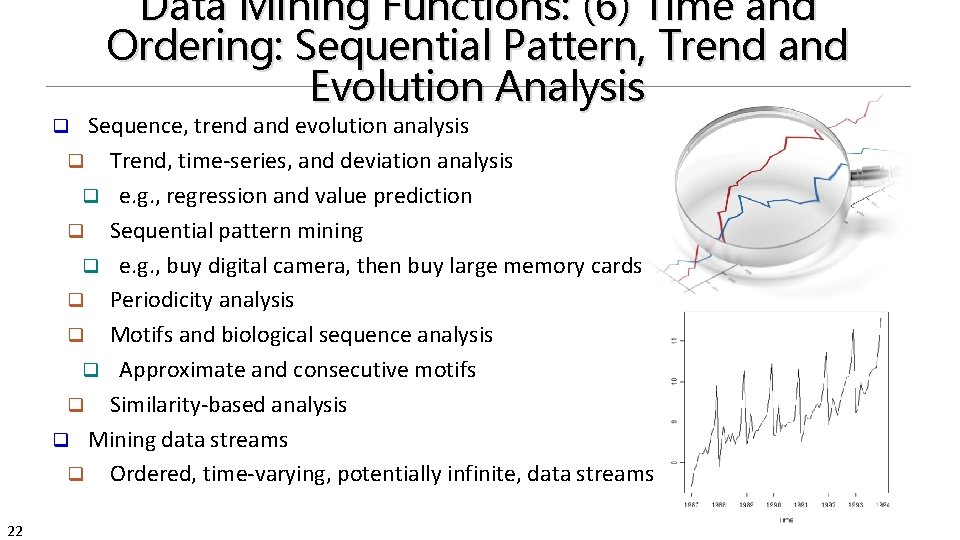
Data Mining Functions: (6) Time and Ordering: Sequential Pattern, Trend and Evolution Analysis Sequence, trend and evolution analysis q Trend, time-series, and deviation analysis q e. g. , regression and value prediction q Sequential pattern mining q e. g. , buy digital camera, then buy large memory cards q Periodicity analysis q Motifs and biological sequence analysis q Approximate and consecutive motifs q Similarity-based analysis q Mining data streams q Ordered, time-varying, potentially infinite, data streams q 22
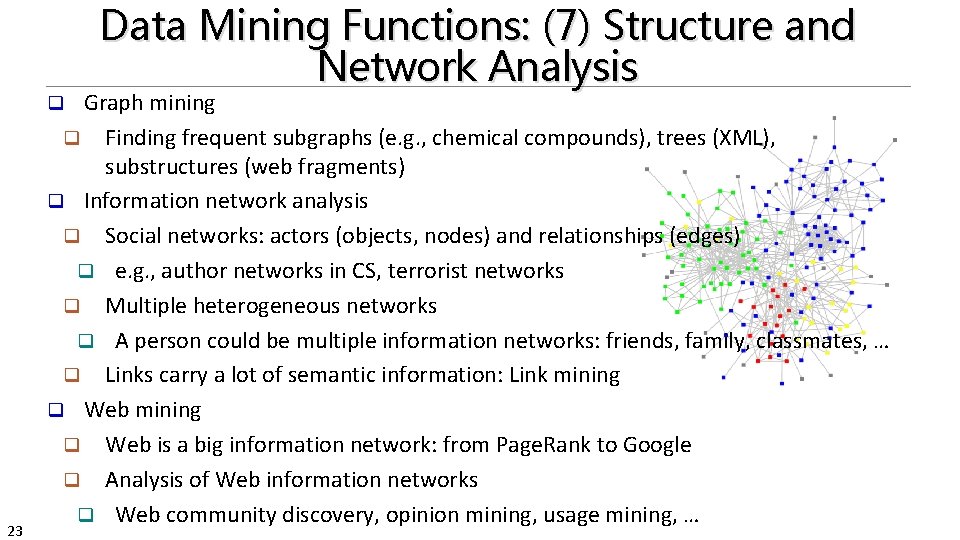
Graph mining q Finding frequent subgraphs (e. g. , chemical compounds), trees (XML), substructures (web fragments) q Information network analysis q Social networks: actors (objects, nodes) and relationships (edges) q e. g. , author networks in CS, terrorist networks q Multiple heterogeneous networks q A person could be multiple information networks: friends, family, classmates, … q Links carry a lot of semantic information: Link mining q Web is a big information network: from Page. Rank to Google q Analysis of Web information networks q Web community discovery, opinion mining, usage mining, … q 23 Data Mining Functions: (7) Structure and Network Analysis
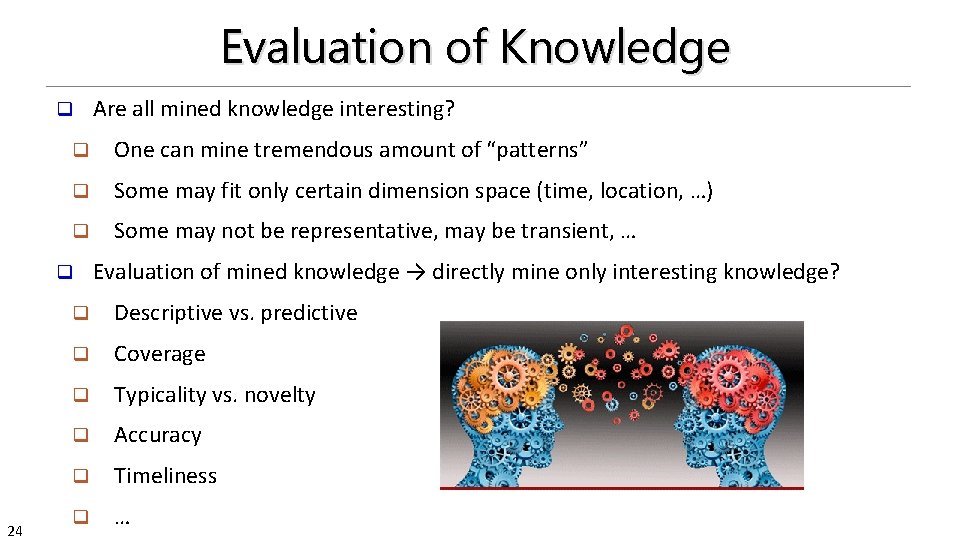
Evaluation of Knowledge q q One can mine tremendous amount of “patterns” q Some may fit only certain dimension space (time, location, …) q Some may not be representative, may be transient, … q 24 Are all mined knowledge interesting? Evaluation of mined knowledge → directly mine only interesting knowledge? q Descriptive vs. predictive q Coverage q Typicality vs. novelty q Accuracy q Timeliness q …

Lect 1. Introduction 25 q Why Data Mining? q What Is Data Mining? q A Multi-Dimensional View of Data Mining q What Kinds of Data Can Be Mined? q What Kinds of Patterns Can Be Mined? q What Kinds of Technologies Are Used? q What Kinds of Applications Are Targeted? q Major Issues in Data Mining q A Brief History of Data Mining and Data Mining Society q Summary
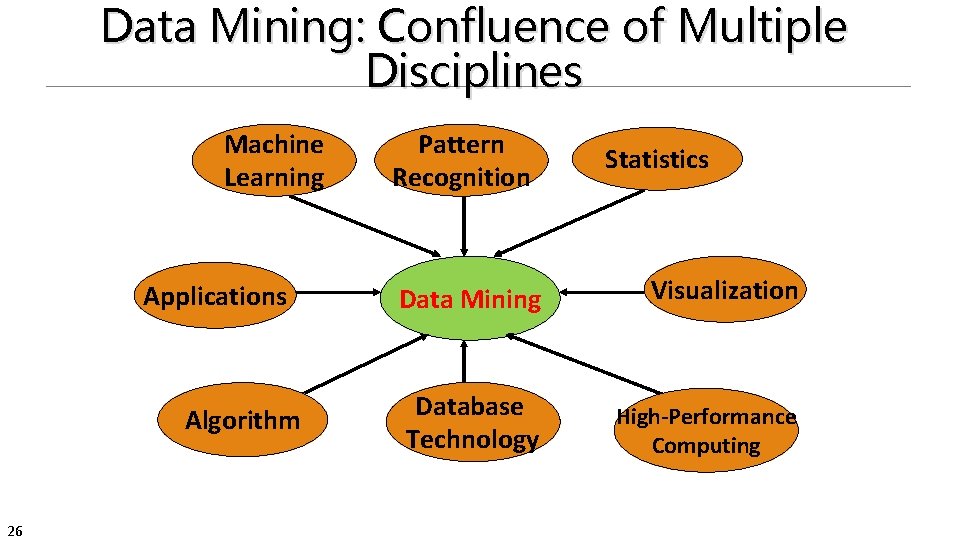
Data Mining: Confluence of Multiple Disciplines Machine Learning Applications Algorithm 26 Pattern Recognition Statistics Data Mining Visualization Database Technology High-Performance Computing
Why Confluence of Multiple Disciplines? Tremendous amount of data q Algorithms must be scalable to handle big data q High-dimensionality of data q Micro-array may have tens of thousands of dimensions q High complexity of data q Data streams and sensor data q Time-series data, temporal data, sequence data q Structure data, graphs, social and information networks q Spatial, spatiotemporal, multimedia, text and Web data q Software programs, scientific simulations q New and sophisticated applications q 27
Lect 1. Introduction 28 q Why Data Mining? q What Is Data Mining? q A Multi-Dimensional View of Data Mining q What Kinds of Data Can Be Mined? q What Kinds of Patterns Can Be Mined? q What Kinds of Technologies Are Used? q What Kinds of Applications Are Targeted? q Major Issues in Data Mining q A Brief History of Data Mining and Data Mining Society q Summary
Applications of Data Mining q Web page analysis: classification, clustering, ranking q Collaborative analysis & recommender systems q Basket data analysis to targeted marketing q Biological and medical data analysis q Data mining and software engineering q Data mining and text analysis q Data mining and social and information network analysis q Built-in (invisible data mining) functions in Google, MS, Yahoo!, Linked, Facebook, … q Major dedicated data mining systems/tools q 29 SAS, MS SQL-Server Analysis Manager, Oracle Data Mining Tools)
Lect 1. Introduction 30 q Why Data Mining? q What Is Data Mining? q A Multi-Dimensional View of Data Mining q What Kinds of Data Can Be Mined? q What Kinds of Patterns Can Be Mined? q What Kinds of Technologies Are Used? q What Kinds of Applications Are Targeted? q Major Issues in Data Mining q A Brief History of Data Mining and Data Mining Society q Summary
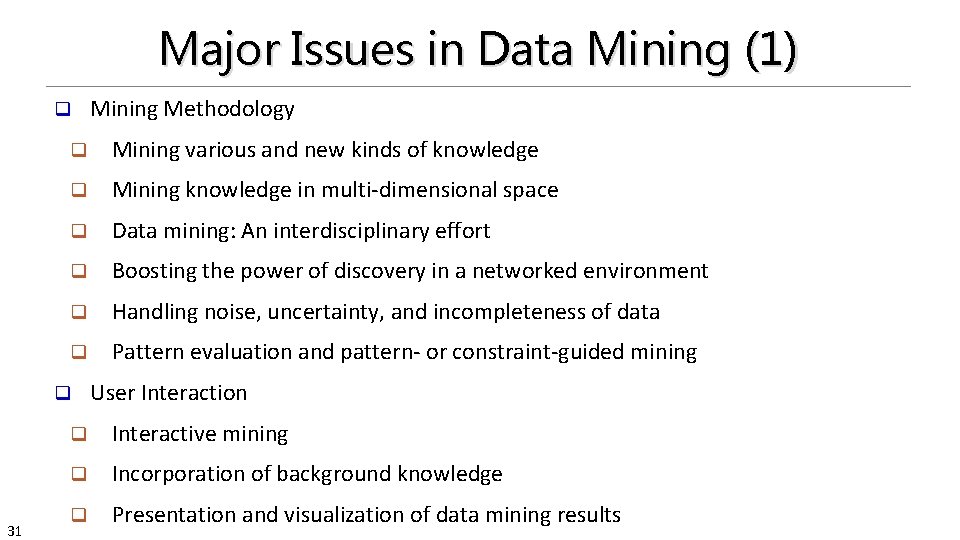
Major Issues in Data Mining (1) q q Mining various and new kinds of knowledge q Mining knowledge in multi-dimensional space q Data mining: An interdisciplinary effort q Boosting the power of discovery in a networked environment q Handling noise, uncertainty, and incompleteness of data q Pattern evaluation and pattern- or constraint-guided mining q 31 Mining Methodology User Interaction q Interactive mining q Incorporation of background knowledge q Presentation and visualization of data mining results
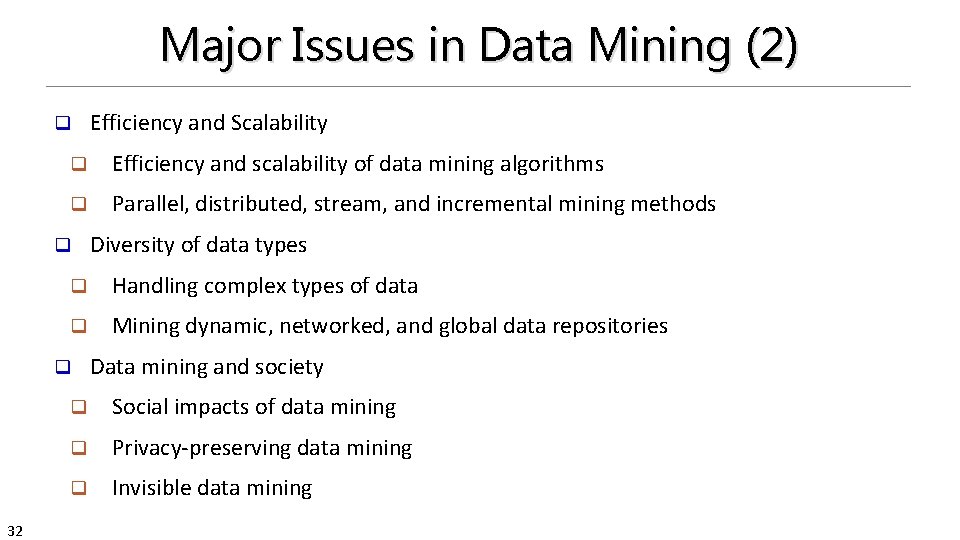
Major Issues in Data Mining (2) q q Efficiency and scalability of data mining algorithms q Parallel, distributed, stream, and incremental mining methods q Diversity of data types q Handling complex types of data q Mining dynamic, networked, and global data repositories q 32 Efficiency and Scalability Data mining and society q Social impacts of data mining q Privacy-preserving data mining q Invisible data mining
Lect 1. Introduction 33 q Why Data Mining? q What Is Data Mining? q A Multi-Dimensional View of Data Mining q What Kinds of Data Can Be Mined? q What Kinds of Patterns Can Be Mined? q What Kinds of Technologies Are Used? q What Kinds of Applications Are Targeted? q Major Issues in Data Mining q A Brief History of Data Mining and Data Mining Society q Summary
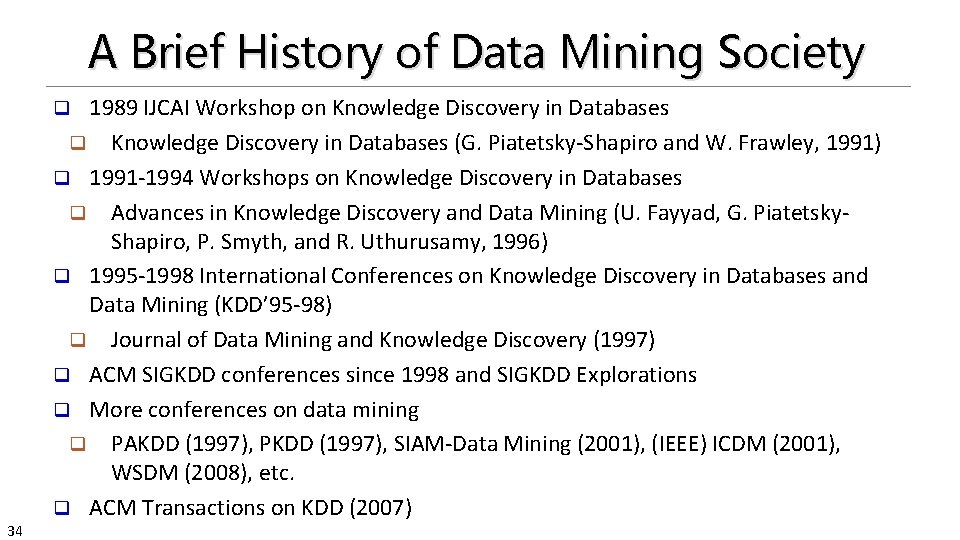
A Brief History of Data Mining Society 1989 IJCAI Workshop on Knowledge Discovery in Databases q Knowledge Discovery in Databases (G. Piatetsky-Shapiro and W. Frawley, 1991) q 1991 -1994 Workshops on Knowledge Discovery in Databases q Advances in Knowledge Discovery and Data Mining (U. Fayyad, G. Piatetsky. Shapiro, P. Smyth, and R. Uthurusamy, 1996) q 1995 -1998 International Conferences on Knowledge Discovery in Databases and Data Mining (KDD’ 95 -98) q Journal of Data Mining and Knowledge Discovery (1997) q ACM SIGKDD conferences since 1998 and SIGKDD Explorations q More conferences on data mining q PAKDD (1997), PKDD (1997), SIAM-Data Mining (2001), (IEEE) ICDM (2001), WSDM (2008), etc. q ACM Transactions on KDD (2007) q 34
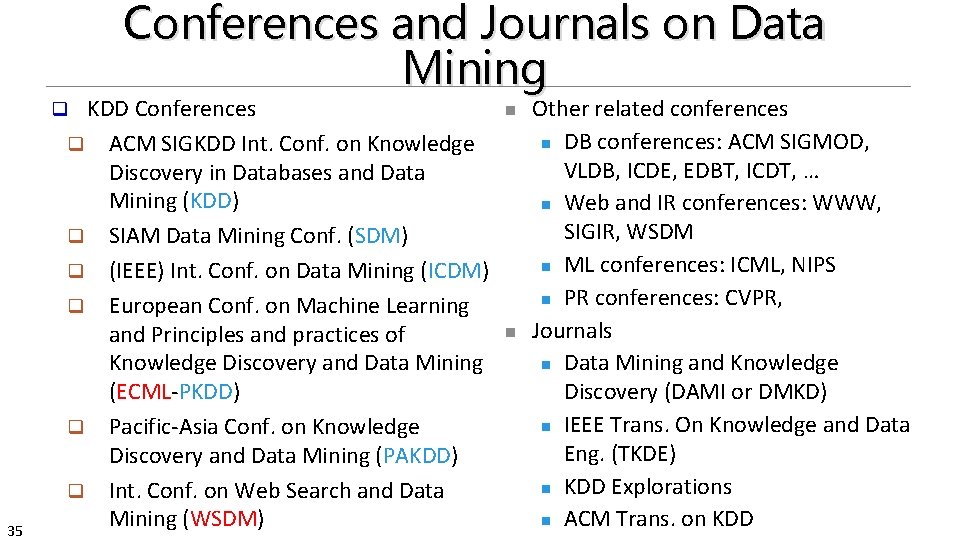
Conferences and Journals on Data Mining KDD Conferences q ACM SIGKDD Int. Conf. on Knowledge Discovery in Databases and Data Mining (KDD) q SIAM Data Mining Conf. (SDM) q (IEEE) Int. Conf. on Data Mining (ICDM) q European Conf. on Machine Learning and Principles and practices of Knowledge Discovery and Data Mining (ECML-PKDD) q Pacific-Asia Conf. on Knowledge Discovery and Data Mining (PAKDD) q Int. Conf. on Web Search and Data Mining (WSDM) q 35 n n Other related conferences n DB conferences: ACM SIGMOD, VLDB, ICDE, EDBT, ICDT, … n Web and IR conferences: WWW, SIGIR, WSDM n ML conferences: ICML, NIPS n PR conferences: CVPR, Journals n Data Mining and Knowledge Discovery (DAMI or DMKD) n IEEE Trans. On Knowledge and Data Eng. (TKDE) n KDD Explorations n ACM Trans. on KDD
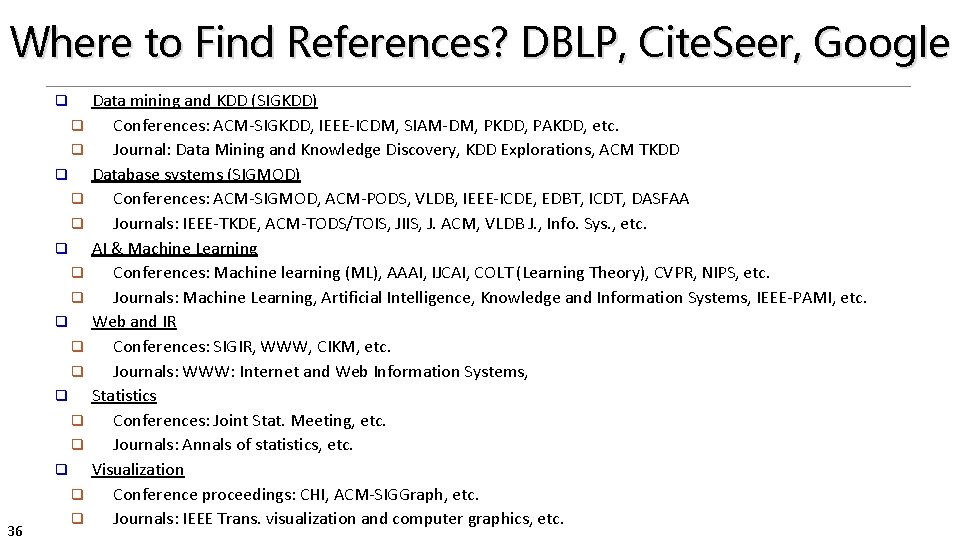
Where to Find References? DBLP, Cite. Seer, Google q q q q q 36 q Data mining and KDD (SIGKDD) Conferences: ACM-SIGKDD, IEEE-ICDM, SIAM-DM, PKDD, PAKDD, etc. Journal: Data Mining and Knowledge Discovery, KDD Explorations, ACM TKDD Database systems (SIGMOD) Conferences: ACM-SIGMOD, ACM-PODS, VLDB, IEEE-ICDE, EDBT, ICDT, DASFAA Journals: IEEE-TKDE, ACM-TODS/TOIS, JIIS, J. ACM, VLDB J. , Info. Sys. , etc. AI & Machine Learning Conferences: Machine learning (ML), AAAI, IJCAI, COLT (Learning Theory), CVPR, NIPS, etc. Journals: Machine Learning, Artificial Intelligence, Knowledge and Information Systems, IEEE-PAMI, etc. Web and IR Conferences: SIGIR, WWW, CIKM, etc. Journals: WWW: Internet and Web Information Systems, Statistics Conferences: Joint Stat. Meeting, etc. Journals: Annals of statistics, etc. Visualization Conference proceedings: CHI, ACM-SIGGraph, etc. Journals: IEEE Trans. visualization and computer graphics, etc.
Lect 1. Introduction 37 q Why Data Mining? q What Is Data Mining? q A Multi-Dimensional View of Data Mining q What Kinds of Data Can Be Mined? q What Kinds of Patterns Can Be Mined? q What Kinds of Technologies Are Used? q What Kinds of Applications Are Targeted? q Major Issues in Data Mining q A Brief History of Data Mining and Data Mining Society q Summary
Summary 38 q Data mining: Discovering interesting patterns and knowledge from massive amount of data q A natural evolution of science and information technology, in great demand, with wide applications q A KDD process includes data cleaning, data integration, data selection, transformation, data mining, pattern evaluation, and knowledge presentation q Mining can be performed in a variety of data q Data mining functionalities: characterization, discrimination, association, classification, clustering, trend and outlier analysis, etc. q Data mining technologies and applications q Major issues in data mining
Recommended Reference Books q Charu C. Aggarwal, Data Mining: The Textbook, Springer, 2015 q J. Han, M. Kamber, and J. Pei, Data Mining: Concepts and Techniques. Morgan Kaufmann, 3 rd ed. , 2011 P. -N. Tan, M. Steinbach and V. Kumar, Introduction to Data Mining, Wiley, 2005 (2 nd ed. 2016) Mohammed J. Zaki and Wagner Meira Jr. , Data Mining and Analysis: Fundamental Concepts and Algorithms 2014 q q 39
- Slides: 39