
DATA MINING Introductory and Advanced Topics Part I
![KDD Process Modified from [FPSS 96 C] n n n Selection: Obtain data from](https://slidetodoc.com/presentation_image_h2/594e005a75c00c863d0b540dffb30cf4/image-6.jpg "KDD Process Modified from [FPSS 96 C] n n n Selection: Obtain data from")
- Slides: 49
DATA MINING Introductory and Advanced Topics Part I Margaret H. Dunham Department of Computer Science and Engineering Southern Methodist University Companion slides for the text by Dr. M. H. Dunham, Data Mining, Introductory and Advanced Topics, Prentice Hall, 2002. Modified by Elizabeth Leon © Prentice Hall 1
Data Mining Outline n PART I – Introduction – Related Concepts – Data Mining Techniques n PART II – Classification – Clustering – Association Rules PART III – Web Mining – Spatial Mining – Temporal Mining n © Prentice Hall 2
Introduction Outline Goal: Provide an overview of data mining. Define data mining and KDD n Data mining vs. databases n Basic data mining tasks n Data mining development n Data mining issues n © Prentice Hall 3
Introduction Data is growing at a phenomenal rate n Huge DB’s contain a wealth of info, still not fully exploited (valuable info (gold!) may be lurking within data). n Users expect more sophisticated information n How? UNCOVER HIDDEN INFORMATION DATA MINING n © Prentice Hall 4
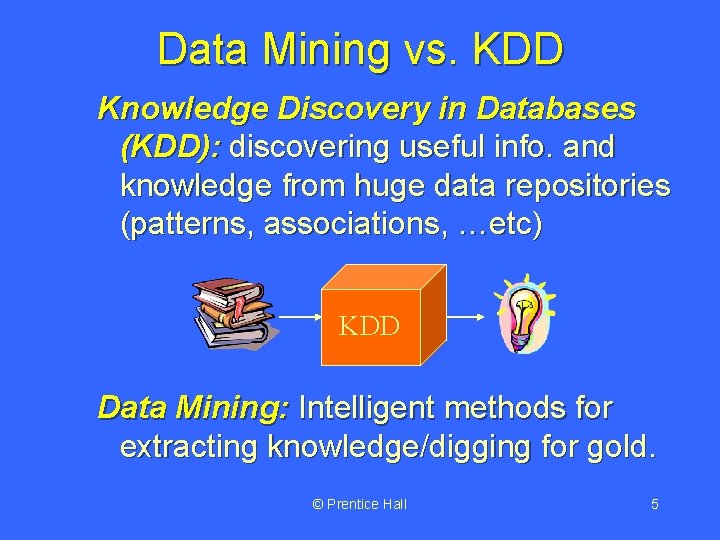
Data Mining vs. KDD Knowledge Discovery in Databases (KDD): discovering useful info. and knowledge from huge data repositories (patterns, associations, …etc) KDD Data Mining: Intelligent methods for extracting knowledge/digging for gold. © Prentice Hall 5
KDD Process Modified from [FPSS 96 C] n n n Selection: Obtain data from various sources. Preprocessing: Cleanse data. Transformation: Convert to common format. Transform to new format. Data Mining: Obtain desired results. Interpretation/Evaluation: Present results to user in meaningful manner. © Prentice Hall 6
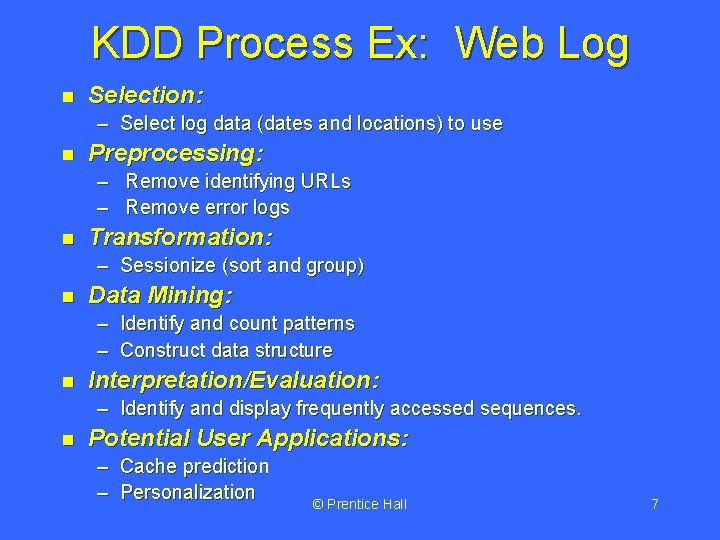
KDD Process Ex: Web Log n Selection: – Select log data (dates and locations) to use n Preprocessing: – Remove identifying URLs – Remove error logs n Transformation: – Sessionize (sort and group) n Data Mining: – Identify and count patterns – Construct data structure n Interpretation/Evaluation: – Identify and display frequently accessed sequences. n Potential User Applications: – Cache prediction – Personalization © Prentice Hall 7
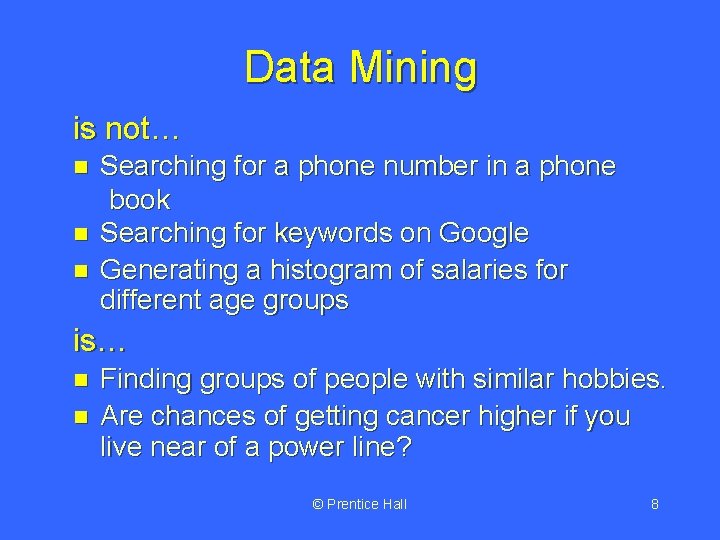
Data Mining is not… n n n Searching for a phone number in a phone book Searching for keywords on Google Generating a histogram of salaries for different age groups is… n n Finding groups of people with similar hobbies. Are chances of getting cancer higher if you live near of a power line? © Prentice Hall 8
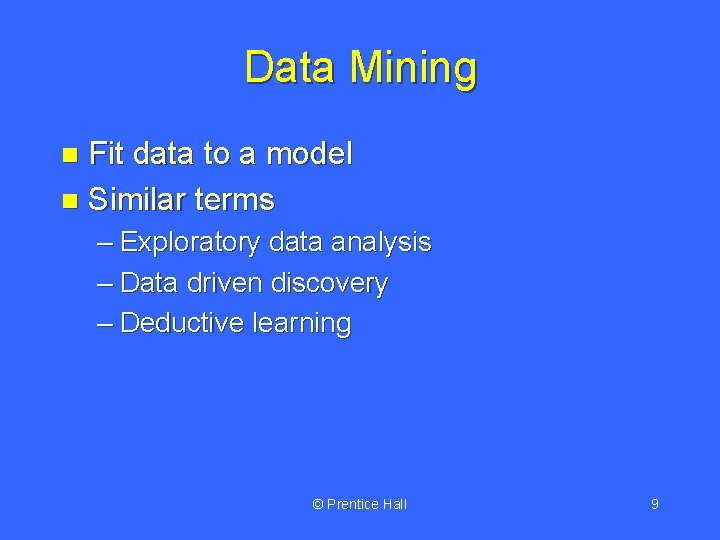
Data Mining Fit data to a model n Similar terms n – Exploratory data analysis – Data driven discovery – Deductive learning © Prentice Hall 9
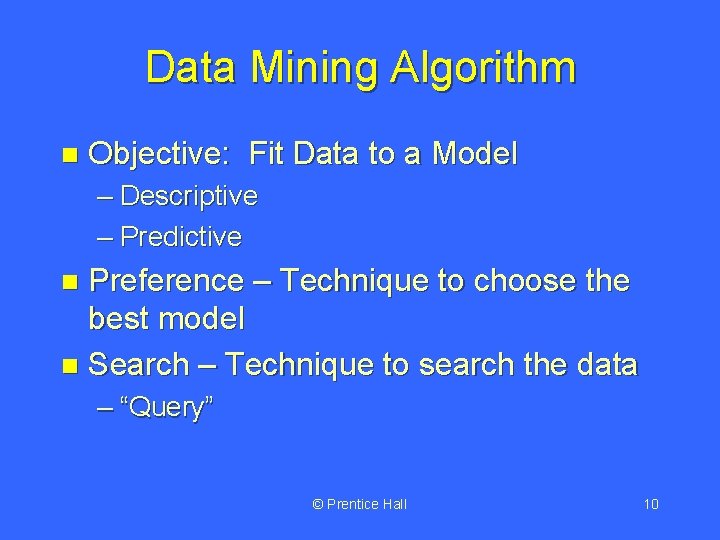
Data Mining Algorithm n Objective: Fit Data to a Model – Descriptive – Predictive Preference – Technique to choose the best model n Search – Technique to search the data n – “Query” © Prentice Hall 10
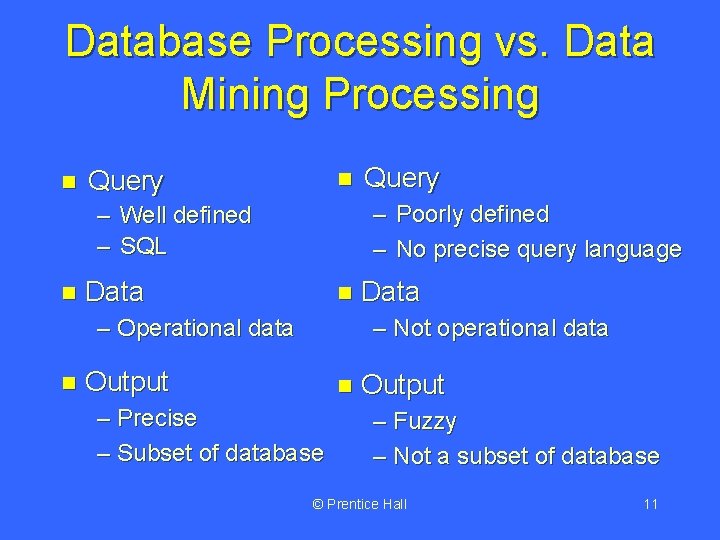
Database Processing vs. Data Mining Processing n Query n – Poorly defined – No precise query language – Well defined – SQL n Data n – Operational data n Query Data – Not operational data Output n – Precise – Subset of database Output – Fuzzy – Not a subset of database © Prentice Hall 11
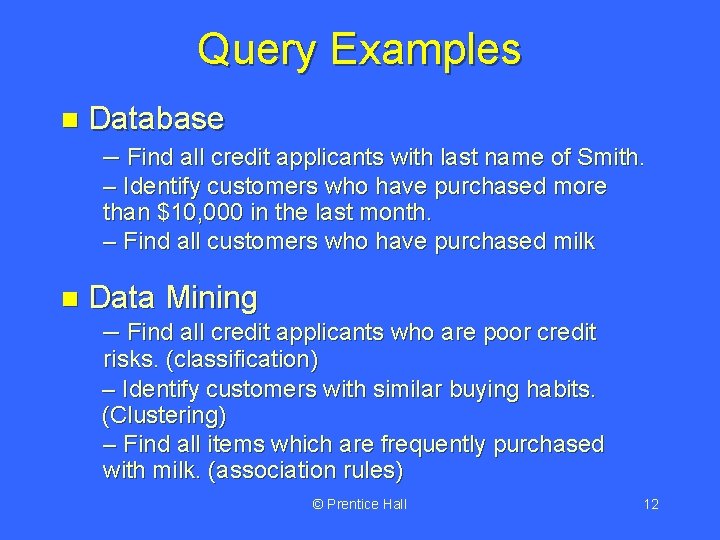
Query Examples n Database – Find all credit applicants with last name of Smith. – Identify customers who have purchased more than $10, 000 in the last month. – Find all customers who have purchased milk n Data Mining – Find all credit applicants who are poor credit risks. (classification) – Identify customers with similar buying habits. (Clustering) – Find all items which are frequently purchased with milk. (association rules) © Prentice Hall 12
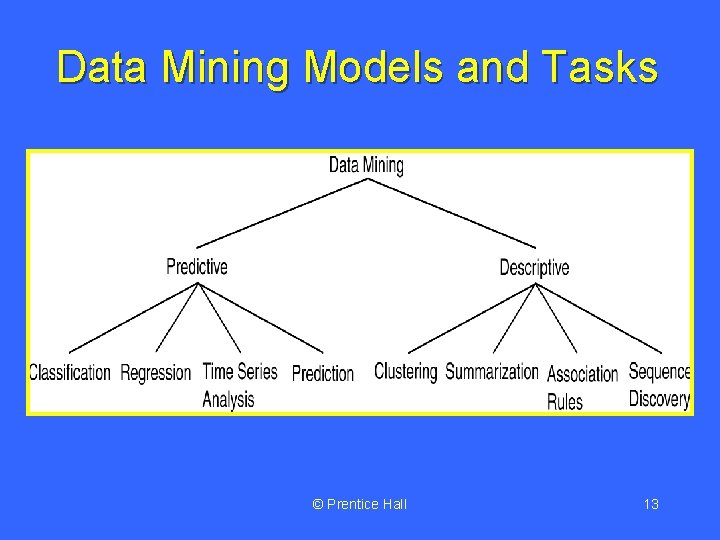
Data Mining Models and Tasks © Prentice Hall 13
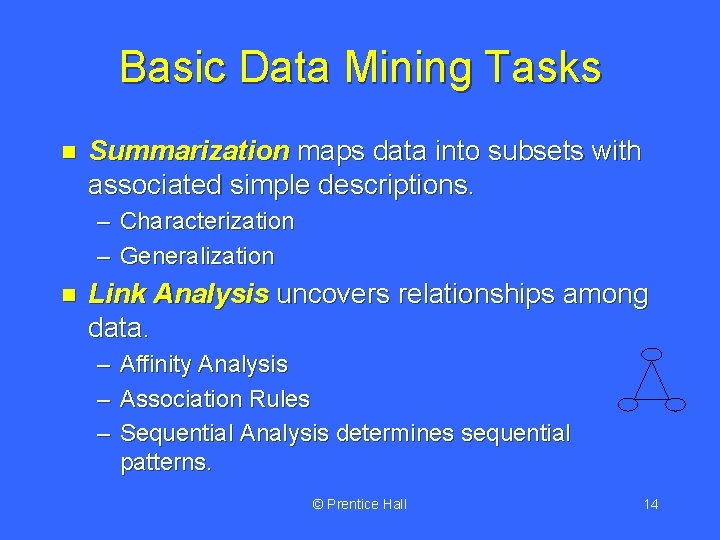
Basic Data Mining Tasks n Summarization maps data into subsets with associated simple descriptions. – Characterization – Generalization n Link Analysis uncovers relationships among data. – Affinity Analysis – Association Rules – Sequential Analysis determines sequential patterns. © Prentice Hall 14
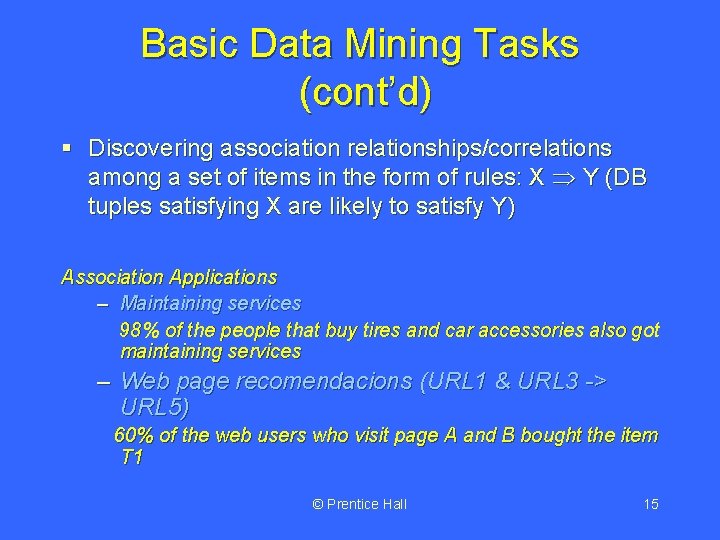
Basic Data Mining Tasks (cont’d) § Discovering association relationships/correlations among a set of items in the form of rules: X Y (DB tuples satisfying X are likely to satisfy Y) Association Applications – Maintaining services 98% of the people that buy tires and car accessories also got maintaining services – Web page recomendacions (URL 1 & URL 3 -> URL 5) 60% of the web users who visit page A and B bought the item T 1 © Prentice Hall 15
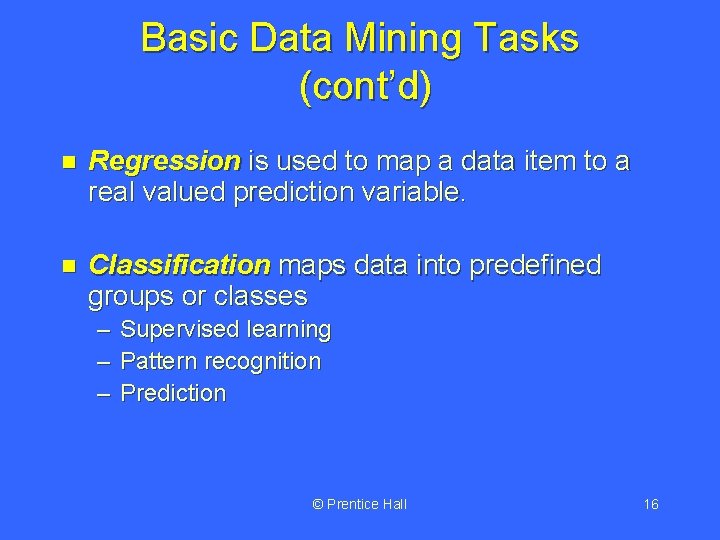
Basic Data Mining Tasks (cont’d) n Regression is used to map a data item to a real valued prediction variable. n Classification maps data into predefined groups or classes – Supervised learning – Pattern recognition – Prediction © Prentice Hall 16
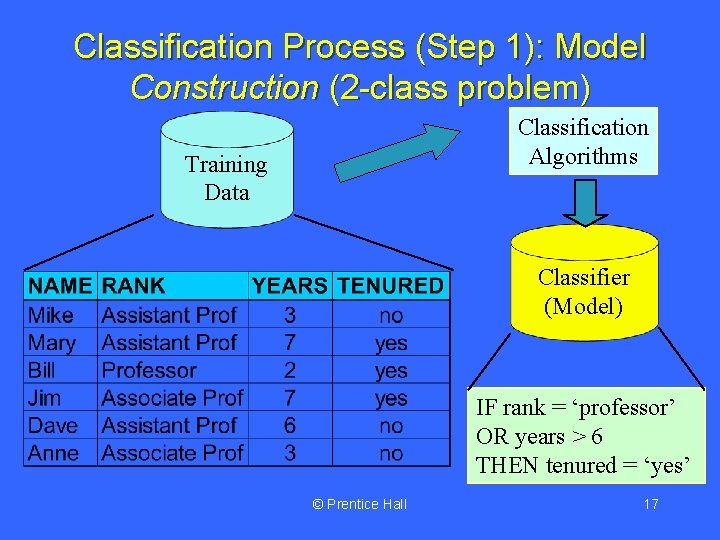
Classification Process (Step 1): Model Construction (2 -class problem) Classification Algorithms Training Data Classifier (Model) IF rank = ‘professor’ OR years > 6 THEN tenured = ‘yes’ © Prentice Hall 17
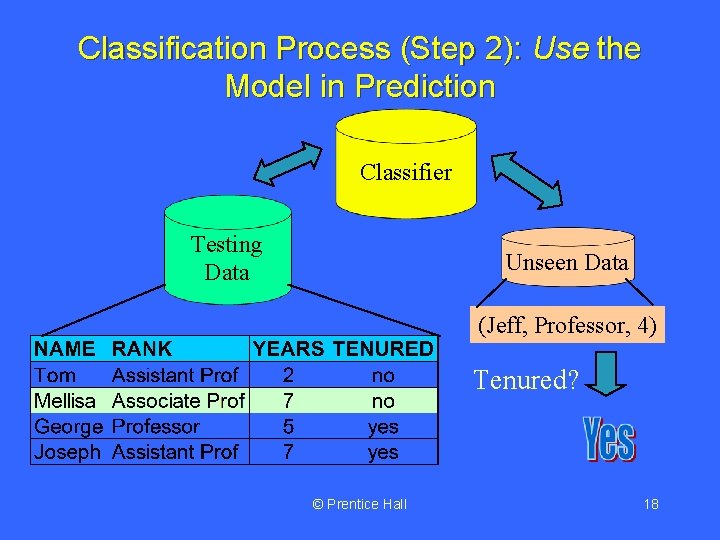
Classification Process (Step 2): Use the Model in Prediction Classifier Testing Data Unseen Data (Jeff, Professor, 4) Tenured? © Prentice Hall 18
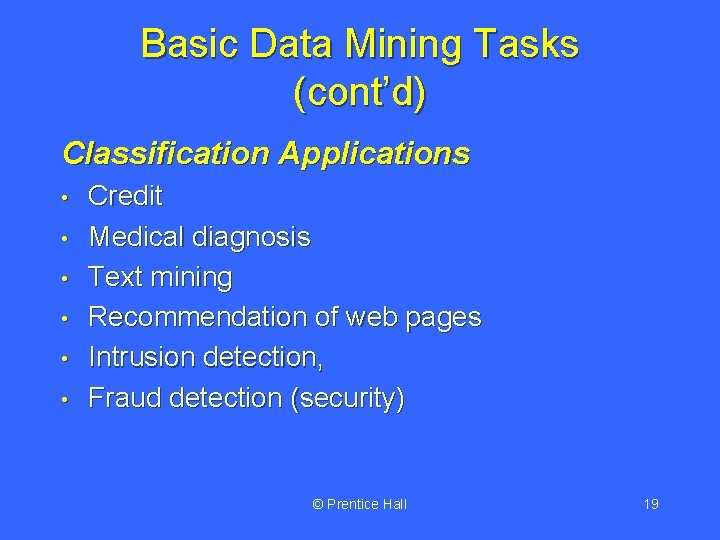
Basic Data Mining Tasks (cont’d) Classification Applications • • • Credit Medical diagnosis Text mining Recommendation of web pages Intrusion detection, Fraud detection (security) © Prentice Hall 19
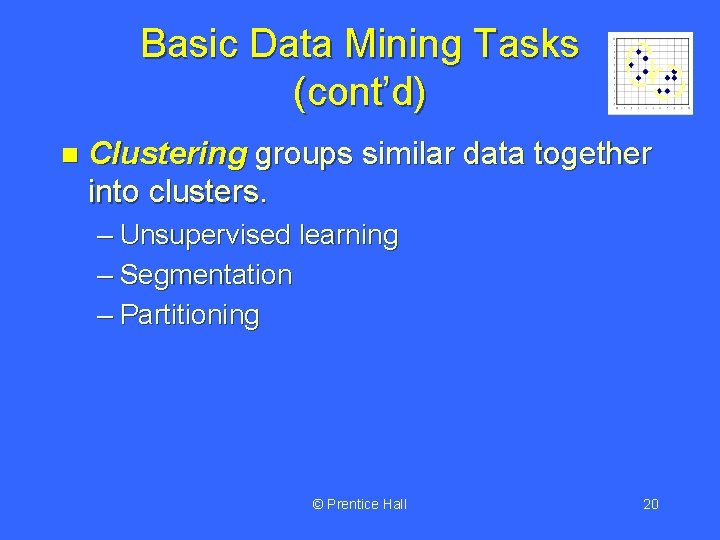
Basic Data Mining Tasks (cont’d) n Clustering groups similar data together into clusters. – Unsupervised learning – Segmentation – Partitioning © Prentice Hall 20
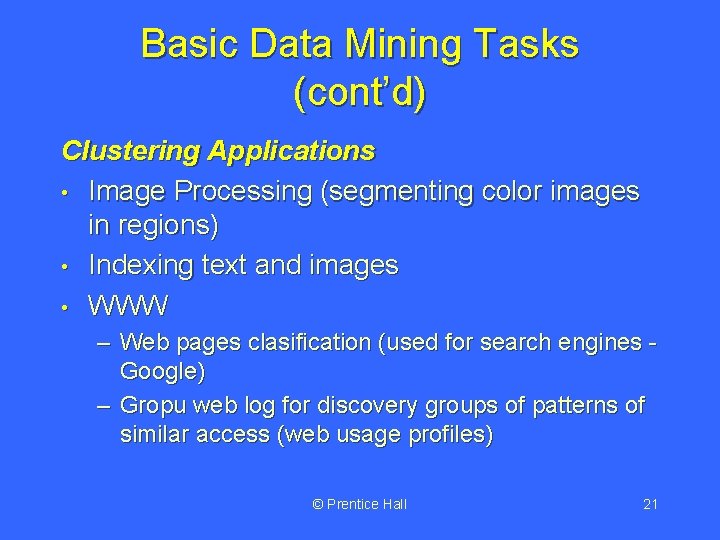
Basic Data Mining Tasks (cont’d) Clustering Applications • Image Processing (segmenting color images in regions) • Indexing text and images • WWW – Web pages clasification (used for search engines Google) – Gropu web log for discovery groups of patterns of similar access (web usage profiles) © Prentice Hall 21
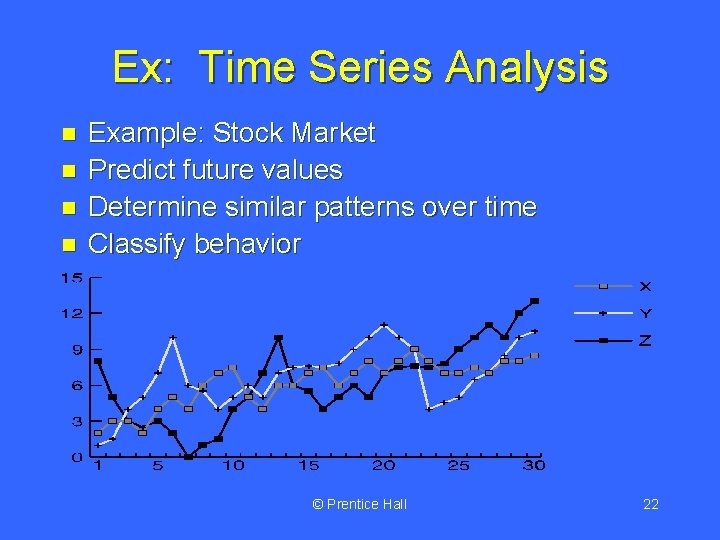
Ex: Time Series Analysis n n Example: Stock Market Predict future values Determine similar patterns over time Classify behavior © Prentice Hall 22
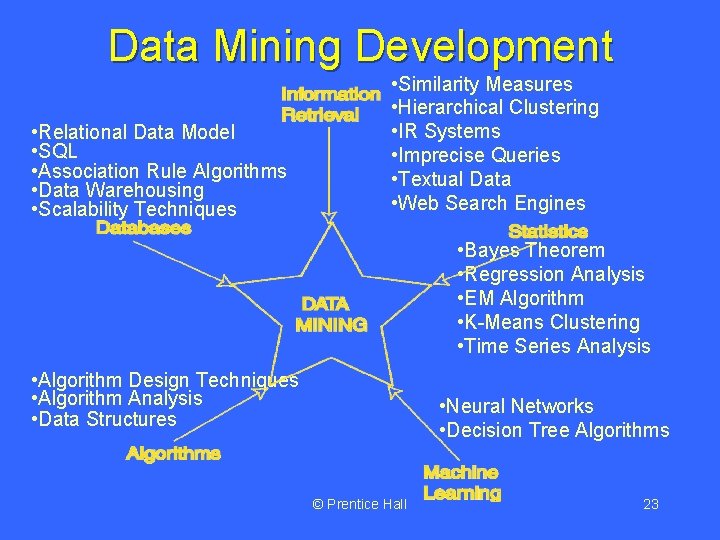
Data Mining Development • Relational Data Model • SQL • Association Rule Algorithms • Data Warehousing • Scalability Techniques • Similarity Measures • Hierarchical Clustering • IR Systems • Imprecise Queries • Textual Data • Web Search Engines • Bayes Theorem • Regression Analysis • EM Algorithm • K-Means Clustering • Time Series Analysis • Algorithm Design Techniques • Algorithm Analysis • Data Structures • Neural Networks • Decision Tree Algorithms © Prentice Hall 23
KDD Issues (cont’d) Multimedia Data n Missing Data n Irrelevant Data n Noisy Data n Changing Data n Integration n Application n © Prentice Hall 24
Social Implications of DM Privacy n Profiling n Unauthorized use n © Prentice Hall 25
Data Mining Metrics Usefulness n Return on Investment (ROI) n Accuracy n Space/Time n © Prentice Hall 26
Database Perspective on Data Mining Scalability n Real World Data n Updates n Ease of Use n © Prentice Hall 27
Related Concepts Outline Goal: Examine some areas which are related to data mining. n Database/OLTP Systems n Fuzzy Sets and Logic n Information Retrieval(Web Search Engines) n Dimensional Modeling n Data Warehousing n OLAP/DSS n Statistics n Machine Learning n Pattern Matching © Prentice Hall 28
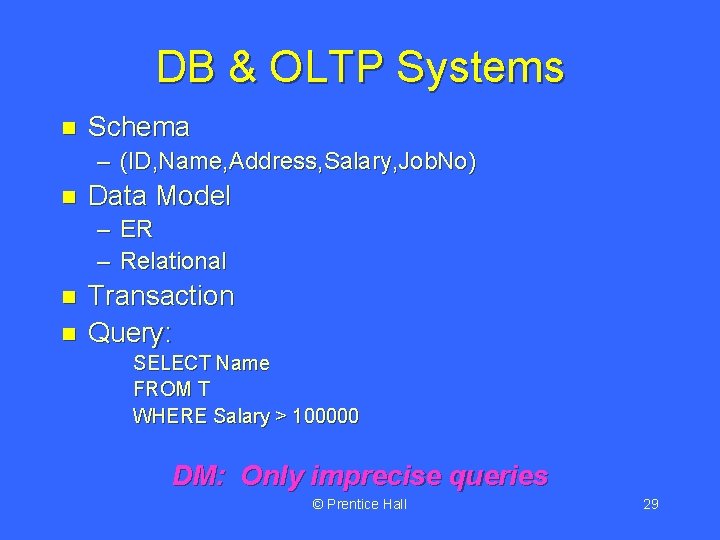
DB & OLTP Systems n Schema – (ID, Name, Address, Salary, Job. No) n Data Model – ER – Relational n n Transaction Query: SELECT Name FROM T WHERE Salary > 100000 DM: Only imprecise queries © Prentice Hall 29
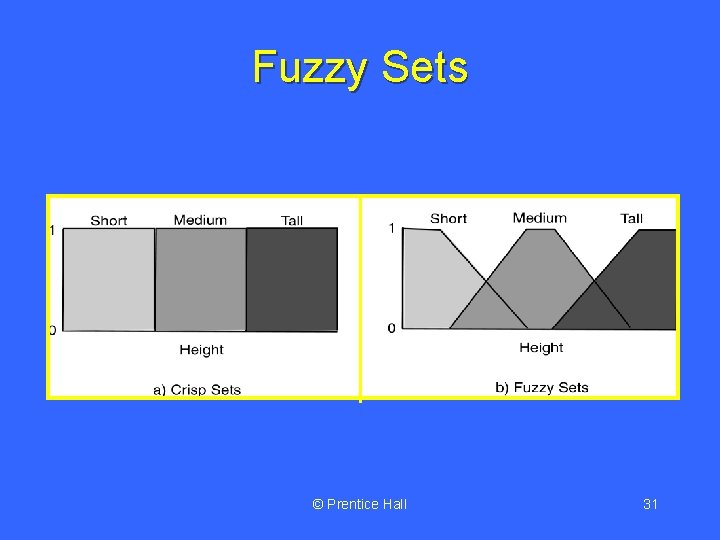
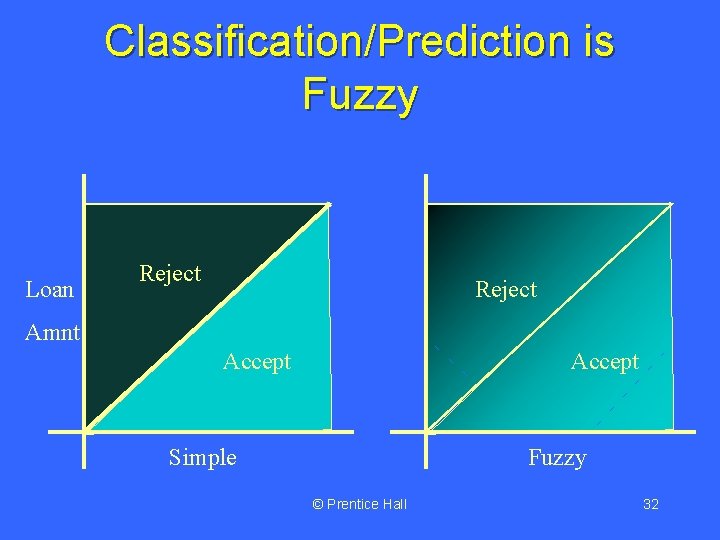
Fuzzy Sets and Logic n n Fuzzy Set: Set membership function is a real valued function with output in the range [0, 1]. f(x): Probability x is in F. 1 -f(x): Probability x is not in F. EX: – T = {x | x is a person and x is tall} – Let f(x) be the probability that x is tall – Here f is the membership function DM: Prediction and classification are fuzzy. © Prentice Hall 30
Fuzzy Sets © Prentice Hall 31
Classification/Prediction is Fuzzy Loan Reject Amnt Accept Simple Fuzzy © Prentice Hall 32
Information Retrieval n n n Information Retrieval (IR): retrieving desired information from textual data. Library Science Digital Libraries Web Search Engines Traditionally keyword based Sample query: Find all documents about “data mining”. DM: Similarity measures; Mine text/Web data. © Prentice Hall 33
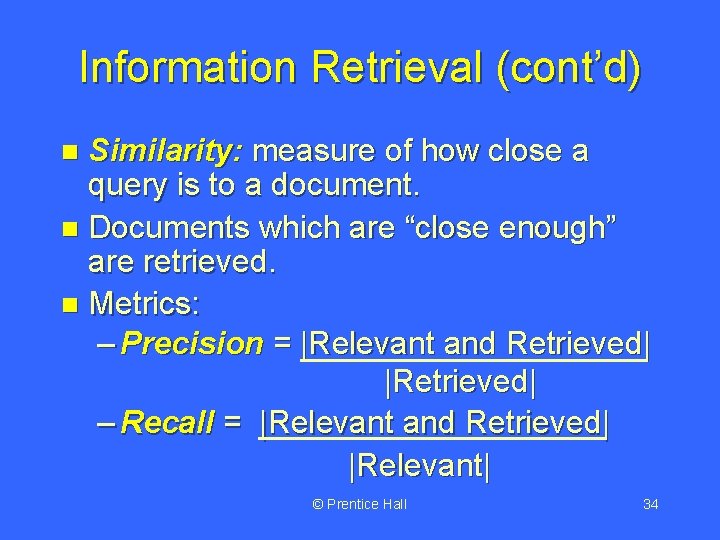
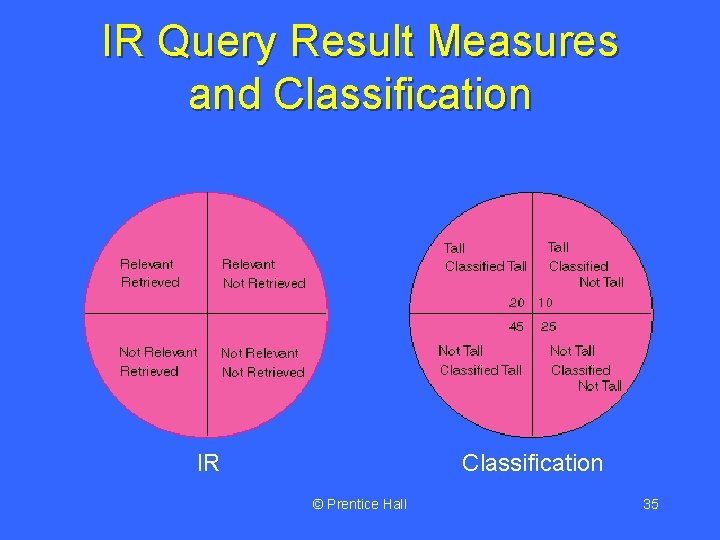
Information Retrieval (cont’d) Similarity: measure of how close a query is to a document. n Documents which are “close enough” are retrieved. n Metrics: – Precision = |Relevant and Retrieved| |Retrieved| – Recall = |Relevant and Retrieved| |Relevant| n © Prentice Hall 34
IR Query Result Measures and Classification IR Classification © Prentice Hall 35
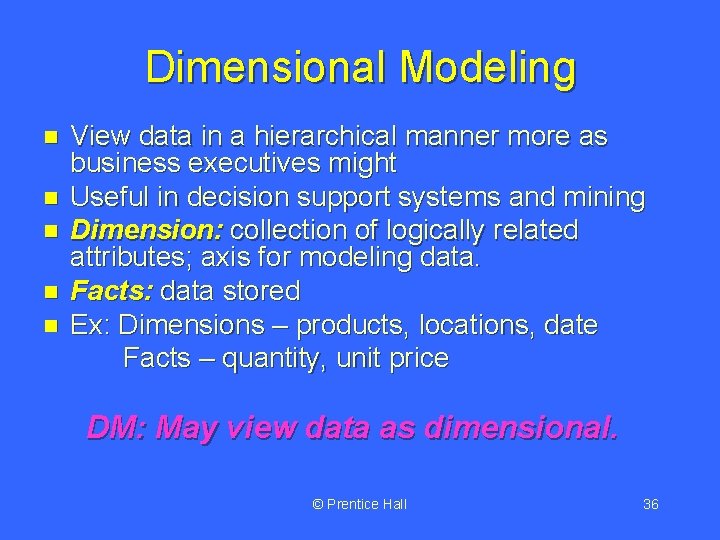
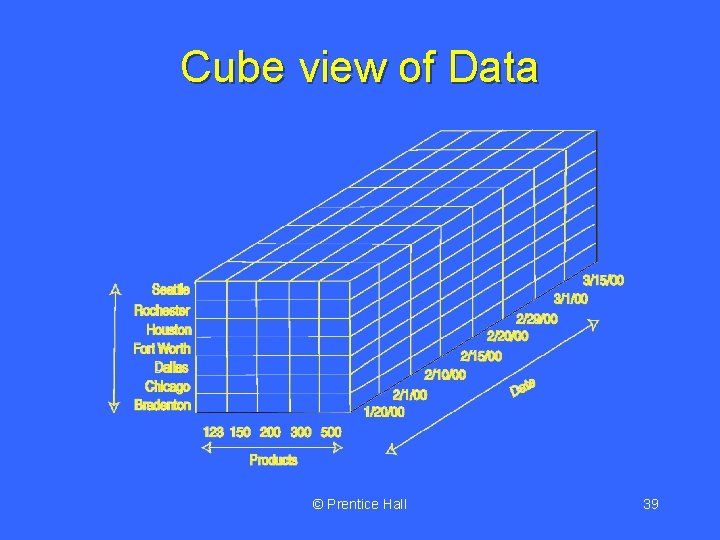
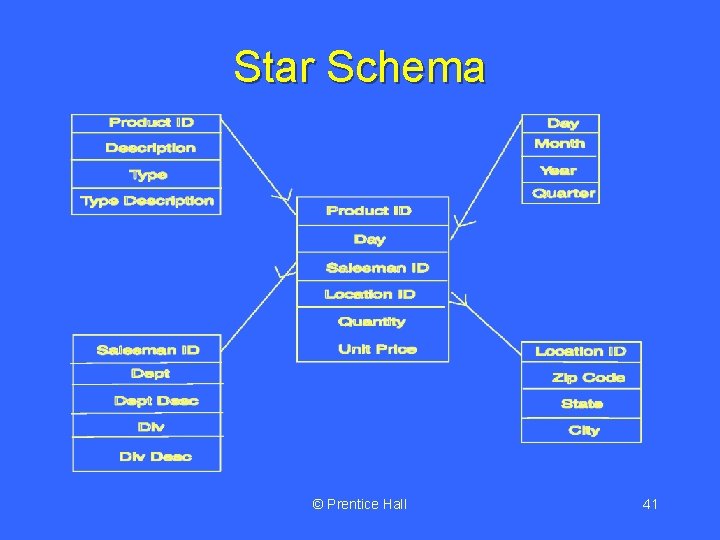
Dimensional Modeling n n n View data in a hierarchical manner more as business executives might Useful in decision support systems and mining Dimension: collection of logically related attributes; axis for modeling data. Facts: data stored Ex: Dimensions – products, locations, date Facts – quantity, unit price DM: May view data as dimensional. © Prentice Hall 36
Relational View of Data © Prentice Hall 37
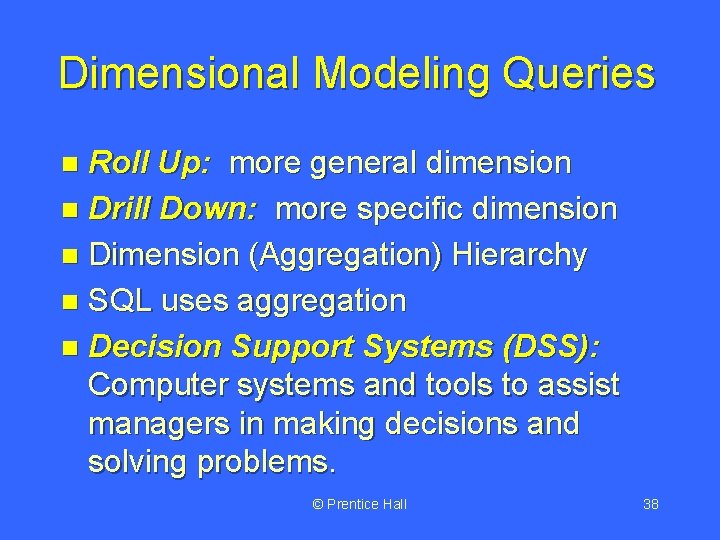
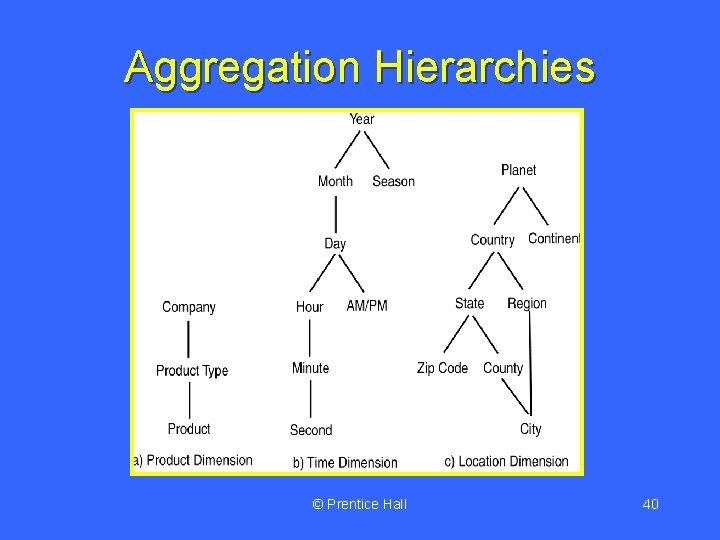
Dimensional Modeling Queries Roll Up: more general dimension n Drill Down: more specific dimension n Dimension (Aggregation) Hierarchy n SQL uses aggregation n Decision Support Systems (DSS): Computer systems and tools to assist managers in making decisions and solving problems. n © Prentice Hall 38
Cube view of Data © Prentice Hall 39
Aggregation Hierarchies © Prentice Hall 40
Star Schema © Prentice Hall 41
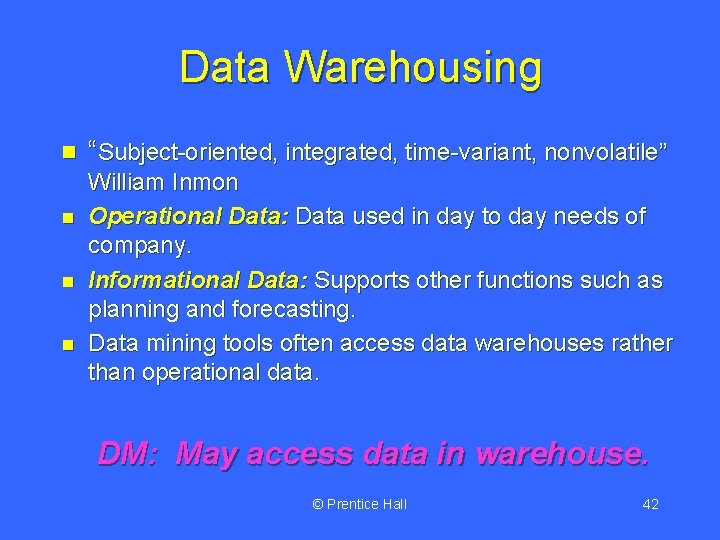
Data Warehousing n “Subject-oriented, integrated, time-variant, nonvolatile” n n n William Inmon Operational Data: Data used in day to day needs of company. Informational Data: Supports other functions such as planning and forecasting. Data mining tools often access data warehouses rather than operational data. DM: May access data in warehouse. © Prentice Hall 42
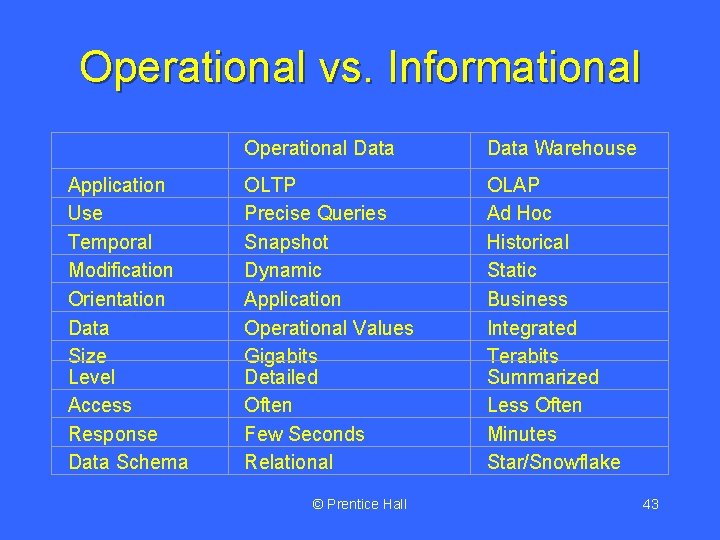
Operational vs. Informational Application Use Temporal Modification Orientation Data Size Level Access Response Data Schema Operational Data Warehouse OLTP Precise Queries Snapshot Dynamic Application Operational Values Gigabits Detailed Often Few Seconds Relational OLAP Ad Hoc Historical Static Business Integrated Terabits Summarized Less Often Minutes Star/Snowflake © Prentice Hall 43
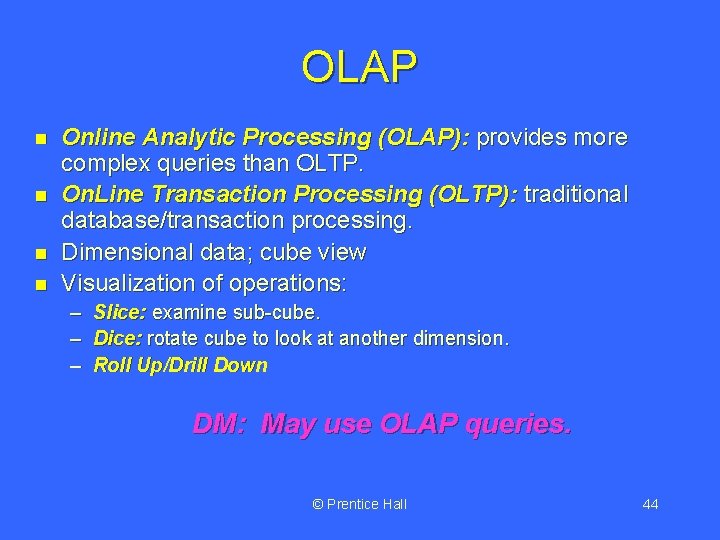
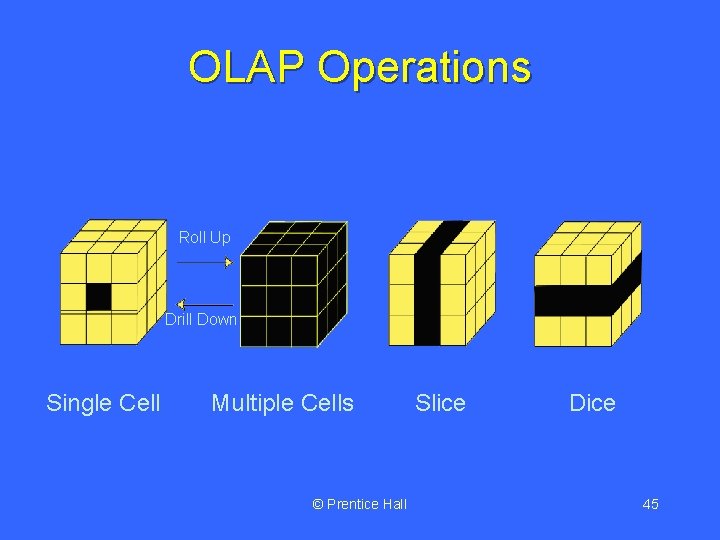
OLAP n n Online Analytic Processing (OLAP): provides more complex queries than OLTP. On. Line Transaction Processing (OLTP): traditional database/transaction processing. Dimensional data; cube view Visualization of operations: – – – Slice: examine sub-cube. Dice: rotate cube to look at another dimension. Roll Up/Drill Down DM: May use OLAP queries. © Prentice Hall 44
OLAP Operations Roll Up Drill Down Single Cell Multiple Cells © Prentice Hall Slice Dice 45
Statistics n n Simple descriptive models Statistical inference: generalizing a model created from a sample of the data to the entire dataset. Exploratory Data Analysis: – Data can actually drive the creation of the model – Opposite of traditional statistical view. Data mining targeted to business user DM: Many data mining methods come from statistical techniques. © Prentice Hall 46
Machine Learning n n n Machine Learning: area of AI that examines how to write programs that can learn. Often used in classification and prediction Supervised Learning: learns by example. Unsupervised Learning: learns without knowledge of correct answers. Machine learning often deals with small static datasets. DM: Uses many machine learning techniques. © Prentice Hall 47
Pattern Matching (Recognition) Pattern Matching: finds occurrences of a predefined pattern in the data. n Applications include speech recognition, information retrieval, time series analysis. n DM: Type of classification. © Prentice Hall 48
DM vs. Related Topics © Prentice Hall 49