
DATA MINING INTRODUCTION TO CLASSIFICATION USING LINEAR CLASSIFIERS

- Slides: 37
DATA MINING INTRODUCTION TO CLASSIFICATION USING LINEAR CLASSIFIERS Last modified 1/1/19 1
Why Start with Linear Classifiers? Linear classifiers are the simplest classifiers Simpler than decision trees �Textbook starts with decision trees �We will use decision trees to introduce some of the more advanced concepts Learning method is linear regression We will use linear classifiers to introduce some concepts in classification Linear classifier also provides yet one more classification algorithm Also helps demonstrate how different algorithms form different types of decision boundaries 2
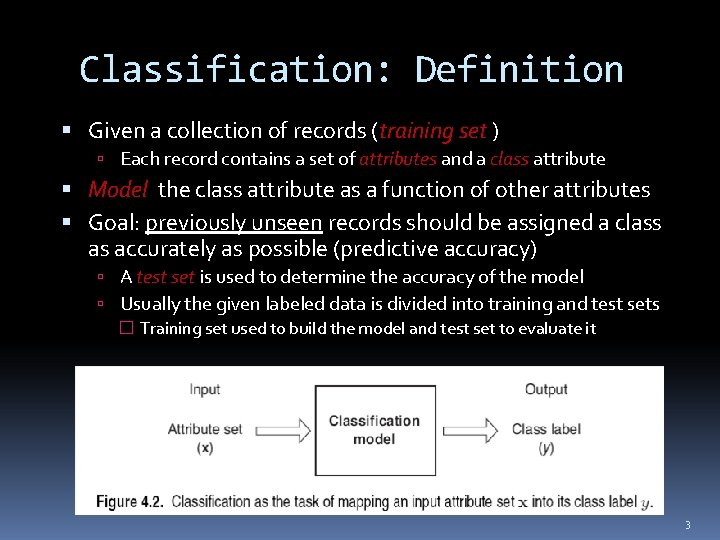
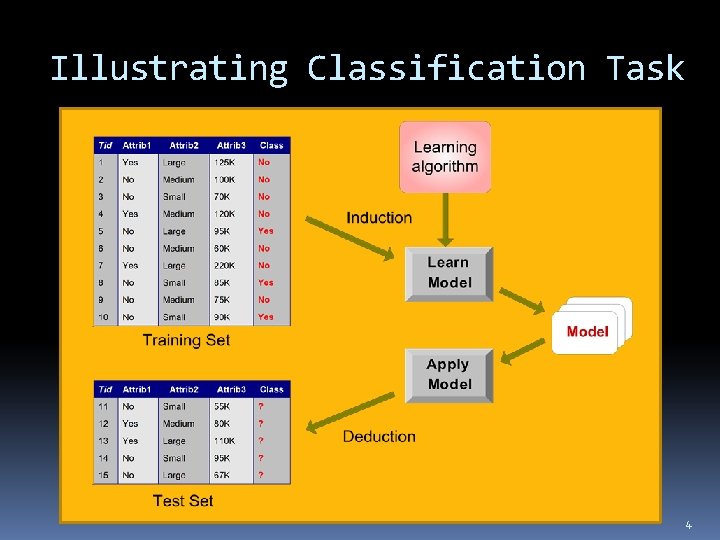
Classification: Definition Given a collection of records (training set ) Each record contains a set of attributes and a class attribute Model the class attribute as a function of other attributes Goal: previously unseen records should be assigned a class as accurately as possible (predictive accuracy) A test set is used to determine the accuracy of the model Usually the given labeled data is divided into training and test sets � Training set used to build the model and test set to evaluate it 3
Illustrating Classification Task 4
Classification Examples Predicting tumor cells as benign or malignant Classifying credit card transactions as legitimate or fraudulent Classifying physical activities based on smartphone sensor data Categorizing news stories as finance, weather, entertainment, sports, etc 5
Classification Techniques Decision Tree based Methods Memory based reasoning (Nearest Neighbor) Neural Networks Naïve Bayes Support Vector Machines Linear Regression (we start with this) 6
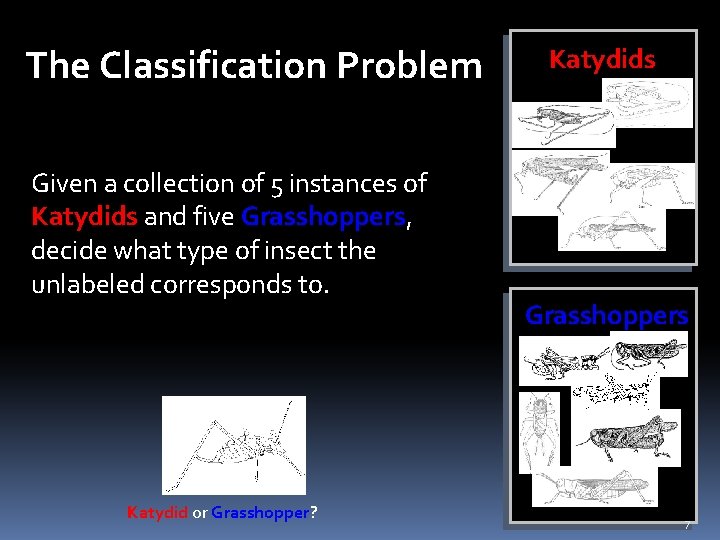
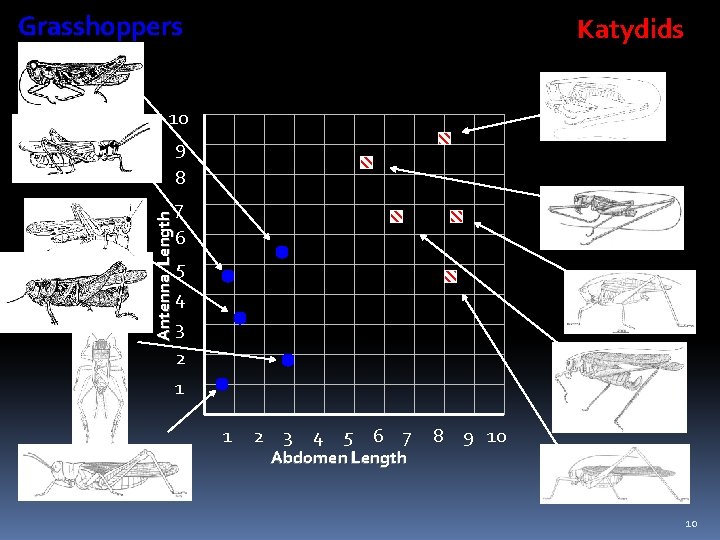
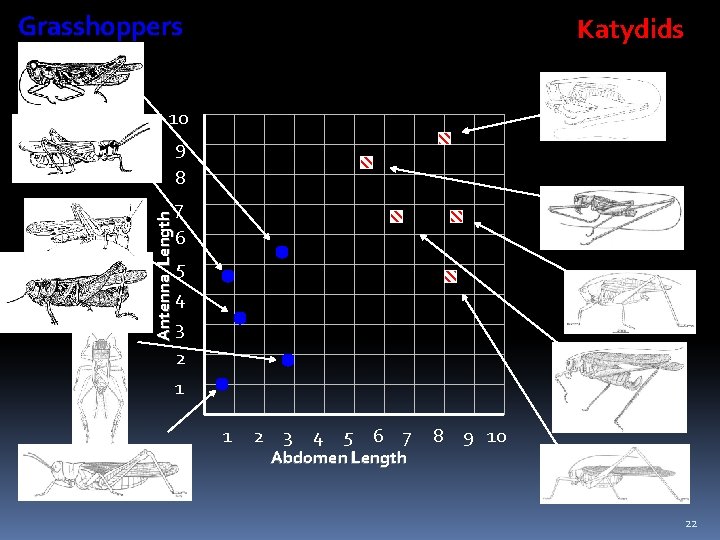
The Classification Problem Given a collection of 5 instances of Katydids and five Grasshoppers, decide what type of insect the unlabeled corresponds to. Katydid or Grasshopper? Katydids Grasshoppers 7
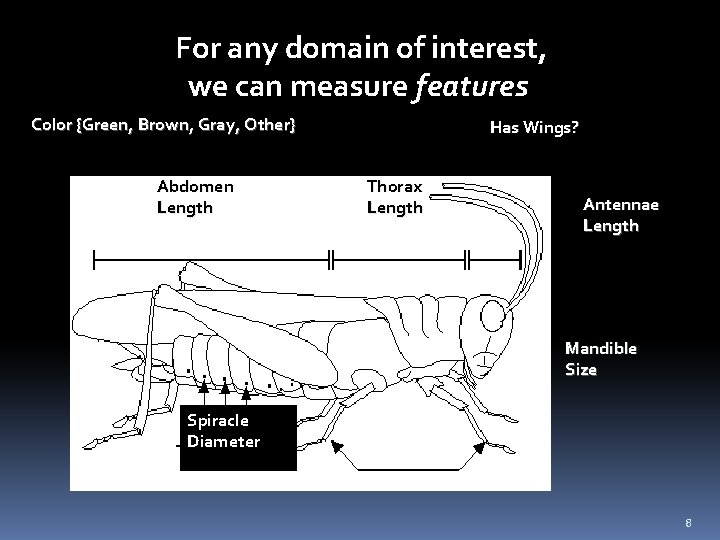
For any domain of interest, we can measure features Color {Green, Brown, Gray, Other} Abdomen Length Has Wings? Thorax Length Antennae Length Mandible Size Spiracle Diameter Leg Length 8
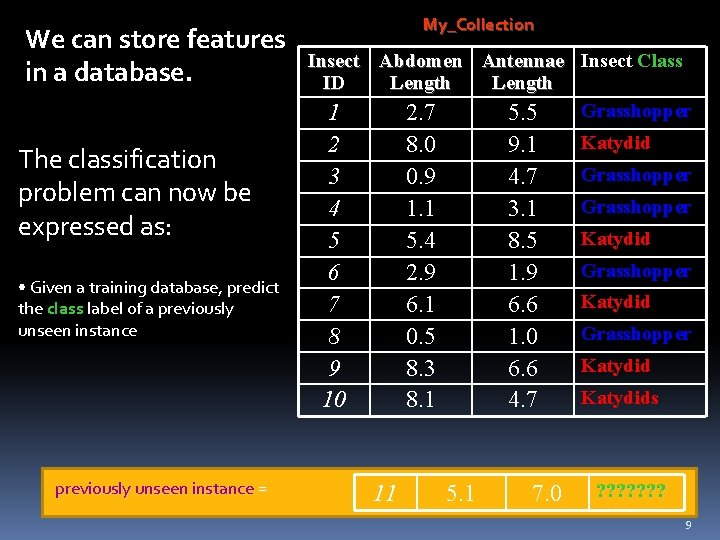
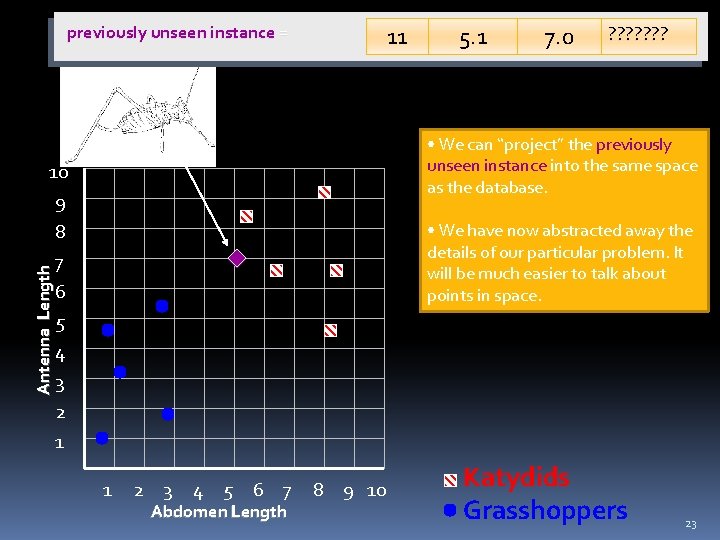
We can store features in a database. The classification problem can now be expressed as: • Given a training database, predict the class label of a previously unseen instance = My_Collection Insect Abdomen Antennae Insect Class ID Length Grasshopper 1 2. 7 5. 5 2 3 4 5 6 7 8 9 10 8. 0 0. 9 1. 1 5. 4 2. 9 6. 1 0. 5 8. 3 8. 1 11 9. 1 4. 7 3. 1 8. 5 1. 9 6. 6 1. 0 6. 6 4. 7 5. 1 7. 0 Katydid Grasshopper Katydids ? ? ? ? 9
Grasshoppers Katydids Antenna Length 10 9 8 7 6 5 4 3 2 1 1 2 3 4 5 6 7 Abdomen Length 8 9 10 10
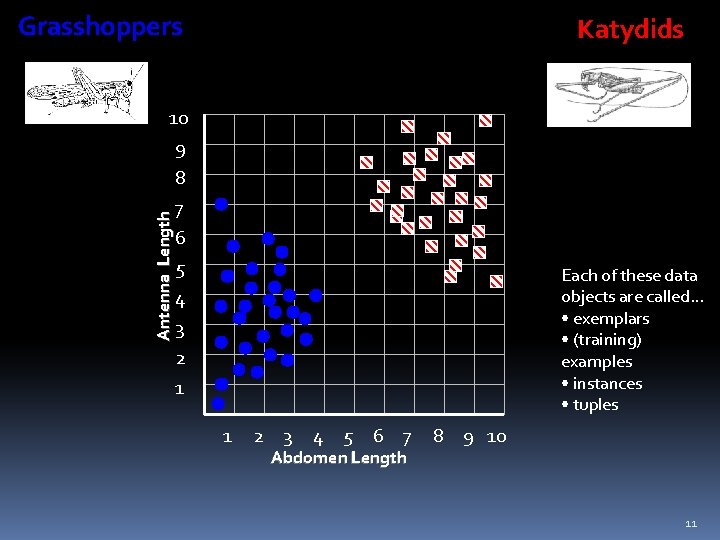
Grasshoppers Katydids Antenna Length 10 9 8 7 6 5 4 3 2 1 Each of these data objects are called… • exemplars • (training) examples • instances • tuples 1 2 3 4 5 6 7 Abdomen Length 8 9 10 11
We will return to the previous slide in two minutes. In the meantime, we are going to play a quick game. 12
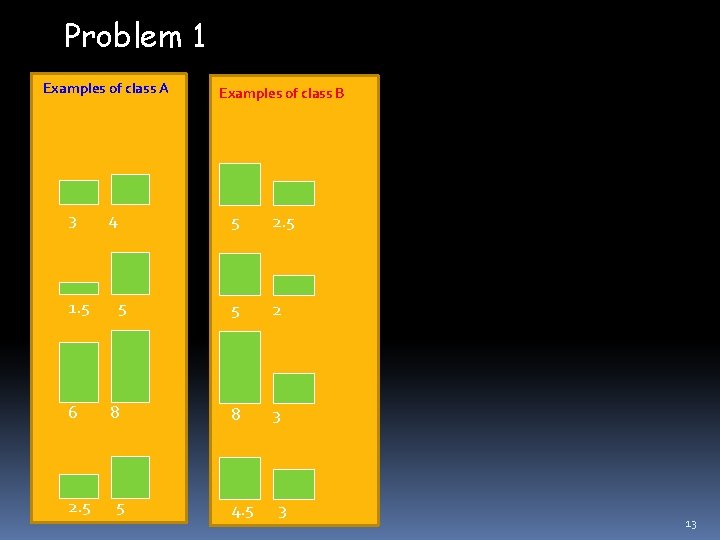
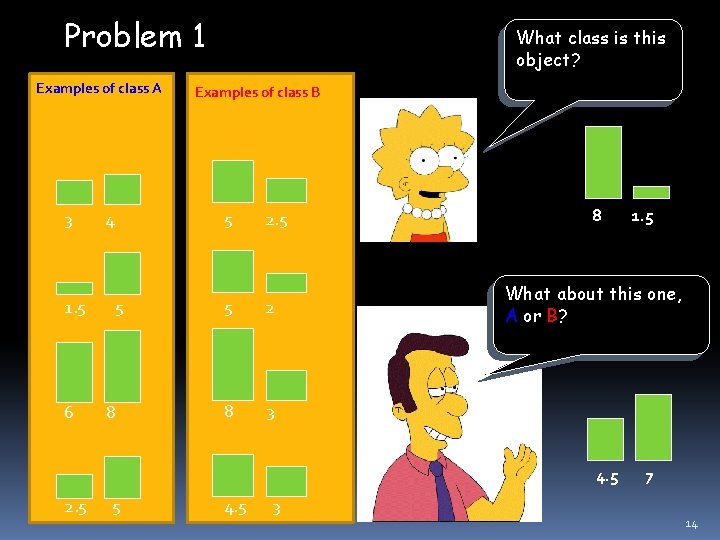
Problem 1 Examples of class A 3 1. 5 6 2. 5 4 5 8 5 Examples of class B 5 2. 5 5 2 8 3 4. 5 3 13
Problem 1 Examples of class A 3 1. 5 6 4 5 8 What class is this object? Examples of class B 5 2. 5 5 2 8 3 8 What about this one, A or B? 4. 5 2. 5 5 4. 5 3 1. 5 7 14
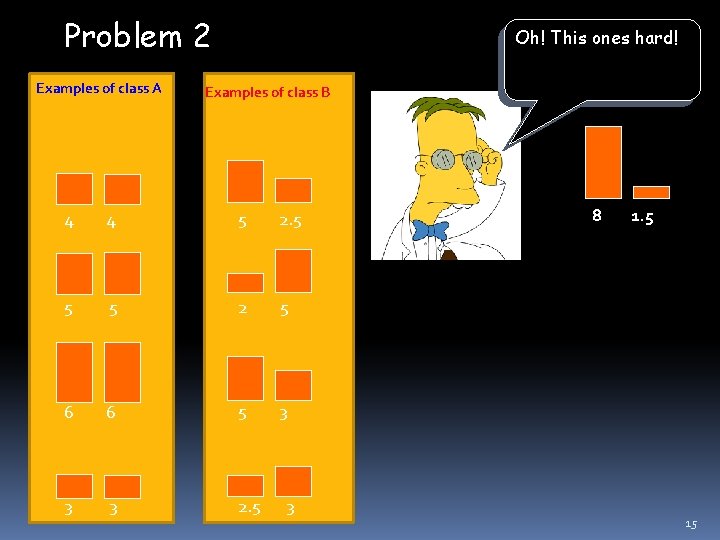
Problem 2 Examples of class A Oh! This ones hard! Examples of class B 4 4 5 2. 5 5 5 2 5 6 6 5 3 3 3 2. 5 3 8 1. 5 15
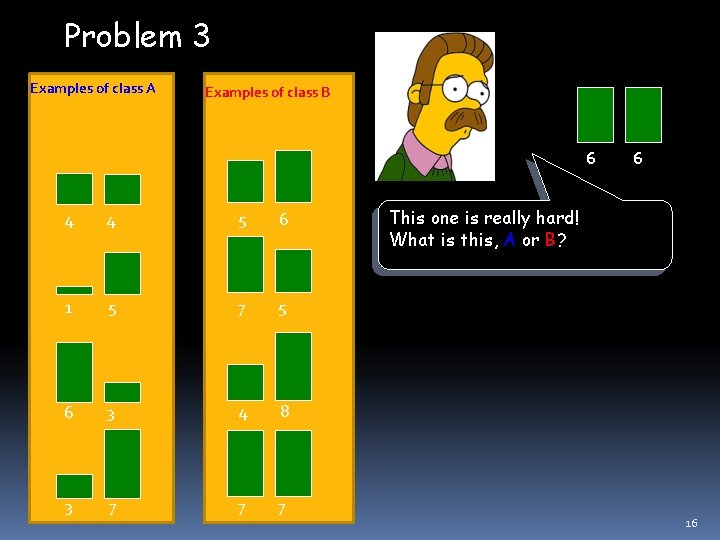
Problem 3 Examples of class A Examples of class B 6 4 4 5 6 1 5 7 5 6 3 4 8 3 7 7 7 6 This one is really hard! What is this, A or B? 16
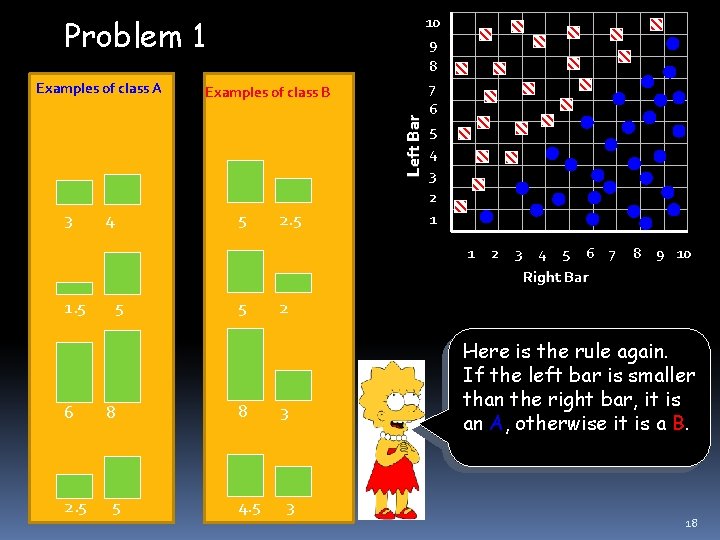
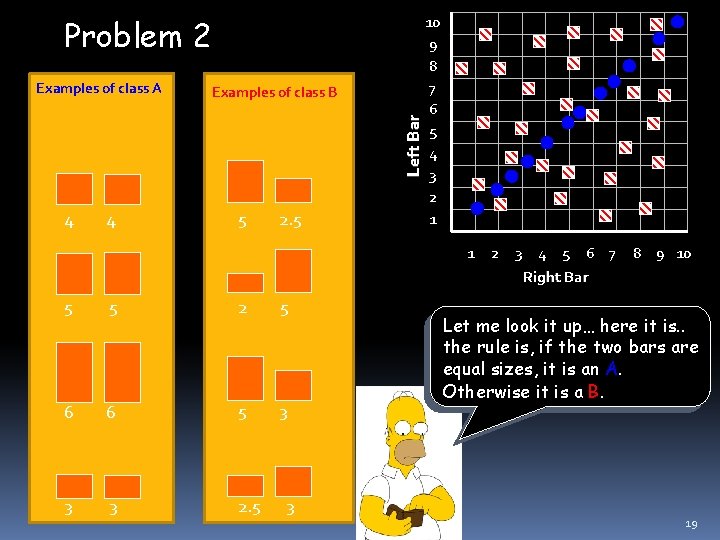
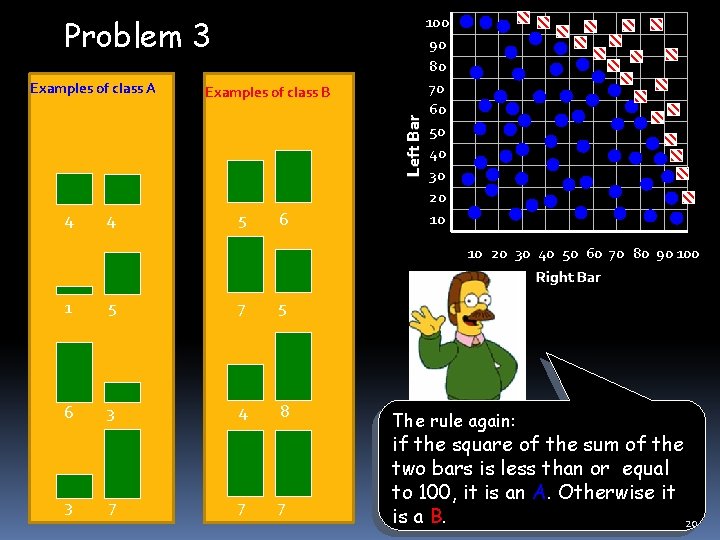
Why did we spend so much time with this game? Because we wanted to show that almost all classification problems have a geometric interpretation, check out the next 3 slides… 17
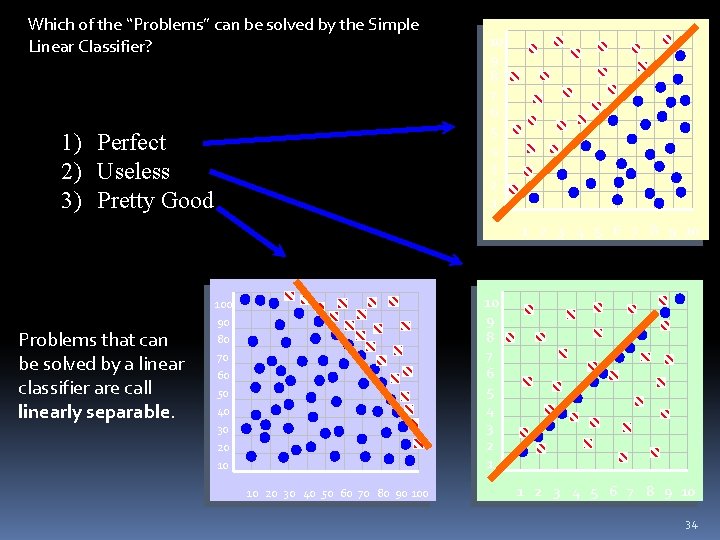
Problem 1 Examples of class B Left Bar Examples of class A 3 5 4 2. 5 10 9 8 7 6 5 4 3 2 1 1 1. 5 6 2. 5 5 8 4. 5 2 3 4 5 6 7 Right Bar 8 9 10 2 3 3 Here is the rule again. If the left bar is smaller than the right bar, it is an A, otherwise it is a B. 18
Problem 2 Examples of class B Left Bar Examples of class A 4 4 5 2. 5 10 9 8 7 6 5 4 3 2 1 1 5 5 2 5 6 6 5 3 3 3 2. 5 3 2 3 4 5 6 7 Right Bar 8 9 10 Let me look it up… here it is. . the rule is, if the two bars are equal sizes, it is an A. Otherwise it is a B. 19
Problem 3 Examples of class B Left Bar Examples of class A 4 4 5 6 100 90 80 70 60 50 40 30 20 10 10 20 30 40 50 60 70 80 90 100 Right Bar 1 5 7 5 6 3 4 8 3 7 7 7 The rule again: if the square of the sum of the two bars is less than or equal to 100, it is an A. Otherwise it is a B. 20
Problem 3 An alternative rule that works on the original training data is X + Y ≤ 10 Class A; else B Which is better? Ultimately is one right and one wrong? 21
Grasshoppers Katydids Antenna Length 10 9 8 7 6 5 4 3 2 1 1 2 3 4 5 6 7 Abdomen Length 8 9 10 22
11 previously unseen instance = 7. 0 ? ? ? ? • We can “project” the previously unseen instance into the same space as the database. 10 Antenna Length 5. 1 9 8 7 6 5 4 3 2 1 • We have now abstracted away the details of our particular problem. It will be much easier to talk about points in space. 1 2 3 4 5 6 7 Abdomen Length 8 9 10 Katydids Grasshoppers 23
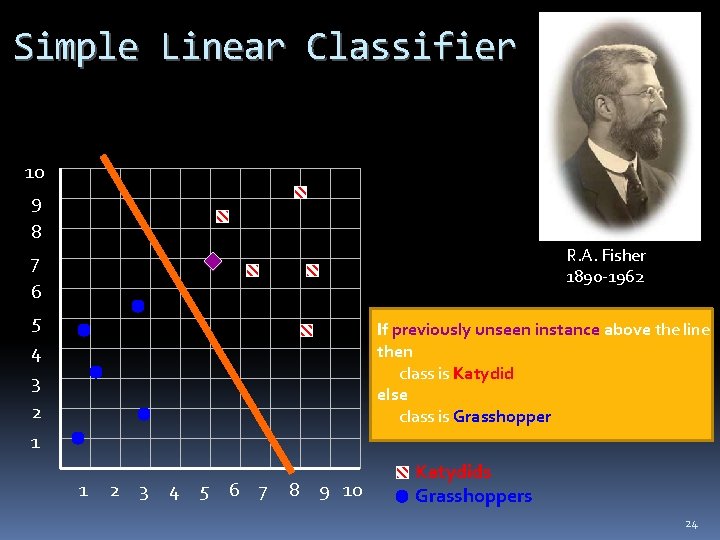
Simple Linear Classifier 10 9 8 7 6 5 4 3 2 1 R. A. Fisher 1890 -1962 If previously unseen instance above the line then class is Katydid else class is Grasshopper 1 2 3 4 5 6 7 8 9 10 Katydids Grasshoppers 24
Fitting a Model to Data One way to build a predictive model is to specify the structure of the model with some parameters missing Parameter learning or parameter modeling Common in statistics but includes data mining methods since fields overlap Linear regression, logistic regression, support vector machines 25
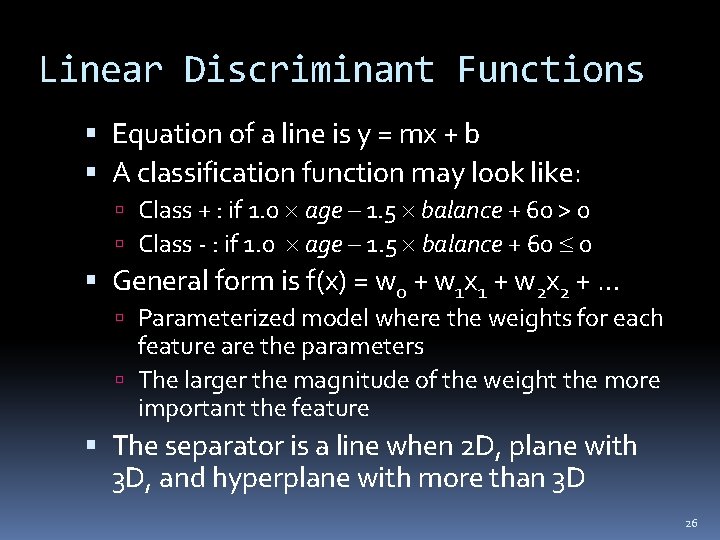
Linear Discriminant Functions Equation of a line is y = mx + b A classification function may look like: Class + : if 1. 0 age – 1. 5 balance + 60 > 0 Class - : if 1. 0 age – 1. 5 balance + 60 0 General form is f(x) = w 0 + w 1 x 1 + w 2 x 2 + … Parameterized model where the weights for each feature are the parameters The larger the magnitude of the weight the more important the feature The separator is a line when 2 D, plane with 3 D, and hyperplane with more than 3 D 26
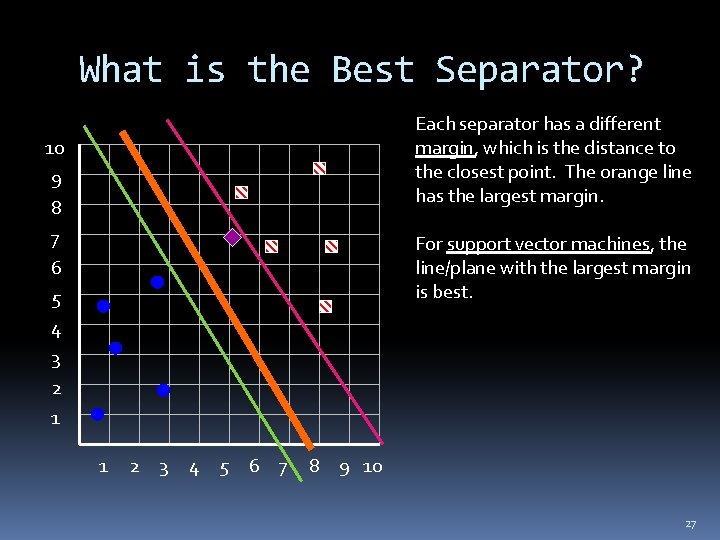
What is the Best Separator? Each separator has a different margin, which is the distance to the closest point. The orange line has the largest margin. 10 9 8 7 6 5 4 3 2 1 For support vector machines, the line/plane with the largest margin is best. 1 2 3 4 5 6 7 8 9 10 27
Scoring and Ranking Instances Sometimes we want to know which examples are most likely to belong to a class Linear discriminant functions can give us this Closer to separator is less confident and further away is more confident In fact the magnitude of f(x) give us this where larger values are more confident/likely 28
Class Probability Estimation Class probability estimation is also something you often want Often free with methods like decision trees More complicated with linear discriminant functions since the distance from the separator not a probability Logistic regression solves this We will not go into the details in this class Logistic regression determines class probability estimate 29
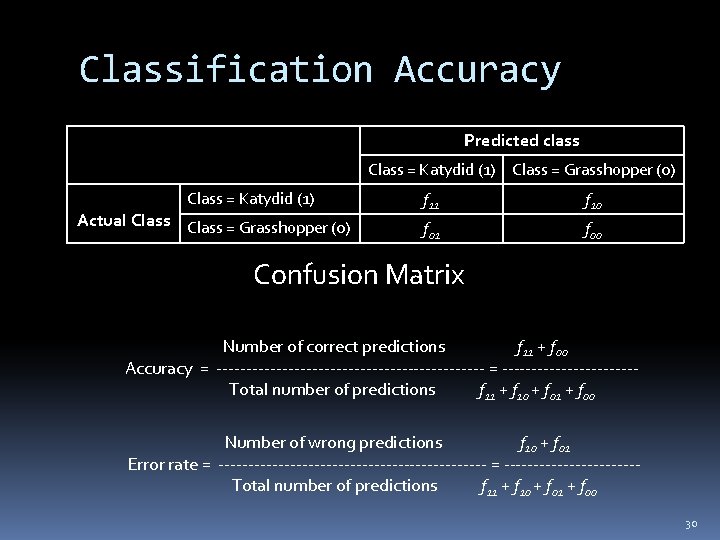
Classification Accuracy Predicted class Class = Katydid (1) Class = Grasshopper (0) Class = Katydid (1) Actual Class = Grasshopper (0) f 11 f 10 f 01 f 00 Confusion Matrix Number of correct predictions f 11 + f 00 Accuracy = ----------------------- = -----------Total number of predictions f 11 + f 10 + f 01 + f 00 Number of wrong predictions f 10 + f 01 Error rate = ----------------------- = -----------Total number of predictions f 11 + f 10 + f 01 + f 00 30
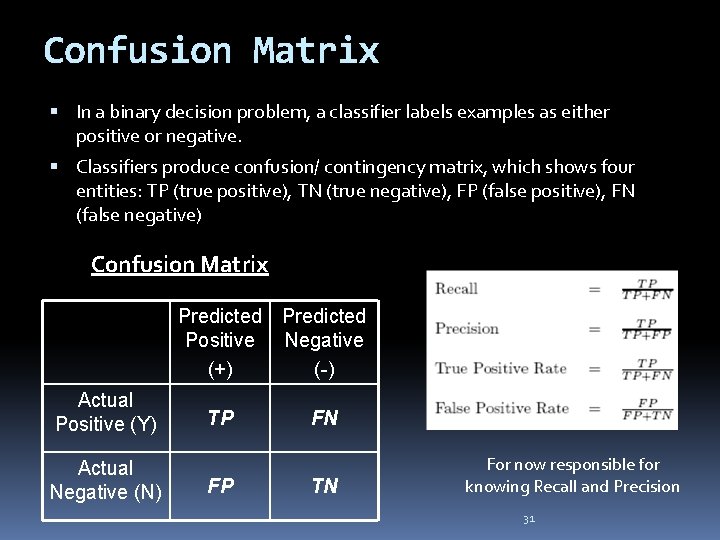
Confusion Matrix In a binary decision problem, a classifier labels examples as either positive or negative. Classifiers produce confusion/ contingency matrix, which shows four entities: TP (true positive), TN (true negative), FP (false positive), FN (false negative) Confusion Matrix Predicted Positive Negative (+) (-) Actual Positive (Y) Actual Negative (N) TP FP FN TN For now responsible for knowing Recall and Precision 31
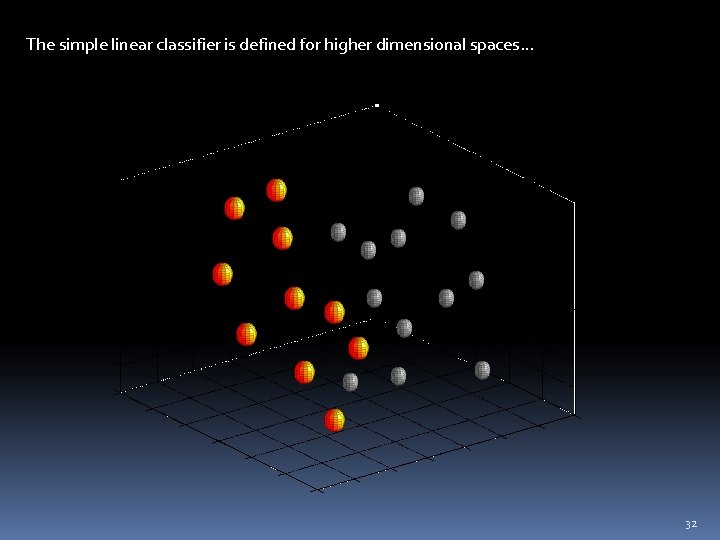
The simple linear classifier is defined for higher dimensional spaces… 32
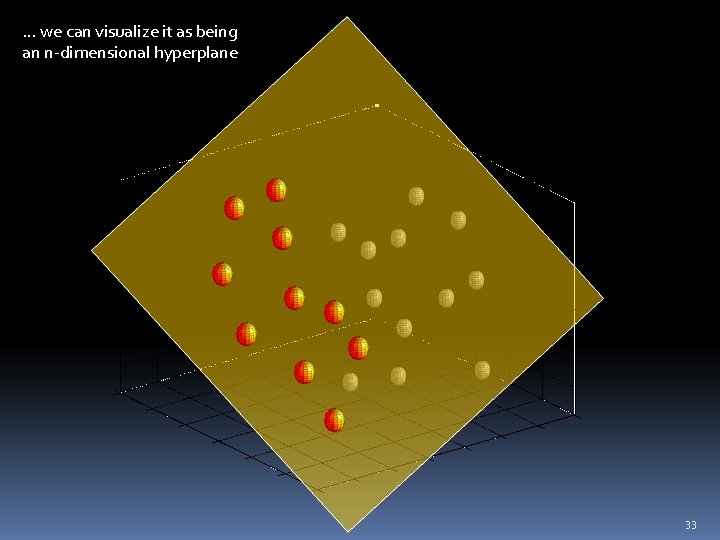
… we can visualize it as being an n-dimensional hyperplane 33
Which of the “Problems” can be solved by the Simple Linear Classifier? 1) Perfect 2) Useless 3) Pretty Good 10 9 8 7 6 5 4 3 2 1 1 2 3 4 5 6 7 8 9 10 Problems that can be solved by a linear classifier are call linearly separable. 10 9 8 7 6 5 4 3 2 1 100 90 80 70 60 50 40 30 20 10 10 20 30 40 50 60 70 80 90 100 1 2 3 4 5 6 7 8 9 10 34
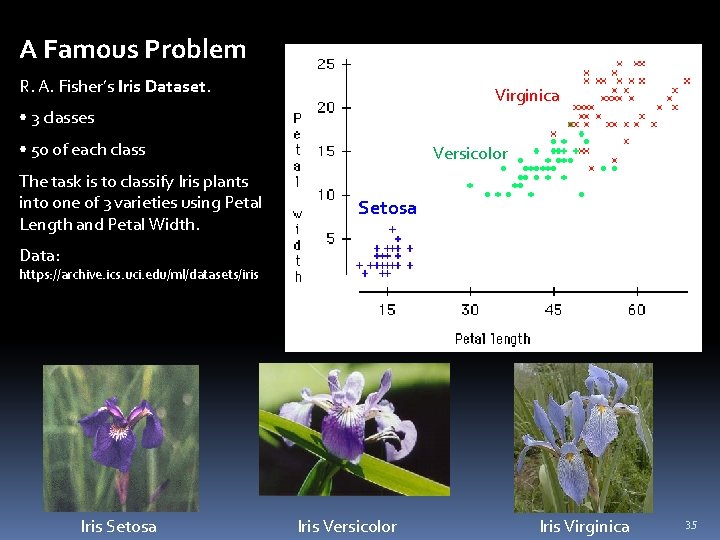
A Famous Problem R. A. Fisher’s Iris Dataset. Virginica • 3 classes • 50 of each class The task is to classify Iris plants into one of 3 varieties using Petal Length and Petal Width. Versicolor Setosa Versicolor Data: https: //archive. ics. uci. edu/ml/datasets/iris Iris Setosa Iris Versicolor Iris Virginica 35
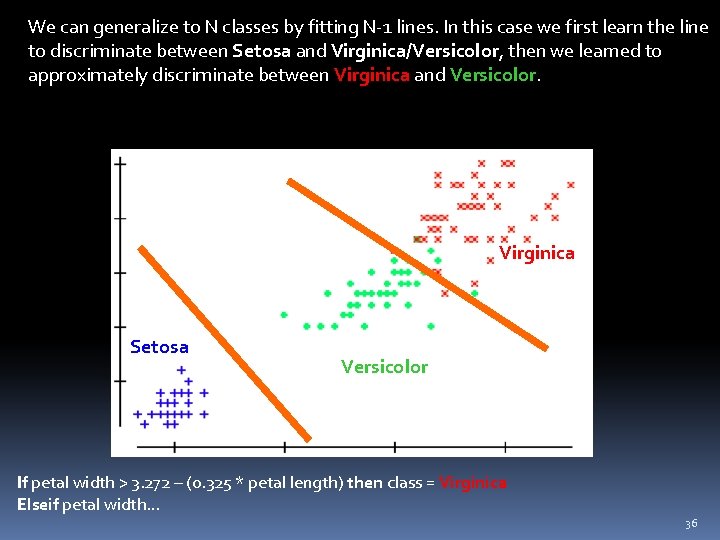
We can generalize to N classes by fitting N-1 lines. In this case we first learn the line to discriminate between Setosa and Virginica/Versicolor, then we learned to approximately discriminate between Virginica and Versicolor. Virginica Setosa Versicolor If petal width > 3. 272 – (0. 325 * petal length) then class = Virginica Elseif petal width… 36
How to Compare Classification Algorithms? What criteria do we care about? What matters? Performance- predictive accuracy etc. Speed and Scalability �time to construct model �time to use/apply the model Expressive Power �how flexible is the decision boundary Interpretability �understanding and insight provided by the model �ability to explain/justify the results Robustness �handling noise, missing values and irrelevant features, streaming data 37