
Data Mining Data Data Attribute values Types of
Data Mining: Data
Data, Attribute values, Types of Attributes ● Data is a collection of data objects and their attributes ○ ○ An object is made up of a set of attributes that describe it An attribute, also known as a variable, field, or feature, is a property or characteristic of an object. ● Attribute values are numbers or symbols assigned to an attribute ○ ○ A measurement scale associates a numerical or symbolic value with an attribute The type of attribute tells us the properties that are reflected in the values used to measure it ● Attributes can be discrete or continuous based on the number of values ○ ○ Discrete attributes have a finite or countably infinite set of values Continuous attributes have values that are real numbers
Data, Attribute values, Types of Attributes ● A way to specify the type of an attribute is to look at the properties it possess ○ ○ Distinctness: = != Order: < > Addition: + Multiplication: * / ● Based on these properties, there are 4 attribute types that fall into 2 groups ○ ○ Categorical (Qualitative) ■ Nominal: Values are just different names (=, !=) ■ Ordinal: Values provide enough information to order objects (<, >) Numeric (Quantitative) ■ Interval: Differences are meaningful and a unit of measurement exists (+, -) ■ Ratio: Differences and ratios of values are both meaningful (*, /)
Types Of Data Sets: Record Data that consists of a collection of records, each of which consists of a fixed set of attributes. ● ● ● Data Matrix: If data objects have the same fixed set of numeric attributes, then the data objects can be thought of as points in a multi-dimensional space, where each dimension represents a distinct attribute. Document Data: Each document becomes a `term' vector; each term is a attribute of the vector. And the value of each attribute is the number of times the corresponding term occurs in the document. Transaction Data: Transactional databases is a collection of data organized by time stamps, date, etc to represent transaction in databases.
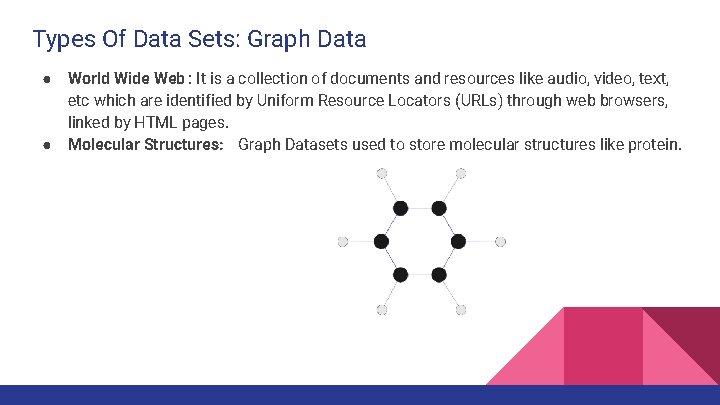
Types Of Data Sets: Graph Data ● ● World Wide Web : It is a collection of documents and resources like audio, video, text, etc which are identified by Uniform Resource Locators (URLs) through web browsers, linked by HTML pages. Molecular Structures: Graph Datasets used to store molecular structures like protein.
Types Of Data Sets: Ordered Data ● ● Spatial Data : To store geographical information. Temporal Data : Temporal data mining refers to the extraction of implicit, non-trivial, and potentially useful abstract information from large collections of temporal data Sequential Data : It contains stock exchange data and user logged activities. Handles array of numbers indexed by time, date, etc. Genetic Sequence Data : A subtype of sequence data which stores DNA data.

Data Preprocessing ● Aggregation: Combining two or more attributes (or objects) into a single attribute (or object) ● Sampling: Sampling is the main technique employed for data selection. This is used in data mining because processing the entire set of data of interest is too expensive or time consuming. ● Dimensionality Reduction: It reduces amount of time and memory required data mining algorithms, by this data can be more visualized. It helps to eliminate irrelevant features or reduced noise. ● Feature subset selection: This is the other way to reduce dimensionality reduction of data. Techniques are as follows: ● Brute-force approach: Try all possible feature subsets as input to data mining algorithm
Embedded approaches: Feature selection occurs naturally as part of data mining algorithm Filter approaches: Features are selected before data mining algorithm is run Wrapper approaches: Use the data mining algorithm as a black box to find best subset of attributes Feature creation: ● ● Creates new attributes that can capture the important information in a data set much more efficiently than the original attributes. ● ● Discretization and Binarization: ● Discretization is used to transform a continuous attribute to categorical attribute. ● Binarization is used to transform both the discrete attributes and the continuous attributes into binary attributes in data mining. Attribute Transformation: A function that maps the entire set of values of a given attribute to a new set of replacement values such that each old value can be identified with one of the new values
Similarity and Dissimilarity Similarity – It is a numerical measure of the degree to which the two objects are alike. – Similarities are higher for pairs of objects that are more alike. – Similarities are usually non-negative and often falls in the range [0, 1] Dissimilarity – Numerical measure of how different are two data objects – Dissimilarity is lower for more similar pairs of objects. – Minimum dissimilarity is often 0 – The lower limit is 0 and the upper limit varies from 1 to infinity.
Common properties of Similarity Some of the well known properties of Similarity. 1. s(p, q) = 1 (or maximum similarity) only if p = q. 2. s(p, q) = s(q, p) for all p and q. (Symmetry) where s(p, q) is the similarity between points (data objects), p and q. Proximity measures: ● Proximity measures are defined to have values in the interval [0, 1]. ● We can make them fall into the range [0, 1] by using the formula: s’=(s-1)/9
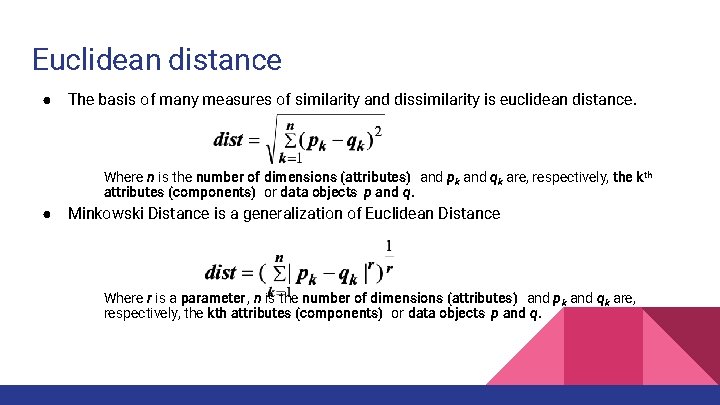
Euclidean distance ● The basis of many measures of similarity and dissimilarity is euclidean distance. Where n is the number of dimensions (attributes) and p k and q k are, respectively, the kth attributes (components) or data objects p and q. ● Minkowski Distance is a generalization of Euclidean Distance Where r is a parameter , n is the number of dimensions (attributes) and p k and q k are, respectively, the kth attributes (components) or data objects p and q.
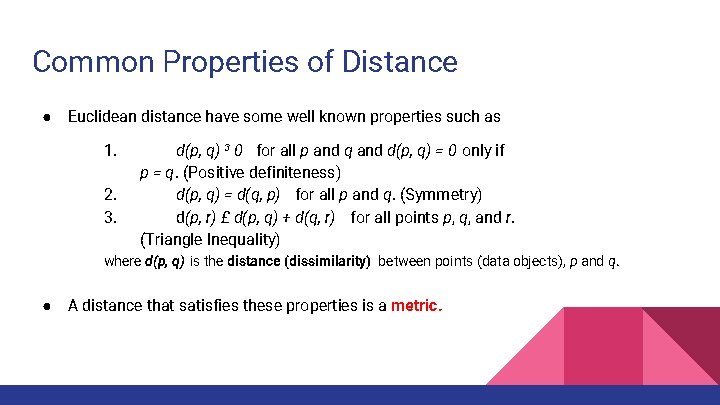
Common Properties of Distance ● Euclidean distance have some well known properties such as 1. 2. 3. d(p, q) ³ 0 for all p and q and d(p, q) = 0 only if p = q. (Positive definiteness) d(p, q) = d(q, p) for all p and q. (Symmetry) d(p, r) £ d(p, q) + d(q, r) for all points p, q, and r. (Triangle Inequality) where d(p, q) is the distance (dissimilarity) between points (data objects), p and q. ● A distance that satisfies these properties is a metric.
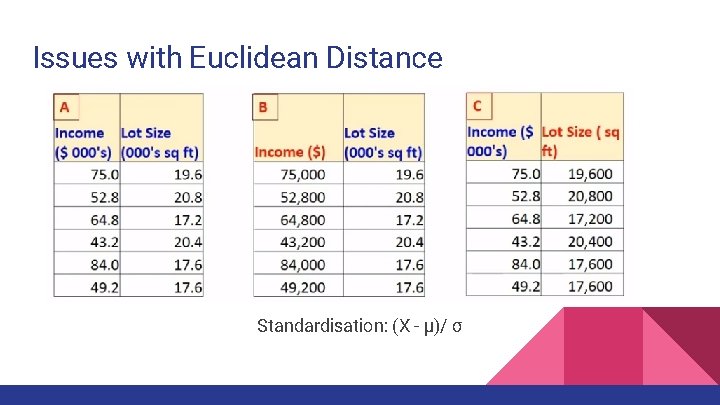
Issues with Euclidean Distance Standardisation: (X - μ)/ σ
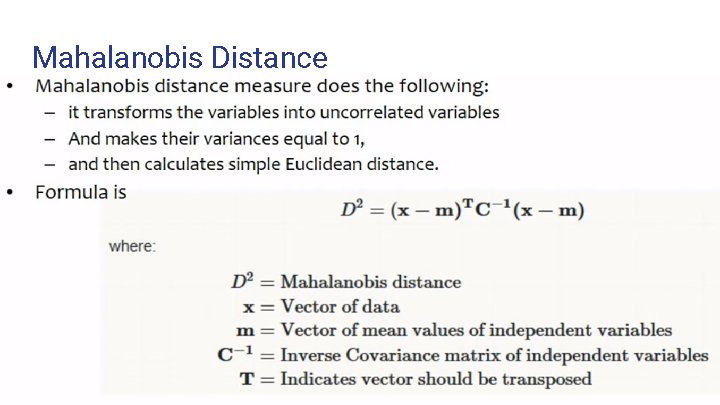
Mahalanobis Distance
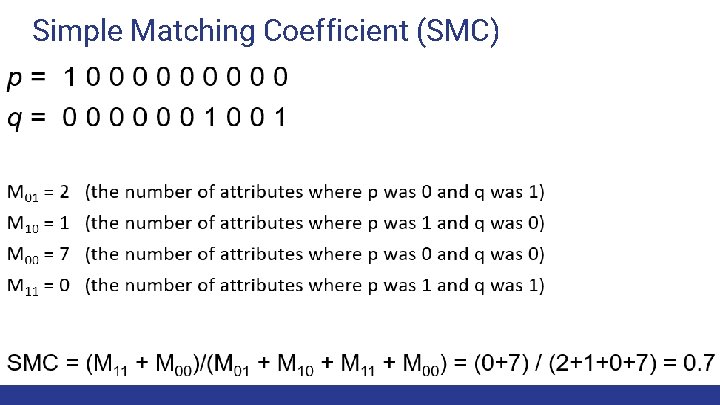
Simple Matching Coefficient (SMC)
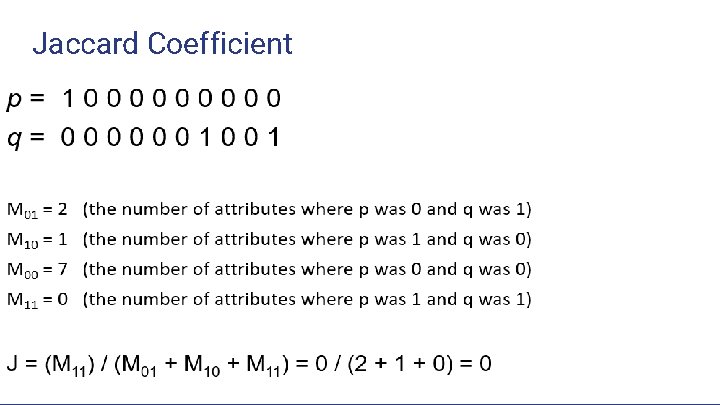
Jaccard Coefficient
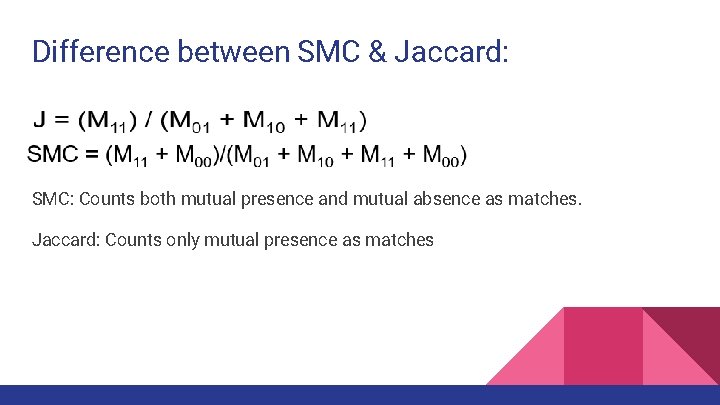
Difference between SMC & Jaccard: SMC: Counts both mutual presence and mutual absence as matches. Jaccard: Counts only mutual presence as matches
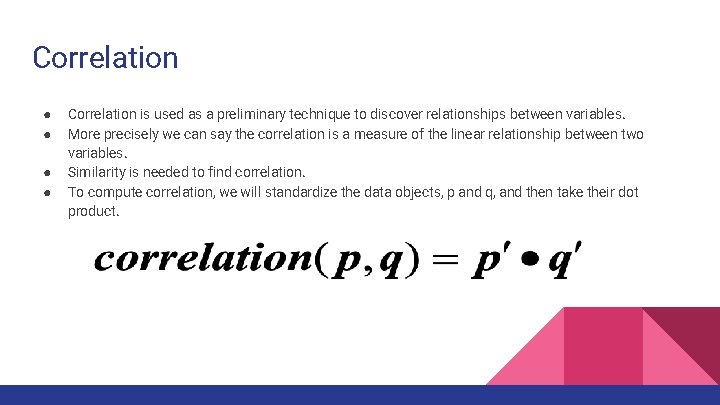
Correlation ● ● Correlation is used as a preliminary technique to discover relationships between variables. More precisely we can say the correlation is a measure of the linear relationship between two variables. Similarity is needed to find correlation. To compute correlation, we will standardize the data objects, p and q, and then take their dot product.
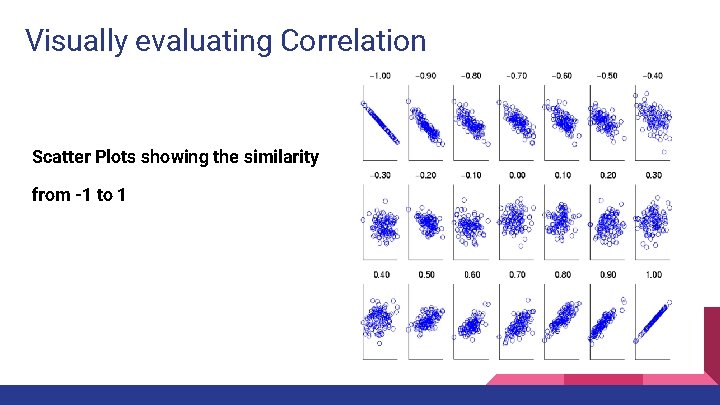
Visually evaluating Correlation Scatter Plots showing the similarity from -1 to 1
Density-Based Clustering refers to unsupervised learning methods that identify distinctive groups/clusters in the data, based on the idea that a cluster in a data space is a contiguous region of high point density, separated from other such clusters by contiguous regions of low point density. The data points in the separating regions of low point density are typically considered noise/outliers. There a few methods and the Euclidean distance method is the simplest way of determining clusters. ● ● It works more efficiently when there’s a low level of dimensionality; otherwise it faces the curse of dimensionality. It’s also sensitive to parameters, so the selection and tuning of the parameters can become difficult
Euclidean Density Euclidean density = number of points per unit volume ● Simplest approach is to divide region into a number of rectangular cells of equal volume and define density as number of points the cell contains. Euclidean density is generally of two types: 1. Cell based 2. Centre based
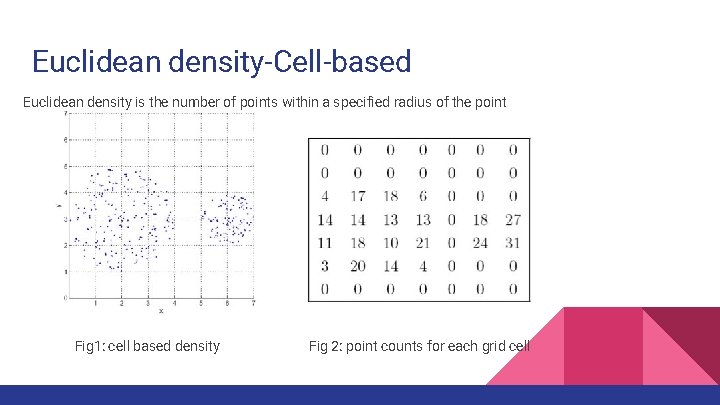
Euclidean density-Cell-based Euclidean density is the number of points within a specified radius of the point Fig 1: cell based density Fig 2: point counts for each grid cell
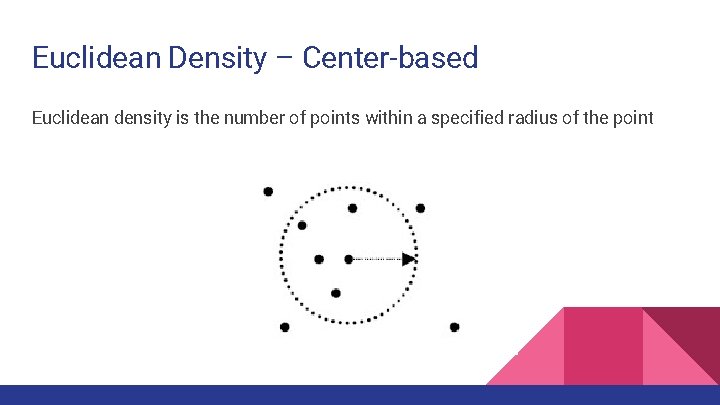
Euclidean Density – Center-based Euclidean density is the number of points within a specified radius of the point
- Slides: 23