
Data Mining Cluster Analysis 1002 DM 04 MI
- Slides: 30
Data Mining 資料探勘 分群分析 (Cluster Analysis) 1002 DM 04 MI 4 Thu. 9, 10 (16: 10 -18: 00) B 513 Min-Yuh Day 戴敏育 Assistant Professor 專任助理教授 Dept. of Information Management, Tamkang University 淡江大學 資訊管理學系 http: //mail. tku. edu. tw/myday/ 2012 -03 -08 1
課程大綱 (Syllabus) 週次 日期 1 101/02/16 2 101/02/23 3 101/03/01 4 101/03/08 5 101/03/15 內容(Subject/Topics) 資料探勘導論 (Introduction to Data Mining) 關連分析 (Association Analysis) 分類與預測 (Classification and Prediction) 分群分析 (Cluster Analysis) 個案分析與實作一 (分群分析): Banking Segmentation (Cluster Analysis – KMeans) 6 101/03/22 個案分析與實作二 (關連分析): Web Site Usage Associations ( Association Analysis) 7 101/03/29 期中報告 (Midterm Presentation) 8 101/04/05 教學行政觀摩日 (--No Class--) 2
課程大綱 (Syllabus) 週次 日期 內容(Subject/Topics) 9 101/04/12 個案分析與實作三 (決策樹、模型評估): Enrollment Management Case Study (Decision Tree, Model Evaluation 10 101/04/19 期中考試週 11 101/04/26 個案分析與實作四 (迴歸分析、類神經網路): Credit Risk Case Study (Regression Analysis, Artificial Neural Network) 12 101/05/03 文字探勘與網頁探勘 (Text and Web Mining) 13 101/05/10 社會網路分析、意見分析 (Social Network Analysis, Opinion Mining) 14 101/05/17 期末專題報告 (Term Project Presentation) 15 101/05/24 畢業考試週 3
Outline • Cluster Analysis • K-Means Clustering Source: Han & Kamber (2006) 4
Cluster Analysis • Used for automatic identification of natural groupings of things • Part of the machine-learning family • Employ unsupervised learning • Learns the clusters of things from past data, then assigns new instances • There is not an output variable • Also known as segmentation Source: Turban et al. (2011), Decision Support and Business Intelligence Systems 5
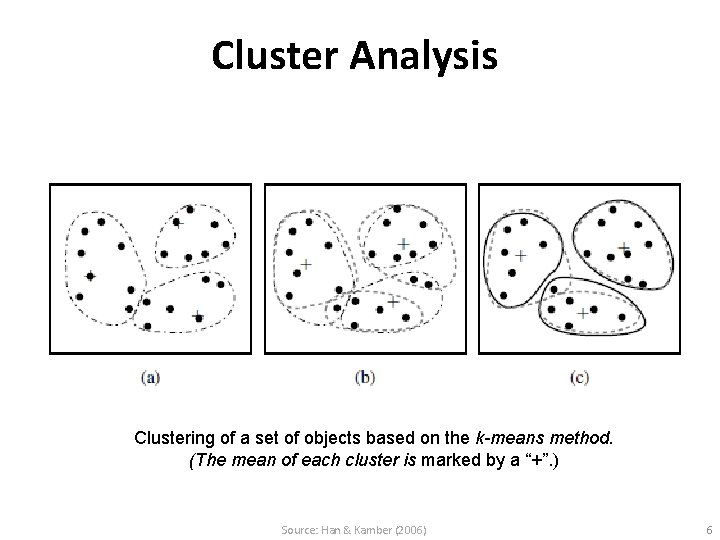
Cluster Analysis Clustering of a set of objects based on the k-means method. (The mean of each cluster is marked by a “+”. ) Source: Han & Kamber (2006) 6
Cluster Analysis • Clustering results may be used to – Identify natural groupings of customers – Identify rules for assigning new cases to classes for targeting/diagnostic purposes – Provide characterization, definition, labeling of populations – Decrease the size and complexity of problems for other data mining methods – Identify outliers in a specific domain (e. g. , rareevent detection) Source: Turban et al. (2011), Decision Support and Business Intelligence Systems 7
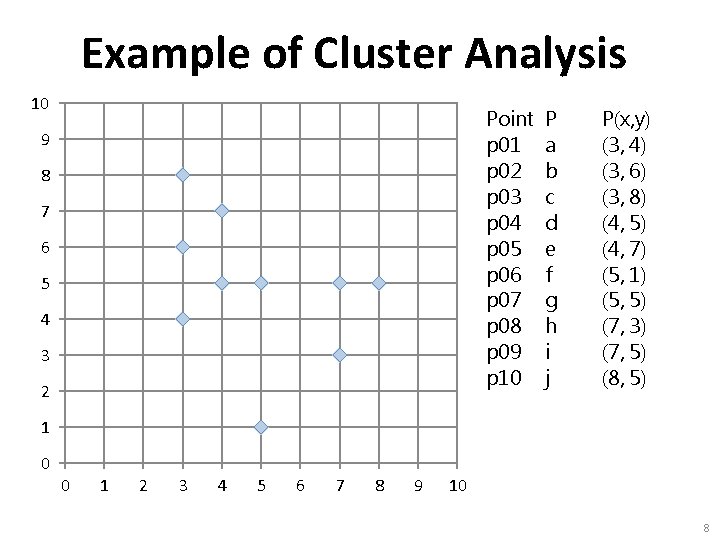
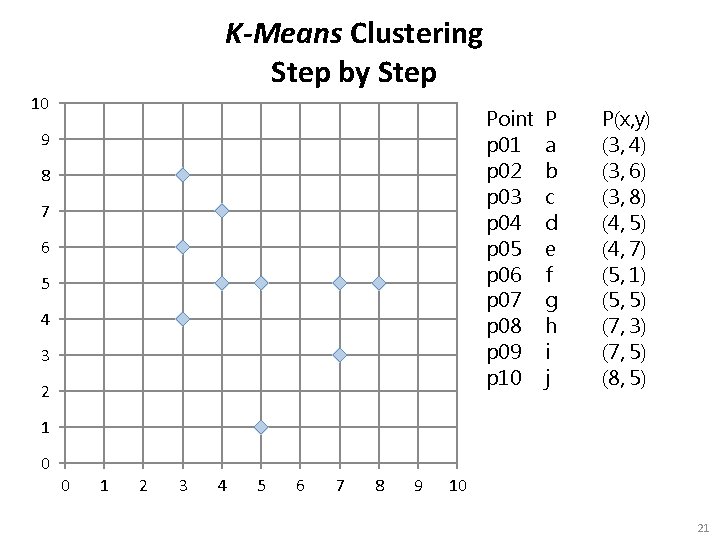
Example of Cluster Analysis 10 Point p 01 p 02 p 03 p 04 p 05 p 06 p 07 p 08 p 09 p 10 9 8 7 6 5 4 3 2 P a b c d e f g h i j P(x, y) (3, 4) (3, 6) (3, 8) (4, 5) (4, 7) (5, 1) (5, 5) (7, 3) (7, 5) (8, 5) 1 0 0 1 2 3 4 5 6 7 8 9 10 8
Cluster Analysis for Data Mining • Analysis methods – Statistical methods (including both hierarchical and nonhierarchical), such as k-means, k-modes, and so on – Neural networks (adaptive resonance theory [ART], self-organizing map [SOM]) – Fuzzy logic (e. g. , fuzzy c-means algorithm) – Genetic algorithms • Divisive versus Agglomerative methods Source: Turban et al. (2011), Decision Support and Business Intelligence Systems 9
Cluster Analysis for Data Mining • How many clusters? – There is not a “truly optimal” way to calculate it – Heuristics are often used 1. 2. 3. 4. Look at the sparseness of clusters Number of clusters = (n/2)1/2 (n: no of data points) Use Akaike information criterion (AIC) Use Bayesian information criterion (BIC) • Most cluster analysis methods involve the use of a distance measure to calculate the closeness between pairs of items – Euclidian versus Manhattan (rectilinear) distance Source: Turban et al. (2011), Decision Support and Business Intelligence Systems 10
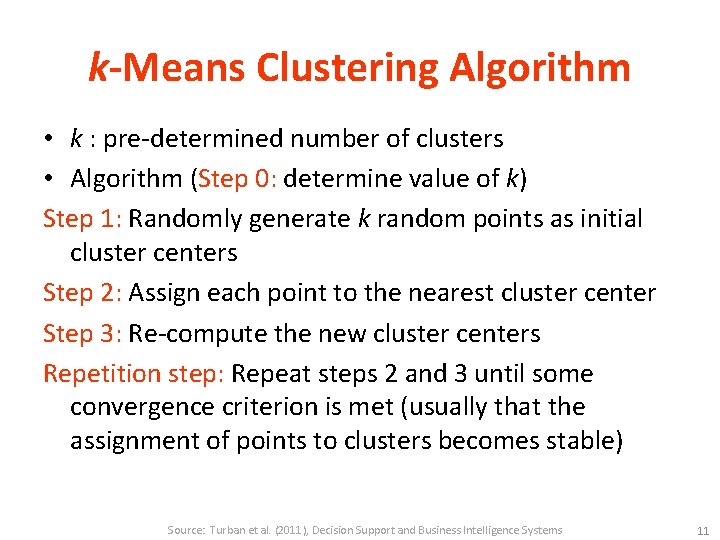
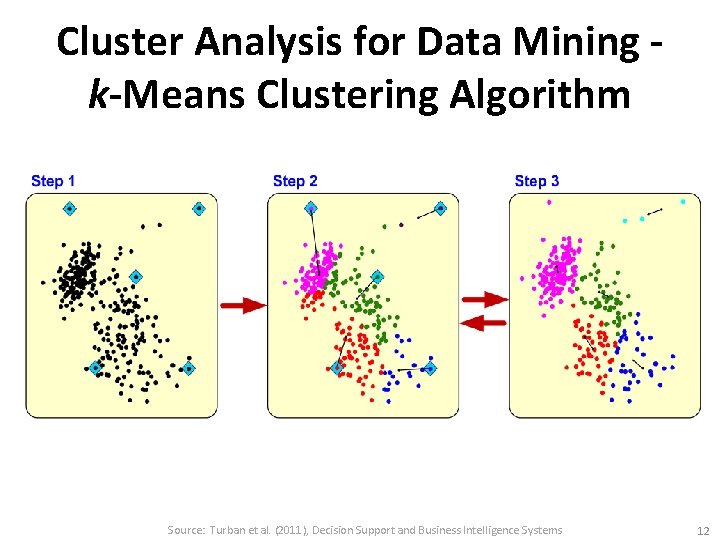
k-Means Clustering Algorithm • k : pre-determined number of clusters • Algorithm (Step 0: determine value of k) Step 1: Randomly generate k random points as initial cluster centers Step 2: Assign each point to the nearest cluster center Step 3: Re-compute the new cluster centers Repetition step: Repeat steps 2 and 3 until some convergence criterion is met (usually that the assignment of points to clusters becomes stable) Source: Turban et al. (2011), Decision Support and Business Intelligence Systems 11
Cluster Analysis for Data Mining k-Means Clustering Algorithm Source: Turban et al. (2011), Decision Support and Business Intelligence Systems 12
Quality: What Is Good Clustering? • A good clustering method will produce high quality clusters with – high intra-class similarity – low inter-class similarity • The quality of a clustering result depends on both the similarity measure used by the method and its implementation • The quality of a clustering method is also measured by its ability to discover some or all of the hidden patterns Source: Han & Kamber (2006) 13
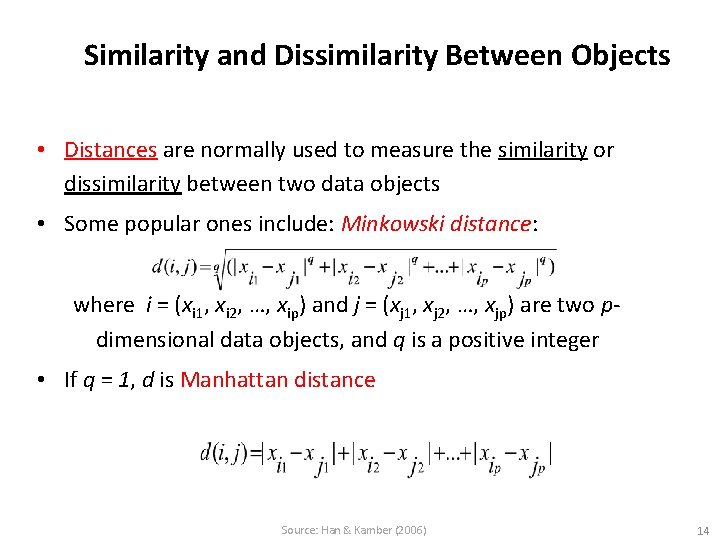
Similarity and Dissimilarity Between Objects • Distances are normally used to measure the similarity or dissimilarity between two data objects • Some popular ones include: Minkowski distance: where i = (xi 1, xi 2, …, xip) and j = (xj 1, xj 2, …, xjp) are two pdimensional data objects, and q is a positive integer • If q = 1, d is Manhattan distance Source: Han & Kamber (2006) 14
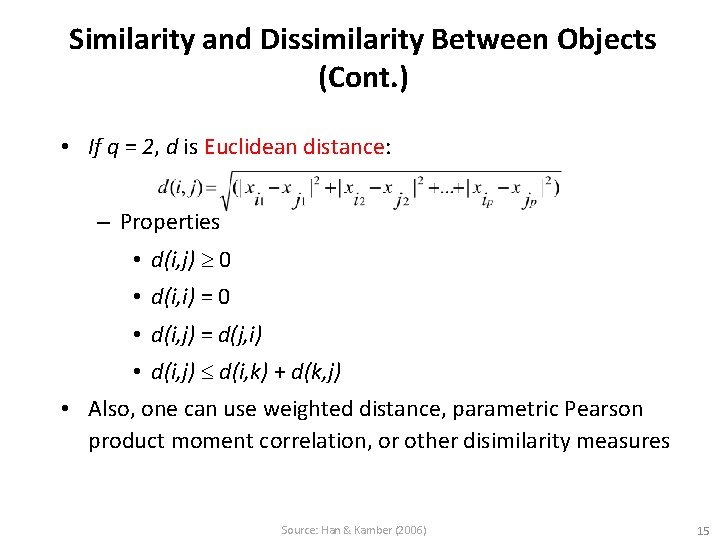
Similarity and Dissimilarity Between Objects (Cont. ) • If q = 2, d is Euclidean distance: – Properties • d(i, j) 0 • d(i, i) = 0 • d(i, j) = d(j, i) • d(i, j) d(i, k) + d(k, j) • Also, one can use weighted distance, parametric Pearson product moment correlation, or other disimilarity measures Source: Han & Kamber (2006) 15
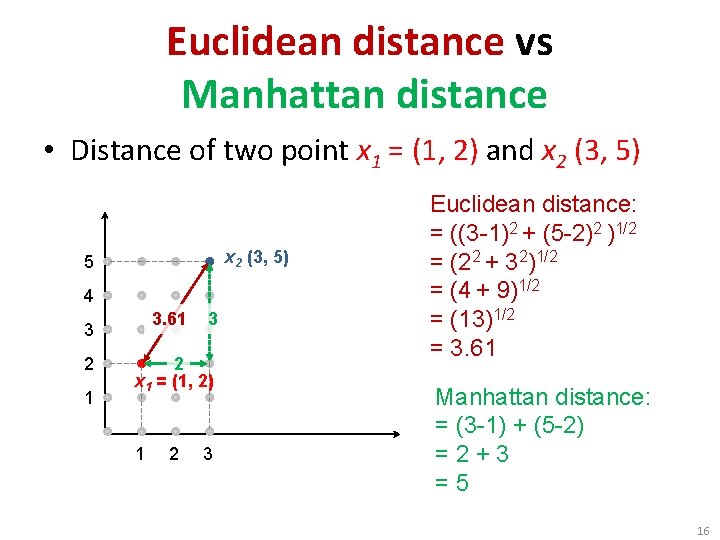
Euclidean distance vs Manhattan distance • Distance of two point x 1 = (1, 2) and x 2 (3, 5) 5 4 3. 61 3 2 x 1 = (1, 2) 1 2 3 Euclidean distance: = ((3 -1)2 + (5 -2)2 )1/2 = (22 + 32)1/2 = (4 + 9)1/2 = (13)1/2 = 3. 61 Manhattan distance: = (3 -1) + (5 -2) =2+3 =5 16
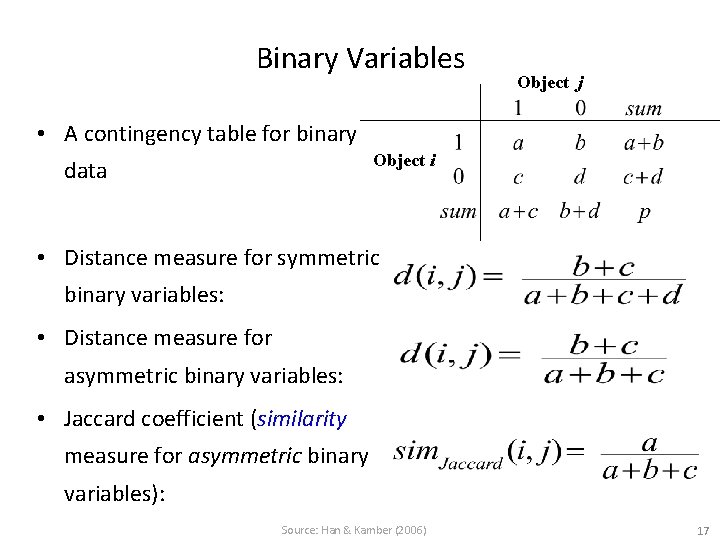
Binary Variables Object j • A contingency table for binary Object i data • Distance measure for symmetric binary variables: • Distance measure for asymmetric binary variables: • Jaccard coefficient (similarity measure for asymmetric binary variables): Source: Han & Kamber (2006) 17
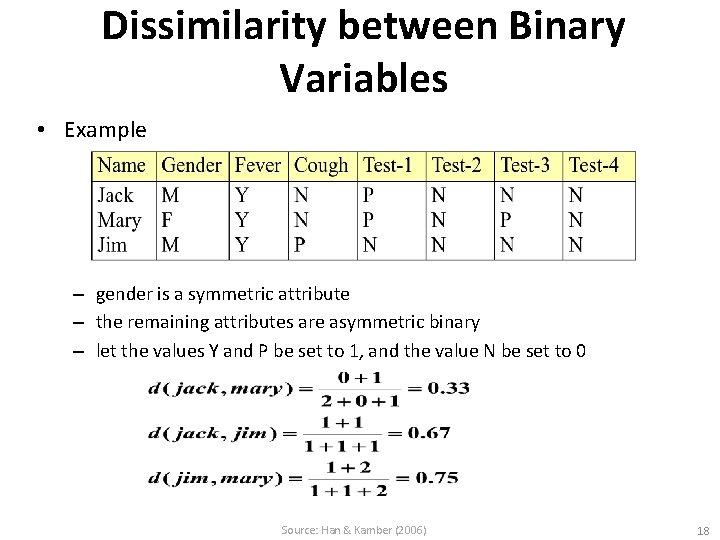
Dissimilarity between Binary Variables • Example – gender is a symmetric attribute – the remaining attributes are asymmetric binary – let the values Y and P be set to 1, and the value N be set to 0 Source: Han & Kamber (2006) 18
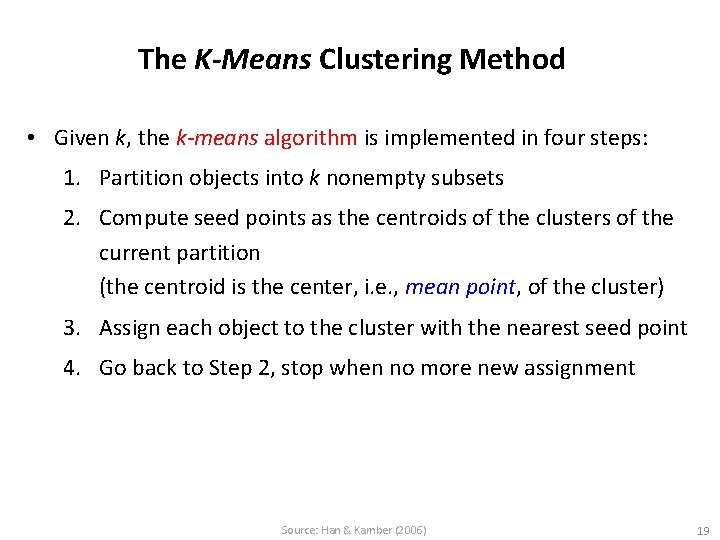
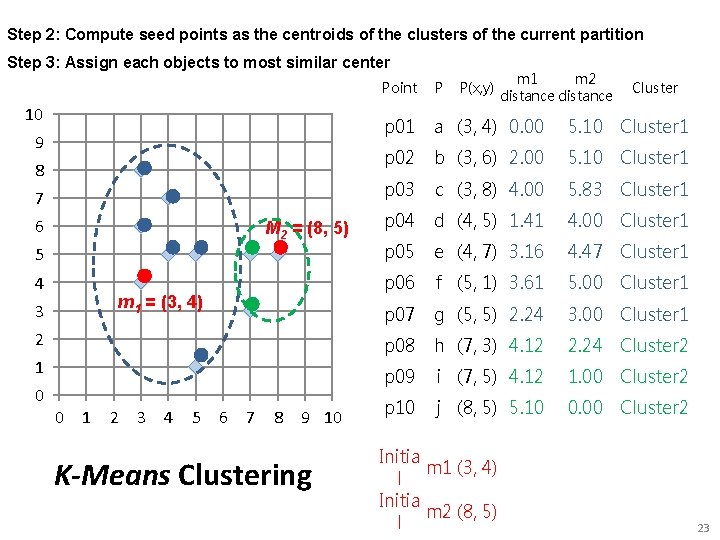
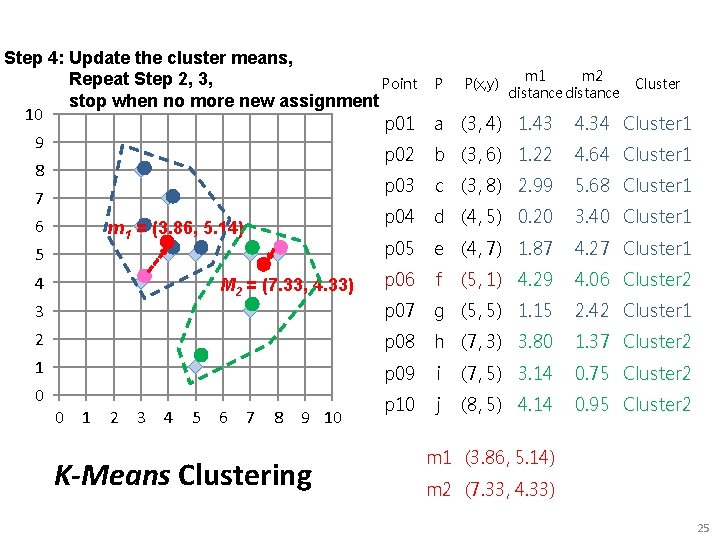
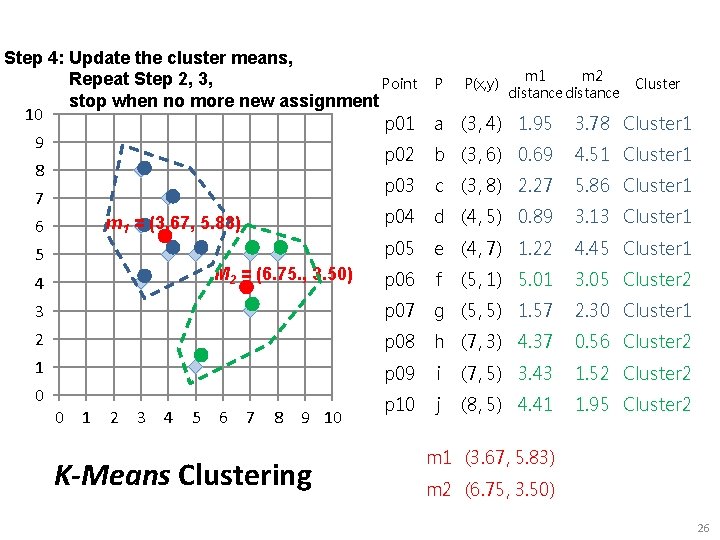
The K-Means Clustering Method • Given k, the k-means algorithm is implemented in four steps: 1. Partition objects into k nonempty subsets 2. Compute seed points as the centroids of the clusters of the current partition (the centroid is the center, i. e. , mean point, of the cluster) 3. Assign each object to the cluster with the nearest seed point 4. Go back to Step 2, stop when no more new assignment Source: Han & Kamber (2006) 19
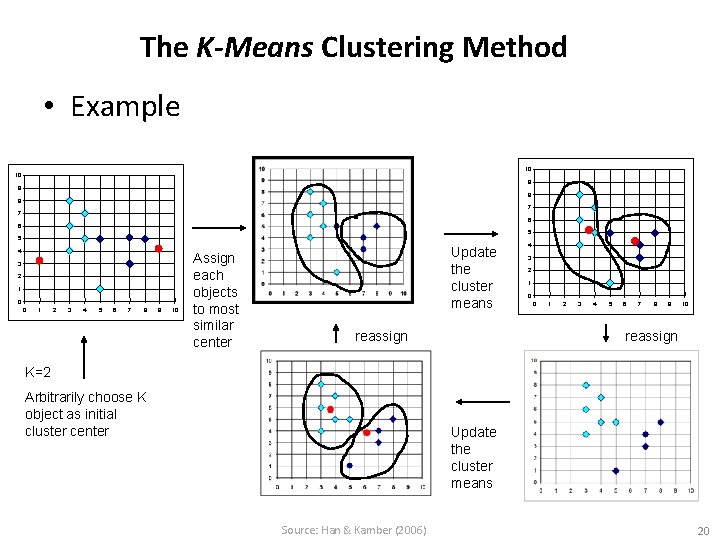
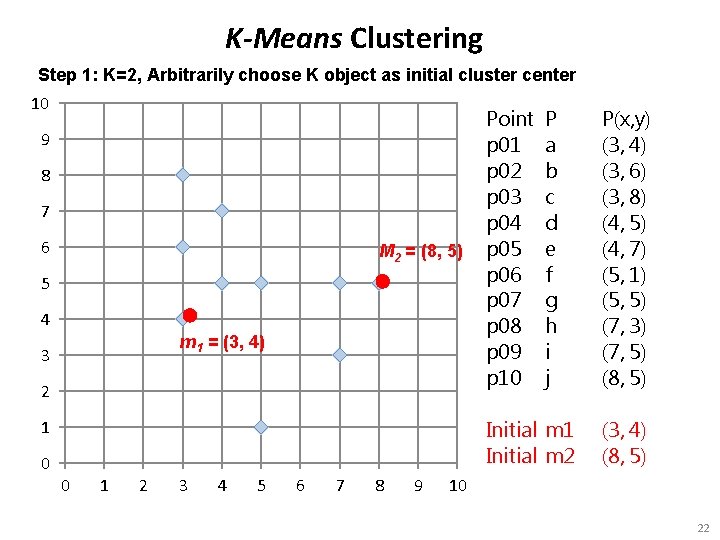
The K-Means Clustering Method • Example 10 10 9 9 8 8 7 7 6 6 5 5 4 3 2 1 0 0 1 2 3 4 5 6 7 8 9 10 Assign each objects to most similar center Update the cluster means reassign 4 3 2 1 0 0 1 2 3 4 5 6 7 8 9 10 reassign K=2 Arbitrarily choose K object as initial cluster center Update the cluster means Source: Han & Kamber (2006) 20
K-Means Clustering Step by Step 10 Point p 01 p 02 p 03 p 04 p 05 p 06 p 07 p 08 p 09 p 10 9 8 7 6 5 4 3 2 P a b c d e f g h i j P(x, y) (3, 4) (3, 6) (3, 8) (4, 5) (4, 7) (5, 1) (5, 5) (7, 3) (7, 5) (8, 5) 1 0 0 1 2 3 4 5 6 7 8 9 10 21
K-Means Clustering Step 1: K=2, Arbitrarily choose K object as initial cluster center 10 9 8 7 6 M 2 = (8, 5) 5 4 m 1 = (3, 4) 3 2 P a b c d e f g h i j Initial m 1 Initial m 2 1 0 Point p 01 p 02 p 03 p 04 p 05 p 06 p 07 p 08 p 09 p 10 0 1 2 3 4 5 6 7 8 9 P(x, y) (3, 4) (3, 6) (3, 8) (4, 5) (4, 7) (5, 1) (5, 5) (7, 3) (7, 5) (8, 5) (3, 4) (8, 5) 10 22
Step 2: Compute seed points as the centroids of the clusters of the current partition Step 3: Assign each objects to most similar center P p 01 a (3, 4) 0. 00 5. 10 Cluster 1 p 02 b (3, 6) 2. 00 5. 10 Cluster 1 p 03 c (3, 8) 4. 00 5. 83 Cluster 1 p 04 d (4, 5) 1. 41 4. 00 Cluster 1 5 p 05 e (4, 7) 3. 16 4. 47 Cluster 1 4 p 06 f (5, 1) 3. 61 5. 00 Cluster 1 p 07 g (5, 5) 2. 24 3. 00 Cluster 1 p 08 h (7, 3) 4. 12 2. 24 Cluster 2 p 09 i (7, 5) 4. 12 1. 00 Cluster 2 p 10 j (8, 5) 5. 10 0. 00 Cluster 2 10 9 8 7 6 M 2 = (8, 5) m 1 = (3, 4) 3 2 1 0 0 1 2 3 4 5 6 7 8 9 10 K-Means Clustering P(x, y) m 1 m 2 distance Point Initia m 1 (3, 4) l Initia m 2 (8, 5) l Cluster 23
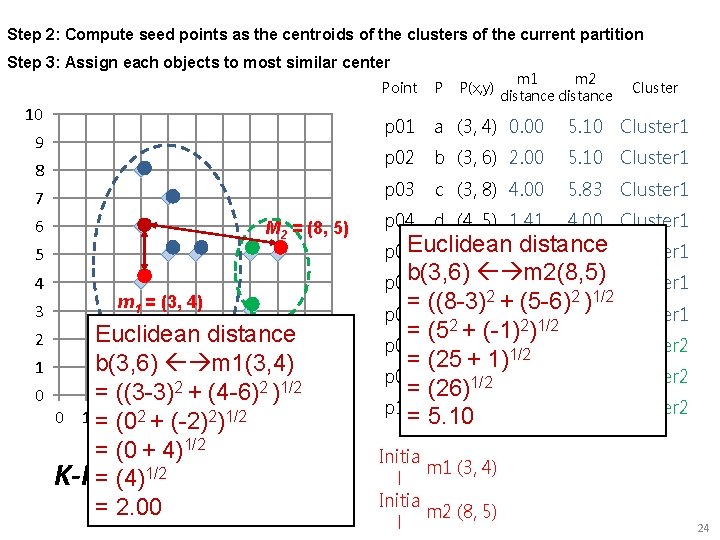
Step 2: Compute seed points as the centroids of the clusters of the current partition Step 3: Assign each objects to most similar center 10 9 8 7 6 M 2 = (8, 5) 5 4 3 2 1 0 P Cluster p 01 a (3, 4) 0. 00 5. 10 Cluster 1 p 02 b (3, 6) 2. 00 5. 10 Cluster 1 p 03 c (3, 8) 4. 00 5. 83 Cluster 1 p 04 d (4, 5) 1. 41 4. 00 Cluster 1 distance p 05 Euclidean e (4, 7) 3. 16 4. 47 Cluster 1 p 06 b(3, 6) f (5, m 2(8, 5) 1) 3. 61 5. 00 Cluster 1 m 1 = (3, 4) Euclidean distance b(3, 6) m 1(3, 4) = ((3 -3)2 + (4 -6)2 )1/2 0 1 =2(032 +4(-2) 5 2)61/27 8 9 = (0 + 4)1/2 K-Means = (4)1/2 Clustering = 2. 00 P(x, y) m 1 m 2 distance Point 10 2 + (5 -6)2 )1/2 = ((8 -3) p 07 g (5, 5) 2. 24 3. 00 Cluster 1 = (52 + (-1)2)1/2 p 08 h (7, 3) 1/2 4. 12 2. 24 Cluster 2 = (25 + 1) p 09 i (7, 1/2 5) 4. 12 1. 00 Cluster 2 = (26) p 10 j (8, 5) 5. 10 0. 00 Cluster 2 = 5. 10 Initia m 1 (3, 4) l Initia m 2 (8, 5) l 24
Step 4: Update the cluster means, Repeat Step 2, 3, Point stop when no more new assignment 10 p 01 9 p 02 8 p 03 7 p 04 6 m 1 = (3. 86, 5. 14) p 05 5 p 06 4 M = (7. 33, 4. 33) P P(x, y) m 1 m 2 distance Cluster a (3, 4) 1. 43 4. 34 Cluster 1 b (3, 6) 1. 22 4. 64 Cluster 1 c (3, 8) 2. 99 5. 68 Cluster 1 d (4, 5) 0. 20 3. 40 Cluster 1 e (4, 7) 1. 87 4. 27 Cluster 1 f (5, 1) 4. 29 4. 06 Cluster 2 3 p 07 g (5, 5) 1. 15 2. 42 Cluster 1 2 p 08 h (7, 3) 3. 80 1. 37 Cluster 2 1 p 09 i (7, 5) 3. 14 0. 75 Cluster 2 p 10 j (8, 5) 4. 14 0. 95 Cluster 2 2 0 0 1 2 3 4 5 6 7 8 9 10 K-Means Clustering m 1 (3. 86, 5. 14) m 2 (7. 33, 4. 33) 25
Step 4: Update the cluster means, Repeat Step 2, 3, Point stop when no more new assignment 10 p 01 9 p 02 8 p 03 7 p 04 m 1 = (3. 67, 5. 83) 6 p 05 5 M 2 = (6. 75. , 3. 50) p 06 4 P P(x, y) m 1 m 2 distance Cluster a (3, 4) 1. 95 3. 78 Cluster 1 b (3, 6) 0. 69 4. 51 Cluster 1 c (3, 8) 2. 27 5. 86 Cluster 1 d (4, 5) 0. 89 3. 13 Cluster 1 e (4, 7) 1. 22 4. 45 Cluster 1 f (5, 1) 5. 01 3. 05 Cluster 2 3 p 07 g (5, 5) 1. 57 2. 30 Cluster 1 2 p 08 h (7, 3) 4. 37 0. 56 Cluster 2 1 p 09 i (7, 5) 3. 43 1. 52 Cluster 2 p 10 j (8, 5) 4. 41 1. 95 Cluster 2 0 0 1 2 3 4 5 6 7 8 9 10 K-Means Clustering m 1 (3. 67, 5. 83) m 2 (6. 75, 3. 50) 26
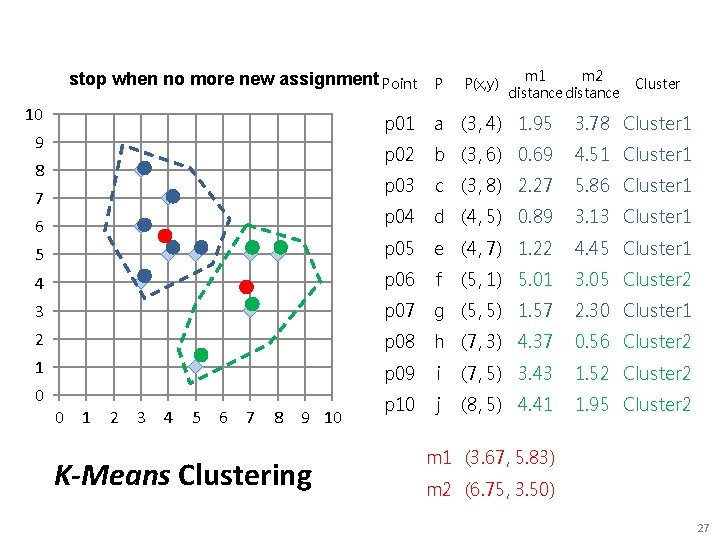
stop when no more new assignment Point 10 p 01 P P(x, y) m 1 m 2 distance Cluster a (3, 4) 1. 95 3. 78 Cluster 1 p 02 b (3, 6) 0. 69 4. 51 Cluster 1 p 03 c (3, 8) 2. 27 5. 86 Cluster 1 p 04 d (4, 5) 0. 89 3. 13 Cluster 1 5 p 05 e (4, 7) 1. 22 4. 45 Cluster 1 4 p 06 f (5, 1) 5. 01 3. 05 Cluster 2 3 p 07 g (5, 5) 1. 57 2. 30 Cluster 1 2 p 08 h (7, 3) 4. 37 0. 56 Cluster 2 1 p 09 i (7, 5) 3. 43 1. 52 Cluster 2 p 10 j (8, 5) 4. 41 1. 95 Cluster 2 9 8 7 6 0 0 1 2 3 4 5 6 7 8 9 10 K-Means Clustering m 1 (3. 67, 5. 83) m 2 (6. 75, 3. 50) 27
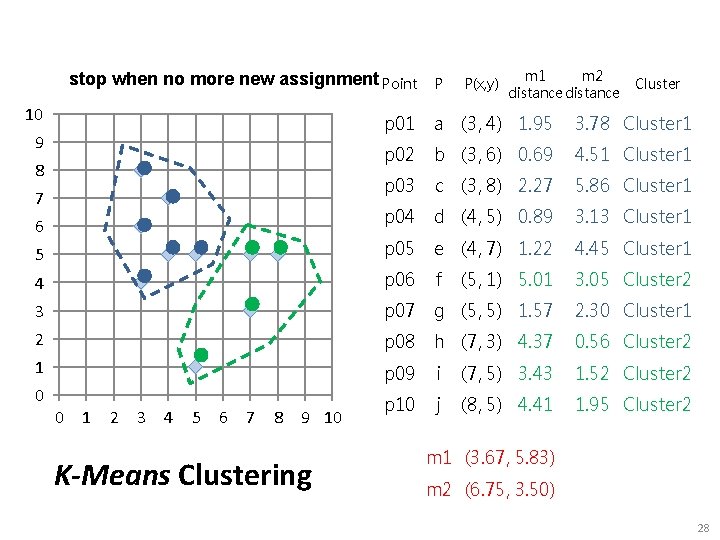
stop when no more new assignment Point 10 p 01 P P(x, y) m 1 m 2 distance Cluster a (3, 4) 1. 95 3. 78 Cluster 1 p 02 b (3, 6) 0. 69 4. 51 Cluster 1 p 03 c (3, 8) 2. 27 5. 86 Cluster 1 p 04 d (4, 5) 0. 89 3. 13 Cluster 1 5 p 05 e (4, 7) 1. 22 4. 45 Cluster 1 4 p 06 f (5, 1) 5. 01 3. 05 Cluster 2 3 p 07 g (5, 5) 1. 57 2. 30 Cluster 1 2 p 08 h (7, 3) 4. 37 0. 56 Cluster 2 1 p 09 i (7, 5) 3. 43 1. 52 Cluster 2 p 10 j (8, 5) 4. 41 1. 95 Cluster 2 9 8 7 6 0 0 1 2 3 4 5 6 7 8 9 10 K-Means Clustering m 1 (3. 67, 5. 83) m 2 (6. 75, 3. 50) 28
Summary • Cluster Analysis • K-Means Clustering Source: Han & Kamber (2006) 29
References • Jiawei Han and Micheline Kamber, Data Mining: Concepts and Techniques, Second Edition, 2006, Elsevier • Efraim Turban, Ramesh Sharda, Dursun Delen, Decision Support and Business Intelligence Systems, Ninth Edition, 2011, Pearson. 30