
Data Management Maturity How It Can Leverages Your

- Slides: 48
Data Management Maturity: How It Can Leverages Your Data Management Expertise Milwaukee, Wisconsin December 1, 2016 This presentation is intended for the sole use of the organization or group to which it is presented. SM DMM Model, EDME, DMM LA, CMM Integration, SCAMPI Lead Appraiser, TSP, and IDEAL are service marks of CMMI Institute. ® CMMI, Capability Maturity Modeling, and CMM registered in the US Patent and Trademark Office by Carnegie Mellon University.
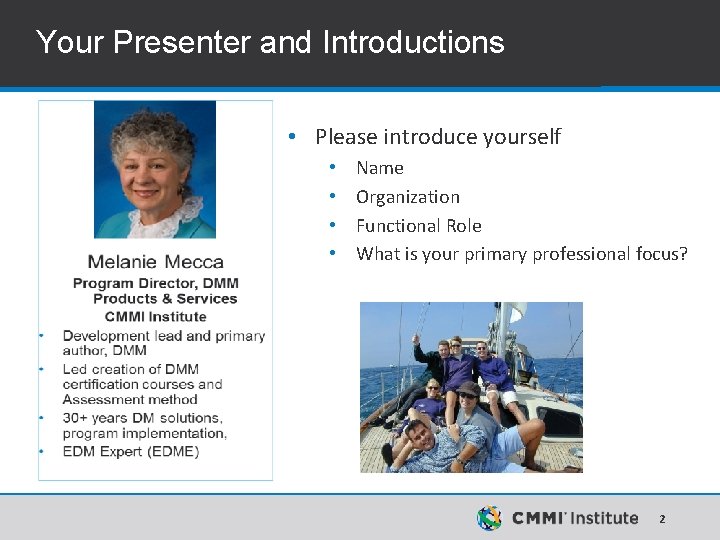
Your Presenter and Introductions • Please introduce yourself • • Name Organization Functional Role What is your primary professional focus? 2
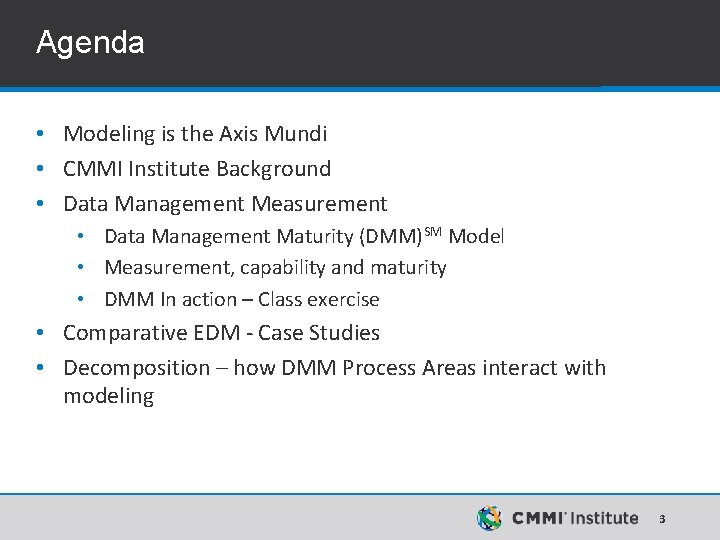
Agenda • Modeling is the Axis Mundi • CMMI Institute Background • Data Management Measurement • Data Management Maturity (DMM)SM Model • Measurement, capability and maturity • DMM In action – Class exercise • Comparative EDM - Case Studies • Decomposition – how DMM Process Areas interact with modeling 3
Where it all started “The achievements of data modelers over the past decades have been a solid foundation for transforming the thinking of the data management industry. ” “Data models and modeling form the conceptual background for almost all data management disciplines. ” Data Model Scorecard Chapter 3, DMM Context (And let’s add the conclusion for today’s seminar ) “ If you’ve been a data architect / modeler, you already know virtually everything you need to know to plan and implement an enterprise data management program. ” 4
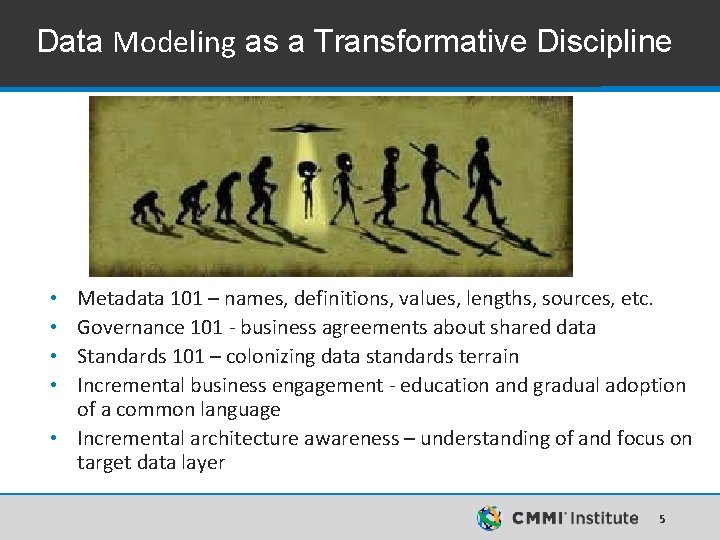
Data Modeling as a Transformative Discipline Metadata 101 – names, definitions, values, lengths, sources, etc. Governance 101 - business agreements about shared data Standards 101 – colonizing data standards terrain Incremental business engagement - education and gradual adoption of a common language • Incremental architecture awareness – understanding of and focus on target data layer • • 5
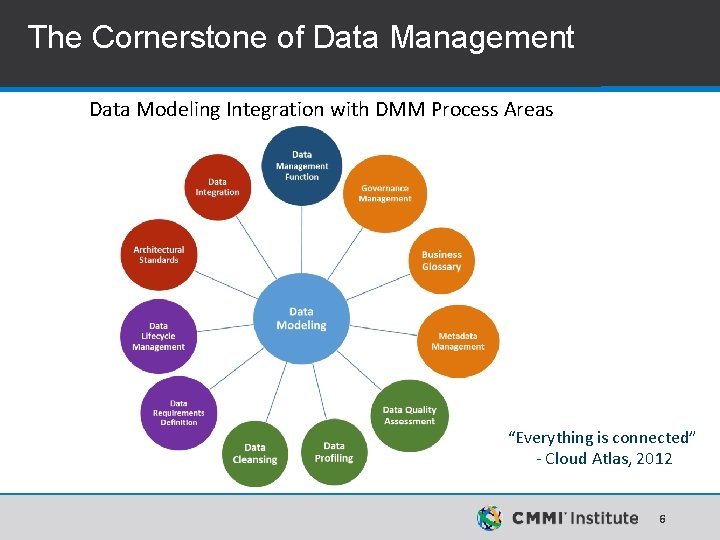
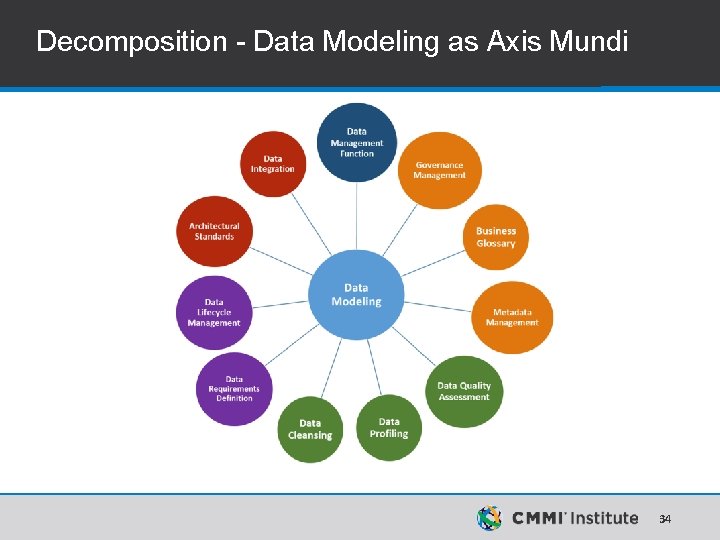
The Cornerstone of Data Management Data Modeling Integration with DMM Process Areas “Everything is connected” - Cloud Atlas, 2012 6
CMMI Institute Background • Evolved from Carnegie Mellon’s Software Engineering Institute (SEI) - a federally funded research and development center (FFRDC) • Continues to support and provide all CMMI offerings and services delivered over its 20+ year history at the SEI o Industry leading reference models - benchmarks and guidelines for improvement – Development, Acquisition, Services, People, Data Management o Training and Certification program, Partner program • Dedicated training, partner and certification teams to support organizations and professionals • Now owned by ISACA (CISO/M, COBIT, IT Governance, Cybersecurity) and joint product offerings are planned 7
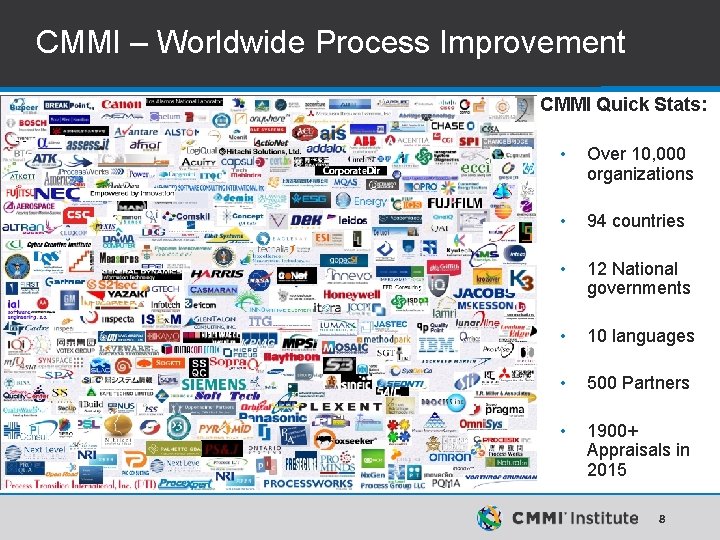
CMMI – Worldwide Process Improvement CMMI Quick Stats: • Over 10, 000 organizations • 94 countries • 12 National governments • 10 languages • 500 Partners • 1900+ Appraisals in 2015 8
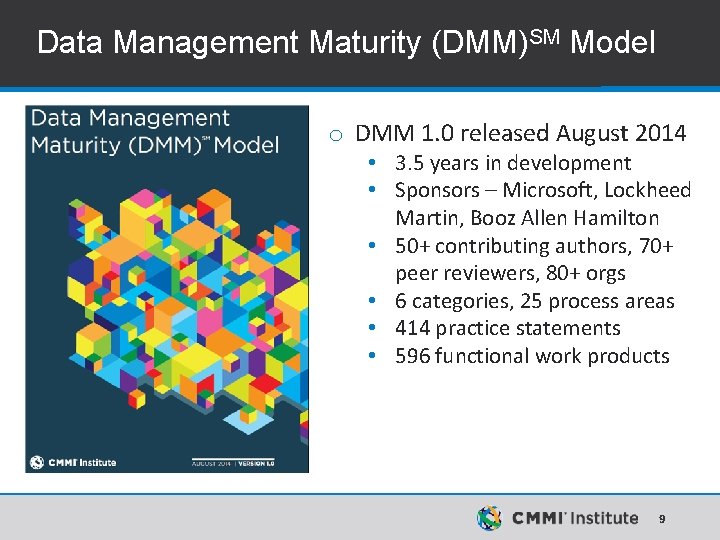
Data Management Maturity (DMM)SM Model o DMM 1. 0 released August 2014 • 3. 5 years in development • Sponsors – Microsoft, Lockheed Martin, Booz Allen Hamilton • 50+ contributing authors, 70+ peer reviewers, 80+ orgs • 6 categories, 25 process areas • 414 practice statements • 596 functional work products 9
DMM - Guided Navigation to Lasting Solutions • Reference model framework of fundamental data management best practices • Measurement instrument for organizations to evaluate capability maturity, identify gaps, and incorporate guidelines for improvements • Developed by CMMI Institute with corporate sponsors and 50+ expert authors • Answers: “How are we doing now? ” • Guides: “What should we do next? ” • Baseline for: Integrated program, high value initiatives and improvements 10
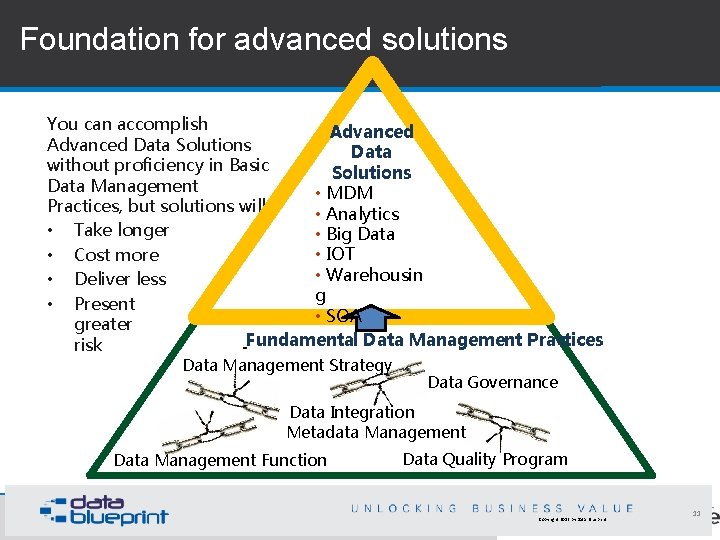
Foundation for advanced solutions You can accomplish Advanced Data Solutions Data without proficiency in Basic Solutions Data Management • MDM Practices, but solutions will: • Analytics • Take longer • Big Data • IOT • Cost more • Warehousin • Deliver less g • Present • SOA greater Fundamental Data Management Practices risk Data Management Strategy Data Governance Data Integration Metadata Management Data Management Function Data Quality Program Copyright 2013 by Data Blueprint 11 11 1 1
Foundation for Business Results • Trusted Data – demonstrated, independently measured capability to ensure customer confidence in the data • Improved Risk and Analytics Decisions – comprehensive and measured DM strategy ensures decisions are based on accurate data • Cost Reduction/Operational Efficiency – identification of current and target states supports elimination of redundant data and streamlining of processes and systems • Regulatory Compliance – independently evaluated and measured DM capabilities to meet and substantiate industry and regulator requirements 12
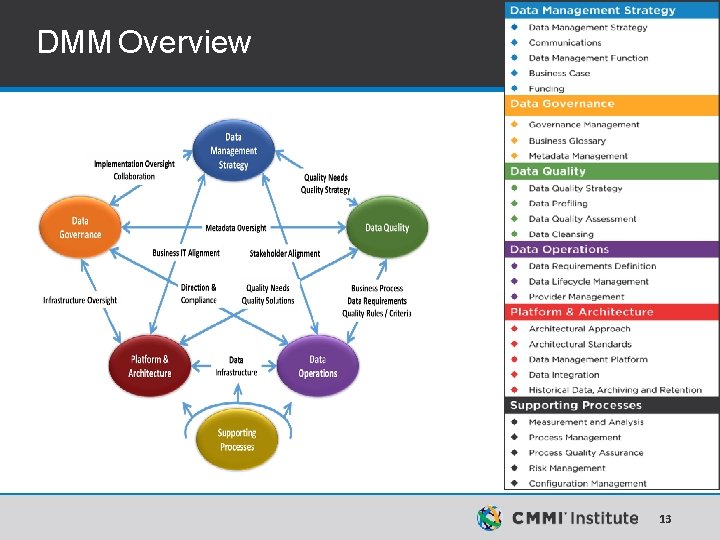
DMM Overview 13
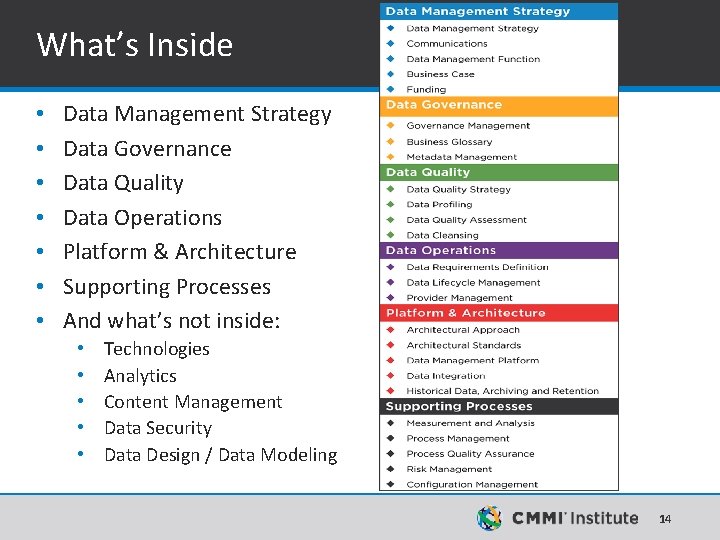
What’s Inside • • Data Management Strategy Data Governance Data Quality Data Operations Platform & Architecture Supporting Processes And what’s not inside: • • • Technologies Analytics Content Management Data Security Data Design / Data Modeling 14
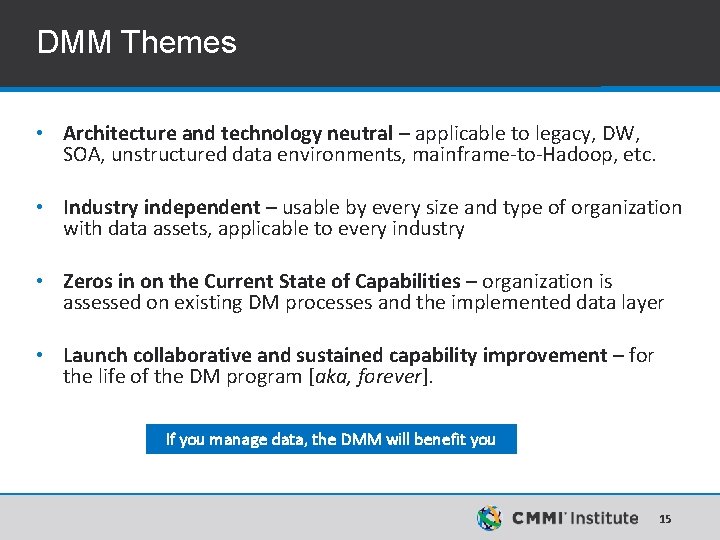
DMM Themes • Architecture and technology neutral – applicable to legacy, DW, SOA, unstructured data environments, mainframe-to-Hadoop, etc. • Industry independent – usable by every size and type of organization with data assets, applicable to every industry • Zeros in on the Current State of Capabilities – organization is assessed on existing DM processes and the implemented data layer • Launch collaborative and sustained capability improvement – for the life of the DM program [aka, forever]. If you manage data, the DMM will benefit you 15
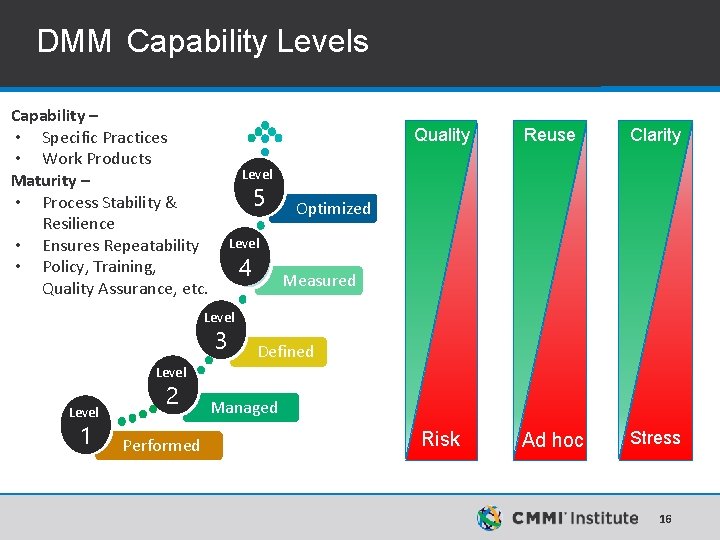
DMM Capability Levels Capability – • Specific Practices • Work Products Maturity – • Process Stability & Resilience • Ensures Repeatability • Policy, Training, Quality Assurance, etc. Quality Reuse Clarity Risk Ad hoc Stress Level 5 Optimized Level 4 Measured Level 3 Defined Level 1 2 Performed Managed 16
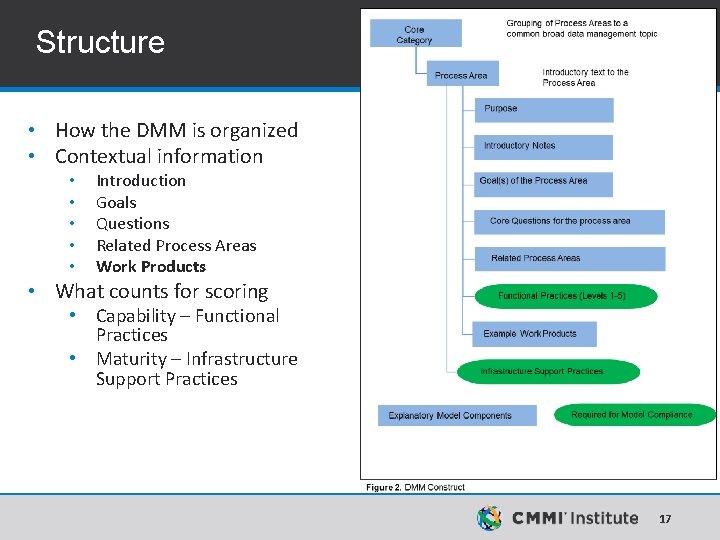
Structure • How the DMM is organized • Contextual information • • • Introduction Goals Questions Related Process Areas Work Products • What counts for scoring • Capability – Functional Practices • Maturity – Infrastructure Support Practices 17
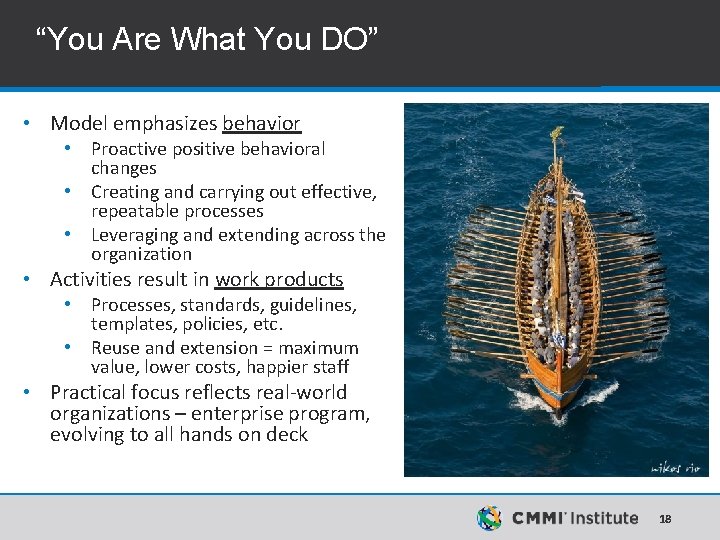
“You Are What You DO” • Model emphasizes behavior • Proactive positive behavioral changes • Creating and carrying out effective, repeatable processes • Leveraging and extending across the organization • Activities result in work products • Processes, standards, guidelines, templates, policies, etc. • Reuse and extension = maximum value, lower costs, happier staff • Practical focus reflects real-world organizations – enterprise program, evolving to all hands on deck 18
DMM and DMBOK CMMI Institute and DAMA International are collaborating to: • Eliminate any confusion between the two tools and highlight their complementarity • Extend and enhance data management training for organizations and professionals • Provide benefits to DAMA members (members receive a discount for our public training classes) • DMM represents another cool power tool in your ammo box – a substantive approach to help your organization. 19
Let’s Test-Drive the DMM • Class Exercise – evaluate an organization of your choice against the DMM on its Business Glossary Practices • Why Business Glossary? • Instructions – 10 minutes • Select an organization – your current organization or a previous organization • Read the excerpt through Level 3 • Determine if each statement is Fully Met, Partially Met, or Not Met for the organization • Note your answers by statement number • We’ll discuss the scores together 20
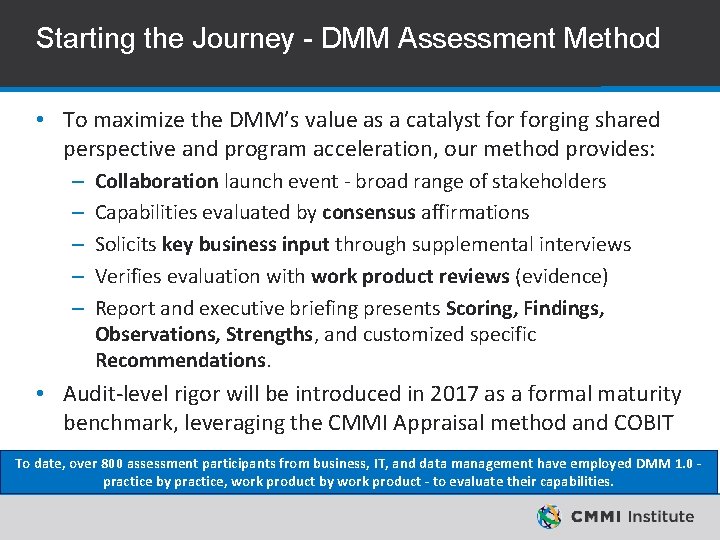
Starting the Journey - DMM Assessment Method • To maximize the DMM’s value as a catalyst forging shared perspective and program acceleration, our method provides: – – – Collaboration launch event - broad range of stakeholders Capabilities evaluated by consensus affirmations Solicits key business input through supplemental interviews Verifies evaluation with work product reviews (evidence) Report and executive briefing presents Scoring, Findings, Observations, Strengths, and customized specific Recommendations. • Audit-level rigor will be introduced in 2017 as a formal maturity benchmark, leveraging the CMMI Appraisal method and COBIT To date, over 800 assessment participants from business, IT, and data management have employed DMM 1. 0 practice by practice, work product by work product - to evaluate their capabilities.
DMM Assessment Summary Sample Organization 22
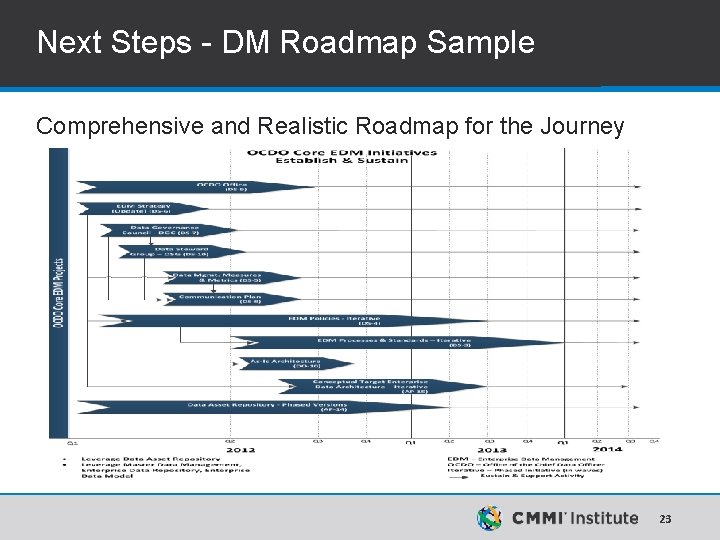
Next Steps - DM Roadmap Sample Comprehensive and Realistic Roadmap for the Journey 23
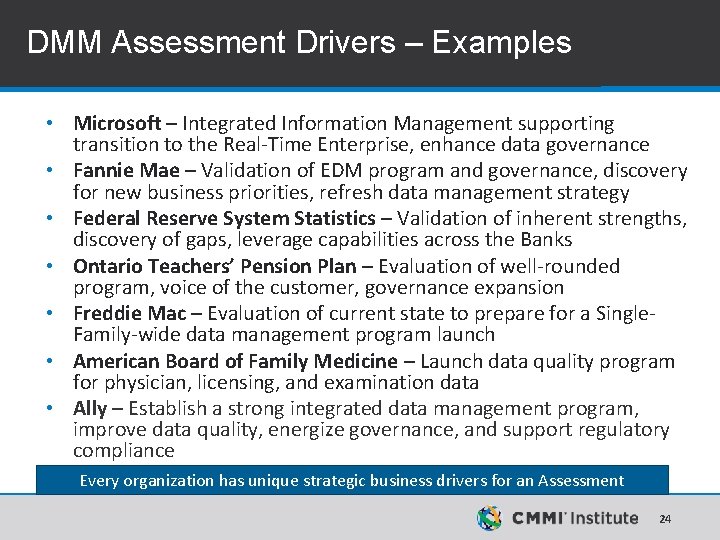
DMM Assessment Drivers – Examples • Microsoft – Integrated Information Management supporting transition to the Real-Time Enterprise, enhance data governance • Fannie Mae – Validation of EDM program and governance, discovery for new business priorities, refresh data management strategy • Federal Reserve System Statistics – Validation of inherent strengths, discovery of gaps, leverage capabilities across the Banks • Ontario Teachers’ Pension Plan – Evaluation of well-rounded program, voice of the customer, governance expansion • Freddie Mac – Evaluation of current state to prepare for a Single. Family-wide data management program launch • American Board of Family Medicine – Launch data quality program for physician, licensing, and examination data • Ally – Establish a strong integrated data management program, improve data quality, energize governance, and support regulatory compliance Every organization has unique strategic business drivers for an Assessment 24
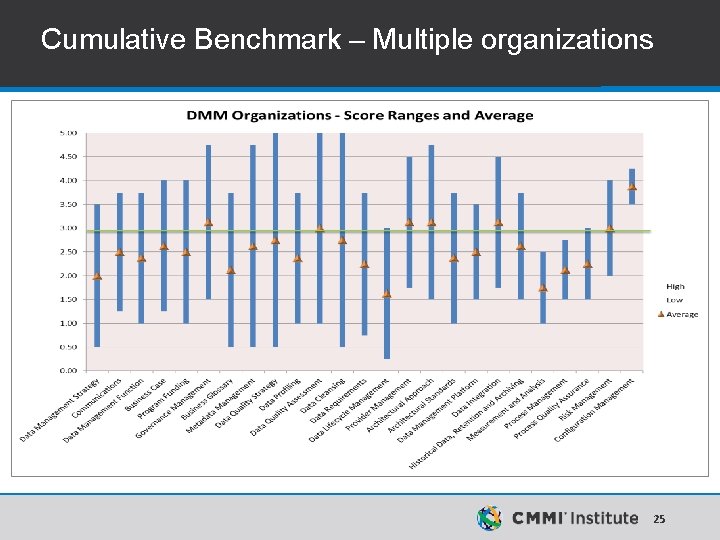
Cumulative Benchmark – Multiple organizations 25
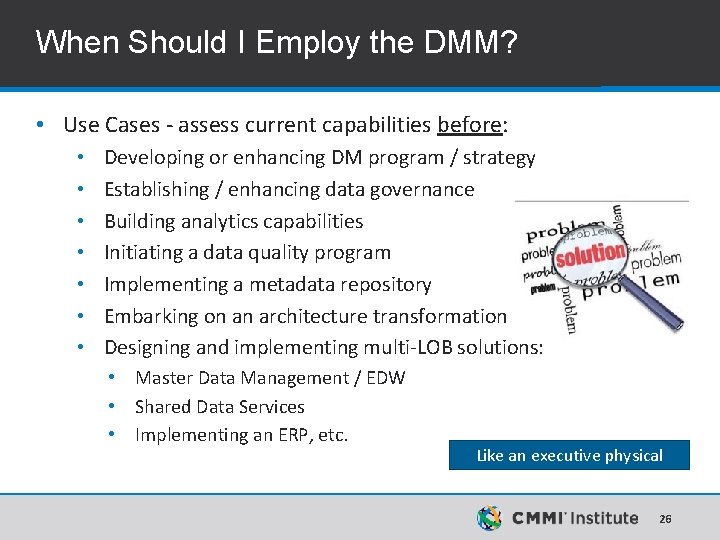
When Should I Employ the DMM? • Use Cases - assess current capabilities before: • • Developing or enhancing DM program / strategy Establishing / enhancing data governance Building analytics capabilities Initiating a data quality program Implementing a metadata repository Embarking on an architecture transformation Designing and implementing multi-LOB solutions: • Master Data Management / EDW • Shared Data Services • Implementing an ERP, etc. Like an executive physical 26
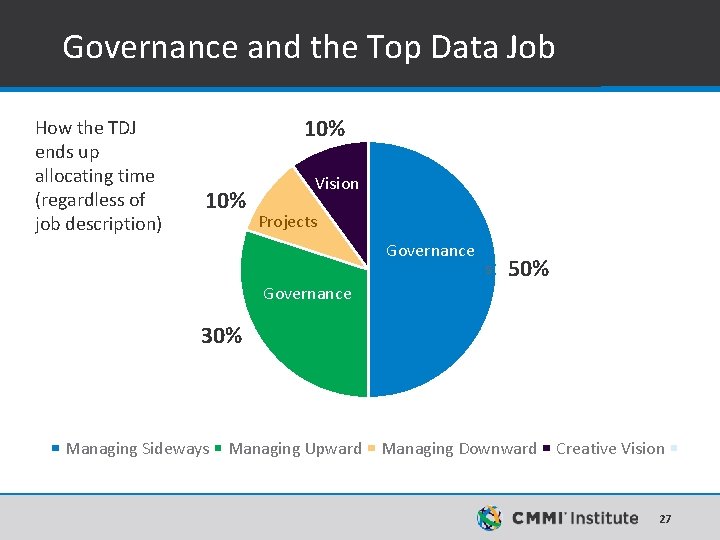
Governance and the Top Data Job How the TDJ ends up allocating time (regardless of job description) 10% Vision Projects Governance 50% 30% Managing Sideways Managing Upward Managing Downward Creative Vision 27
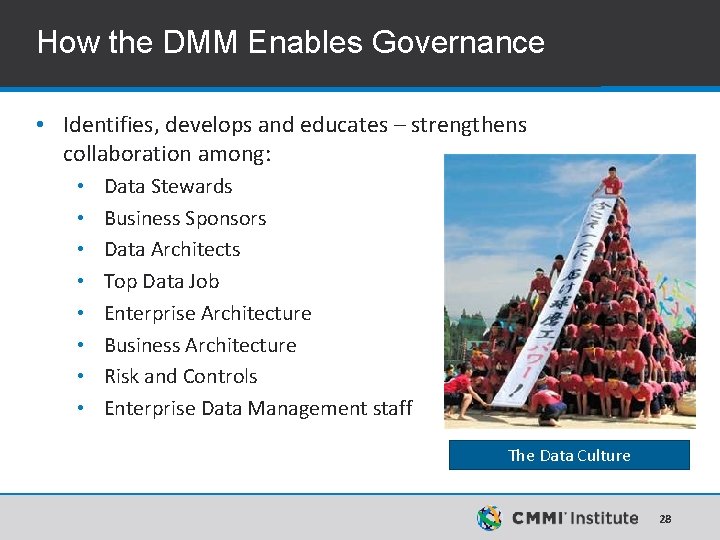
How the DMM Enables Governance • Identifies, develops and educates – strengthens collaboration among: • • Data Stewards Business Sponsors Data Architects Top Data Job Enterprise Architecture Business Architecture Risk and Controls Enterprise Data Management staff The Data Culture 28
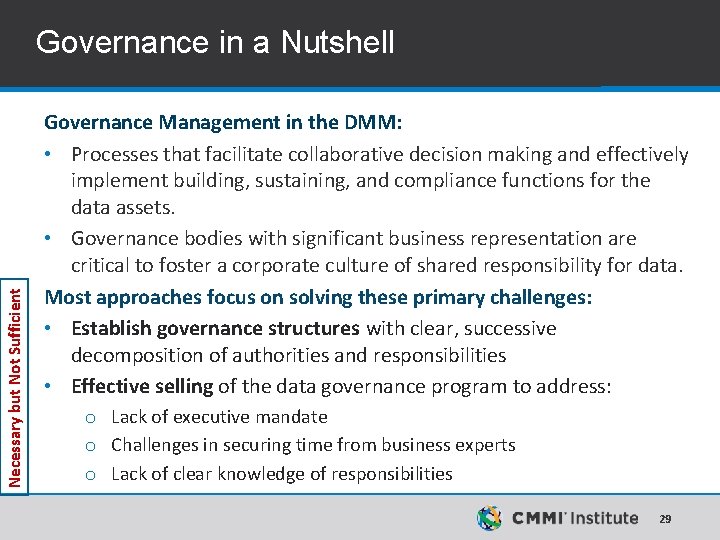
Necessary but Not Sufficient Governance in a Nutshell Governance Management in the DMM: • Processes that facilitate collaborative decision making and effectively implement building, sustaining, and compliance functions for the data assets. • Governance bodies with significant business representation are critical to foster a corporate culture of shared responsibility for data. Most approaches focus on solving these primary challenges: • Establish governance structures with clear, successive decomposition of authorities and responsibilities • Effective selling of the data governance program to address: o Lack of executive mandate o Challenges in securing time from business experts o Lack of clear knowledge of responsibilities 29
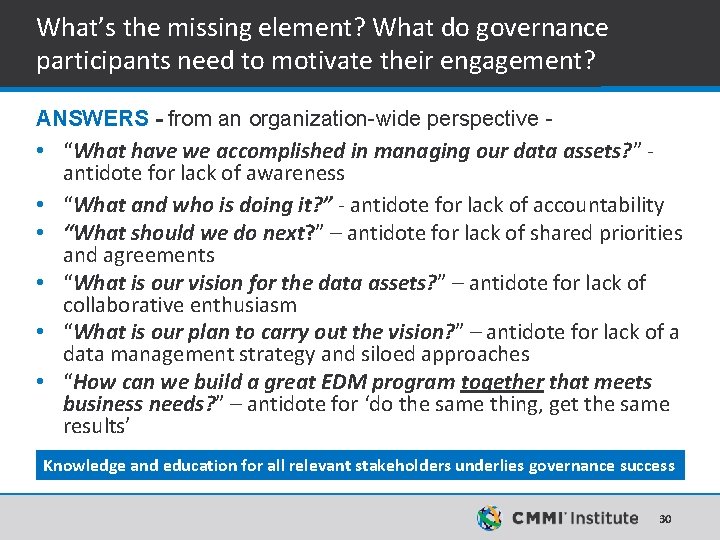
What’s the missing element? What do governance participants need to motivate their engagement? ANSWERS - from an organization-wide perspective • “What have we accomplished in managing our data assets? ” - antidote for lack of awareness • “What and who is doing it? ” - antidote for lack of accountability • “What should we do next? ” – antidote for lack of shared priorities and agreements • “What is our vision for the data assets? ” – antidote for lack of collaborative enthusiasm • “What is our plan to carry out the vision? ” – antidote for lack of a data management strategy and siloed approaches • “How can we build a great EDM program together that meets business needs? ” – antidote for ‘do the same thing, get the same results’ Knowledge and education for all relevant stakeholders underlies governance success 30
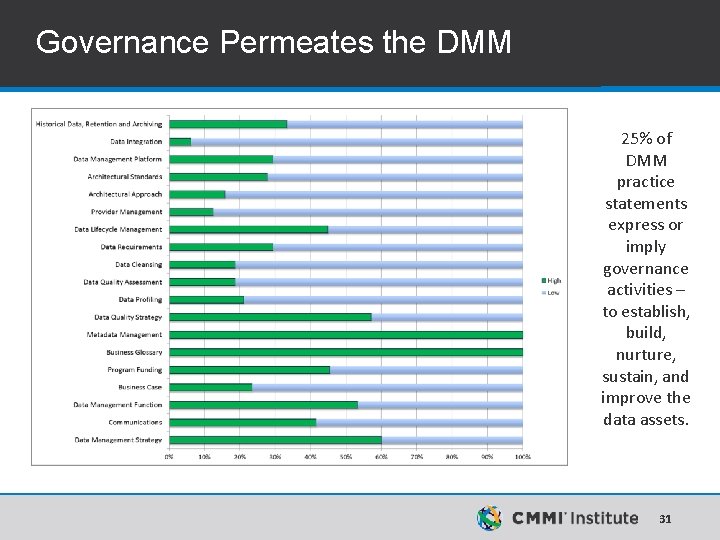
Governance Permeates the DMM 25% of DMM practice statements express or imply governance activities – to establish, build, nurture, sustain, and improve the data assets. 31
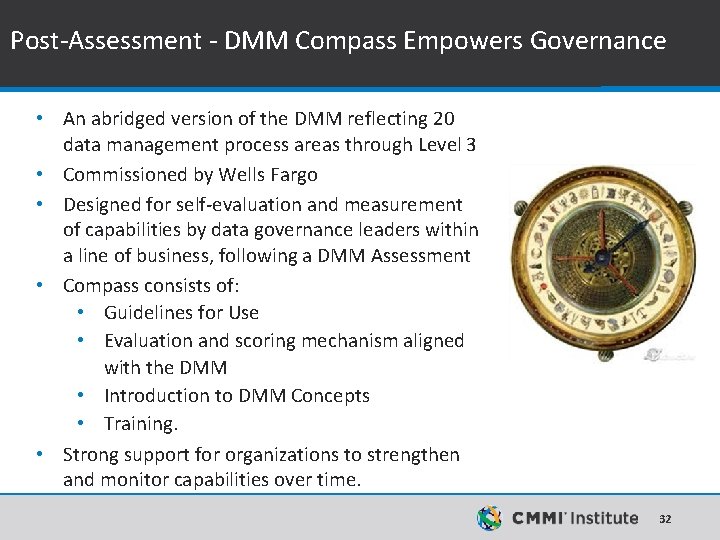
Post-Assessment - DMM Compass Empowers Governance • An abridged version of the DMM reflecting 20 data management process areas through Level 3 • Commissioned by Wells Fargo • Designed for self-evaluation and measurement of capabilities by data governance leaders within a line of business, following a DMM Assessment • Compass consists of: • Guidelines for Use • Evaluation and scoring mechanism aligned with the DMM • Introduction to DMM Concepts • Training. • Strong support for organizations to strengthen and monitor capabilities over time. 32
Questions? Any questions? 33
Decomposition - Data Modeling as Axis Mundi 34
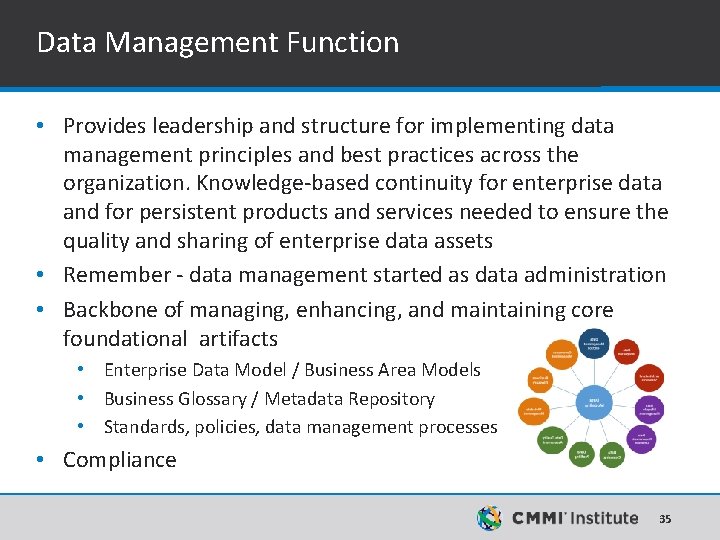
Data Management Function • Provides leadership and structure for implementing data management principles and best practices across the organization. Knowledge-based continuity for enterprise data and for persistent products and services needed to ensure the quality and sharing of enterprise data assets • Remember - data management started as data administration • Backbone of managing, enhancing, and maintaining core foundational artifacts • Enterprise Data Model / Business Area Models • Business Glossary / Metadata Repository • Standards, policies, data management processes • Compliance 35
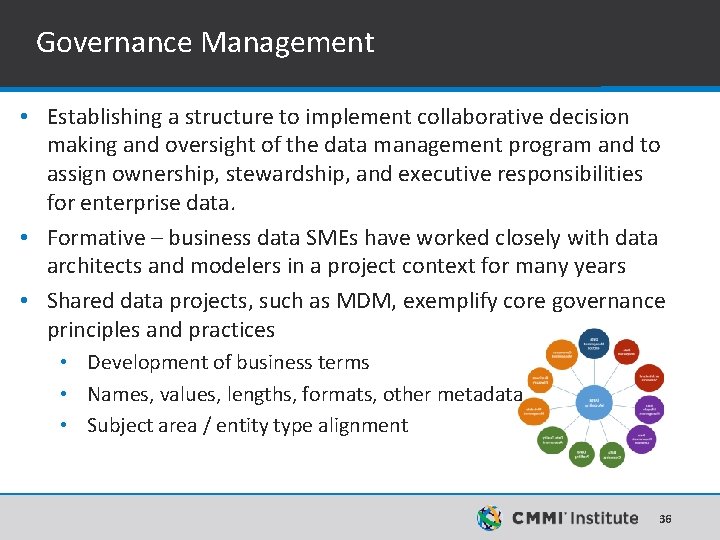
Governance Management • Establishing a structure to implement collaborative decision making and oversight of the data management program and to assign ownership, stewardship, and executive responsibilities for enterprise data. • Formative – business data SMEs have worked closely with data architects and modelers in a project context for many years • Shared data projects, such as MDM, exemplify core governance principles and practices • Development of business terms • Names, values, lengths, formats, other metadata • Subject area / entity type alignment 36
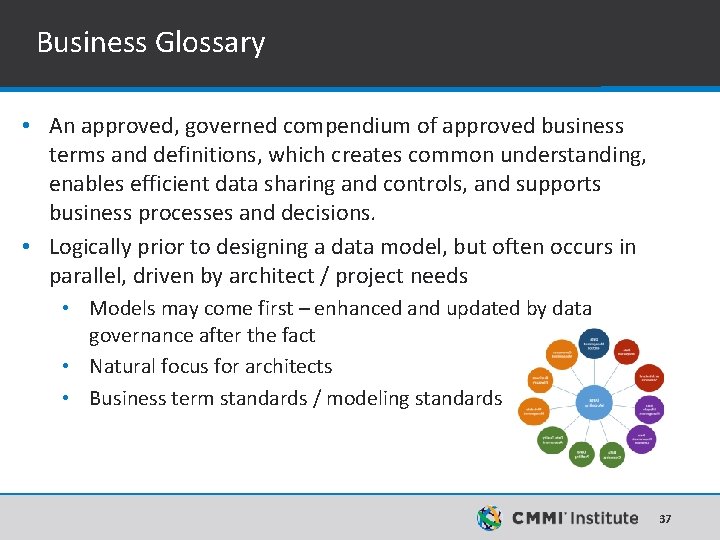
Business Glossary • An approved, governed compendium of approved business terms and definitions, which creates common understanding, enables efficient data sharing and controls, and supports business processes and decisions. • Logically prior to designing a data model, but often occurs in parallel, driven by architect / project needs • Models may come first – enhanced and updated by data governance after the fact • Natural focus for architects • Business term standards / modeling standards 37
Business Glossary Handout Business Term Standards Sample • Approved and implemented with governance engagement at large retailer and major financial organization • As with any sample or template, must be tailored for your organization and approved • Enjoy! 38
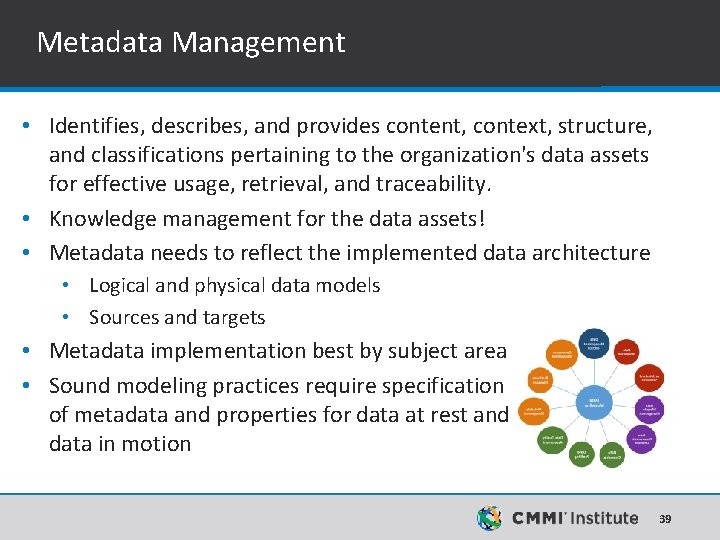
Metadata Management • Identifies, describes, and provides content, context, structure, and classifications pertaining to the organization's data assets for effective usage, retrieval, and traceability. • Knowledge management for the data assets! • Metadata needs to reflect the implemented data architecture • Logical and physical data models • Sources and targets • Metadata implementation best by subject area • Sound modeling practices require specification of metadata and properties for data at rest and data in motion 39
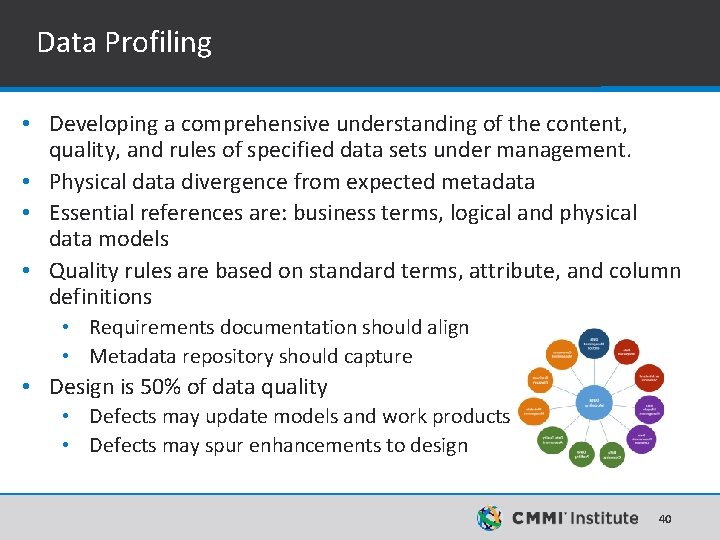
Data Profiling • Developing a comprehensive understanding of the content, quality, and rules of specified data sets under management. • Physical data divergence from expected metadata • Essential references are: business terms, logical and physical data models • Quality rules are based on standard terms, attribute, and column definitions • Requirements documentation should align • Metadata repository should capture • Design is 50% of data quality • Defects may update models and work products • Defects may spur enhancements to design 40
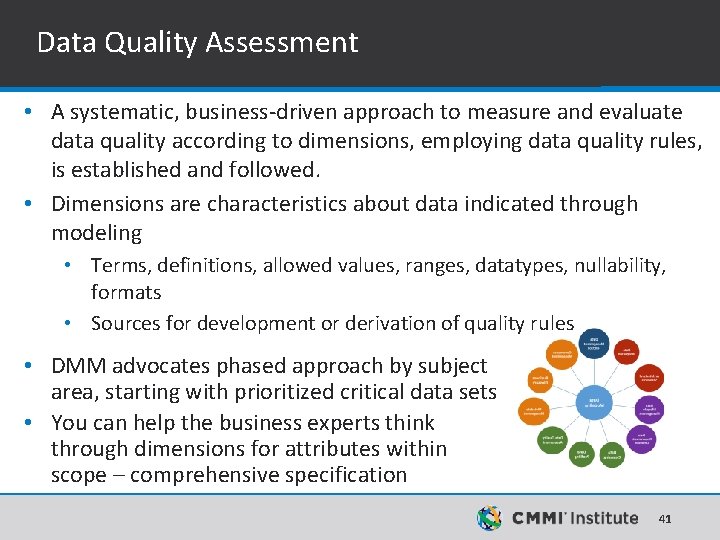
Data Quality Assessment • A systematic, business-driven approach to measure and evaluate data quality according to dimensions, employing data quality rules, is established and followed. • Dimensions are characteristics about data indicated through modeling • Terms, definitions, allowed values, ranges, datatypes, nullability, formats • Sources for development or derivation of quality rules • DMM advocates phased approach by subject area, starting with prioritized critical data sets • You can help the business experts think through dimensions for attributes within scope – comprehensive specification 41
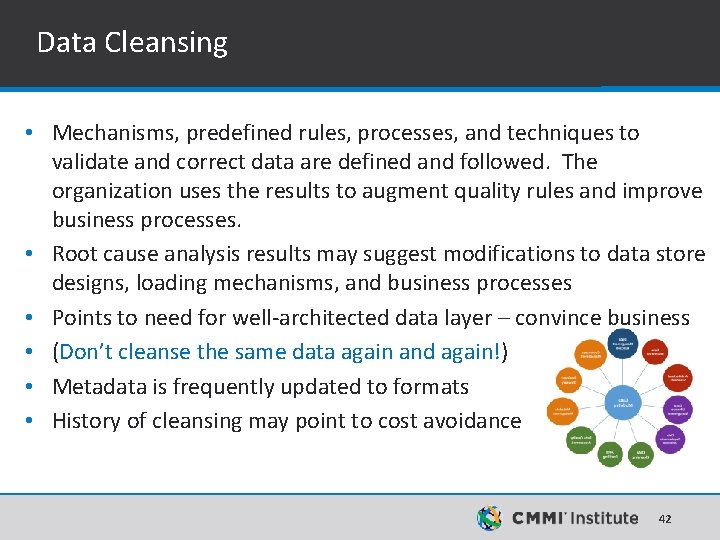
Data Cleansing • Mechanisms, predefined rules, processes, and techniques to validate and correct data are defined and followed. The organization uses the results to augment quality rules and improve business processes. • Root cause analysis results may suggest modifications to data store designs, loading mechanisms, and business processes • Points to need for well-architected data layer – convince business • (Don’t cleanse the same data again and again!) • Metadata is frequently updated to formats • History of cleansing may point to cost avoidance 42
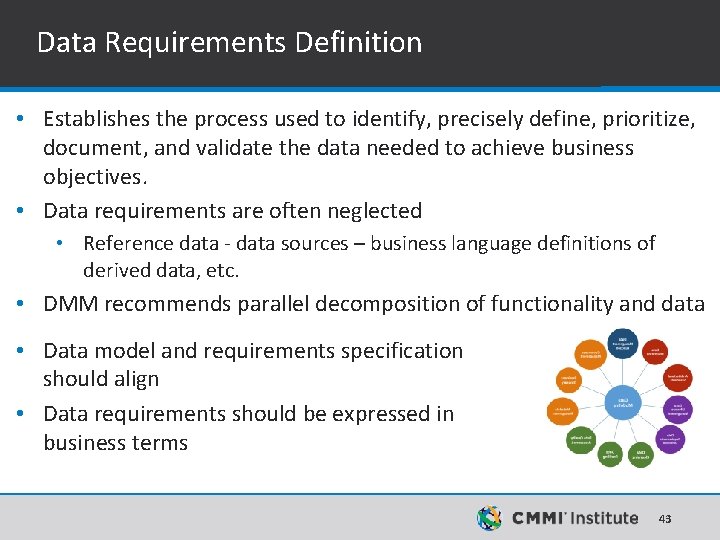
Data Requirements Definition • Establishes the process used to identify, precisely define, prioritize, document, and validate the data needed to achieve business objectives. • Data requirements are often neglected • Reference data - data sources – business language definitions of derived data, etc. • DMM recommends parallel decomposition of functionality and data • Data model and requirements specification should align • Data requirements should be expressed in business terms 43
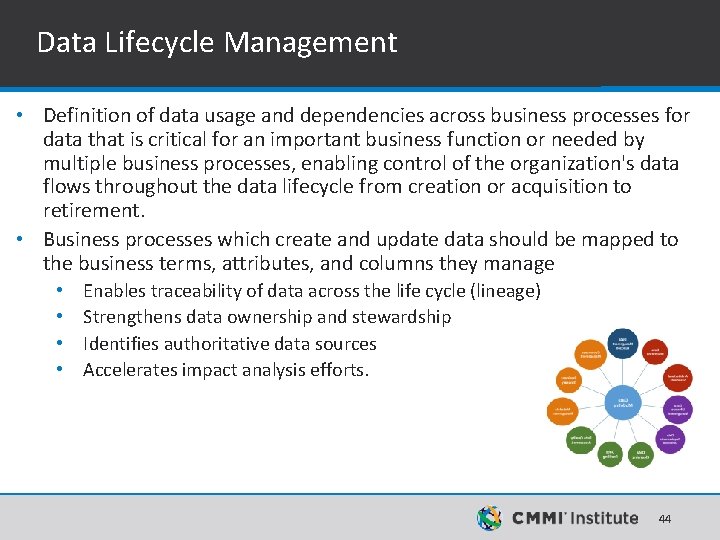
Data Lifecycle Management • Definition of data usage and dependencies across business processes for data that is critical for an important business function or needed by multiple business processes, enabling control of the organization's data flows throughout the data lifecycle from creation or acquisition to retirement. • Business processes which create and update data should be mapped to the business terms, attributes, and columns they manage • • Enables traceability of data across the life cycle (lineage) Strengthens data ownership and stewardship Identifies authoritative data sources Accelerates impact analysis efforts. 44
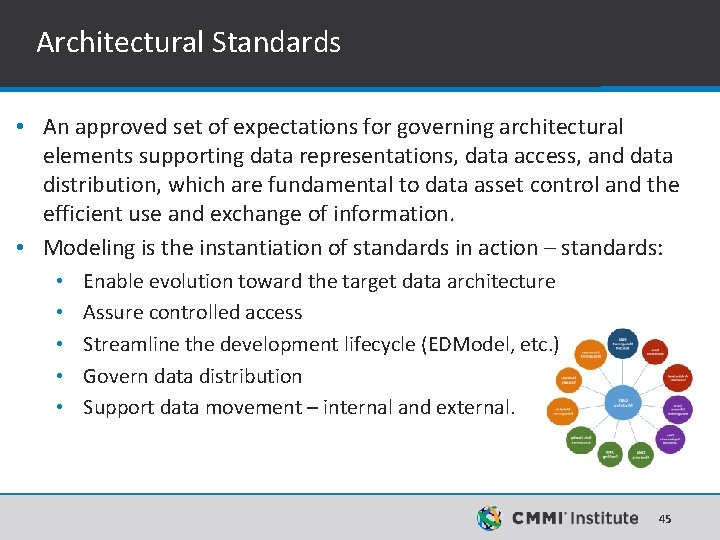
Architectural Standards • An approved set of expectations for governing architectural elements supporting data representations, data access, and data distribution, which are fundamental to data asset control and the efficient use and exchange of information. • Modeling is the instantiation of standards in action – standards: • • • Enable evolution toward the target data architecture Assure controlled access Streamline the development lifecycle (EDModel, etc. ) Govern data distribution Support data movement – internal and external. 45
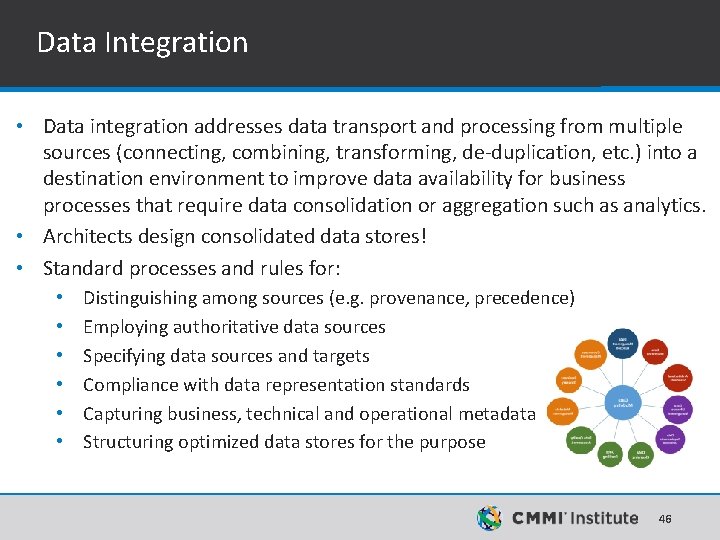
Data Integration • Data integration addresses data transport and processing from multiple sources (connecting, combining, transforming, de-duplication, etc. ) into a destination environment to improve data availability for business processes that require data consolidation or aggregation such as analytics. • Architects design consolidated data stores! • Standard processes and rules for: • • • Distinguishing among sources (e. g. provenance, precedence) Employing authoritative data sources Specifying data sources and targets Compliance with data representation standards Capturing business, technical and operational metadata Structuring optimized data stores for the purpose 46
How did we do today? Pick any question • Has this seminar helped you to respond “yes” to: • You can put on the ‘enterprise hat? ’ • You have greater confidence in your broad data management knowledge base? • You’re able to learn and begin to apply the DMM Framework? • You can add a a holistic data perspective when crafting business cases? • You’re more prepared to help your colleagues to appreciate the bigger picture? 47
Learn More mmecca@cmmiinstitute. com – and connect with me on Linked In http: //cmmiinstitute. com/data-management-maturity - white papers and DMM download http: //cmmiinstitute. com/dmm-training - data management training and certification – e. Learning, on-site, and public courses Twitter: https: //twitter. com/CMMI_Institute Linked. In: https: //www. linkedin. com/company/cmmi-institute 48