
DATA MANAGEMENT CENTER OVERVIEW Nicole Harris Program Manager

- Slides: 10
DATA MANAGEMENT CENTER OVERVIEW Nicole Harris Program Manager Data Management Center June 2017
DATA MANAGEMENT CENTER (DMC) Summary • Established in 1981, the Data Management Center (DMC) serves as the nation’s central processing center to provide registration, compliance and verification handling for those required to register. • It is currently co located with the Selective Service System’s Region I headquarters and the U. S. Military Entrance Processing Command (USMEPCOM) on the grounds of Great Lakes Naval Training Center in northern Illinois. Function • The DMC is responsible for the receipt, control, data processing, and records management for the Agency’s Registration, Compliance, and Verification (RCV) system for men born after December 31, 1959. • This includes: • All registrations production systems, public website, and telephone registration • Data entry • Computer programming and processing • Error correction • Registration documentation and update processing • Centralized mail applications, including letter production • Microfilming and records disposition • Providing Agency responses to registration related inquiries and administrative support functions.
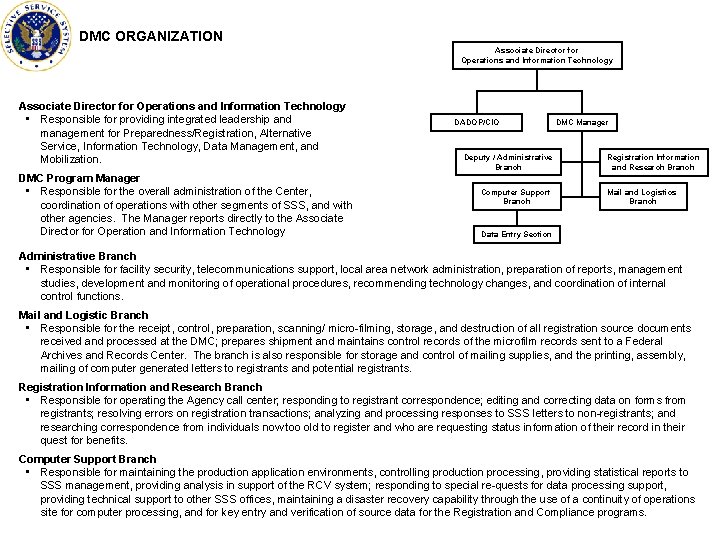
DMC ORGANIZATION Associate Director for Operations and Information Technology • Responsible for providing integrated leadership and management for Preparedness/Registration, Alternative Service, Information Technology, Data Management, and Mobilization. DMC Program Manager • Responsible for the overall administration of the Center, coordination of operations with other segments of SSS, and with other agencies. The Manager reports directly to the Associate Director for Operation and Information Technology DADOP/CIO Deputy / Administrative Branch Computer Support Branch DMC Manager Registration Information and Research Branch Mail and Logistics Branch Data Entry Section Administrative Branch • Responsible for facility security, telecommunications support, local area network administration, preparation of reports, management studies, development and monitoring of operational procedures, recommending technology changes, and coordination of internal control functions. Mail and Logistic Branch • Responsible for the receipt, control, preparation, scanning/ micro filming, storage, and destruction of all registration source documents received and processed at the DMC; prepares shipment and maintains control records of the microfilm records sent to a Federal Archives and Records Center. The branch is also responsible for storage and control of mailing supplies, and the printing, assembly, mailing of computer generated letters to registrants and potential registrants. Registration Information and Research Branch • Responsible for operating the Agency call center; responding to registrant correspondence; editing and correcting data on forms from registrants; resolving errors on registration transactions; analyzing and processing responses to SSS letters to non registrants; and researching correspondence from individuals now too old to register and who are requesting status information of their record in their quest for benefits. Computer Support Branch • Responsible for maintaining the production application environments, controlling production processing, providing statistical reports to SSS management, providing analysis in support of the RCV system; responding to special re quests for data processing support, providing technical support to other SSS offices, maintaining a disaster recovery capability through the use of a continuity of operations site for computer processing, and for key entry and verification of source data for the Registration and Compliance programs.
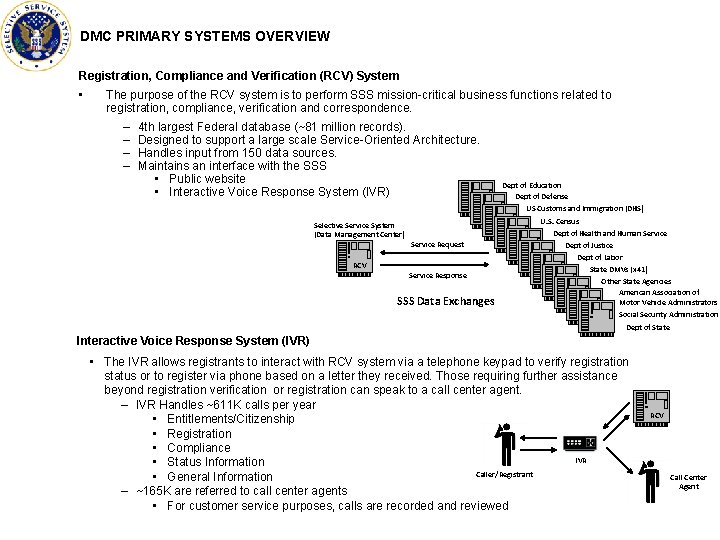
DMC PRIMARY SYSTEMS OVERVIEW Registration, Compliance and Verification (RCV) System • The purpose of the RCV system is to perform SSS mission critical business functions related to registration, compliance, verification and correspondence. – – 4 th largest Federal database (~81 million records). Designed to support a large scale Service Oriented Architecture. Handles input from 150 data sources. Maintains an interface with the SSS • Public website • Interactive Voice Response System (IVR) Dept of Education Dept of Defense US Customs and Immigration (DHS) U. S. Census Dept of Health and Human Service Selective Service System (Data Management Center) Service Request RCV Service Response SSS Data Exchanges Dept of Justice Dept of Labor State DMVs (x 41) Other State Agencies American Association of Motor Vehicle Administrators Social Security Administration Dept of State Interactive Voice Response System (IVR) • The IVR allows registrants to interact with RCV system via a telephone keypad to verify registration status or to register via phone based on a letter they received. Those requiring further assistance beyond registration verification or registration can speak to a call center agent. – IVR Handles ~611 K calls per year • Entitlements/Citizenship • Registration • Compliance IVR • Status Information Caller/Registrant • General Information – ~165 K are referred to call center agents • For customer service purposes, calls are recorded and reviewed RCV Call Center Agent
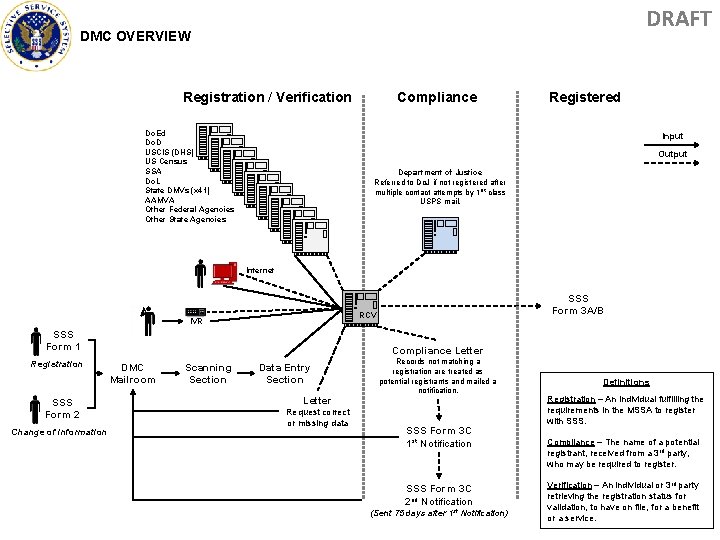
DRAFT DMC OVERVIEW Registration / Verification Do. Ed Do. D USCIS (DHS) US Census SSA Do. L State DMVs (x 41) AAMVA Other Federal Agencies Other State Agencies Compliance Registered Input Output Department of Justice Referred to Do. J if not registered after multiple contact attempts by 1 st class USPS mail. Internet RCV IVR SSS Form 1 Registration SSS Form 2 Change of Information SSS Form 3 A/B Compliance Letter DMC Mailroom Scanning Section Data Entry Section Letter Request correct or missing data Records not matching a registration are treated as potential registrants and mailed a notification. SSS Form 3 C 1 st Notification SSS Form 3 C 2 nd Notification (Sent 75 days after 1 st Notification) Definitions Registration – An individual fulfilling the requirements in the MSSA to register with SSS. Compliance – The name of a potential registrant, received from a 3 rd party, who may be required to register. Verification – An individual or 3 rd party retrieving the registration status for validation, to have on file, for a benefit or a service.
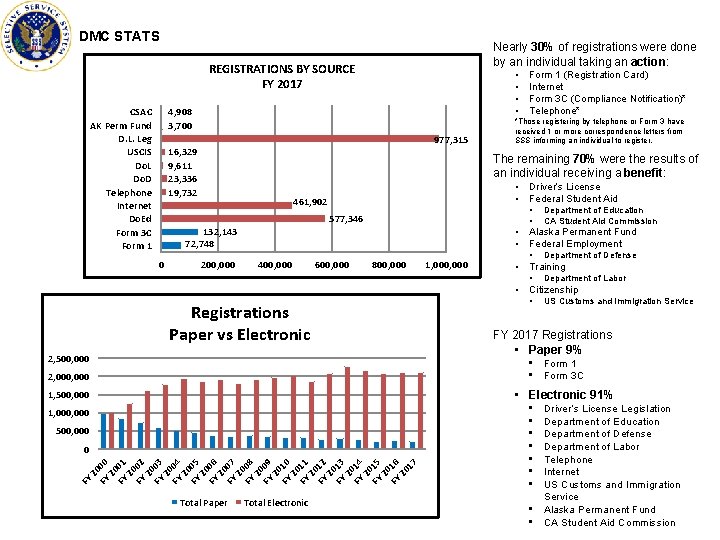
DMC STATS Nearly 30% of registrations were done by an individual taking an action: REGISTRATIONS BY SOURCE FY 2017 CSAC AK Perm Fund D. L. Leg USCIS Do. L Do. D Telephone Internet Do. Ed Form 3 C Form 1 • • 4, 908 3, 700 977, 315 16, 329 9, 611 23, 336 19, 732 *Those registering by telephone or Form 3 have received 1 or more correspondence letters from SSS informing an individual to register. The remaining 70% were the results of an individual receiving a benefit: • • 461, 902 200, 000 • • 400, 000 600, 000 Driver’s License Federal Student Aid • • 577, 346 132, 143 72, 748 0 Form 1 (Registration Card) Internet Form 3 C (Compliance Notification)* Telephone* 800, 000 1, 000 Alaska Permanent Fund Federal Employment • • Registrations Paper vs Electronic 2, 500, 000 Department of Defense Training • • Department of Education CA Student Aid Commission Department of Labor Citizenship • US Customs and Immigration Service FY 2017 Registrations • Paper 9% • Form 1 • Form 3 C 2, 000 • Electronic 91% 1, 500, 000 1, 000 500, 000 FY 20 FY 00 20 FY 01 20 FY 02 20 FY 03 20 FY 04 20 FY 05 20 FY 06 20 FY 07 20 FY 08 20 FY 09 20 FY 10 20 FY 11 20 FY 12 20 FY 13 20 FY 14 20 FY 15 20 FY 16 20 17 0 Total Paper Total Electronic • • • Driver’s License Legislation Department of Education Department of Defense Department of Labor Telephone Internet US Customs and Immigration Service Alaska Permanent Fund CA Student Aid Commission
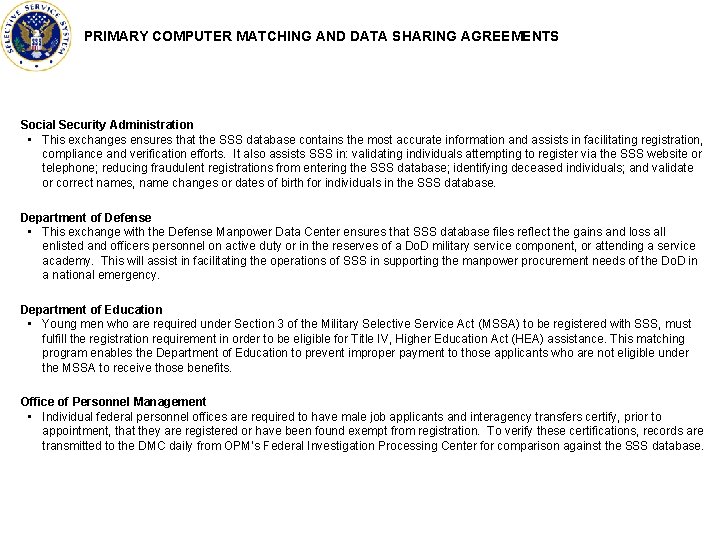
PRIMARY COMPUTER MATCHING AND DATA SHARING AGREEMENTS Social Security Administration • This exchanges ensures that the SSS database contains the most accurate information and assists in facilitating registration, compliance and verification efforts. It also assists SSS in: validating individuals attempting to register via the SSS website or telephone; reducing fraudulent registrations from entering the SSS database; identifying deceased individuals; and validate or correct names, name changes or dates of birth for individuals in the SSS database. Department of Defense • This exchange with the Defense Manpower Data Center ensures that SSS database files reflect the gains and loss all enlisted and officers personnel on active duty or in the reserves of a Do. D military service component, or attending a service academy. This will assist in facilitating the operations of SSS in supporting the manpower procurement needs of the Do. D in a national emergency. Department of Education • Young men who are required under Section 3 of the Military Selective Service Act (MSSA) to be registered with SSS, must fulfill the registration requirement in order to be eligible for Title IV, Higher Education Act (HEA) assistance. This matching program enables the Department of Education to prevent improper payment to those applicants who are not eligible under the MSSA to receive those benefits. Office of Personnel Management • Individual federal personnel offices are required to have male job applicants and interagency transfers certify, prior to appointment, that they are registered or have been found exempt from registration. To verify these certifications, records are transmitted to the DMC daily from OPM’s Federal Investigation Processing Center for comparison against the SSS database.
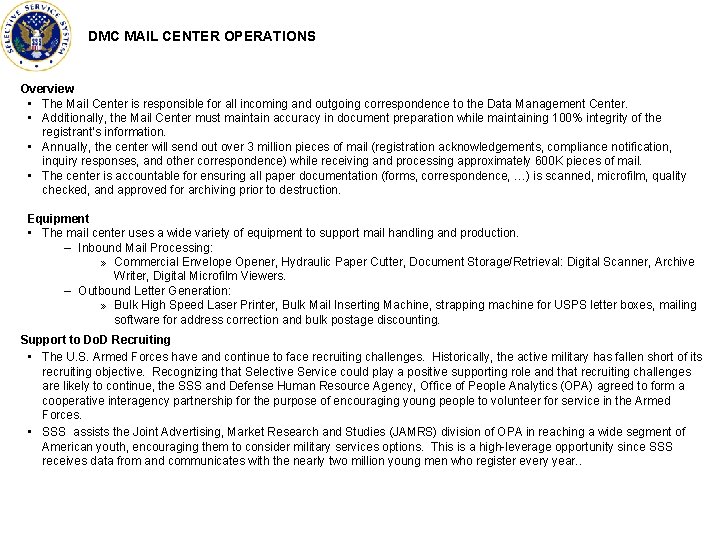
DMC MAIL CENTER OPERATIONS Overview • The Mail Center is responsible for all incoming and outgoing correspondence to the Data Management Center. • Additionally, the Mail Center must maintain accuracy in document preparation while maintaining 100% integrity of the registrant’s information. • Annually, the center will send out over 3 million pieces of mail (registration acknowledgements, compliance notification, inquiry responses, and other correspondence) while receiving and processing approximately 600 K pieces of mail. • The center is accountable for ensuring all paper documentation (forms, correspondence, …) is scanned, microfilm, quality checked, and approved for archiving prior to destruction. Equipment • The mail center uses a wide variety of equipment to support mail handling and production. – Inbound Mail Processing: » Commercial Envelope Opener, Hydraulic Paper Cutter, Document Storage/Retrieval: Digital Scanner, Archive Writer, Digital Microfilm Viewers. – Outbound Letter Generation: » Bulk High Speed Laser Printer, Bulk Mail Inserting Machine, strapping machine for USPS letter boxes, mailing software for address correction and bulk postage discounting. Support to Do. D Recruiting • The U. S. Armed Forces have and continue to face recruiting challenges. Historically, the active military has fallen short of its recruiting objective. Recognizing that Selective Service could play a positive supporting role and that recruiting challenges are likely to continue, the SSS and Defense Human Resource Agency, Office of People Analytics (OPA) agreed to form a cooperative interagency partnership for the purpose of encouraging young people to volunteer for service in the Armed Forces. • SSS assists the Joint Advertising, Market Research and Studies (JAMRS) division of OPA in reaching a wide segment of American youth, encouraging them to consider military services options. This is a high leverage opportunity since SSS receives data from and communicates with the nearly two million young men who register every year. .
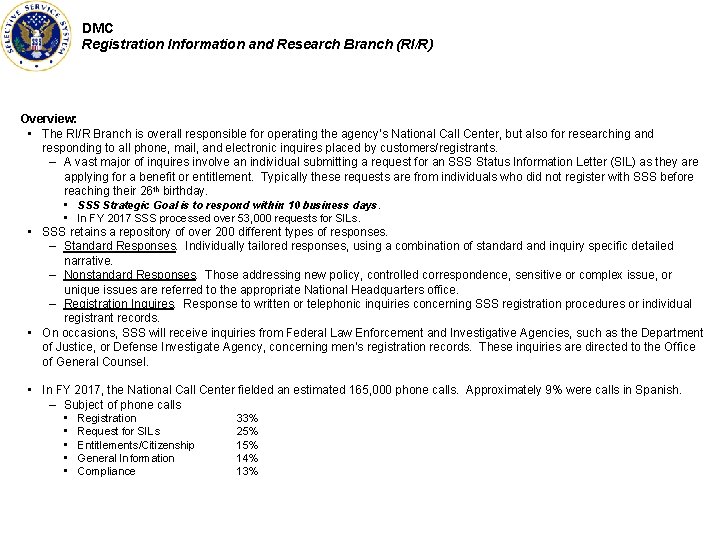
DMC Registration Information and Research Branch (RI/R) Overview: • The RI/R Branch is overall responsible for operating the agency’s National Call Center, but also for researching and responding to all phone, mail, and electronic inquires placed by customers/registrants. – A vast major of inquires involve an individual submitting a request for an SSS Status Information Letter (SIL) as they are applying for a benefit or entitlement. Typically these requests are from individuals who did not register with SSS before reaching their 26 th birthday. • SSS Strategic Goal is to respond within 10 business days. • In FY 2017 SSS processed over 53, 000 requests for SILs. • SSS retains a repository of over 200 different types of responses. – Standard Responses. Individually tailored responses, using a combination of standard and inquiry specific detailed narrative. – Nonstandard Responses. Those addressing new policy, controlled correspondence, sensitive or complex issue, or unique issues are referred to the appropriate National Headquarters office. – Registration Inquires. Response to written or telephonic inquiries concerning SSS registration procedures or individual registrant records. • On occasions, SSS will receive inquiries from Federal Law Enforcement and Investigative Agencies, such as the Department of Justice, or Defense Investigate Agency, concerning men’s registration records. These inquiries are directed to the Office of General Counsel. • In FY 2017, the National Call Center fielded an estimated 165, 000 phone calls. Approximately 9% were calls in Spanish. – Subject of phone calls • • • Registration Request for SILs Entitlements/Citizenship General Information Compliance 33% 25% 14% 13%
DATA MANAGEMENT CENTER OVERVIEW QUESTIONS December 2017