
Data Link Layer Part I Data Link Layer
- Slides: 43
Data Link Layer: Part I • Data Link Layer Functions – – • deliver frames over a single link framing, media access, error checking (error correction), … Local Area Networks (LANs) and MAC Addresses – – – MAC addresses (vs. IP address) point-to-point vs. shared access IP Address Resolution Protocol (ARP) and IP datagram forwarding (revisited!) • Extending LANs & Switched LANs: – – • Self-learning Spanning tree algorithms Readings: Textbook, Chapter 6: Sections 6. 1 and 6. 4. 1 -6. 4. 3 CSci 4211: Data Link Layer: Part 1 1
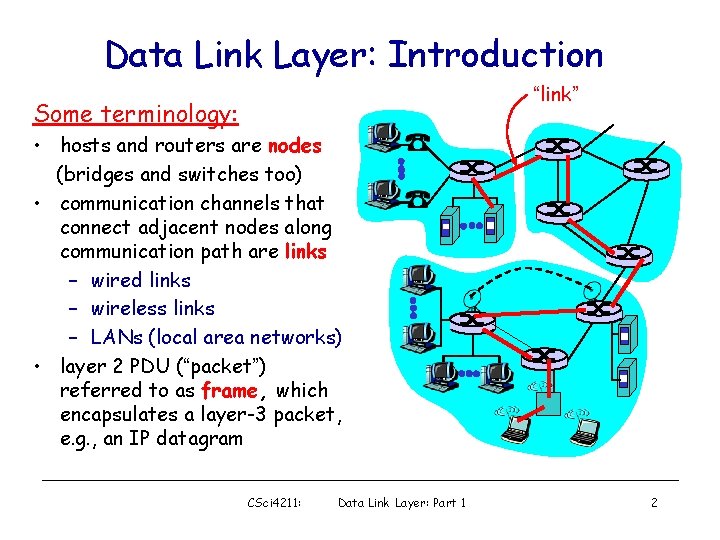
Data Link Layer: Introduction “link” Some terminology: • hosts and routers are nodes (bridges and switches too) • communication channels that connect adjacent nodes along communication path are links – wired links – wireless links – LANs (local area networks) • layer 2 PDU (“packet”) referred to as frame, which encapsulates a layer-3 packet, e. g. , an IP datagram CSci 4211: Data Link Layer: Part 1 2
What Does Data Link Layer Do? Data link layer has responsibility of transferring frames from one node to adjacent node over a single link • An IP packet from host A to host B may traverses different links using different data link protocols – e. g. , Ethernet on first link, frame relay on intermediate links, 802. 11 on last link • Each link protocol provides different services – e. g. , may or may not provide reliable data delivery • Different link protocols are not inter-operable! – IP packets are encapsulated/decapsulated with appropriate data link protocol header over each link – IP protocol and IP routers glue the links (“physical networks”) together and provide end-to-end data delivery! CSci 4211: Data Link Layer: Part 1 3
Data Link Layer Functions • Framing – sender (transmitter): encapsulate datagram into frame, adding header, trailer, transmit frame – receiver: detect beginning of frames, receive frame, decapsulate frame, stripping off header, trailer • Link Access (Media Access Control) – determine whether it’s Okay to transmit over the link • particularly important when link shared by many nodes – also an issue over “half-duplex” point-to-point link (why? ) • need media access control (MAC) – “physical addresses” identify sender/receiver on a link! • particularly important when link shared by many nodes, while over point-to-point link, not necessary • “physical addresses” often referred to as “MAC” addresses – different from IP addresses (which are logical & global)! CSci 4211: Data Link Layer: Part 1 4
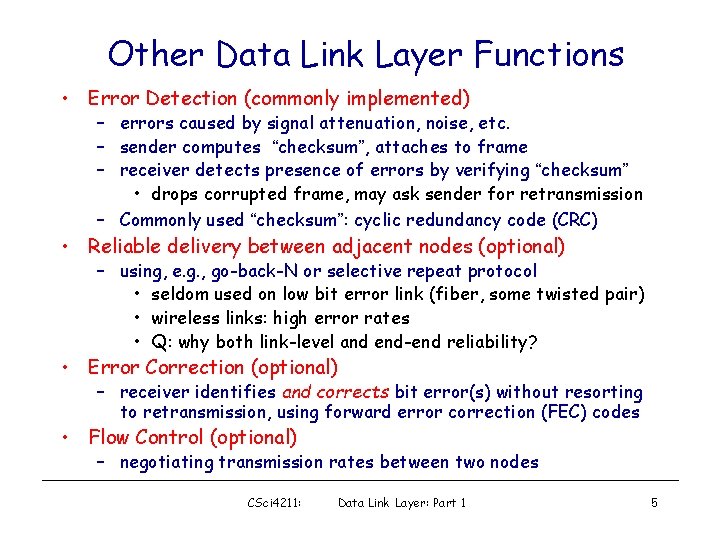
Other Data Link Layer Functions • Error Detection (commonly implemented) – errors caused by signal attenuation, noise, etc. – sender computes “checksum”, attaches to frame – receiver detects presence of errors by verifying “checksum” • drops corrupted frame, may ask sender for retransmission – Commonly used “checksum”: cyclic redundancy code (CRC) • Reliable delivery between adjacent nodes (optional) – using, e. g. , go-back-N or selective repeat protocol • seldom used on low bit error link (fiber, some twisted pair) • wireless links: high error rates • Q: why both link-level and end-end reliability? • Error Correction (optional) – receiver identifies and corrects bit error(s) without resorting to retransmission, using forward error correction (FEC) codes • Flow Control (optional) – negotiating transmission rates between two nodes CSci 4211: Data Link Layer: Part 1 5
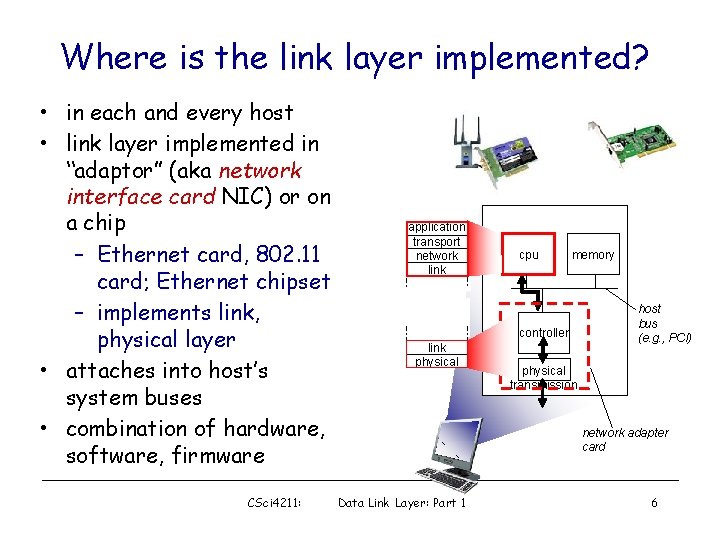
Where is the link layer implemented? • in each and every host • link layer implemented in “adaptor” (aka network interface card NIC) or on a chip – Ethernet card, 802. 11 card; Ethernet chipset – implements link, physical layer • attaches into host’s system buses • combination of hardware, software, firmware CSci 4211: application transport network link cpu memory controller link physical host bus (e. g. , PCI) physical transmission network adapter card Data Link Layer: Part 1 6
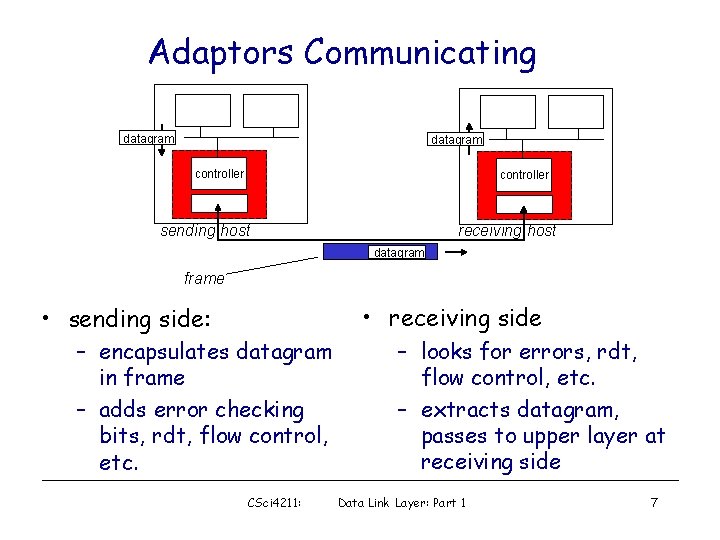
Adaptors Communicating datagram controller receiving host sending host datagram frame • receiving side • sending side: – encapsulates datagram in frame – adds error checking bits, rdt, flow control, etc. CSci 4211: – looks for errors, rdt, flow control, etc. – extracts datagram, passes to upper layer at receiving side Data Link Layer: Part 1 7
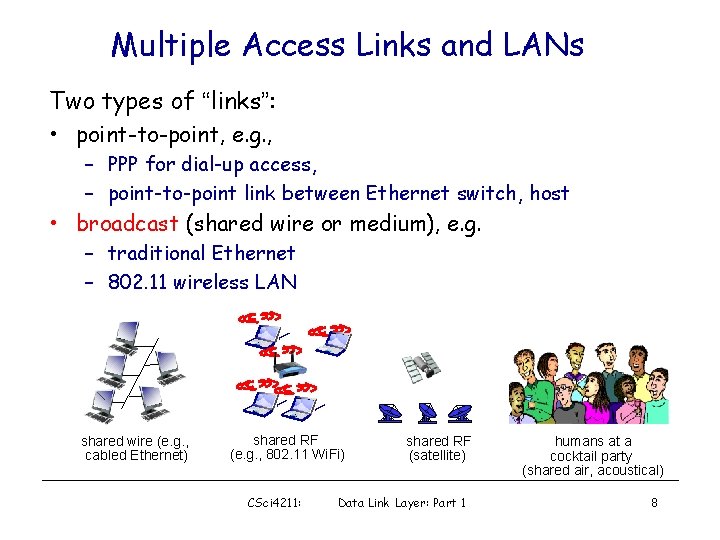
Multiple Access Links and LANs Two types of “links”: • point-to-point, e. g. , – PPP for dial-up access, – point-to-point link between Ethernet switch, host • broadcast (shared wire or medium), e. g. – traditional Ethernet – 802. 11 wireless LAN shared wire (e. g. , cabled Ethernet) shared RF (e. g. , 802. 11 Wi. Fi) CSci 4211: shared RF (satellite) Data Link Layer: Part 1 humans at a cocktail party (shared air, acoustical) 8
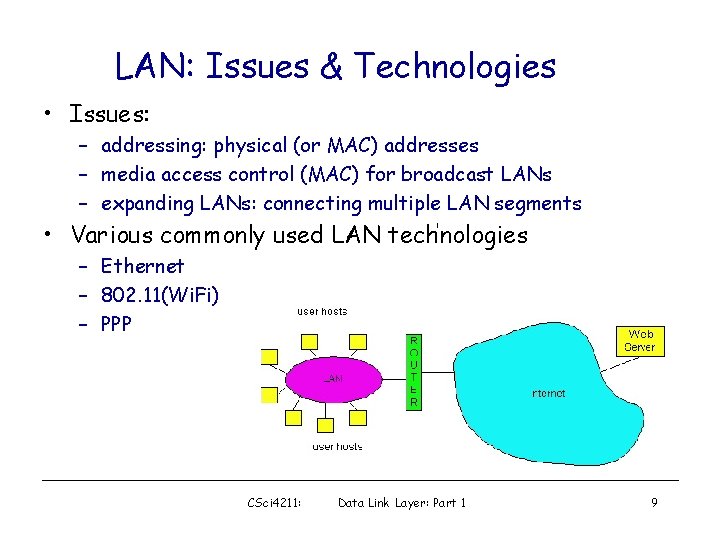
LAN: Issues & Technologies • Issues: – addressing: physical (or MAC) addresses – media access control (MAC) for broadcast LANs – expanding LANs: connecting multiple LAN segments • Various commonly used LAN technologies – Ethernet – 802. 11(Wi. Fi) – PPP CSci 4211: Data Link Layer: Part 1 9
MAC (Physical, or LAN) Addresses • used to get frames from one interface to another physicallyconnected interface (same physical network, i. e. , p 2 p or LAN) • 48 bit MAC address (for most LANs) – fixed for each adaptor, burned in the adapter ROM – MAC address allocation administered by IEEE • 1 st bit: 0 unicast, 1 multicast. • all 1’s : broadcast • MAC flat address -> portability – can move LAN card from one LAN to another • MAC addressing operations on a LAN: – – – each adaptor on the LAN “sees” all frames accept a frame if dest. MAC address matches its own MAC address accept all broadcast (MAC= all 1’s) frames accept all frames if set in “promiscuous” mode can configure to accept certain multicast addresses (first bit = 1) CSci 4211: Data Link Layer: Part 1 10
MAC vs. IP Addresses 32 -bit IP address: • network-layer address, logical – i. e. , not bound to any physical device, can be re-assigned • IP hierarchical address NOT portable – depends on IP network to which an interface is attached – when move to another IP network, IP address re-assigned • used to get IP packets to destination IP network – Recall how IP datagram forwarding is performed • IP network is “virtual, ” actually packet delivery done by the underlying physical networks – from source host to destination host, hop-by-hop via IP routers – over each link, different link layer protocol used, with its own frame headers, and source and destination MAC addresses • Underlying physical networks do not understand IP protocol and datagram format! CSci 4211: Data Link Layer: Part 1 11
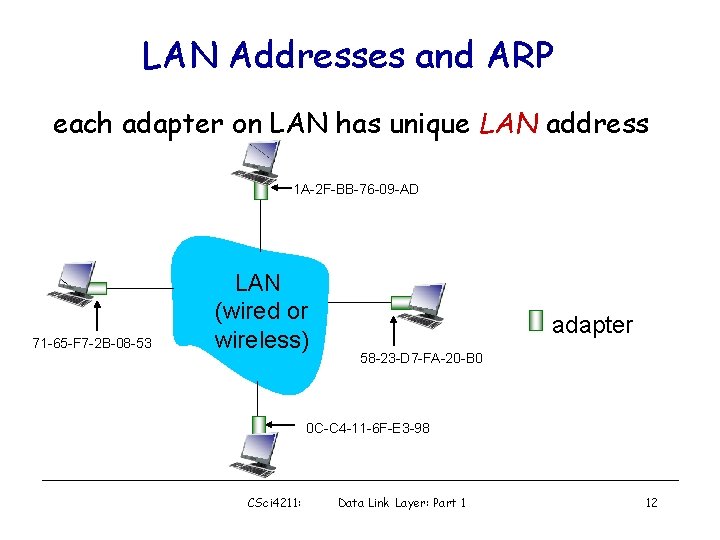
LAN Addresses and ARP each adapter on LAN has unique LAN address 1 A-2 F-BB-76 -09 -AD 71 -65 -F 7 -2 B-08 -53 LAN (wired or wireless) adapter 58 -23 -D 7 -FA-20 -B 0 0 C-C 4 -11 -6 F-E 3 -98 CSci 4211: Data Link Layer: Part 1 12
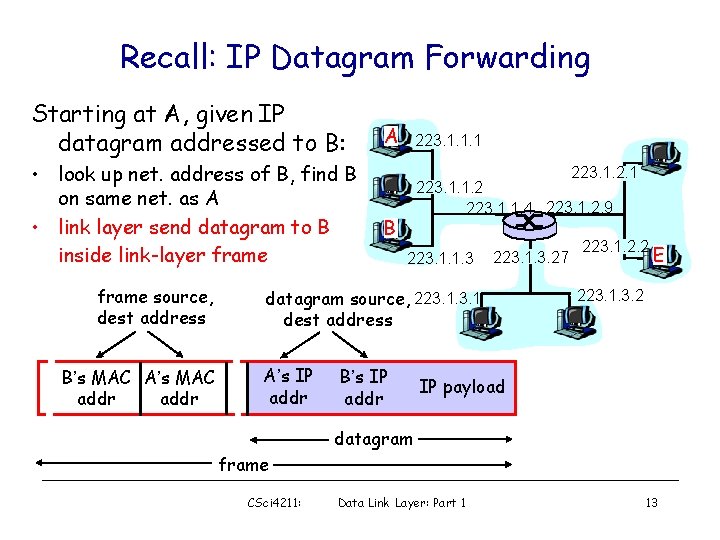
Recall: IP Datagram Forwarding Starting at A, given IP datagram addressed to B: • look up net. address of B, find B on same net. as A • link layer send datagram to B inside link-layer frame source, dest address B’s MAC A’s MAC addr A 223. 1. 1. 1 223. 1. 2. 1 223. 1. 1. 2 223. 1. 1. 4 223. 1. 2. 9 B 223. 1. 1. 3 223. 1. 3. 27 datagram source, 223. 1 dest address A’s IP addr B’s IP addr 223. 1. 2. 2 E 223. 1. 3. 2 IP payload datagram frame CSci 4211: Data Link Layer: Part 1 13
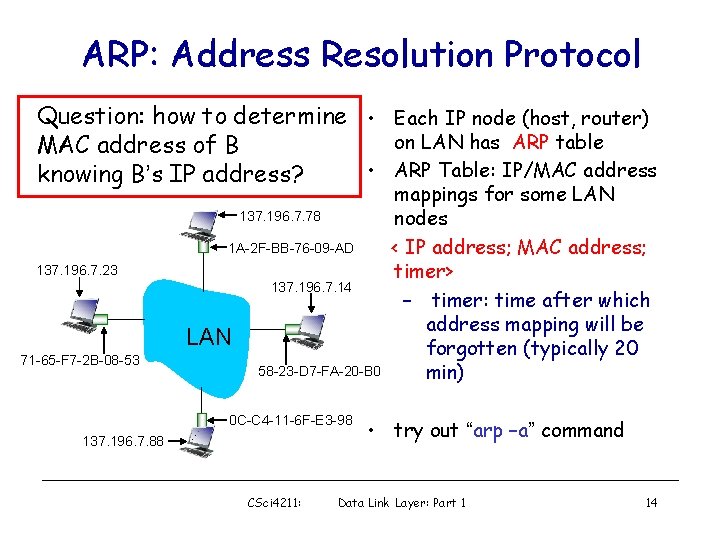
ARP: Address Resolution Protocol Question: how to determine • Each IP node (host, router) on LAN has ARP table MAC address of B • ARP Table: IP/MAC address knowing B’s IP address? 137. 196. 7. 78 1 A-2 F-BB-76 -09 -AD 137. 196. 7. 23 137. 196. 7. 14 LAN 71 -65 -F 7 -2 B-08 -53 58 -23 -D 7 -FA-20 -B 0 0 C-C 4 -11 -6 F-E 3 -98 137. 196. 7. 88 CSci 4211: mappings for some LAN nodes < IP address; MAC address; timer> – timer: time after which address mapping will be forgotten (typically 20 min) • try out “arp –a” command Data Link Layer: Part 1 14
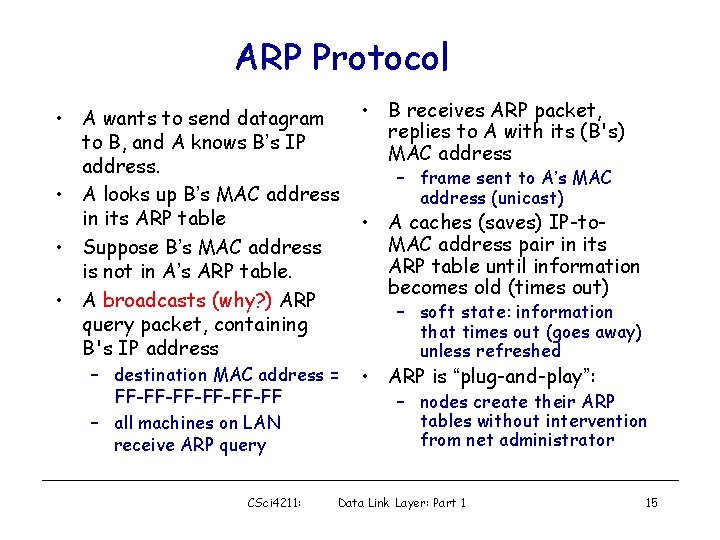
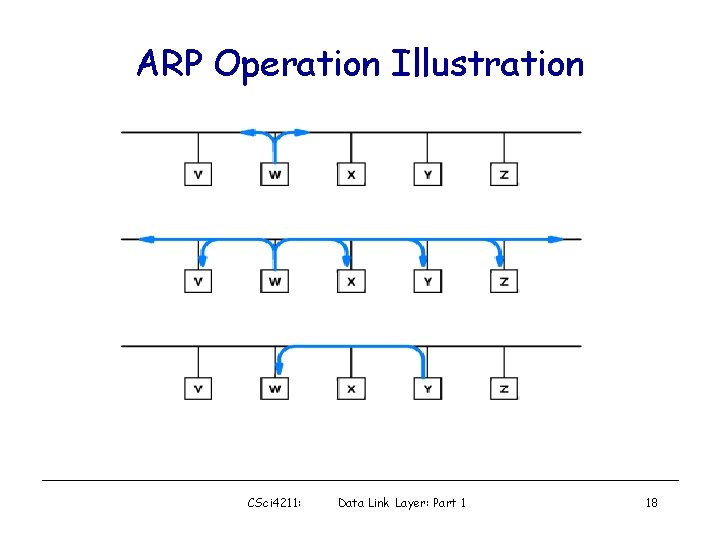
ARP Protocol • A wants to send datagram to B, and A knows B’s IP address. • A looks up B’s MAC address in its ARP table • Suppose B’s MAC address is not in A’s ARP table. • A broadcasts (why? ) ARP query packet, containing B's IP address – destination MAC address = FF-FF-FF-FF – all machines on LAN receive ARP query CSci 4211: • B receives ARP packet, replies to A with its (B's) MAC address – frame sent to A’s MAC address (unicast) • A caches (saves) IP-to. MAC address pair in its ARP table until information becomes old (times out) – soft state: information that times out (goes away) unless refreshed • ARP is “plug-and-play”: – nodes create their ARP tables without intervention from net administrator Data Link Layer: Part 1 15
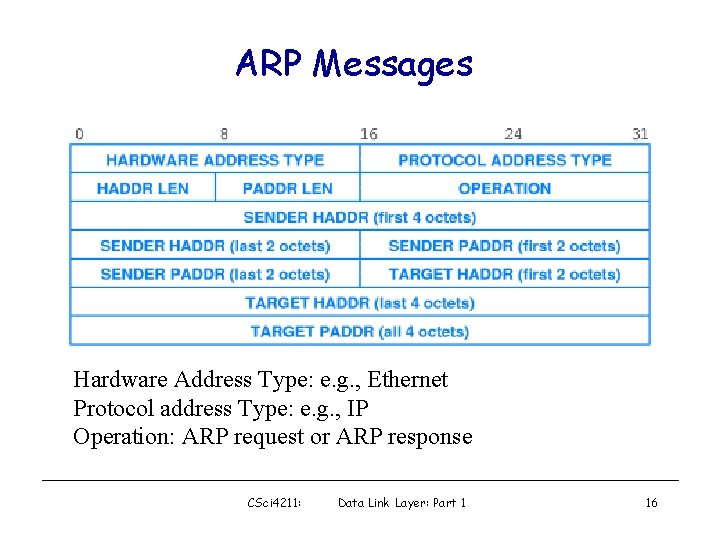
ARP Messages Hardware Address Type: e. g. , Ethernet Protocol address Type: e. g. , IP Operation: ARP request or ARP response CSci 4211: Data Link Layer: Part 1 16
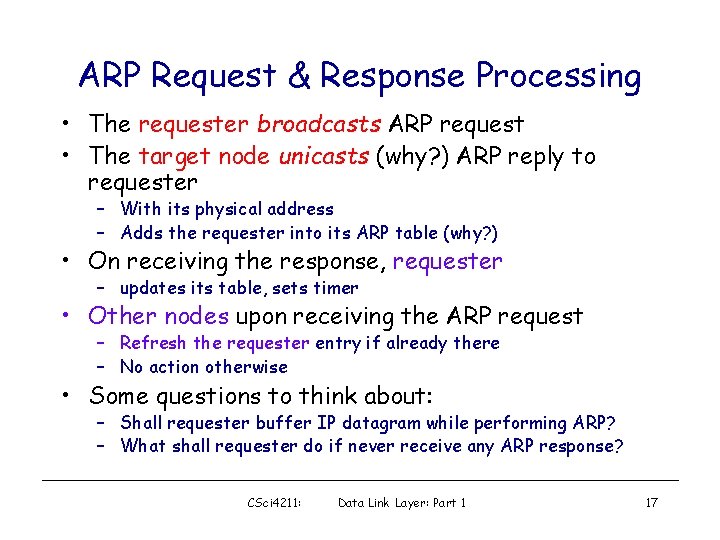
ARP Request & Response Processing • The requester broadcasts ARP request • The target node unicasts (why? ) ARP reply to requester – With its physical address – Adds the requester into its ARP table (why? ) • On receiving the response, requester – updates its table, sets timer • Other nodes upon receiving the ARP request – Refresh the requester entry if already there – No action otherwise • Some questions to think about: – Shall requester buffer IP datagram while performing ARP? – What shall requester do if never receive any ARP response? CSci 4211: Data Link Layer: Part 1 17
ARP Operation Illustration CSci 4211: Data Link Layer: Part 1 18
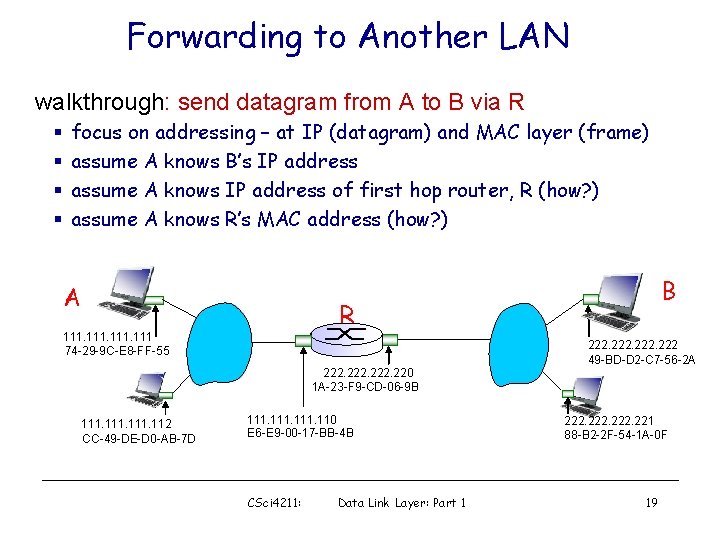
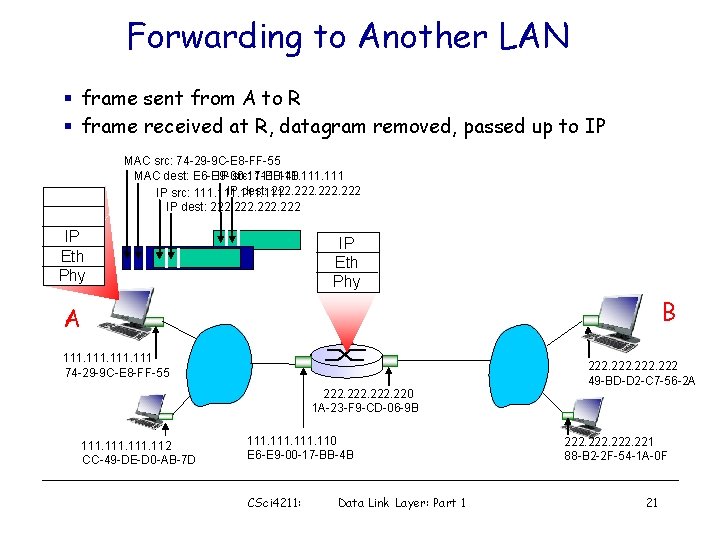
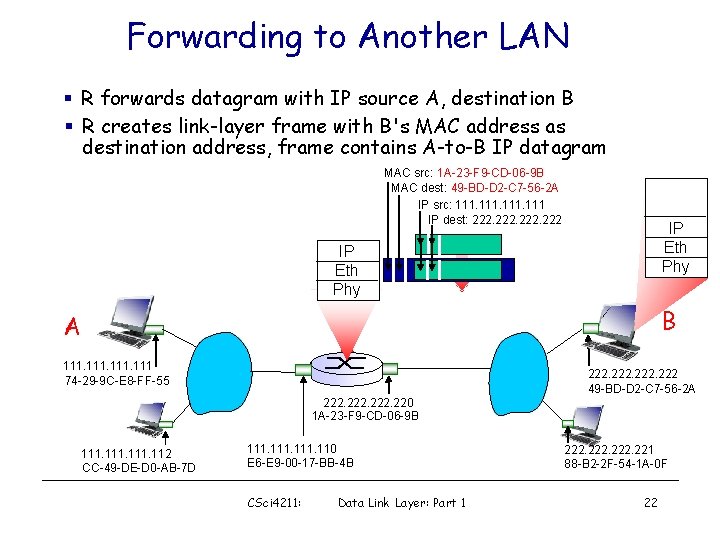
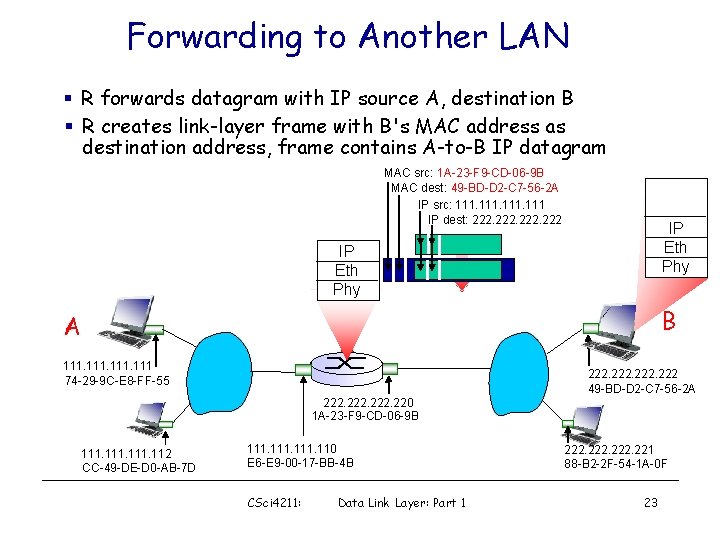
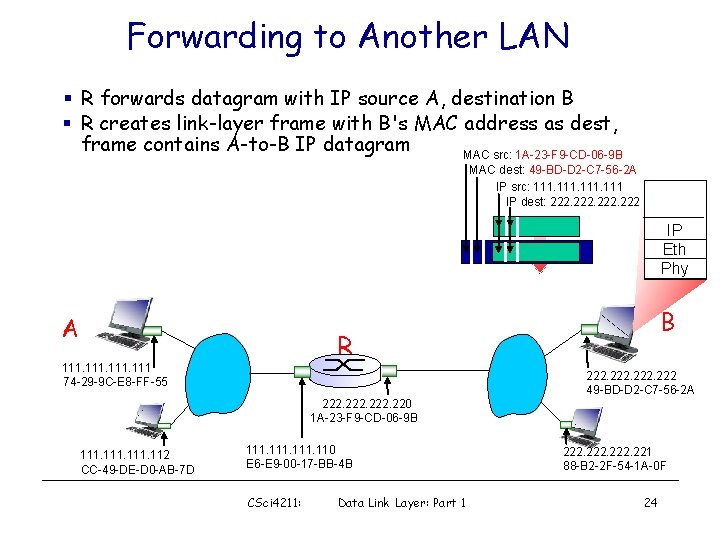
Forwarding to Another LAN walkthrough: send datagram from A to B via R § § focus on addressing – at IP (datagram) and MAC layer (frame) assume A knows B’s IP address assume A knows IP address of first hop router, R (how? ) assume A knows R’s MAC address (how? ) A B R 111 74 -29 -9 C-E 8 -FF-55 222 49 -BD-D 2 -C 7 -56 -2 A 222. 220 1 A-23 -F 9 -CD-06 -9 B 111. 112 CC-49 -DE-D 0 -AB-7 D 111. 110 E 6 -E 9 -00 -17 -BB-4 B CSci 4211: Data Link Layer: Part 1 222. 221 88 -B 2 -2 F-54 -1 A-0 F 19
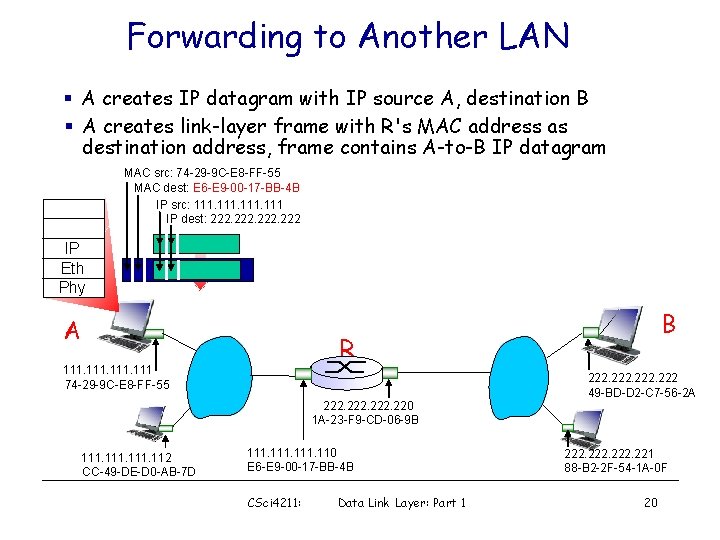
Forwarding to Another LAN § A creates IP datagram with IP source A, destination B § A creates link-layer frame with R's MAC address as destination address, frame contains A-to-B IP datagram MAC src: 74 -29 -9 C-E 8 -FF-55 MAC dest: E 6 -E 9 -00 -17 -BB-4 B IP src: 111 IP dest: 222 IP Eth Phy A B R 111 74 -29 -9 C-E 8 -FF-55 222 49 -BD-D 2 -C 7 -56 -2 A 222. 220 1 A-23 -F 9 -CD-06 -9 B 111. 112 CC-49 -DE-D 0 -AB-7 D 111. 110 E 6 -E 9 -00 -17 -BB-4 B CSci 4211: Data Link Layer: Part 1 222. 221 88 -B 2 -2 F-54 -1 A-0 F 20
Forwarding to Another LAN § frame sent from A to R § frame received at R, datagram removed, passed up to IP MAC src: 74 -29 -9 C-E 8 -FF-55 MAC dest: E 6 -E 9 -00 -17 -BB-4 B IP src: 111 IP dest: 222 IP Eth Phy A B R 111 74 -29 -9 C-E 8 -FF-55 222 49 -BD-D 2 -C 7 -56 -2 A 222. 220 1 A-23 -F 9 -CD-06 -9 B 111. 112 CC-49 -DE-D 0 -AB-7 D 111. 110 E 6 -E 9 -00 -17 -BB-4 B CSci 4211: Data Link Layer: Part 1 222. 221 88 -B 2 -2 F-54 -1 A-0 F 21
Forwarding to Another LAN § R forwards datagram with IP source A, destination B § R creates link-layer frame with B's MAC address as destination address, frame contains A-to-B IP datagram MAC src: 1 A-23 -F 9 -CD-06 -9 B MAC dest: 49 -BD-D 2 -C 7 -56 -2 A IP src: 111 IP dest: 222 IP Eth Phy A B R 111 74 -29 -9 C-E 8 -FF-55 222 49 -BD-D 2 -C 7 -56 -2 A 222. 220 1 A-23 -F 9 -CD-06 -9 B 111. 112 CC-49 -DE-D 0 -AB-7 D 111. 110 E 6 -E 9 -00 -17 -BB-4 B CSci 4211: Data Link Layer: Part 1 222. 221 88 -B 2 -2 F-54 -1 A-0 F 22
Forwarding to Another LAN § R forwards datagram with IP source A, destination B § R creates link-layer frame with B's MAC address as destination address, frame contains A-to-B IP datagram MAC src: 1 A-23 -F 9 -CD-06 -9 B MAC dest: 49 -BD-D 2 -C 7 -56 -2 A IP src: 111 IP dest: 222 IP Eth Phy A B R 111 74 -29 -9 C-E 8 -FF-55 222 49 -BD-D 2 -C 7 -56 -2 A 222. 220 1 A-23 -F 9 -CD-06 -9 B 111. 112 CC-49 -DE-D 0 -AB-7 D 111. 110 E 6 -E 9 -00 -17 -BB-4 B CSci 4211: Data Link Layer: Part 1 222. 221 88 -B 2 -2 F-54 -1 A-0 F 23
Forwarding to Another LAN § R forwards datagram with IP source A, destination B § R creates link-layer frame with B's MAC address as dest, frame contains A-to-B IP datagram MAC src: 1 A-23 -F 9 -CD-06 -9 B MAC dest: 49 -BD-D 2 -C 7 -56 -2 A IP src: 111 IP dest: 222 IP Eth Phy A B R 111 74 -29 -9 C-E 8 -FF-55 222 49 -BD-D 2 -C 7 -56 -2 A 222. 220 1 A-23 -F 9 -CD-06 -9 B 111. 112 CC-49 -DE-D 0 -AB-7 D 111. 110 E 6 -E 9 -00 -17 -BB-4 B CSci 4211: Data Link Layer: Part 1 222. 221 88 -B 2 -2 F-54 -1 A-0 F 24
Ethernet Switch • link-layer device: takes an active role – store, forward Ethernet frames – examine incoming frame’s MAC address, selectively forward frame to one-or-more outgoing links when frame is to be forwarded on segment, uses CSMA/CD to access segment • transparent – hosts are unaware of presence of switches • plug-and-play, self-learning – switches do not need to be configured CSci 4211: Data Link Layer: Part 1 25
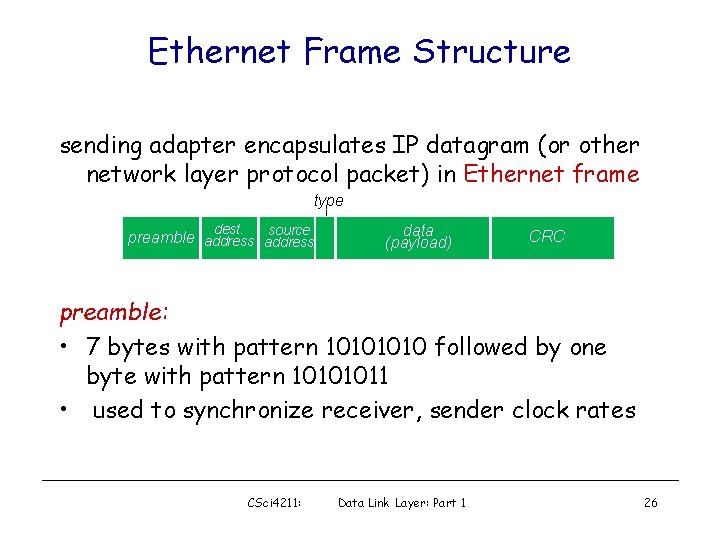
Ethernet Frame Structure sending adapter encapsulates IP datagram (or other network layer protocol packet) in Ethernet frame type dest. source preamble address data (payload) CRC preamble: • 7 bytes with pattern 1010 followed by one byte with pattern 10101011 • used to synchronize receiver, sender clock rates CSci 4211: Data Link Layer: Part 1 26
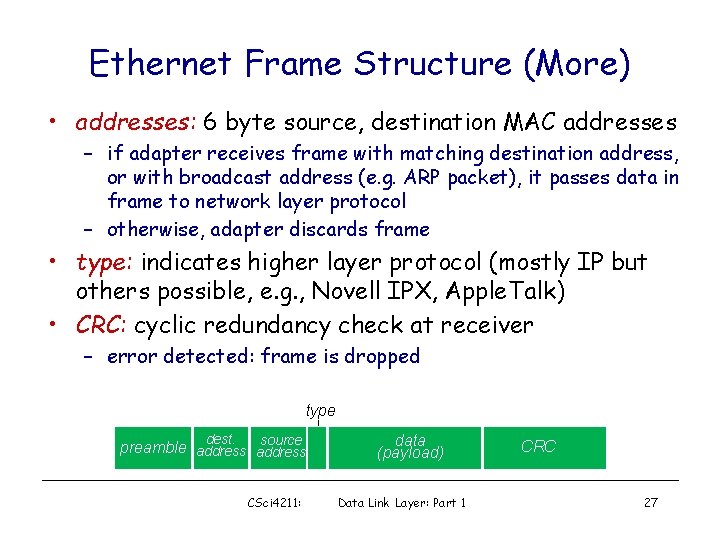
Ethernet Frame Structure (More) • addresses: 6 byte source, destination MAC addresses – if adapter receives frame with matching destination address, or with broadcast address (e. g. ARP packet), it passes data in frame to network layer protocol – otherwise, adapter discards frame • type: indicates higher layer protocol (mostly IP but others possible, e. g. , Novell IPX, Apple. Talk) • CRC: cyclic redundancy check at receiver – error detected: frame is dropped type dest. source preamble address CSci 4211: data (payload) Data Link Layer: Part 1 CRC 27
Ethernet: Unreliable, Connectionless • connectionless: no handshaking between sending and receiving NICs • unreliable: receiving NIC doesn't send acks or nacks to sending NIC – data in dropped frames recovered only if initial sender uses higher layer rdt (e. g. , TCP), otherwise dropped data lost • Ethernet’s MAC protocol: unslotted CSMA/CD with binary backoff Will discuss Ethernet MAC CSMA/CD protocol later! CSci 4211: Data Link Layer: Part 1 28
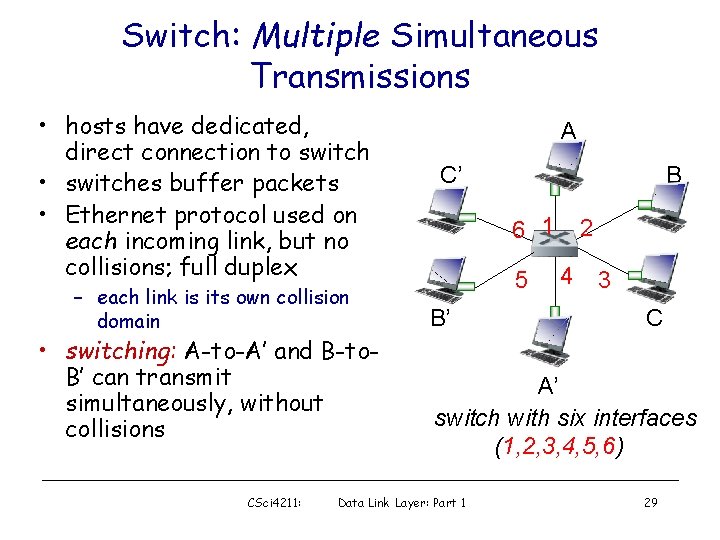
Switch: Multiple Simultaneous Transmissions • hosts have dedicated, direct connection to switch • switches buffer packets • Ethernet protocol used on each incoming link, but no collisions; full duplex – each link is its own collision domain • switching: A-to-A’ and B-to. B’ can transmit simultaneously, without collisions CSci 4211: A C’ B 6 1 5 B’ 2 4 3 C A’ switch with six interfaces (1, 2, 3, 4, 5, 6) Data Link Layer: Part 1 29
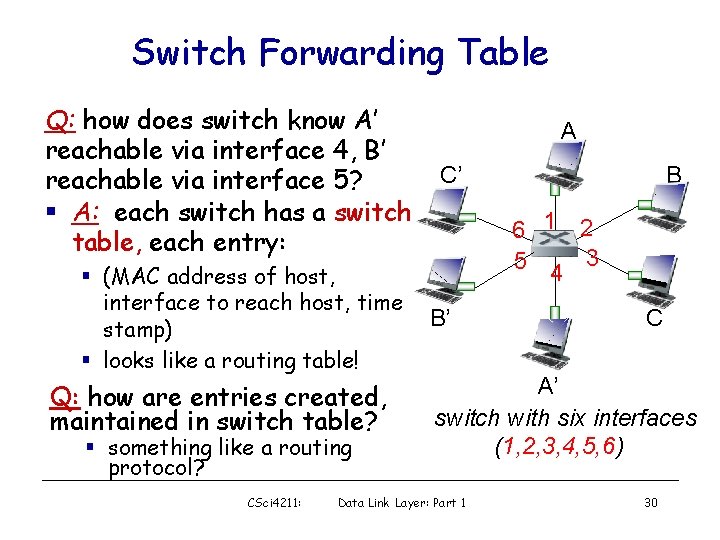
Switch Forwarding Table Q: how does switch know A’ reachable via interface 4, B’ reachable via interface 5? § A: each switch has a switch table, each entry: § (MAC address of host, interface to reach host, time stamp) § looks like a routing table! Q: how are entries created, maintained in switch table? § something like a routing protocol? CSci 4211: A C’ B 6 1 2 3 5 4 B’ C A’ switch with six interfaces (1, 2, 3, 4, 5, 6) Data Link Layer: Part 1 30
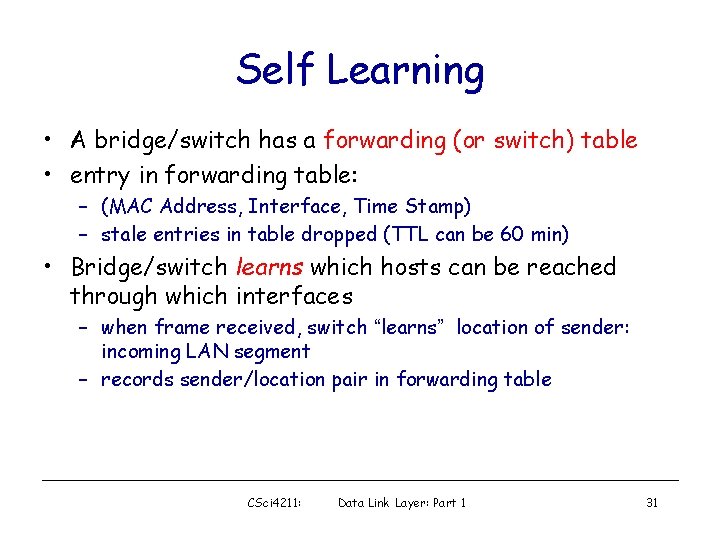
Self Learning • A bridge/switch has a forwarding (or switch) table • entry in forwarding table: – (MAC Address, Interface, Time Stamp) – stale entries in table dropped (TTL can be 60 min) • Bridge/switch learns which hosts can be reached through which interfaces – when frame received, switch “learns” location of sender: incoming LAN segment – records sender/location pair in forwarding table CSci 4211: Data Link Layer: Part 1 31
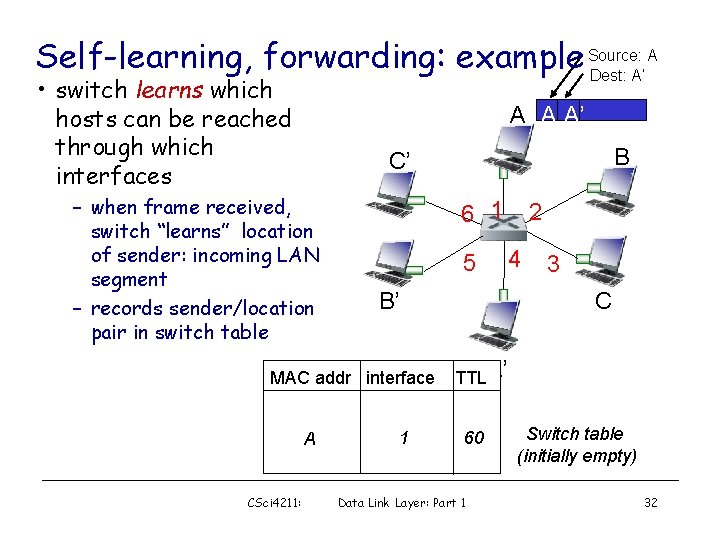
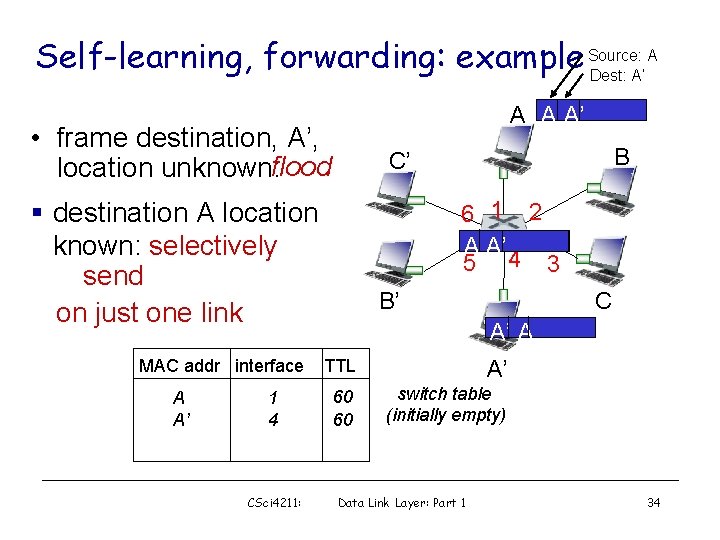
A Self-learning, forwarding: example Source: Dest: A’ • switch learns which hosts can be reached through which interfaces A A A’ – when frame received, switch “learns” location of sender: incoming LAN segment – records sender/location pair in switch table 6 1 5 A 2 4 B’ MAC addr interface CSci 4211: B C’ 1 3 C TTLA’ 60 Data Link Layer: Part 1 Switch table (initially empty) 32
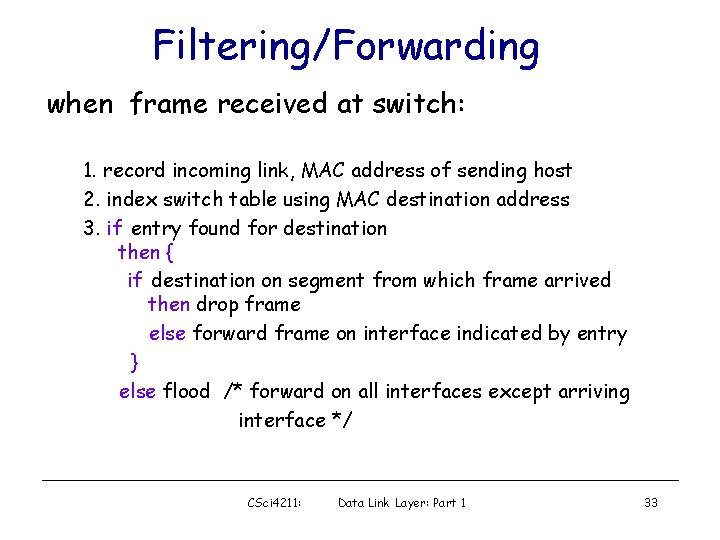
Filtering/Forwarding when frame received at switch: 1. record incoming link, MAC address of sending host 2. index switch table using MAC destination address 3. if entry found for destination then { if destination on segment from which frame arrived then drop frame else forward frame on interface indicated by entry } else flood /* forward on all interfaces except arriving interface */ CSci 4211: Data Link Layer: Part 1 33
A Self-learning, forwarding: example Source: Dest: A’ A A A’ • frame destination, A’, location unknown: flood 6 1 2 A A’ 5 4 3 § destination A location known: selectively send on just one link MAC addr interface A A’ 1 4 CSci 4211: B C’ B’ C A’ A TTL A’ 60 60 switch table (initially empty) Data Link Layer: Part 1 34
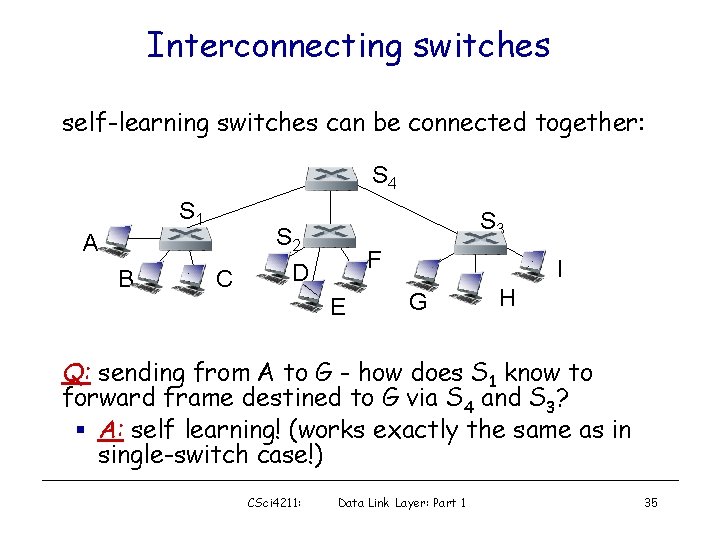
Interconnecting switches self-learning switches can be connected together: S 4 S 1 A B C S 3 S 2 D F E I G H Q: sending from A to G - how does S 1 know to forward frame destined to G via S 4 and S 3? § A: self learning! (works exactly the same as in single-switch case!) CSci 4211: Data Link Layer: Part 1 35
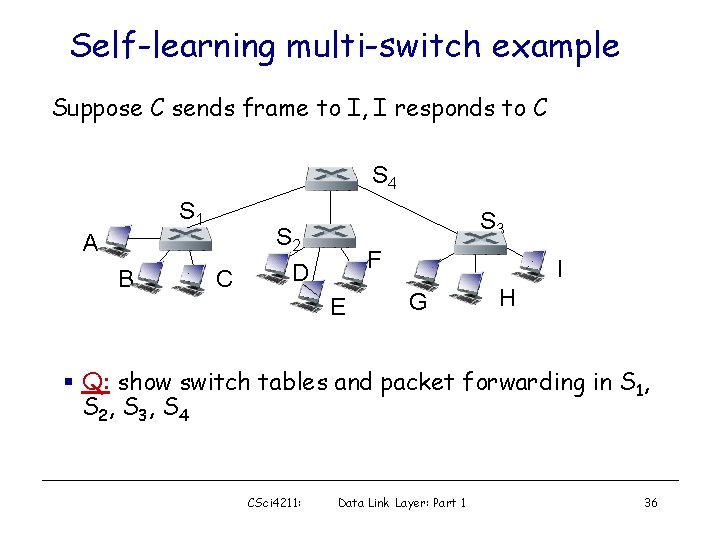
Self-learning multi-switch example Suppose C sends frame to I, I responds to C S 4 S 1 A B C S 3 S 2 D F E I G H § Q: show switch tables and packet forwarding in S 1, S 2, S 3, S 4 CSci 4211: Data Link Layer: Part 1 36
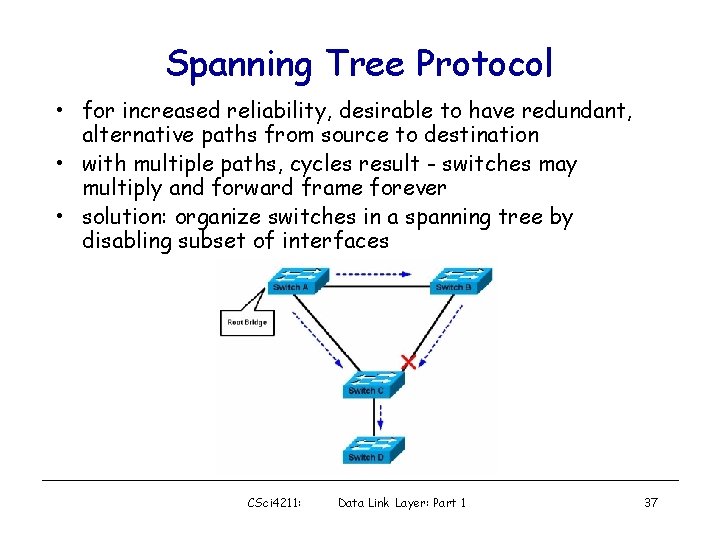
Spanning Tree Protocol • for increased reliability, desirable to have redundant, alternative paths from source to destination • with multiple paths, cycles result - switches may multiply and forward frame forever • solution: organize switches in a spanning tree by disabling subset of interfaces CSci 4211: Data Link Layer: Part 1 37
Switch Spanning Tree Algorithm: Algorhyme I think that I shall never see A graph more lovely than a tree. A tree whose crucial property Is loop-free connectivity. A tree that must be sure to span So packets can reach every LAN. First, the root must be selected. By ID, it is elected. Least cost paths from root are traced. In the tree, these paths are placed. A mesh is made by folks like me, Then bridges find a spanning tree -- Radia Perlman CSci 4211: Data Link Layer: Part 1 38
Some Switch Features • Isolates collision domains resulting in higher total max throughput • limitless number of nodes and geographical coverage • Can connect different Ethernet types • Transparent (“plug-and-play”): no configuration necessary CSci 4211: Data Link Layer: Part 1 39
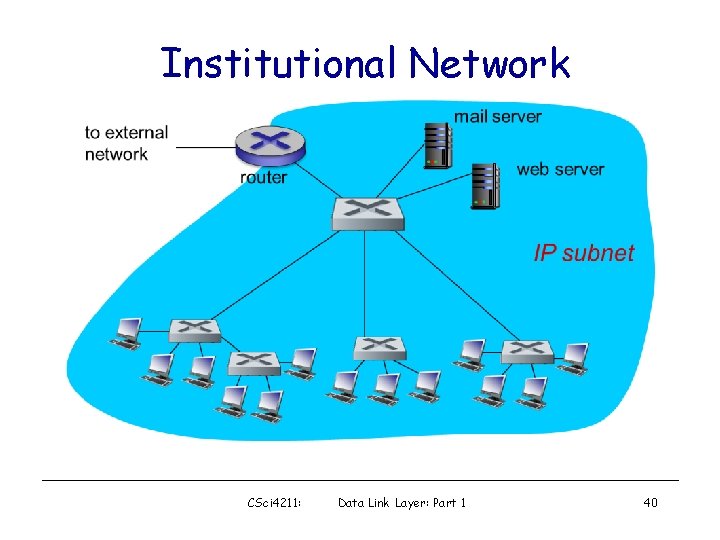
Institutional Network CSci 4211: Data Link Layer: Part 1 40
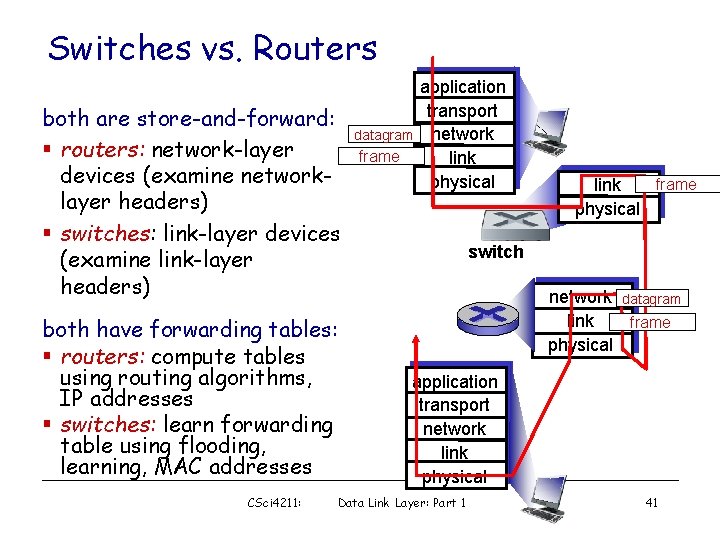
Switches vs. Routers both are store-and-forward: § routers: network-layer devices (examine networklayer headers) § switches: link-layer devices (examine link-layer headers) both have forwarding tables: § routers: compute tables using routing algorithms, IP addresses § switches: learn forwarding table using flooding, learning, MAC addresses CSci 4211: datagram frame application transport network link physical frame link physical switch network datagram link frame physical application transport network link physical Data Link Layer: Part 1 41
Routers vs. Switches+ and + Switch operation is simpler requiring less packet processing + Switch tables are self learning - All traffic confined to spanning tree, even when alternative bandwidth is available - Switches do not offer protection from broadcast storms CSci 4211: Data Link Layer: Part 1 42
Routers vs. Switches Routers + and + arbitrary topologies can be supported, cycling is limited by TTL counters (and good routing protocols) + provide protection against broadcast storms - require IP address configuration (not plug and play) - require higher packet processing • switches do well in small (few hundred hosts) while routers used in large networks (thousands of hosts) CSci 4211: Data Link Layer: Part 1 43