
Data Lifecycle Management Challenges and Techniques a users
- Slides: 36
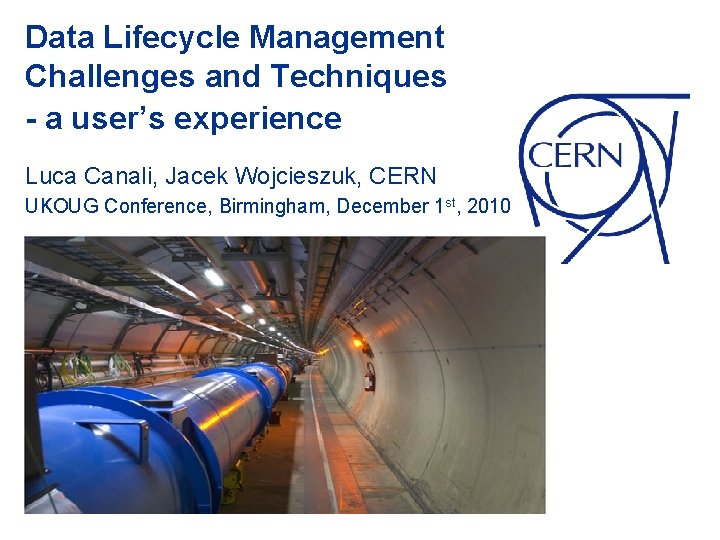
Data Lifecycle Management Challenges and Techniques - a user’s experience Luca Canali, Jacek Wojcieszuk, CERN UKOUG Conference, Birmingham, December 1 st, 2010
Outline § CERN, LHC and Database Services at CERN § Motivations for Data Life Cycle Management activities § Techniques used § Sharing our experience with examples Data Life Cycle Management @ CERN, Luca Canali, Jacek Wojcieszuk 2
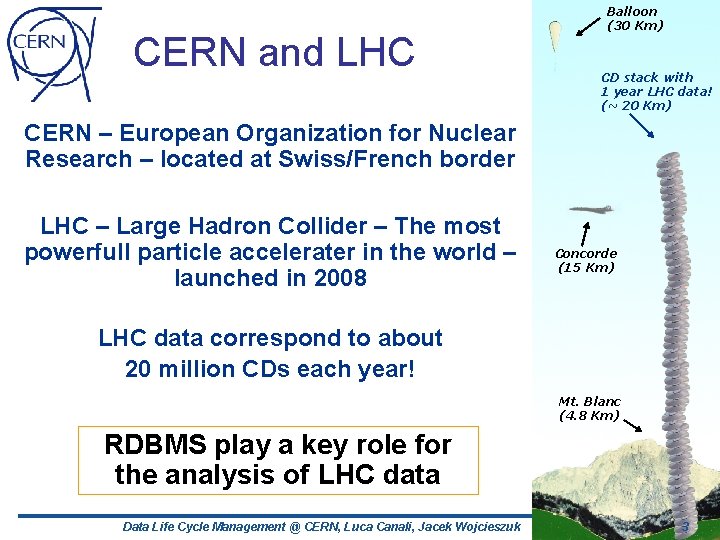
CERN and LHC Balloon (30 Km) CD stack with 1 year LHC data! (~ 20 Km) CERN – European Organization for Nuclear Research – located at Swiss/French border LHC – Large Hadron Collider – The most powerfull particle accelerater in the world – launched in 2008 Concorde (15 Km) LHC data correspond to about 20 million CDs each year! Mt. Blanc (4. 8 Km) RDBMS play a key role for the analysis of LHC data Data Life Cycle Management @ CERN, Luca Canali, Jacek Wojcieszuk 3
LHC and Databases § Relational DBs play today a key role for LHC Physics data processing § online acquisition, offline production, data (re)processing, data distribution, analysis • SCADA, conditions, geometry, alignment, calibration, file bookkeeping, file transfers, etc. . § Grid Infrastructure and Operation services • Monitoring, Dashboards, User-role management, . . § Data Management Services • File catalogues, file transfers and storage management, … Metadata and transaction processing for custom tapebased storage system of physics data § Accelerator logging and monitoring systems § Data Life Cycle Management @ CERN, Luca Canali, Jacek Wojcieszuk 4
CERN Databases in Numbers § CERN databases services – global numbers Global users community of several thousand users § ~100 Oracle RAC database clusters (2 – 6 nodes) § Currently over ~3000 disk spindles providing more than ~3 PB raw disk space (NAS and SAN) § § Some notable DBs at CERN § Experiment databases – 13 production databases • Currently between 1 and 12 TB in size • Expected growth between 1 and 19 TB / year § LHC accelerator logging database (ACCLOG) – ~50 TB • Expected growth up to 30 TB / year § . . . Several more DBs on the range 1 -2 TB Data Life Cycle Management @ CERN, Luca Canali, Jacek Wojcieszuk 5
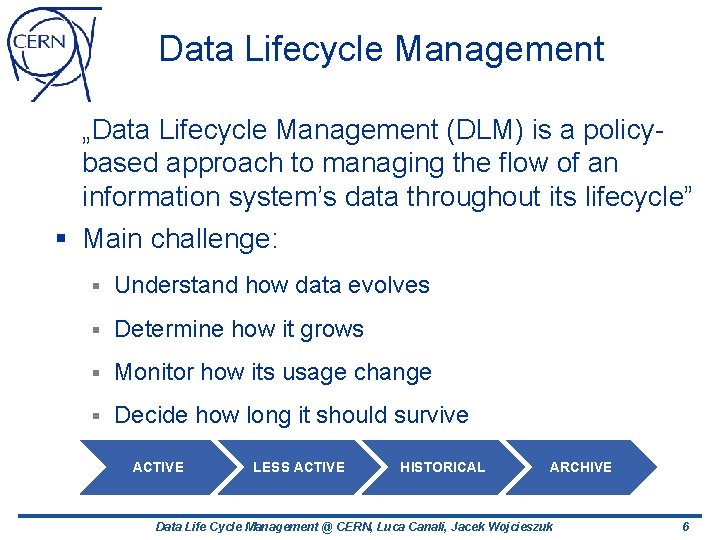
Data Lifecycle Management „Data Lifecycle Management (DLM) is a policybased approach to managing the flow of an information system’s data throughout its lifecycle” § Main challenge: § Understand how data evolves § Determine how it grows § Monitor how its usage change § Decide how long it should survive ACTIVE LESS ACTIVE HISTORICAL ARCHIVE Data Life Cycle Management @ CERN, Luca Canali, Jacek Wojcieszuk 6
Data Lifecycle Management @CERN § Motivated by large data volumes produced by LHC experiments Large amounts of data are being collected and stored for several years § Different requirements on performance and SLA can often be found for ‘current’ and ‘old’ data sets § § Proactively attack ‘issues’ of databases that grow ‘too large’ Administration § Performance § Cost § Data Life Cycle Management @ CERN, Luca Canali, Jacek Wojcieszuk 7
Attack Problem from Multiple Sides § No out of the box solutions available § Attack the problem where possible HW architecture § Applications § Oracle and DB features § § Application layer Focus on discussing with developers § Build life cycle concepts in the applications § § Oracle layer Leverage partitioning and compression § Movement of data to an external ‘archival DB’ § Data Life Cycle Management @ CERN, Luca Canali, Jacek Wojcieszuk 8
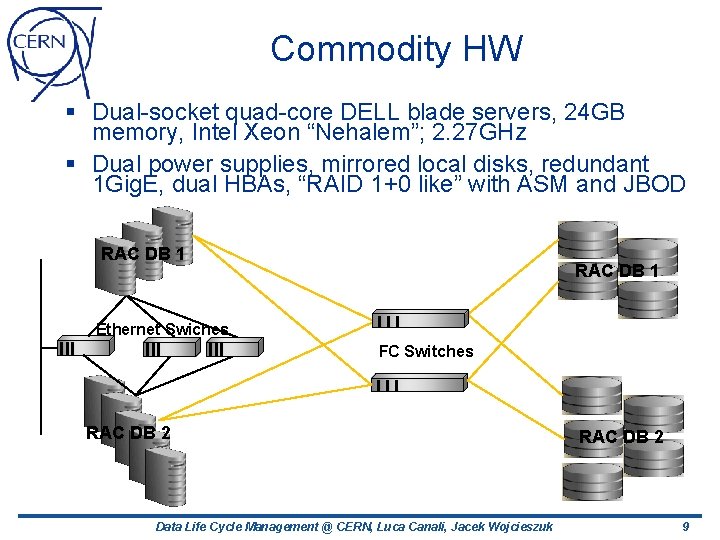
Commodity HW § Dual-socket quad-core DELL blade servers, 24 GB memory, Intel Xeon “Nehalem”; 2. 27 GHz § Dual power supplies, mirrored local disks, redundant 1 Gig. E, dual HBAs, “RAID 1+0 like” with ASM and JBOD RAC DB 1 Ethernet Swiches FC Switches RAC DB 2 Data Life Cycle Management @ CERN, Luca Canali, Jacek Wojcieszuk RAC DB 2 9
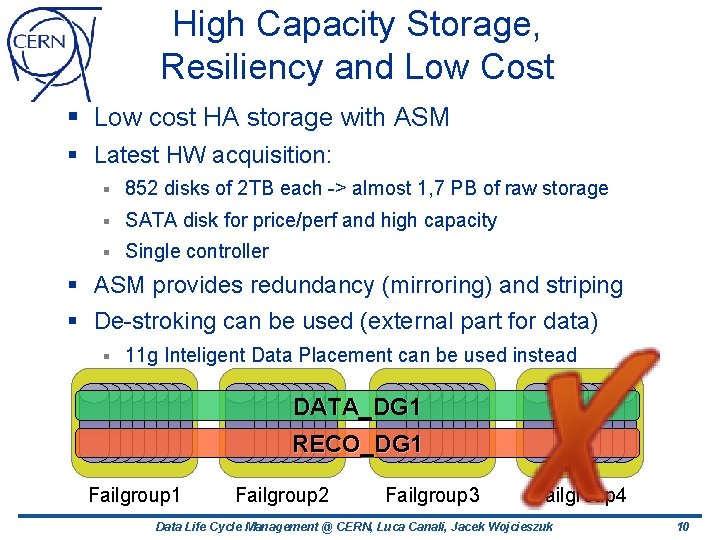
High Capacity Storage, Resiliency and Low Cost § Low cost HA storage with ASM § Latest HW acquisition: § 852 disks of 2 TB each -> almost 1, 7 PB of raw storage § SATA disk for price/perf and high capacity § Single controller § ASM provides redundancy (mirroring) and striping § De-stroking can be used (external part for data) § 11 g Inteligent Data Placement can be used instead DATA_DG 1 RECO_DG 1 Failgroup 2 Failgroup 3 Failgroup 4 Data Life Cycle Management @ CERN, Luca Canali, Jacek Wojcieszuk 10
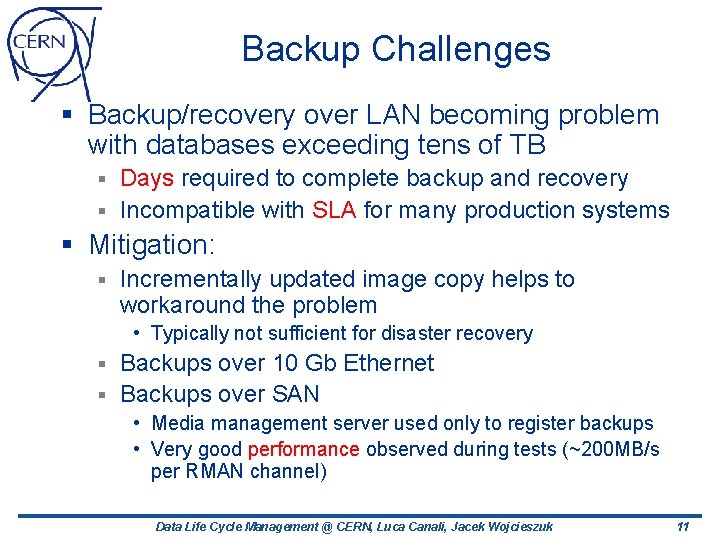
Backup Challenges § Backup/recovery over LAN becoming problem with databases exceeding tens of TB Days required to complete backup and recovery § Incompatible with SLA for many production systems § § Mitigation: § Incrementally updated image copy helps to workaround the problem • Typically not sufficient for disaster recovery Backups over 10 Gb Ethernet § Backups over SAN § • Media management server used only to register backups • Very good performance observed during tests (~200 MB/s per RMAN channel) Data Life Cycle Management @ CERN, Luca Canali, Jacek Wojcieszuk 11
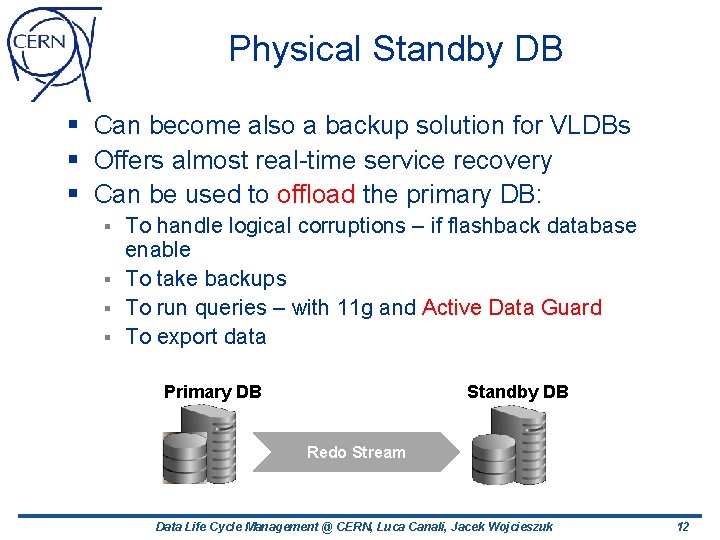
Physical Standby DB § Can become also a backup solution for VLDBs § Offers almost real-time service recovery § Can be used to offload the primary DB: To handle logical corruptions – if flashback database enable § To take backups § To run queries – with 11 g and Active Data Guard § To export data § Primary DB Standby DB Redo Stream Data Life Cycle Management @ CERN, Luca Canali, Jacek Wojcieszuk 12
Application Layer § Data Life Cycle policies cannot be easily implemented from the DBA side only § We make sure to discuss with application developers and application owners To reduced amount of data produced § To allow for DB structure that can more easily allow archiving § Define data availability agreements for online data and archive § Identify how to leverage Oracle features for VLDBs § Data Life Cycle Management @ CERN, Luca Canali, Jacek Wojcieszuk 13
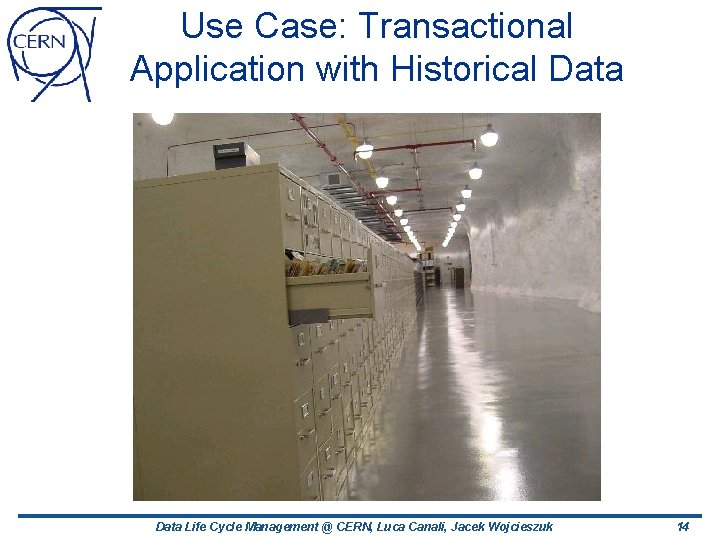
Use Case: Transactional Application with Historical Data Life Cycle Management @ CERN, Luca Canali, Jacek Wojcieszuk 14
Active Dataset § At a given time only a subset of data is actively used § Typical for many physics applications § Typically time-organized data § Natural optimization: having large amounts of data that are set read only • Can be used to simplify administration • Replication and backup can profit too § This leads to range-based partitioning • Oracle partitioning • Manual split Data Life Cycle Management @ CERN, Luca Canali, Jacek Wojcieszuk 15
Techniques: Oracle Partitioning § Typically range partitioning on timestamp attributes § Mature and widely used technology § Almost transparent to applications § Can improve performance § Full scan operation, if they happen, do not span whole tables § Important improvements in Oracle 11 g Interval partitioning – automatic creation of partitions for ‘future time ranges’ § 11 g reference partitioning § Data Life Cycle Management @ CERN, Luca Canali, Jacek Wojcieszuk 16
Oracle Partitioning Issues § Index strategy § Indexes need to be local partitioned in the ideal case to fully make use of ‘partition isolation’ • Often impossible for unique indexes Depends on application § Sometimes global indexes better for performance § § Data movement issues § Using ‘Transportablespaces’ for single partitions is not straightforward § Query tuning § App owners and DBAs need to make sure there are no ‘stray queries’ that run over multiple partitions by mistake Data Life Cycle Management @ CERN, Luca Canali, Jacek Wojcieszuk 17
Oracle Partitioning for DLM and Indexes § Local-partitioned indexes preferred That is index partitioned as the table § Good for maintenance, often also for performance § Sometimes problematic for queries § Important limitation: columns in unique indexes need be superset of partitioning key § • May require disabling PK/UKs • Or changing PK/UKs to include partitioning key § DDL operations on partitions makes global indexes unusable § ‘update global indexes’ option helps but makes whole operation much slower Data Life Cycle Management @ CERN, Luca Canali, Jacek Wojcieszuk 18
Example: PANDA Archive § GRID jobs’ monitoring system § § Schema contains historical data coming from production Currently 1. 2 TB of data § DLM implementation § Oracle partitioning by time range • One partition per 3 days • Query speed-up because of partition-pruning § § One tablespace per year All indexes are local • Compromise change -> unique index on panda_id changed to be non-unique to use partitioning § Old partitions can be moved to archive system § Performance § Application modified to add time range in all queries -> to use partition pruning Data Life Cycle Management @ CERN, Luca Canali, Jacek Wojcieszuk 19
Techniques: ‘Manual’ Partitioning § Range partitioning obtained by creating multiple schemas and sets of tables § Flexible, does not require partitioning option • And is not subject to partitioning limitations § Much more work goes into the application layer • Application needs to keep track of ‘catalog’ of partitions § CERN Production examples PVSS (commercial SCADA system) § COMPASS (custom development at CERN) § Data Life Cycle Management @ CERN, Luca Canali, Jacek Wojcieszuk 20
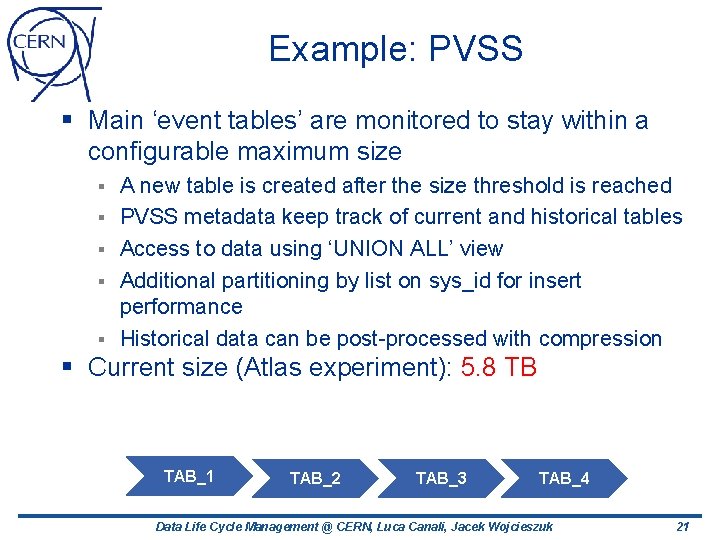
Example: PVSS § Main ‘event tables’ are monitored to stay within a configurable maximum size § § § A new table is created after the size threshold is reached PVSS metadata keep track of current and historical tables Access to data using ‘UNION ALL’ view Additional partitioning by list on sys_id for insert performance Historical data can be post-processed with compression § Current size (Atlas experiment): 5. 8 TB TAB_1 TAB_2 TAB_3 TAB_4 Data Life Cycle Management @ CERN, Luca Canali, Jacek Wojcieszuk 21
Example: COMPASS § Each week of data is a separate table § In a separate schema too • raw and re-processed data also separated • The aplication maintains a catalog IOT used § Up to 4. 6 billion rows per table § Key compression used for IOT § § Current total size: ~12 TB § Biggest table 326 GB Data Life Cycle Management @ CERN, Luca Canali, Jacek Wojcieszuk 22
Techniques: Schema Reorganization § When downtime of part of the application can be afforded Alter table move (or CTAS) § Alter index rebuild § • Online rebuild also possible § More sophisticated DBMS_REDEFINITION § Allows to reorganization of tables online (add partitioning for example) § Users experience, works well but it has let us down a couple of times in presence of high transaction rates § • hard to debug and test ahead Data Life Cycle Management @ CERN, Luca Canali, Jacek Wojcieszuk 23
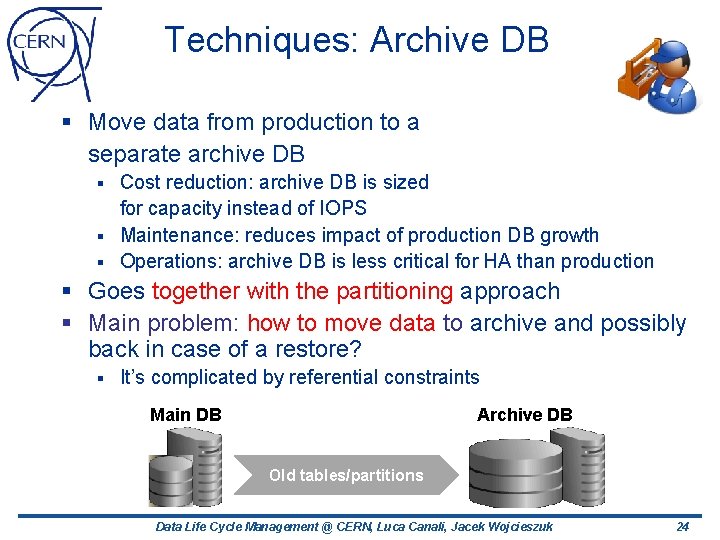
Techniques: Archive DB § Move data from production to a separate archive DB Cost reduction: archive DB is sized for capacity instead of IOPS § Maintenance: reduces impact of production DB growth § Operations: archive DB is less critical for HA than production § § Goes together with the partitioning approach § Main problem: how to move data to archive and possibly back in case of a restore? § It’s complicated by referential constraints Main DB Archive DB Old tables/partitions Data Life Cycle Management @ CERN, Luca Canali, Jacek Wojcieszuk 24
Archive DB in Practice § Detach ‘old’ partitions form prod and load them on the archive DB Can use partition exchange to table § Transportablespaces is a tool that can help § Post-move jobs can implement compression and drop indexes § § Difficult point: One needs to move a consistent set of data § Applications need to be developed to support this move § • Access to data of archive need to be validated • Database links, views and synonyms can help to hide data distribution • New releases of software need to be able to read archived data Data Life Cycle Management @ CERN, Luca Canali, Jacek Wojcieszuk 25
Techniques: Data Movement § Create table as select over a DB link Good enough for single tables/partitions § Too laborious if many objects needs to be copied § § impdp/expdp Very useful although performance issues found § Impdp over DB link in particular § § Partitioning and data movement § Exchange partition with table § Transportablespaces Very fast Oracle-Oracle data movement § Requires TBS to be set read only § • Can be a problem in production Data Life Cycle Management @ CERN, Luca Canali, Jacek Wojcieszuk 26
Transportable Tablespaces and Standby DBs § Physical standby database can be used as a source for transportablespaces procedure Standby needs to be opened in read-only mode § Active Data Guard option not needed § DBMS_FILE_TRANSFER package to copy datafile § • Much faster than scp § impdp over a DB link to export/import metadata • If 10. 2. 0. 4 or 11. 1. 0. 6 patch 7331929 needed • 10. 2. 0. 5 and 11. 1. 0. 7 patchsets include the fix • With Flashback Database feature enabled one can also temporarily open a physical standby DB readwrite Data Life Cycle Management @ CERN, Luca Canali, Jacek Wojcieszuk 27
Techniques: Compression § Another tool to control DB growth Several compresion techniques available in Oracle RDMBS § Especially useful if spare CPU cycles available § Can help in reducing physical IO § Data Life Cycle Management @ CERN, Luca Canali, Jacek Wojcieszuk 28
Oracle Segment Compression What is Available § Heap table compression: Basic (from 9 i) § For OLTP (from 11 g. R 1) § 11 g. R 2 hybrid columnar (11 g. R 2 exadata) § § Other compression technologies § Index compression • Key factoring • Applies also to IOTs § Secure files (LOB) compression • 11 g compression and de-duplication § Compressed external tables (11 g. R 2) Data Life Cycle Management @ CERN, Luca Canali, Jacek Wojcieszuk 29
Evaluating Compression Benefits § Compressing segments in Oracle § Save disk space • Can save cost in HW • Beware that capacity in often not as important as number of disks, which determine max IOPS § Compressed segments need less blocks so • Less physical IO required for full scan • Less logical IO / space occupied in buffer cache • Beware compressed segments will make you consume more CPU Data Life Cycle Management @ CERN, Luca Canali, Jacek Wojcieszuk 30
Making it Work with Applications § Evaluate gains case by case Not all applications can profit § Not all data models can allow for it § Compression can give significant gains for some applications § In some other cases applications can be modified to take advantage of compression § § Comment: Implementation involves developers and DBAs § DBMS_COMPRESSION package to evaluate possible gains § Data Life Cycle Management @ CERN, Luca Canali, Jacek Wojcieszuk 31
Compression and Expectations § A 10 TB DB can be shrunk to 1 TB of storage with a 10 x compression? § Not really unless one can get rid of indexes • Applies more to DW § Often indexes’ compression is lower than tables’ • So archive can be dominated by indexes size § Licensing costs Advanced compression option required for anything but basic compression § Exadata storage required for hybrid columnar compression § Data Life Cycle Management @ CERN, Luca Canali, Jacek Wojcieszuk 32
Table Compression In Practice § ‘Alter table move’ or online redefinition to populate compressed segments § See earlier comments regarding online redefinition § Measured compression factors for tables: § About 3 x for BASIC and OLTP • Important to sort properly data while populating compressed tables § 10 -20 x for hybrid columnar (archive) Data Life Cycle Management @ CERN, Luca Canali, Jacek Wojcieszuk 33
Conclusions § Data Life Cycle Management experience at CERN Proactively address issues of growing DBs § manageability § performance § cost § § Involvement of application owners is fundamental § Techniques within Oracle that can help Partitioning § Archival DB service § Compression § Data Life Cycle Management @ CERN, Luca Canali, Jacek Wojcieszuk 34
Conclusions § Data Life Cycle Management experience at CERN Proactively address issues of growing DBs § Manageability § Performance § Cost § § Involvement of application owners is fundamental § Techniques within Oracle that can help Partitioning § Archival DB service § Compression § Data Life Cycle Management @ CERN, Luca Canali, Jacek Wojcieszuk 35
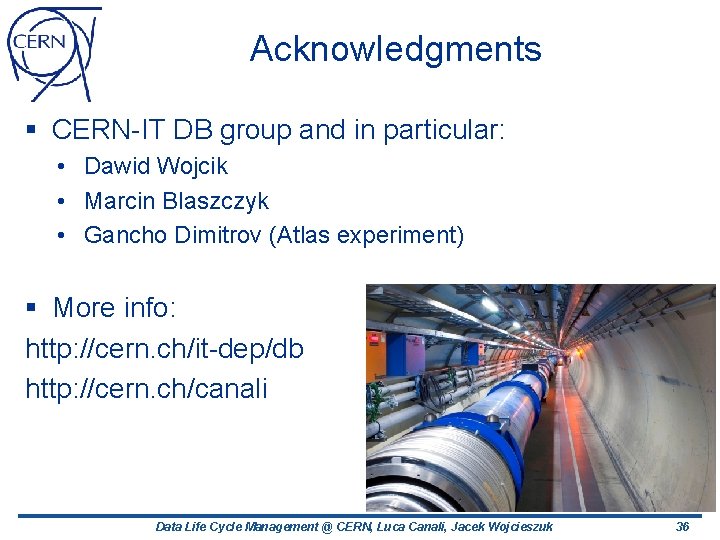
Acknowledgments § CERN-IT DB group and in particular: • Dawid Wojcik • Marcin Blaszczyk • Gancho Dimitrov (Atlas experiment) § More info: http: //cern. ch/it-dep/db http: //cern. ch/canali Data Life Cycle Management @ CERN, Luca Canali, Jacek Wojcieszuk 36