
Data Layout Transformation for Enhancing Data Locality on
![Polyhedral Model for (i=1; i<=7; i++) for (j=2; j<=6; j++) S 1: a[i][j] =](https://slidetodoc.com/presentation_image_h2/dec9d236806450f8e695d9897517c5d8/image-9.jpg "Polyhedral Model for (i=1; i<=7; i++) for (j=2; j<=6; j++) S 1: a[i][j] =")

![Data Layout Transformation (Cont. ) A[0] A[1] A[2] A[3] A[4] A[5] A[6] A[7] A[8]](https://slidetodoc.com/presentation_image_h2/dec9d236806450f8e695d9897517c5d8/image-15.jpg "Data Layout Transformation (Cont. ) A[0] A[1] A[2] A[3] A[4] A[5] A[6] A[7] A[8]")
- Slides: 24
Data Layout Transformation for Enhancing Data Locality on NUCA Chip Multiprocessors Qingda Lu 1, Christophe Alias 2, Uday Bondhugula 1, Thomas Henretty 1, Sriram Krishnamoorthy 3, J. Ramanujam 4, Atanas Rountev 1, P. Sadayappan 1, Yongjian Chen 5, Haibo Lin 6, Tin-Fook Ngai 5 1 The 3 Pacific Ohio State University, 2 ENS Lyon – INRIA, Northwest National Lab, 4 Louisiana State University, 5 Intel 10/22/2021 Corp. , 6 IBM China Research Lab 1
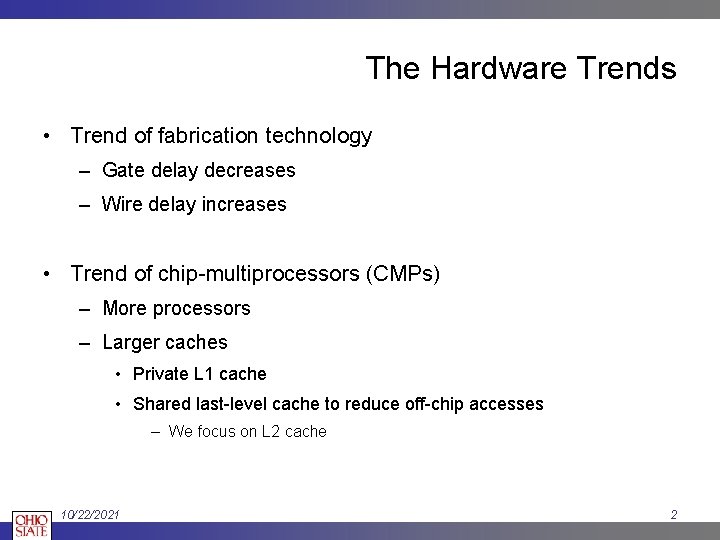
The Hardware Trends • Trend of fabrication technology – Gate delay decreases – Wire delay increases • Trend of chip-multiprocessors (CMPs) – More processors – Larger caches • Private L 1 cache • Shared last-level cache to reduce off-chip accesses – We focus on L 2 cache 10/22/2021 2
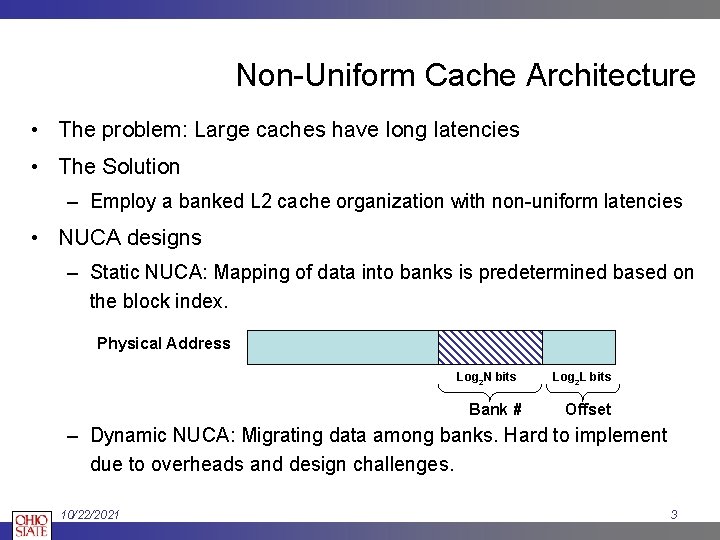
Non-Uniform Cache Architecture • The problem: Large caches have long latencies • The Solution – Employ a banked L 2 cache organization with non-uniform latencies • NUCA designs – Static NUCA: Mapping of data into banks is predetermined based on the block index. Physical Address Log 2 N bits Bank # Log 2 L bits Offset – Dynamic NUCA: Migrating data among banks. Hard to implement due to overheads and design challenges. 10/22/2021 3
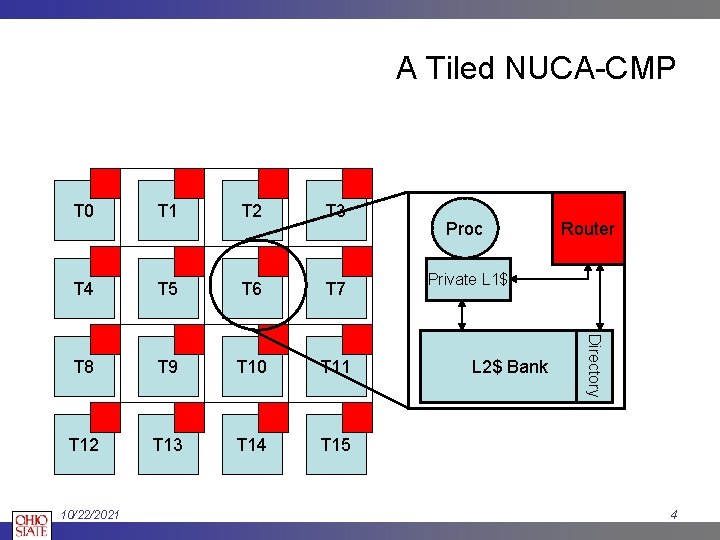
A Tiled NUCA-CMP T 1 T 2 T 3 T 4 T 5 T 6 T 7 T 8 T 9 T 10 T 11 T 12 T 13 T 14 T 15 10/22/2021 Proc Router Private L 1$ L 2$ Bank Directory T 0 4
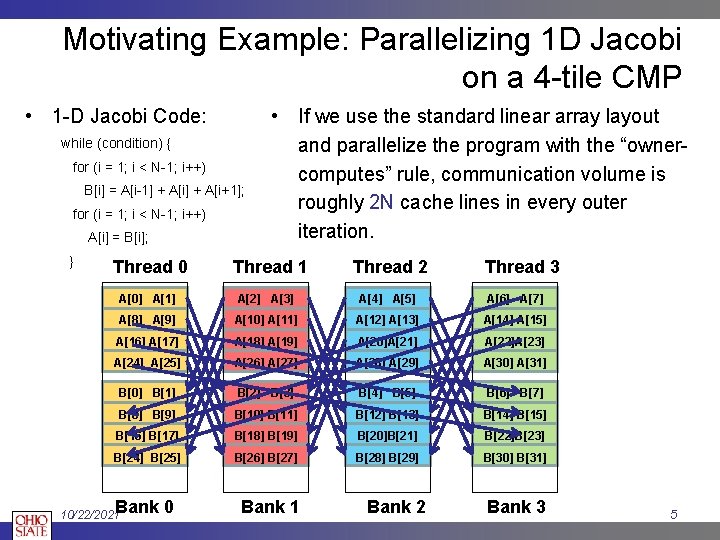
Motivating Example: Parallelizing 1 D Jacobi on a 4 -tile CMP • 1 -D Jacobi Code: while (condition) { for (i = 1; i < N-1; i++) B[i] = A[i-1] + A[i+1]; for (i = 1; i < N-1; i++) A[i] = B[i]; } Thread 0 • If we use the standard linear array layout and parallelize the program with the “ownercomputes” rule, communication volume is roughly 2 N cache lines in every outer iteration. Thread 1 Thread 2 Thread 3 A[0] A[1] A[2] A[3] A[4] A[5] A[6] A[7] A[8] A[9] A[10] A[11] A[12] A[13] A[14] A[15] A[16] A[17] A[18] A[19] A[20]A[21] A[22]A[23] A[24] A[25] A[26] A[27] A[28] A[29] A[30] A[31] B[0] B[1] B[2] B[3] B[4] B[5] B[6] B[7] B[8] B[9] B[10] B[11] B[12] B[13] B[14] B[15] B[16] B[17] B[18] B[19] B[20]B[21] B[22]B[23] B[24] B[25] B[26] B[27] B[28] B[29] B[30] B[31] Bank 0 10/22/2021 Bank 2 Bank 3 5
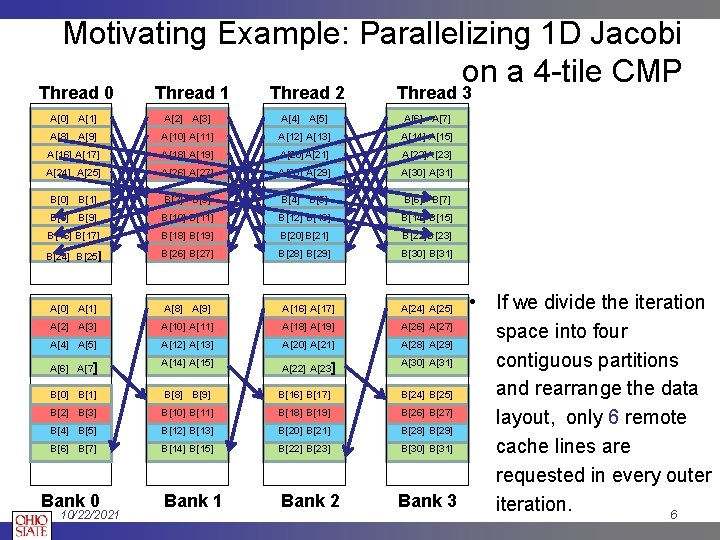
Motivating Example: Parallelizing 1 D Jacobi on a 4 -tile CMP Thread 0 Thread 1 Thread 2 Thread 3 A[0] A[1] A[2] A[3] A[4] A[5] A[6] A[7] A[8] A[9] A[10] A[11] A[12] A[13] A[14] A[15] A[16] A[17] A[18] A[19] A[20]A[21] A[22]A[23] A[24] A[25] A[26] A[27] A[28] A[29] A[30] A[31] B[0] B[1] B[2] B[3] B[4] B[5] B[6] B[7] B[8] B[9] B[10] B[11] B[12] B[13] B[14] B[15] B[16] B[17] B[18] B[19] B[20]B[21] B[22]B[23] B[24] B[25] B[26] B[27] B[28] B[29] B[30] B[31] A[0] A[1] A[8] A[9] A[16] A[17] A[2] A[3] A[10] A[11] A[18] A[19] A[4] A[5] A[12] A[13] A[20] A[21] A[6] A[7] A[14] A[15] A[22] A[23] B[0] B[1] B[8] B[9] B[16] B[17] B[2] B[3] B[10] B[11] B[18] B[19] B[4] B[5] B[12] B[13] B[20] B[21] B[6] B[7] B[14] B[15] B[22] B[23] Bank 1 Bank 2 Bank 0 10/22/2021 • If we divide the iteration A[26] A[27] space into four A[28] A[29] A[30] A[31] contiguous partitions and rearrange the data B[24] B[25] B[26] B[27] layout, only 6 remote B[28] B[29] B[30] B[31] cache lines are requested in every outer Bank 3 iteration. 6 A[24] A[25]
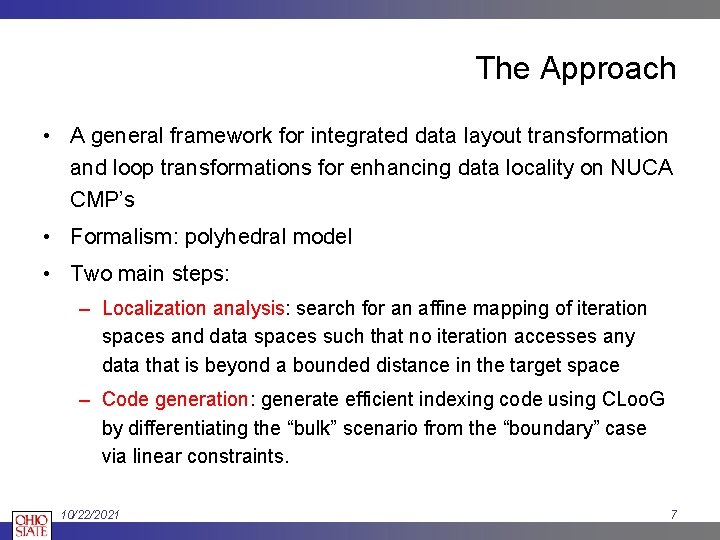
The Approach • A general framework for integrated data layout transformation and loop transformations for enhancing data locality on NUCA CMP’s • Formalism: polyhedral model • Two main steps: – Localization analysis: search for an affine mapping of iteration spaces and data spaces such that no iteration accesses any data that is beyond a bounded distance in the target space – Code generation: generate efficient indexing code using CLoo. G by differentiating the “bulk” scenario from the “boundary” case via linear constraints. 10/22/2021 7
Polyhedral Model • An algebraic framework for representing affine programs – statement domains, dependences, array access functions – and affine program transformations • Regular affine programs – Dense arrays – Loop bounds – affine functions of outer loop variables, constants and program parameters – Array access functions - affine functions of surrounding loop variables, constants and program parameters
Polyhedral Model for (i=1; i<=7; i++) for (j=2; j<=6; j++) S 1: a[i][j] = a[j][i] + a[i][j-1]; i j≥ 2 ₣S 1, a (x. S 1) = 10 01 i j . 0 + -1 j≤ 6 i≤ 7 1 0 -1 x. S 1 = i≥ 1 j i j DS 1 (x. S 1) = -1 0 7 0 1 -2 0 -1 6 . i j 1 ≥ 0
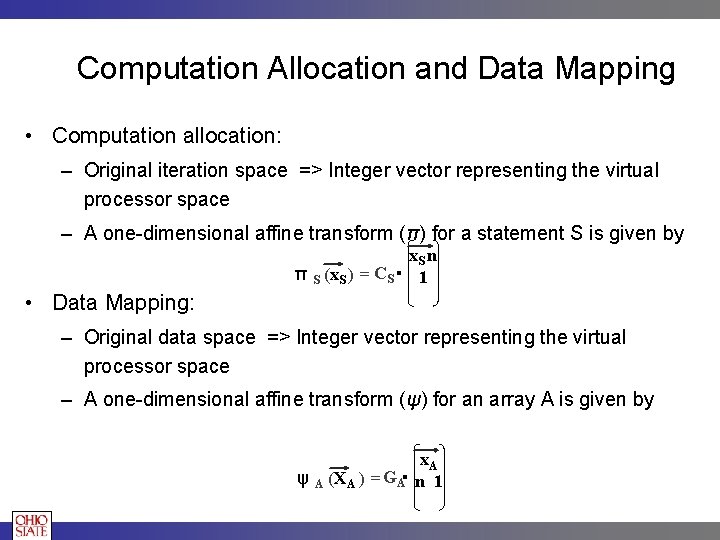
Computation Allocation and Data Mapping • Computation allocation: – Original iteration space => Integer vector representing the virtual processor space – A one-dimensional affine transform (π) for a statement S is given by π S (x. S x n. ) =C 1 S S • Data Mapping: – Original data space => Integer vector representing the virtual processor space – A one-dimensional affine transform (ψ) for an array A is given by ψ A (XA x. ) =G n 1 A A
Localized Computation Allocation and Data Mapping • Definition: For a program P, let D be its index set, computation allocation π and data mapping ψ for P are localized if and only if for any array A, and any reference FS, A, , where q is a constant. • As a special case, communication-free localization can be achieved if and only if for any array A and any array reference FS, A in a statement S, computation allocation π and data mapping ψ satisfy 10/22/2021 11
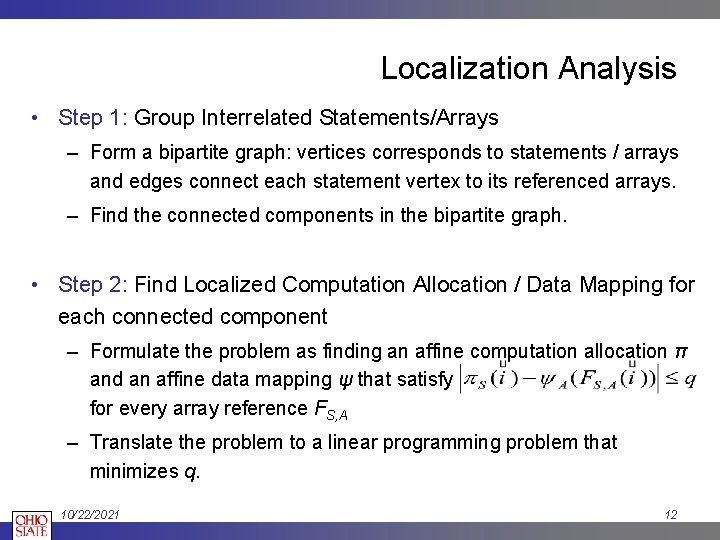
Localization Analysis • Step 1: Group Interrelated Statements/Arrays – Form a bipartite graph: vertices corresponds to statements / arrays and edges connect each statement vertex to its referenced arrays. – Find the connected components in the bipartite graph. • Step 2: Find Localized Computation Allocation / Data Mapping for each connected component – Formulate the problem as finding an affine computation allocation π and an affine data mapping ψ that satisfy for every array reference FS, A – Translate the problem to a linear programming problem that minimizes q. 10/22/2021 12
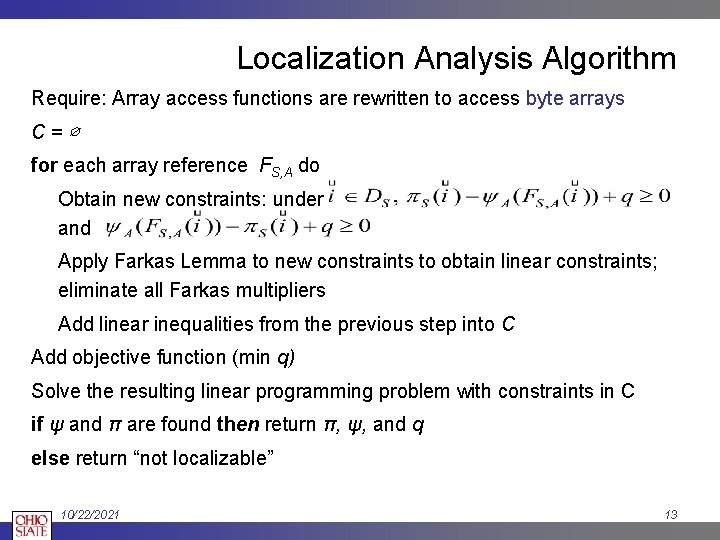
Localization Analysis Algorithm Require: Array access functions are rewritten to access byte arrays C=∅ for each array reference FS, A do Obtain new constraints: under and Apply Farkas Lemma to new constraints to obtain linear constraints; eliminate all Farkas multipliers Add linear inequalities from the previous step into C Add objective function (min q) Solve the resulting linear programming problem with constraints in C if ψ and π are found then return π, ψ, and q else return “not localizable” 10/22/2021 13
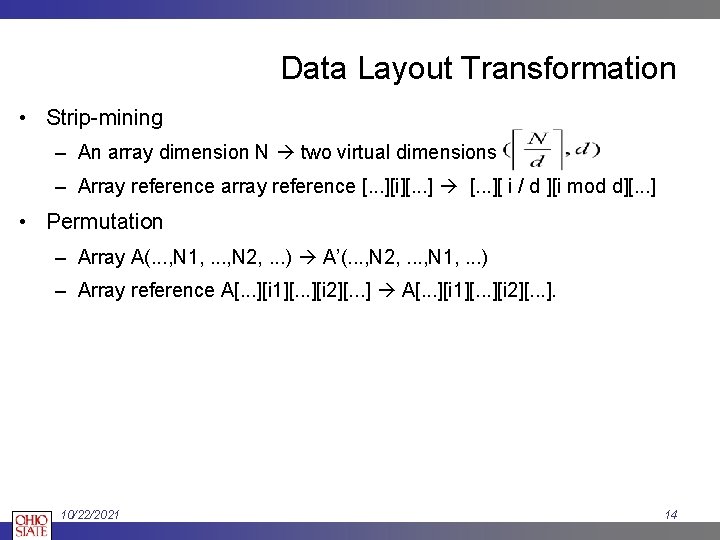
Data Layout Transformation • Strip-mining – An array dimension N two virtual dimensions – Array reference array reference [. . . ][i][. . . ] [. . . ][ i / d ][i mod d][. . . ] • Permutation – Array A(. . . , N 1, . . . , N 2, . . . ) A’(. . . , N 2, . . . , N 1, . . . ) – Array reference A[. . . ][i 1][. . . ][i 2][. . . ]. 10/22/2021 14
Data Layout Transformation (Cont. ) A[0] A[1] A[2] A[3] A[4] A[5] A[6] A[7] A[8] A[9] A[10] A[11] A[12] A[13] A[14] A[15] A[16] A[17] A[18] A[19] A[20]A[21] A[22]A[23] A[24] A[25] A[26] A[27] A[28] A[29] A[30] A[31] B[0] B[1] B[2] B[3] B[4] B[5] B[6] B[7] B[8] B[9] B[10] B[11] B[12] B[13] B[14] B[15] B[16] B[17] B[18] B[19] B[20]B[21] B[22]B[23] B[24] B[25] B[26] B[27] B[28] B[29] B[30] B[31] A[0] A[1] A[8] A[9] A[16] A[17] A[24] A[25] A[2] A[3] A[10] A[11] A[18] A[19] A[26] A[27] A[4] A[5] A[12] A[13] A[20] A[21] A[28] A[29] A[6] A[7] A[14] A[15] A[22] A[23] A[30] A[31] B[0] B[1] B[8] B[9] B[16] B[17] B[24] B[25] B[2] B[3] B[10] B[11] B[18] B[19] B[26] B[27] B[4] B[5] B[12] B[13] B[20] B[21] B[28] B[29] B[6] B[7] B[14] B[15] B[22] B[23] B[30] B[31] Bank 1 Bank 2 Bank 0 10/22/2021 Bank 3 The 1 D jacobi example: Combination of strip-mining and permutation 15
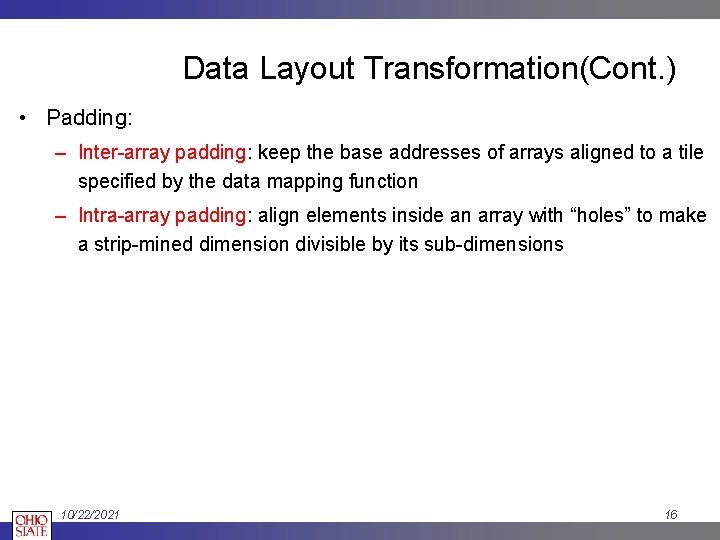
Data Layout Transformation(Cont. ) • Padding: – Inter-array padding: keep the base addresses of arrays aligned to a tile specified by the data mapping function – Intra-array padding: align elements inside an array with “holes” to make a strip-mined dimension divisible by its sub-dimensions 10/22/2021 16
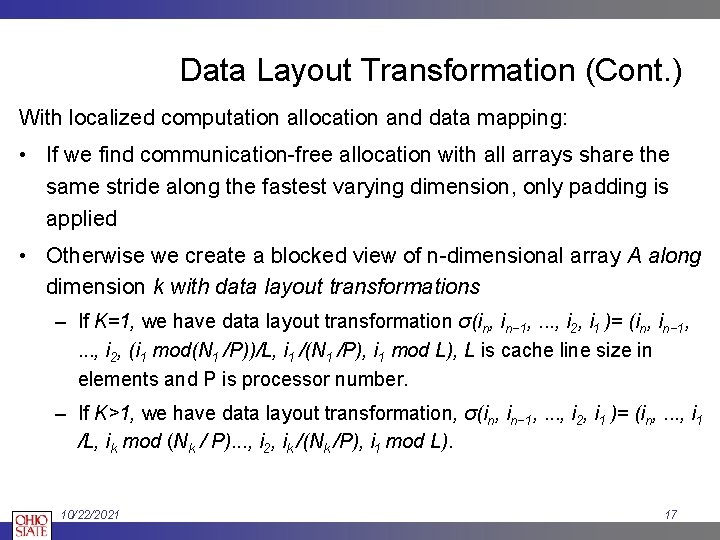
Data Layout Transformation (Cont. ) With localized computation allocation and data mapping: • If we find communication-free allocation with all arrays share the same stride along the fastest varying dimension, only padding is applied • Otherwise we create a blocked view of n-dimensional array A along dimension k with data layout transformations – If K=1, we have data layout transformation σ(in, in− 1, . . . , i 2, i 1 )= (in, in− 1, . . . , i 2, (i 1 mod(N 1 /P))/L, i 1 /(N 1 /P), i 1 mod L), L is cache line size in elements and P is processor number. – If K>1, we have data layout transformation, σ(in, in− 1, . . . , i 2, i 1 )= (in, . . . , i 1 /L, ik mod (Nk / P). . . , i 2, ik /(Nk /P), i 1 mod L). 10/22/2021 17
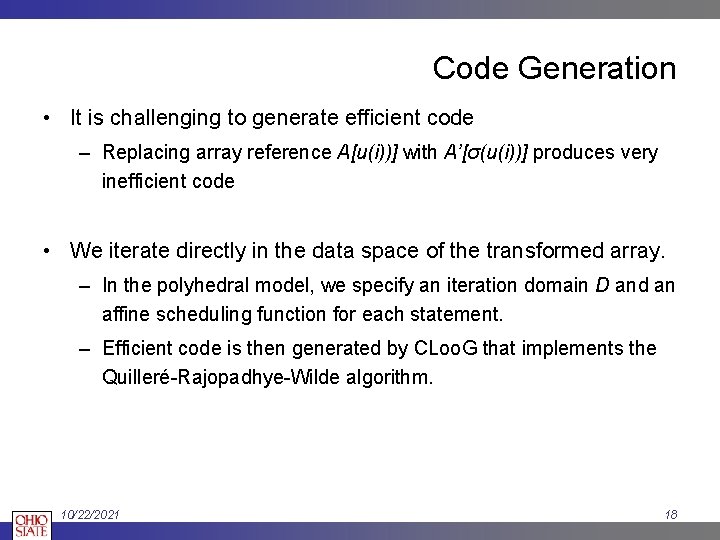
Code Generation • It is challenging to generate efficient code – Replacing array reference A[u(i))] with A’[σ(u(i))] produces very inefficient code • We iterate directly in the data space of the transformed array. – In the polyhedral model, we specify an iteration domain D and an affine scheduling function for each statement. – Efficient code is then generated by CLoo. G that implements the Quilleré-Rajopadhye-Wilde algorithm. 10/22/2021 18
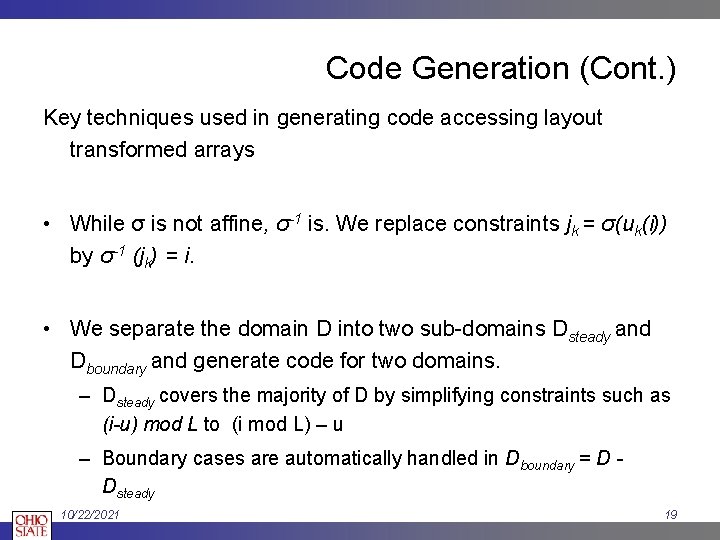
Code Generation (Cont. ) Key techniques used in generating code accessing layout transformed arrays • While σ is not affine, σ-1 is. We replace constraints jk = σ(uk(i)) by σ-1 (jk) = i. • We separate the domain D into two sub-domains Dsteady and Dboundary and generate code for two domains. – Dsteady covers the majority of D by simplifying constraints such as (i-u) mod L to (i mod L) – u – Boundary cases are automatically handled in Dboundary = D Dsteady 10/22/2021 19
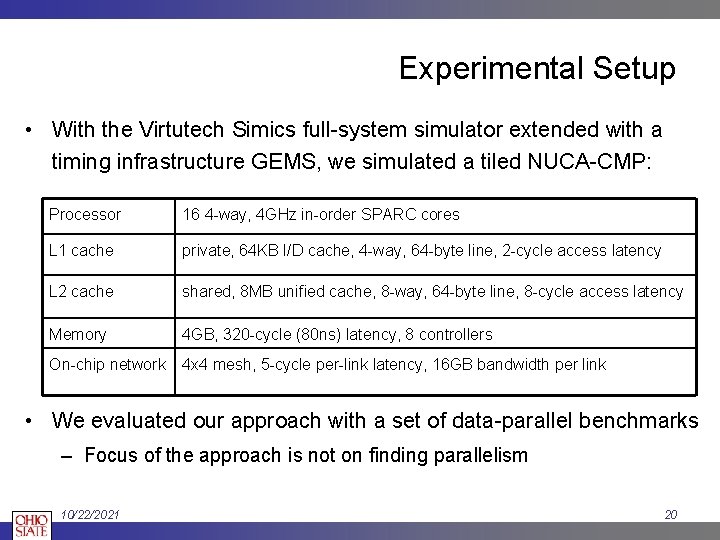
Experimental Setup • With the Virtutech Simics full-system simulator extended with a timing infrastructure GEMS, we simulated a tiled NUCA-CMP: Processor 16 4 -way, 4 GHz in-order SPARC cores L 1 cache private, 64 KB I/D cache, 4 -way, 64 -byte line, 2 -cycle access latency L 2 cache shared, 8 MB unified cache, 8 -way, 64 -byte line, 8 -cycle access latency Memory 4 GB, 320 -cycle (80 ns) latency, 8 controllers On-chip network 4 x 4 mesh, 5 -cycle per-link latency, 16 GB bandwidth per link • We evaluated our approach with a set of data-parallel benchmarks – Focus of the approach is not on finding parallelism 10/22/2021 20
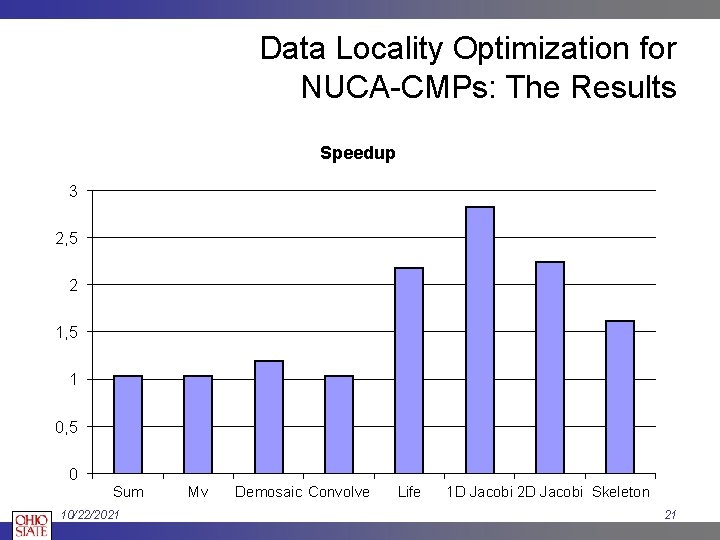
Data Locality Optimization for NUCA-CMPs: The Results Speedup 3 2, 5 2 1, 5 1 0, 5 0 Sum 10/22/2021 Mv Demosaic Convolve Life 1 D Jacobi 2 D Jacobi Skeleton 21
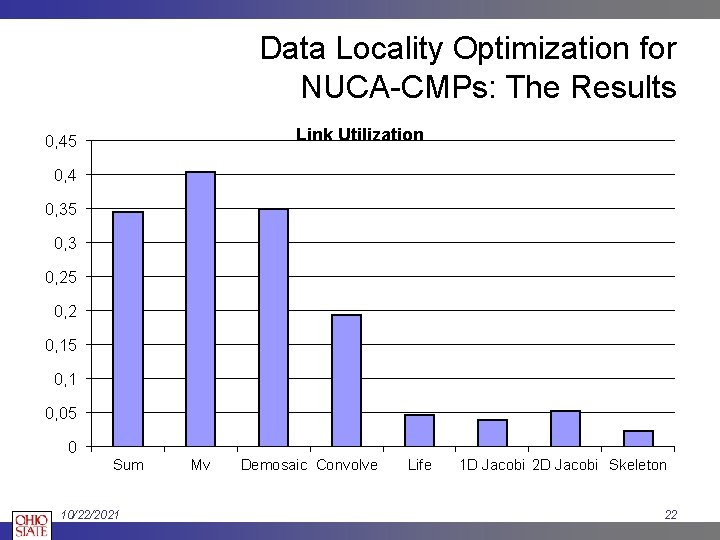
Data Locality Optimization for NUCA-CMPs: The Results Link Utilization 0, 45 0, 4 0, 35 0, 3 0, 25 0, 2 0, 15 0, 1 0, 05 0 Sum 10/22/2021 Mv Demosaic Convolve Life 1 D Jacobi 2 D Jacobi Skeleton 22
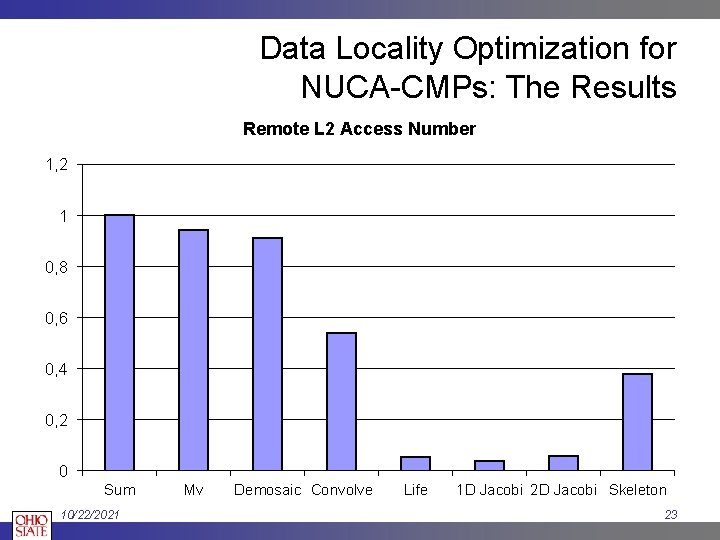
Data Locality Optimization for NUCA-CMPs: The Results Remote L 2 Access Number 1, 2 1 0, 8 0, 6 0, 4 0, 2 0 Sum 10/22/2021 Mv Demosaic Convolve Life 1 D Jacobi 2 D Jacobi Skeleton 23
Conclusion • We believe that the approach developed in this study provides very general treatment of code generation for data layout transformation – analysis of data access affinities – automated generation of efficient code for the transformed layout 10/22/2021 24