
Data Governance Stewardship Role of Libraries Anjali Bandiwadekar
Data Governance & Stewardship: Role of Libraries Anjali Bandiwadekar Deputy Librarian Indian Institute of Technology Indore

RDM/RDS … Academic librarians are increasingly focusing on research data management and research data services, as reflected in the professional literature. Related concepts in this context: • Data Governance • Data Stewardship • Data Literacy • Data Quality……. .
Paradigm Shift or Extension of traditional services? • The shifting focus can also be seen as an extension of traditional library services to the digital landscape, as academic libraries have always provided access to scholarly records in various formats • For example • Data Literacy (can be viewed as extension of Information Literacy)
Driving factors • The shift in the focus of academic libraries is necessitated by many factors including: - Data deluge - Increasingly data intensive science - Funding agency, Government & publishers require researchers to develop data management plans - open scholarship
Data Governance • Rules/ Policies • Decision Rights • Accountability • Enforcement • Access & sharing (e. g. issues such as licensing) A well developed data governance policy is a precondition for open data
Data Stewardship • Crucial component of Data Governance • Involves organization of data
Data Literacy • can be defined as a specific skill set and knowledge base • which empowers individuals to transform data into information and into actionable knowledge • by enabling them to access, interpret, critically assess, manage and ethically use data (Koltay, 2015 a).

Data Quality • Availability and discoverability • Trust and authencity • Accuracy • Completeness • Usability • Standards

Role of Libraries Research Data Services such as • Data documentation and citation • Data management planning • Intellectual property and copyright • Data curation – involves preserving and adding value • Training researchers in data management • Advocacy for Data Management Planning
Role of Libraries • Data quality management • Data Literacy Instruction
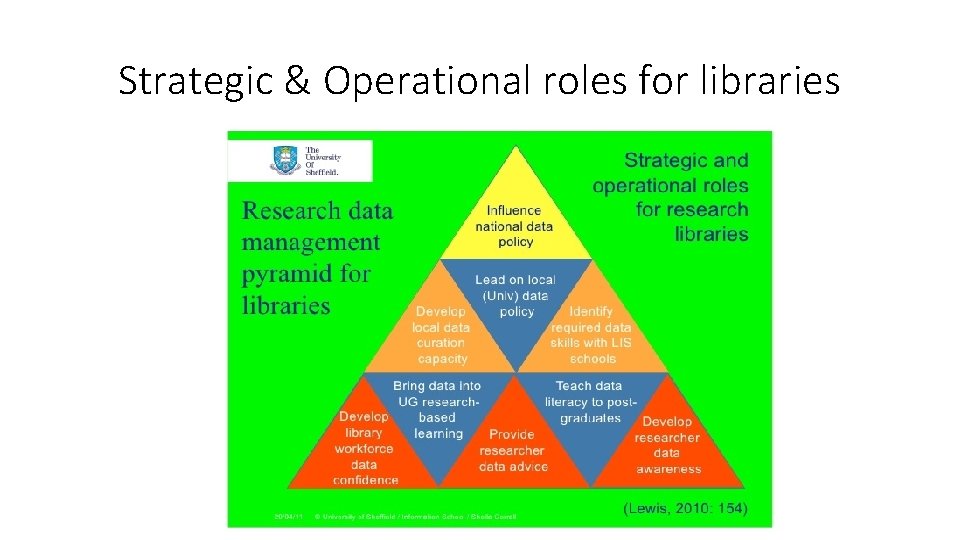
Strategic & Operational roles for libraries
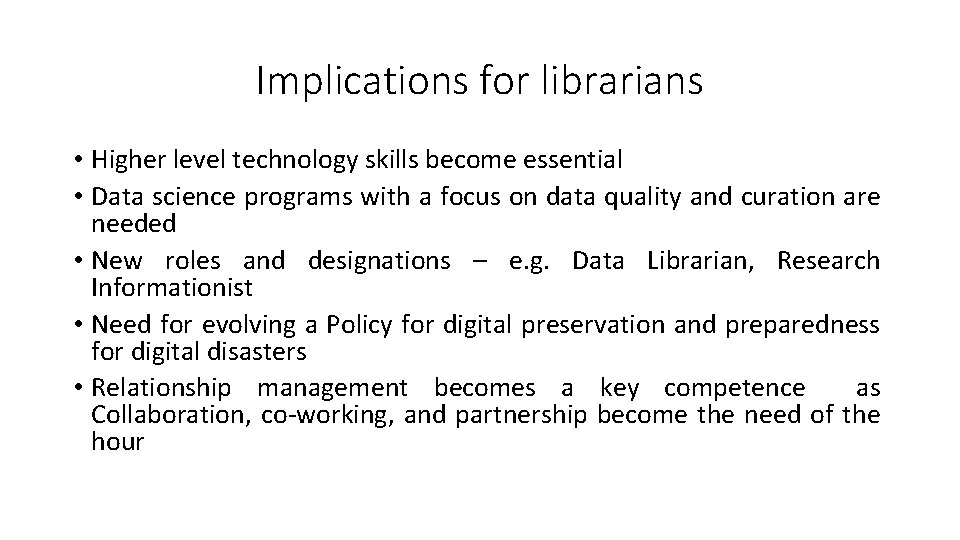
Implications for librarians • Higher level technology skills become essential • Data science programs with a focus on data quality and curation are needed • New roles and designations – e. g. Data Librarian, Research Informationist • Need for evolving a Policy for digital preservation and preparedness for digital disasters • Relationship management becomes a key competence as Collaboration, co-working, and partnership become the need of the hour
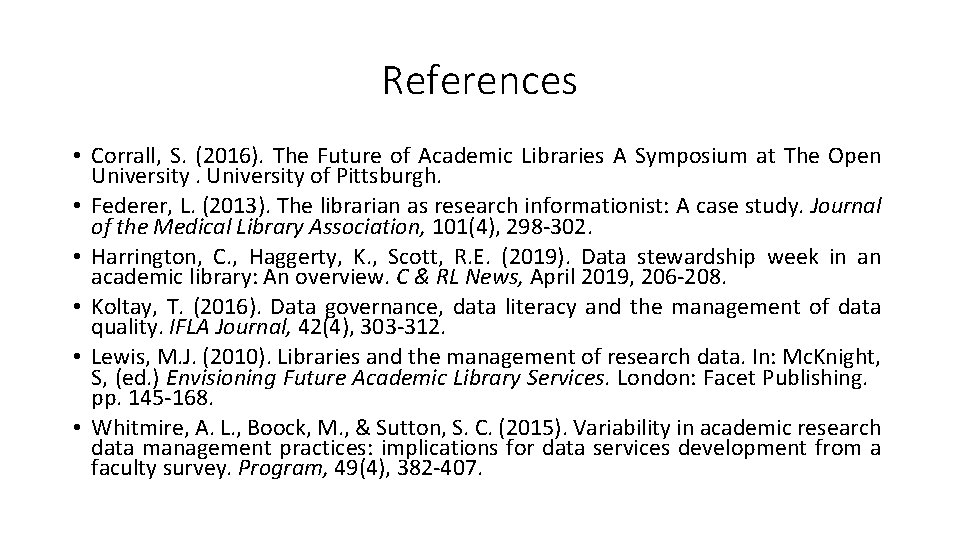
References • Corrall, S. (2016). The Future of Academic Libraries A Symposium at The Open University of Pittsburgh. • Federer, L. (2013). The librarian as research informationist: A case study. Journal of the Medical Library Association, 101(4), 298 -302. • Harrington, C. , Haggerty, K. , Scott, R. E. (2019). Data stewardship week in an academic library: An overview. C & RL News, April 2019, 206 -208. • Koltay, T. (2016). Data governance, data literacy and the management of data quality. IFLA Journal, 42(4), 303 -312. • Lewis, M. J. (2010). Libraries and the management of research data. In: Mc. Knight, S, (ed. ) Envisioning Future Academic Library Services. London: Facet Publishing. pp. 145 -168. • Whitmire, A. L. , Boock, M. , & Sutton, S. C. (2015). Variability in academic research data management practices: implications for data services development from a faculty survey. Program, 49(4), 382 -407.

Thank you for your attention!
- Slides: 14