
Data Driven Job Search Engine Using Skills and
Data Driven Job Search Engine Using Skills and Company Attribute Filters
Data Extraction and Processing A. Skills Data: Extracted a set of skills mentioned in professional social networks using DBpedia. Normalized, Lemmatized and Filtered the skills from 750 k to 73 k. Eg: “C#/. net”, ”C# /. net”, “C# &. net” and “C# and. net” are mapped to ”C# and. net. Eg: “systems installations”, “systems installation”, and “system installing” are mapped to “system installation”.
Data Extraction and Processing B. Job Postings Data: Extracted job postings data from different companies web pages and Indeed API. Attributes extracted are: Company Name, URL, Job description, job title, company address. Title normalization and parsing. Company name normalizing so that it can be used to generate the domain name which is useful for data merging. Extract skills lemma dictionary with counts for each job description. Company name to website/ domain name. Join with Everstring’s company knowledge data base to populate company related firmographics.
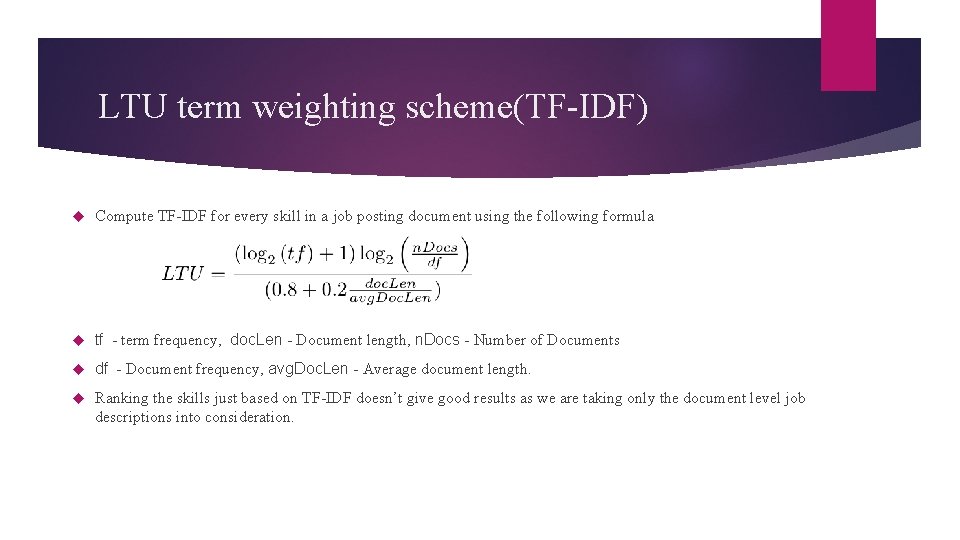
LTU term weighting scheme(TF-IDF) Compute TF-IDF for every skill in a job posting document using the following formula tf - term frequency, doc. Len - Document length, n. Docs - Number of Documents df - Document frequency, avg. Doc. Len - Average document length. Ranking the skills just based on TF-IDF doesn’t give good results as we are taking only the document level job descriptions into consideration.
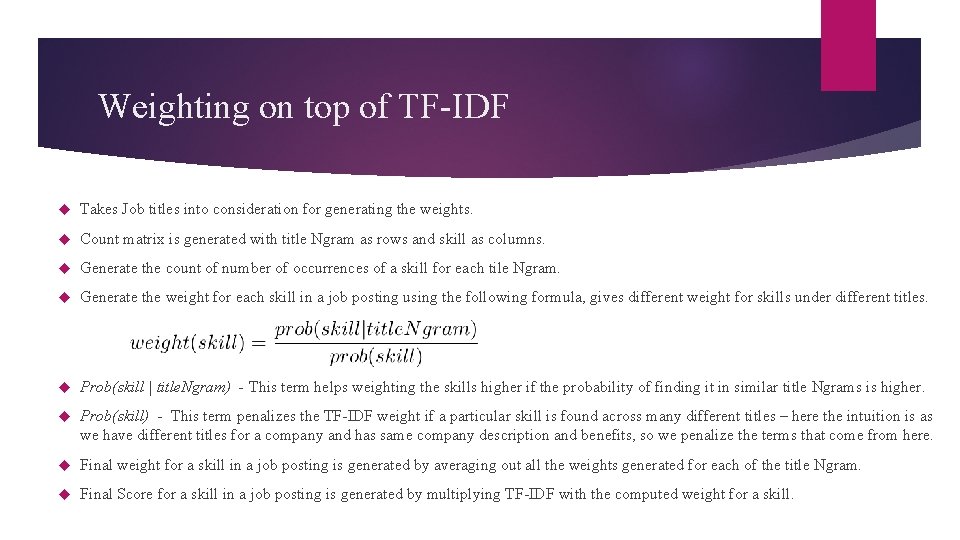
Weighting on top of TF-IDF Takes Job titles into consideration for generating the weights. Count matrix is generated with title Ngram as rows and skill as columns. Generate the count of number of occurrences of a skill for each tile Ngram. Generate the weight for each skill in a job posting using the following formula, gives different weight for skills under different titles. Prob(skill | title. Ngram) - This term helps weighting the skills higher if the probability of finding it in similar title Ngrams is higher. Prob(skill) - This term penalizes the TF-IDF weight if a particular skill is found across many different titles – here the intuition is as we have different titles for a company and has same company description and benefits, so we penalize the terms that come from here. Final weight for a skill in a job posting is generated by averaging out all the weights generated for each of the title Ngram. Final Score for a skill in a job posting is generated by multiplying TF-IDF with the computed weight for a skill.
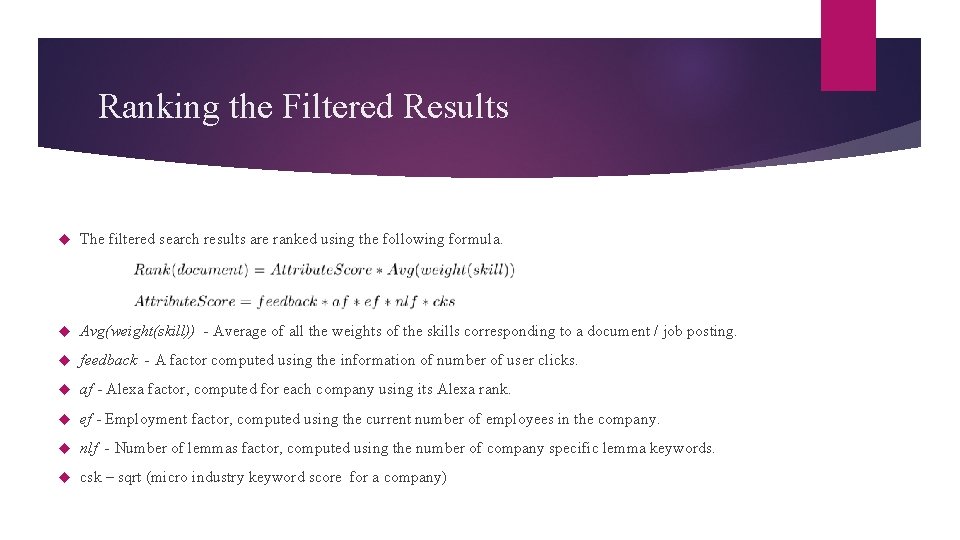
Ranking the Filtered Results The filtered search results are ranked using the following formula. Avg(weight(skill)) - Average of all the weights of the skills corresponding to a document / job posting. feedback - A factor computed using the information of number of user clicks. af - Alexa factor, computed for each company using its Alexa rank. ef - Employment factor, computed using the current number of employees in the company. nlf - Number of lemmas factor, computed using the number of company specific lemma keywords. csk – sqrt (micro industry keyword score for a company)
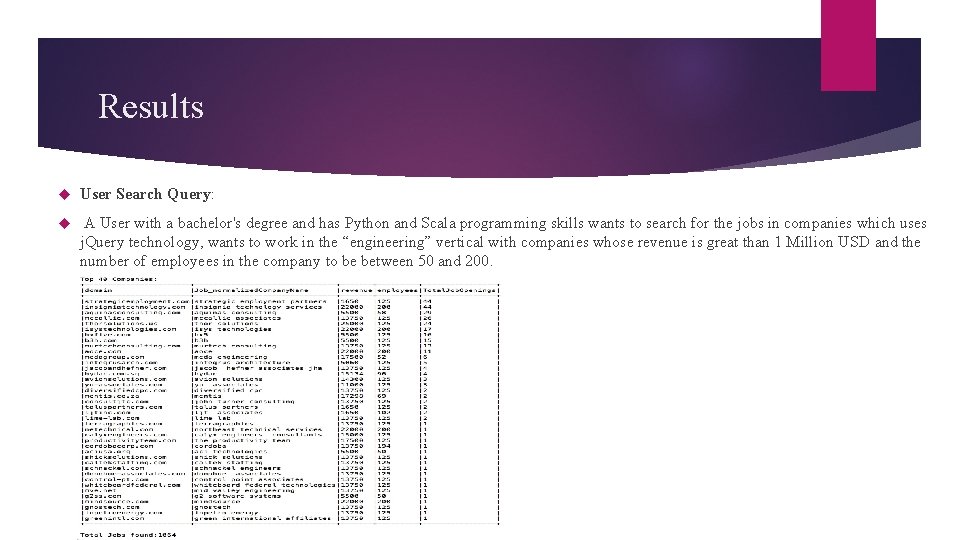
Results User Search Query: A User with a bachelor's degree and has Python and Scala programming skills wants to search for the jobs in companies which uses j. Query technology, wants to work in the “engineering” vertical with companies whose revenue is great than 1 Million USD and the number of employees in the company to be between 50 and 200.
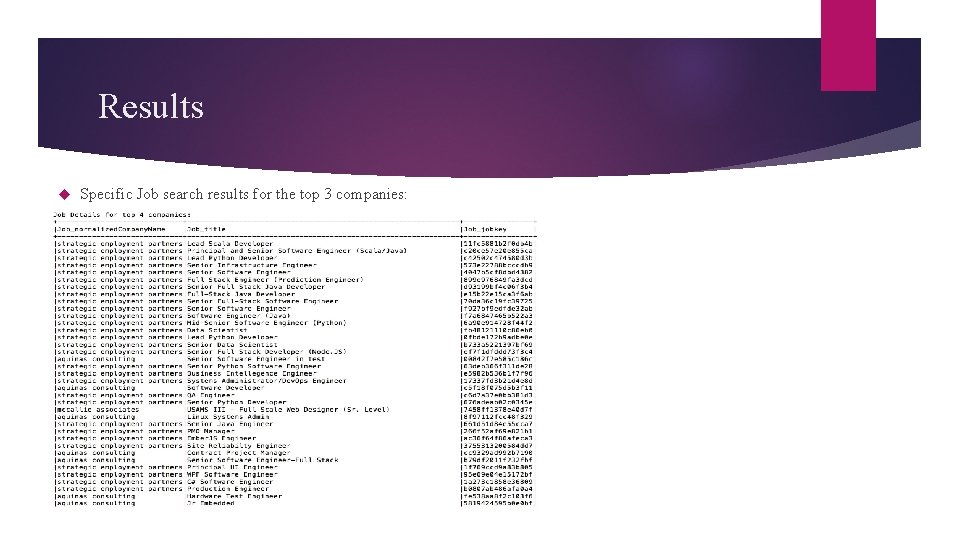
Results Specific Job search results for the top 3 companies:
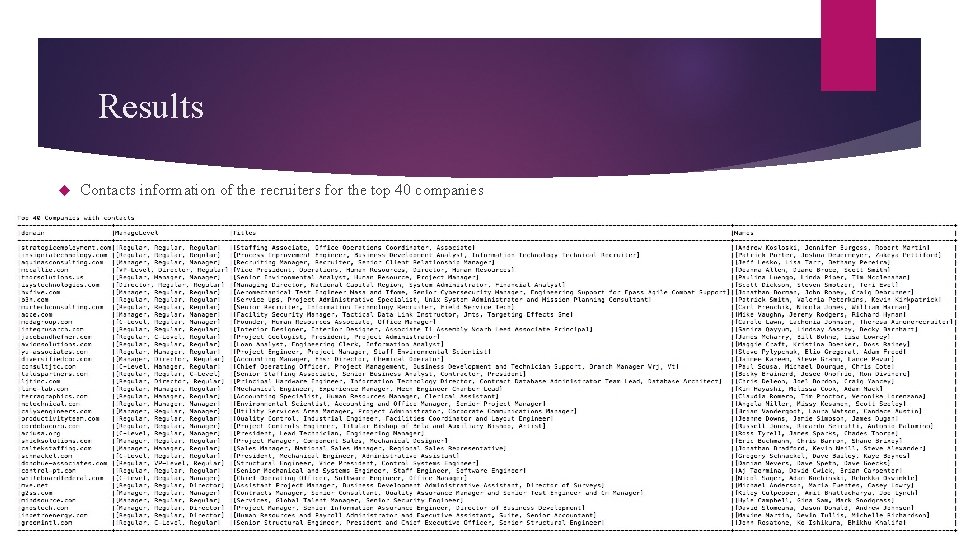
Results Contacts information of the recruiters for the top 40 companies
Results Search query has Python and Scala. Why are we getting results like ”Full Stack java developer”? Job key: d 93199 bf 4 c 06 f 3 b Link: https: //www. indeed. com/rc/clk? jk=d 93199 bf 4 c 06 f 3 b 4&fccid=d 85 b 448 de 778 e 20 c Why are we getting the search results in clusters? As most of the results ranking schema depends on the company specific attributes we tend to see the results in clusters corresponding to each company. The results can be better if we have more data on the job postings.
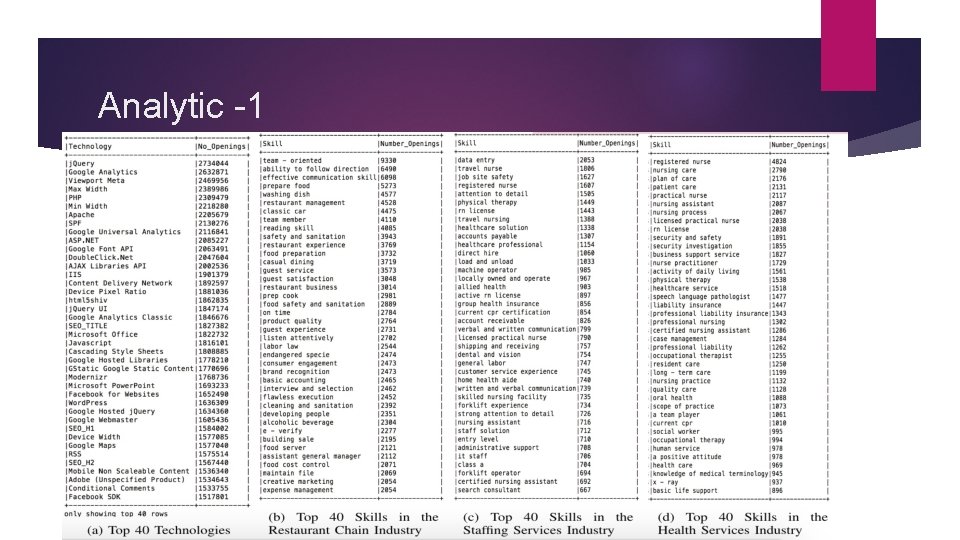
Analytic -1
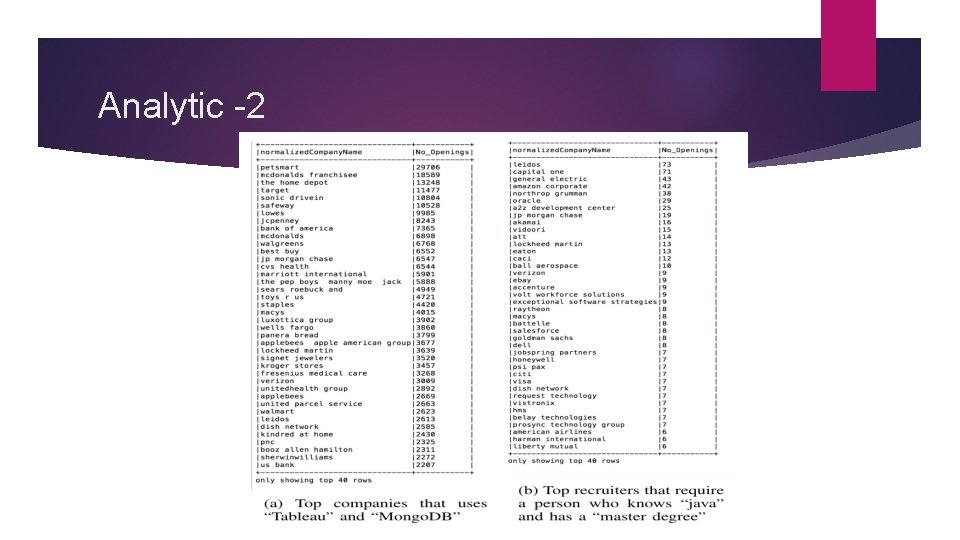
Analytic -2

Questions?

Thank You!
- Slides: 14