
Data Distribution Architecture Overview of Data Discovery and
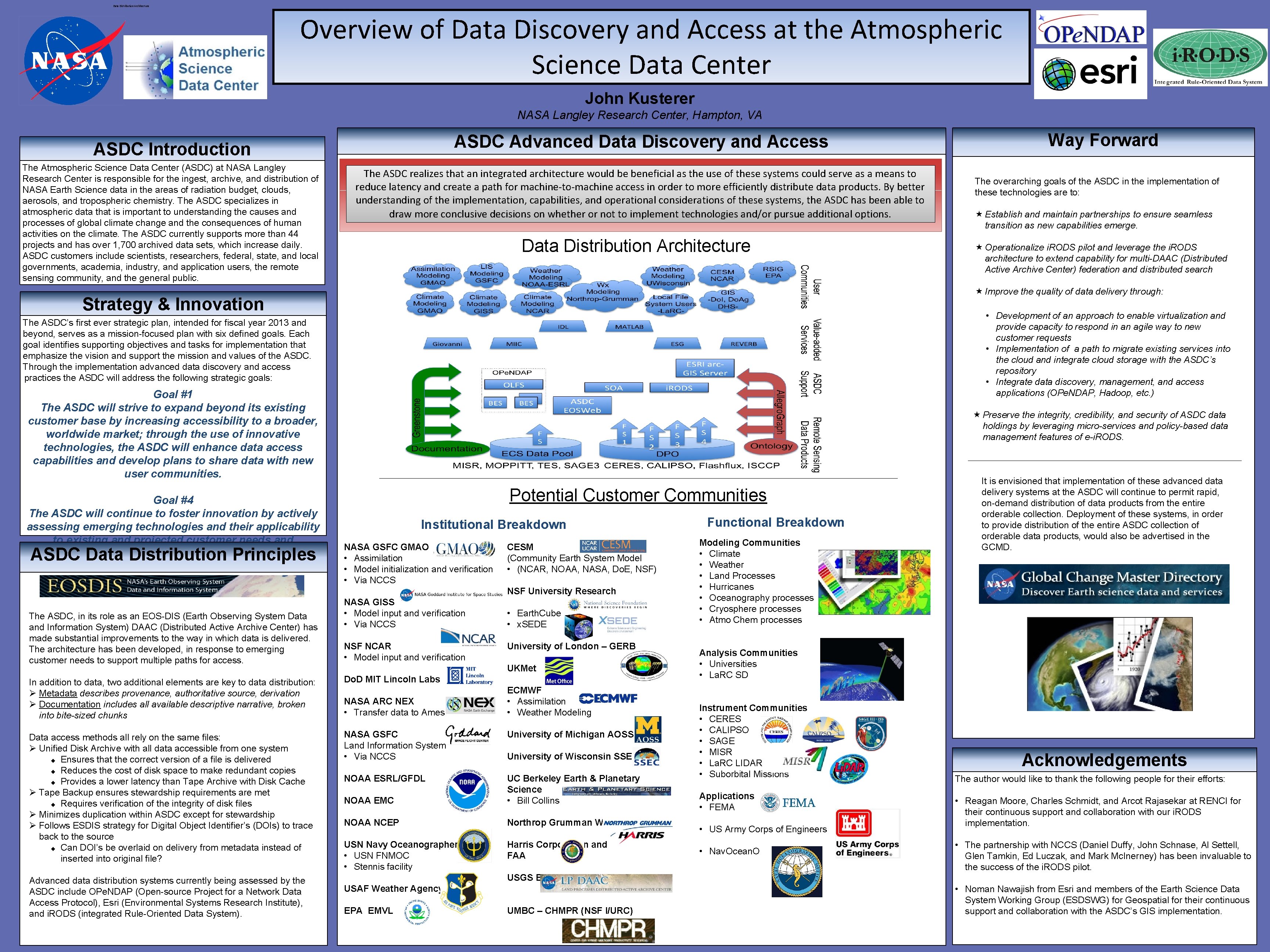
Data Distribution Architecture Overview of Data Discovery and Access at the Atmospheric Science Data Center John Kusterer NASA Langley Research Center, Hampton, VA ASDC Advanced Data Discovery and Access ASDC Introduction The Atmospheric Science Data Center (ASDC) at NASA Langley Research Center is responsible for the ingest, archive, and distribution of NASA Earth Science data in the areas of radiation budget, clouds, aerosols, and tropospheric chemistry. The ASDC specializes in atmospheric data that is important to understanding the causes and processes of global climate change and the consequences of human activities on the climate. The ASDC currently supports more than 44 projects and has over 1, 700 archived data sets, which increase daily. ASDC customers include scientists, researchers, federal, state, and local governments, academia, industry, and application users, the remote sensing community, and the general public. The ASDC realizes that an integrated architecture would be beneficial as the use of these systems could serve as a means to reduce latency and create a path for machine-to-machine access in order to more efficiently distribute data products. By better understanding of the implementation, capabilities, and operational considerations of these systems, the ASDC has been able to draw more conclusive decisions on whether or not to implement technologies and/or pursue additional options. Data Distribution Architecture Goal #1 The ASDC will strive to expand beyond its existing customer base by increasing accessibility to a broader, worldwide market; through the use of innovative technologies, the ASDC will enhance data access capabilities and develop plans to share data with new user communities. Potential Customer Communities Institutional Breakdown NASA GSFC GMAO • Assimilation • Model initialization and verification • Via NCCS CESM (Community Earth System Model • (NCAR, NOAA, NASA, Do. E, NSF) NASA GISS • Model input and verification • Via NCCS NSF NCAR • Model input and verification • Earth. Cube • x. SEDE University of London – GERB UKMet , In addition to data, two additional elements are key to data distribution: Ø Metadata describes provenance, authoritative source, derivation Ø Documentation includes all available descriptive narrative, broken into bite-sized chunks Do. D MIT Lincoln Labs Data access methods all rely on the same files: Ø Unified Disk Archive with all data accessible from one system u Ensures that the correct version of a file is delivered u Reduces the cost of disk space to make redundant copies u Provides a lower latency than Tape Archive with Disk Cache Ø Tape Backup ensures stewardship requirements are met u Requires verification of the integrity of disk files Ø Minimizes duplication within ASDC except for stewardship Ø Follows ESDIS strategy for Digital Object Identifier’s (DOIs) to trace back to the source u Can DOI’s be overlaid on delivery from metadata instead of inserted into original file? NASA GSFC Land Information System • Via NCCS University of Michigan AOSS NOAA ESRL/GFDL NOAA EMC UC Berkeley Earth & Planetary Science • Bill Collins NOAA NCEP Northrop Grumman Weather Models USN Navy Oceanographer • USN FNMOC • Stennis facility Harris Corporation and FAA Advanced data distribution systems currently being assessed by the ASDC include OPe. NDAP (Open-source Project for a Network Data Access Protocol), Esri (Environmental Systems Research Institute), and i. RODS (integrated Rule-Oriented Data System). Operationalize i. RODS pilot and leverage the i. RODS architecture to extend capability for multi-DAAC (Distributed Active Archive Center) federation and distributed search Preserve the integrity, credibility, and security of ASDC data holdings by leveraging micro-services and policy-based data management features of e-i. RODS. NSF University Research The ASDC, in its role as an EOS-DIS (Earth Observing System Data and Information System) DAAC (Distributed Active Archive Center) has made substantial improvements to the way in which data is delivered. The architecture has been developed, in response to emerging customer needs to support multiple paths for access. Establish and maintain partnerships to ensure seamless transition as new capabilities emerge. • Development of an approach to enable virtualization and provide capacity to respond in an agile way to new customer requests • Implementation of a path to migrate existing services into the cloud and integrate cloud storage with the ASDC’s repository • Integrate data discovery, management, and access applications (OPe. NDAP, Hadoop, etc. ) The ASDC’s first ever strategic plan, intended for fiscal year 2013 and beyond, serves as a mission-focused plan with six defined goals. Each goal identifies supporting objectives and tasks for implementation that emphasize the vision and support the mission and values of the ASDC. Through the implementation advanced data discovery and access practices the ASDC will address the following strategic goals: ASDC Data Distribution Principles The overarching goals of the ASDC in the implementation of these technologies are to: Improve the quality of data delivery through: Strategy & Innovation Goal #4 The ASDC will continue to foster innovation by actively assessing emerging technologies and their applicability to existing and projected customer needs and requirements in order to mitigate gaps in capability Way Forward NASA ARC NEX • Transfer data to Ames ECMWF • Assimilation • Weather Modeling University of Wisconsin SSEC Functional Breakdown Modeling Communities • Climate • Weather • Land Processes • Hurricanes • Oceanography processes • Cryosphere processes • Atmo Chem processes It is envisioned that implementation of these advanced data delivery systems at the ASDC will continue to permit rapid, on-demand distribution of data products from the entire orderable collection. Deployment of these systems, in order to provide distribution of the entire ASDC collection of orderable data products, would also be advertised in the GCMD. Analysis Communities • Universities • La. RC SD Instrument Communities • CERES • CALIPSO • SAGE • MISR • La. RC LIDAR • Suborbital Missions Applications • FEMA • US Army Corps of Engineers • Nav. Ocean. O Acknowledgements The author would like to thank the following people for their efforts: • Reagan Moore, Charles Schmidt, and Arcot Rajasekar at RENCI for their continuous support and collaboration with our i. RODS implementation. • The partnership with NCCS (Daniel Duffy, John Schnase, Al Settell, Glen Tamkin, Ed Luczak, and Mark Mc. Inerney) has been invaluable to the success of the i. RODS pilot. USGS Eros Data Center (LP DAAC) USAF Weather Agency EPA EMVL UMBC – CHMPR (NSF I/URC) • Noman Nawajish from Esri and members of the Earth Science Data System Working Group (ESDSWG) for Geospatial for their continuous support and collaboration with the ASDC’s GIS implementation.
- Slides: 1