
Data Compression Basics Uniquely Decodable Codes A variable
Data Compression Basics
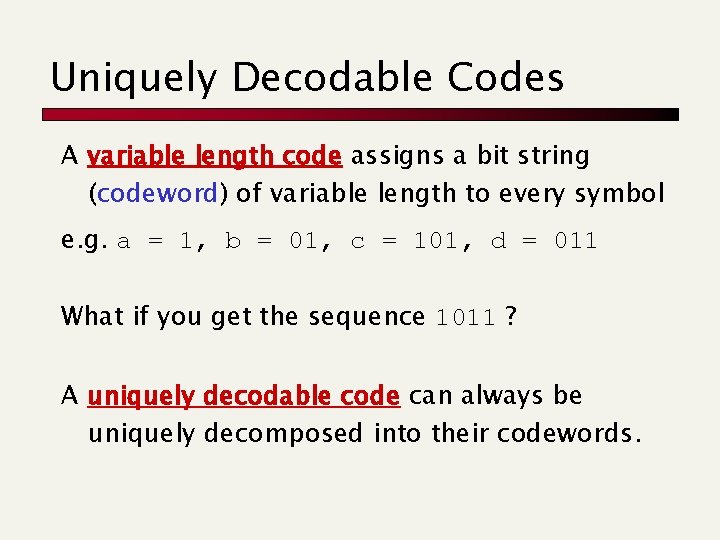
Uniquely Decodable Codes A variable length code assigns a bit string (codeword) of variable length to every symbol e. g. a = 1, b = 01, c = 101, d = 011 What if you get the sequence 1011 ? A uniquely decodable code can always be uniquely decomposed into their codewords.
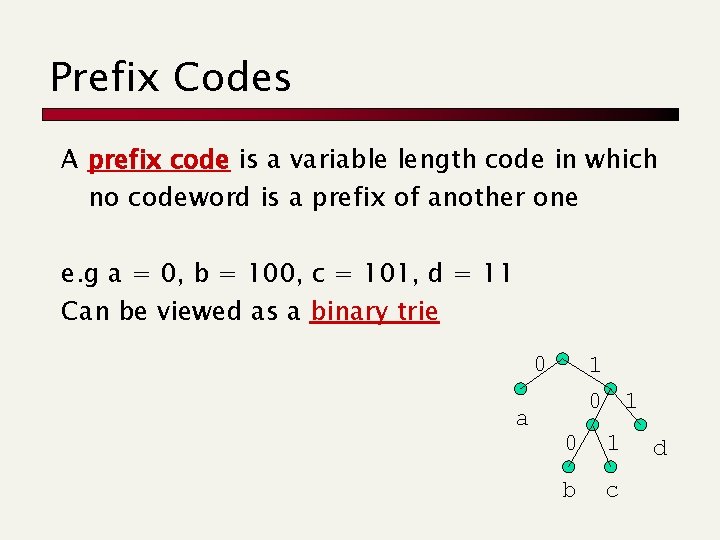
Prefix Codes A prefix code is a variable length code in which no codeword is a prefix of another one e. g a = 0, b = 100, c = 101, d = 11 Can be viewed as a binary trie 0 a 1 0 1 b c d
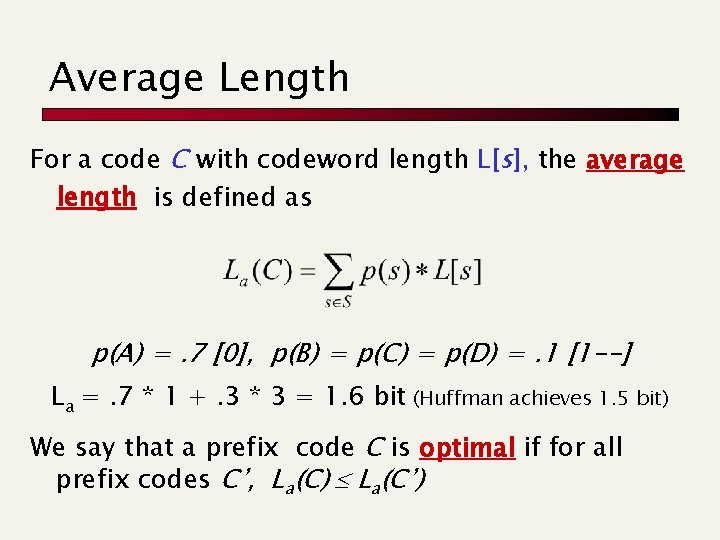
Average Length For a code C with codeword length L[s], the average length is defined as p(A) =. 7 [0], p(B) = p(C) = p(D) =. 1 [1 --] La =. 7 * 1 +. 3 * 3 = 1. 6 bit (Huffman achieves 1. 5 bit) We say that a prefix code C is optimal if for all prefix codes C’, La(C) La(C’)
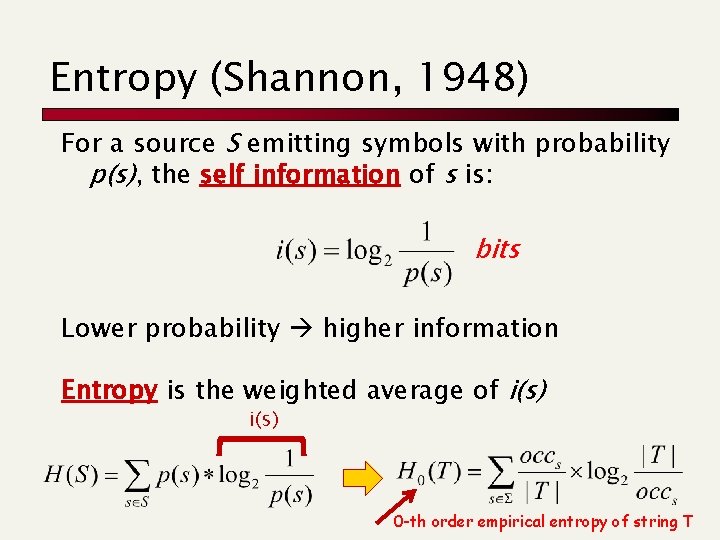
Entropy (Shannon, 1948) For a source S emitting symbols with probability p(s), the self information of s is: bits Lower probability higher information Entropy is the weighted average of i(s) 0 -th order empirical entropy of string T
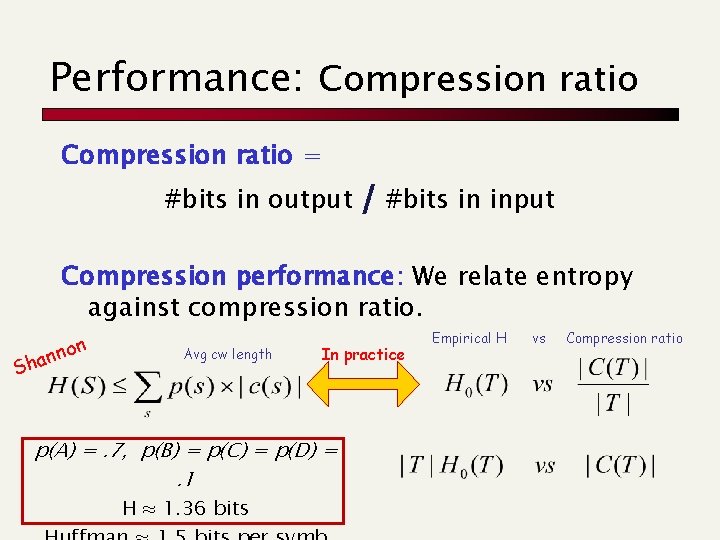
Performance: Compression ratio = #bits in output / #bits in input Compression performance: We relate entropy against compression ratio. Sha n nno Avg cw length In practice p(A) =. 7, p(B) = p(C) = p(D) =. 1 H ≈ 1. 36 bits Empirical H vs Compression ratio
Statistical Coding How do we use probability p(s) to encode s? n Huffman codes n Arithmetic codes
Data Compression Huffman coding
Huffman Codes Invented by Huffman as a class assignment in ‘ 50. Used in most compression algorithms n gzip, bzip, jpeg (as option), fax compression, … Properties: n n n Generates optimal prefix codes Cheap to encode and decode La(Huff) = H if probabilities are powers of 2 n Otherwise, La(Huff) < H +1 < +1 bit per symb on avg!!
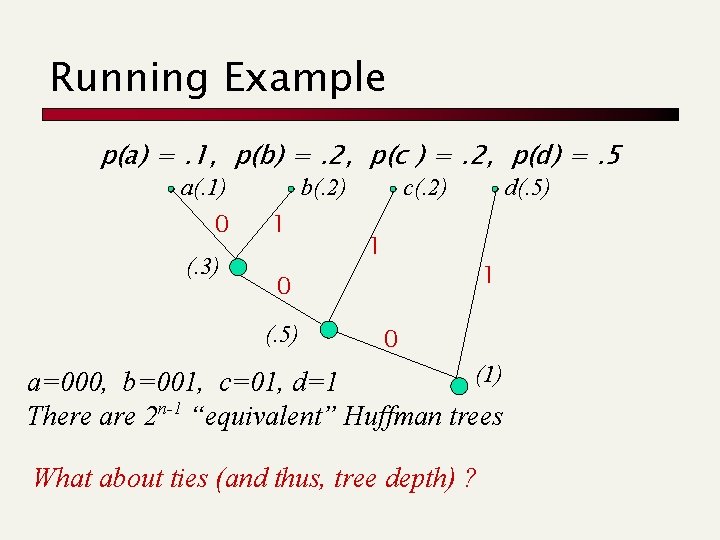
Running Example p(a) =. 1, p(b) =. 2, p(c ) =. 2, p(d) =. 5 a(. 1) 0 (. 3) b(. 2) 1 c(. 2) 1 1 0 (. 5) d(. 5) 0 (1) a=000, b=001, c=01, d=1 There are 2 n-1 “equivalent” Huffman trees What about ties (and thus, tree depth) ?
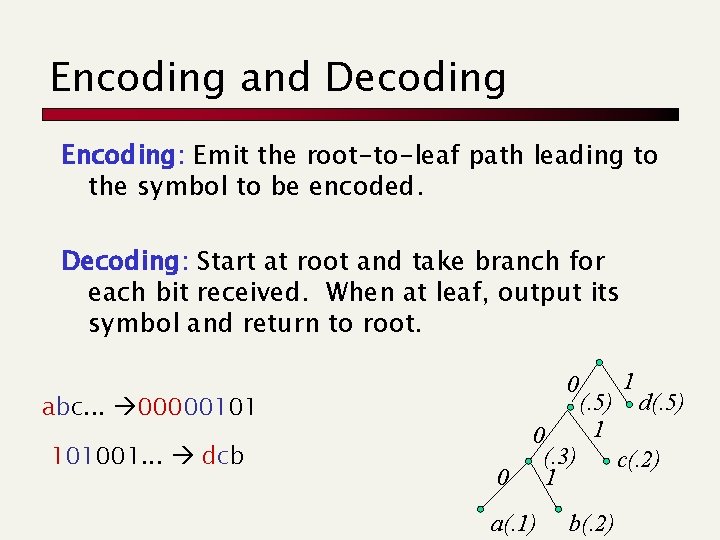
Encoding and Decoding Encoding: Emit the root-to-leaf path leading to the symbol to be encoded. Decoding: Start at root and take branch for each bit received. When at leaf, output its symbol and return to root. 0 abc. . . 00000101 101001. . . dcb 0 0 (. 3) 1 a(. 1) (. 5) 1 b(. 2) 1 d(. 5) c(. 2)
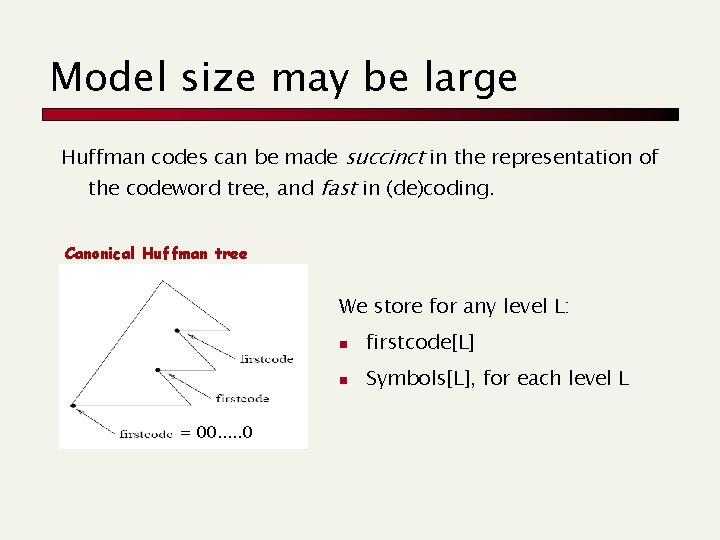
Model size may be large Huffman codes can be made succinct in the representation of the codeword tree, and fast in (de)coding. Canonical Huffman tree We store for any level L: = 00. . . 0 n firstcode[L] n Symbols[L], for each level L
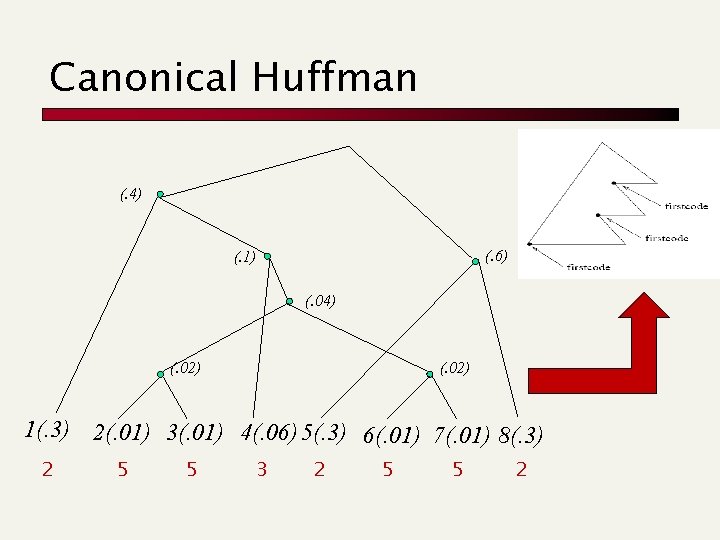
Canonical Huffman (. 4) (. 6) (. 1) (. 04) (. 02) 1(. 3) 2(. 01) 3(. 01) 4(. 06) 5(. 3) 6(. 01) 7(. 01) 8(. 3) 2 5 5 3 2 5 5 2
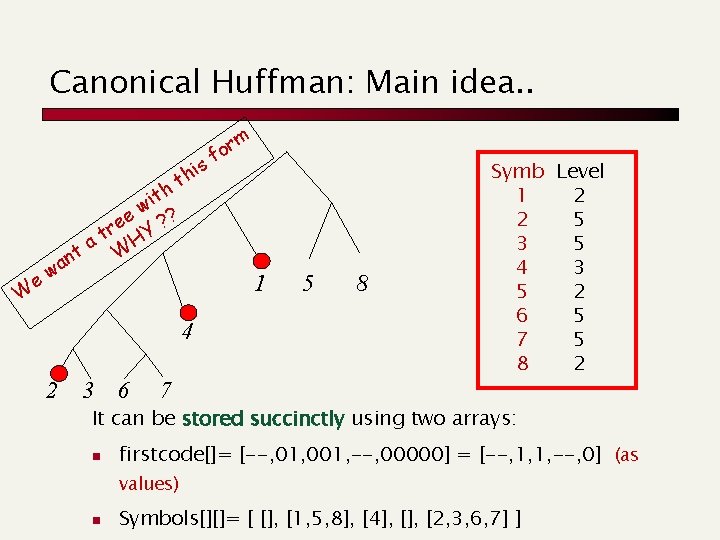
Canonical Huffman: Main idea. . is th th i w ? e re Y ? t a WH t n a w e 1 W 4 2 3 6 7 m r fo 5 8 Symb Level 1 2 2 5 3 5 4 3 5 2 6 5 7 5 8 2 It can be stored succinctly using two arrays: n firstcode[]= [--, 01, 001, --, 00000] = [--, 1, 1, --, 0] (as values) n Symbols[][]= [ [], [1, 5, 8], [4], [2, 3, 6, 7] ]
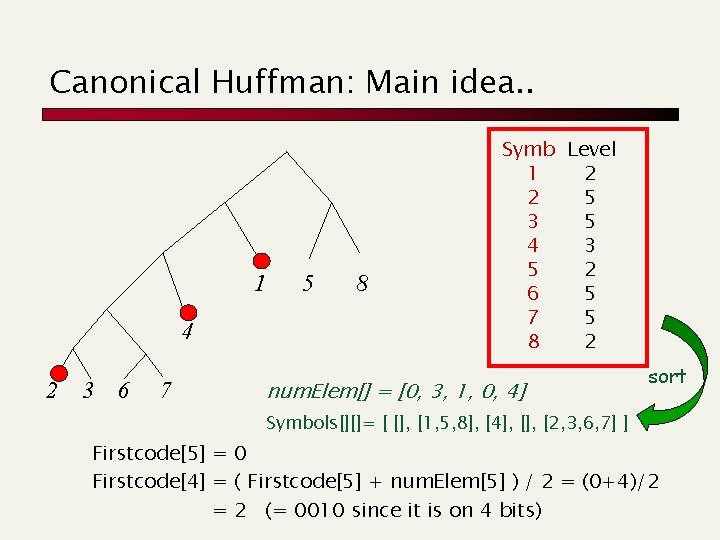
Canonical Huffman: Main idea. . 1 4 2 3 6 7 5 8 Symb Level 1 2 2 5 3 5 4 3 5 2 6 5 7 5 8 2 num. Elem[] = [0, 3, 1, 0, 4] sort Symbols[][]= [ [], [1, 5, 8], [4], [2, 3, 6, 7] ] Firstcode[5] = 0 Firstcode[4] = ( Firstcode[5] + num. Elem[5] ) / 2 = (0+4)/2 = 2 (= 0010 since it is on 4 bits)
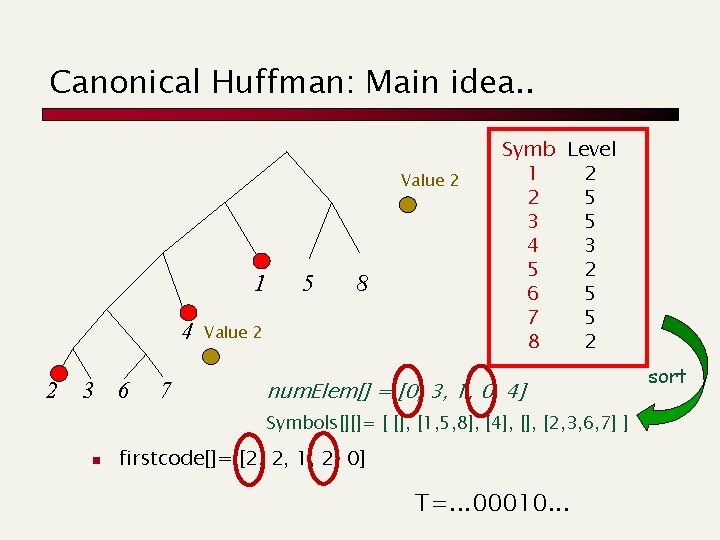
Canonical Huffman: Main idea. . Value 2 1 4 2 3 6 7 5 8 Value 2 Symb Level 1 2 2 5 3 5 4 3 5 2 6 5 7 5 8 2 num. Elem[] = [0, 3, 1, 0, 4] Symbols[][]= [ [], [1, 5, 8], [4], [2, 3, 6, 7] ] n firstcode[]= [2, 2, 1, 2, 0] T=. . . 00010. . . sort
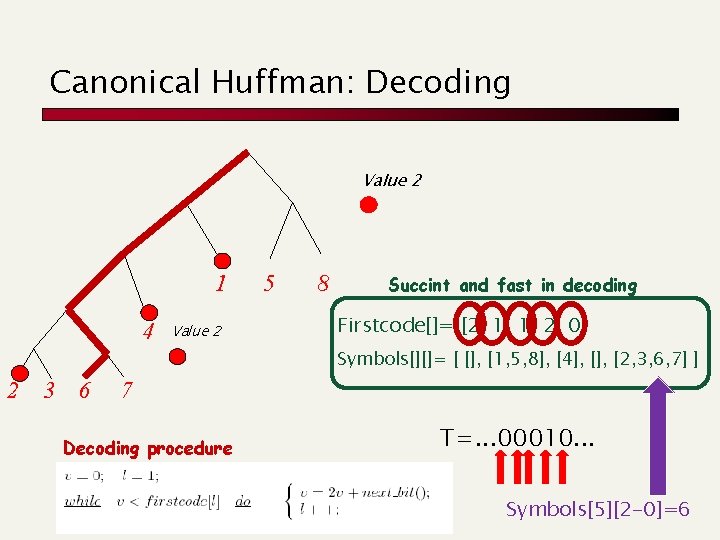
Canonical Huffman: Decoding Value 2 1 4 Value 2 5 8 Succint and fast in decoding Firstcode[]= [2, 1, 1, 2, 0] Symbols[][]= [ [], [1, 5, 8], [4], [2, 3, 6, 7] ] 2 3 6 7 Decoding procedure T=. . . 00010. . . Symbols[5][2 -0]=6
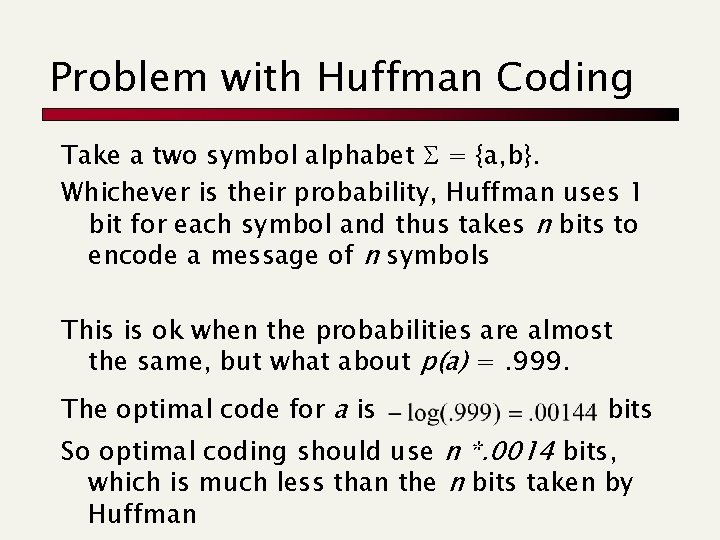
Problem with Huffman Coding Take a two symbol alphabet = {a, b}. Whichever is their probability, Huffman uses 1 bit for each symbol and thus takes n bits to encode a message of n symbols This is ok when the probabilities are almost the same, but what about p(a) =. 999. The optimal code for a is bits So optimal coding should use n *. 0014 bits, which is much less than the n bits taken by Huffman
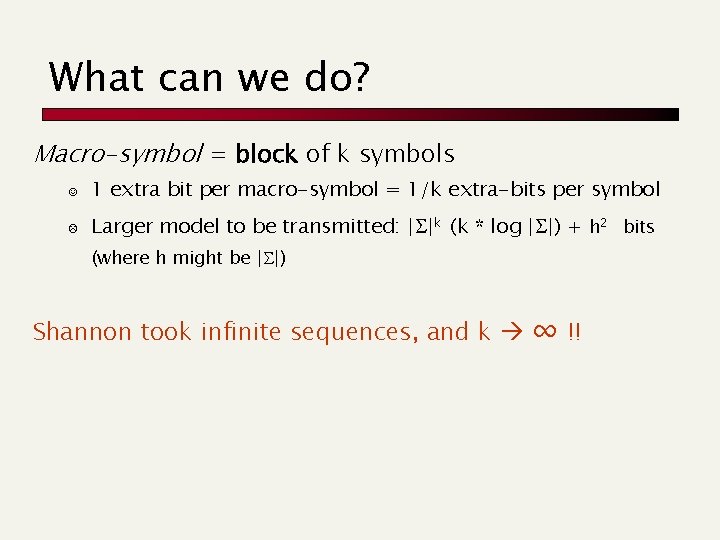
What can we do? Macro-symbol = block of k symbols J 1 extra bit per macro-symbol = 1/k extra-bits per symbol L Larger model to be transmitted: | |k (k * log | |) + h 2 bits (where h might be | |) Shannon took infinite sequences, and k ∞ !!
Data Compression Dictionary-based compressors
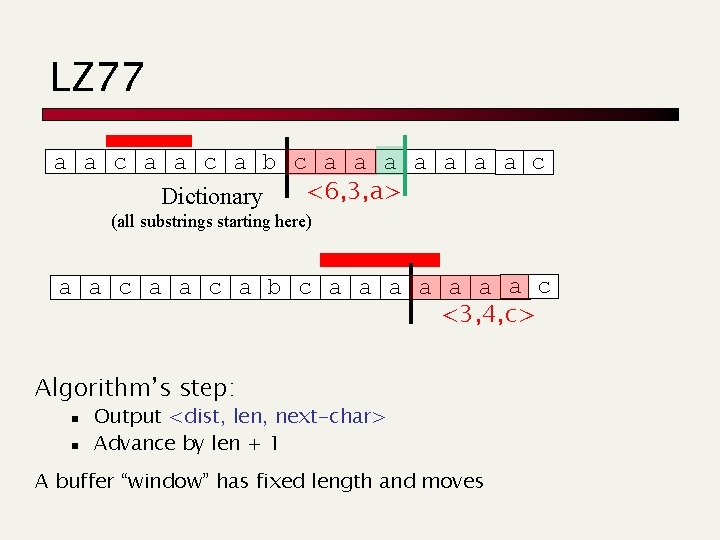
LZ 77 a a c a b c a a a a c <6, 3, a> Dictionary (all substrings starting here) a a c a b c a a a a c c <3, 4, c> Algorithm’s step: n n Output <dist, len, next-char> Advance by len + 1 A buffer “window” has fixed length and moves
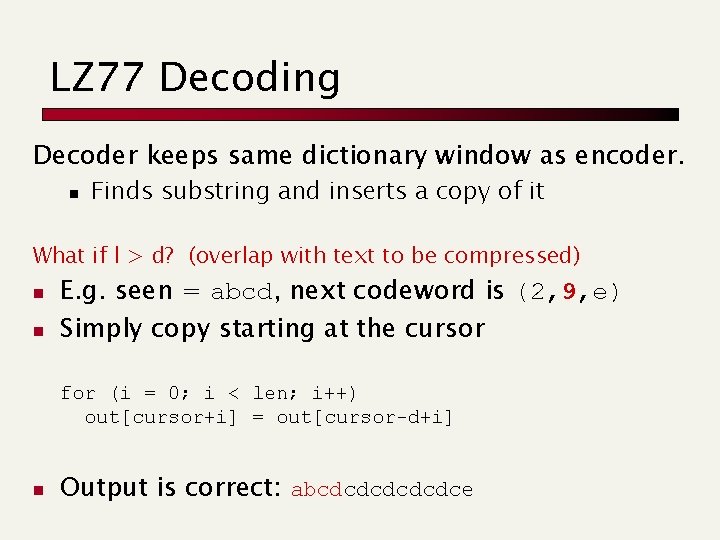
LZ 77 Decoding Decoder keeps same dictionary window as encoder. n Finds substring and inserts a copy of it What if l > d? (overlap with text to be compressed) n n E. g. seen = abcd, next codeword is (2, 9, e) Simply copy starting at the cursor for (i = 0; i < len; i++) out[cursor+i] = out[cursor-d+i] n Output is correct: abcdcdcdce
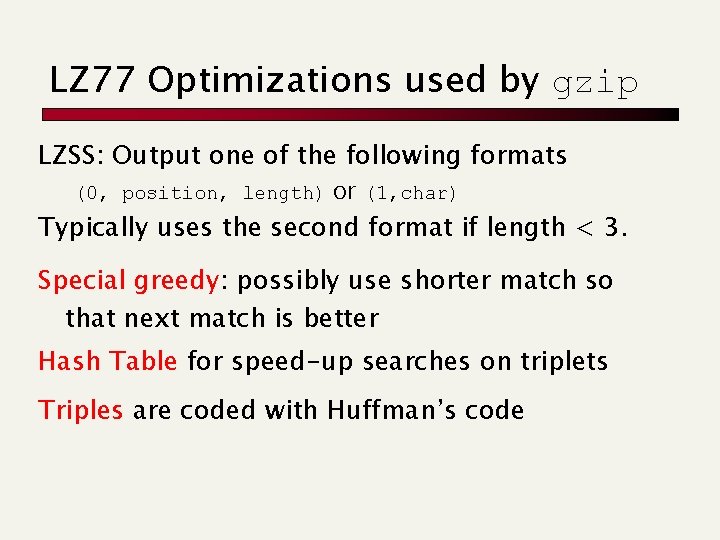
LZ 77 Optimizations used by gzip LZSS: Output one of the following formats (0, position, length) or (1, char) Typically uses the second format if length < 3. Special greedy: possibly use shorter match so that next match is better Hash Table for speed-up searches on triplets Triples are coded with Huffman’s code
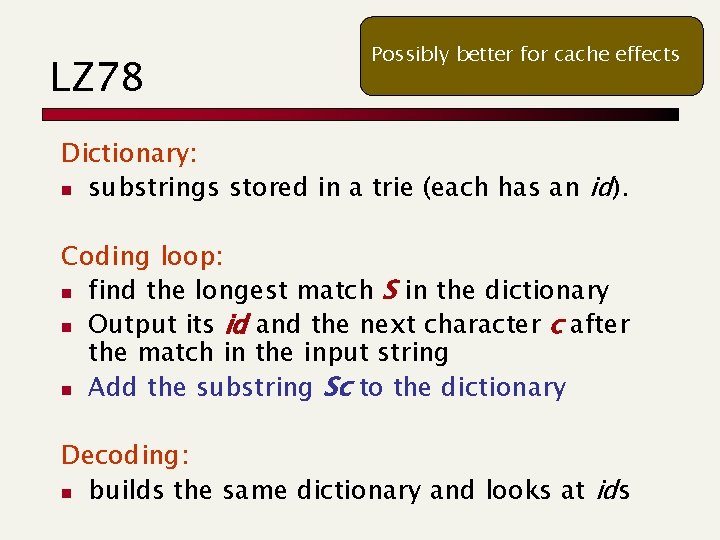
LZ 78 Possibly better for cache effects Dictionary: n substrings stored in a trie (each has an id). Coding loop: n find the longest match S in the dictionary n Output its id and the next character c after the match in the input string n Add the substring Sc to the dictionary Decoding: n builds the same dictionary and looks at ids
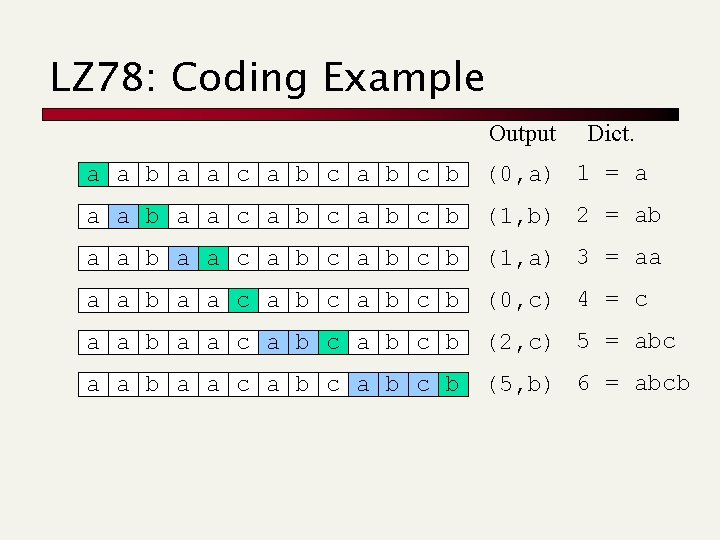
LZ 78: Coding Example Output Dict. a a b a a c a b c b (0, a) 1 = a a a b a a c a b c b (1, b) 2 = ab a a c a b c b (1, a) 3 = aa a a b a a c a b c b (0, c) 4 = c a a b a a c a b c b (2, c) 5 = abc a a b a a c a b c b (5, b) 6 = abcb
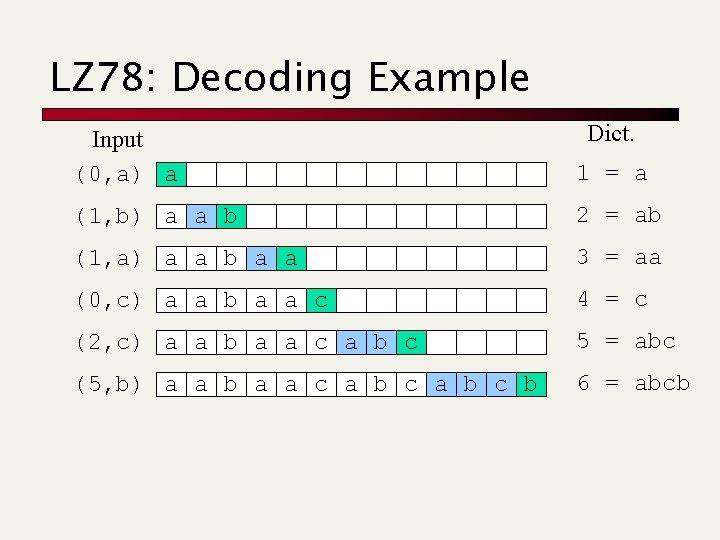
LZ 78: Decoding Example Dict. Input (0, a) a 1 = a (1, b) a a b 2 = ab (1, a) a a b a a 3 = aa (0, c) a a b a a c 4 = c (2, c) a a b a a c a b c 5 = abc (5, b) a a b a a c a b c b 6 = abcb
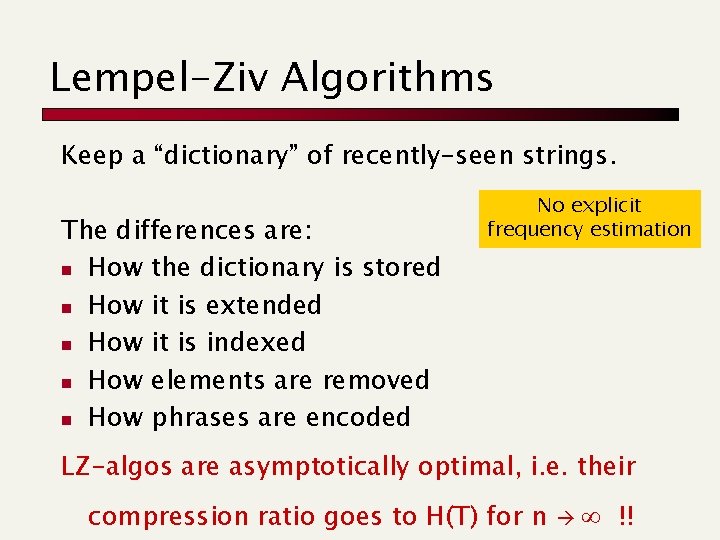
Lempel-Ziv Algorithms Keep a “dictionary” of recently-seen strings. The differences are: n How the dictionary is stored n How it is extended n How it is indexed n How elements are removed n How phrases are encoded No explicit frequency estimation LZ-algos are asymptotically optimal, i. e. their compression ratio goes to H(T) for n !!
You find this at: www. gzip. org/zlib/
- Slides: 28