
Data Communications and Networks Chapter 7 IP Addressing

- Slides: 25
Data Communications and Networks Chapter 7 – IP Addressing ICT-BVF 8. 1 - Data Communications and Network Trainer: Dr. Abbes Sebihi
Agenda • • • Objective; What is an IP Address? IP Address; Network Prefix and Host Number; Subnetting; Subnetmask; IP Address classes; CIDR; Routing; ICT-BVF 8. 1 - Data Communications and Network Trainer: Dr. Abbes Sebihi
Objective By the end of this lesson, the student will understand how the IP addresses work and how to calculate a subnet address. ICT-BVF 8. 1 - Data Communications and Network Trainer: Dr. Abbes Sebihi
Pre-assessment What do you know about? • • IP Address; Subnetting; Subnetmask; CIDR. ICT-BVF 8. 1 - Data Communications and Network Trainer: Dr. Abbes Sebihi
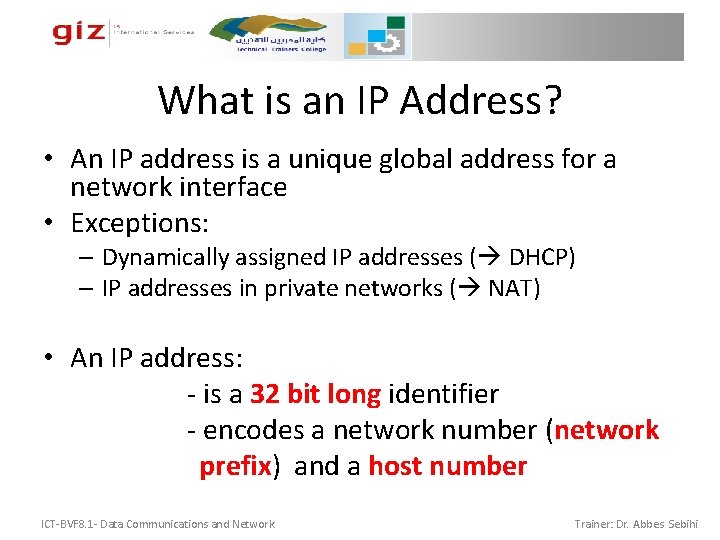
What is an IP Address? • An IP address is a unique global address for a network interface • Exceptions: – Dynamically assigned IP addresses ( DHCP) – IP addresses in private networks ( NAT) • An IP address: - is a 32 bit long identifier - encodes a network number (network prefix) and a host number ICT-BVF 8. 1 - Data Communications and Network Trainer: Dr. Abbes Sebihi
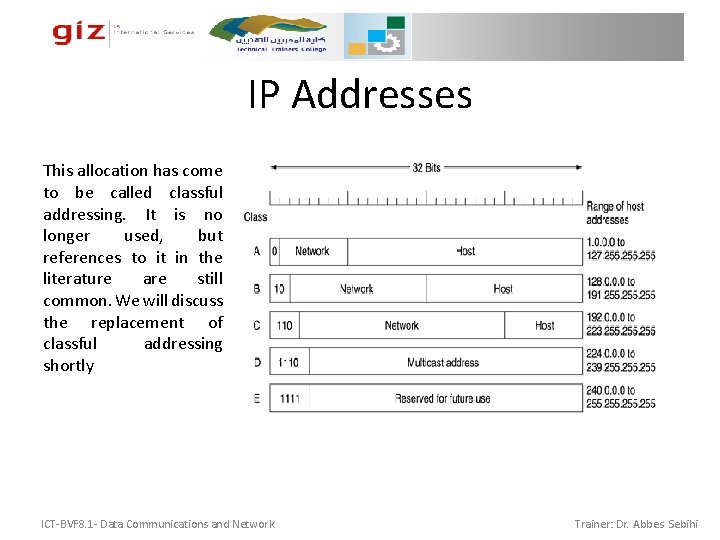
IP Addresses This allocation has come to be called classful addressing. It is no longer used, but references to it in the literature are still common. We will discuss the replacement of classful addressing shortly ICT-BVF 8. 1 - Data Communications and Network Trainer: Dr. Abbes Sebihi
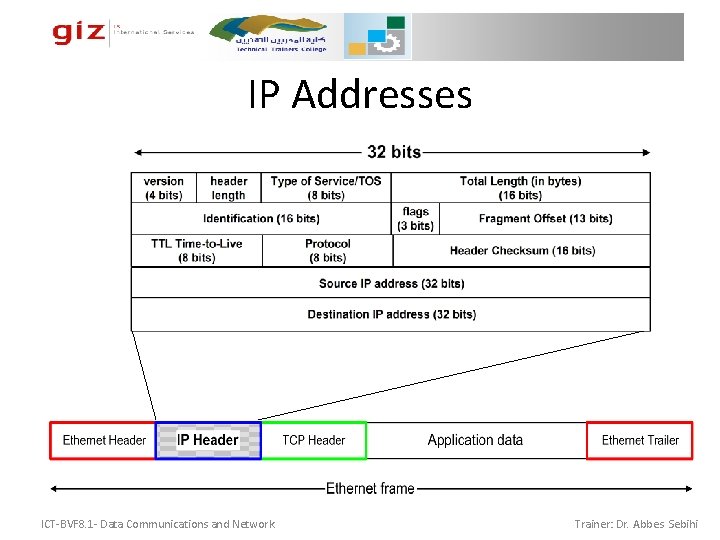
IP Addresses ICT-BVF 8. 1 - Data Communications and Network Trainer: Dr. Abbes Sebihi
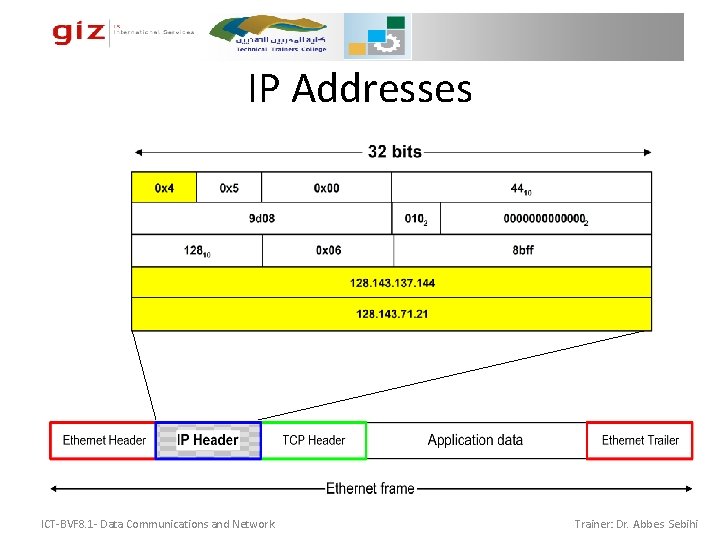
IP Addresses ICT-BVF 8. 1 - Data Communications and Network Trainer: Dr. Abbes Sebihi
Network prefix and host number • The network prefix identifies a network and the host number identifies a specific host (actually, interface on the network). • How do we know how long the network prefix is? – Before 1993: The network prefix is implicitly defined (see classbased addressing) or – After 1993: The network prefix is indicated by a netmask. ICT-BVF 8. 1 - Data Communications and Network Trainer: Dr. Abbes Sebihi
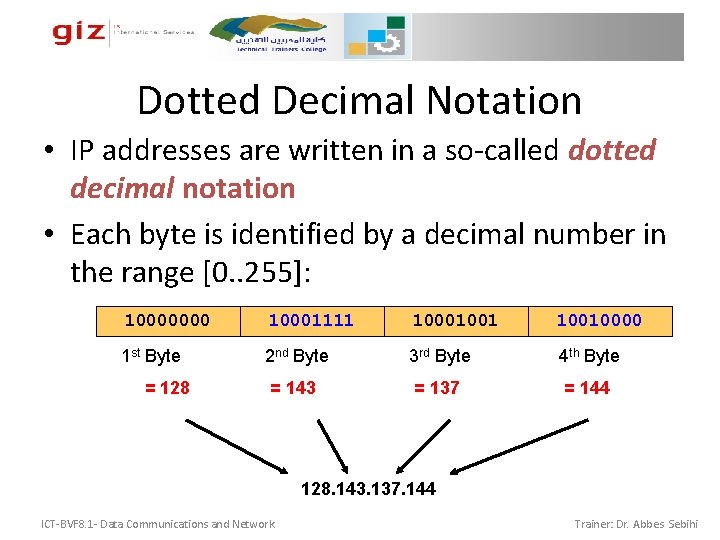
Dotted Decimal Notation • IP addresses are written in a so-called dotted decimal notation • Each byte is identified by a decimal number in the range [0. . 255]: 10000000 10001111 100010010000 1 st Byte 2 nd Byte 3 rd Byte 4 th Byte = 143 = 137 = 144 = 128. 143. 137. 144 ICT-BVF 8. 1 - Data Communications and Network Trainer: Dr. Abbes Sebihi
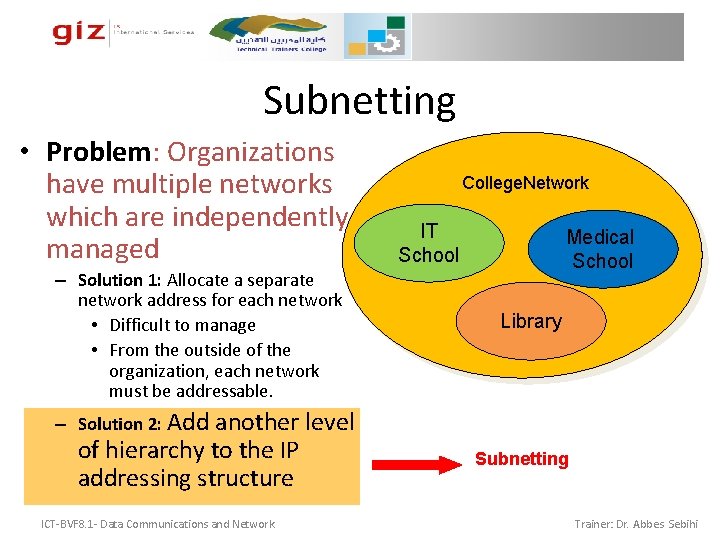
Subnetting • Problem: Organizations have multiple networks which are independently managed – Solution 1: Allocate a separate network address for each network • Difficult to manage • From the outside of the organization, each network must be addressable. another level of hierarchy to the IP addressing structure College. Network IT School Medical School Library – Solution 2: Add ICT-BVF 8. 1 - Data Communications and Network Subnetting Trainer: Dr. Abbes Sebihi
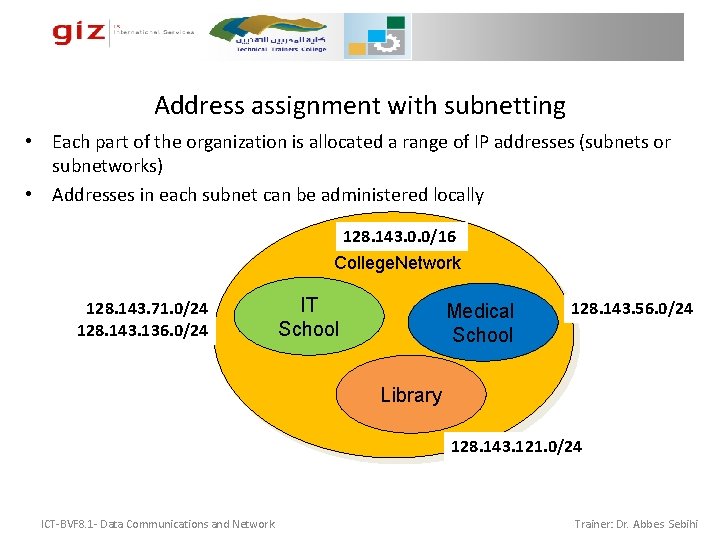
Address assignment with subnetting • Each part of the organization is allocated a range of IP addresses (subnets or subnetworks) • Addresses in each subnet can be administered locally 128. 143. 0. 0/16 College. Network 128. 143. 71. 0/24 128. 143. 136. 0/24 IT School Medical School 128. 143. 56. 0/24 Library 128. 143. 121. 0/24 ICT-BVF 8. 1 - Data Communications and Network Trainer: Dr. Abbes Sebihi
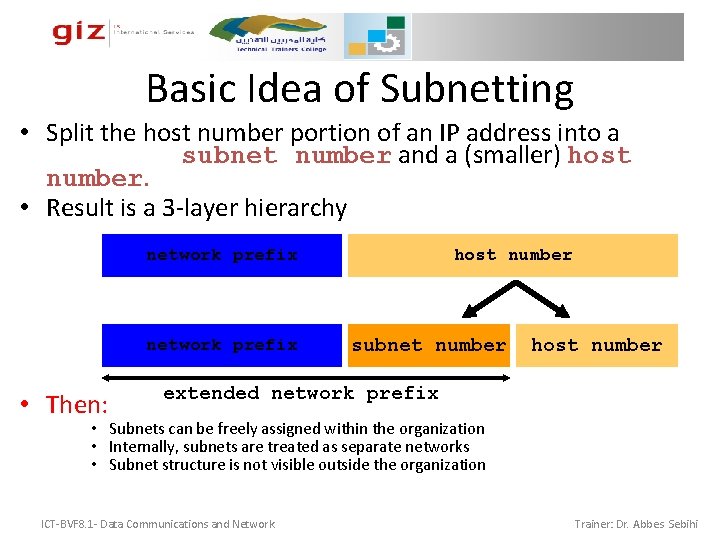
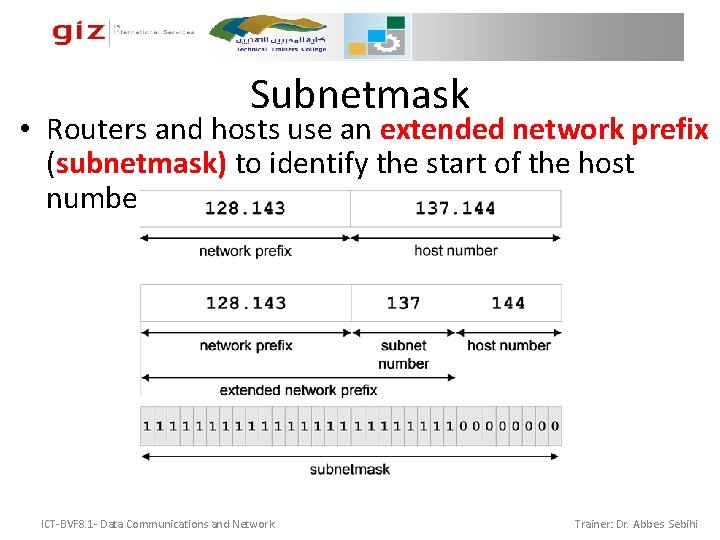
Basic Idea of Subnetting • Split the host number portion of an IP address into a subnet number and a (smaller) host number. • Result is a 3 -layer hierarchy network prefix • Then: host number subnet number host number extended network prefix • Subnets can be freely assigned within the organization • Internally, subnets are treated as separate networks • Subnet structure is not visible outside the organization ICT-BVF 8. 1 - Data Communications and Network Trainer: Dr. Abbes Sebihi
Subnetmask • Routers and hosts use an extended network prefix (subnetmask) to identify the start of the host numbers ICT-BVF 8. 1 - Data Communications and Network Trainer: Dr. Abbes Sebihi
Advantages of Subnetting • With subnetting, IP addresses use a 3 -layer hierarchy: » Network » Subnet » Host • Reduces router complexity. Since external routers do not know about subnetting, the complexity of routing tables at external routers is reduced. • Note: Length of the subnet mask need not be identical at all subnetworks. ICT-BVF 8. 1 - Data Communications and Network Trainer: Dr. Abbes Sebihi
Example: Subnetmask 128. 143. 0. 0/16 is the IP address of the network 128. 143. 137. 0/24 is the IP address of the subnet 128. 143. 137. 144 is the IP address of the host 255. 0 (or ffffff 00) is the subnetmask of the host When subnetting is used, one generally speaks of a “subnetmask” (instead of a netmask) and a “subnet” (instead of a network) • Use of subnetting or length of the subnetmask if decided by the network administrator • Consistency of subnetmasks is responsibility of administrator • • • ICT-BVF 8. 1 - Data Communications and Network Trainer: Dr. Abbes Sebihi
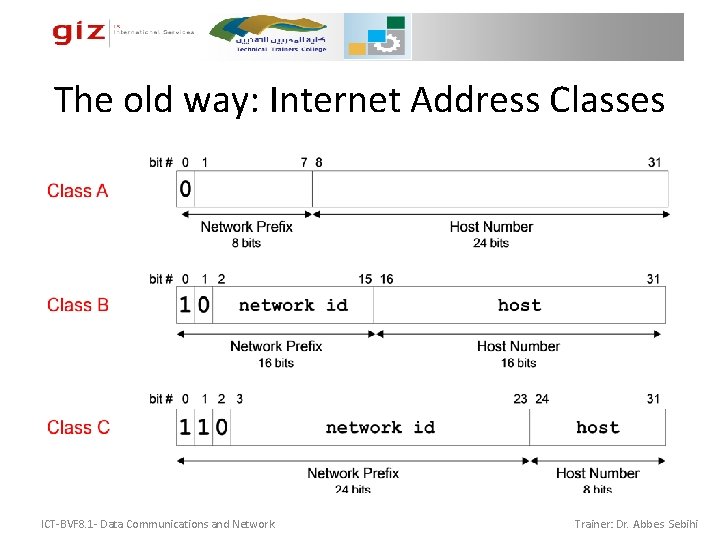
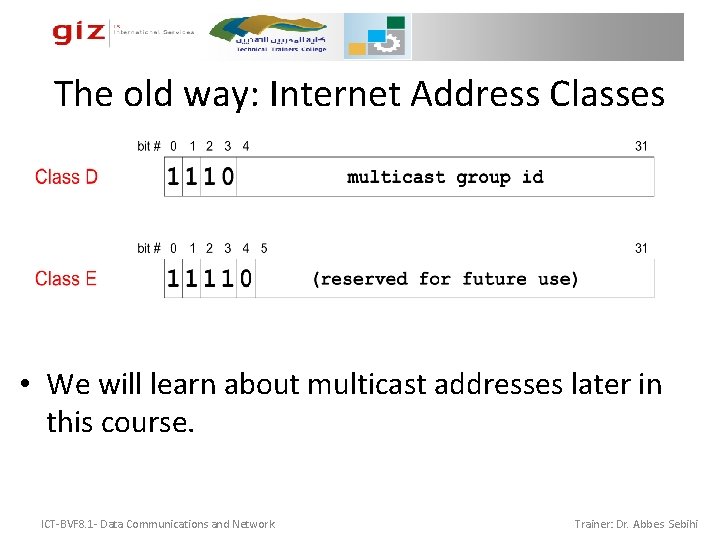
The old way: Internet Address Classes ICT-BVF 8. 1 - Data Communications and Network Trainer: Dr. Abbes Sebihi
The old way: Internet Address Classes • We will learn about multicast addresses later in this course. ICT-BVF 8. 1 - Data Communications and Network Trainer: Dr. Abbes Sebihi
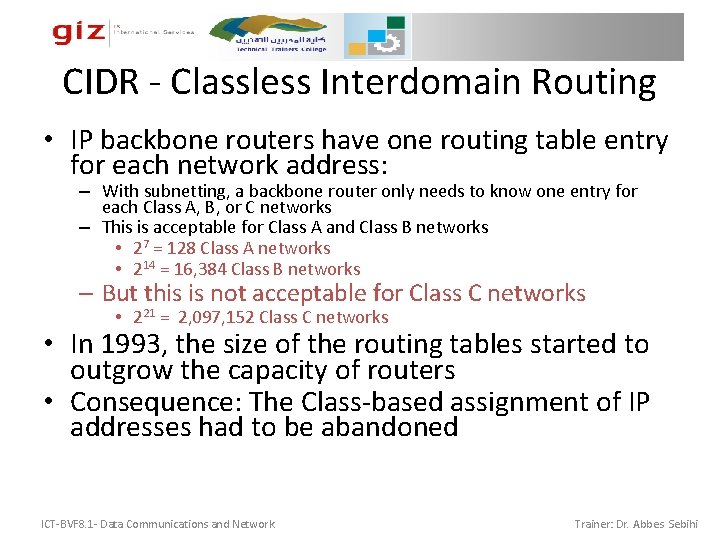
CIDR - Classless Interdomain Routing • IP backbone routers have one routing table entry for each network address: – With subnetting, a backbone router only needs to know one entry for each Class A, B, or C networks – This is acceptable for Class A and Class B networks • 27 = 128 Class A networks • 214 = 16, 384 Class B networks – But this is not acceptable for Class C networks • 221 = 2, 097, 152 Class C networks • In 1993, the size of the routing tables started to outgrow the capacity of routers • Consequence: The Class-based assignment of IP addresses had to be abandoned ICT-BVF 8. 1 - Data Communications and Network Trainer: Dr. Abbes Sebihi
CIDR - Classless Interdomain Routing • Goals: – New interpretation of the IP address space – Restructure IP address assignments to increase efficiency – Permits route aggregation to minimize route table entries • CIDR (Classless Interdomain routing) – abandons the notion of classes – Key Concept: The length of the network prefix in the IP addresses is kept arbitrary – Consequence: Size of the network prefix must be provided with an IP address ICT-BVF 8. 1 - Data Communications and Network Trainer: Dr. Abbes Sebihi
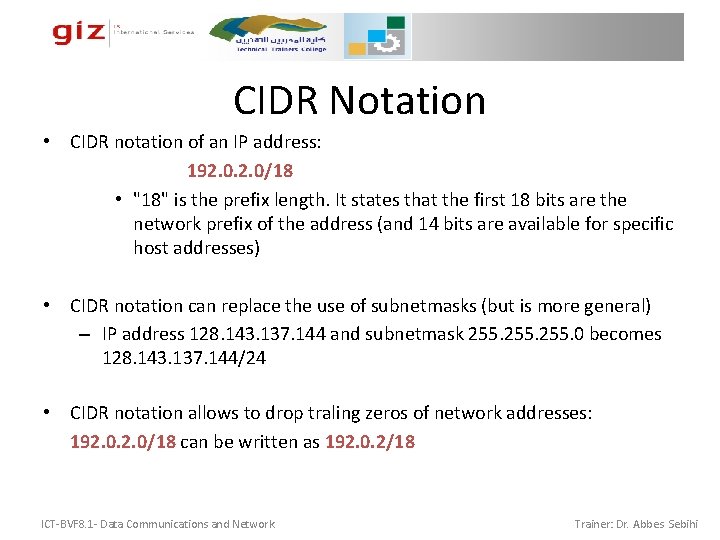
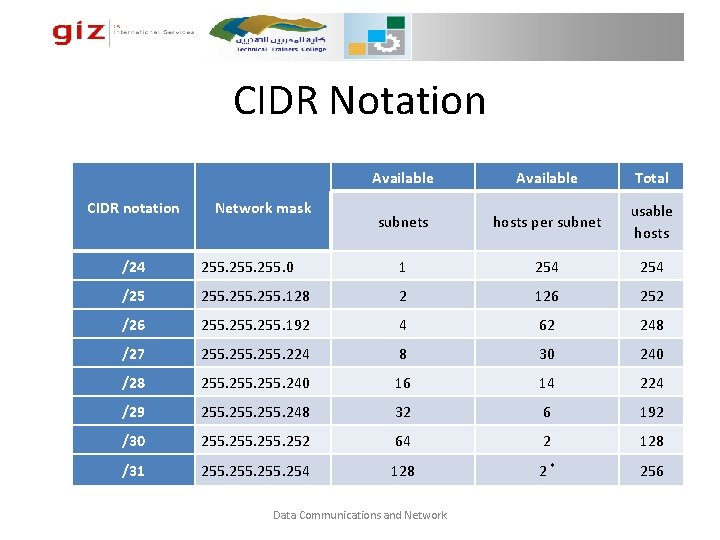
CIDR Notation • CIDR notation of an IP address: 192. 0/18 • "18" is the prefix length. It states that the first 18 bits are the network prefix of the address (and 14 bits are available for specific host addresses) • CIDR notation can replace the use of subnetmasks (but is more general) – IP address 128. 143. 137. 144 and subnetmask 255. 0 becomes 128. 143. 137. 144/24 • CIDR notation allows to drop traling zeros of network addresses: 192. 0/18 can be written as 192. 0. 2/18 ICT-BVF 8. 1 - Data Communications and Network Trainer: Dr. Abbes Sebihi
CIDR Notation CIDR notation Network mask Available Total subnets hosts per subnet usable hosts /24 255. 0 1 254 /25 255. 128 2 126 252 /26 255. 192 4 62 248 /27 255. 224 8 30 240 /28 255. 240 16 14 224 /29 255. 248 32 6 192 /30 255. 252 64 2 128 /31 255. 254 128 2* 256 Data Communications and Network
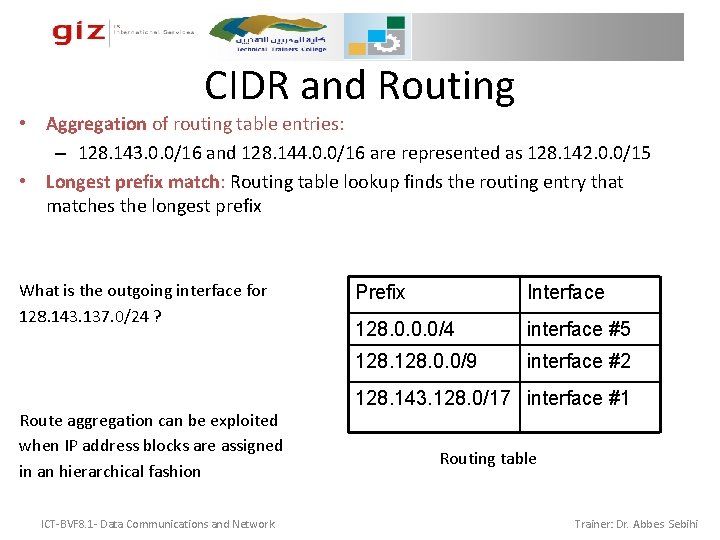
CIDR and Routing • Aggregation of routing table entries: – 128. 143. 0. 0/16 and 128. 144. 0. 0/16 are represented as 128. 142. 0. 0/15 • Longest prefix match: Routing table lookup finds the routing entry that matches the longest prefix What is the outgoing interface for 128. 143. 137. 0/24 ? Route aggregation can be exploited when IP address blocks are assigned in an hierarchical fashion ICT-BVF 8. 1 - Data Communications and Network Prefix Interface 128. 0. 0. 0/4 interface #5 128. 0. 0/9 interface #2 128. 143. 128. 0/17 interface #1 Routing table Trainer: Dr. Abbes Sebihi
Summary Every host and router on the Internet has an IP address, which encodes its network number and host number. The combination is unique: in principle, no two machines on the Internet have the same IP address. The IP addressing calculation is very important for a network administrator, because it gives you the knowledge necessary for designing or configuring a network. ICT-BVF 8. 1 - Data Communications and Network Trainer: Dr. Abbes Sebihi
Questions Data Communications and Network