
DATA COMMUNICATIONS AND NETWORKING Objectives Introduce the readers
DATA COMMUNICATIONS AND NETWORKING
Objectives • Introduce the readers to data communication and its Fundamentals • Define networks • Define protocols • Standards in networking
INTRODUCTION • This chapter provides an introduction to Computer networks and covers fundamental topics like data, information to the definition of communication and computer networks. • The main objective of data communication and networking is to enable seamless exchange of data between any two points in the world. • This exchange of data takes place over a computer network.
DATA & INFORMATION Data refers to the raw facts that are collected while information refers to processed data that enables us to take decisions. Ex. When result of a particular test is declared it contains data of all students, when you find the marks you have scored you have the information that lets you know whether you have passed or failed. The word data refers to any information which is presented in a form that is agreed and accepted upon by is creators and users.
DATA COMMUNICATION Data Communication is a process of exchanging data or information. In case of computer networks this exchange is done between two devices over a transmission medium.
This process involves a communication system which is made up of hardware and software. The hardware part involves the sender and receiver devices and the intermediate devices through which the data passes. The software part involves certain rules which specify what is to be communicated, how it is to be communicated and when. It is also called as a Protocol.
Characteristics of Data Communication 1. Delivery: The data should be delivered to the correct destination and correct user. 2. Accuracy: The communication system should deliver the data accurately, without introducing any errors. The data may get corrupted during transmission affecting the accuracy of the delivered data.
3. Timeliness: Audio and Video data has to be delivered in a timely manner without any delay; such a data delivery is called real time transmission of data. 4. Jitter: It is the variation in the packet arrival time. Uneven Jitter may affect the timeliness of data being transmitted.
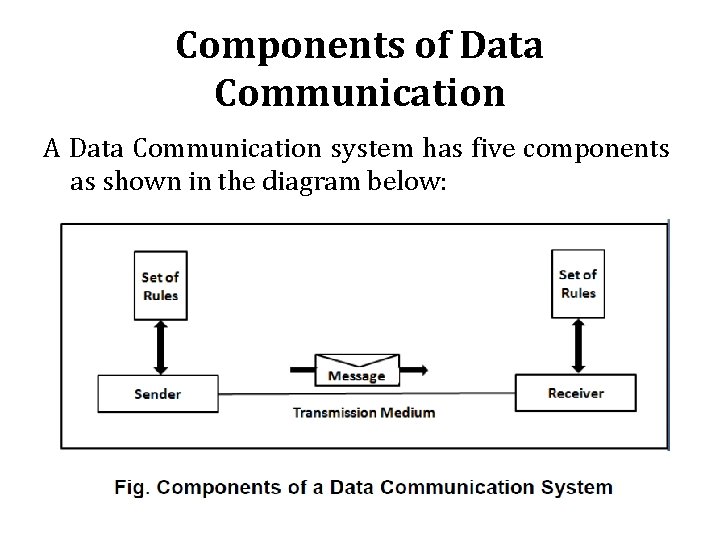
Components of Data Communication A Data Communication system has five components as shown in the diagram below:
1. Message is the information to be communicated by the sender to the receiver. 2. Sender The sender is any device that is capable of sending the data (message).
3. Receiver The receiver is a device that the sender wants to communicate the data (message). 4. Transmission Medium It is the path by which the message travels from sender to receiver. It can be wired or wireless and many subtypes in both.
5. Protocol It is an agreed upon set or rules used by the sender and receiver to communicate data. A protocol is a set of rules that governs data communication.
DATA REPRESENTATION Data is collection of raw facts which is processed to deduce information. There may be different forms in which data may be represented. Some of the forms of data used in communications are as follows:
1. Text includes combination of alphabets in small case as well as upper case. It is stored as a pattern of bits. Prevalent encoding system : ASCII, Unicode
2. Numbers include combination of digits from 0 to 9. It is stored as a pattern of bits. Prevalent encoding system : ASCII, Unicode
3. Images ―An image is worth a thousand words‖ is a very famous saying. In computers images are digitally stored. A Pixel is the smallest element of an image. To put it in simple terms, a picture or image is a matrix of pixel elements. The pixels are represented in the form of bits. Depending upon the type of image (black n white or color) each pixel would require different number of bits to represent the value of a pixel.
4. Audio Data can also be in the form of sound which can be recorded and broadcasted. Example: What we hear on the radio is a source of data or information. Audio data is continuous, not discrete. 5. Video refers to broadcasting of data in form of picture or movie.
DATA FLOW Two devices communicate with each other by sending and receiving data. The data can flow between the two devices in the following ways. 1. Simplex 2. Half Duplex 3. Full Duplex
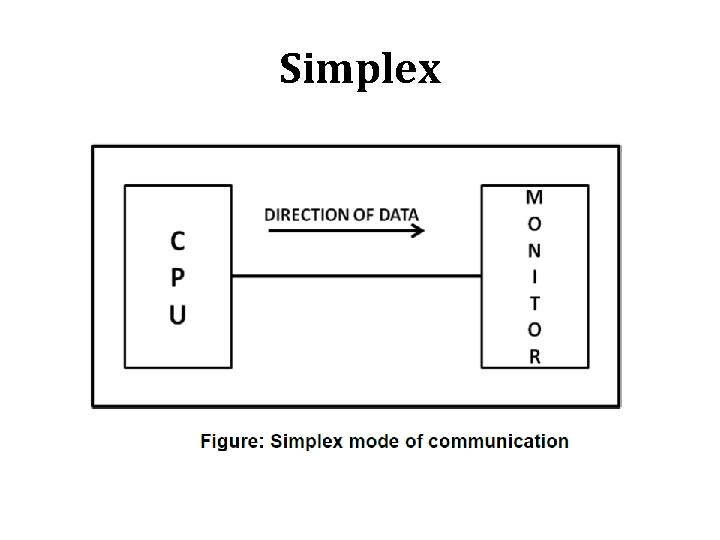
Simplex
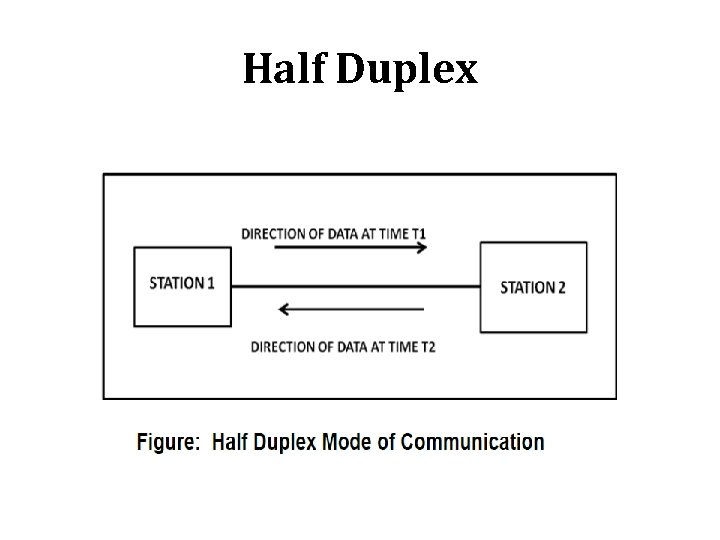
Half Duplex
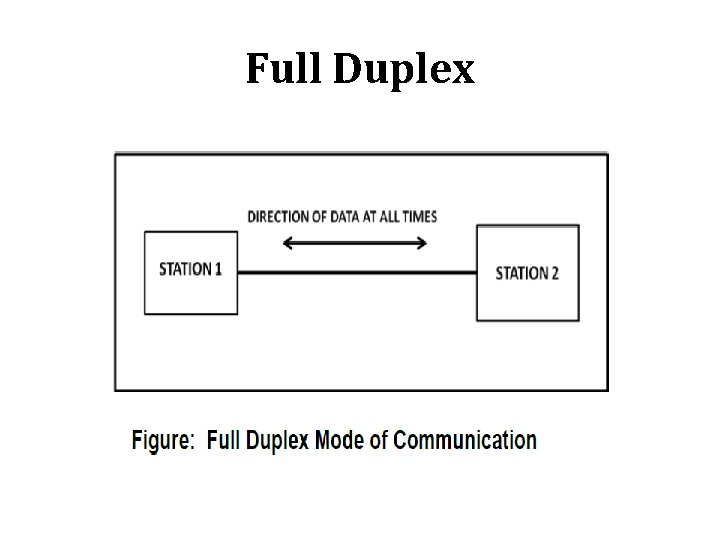
Full Duplex
COMPUTER NETWORK A node can be any device capable of transmitting or receiving data. The communicating nodes have to be connected by communication links A Compute network should ensure • Reliability of the data communication process • Security of the data • Performance by achieving higher throughput and smaller delay times
Categories of Networks are categorized on the basis of their size. The three basic categories of computer networks are: A. Local Area Networks (LAN) is usually limited to a few kilometers of area. It may be privately owned and could be a network inside an office on one of the floor of a building or a LAN could be a network consisting of the computers in a entire building.
B. Wide Area Network (WAN) is made of all the networks in a (geographically) large area. The network in the entire state could be a WAN. C. Metropolitan Area Network (MAN) is of size between LAN & WAN. It is larger than LAN but smaller than WAN. It may comprise the entire network in a city like Mumbai.
PROTOCOL A Protocol is one of the components of a data communications system. Without protocol communication cannot occur. The sending device cannot just send the data and expect the receiving device to receive and further interpret it correctly. When the sender sends a message it may consist of text, number, images, etc. which are converted into bits and grouped into blocks to be transmitted and often certain additional information called control information is also added to help the receiver interpret the data.
For successful communication to occur, the sender and receiver must agree upon certain rules called protocol. A Protocol is defined as a set of rules that governs data communications. A protocol defines what is to be communicated, how it is to be communicated and when it is to be communicated.
Elements of a Protocol A. Syntax It means the structure or format of the data. It is the arrangement of data in a particular order. B. Semantics It tells the meaning of each section of bits and indicates the interpretation of each section. It also tells what action/decision is to be taken based on the interpretation.
C. Timing It tells the sender about the readiness of the receiver to receive the data. It tells the sender at what rate the data should be sent to the receiver to avoid overwhelming the receiver.
STANDARDS IN NETWORKING Standards are necessary in networking to ensure interconnectivity and interoperability between various networking hardware and software components. Without standards we would have proprietary products creating isolated islands of users which cannot interconnect.
Concept of Standards provide guidelines to product manufacturers and vendors to ensure national and international interconnectivity. Data communications standards are classified into two categories:
1. De facto Standard These are the standards that have been traditionally used and mean by fact or by convention These standards are not approved by any organized body but are adopted by widespread use.
2. De jure standard It means by law or by regulation. These standards are legislated and approved by a body that is officially recognized.
Standard Organizations in field of Networking Standards are created by standards creation committees, forums, and government regulatory agencies.
Examples of Standard Creation Committees: 1. International Organization for Standardization (ISO) 2. International Telecommunications Union – Telecommunications Standard (ITU-T) 3. American National Standards Institute (ANSI) 4. Institute of Electrical & Electronics Engineers (IEEE) 5. Electronic Industries Associates (EIA)
- Slides: 34