
Data Communications and Networking Chapter 1 Data Communications

- Slides: 34
Data Communications and Networking Chapter 1 Data Communications, Data Networks, and the Internet Reading: Book Chapter 1 Data and Computer Communications, 8 th edition By William Stallings 1
Outline • Section 1: Data Communications and Networking for Today’s Enterprise • Section 2: A Communications Model • Section 3: Data Communications • Section 4: Networks • Section 5: The Internet • Summary: Key Points • Appendix: History of Communications 2
Section 1 Data Communications and Networking for Today’s Enterprise 3
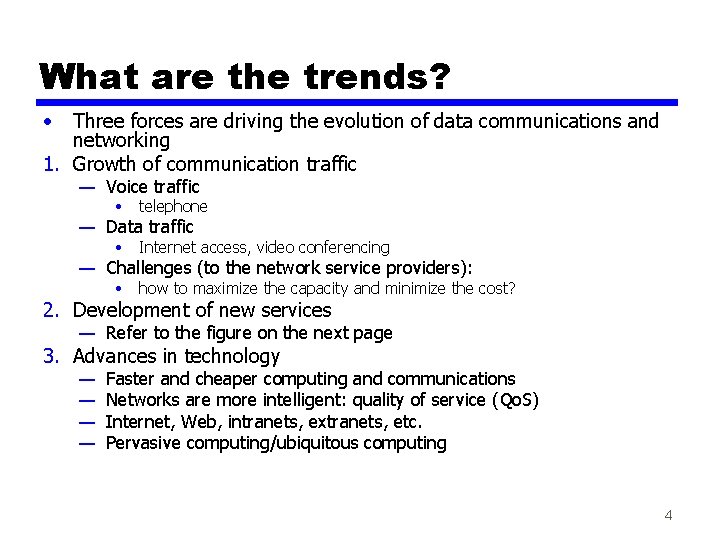
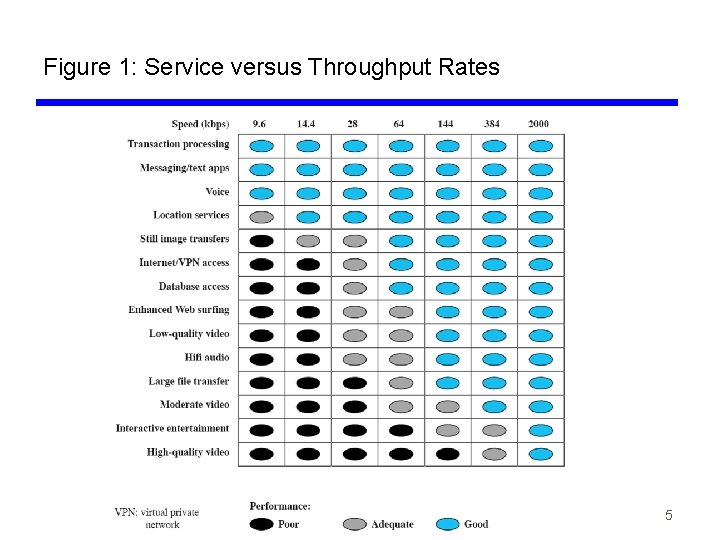
What are the trends? • Three forces are driving the evolution of data communications and networking 1. Growth of communication traffic — Voice traffic • telephone • Internet access, video conferencing • how to maximize the capacity and minimize the cost? — Data traffic — Challenges (to the network service providers): 2. Development of new services — Refer to the figure on the next page 3. Advances in technology — — Faster and cheaper computing and communications Networks are more intelligent: quality of service (Qo. S) Internet, Web, intranets, extranets, etc. Pervasive computing/ubiquitous computing 4
Figure 1: Service versus Throughput Rates 5
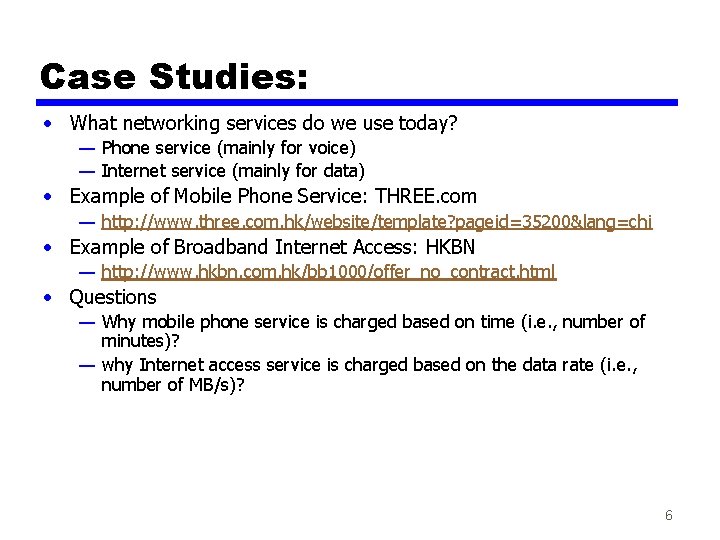
Case Studies: • What networking services do we use today? — Phone service (mainly for voice) — Internet service (mainly for data) • Example of Mobile Phone Service: THREE. com — http: //www. three. com. hk/website/template? pageid=35200&lang=chi • Example of Broadband Internet Access: HKBN — http: //www. hkbn. com. hk/bb 1000/offer_no_contract. html • Questions — Why mobile phone service is charged based on time (i. e. , number of minutes)? — why Internet access service is charged based on the data rate (i. e. , number of MB/s)? 6
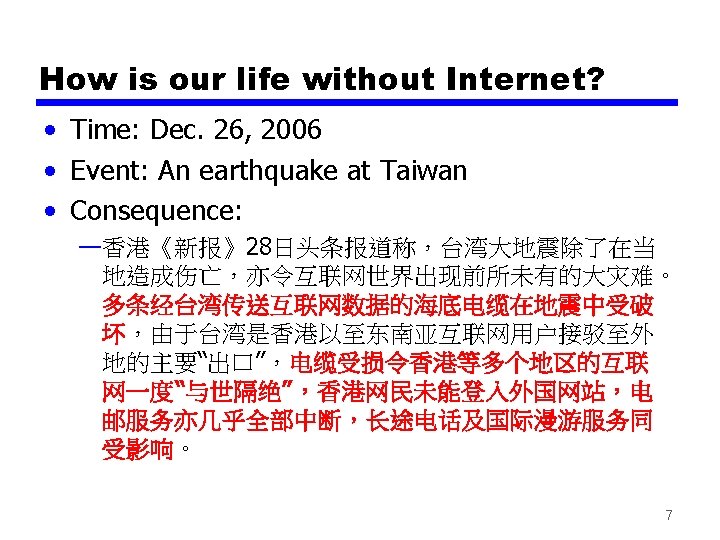
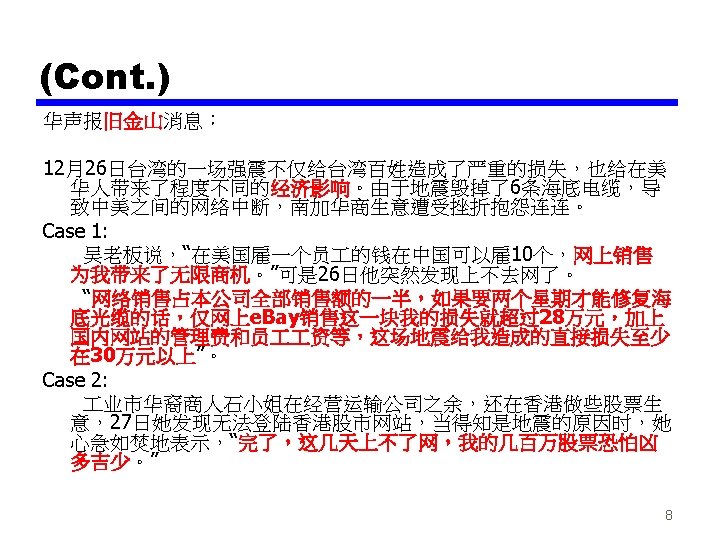
What lessons can we learn? • Internet is an important infrastructure of our society. • Reliability is a critical factor, especially for businesses that rely on networking technology. • Question: If you are a network manager for a company, how will you increase the reliability of your company’s network connection? 9
Section 2 A Communications Model 10
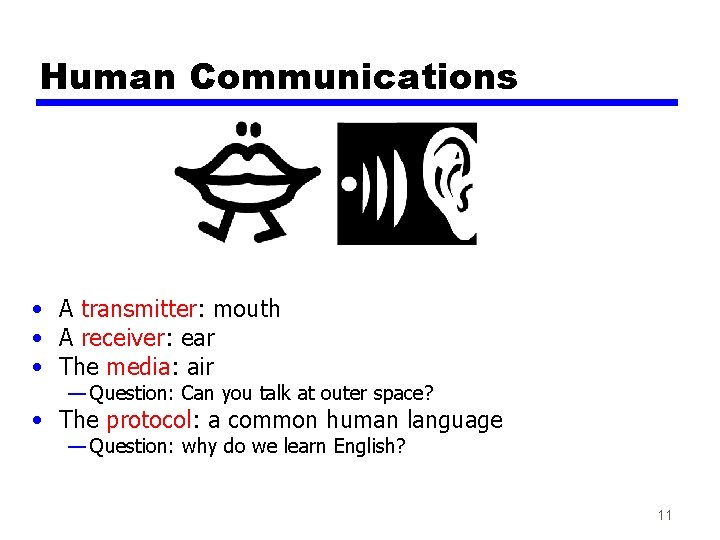
Human Communications • A transmitter: mouth • A receiver: ear • The media: air — Question: Can you talk at outer space? • The protocol: a common human language — Question: why do we learn English? 11
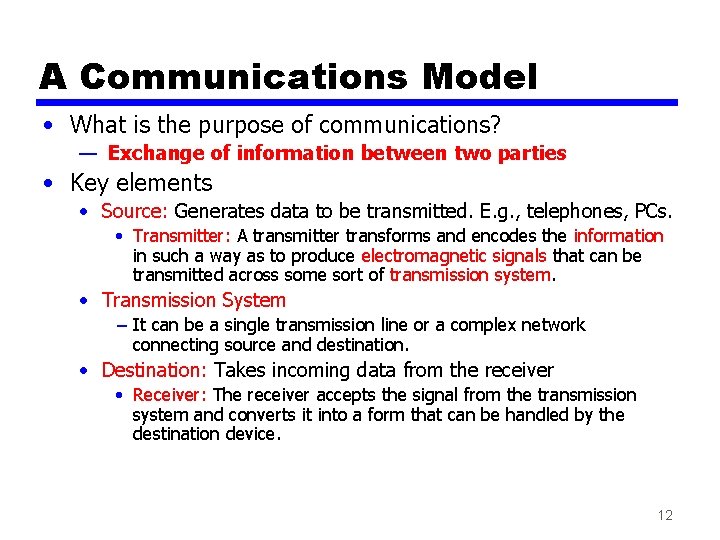
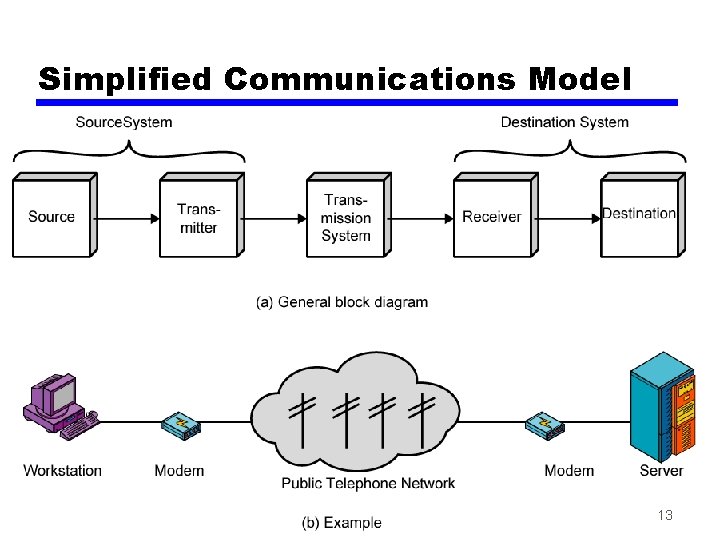
A Communications Model • What is the purpose of communications? — Exchange of information between two parties • Key elements • Source: Generates data to be transmitted. E. g. , telephones, PCs. • Transmitter: A transmitter transforms and encodes the information in such a way as to produce electromagnetic signals that can be transmitted across some sort of transmission system. • Transmission System − It can be a single transmission line or a complex network connecting source and destination. • Destination: Takes incoming data from the receiver • Receiver: The receiver accepts the signal from the transmission system and converts it into a form that can be handled by the destination device. 12
Simplified Communications Model 13
Section 3 Data Communications 14
Simplified Data Communications Model Assume the source and destination are PCs. The source wishes to send a message m to the destination. 15
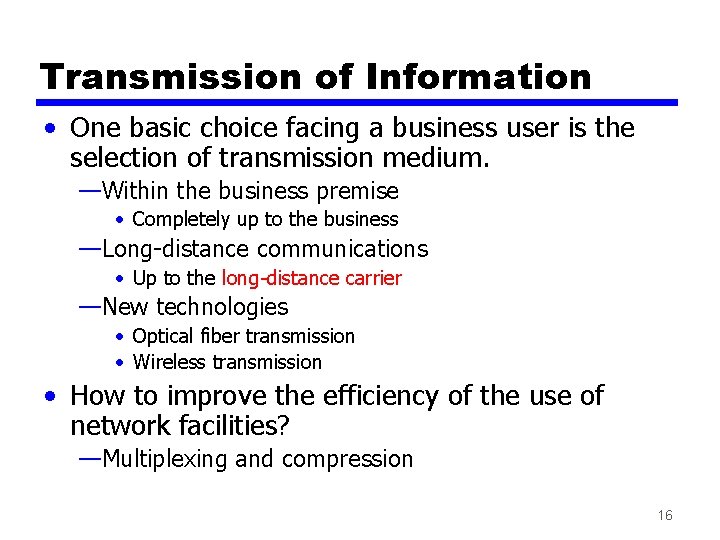
Transmission of Information • One basic choice facing a business user is the selection of transmission medium. —Within the business premise • Completely up to the business —Long-distance communications • Up to the long-distance carrier —New technologies • Optical fiber transmission • Wireless transmission • How to improve the efficiency of the use of network facilities? —Multiplexing and compression 16
Section 4 Networks 17
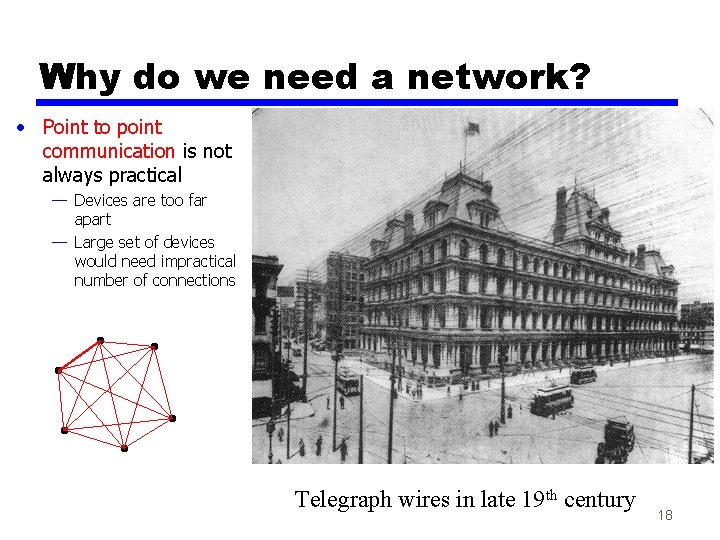
Why do we need a network? • Point to point communication is not always practical — Devices are too far apart — Large set of devices would need impractical number of connections Telegraph wires in late 19 th century 18
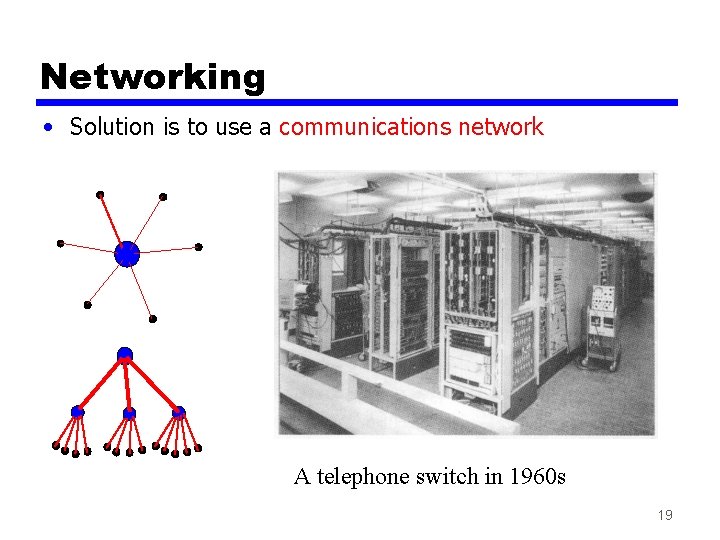
Networking • Solution is to use a communications network A telephone switch in 1960 s 19
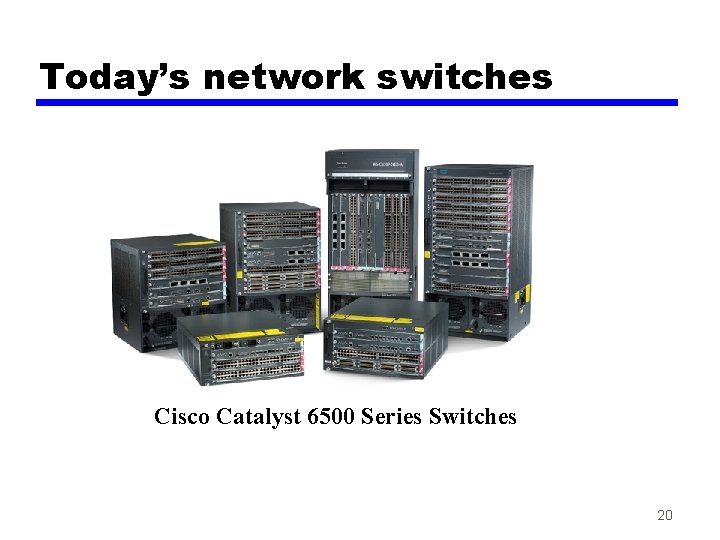
Today’s network switches Cisco Catalyst 6500 Series Switches 20
At Ancient Time • How to achieve long-distance communications? • Solution 1 — Signal fires — Example • See the movie segment in “The Lord Of The Rings – Return Of The King” directed by Peter Jackson. • Solution 2 — Messengers, horses, post houses (驛站) — How efficient is it? • 56 days from 北京 to 廣州 • In both solutions, the concept of “relay” is very important, and it forms the basic principle of today’s Internet. 21
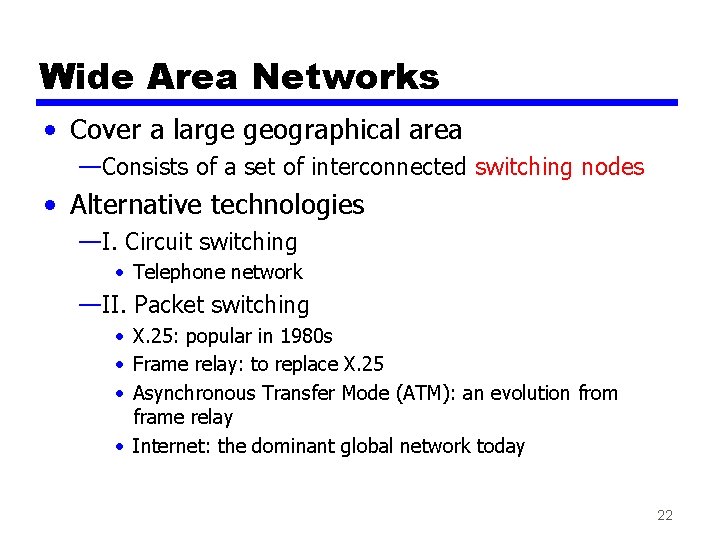
Wide Area Networks • Cover a large geographical area —Consists of a set of interconnected switching nodes • Alternative technologies —I. Circuit switching • Telephone network —II. Packet switching • X. 25: popular in 1980 s • Frame relay: to replace X. 25 • Asynchronous Transfer Mode (ATM): an evolution from frame relay • Internet: the dominant global network today 22
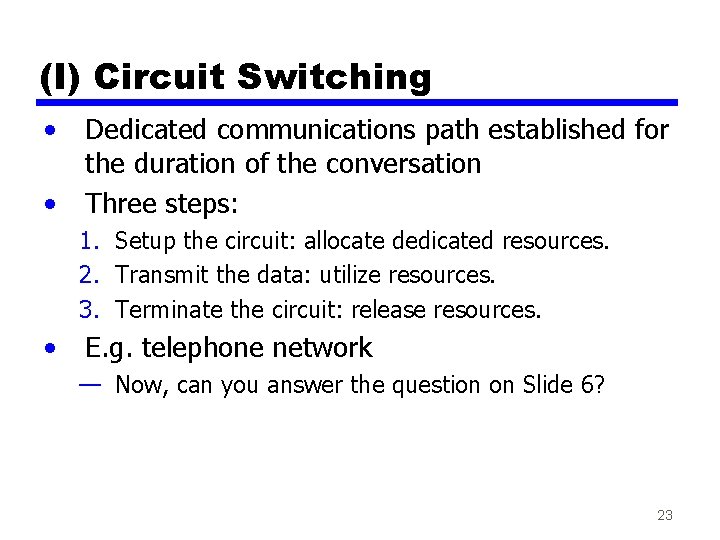
(I) Circuit Switching • • Dedicated communications path established for the duration of the conversation Three steps: 1. Setup the circuit: allocate dedicated resources. 2. Transmit the data: utilize resources. 3. Terminate the circuit: release resources. • E. g. telephone network — Now, can you answer the question on Slide 6? 23
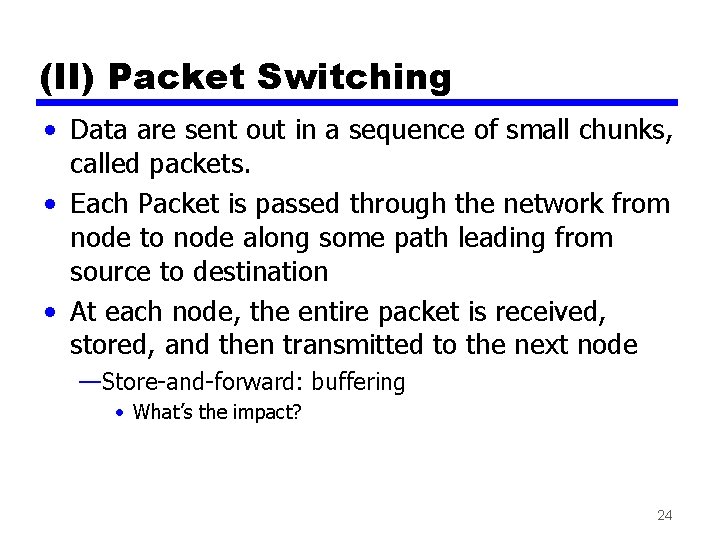
(II) Packet Switching • Data are sent out in a sequence of small chunks, called packets. • Each Packet is passed through the network from node to node along some path leading from source to destination • At each node, the entire packet is received, stored, and then transmitted to the next node —Store-and-forward: buffering • What’s the impact? 24
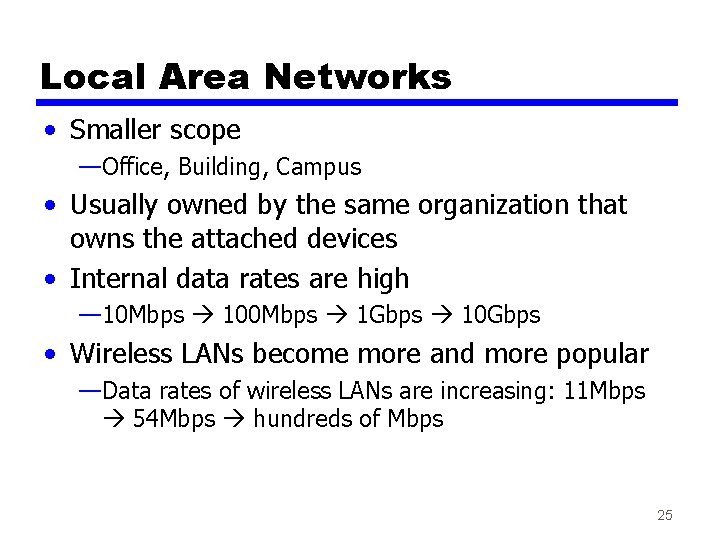
Local Area Networks • Smaller scope —Office, Building, Campus • Usually owned by the same organization that owns the attached devices • Internal data rates are high — 10 Mbps 100 Mbps 1 Gbps 10 Gbps • Wireless LANs become more and more popular —Data rates of wireless LANs are increasing: 11 Mbps 54 Mbps hundreds of Mbps 25
Section 5 The Internet 26
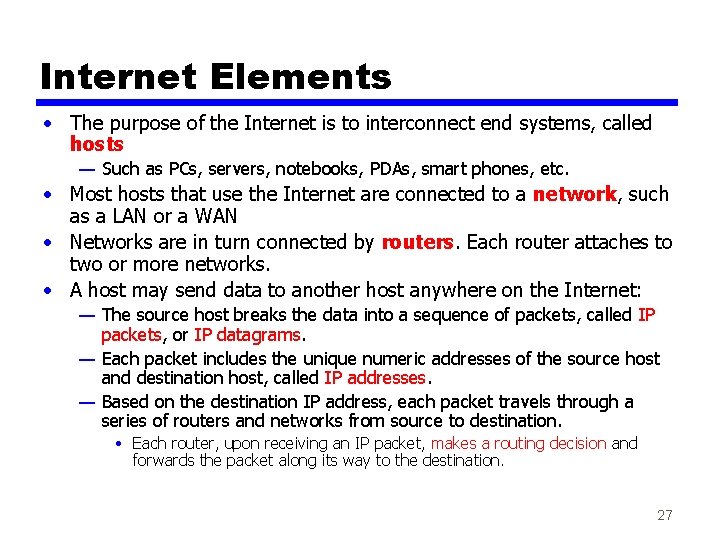
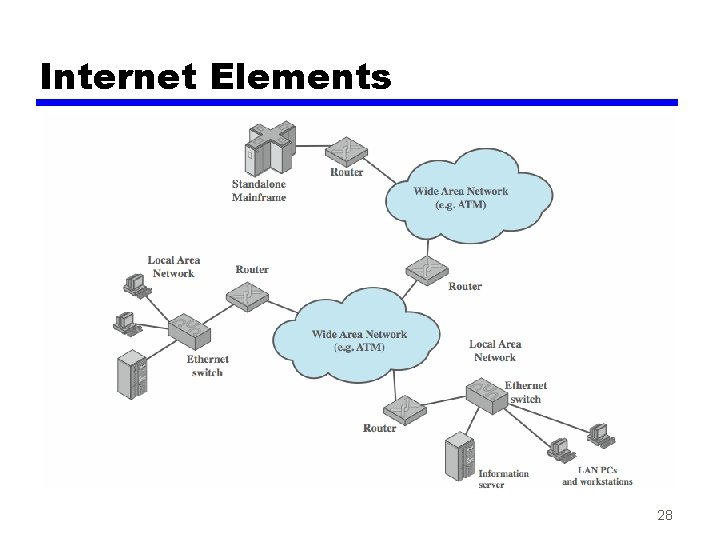
Internet Elements • The purpose of the Internet is to interconnect end systems, called hosts — Such as PCs, servers, notebooks, PDAs, smart phones, etc. • Most hosts that use the Internet are connected to a network, such as a LAN or a WAN • Networks are in turn connected by routers. Each router attaches to two or more networks. • A host may send data to another host anywhere on the Internet: — The source host breaks the data into a sequence of packets, called IP packets, or IP datagrams. — Each packet includes the unique numeric addresses of the source host and destination host, called IP addresses. — Based on the destination IP address, each packet travels through a series of routers and networks from source to destination. • Each router, upon receiving an IP packet, makes a routing decision and forwards the packet along its way to the destination. 27
Internet Elements 28
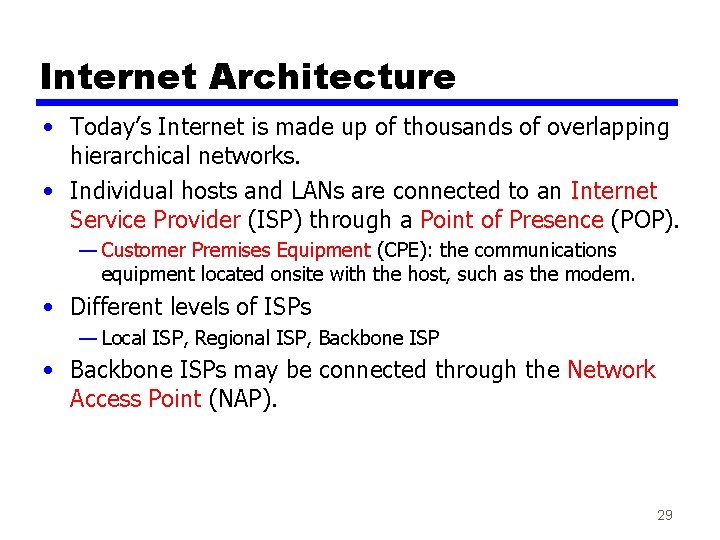
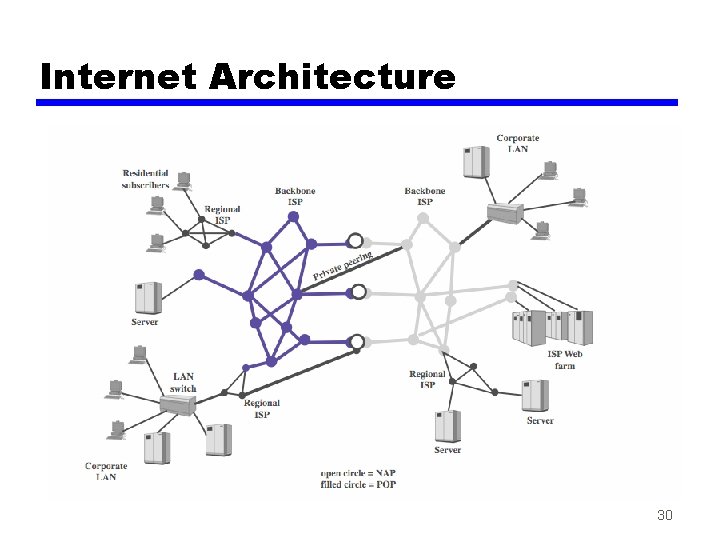
Internet Architecture • Today’s Internet is made up of thousands of overlapping hierarchical networks. • Individual hosts and LANs are connected to an Internet Service Provider (ISP) through a Point of Presence (POP). — Customer Premises Equipment (CPE): the communications equipment located onsite with the host, such as the modem. • Different levels of ISPs — Local ISP, Regional ISP, Backbone ISP • Backbone ISPs may be connected through the Network Access Point (NAP). 29
Internet Architecture 30
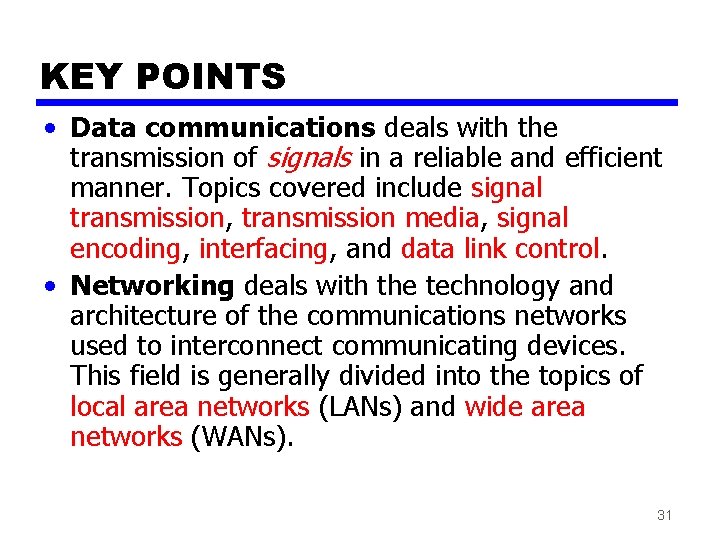
KEY POINTS • Data communications deals with the transmission of signals in a reliable and efficient manner. Topics covered include signal transmission, transmission media, signal encoding, interfacing, and data link control. • Networking deals with the technology and architecture of the communications networks used to interconnect communicating devices. This field is generally divided into the topics of local area networks (LANs) and wide area networks (WANs). 31
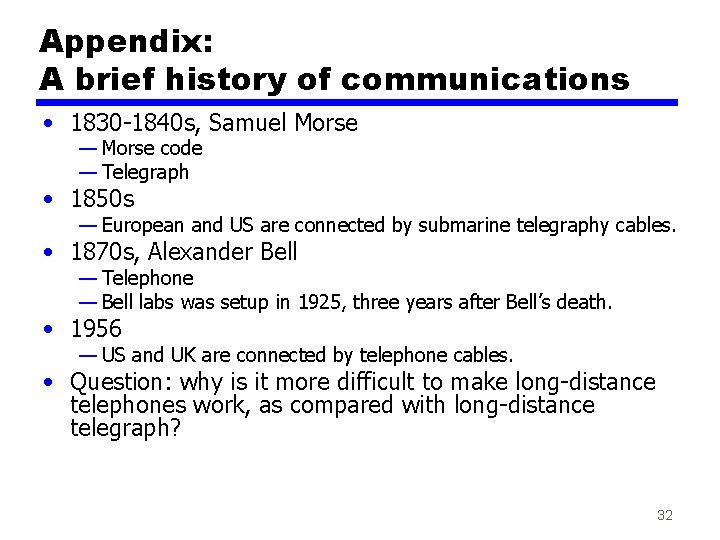
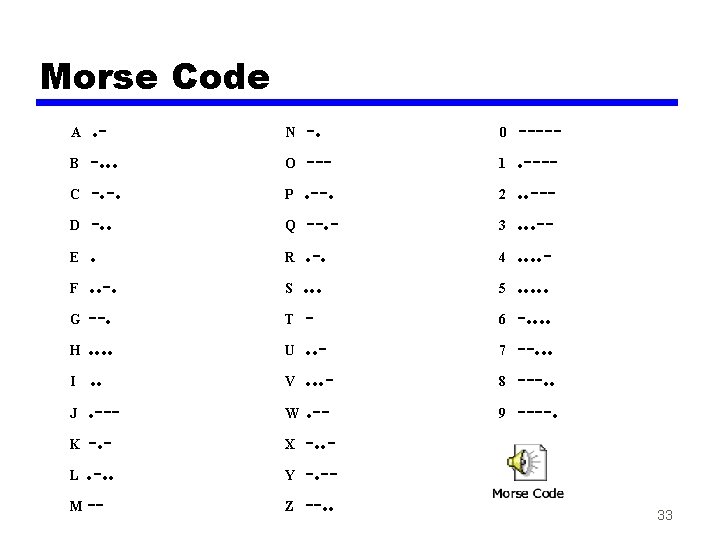
Appendix: A brief history of communications • 1830 -1840 s, Samuel Morse — Morse code — Telegraph • 1850 s — European and US are connected by submarine telegraphy cables. • 1870 s, Alexander Bell — Telephone — Bell labs was setup in 1925, three years after Bell’s death. • 1956 — US and UK are connected by telephone cables. • Question: why is it more difficult to make long-distance telephones work, as compared with long-distance telegraph? 32
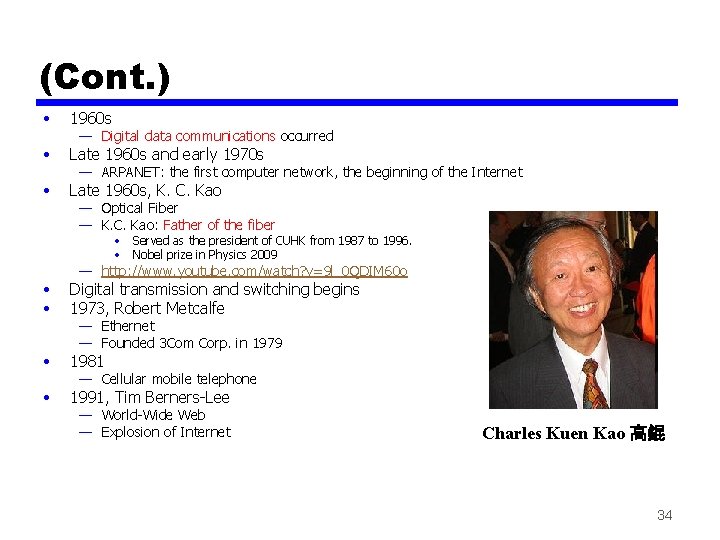
(Cont. ) • 1960 s • Late 1960 s and early 1970 s • Late 1960 s, K. C. Kao — Digital data communications occurred — ARPANET: the first computer network, the beginning of the Internet — Optical Fiber — K. C. Kao: Father of the fiber • Served as the president of CUHK from 1987 to 1996. • Nobel prize in Physics 2009 — http: //www. youtube. com/watch? v=9 l_0 QDIM 60 o • • Digital transmission and switching begins 1973, Robert Metcalfe • 1981 • 1991, Tim Berners-Lee — Ethernet — Founded 3 Com Corp. in 1979 — Cellular mobile telephone — World-Wide Web — Explosion of Internet Charles Kuen Kao 高錕 34