
DATA COMMUNICATION PRINCIPLES Virtual circuit and the frame
- Slides: 4
DATA COMMUNICATION PRINCIPLES : Virtual circuit and the frame relay protocol
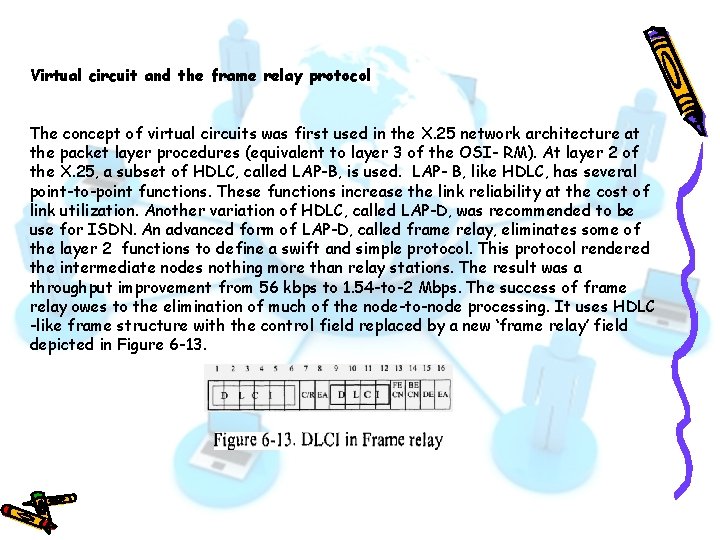
Virtual circuit and the frame relay protocol The concept of virtual circuits was first used in the X. 25 network architecture at the packet layer procedures (equivalent to layer 3 of the OSI- RM). At layer 2 of the X. 25, a subset of HDLC, called LAP-B, is used. LAP- B, like HDLC, has several point-to-point functions. These functions increase the link reliability at the cost of link utilization. Another variation of HDLC, called LAP-D, was recommended to be use for ISDN. An advanced form of LAP-D, called frame relay, eliminates some of the layer 2 functions to define a swift and simple protocol. This protocol rendered the intermediate nodes nothing more than relay stations. The result was a throughput improvement from 56 kbps to 1. 54 -to-2 Mbps. The success of frame relay owes to the elimination of much of the node-to-node processing. It uses HDLC -like frame structure with the control field replaced by a new ‘frame relay’ field depicted in Figure 6 -13.
The data link control identifier (DLCI) in frame relay set the stage for the future of virtual circuit based routing. It consists of the destination address of the frame. The frame relay switching nodes do not have to allocate a permanent physical path for each call. They use a table-look up method described above (see Figure 6 -9) and use only virtual numbers to switch and route frames to the destination. In the actual frame relay standard, specified as ANSI T 1. 618, an extension of address is allowed to another 16 bits. ATM extended the same concept with further reduction of functions, and a small, constant cell size. With reference to Figure 6 -13, some other functions provided by frame relay are as follows: C/R: Command/Response bit. FECN/BECN: Forward/Backward explicit congestion notification. Together, these two bits eliminate the need of link-by-link flow control. FECN is a single bit used to notify the destination that network is experiencing congestion. On receiving FECN message, the destination may inform the traffic source about the congestion. This can be done using an ACK. with the BECN ‘ON’. Alternatively, any intermediate node, on sensing congestion, can activate the BECN bit on a packet going towards the traffic source (backward). DE: Discard eligibility function that allows the user or network to tag lower priority frames. These frames could be discarded in case of congestion. EA: Extended address bit allows for the use of address extended another 16 bits.
REFERENCES • Ahmad A. - Data Communication Principles. For Fixed and Wireless Networks • Cornelius T. Leondes - Database and Data Communication Network Systems, Three-Volume Set_. . -Academic Press