
DATA COMMUNICATION PRINCIPLES The Network Data The Network
- Slides: 6
DATA COMMUNICATION PRINCIPLES : The Network Data
The Network Data A PDU has been described as having two parts, the data part, that is the higher layer PDU, and the protocol control information part in the form of a header/trailer. For example, the network PDU (N-PDU) consists of the network layer header and the transport layer PDU (T-PDU). We call N-PDU as the network (layer) data while it is also said that the T-PDU is the data part of N-PDU. As long as the reader understands from the context, there will be no confusion. However, following is a justification for calling N-PDU as the network layer data.
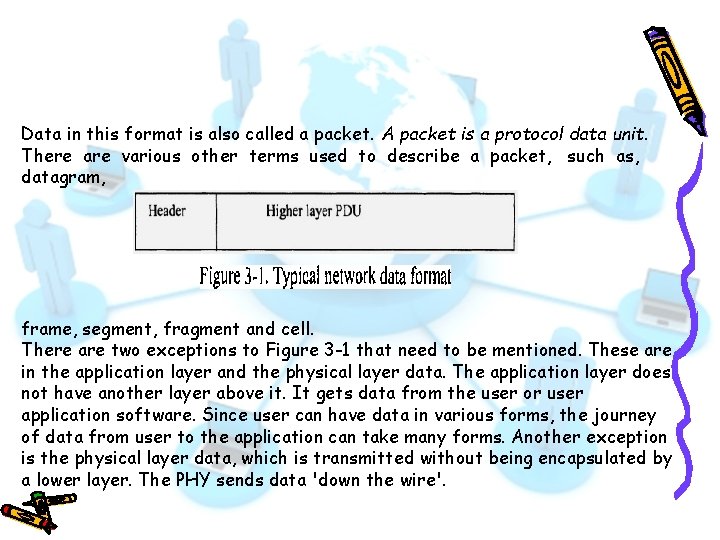
As we learnt earlier, layers talk to their peers. For example, the N- PDU transmitted by the network layer of a sending computer will be processed only by the network layer of the next receiving computer. Thus, for the layer 3 of the receiving computer, the N-PDU is the data to be delivered by the network. However, T-PDU is a part of a primitive sent by the transport layer in the same computer asking the network layer to convey and send it to the transport layer of the destination computer. In computer science terminology, T-PDU will be the parameter of a function (the primitive) passed to the network layer. It can be called the data part of the N-PDU. However, for the network layer the information that is important comes from another network layer in the form of N-PDU. Thus, we differentiate between the network layer data (N-PDU) and the data part of N-PDU, which is T-PDU unless otherwise specified. Data is processed by all layers in ways defined by the respective protocols on those layers. It has the same format on all layers except the PHY: consisting of the header and the higher layer PDU as shown in Figure 3 -1.
Data in this format is also called a packet. A packet is a protocol data unit. There are various other terms used to describe a packet, such as, datagram, frame, segment, fragment and cell. There are two exceptions to Figure 3 -1 that need to be mentioned. These are in the application layer and the physical layer data. The application layer does not have another layer above it. It gets data from the user or user application software. Since user can have data in various forms, the journey of data from user to the application can take many forms. Another exception is the physical layer data, which is transmitted without being encapsulated by a lower layer. The PHY sends data 'down the wire'.
So, for the receiving PHY, the incoming data first consists of the signal on the wire, and after the signal has been received, it may consist of a data packet with a header and a DLC packet in it. Also, before the data reaches from user to the application layer, it may have to go through various processing functions depending on following factors: In what form the data was generated? In what application program it will be used by the receiving computer? In what format is it stored? Before data reaches the destination PHY, it may have to go through several processing functions depending upon factors such as: What type of medium is used for transmission, e. g. , copper cable, optical fiber or air? What distance it traveled? Usually data takes different forms (of modulation) depending upon distance. In what format it was coded? In the next sections, we will have a discussion on various forms of data when it exists before entering the network (application) or before the destination physical layer receives it. We will start by a natural sequence of events to put things in perspective.
REFERENCES • Ahmad A. - Data Communication Principles. For Fixed and Wireless Networks • Cornelius T. Leondes - Database and Data Communication Network Systems, Three-Volume Set_. . -Academic Press