
DATA COMMUNICATION PRINCIPLES Physical Layer Protocol Example EIA
- Slides: 4
DATA COMMUNICATION PRINCIPLES : Physical Layer Protocol Example: EIA 232 -F
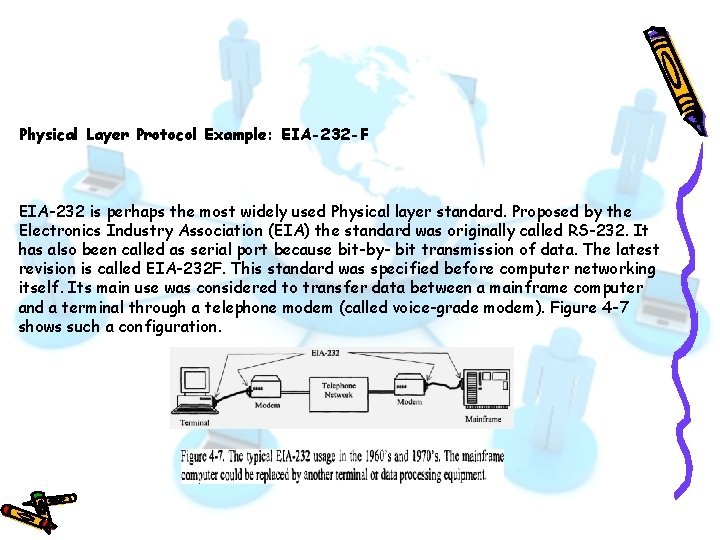
Physical Layer Protocol Example: EIA-232 -F EIA-232 is perhaps the most widely used Physical layer standard. Proposed by the Electronics Industry Association (EIA) the standard was originally called RS-232. It has also been called as serial port because bit-by- bit transmission of data. The latest revision is called EIA-232 F. This standard was specified before computer networking itself. Its main use was considered to transfer data between a mainframe computer and a terminal through a telephone modem (called voice-grade modem). Figure 4 -7 shows such a configuration.
Other assumptions implicit in the specifications were: Low data transfer rate of the order of a few hundreds bps to a few thousands bps. Even the latest revisions are suitable for less than 20 kbps operation. For very short cable, the data rates could be further increased. Short length cables (less than 5 meters) between the modem and the terminal (or the mainframe). Negative bipolar signaling emulating the current-based logic in the earlier (1950 s) Teletype machines. The standard brought with it some terminology that was later followed by some wide area networks. Here are some of the terms.
REFERENCES • Ahmad A. - Data Communication Principles. For Fixed and Wireless Networks • Cornelius T. Leondes - Database and Data Communication Network Systems, Three-Volume Set_. . -Academic Press