
Data Communication Networks Lec 10 Multilevel Schemes Goal
- Slides: 32
Data Communication Networks Lec 10
Multilevel Schemes • Goal is to increase the number of bits per baud. • m data elements encoded into a pattern of n signal elements. • Design are in coding of m. Bn. L, m is the length of binary pattern, B means binary data, n is the length of signal pattern, L is the number of levels in the signaling. • A letter is often used in the place of L: B(binary) for L=2, T (ternary) for L=3 and Q(quaternary)for L=4. • First two letters define the data pattern and second two define signal pattern.
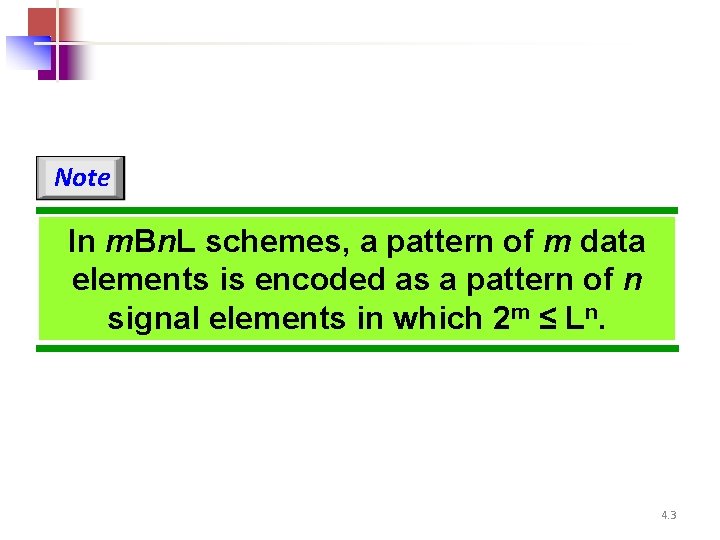
Note In m. Bn. L schemes, a pattern of m data elements is encoded as a pattern of n signal elements in which 2 m ≤ Ln. 4. 3
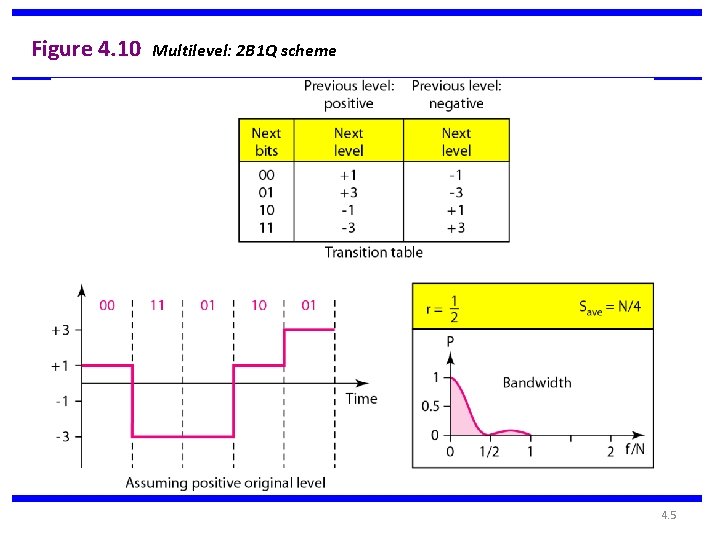
2 B 1 Q(two binary, one quaternary) • In this encoding, m=2, n=1 and L=4. • Have four different signal level, receiver has to discern four different thresholds. • Used in DSL , to provide high speed connection by using telephone lines.
Figure 4. 10 Multilevel: 2 B 1 Q scheme 4. 5
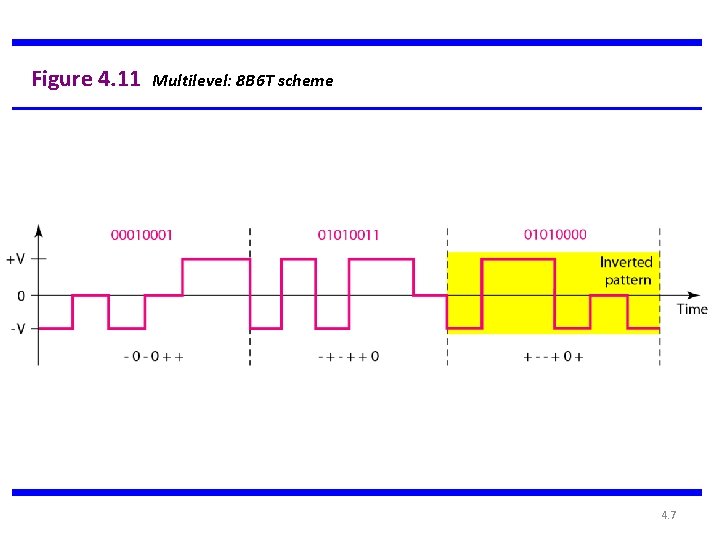
8 B 6 T(eight binary, six ternary) • Used for 100 BASE-4 T cable. • Idea is to encode a pattern of 8 bits as a pattern of 6 signal elements. • Each pattern has a weight of 0 or +1.
Figure 4. 11 Multilevel: 8 B 6 T scheme 4. 7
4 D-PAM 5(four dimensional five-level pulse amplitude modulation ) • 4 D means data is send over four wires at a time.
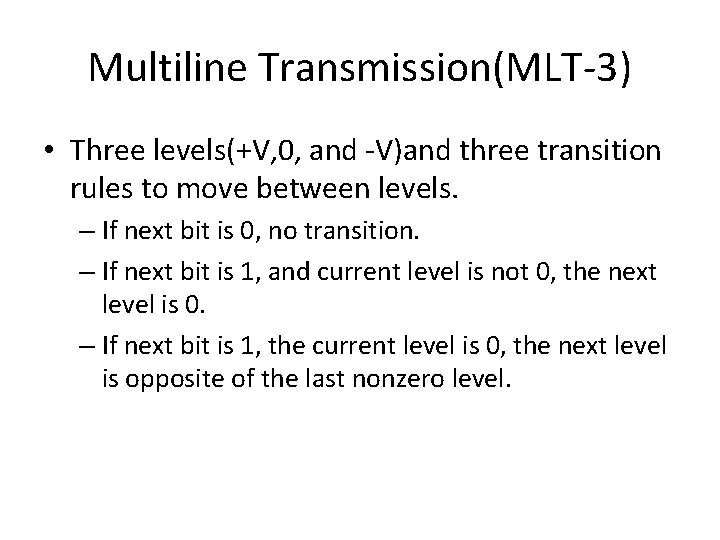
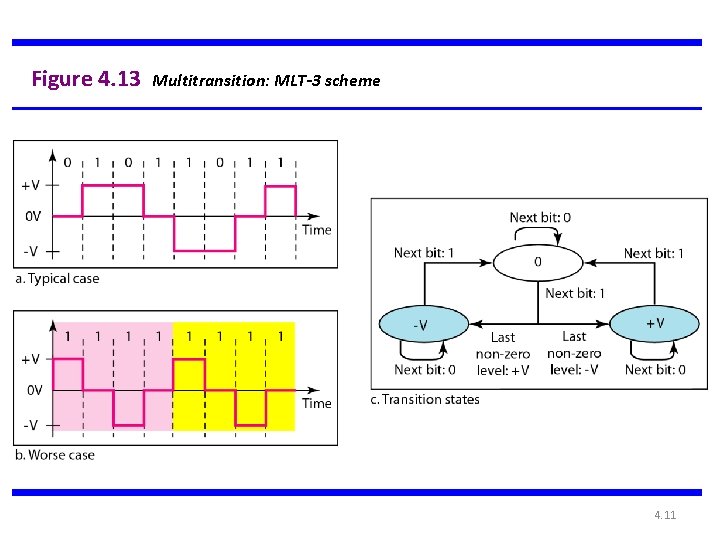
Multiline Transmission(MLT-3) • Three levels(+V, 0, and -V)and three transition rules to move between levels. – If next bit is 0, no transition. – If next bit is 1, and current level is not 0, the next level is 0. – If next bit is 1, the current level is 0, the next level is opposite of the last nonzero level.
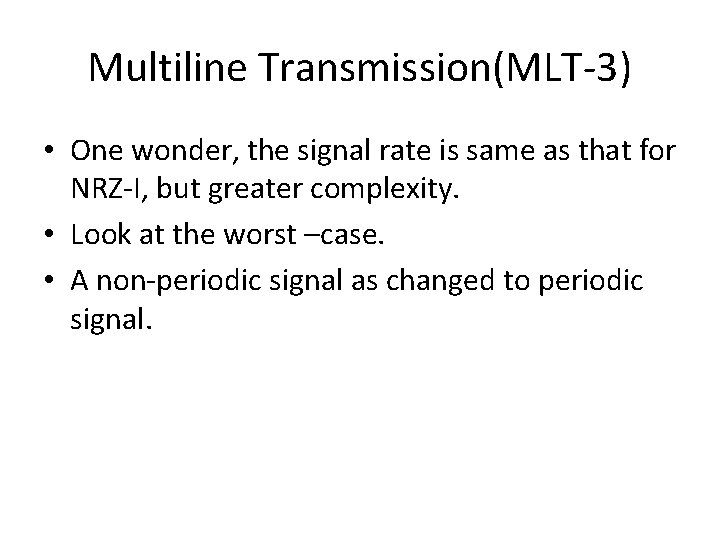
Multiline Transmission(MLT-3) • One wonder, the signal rate is same as that for NRZ-I, but greater complexity. • Look at the worst –case. • A non-periodic signal as changed to periodic signal.
Figure 4. 13 Multitransition: MLT-3 scheme 4. 11
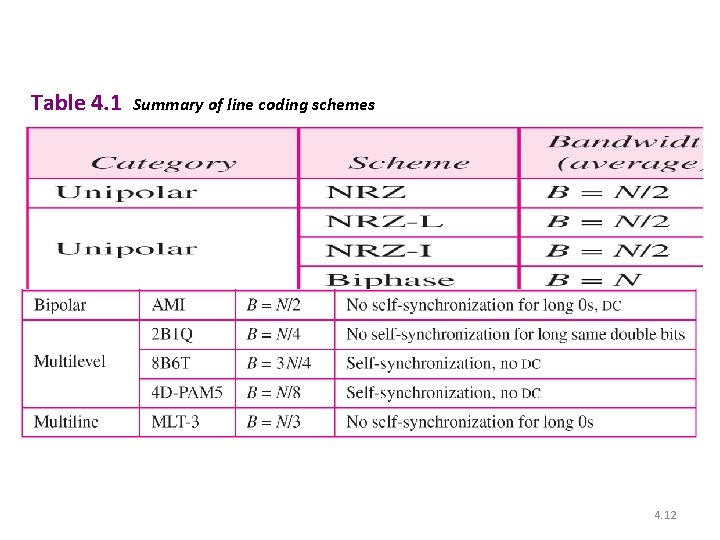
Table 4. 1 Summary of line coding schemes 4. 12
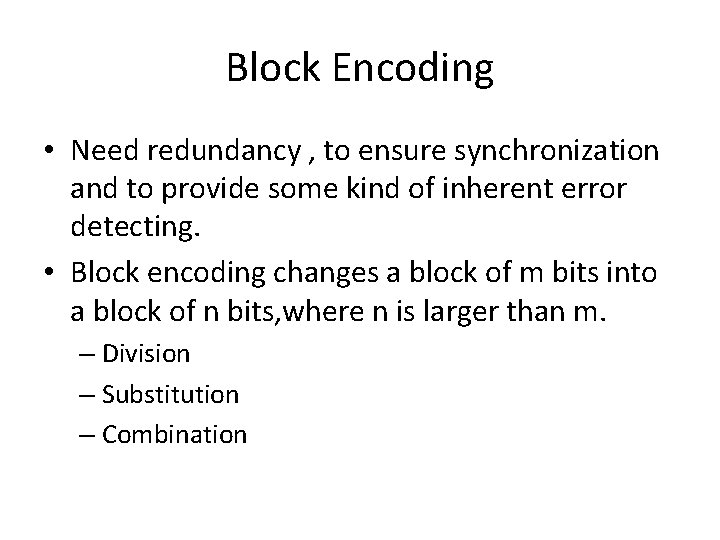
Block Encoding • Need redundancy , to ensure synchronization and to provide some kind of inherent error detecting. • Block encoding changes a block of m bits into a block of n bits, where n is larger than m. – Division – Substitution – Combination
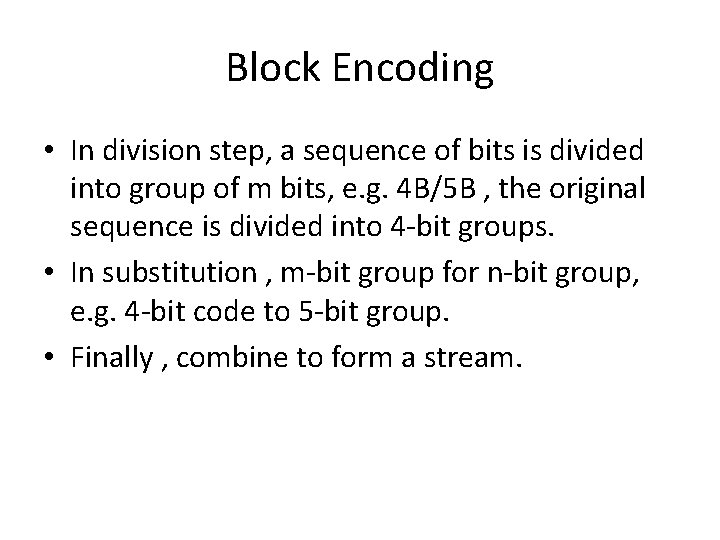
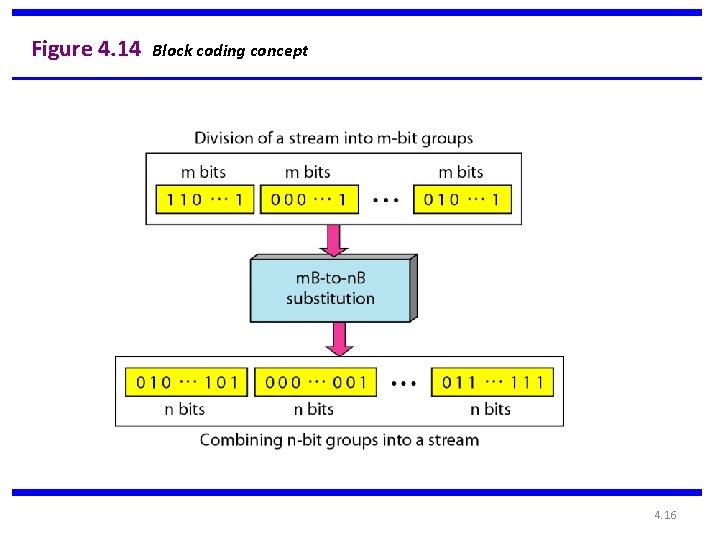
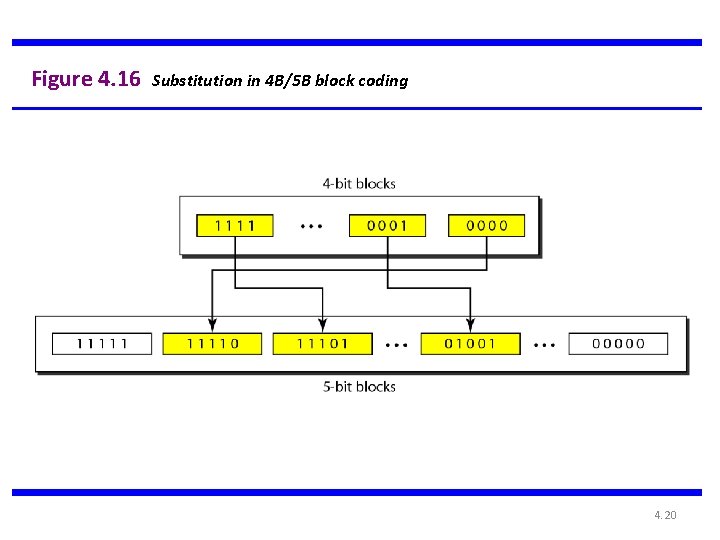
Block Encoding • In division step, a sequence of bits is divided into group of m bits, e. g. 4 B/5 B , the original sequence is divided into 4 -bit groups. • In substitution , m-bit group for n-bit group, e. g. 4 -bit code to 5 -bit group. • Finally , combine to form a stream.
Note Block coding is normally referred to as m. B/n. B coding; it replaces each m-bit group with an n-bit group. 4. 15
Figure 4. 14 Block coding concept 4. 16
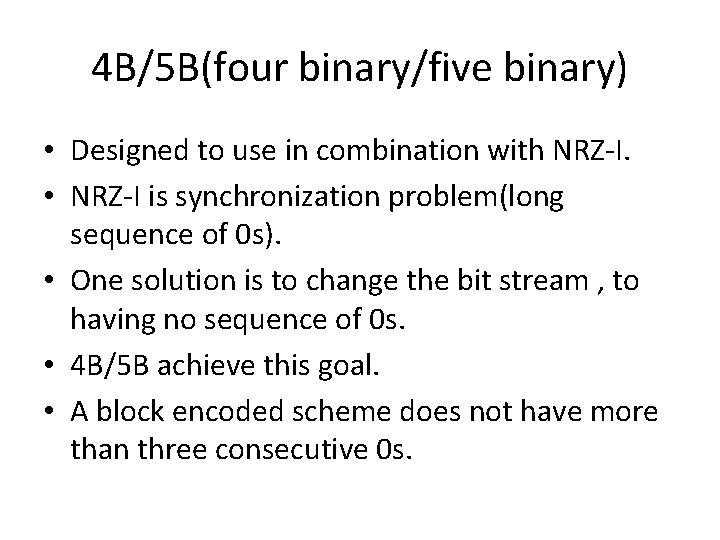
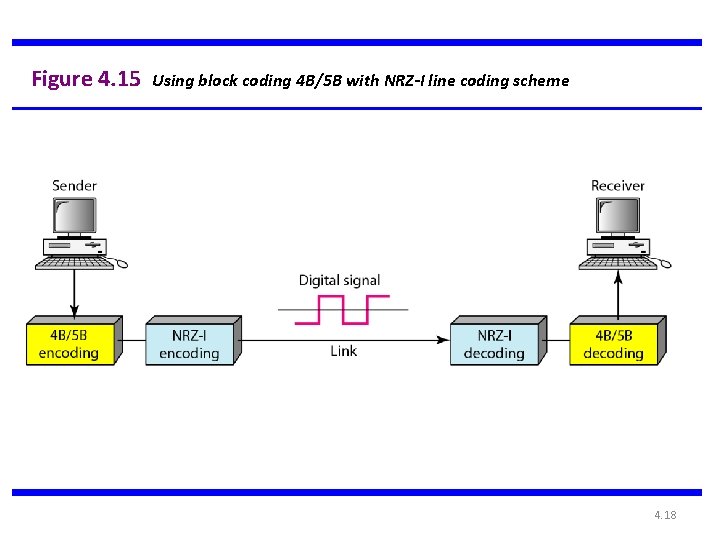
4 B/5 B(four binary/five binary) • Designed to use in combination with NRZ-I. • NRZ-I is synchronization problem(long sequence of 0 s). • One solution is to change the bit stream , to having no sequence of 0 s. • 4 B/5 B achieve this goal. • A block encoded scheme does not have more than three consecutive 0 s.
Figure 4. 15 Using block coding 4 B/5 B with NRZ-I line coding scheme 4. 18
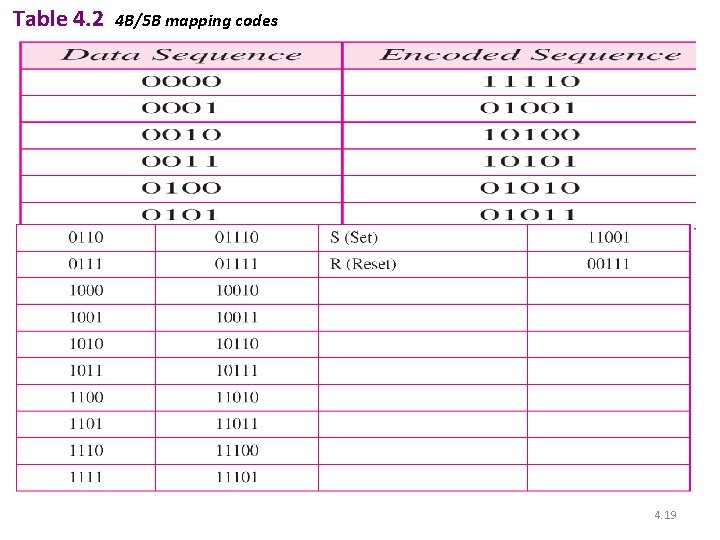
Table 4. 2 4 B/5 B mapping codes 4. 19
Figure 4. 16 Substitution in 4 B/5 B block coding 4. 20
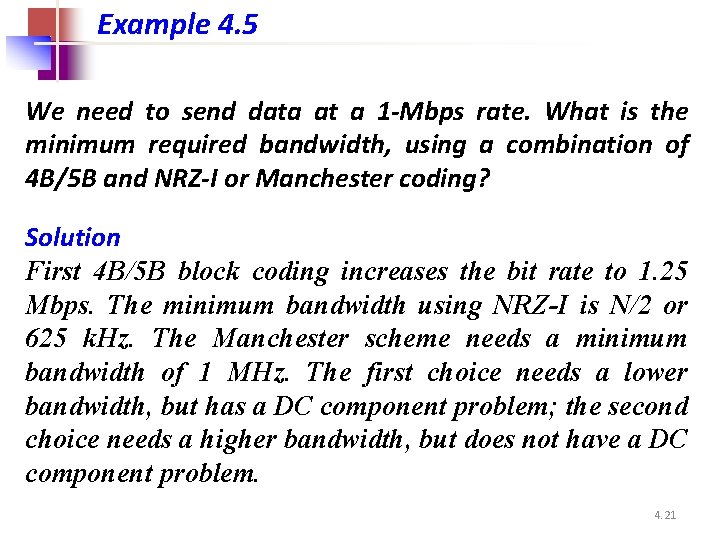
Example 4. 5 We need to send data at a 1 -Mbps rate. What is the minimum required bandwidth, using a combination of 4 B/5 B and NRZ-I or Manchester coding? Solution First 4 B/5 B block coding increases the bit rate to 1. 25 Mbps. The minimum bandwidth using NRZ-I is N/2 or 625 k. Hz. The Manchester scheme needs a minimum bandwidth of 1 MHz. The first choice needs a lower bandwidth, but has a DC component problem; the second choice needs a higher bandwidth, but does not have a DC component problem. 4. 21
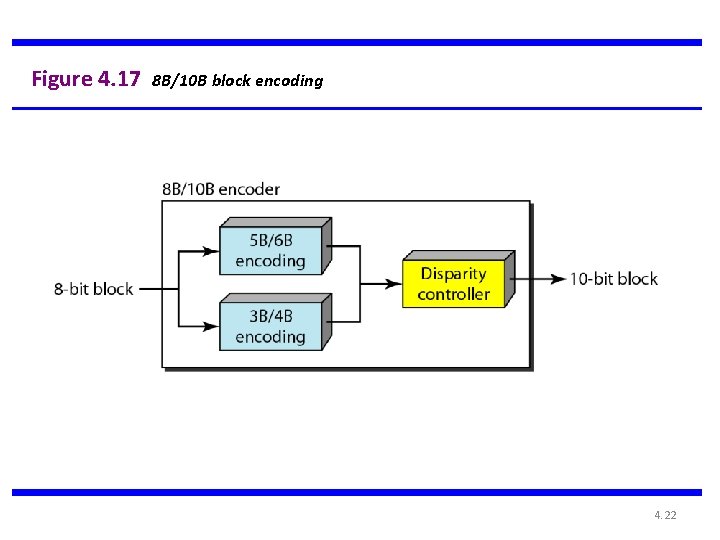
Figure 4. 17 8 B/10 B block encoding 4. 22
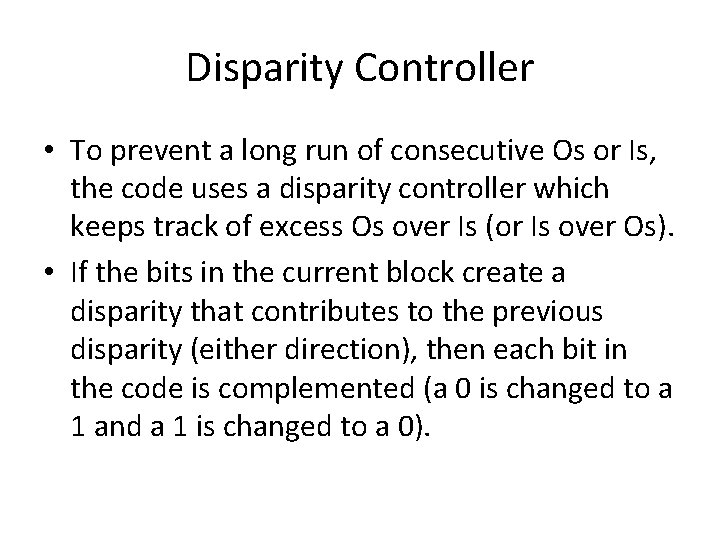
Disparity Controller • To prevent a long run of consecutive Os or Is, the code uses a disparity controller which keeps track of excess Os over Is (or Is over Os). • If the bits in the current block create a disparity that contributes to the previous disparity (either direction), then each bit in the code is complemented (a 0 is changed to a 1 and a 1 is changed to a 0).
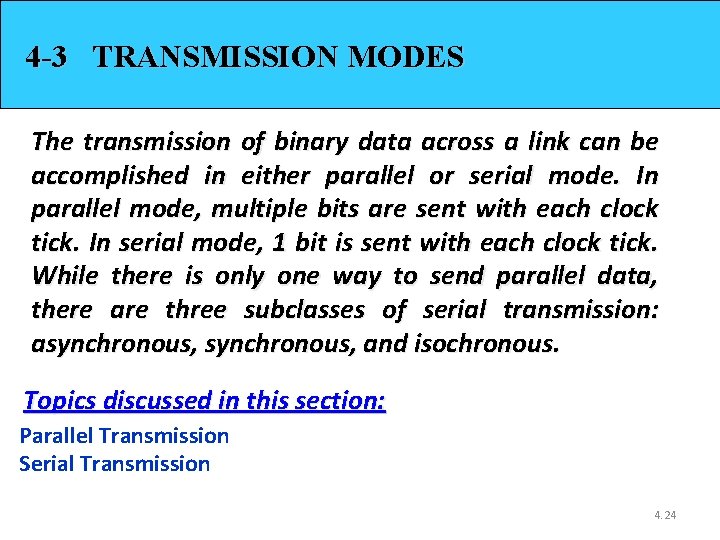
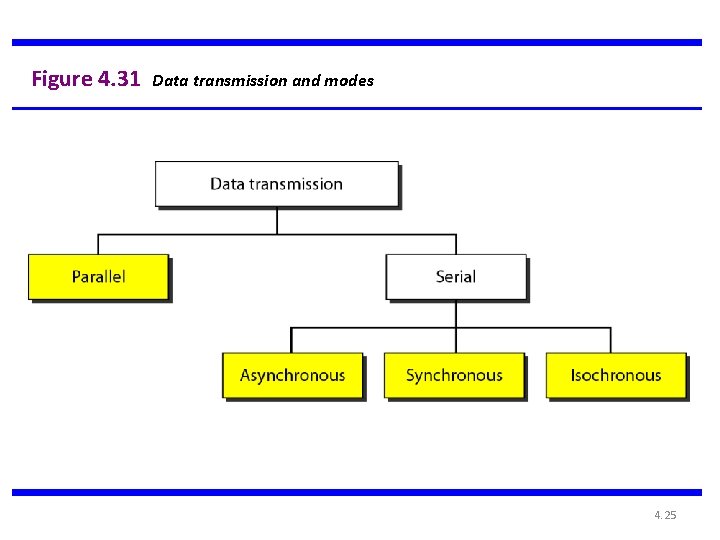
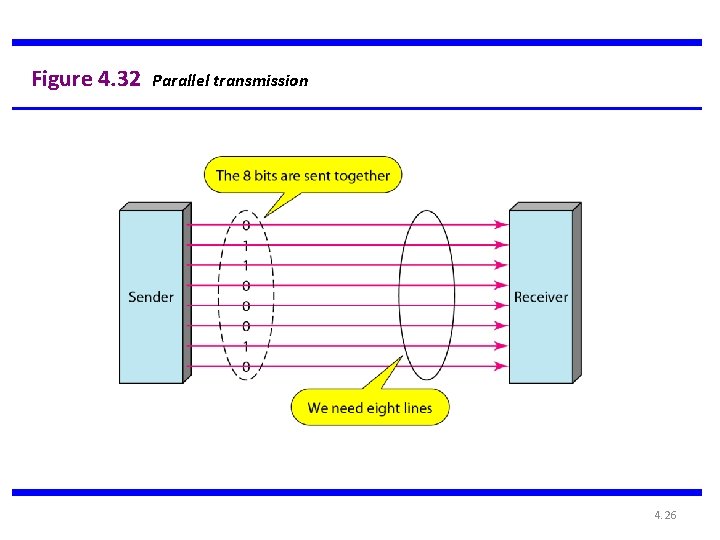
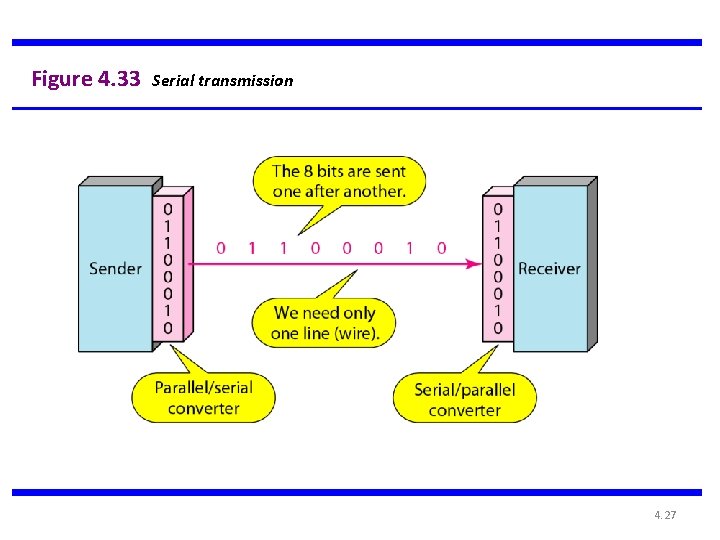
4 -3 TRANSMISSION MODES The transmission of binary data across a link can be accomplished in either parallel or serial mode. In parallel mode, multiple bits are sent with each clock tick. In serial mode, 1 bit is sent with each clock tick. While there is only one way to send parallel data, there are three subclasses of serial transmission: asynchronous, and isochronous. Topics discussed in this section: Parallel Transmission Serial Transmission 4. 24
Figure 4. 31 Data transmission and modes 4. 25
Figure 4. 32 Parallel transmission 4. 26
Figure 4. 33 Serial transmission 4. 27
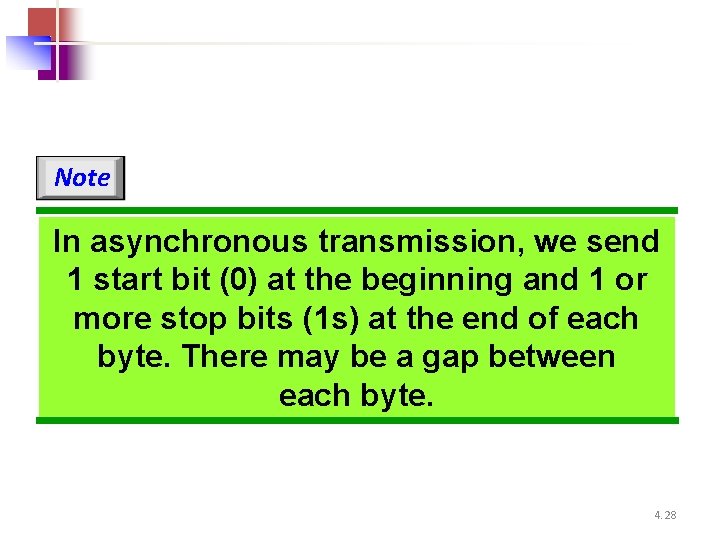
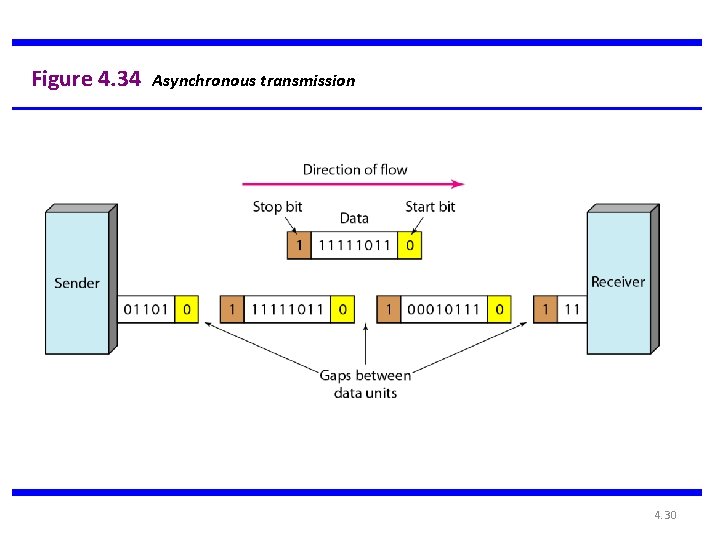
Note In asynchronous transmission, we send 1 start bit (0) at the beginning and 1 or more stop bits (1 s) at the end of each byte. There may be a gap between each byte. 4. 28
Note Asynchronous here means “asynchronous at the byte level, ” but the bits are still synchronized; their durations are the same. 4. 29
Figure 4. 34 Asynchronous transmission 4. 30
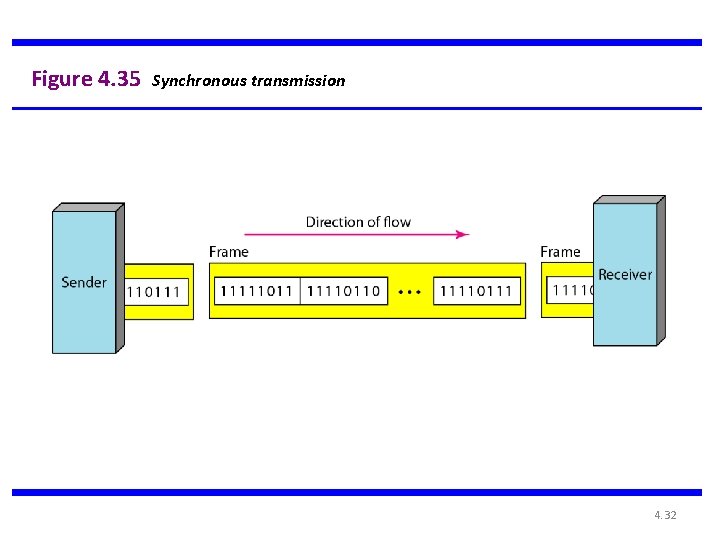
Note In synchronous transmission, we send bits one after another without start or stop bits or gaps. It is the responsibility of the receiver to group the bits. 4. 31
Figure 4. 35 Synchronous transmission 4. 32