
Data Collection We are learning to Describe how
Data Collection
We are learning to… • Describe how population data is gathered • Explain the limitations associated with these methods

I Can… • Answer questions describing and explaining the methods used to collect population data, and their limitations
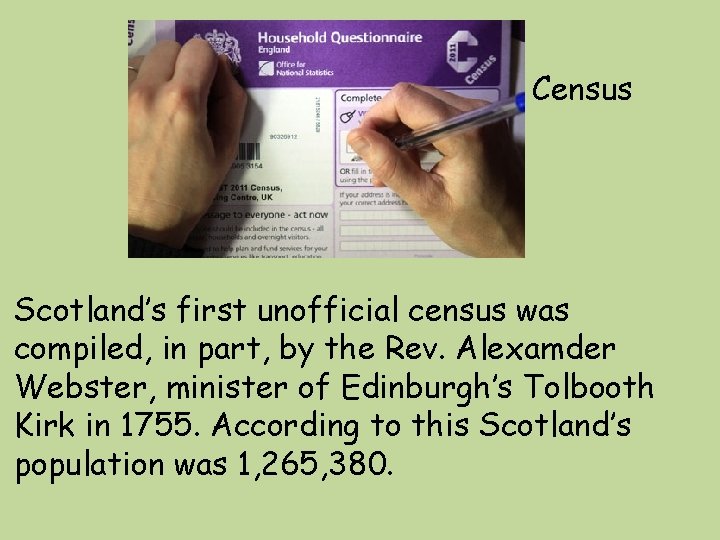
Census Scotland’s first unofficial census was compiled, in part, by the Rev. Alexamder Webster, minister of Edinburgh’s Tolbooth Kirk in 1755. According to this Scotland’s population was 1, 265, 380.

By 1801, the first British census was held, a practice since carried out every 10 years (decennially) apart from 1941. census enumeration is now the responsibility of the Office for National It is the responsibility Statistics in England of the General Register and Wales Office in Scotland
A census is a statistical snapshot of private households and is conducted on a designated day (usually the third Sunday in April). Census data are gathered on the basis of small areas known as enumeration districts. All household in each district are visited by an enumerator who collects the completed census forms and ensures that all individuals are recorded. The 2011 census collected information that gave: • Details about individuals, including their age, sex, occupation, educational qualifications, birthplace, ethnic origins and (in Scotland) knowledge of Gaelic • Details about living conditions and life styles, including type of accommodation, housing tenure, health, amenities Once results are collected, crosstabulated and published (and that, even with increased computerisation, may take several years) they are available for analysis by interested groups
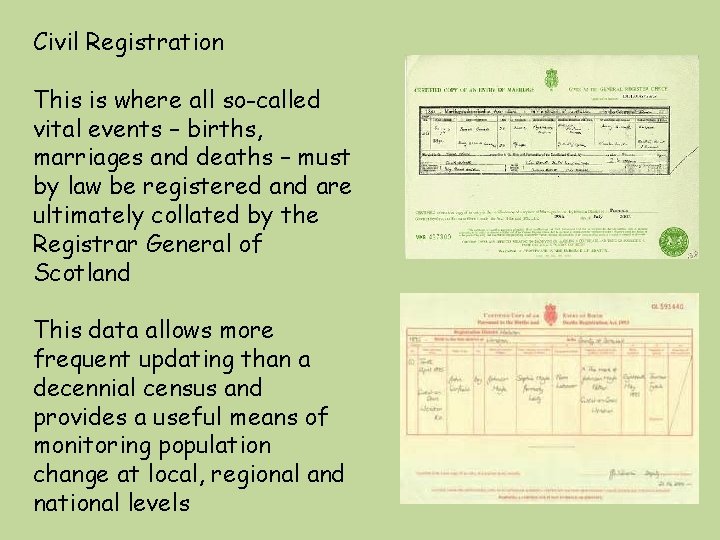
Civil Registration This is where all so-called vital events – births, marriages and deaths – must by law be registered and are ultimately collated by the Registrar General of Scotland This data allows more frequent updating than a decennial census and provides a useful means of monitoring population change at local, regional and national levels
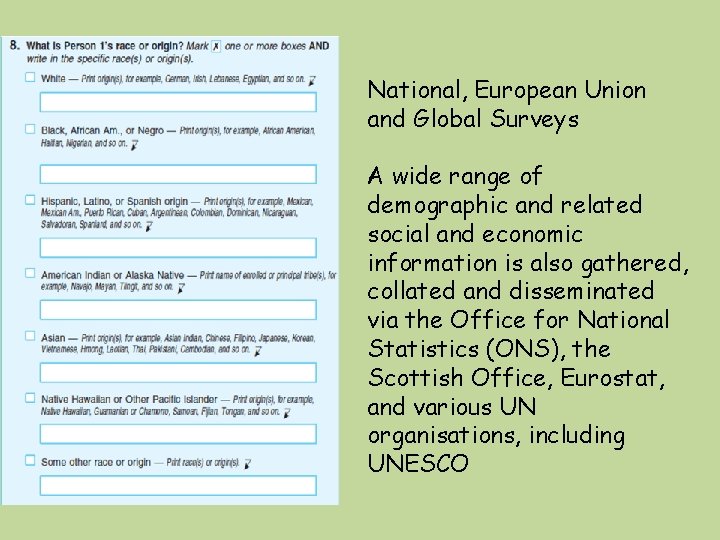
National, European Union and Global Surveys A wide range of demographic and related social and economic information is also gathered, collated and disseminated via the Office for National Statistics (ONS), the Scottish Office, Eurostat, and various UN organisations, including UNESCO
Task One Name three methods of collecting population data and explain in detail what information is collected by each method
The value and uses of Demographic Data Historically, the earliest censuses were for purposes of taxation or army recruitment Today, information from censuses and vital registration is used for varied demographic purposes and by different interest groups Maternity Care Nursery Education Primary and Secondary Education Higher Education Pension Provision Geriatric Health Care & Sheltered Housing
The information gathered is used by the government, industry and commerce who need to know about changes in population size and age structure to assess the needs of people from the ‘cradle to the grave’ Also, to forecast population trends and initiate population policies which may: • Encourage births (pro-natalist policies) • Discourage births (anti-natalist policies) • Promote migration (the transmigration policy in Indonesia, encouraging re-settlement from overcrowded Java to less densely populated Sumatra The information is used as a means of assessing the success of health care and family planning programmes
- Slides: 11