
Data Collection Storage and Retrieval with an Underwater
- Slides: 17
Data Collection, Storage, and Retrieval with an Underwater Sensor Network I. Vasilescu, K. Kotay, and D. Rus MIT CSAIL 2007. 09. 27 1: 00 PM bwkim@dependable. kaist. ac. kr
Contents Introduction The Hardware Infrastructure Networking Data Collection Data Retrieval using Mobility Conclusion & Discussion 2020 -09 -10 2/16
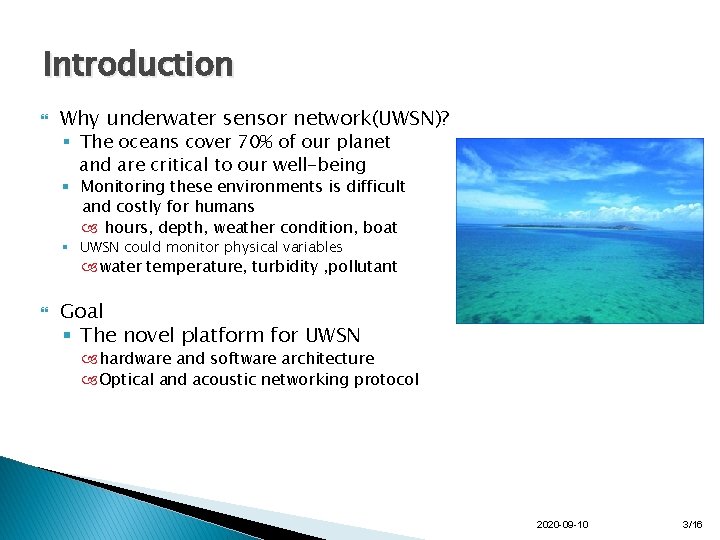
Introduction Why underwater sensor network(UWSN)? § The oceans cover 70% of our planet and are critical to our well-being § Monitoring these environments is difficult and costly for humans hours, depth, weather condition, boat § UWSN could monitor physical variables water temperature, turbidity , pollutant Goal § The novel platform for UWSN hardware and software architecture Optical and acoustic networking protocol 2020 -09 -10 3/16
Key Issues of UWSN Power efficiency, deployment and repair § Common to wireless sensor network deployments on land but more difficult in the underwater environments Communications § Ultrasonic § Optical Mobility § A mean for deploying, reconfiguring, and retrieving the nodes § Large area coverage with sparse network § Mobile nodes can act as data mules No hot spot problem More time-efficient and energy-efficient 2020 -09 -10 4/16
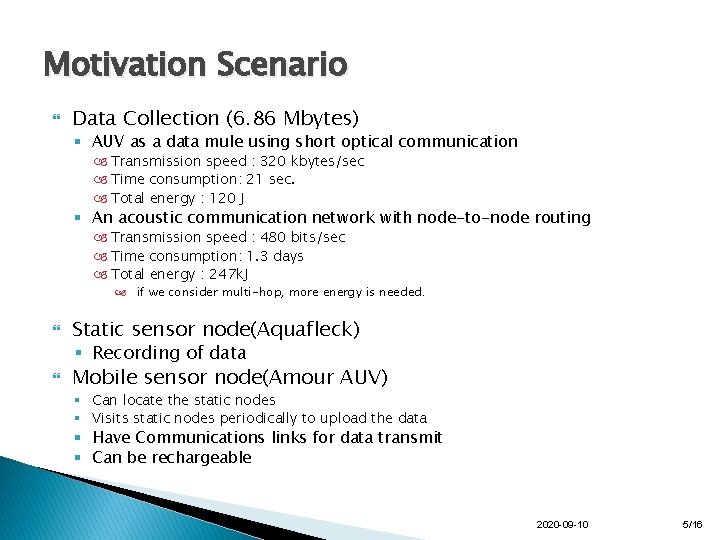
Motivation Scenario Data Collection (6. 86 Mbytes) § AUV as a data mule using short optical communication Transmission speed : 320 kbytes/sec Time consumption: 21 sec. Total energy : 120 J § An acoustic communication network with node-to-node routing Transmission speed : 480 bits/sec Time consumption: 1. 3 days Total energy : 247 k. J if we consider multi-hop, more energy is needed. Static sensor node(Aquafleck) § Recording of data Mobile sensor node(Amour AUV) § Can locate the static nodes § Visits static nodes periodically to upload the data § Have Communications links for data transmit § Can be rechargeable 2020 -09 -10 5/16
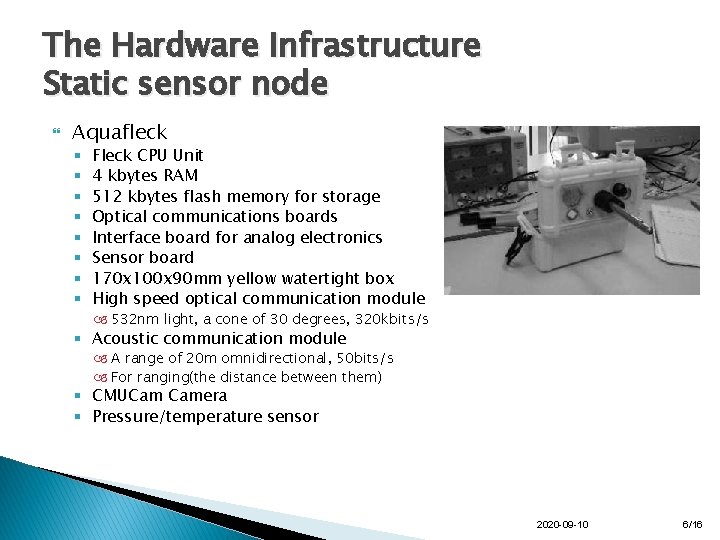
The Hardware Infrastructure Static sensor node Aquafleck § § § § Fleck CPU Unit 4 kbytes RAM 512 kbytes flash memory for storage Optical communications boards Interface board for analog electronics Sensor board 170 x 100 x 90 mm yellow watertight box High speed optical communication module 532 nm light, a cone of 30 degrees, 320 kbits/s § Acoustic communication module A range of 20 m omnidirectional, 50 bits/s For ranging(the distance between them) § CMUCam Camera § Pressure/temperature sensor 2020 -09 -10 6/16
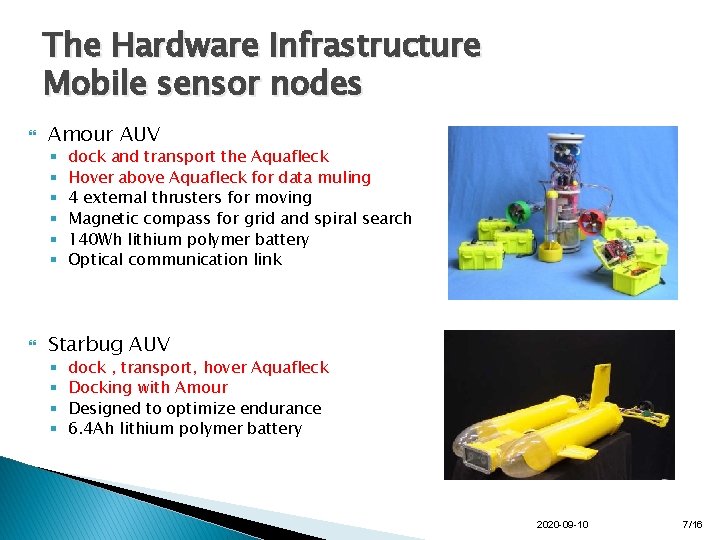
The Hardware Infrastructure Mobile sensor nodes Amour AUV § § § dock and transport the Aquafleck Hover above Aquafleck for data muling 4 external thrusters for moving Magnetic compass for grid and spiral search 140 Wh lithium polymer battery Optical communication link Starbug AUV § § dock , transport, hover Aquafleck Docking with Amour Designed to optimize endurance 6. 4 Ah lithium polymer battery 2020 -09 -10 7/16
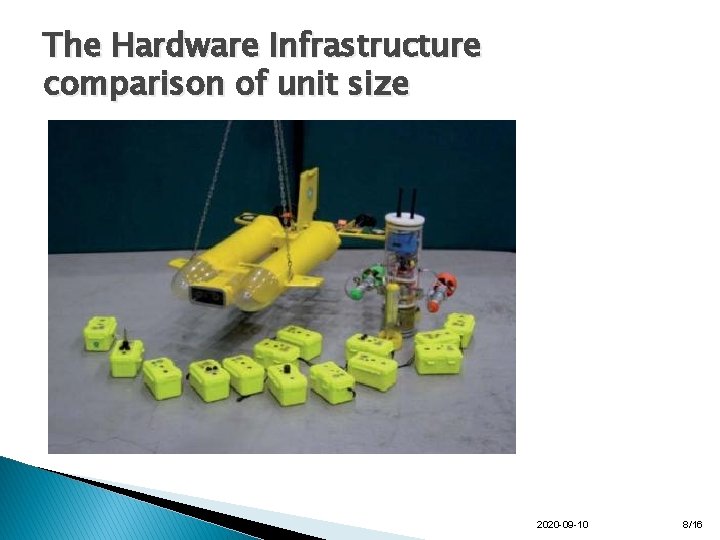
The Hardware Infrastructure comparison of unit size 2020 -09 -10 8/16
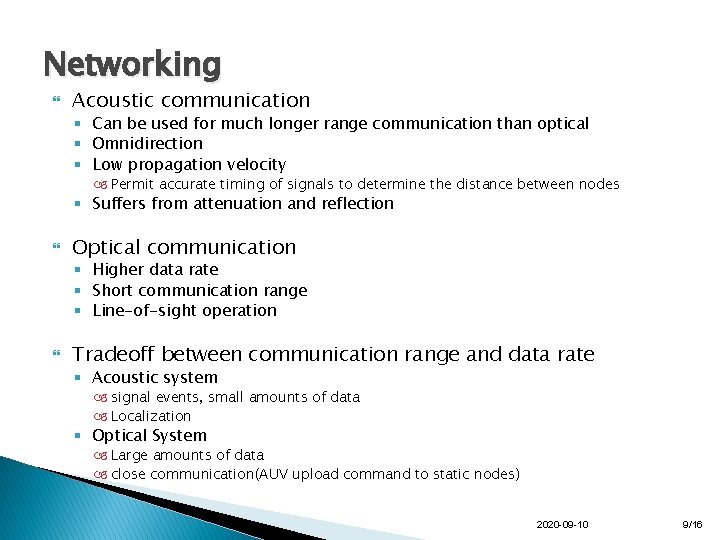
Networking Acoustic communication § Can be used for much longer range communication than optical § Omnidirection § Low propagation velocity Permit accurate timing of signals to determine the distance between nodes § Suffers from attenuation and reflection Optical communication § Higher data rate § Short communication range § Line-of-sight operation Tradeoff between communication range and data rate § Acoustic system signal events, small amounts of data Localization § Optical System Large amounts of data close communication(AUV upload command to static nodes) 2020 -09 -10 9/16
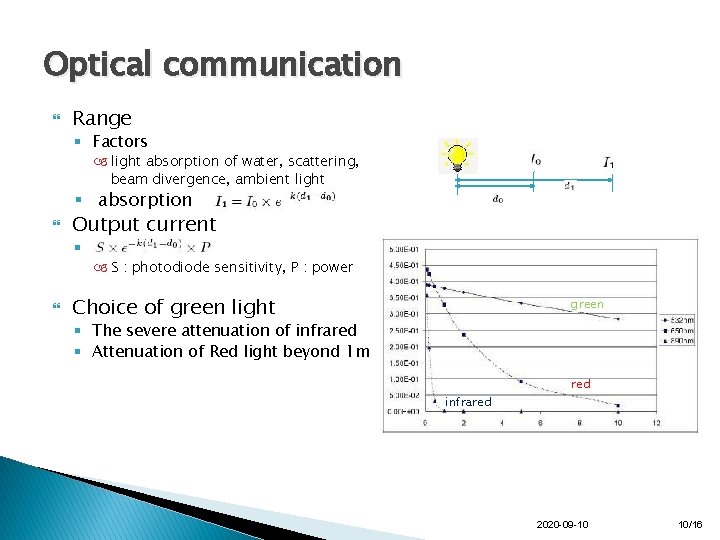
Optical communication Range § Factors light absorption of water, scattering, beam divergence, ambient light § absorption Output current § S : photodiode sensitivity, P : power Choice of green light green § The severe attenuation of infrared § Attenuation of Red light beyond 1 m infrared 2020 -09 -10 10/16
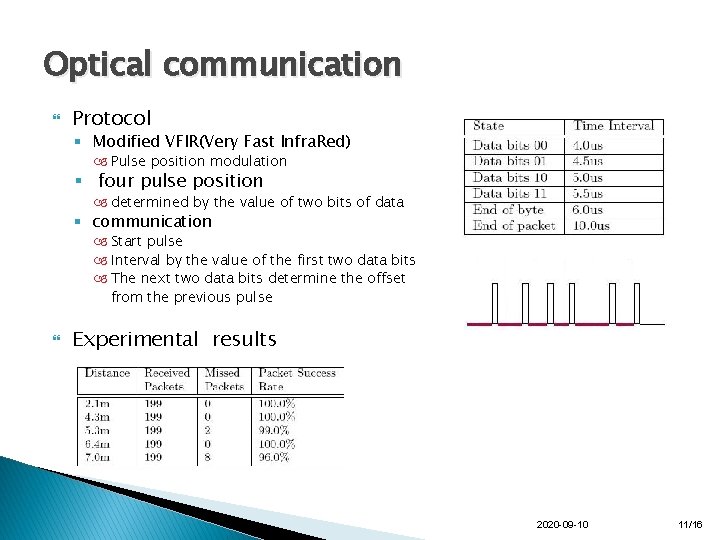
Optical communication Protocol § Modified VFIR(Very Fast Infra. Red) Pulse position modulation § four pulse position determined by the value of two bits of data § communication Start pulse Interval by the value of the first two data bits The next two data bits determine the offset from the previous pulse Experimental results 2020 -09 -10 11/16
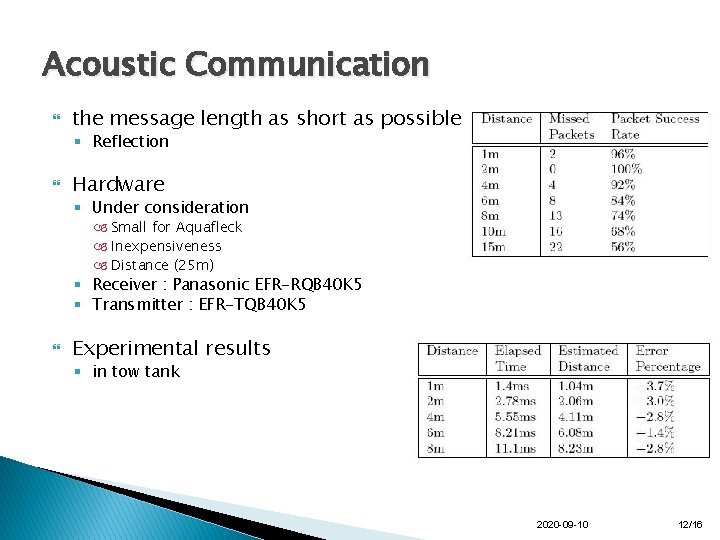
Acoustic Communication the message length as short as possible § Reflection Hardware § Under consideration Small for Aquafleck Inexpensiveness Distance (25 m) § Receiver : Panasonic EFR-RQB 40 K 5 § Transmitter : EFR-TQB 40 K 5 Experimental results § in tow tank 2020 -09 -10 12/16
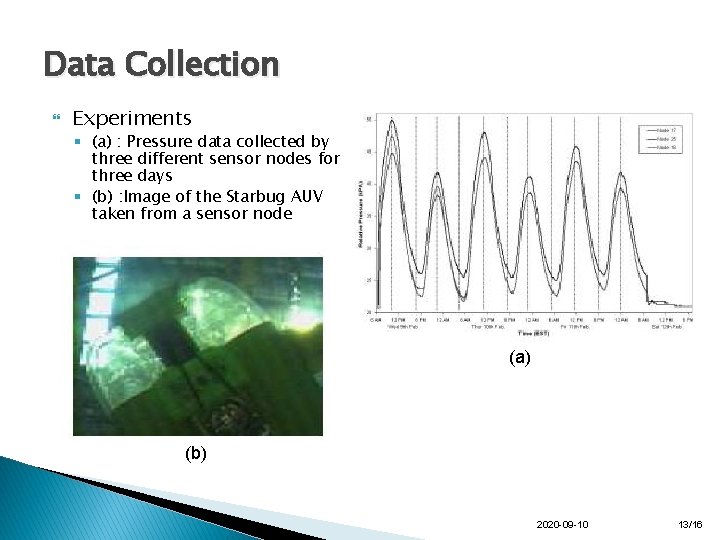
Data Collection Experiments § (a) : Pressure data collected by three different sensor nodes for three days § (b) : Image of the Starbug AUV taken from a sensor node (a) (b) 2020 -09 -10 13/16
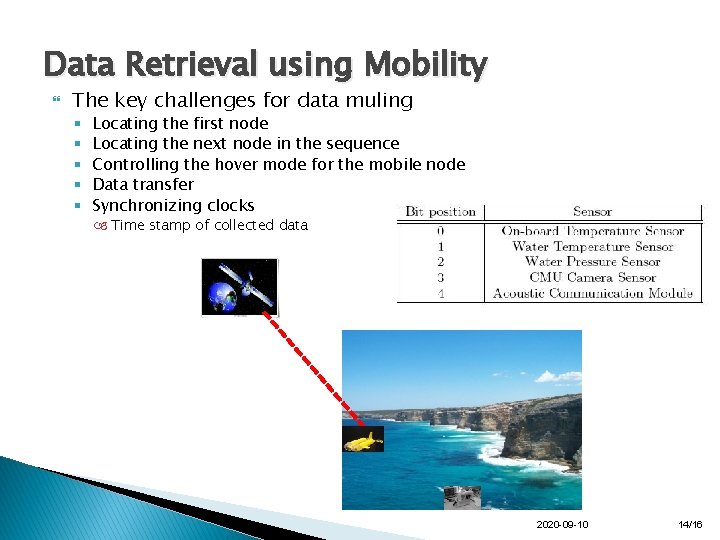
Data Retrieval using Mobility The key challenges for data muling § § § Locating the first node Locating the next node in the sequence Controlling the hover mode for the mobile node Data transfer Synchronizing clocks Time stamp of collected data 2020 -09 -10 14/16
Conclusion A first prototype for an underwater sensor network § developed § built § Used An effective way to collect, store, retrieve large data over long time § Data muling, that is, mobility Software(and hardware) reliability are extremely import § Controlling the mobile nodes in the presence of currents 2020 -09 -10 15/16
Any Question? Thank you for your listening 2020 -09 -10 16/16
References http: //groups. csail. mit. edu/drl/publications/paper-pub-0826. pdf http: //www. csiro. au/files/pf 8 z. pdf http: //www. ict. csiro. au/page. php? cid=87 http: //www. csail. mit. edu/index. php 2020 -09 -10 17/16