
Data Cite Making Data Citable Jan Brase Data
Data. Cite: Making Data Citable Jan Brase (Data. Cite/TIB Hannover) Brigitte Hausstein (GESIS) Wolfgang Zenk-Möltgen (GESIS)
Introduction: Where do we stand? • • • Data is difficult to manage after project funding ends No direct access to data No widely used method to identify datasets No widely used method to cite datasets No effective way to link between datasets and articles Datasets are not included in impact analysis
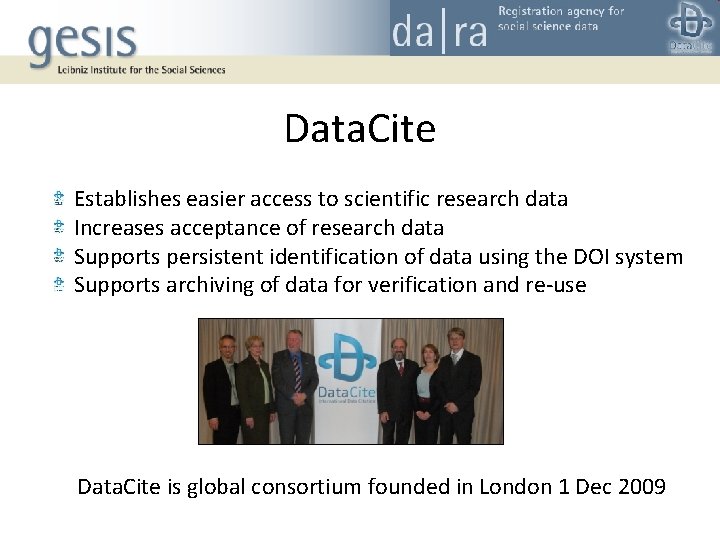
Data. Cite Establishes easier access to scientific research data Increases acceptance of research data Supports persistent identification of data using the DOI system Supports archiving of data for verification and re-use Data. Cite is global consortium founded in London 1 Dec 2009
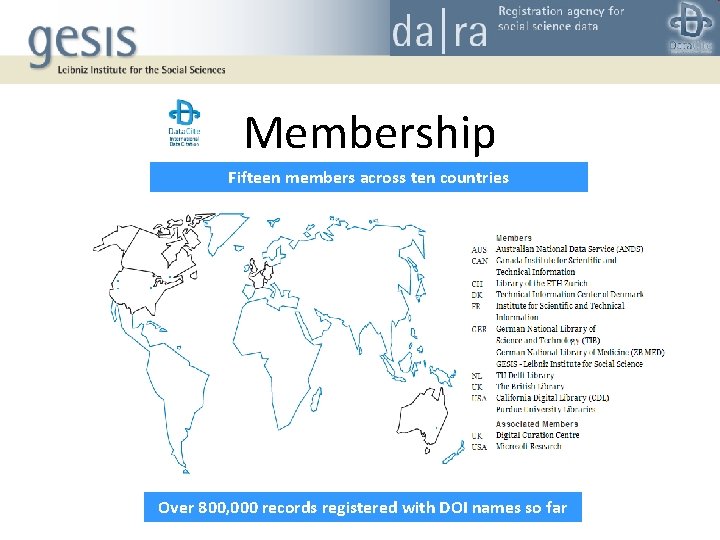
Membership Fifteen members across ten countries Over 800, 000 records registered with DOI names so far
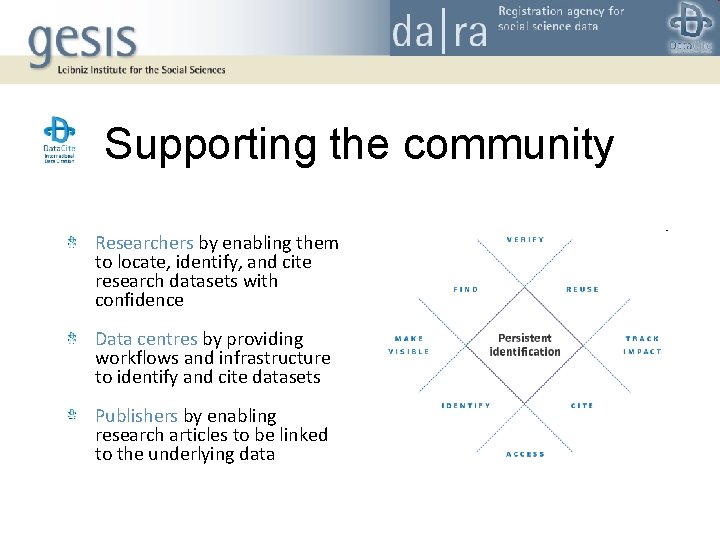
Supporting the community Researchers by enabling them to locate, identify, and cite research datasets with confidence Data centres by providing workflows and infrastructure to identify and cite datasets Publishers by enabling research articles to be linked to the underlying data
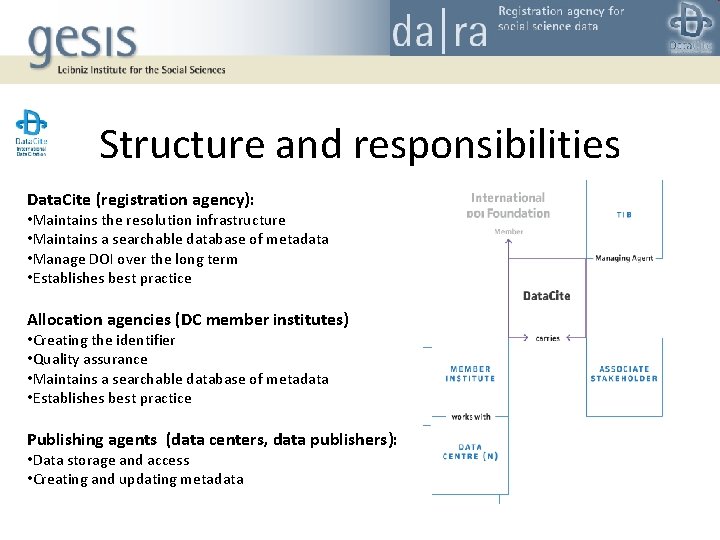
Structure and responsibilities Data. Cite (registration agency): • Maintains the resolution infrastructure • Maintains a searchable database of metadata • Manage DOI over the long term • Establishes best practice Allocation agencies (DC member institutes) • Creating the identifier • Quality assurance • Maintains a searchable database of metadata • Establishes best practice Publishing agents (data centers, data publishers): • Data storage and access • Creating and updating metadata
Registration agency for social science data: da|ra • since February 2010 GESIS member of Datacite • Pilot project March - December 2010 Technical and organisational concept Meta data schema Technical implementation and registration of data sets (GESIS data archive: EVS, Eurobarometer etc. ) • 2011 -2013 Implementation of a registration portal for social and economic data; including upgrade of services
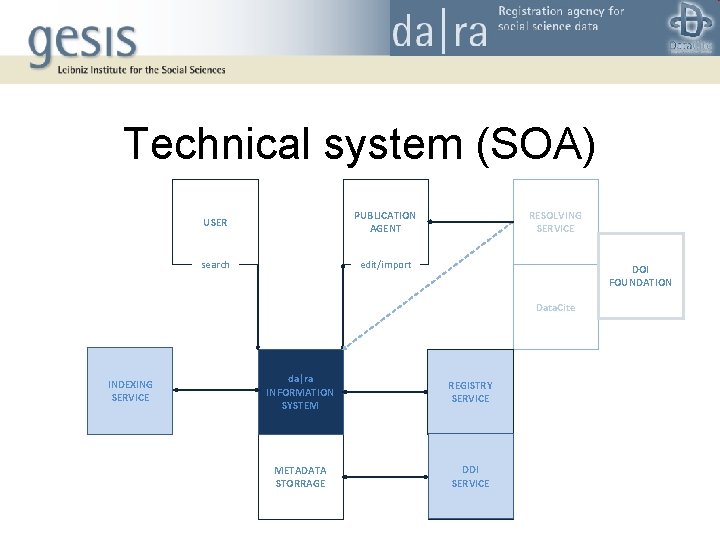
Technical system (SOA) USER PUBLICATION AGENT search edit/import RESOLVING SERVICE DOI FOUNDATION Data. Cite INDEXING SERVICE da|ra INFORMATION SYSTEM REGISTRY SERVICE METADATA STORRAGE DDI SERVICE
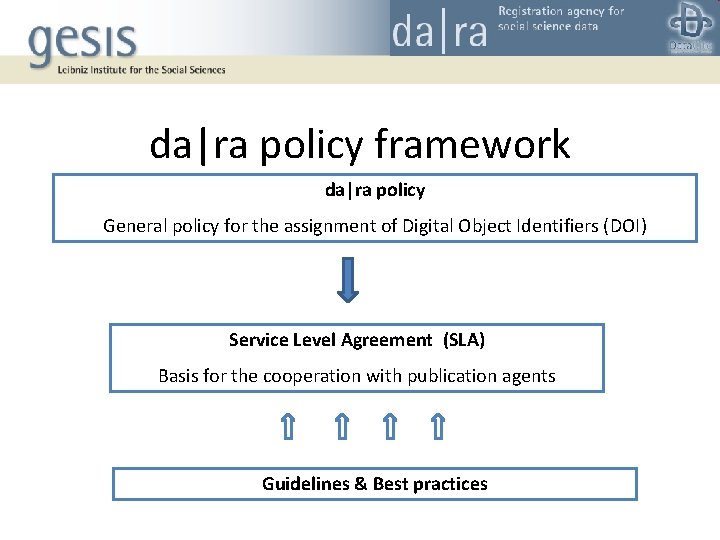
da|ra policy framework da|ra policy General policy for the assignment of Digital Object Identifiers (DOI) Service Level Agreement (SLA) Basis for the cooperation with publication agents Guidelines & Best practices
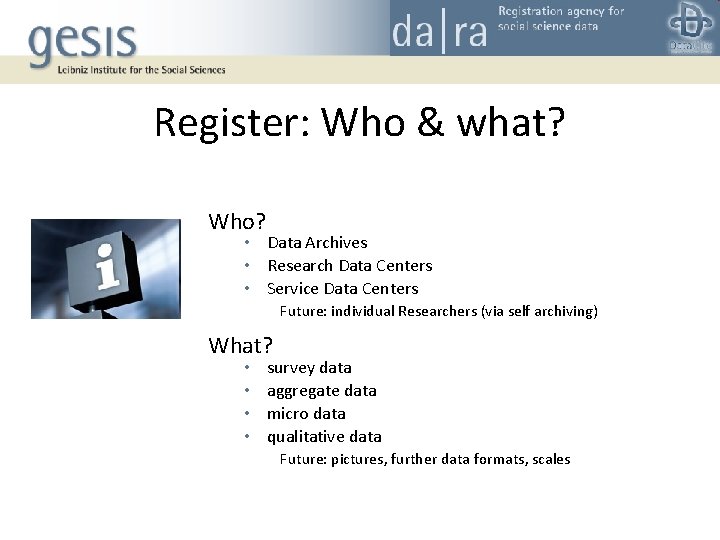
Register: Who & what? Who? • Data Archives • Research Data Centers • Service Data Centers Future: individual Researchers (via self archiving) What? • • survey data aggregate data micro data qualitative data Future: pictures, further data formats, scales
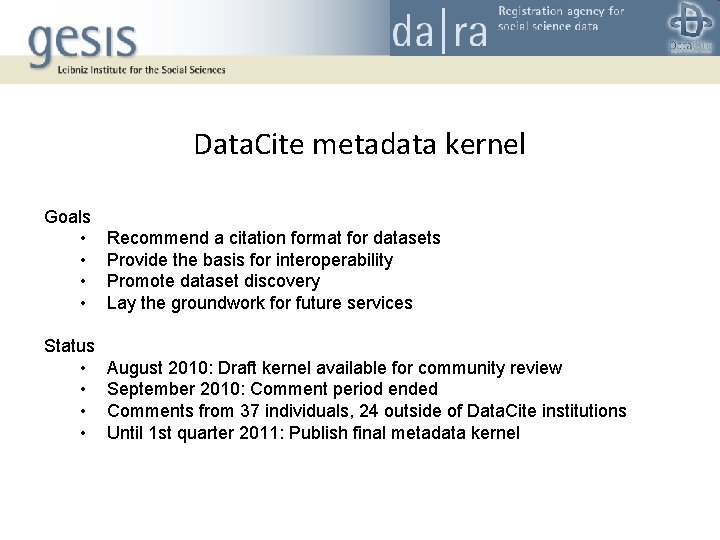
Data. Cite metadata kernel Goals • • Recommend a citation format for datasets Provide the basis for interoperability Promote dataset discovery Lay the groundwork for future services Status • • August 2010: Draft kernel available for community review September 2010: Comment period ended Comments from 37 individuals, 24 outside of Data. Cite institutions Until 1 st quarter 2011: Publish final metadata kernel
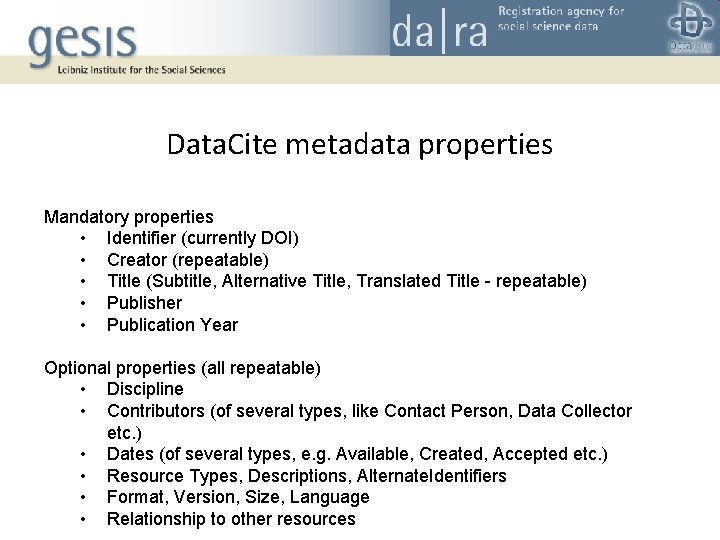
Data. Cite metadata properties Mandatory properties • Identifier (currently DOI) • Creator (repeatable) • Title (Subtitle, Alternative Title, Translated Title - repeatable) • Publisher • Publication Year Optional properties (all repeatable) • Discipline • Contributors (of several types, like Contact Person, Data Collector etc. ) • Dates (of several types, e. g. Available, Created, Accepted etc. ) • Resource Types, Descriptions, Alternate. Identifiers • Format, Version, Size, Language • Relationship to other resources
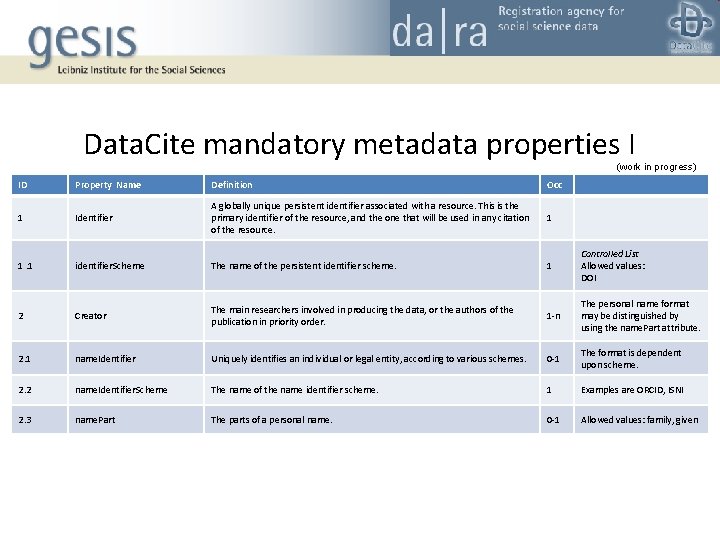
Data. Cite mandatory metadata properties I (work in progress) ID Property Name Definition Occ 1 Identifier A globally unique persistent identifier associated with a resource. This is the primary identifier of the resource, and the one that will be used in any citation of the resource. 1 1. 1 identifier. Scheme The name of the persistent identifier scheme. 1 Controlled List Allowed values: DOI 2 Creator The main researchers involved in producing the data, or the authors of the publication in priority order. 1 -n The personal name format may be distinguished by using the name. Part attribute. 2. 1 name. Identifier Uniquely identifies an individual or legal entity, according to various schemes. 0 -1 The format is dependent upon scheme. 2. 2 name. Identifier. Scheme The name of the name identifier scheme. 1 Examples are ORCID, ISNI 2. 3 name. Part The parts of a personal name. 0 -1 Allowed values: family, given
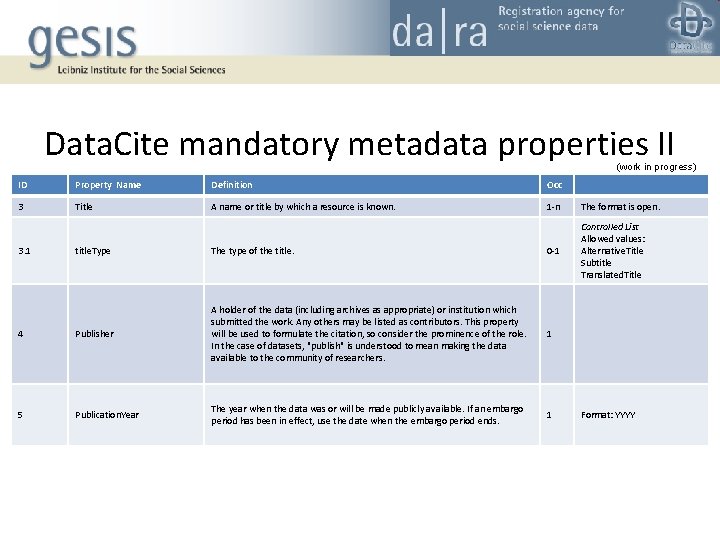
Data. Cite mandatory metadata properties II (work in progress) ID Property Name Definition Occ 3 Title A name or title by which a resource is known. 1 -n The format is open. Controlled List Allowed values: Alternative. Title Subtitle Translated. Title 3. 1 title. Type The type of the title. 0 -1 4 Publisher A holder of the data (including archives as appropriate) or institution which submitted the work. Any others may be listed as contributors. This property will be used to formulate the citation, so consider the prominence of the role. In the case of datasets, "publish" is understood to mean making the data available to the community of researchers. 1 5 Publication. Year The year when the data was or will be made publicly available. If an embargo period has been in effect, use the date when the embargo period ends. 1 Format: YYYY
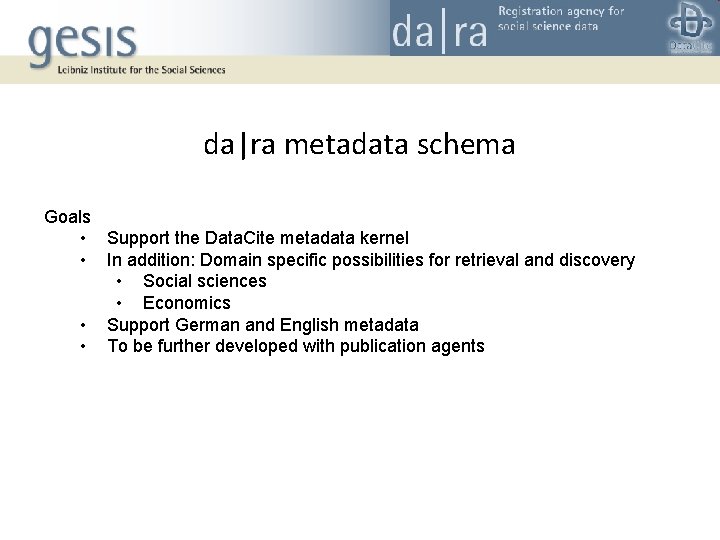
da|ra metadata schema Goals • Support the Data. Cite metadata kernel • In addition: Domain specific possibilities for retrieval and discovery • Social sciences • Economics • Support German and English metadata • To be further developed with publication agents
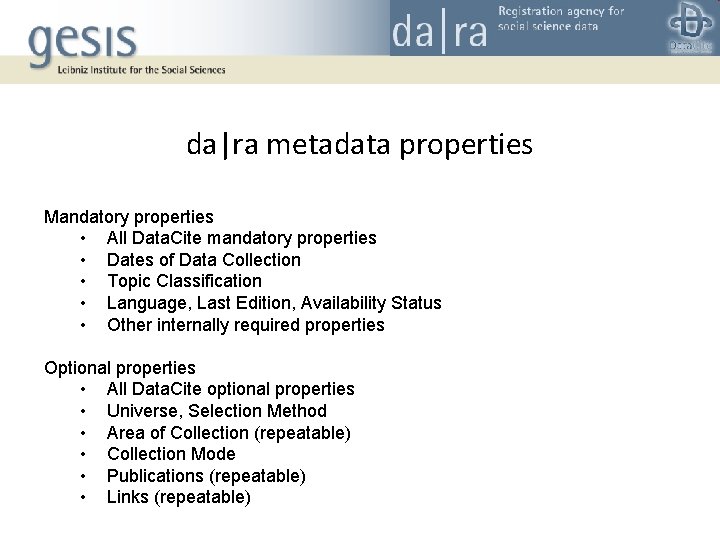
da|ra metadata properties Mandatory properties • All Data. Cite mandatory properties • Dates of Data Collection • Topic Classification • Language, Last Edition, Availability Status • Other internally required properties Optional properties • All Data. Cite optional properties • Universe, Selection Method • Area of Collection (repeatable) • Collection Mode • Publications (repeatable) • Links (repeatable)
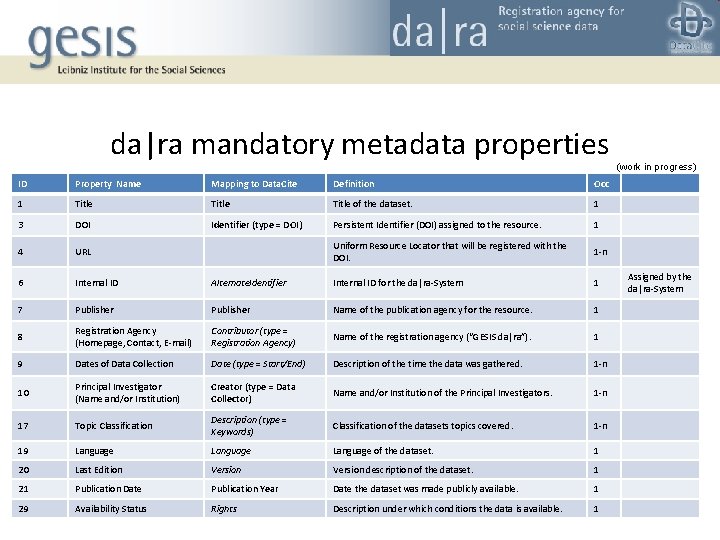
da|ra mandatory metadata properties ID Property Name Mapping to Data. Cite Definition Occ 1 Title of the dataset. 1 3 DOI Identifier (type = DOI) Persistent Identifier (DOI) assigned to the resource. 1 4 URL Uniform Resource Locator that will be registered with the DOI. 1 -n 6 Internal ID Alternate. Identifier Internal ID for the da|ra-System 1 7 Publisher Name of the publication agency for the resource. 1 8 Registration Agency (Homepage, Contact, E-mail) Contributor (type = Registration Agency) Name of the registration agency (“GESIS da|ra”). 1 9 Dates of Data Collection Date (type = Start/End) Description of the time the data was gathered. 1 -n 10 Principal Investigator (Name and/or Institution) Creator (type = Data Collector) Name and/or Institution of the Principal Investigators. 1 -n 17 Topic Classification Description (type = Keywords) Classification of the datasets topics covered. 1 -n 19 Language of the dataset. 1 20 Last Edition Version description of the dataset. 1 21 Publication Date Publication Year Date the dataset was made publicly available. 1 29 Availability Status Rights Description under which conditions the data is available. 1 (work in progress) Assigned by the da|ra-System
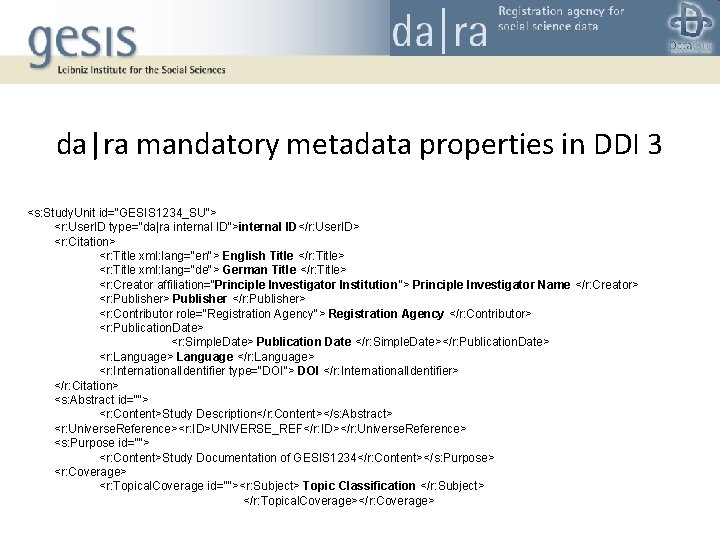
da|ra mandatory metadata properties in DDI 3 <s: Study. Unit id="GESIS 1234_SU"> <r: User. ID type="da|ra internal ID">internal ID</r: User. ID> <r: Citation> <r: Title xml: lang="en"> English Title </r: Title> <r: Title xml: lang="de"> German Title </r: Title> <r: Creator affiliation="Principle Investigator Institution"> Principle Investigator Name </r: Creator> <r: Publisher> Publisher </r: Publisher> <r: Contributor role="Registration Agency"> Registration Agency </r: Contributor> <r: Publication. Date> <r: Simple. Date> Publication Date </r: Simple. Date></r: Publication. Date> <r: Language> Language </r: Language> <r: International. Identifier type="DOI"> DOI </r: International. Identifier> </r: Citation> <s: Abstract id=""> <r: Content>Study Description</r: Content></s: Abstract> <r: Universe. Reference><r: ID>UNIVERSE_REF</r: ID></r: Universe. Reference> <s: Purpose id=""> <r: Content>Study Documentation of GESIS 1234</r: Content></s: Purpose> <r: Coverage> <r: Topical. Coverage id=""><r: Subject> Topic Classification </r: Subject> </r: Topical. Coverage></r: Coverage>
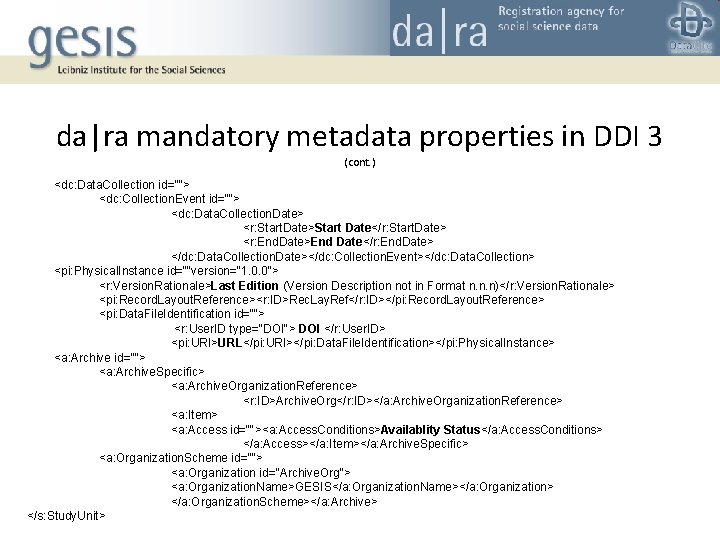
da|ra mandatory metadata properties in DDI 3 (cont. ) <dc: Data. Collection id=""> <dc: Collection. Event id=""> <dc: Data. Collection. Date> <r: Start. Date>Start Date</r: Start. Date> <r: End. Date>End Date</r: End. Date> </dc: Data. Collection. Date></dc: Collection. Event></dc: Data. Collection> <pi: Physical. Instance id="“version="1. 0. 0"> <r: Version. Rationale>Last Edition (Version Description not in Format n. n. n)</r: Version. Rationale> <pi: Record. Layout. Reference><r: ID>Rec. Lay. Ref</r: ID></pi: Record. Layout. Reference> <pi: Data. File. Identification id="“> <r: User. ID type="DOI"> DOI </r: User. ID> <pi: URI>URL</pi: URI></pi: Data. File. Identification></pi: Physical. Instance> <a: Archive id=""> <a: Archive. Specific> <a: Archive. Organization. Reference> <r: ID>Archive. Org</r: ID></a: Archive. Organization. Reference> <a: Item> <a: Access id=""><a: Access. Conditions>Availablity Status</a: Access. Conditions> </a: Access></a: Item></a: Archive. Specific> <a: Organization. Scheme id=""> <a: Organization id="Archive. Org"> <a: Organization. Name>GESIS</a: Organization. Name></a: Organization> </a: Organization. Scheme></a: Archive> </s: Study. Unit>
Metadata interoperability Conclusions • DDI 3 can hold Data. Cite mandatory metadata properties • DDI 3 can also hold da|ra mandatory metadata properties • Mapping for optional properties has to be done Increased visibility for research data from social science and economics
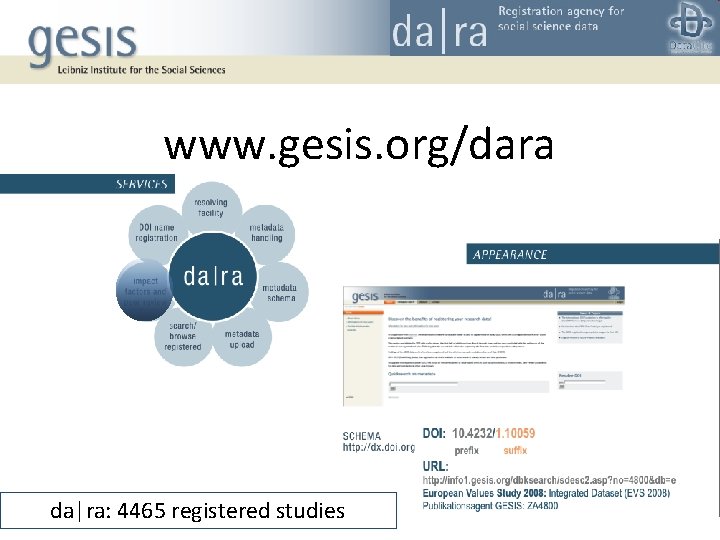
www. gesis. org/dara da|ra: 4465 registered studies
- Slides: 21