
Data as a Service Who What and Why
- Slides: 10
Data as a Service: Who, What and Why Delivered by the Alternative Data User Service
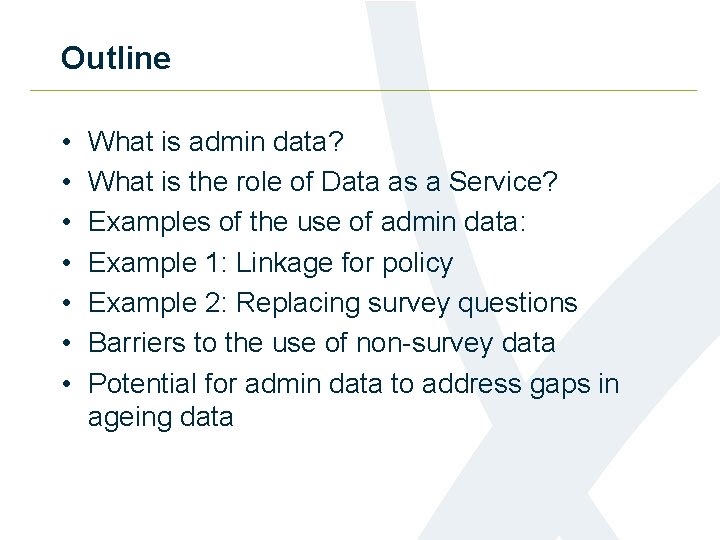
Outline • • What is admin data? What is the role of Data as a Service? Examples of the use of admin data: Example 1: Linkage for policy Example 2: Replacing survey questions Barriers to the use of non-survey data Potential for admin data to address gaps in ageing data
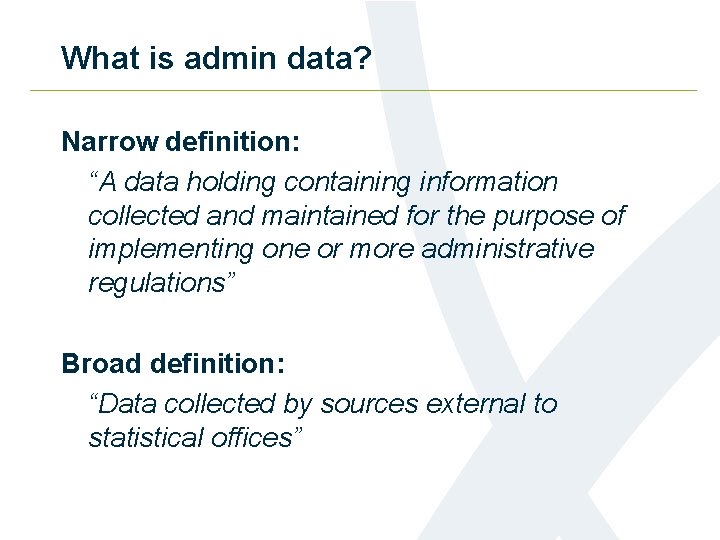
What is admin data? Narrow definition: “A data holding containing information collected and maintained for the purpose of implementing one or more administrative regulations” Broad definition: “Data collected by sources external to statistical offices”
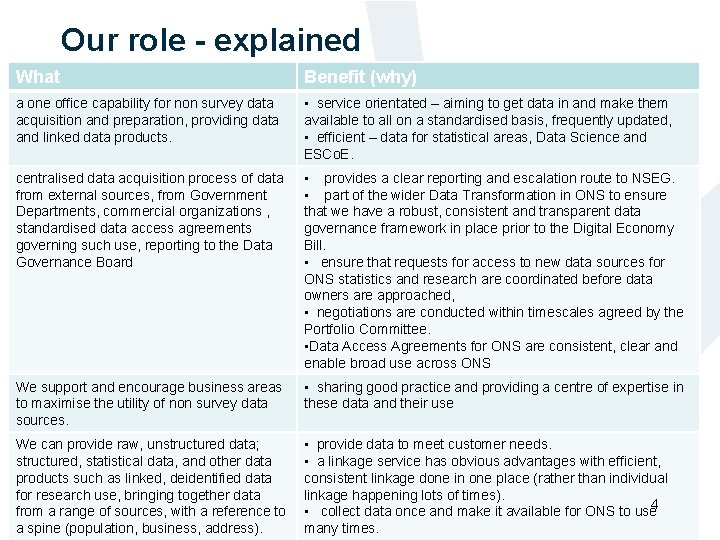
Our role - explained What Benefit (why) a one office capability for non survey data acquisition and preparation, providing data and linked data products. • service orientated – aiming to get data in and make them available to all on a standardised basis, frequently updated, • efficient – data for statistical areas, Data Science and ESCo. E. centralised data acquisition process of data from external sources, from Government Departments, commercial organizations , standardised data access agreements governing such use, reporting to the Data Governance Board • provides a clear reporting and escalation route to NSEG. • part of the wider Data Transformation in ONS to ensure that we have a robust, consistent and transparent data governance framework in place prior to the Digital Economy Bill. • ensure that requests for access to new data sources for ONS statistics and research are coordinated before data owners are approached, • negotiations are conducted within timescales agreed by the Portfolio Committee. • Data Access Agreements for ONS are consistent, clear and enable broad use across ONS We support and encourage business areas to maximise the utility of non survey data sources. • sharing good practice and providing a centre of expertise in these data and their use We can provide raw, unstructured data; structured, statistical data, and other data products such as linked, deidentified data for research use, bringing together data from a range of sources, with a reference to a spine (population, business, address). • provide data to meet customer needs. • a linkage service has obvious advantages with efficient, consistent linkage done in one place (rather than individual linkage happening lots of times). • collect data once and make it available for ONS to use 4 many times.
Example 1 – Linkage for policy • Aug 2016 – PM commissioned an audit to shine a light on how our public services treat people from different backgrounds • “public will be able to check how their race affects how they are treated on issues such as health, education and employment, • the audit will show disadvantages suffered by white working class people as well as ethnic minorities • the findings from this audit will influence government policy to solve these problems”
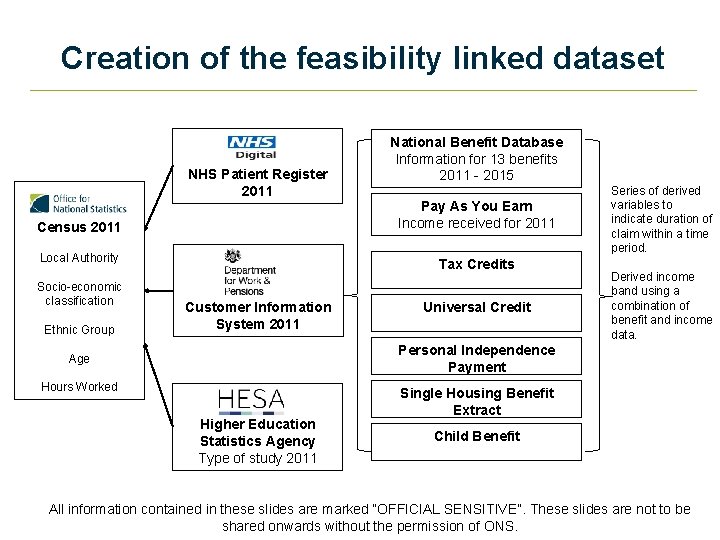
Creation of the feasibility linked dataset NHS Patient Register 2011 Census 2011 Local Authority Socio-economic classification Ethnic Group National Benefit Database Information for 13 benefits 2011 - 2015 Pay As You Earn Income received for 2011 Tax Credits Customer Information System 2011 Universal Credit Series of derived variables to indicate duration of claim within a time period. Derived income band using a combination of benefit and income data. Personal Independence Payment Age Hours Worked Higher Education Statistics Agency Type of study 2011 Single Housing Benefit Extract Child Benefit All information contained in these slides are marked “OFFICIAL SENSITIVE”. These slides are not to be shared onwards without the permission of ONS.
Advantages of Linked Data • Greater insight – the Census is widely recognised as one of the best sources of ethnicity data as: • It is more complete than other admin sources • Sample size – surveys restricted by limited sample size for ethnic minorities • Longitudinal analysis – Census is an excellent spine to then move people forward through time • Lower levels of detail – can disaggregate to lower geography level. • Utilises existing available data. All information contained in these slides are marked “OFFICIAL SENSITIVE”. These slides are not to be shared onwards without the permission of ONS.
Example 2 – Replacing surveys • Council Tax – currently questions on four separate surveys • Daa. S contacting 348 Local Authorities in England Wales • Invite them to share data with us for statistical purposes • Digital Economy Act provides legal gateway • Limited by lack of central register • Collaboration across the office
Barriers to use of non-survey data • Legal restrictions, ethical considerations – use has to be proportionate. • Harmonisation – data collected for admin purposes won’t be harmonised with surveys and methodologies. • Infrastructure – admin data sources tend to be much larger than surveys, requires appropriate technology and expertise • Security restrictions – need to use deidentified and encrypted data which can limit use.
Potential uses of non-survey data to address ageing 1. Benefits and Income Data • Records people claiming: carers allowance Disability living allowance 2. Big data sources • ‘Smartmeter’ – linked to data to identify persons in the household could be used as an indicator for isolation 3. Any ideas from day 1