
DATA AND SIGNAL Outlines Data and data types
- Slides: 26
DATA AND SIGNAL
Outlines Data and data types Analog and digital data Signal and signal types Examples of analog and digital signals Periodic signal characteristics Time and frequency domain representation of signal Spectrum and bandwidth of a signal propagation time and wavelength
Data and Data types What is data? Data is an entity that conveys some meaning based on some mutually agreed upon rules, conventions between a sender and a receiver. e. g 1000001 ASCI Code for A Data Types: Data can be Analog and Digital
Analog Data Analog data have continuous values over time Example of Analog data: Voice and Video
Analog Data Audio or acoustic data
Analog Data Audio or acoustic data Frequency domain
Analog Data Vedio
Analog Data Physical parameters: Data collected from real world with the help of transducers are continuous valued analog in nature.
Digital data take on discrete values Examples of digital data: v Text or character strings v Data stored in memory, say CD, have two discrete values which can be represented as 0 and 1.
ASCII
Signal and Signal types what is signal? It is electric, electronic or optical representation of data which can be sent over a communication media. Signals types: Analog and Digital Ananlog signal has continuous (infinite number of)values over a period of time.
Example of Analog Signal A microphone converts voice data into voice signal , which can be sent over a pair of wire.
Example of Digital Signal Digital signal can have only a limited number of defined values, usually two values 0 and 1.
Analog Signals Analog signal can be classified into two types. First one is simple, second one is composite. Example of a simple analog signal is sine wave. A composite analog signal is consists of a combination of multiple simple signals.
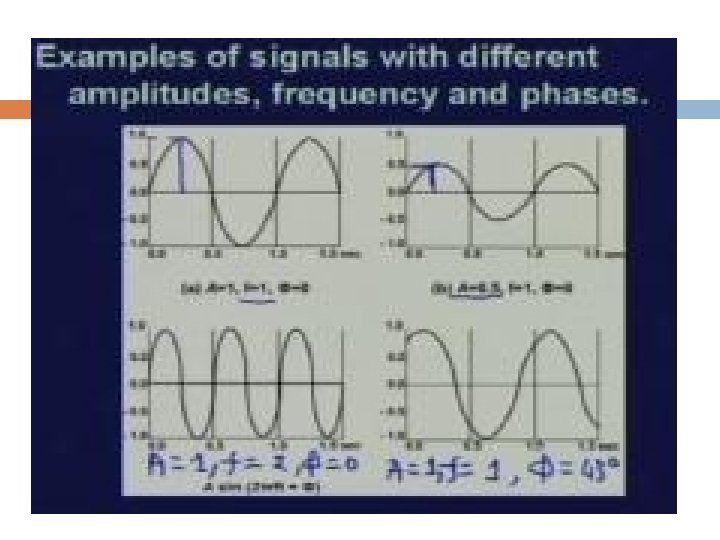
Periodic Signal A signal is periodic if s(t+T)=s(t) where T is time period. A periodic signal is characterized by the following three parameters are -amplitude, frequency and phase.
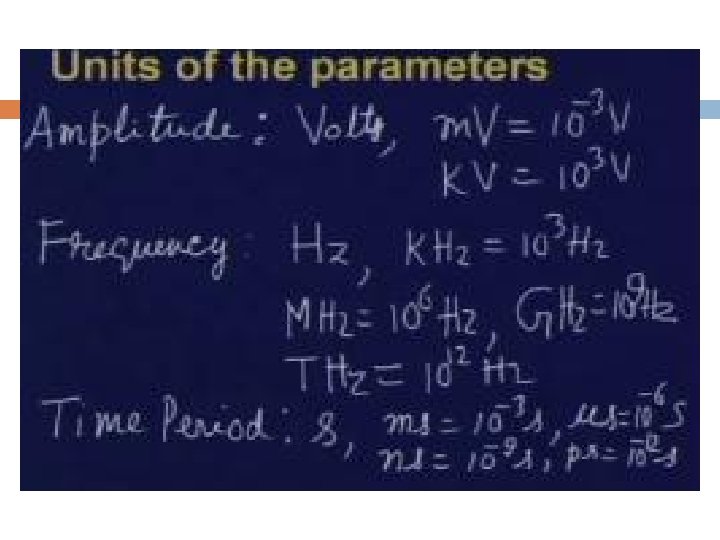
Periodic Signal Amplitude: Amplitude is the value of the signal at different instants of time measured in volts. Frequency: Frequency it is the inverse of the time period and usually it is measured in hertz. Phase: It gives a measure of the relative position of two signals in time , expressed in degree or radian.
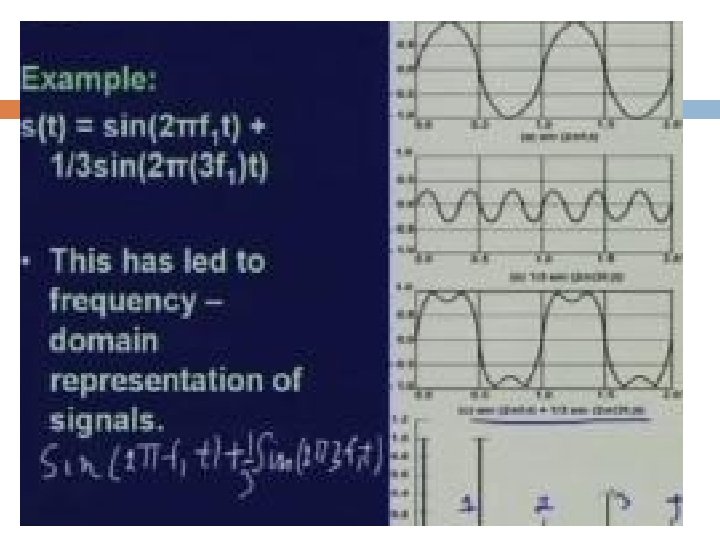
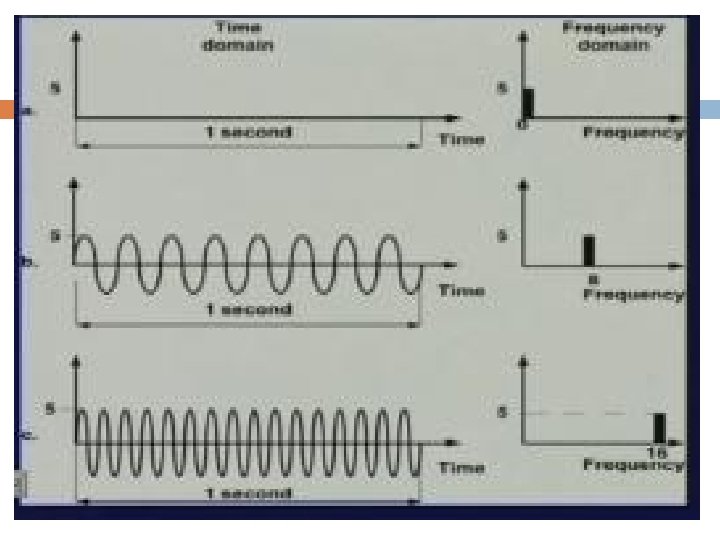
Time and Frequency Domains An electromagnetic signal is commonly a composite signal made up of many frequencies. According to Fourier series analysis , any composite signal can be expressed as a combination of simple sine waves with different amplitudes, frequencies and phases.
Bandwidth Range of frequencies over which most of the signal energy of a signal is contained is known as bandwidth or effective bandwidth of the signal. The term most is somewaht arbitrary.
Bit Interval and Bit Rate Bit Interval: Bit interval is the time required to send a single bit. Bit Rate: It is the number of bit intervals per second(bps).
Analogue Versus Digital A digital signal can be considered as a signal with finite number of frequencies. Digital transmission requires low-pass channel. Analogue transmission requires a band-pass channel.
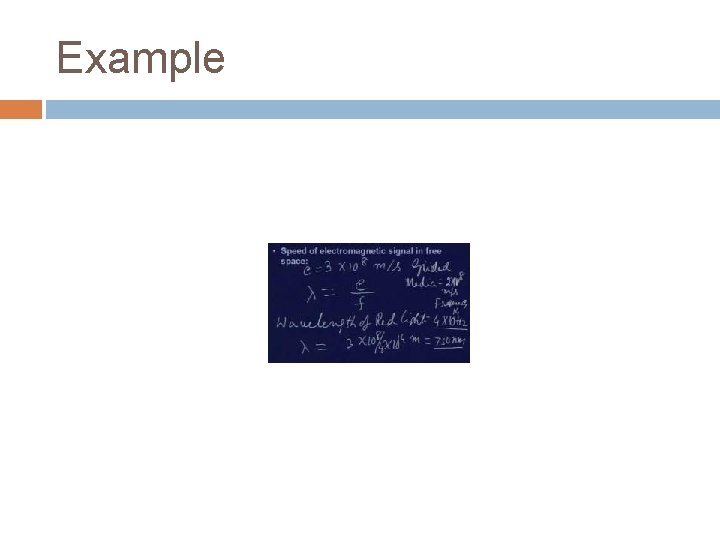
Propagation Time and Wavelength Propagation Time: Time required for a signal to travel from one point of transmission medium to other. Propagation Time= Distance/Propagation speed Wavelength : Distance occupied in space by a single period. Wavelength =Propagation speed*Period Propagation speed/Frequency
Example