
Data and MC comparison in Ice Cube Juan
Data and MC comparison in Ice. Cube Juan Antonio Aguilar
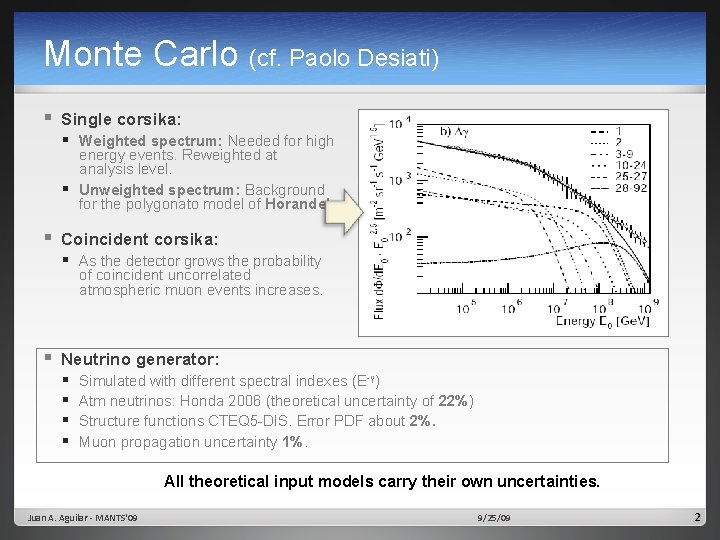
Monte Carlo (cf. Paolo Desiati) § Single corsika: § Weighted spectrum: Needed for high § energy events. Reweighted at analysis level. Unweighted spectrum: Background for the polygonato model of Horandel. § Coincident corsika: § As the detector grows the probability of coincident uncorrelated atmospheric muon events increases. § Neutrino generator: § § Simulated with different spectral indexes (E-γ) Atm neutrinos: Honda 2006 (theoretical uncertainty of 22%) Structure functions CTEQ 5 -DIS. Error PDF about 2%. Muon propagation uncertainty 1%. All theoretical input models carry their own uncertainties. Juan A. Aguilar - MANTS'09 9/25/09 2
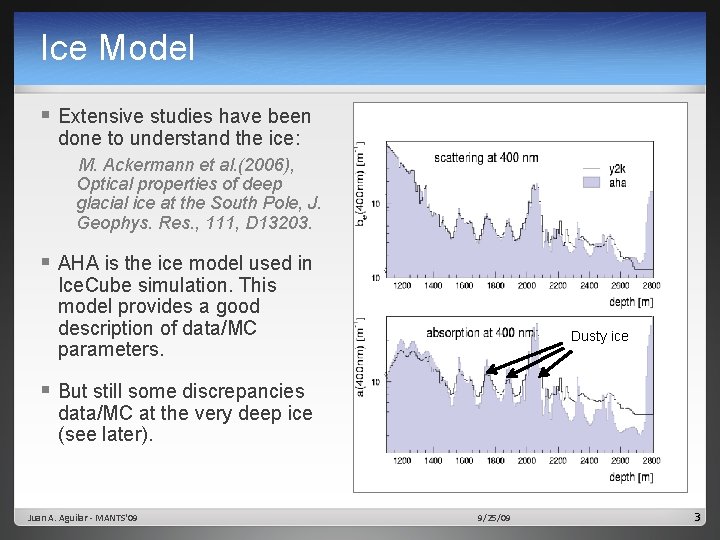
Ice Model § Extensive studies have been done to understand the ice: M. Ackermann et al. (2006), Optical properties of deep glacial ice at the South Pole, J. Geophys. Res. , 111, D 13203. § AHA is the ice model used in Ice. Cube simulation. This model provides a good description of data/MC parameters. Dusty ice § But still some discrepancies data/MC at the very deep ice (see later). Juan A. Aguilar - MANTS'09 9/25/09 3
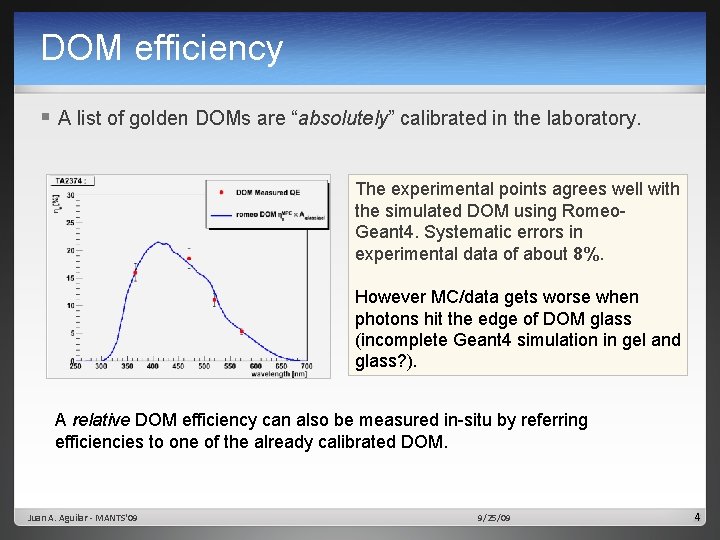
DOM efficiency § A list of golden DOMs are “absolutely” calibrated in the laboratory. The experimental points agrees well with the simulated DOM using Romeo. Geant 4. Systematic errors in experimental data of about 8%. However MC/data gets worse when photons hit the edge of DOM glass (incomplete Geant 4 simulation in gel and glass? ). A relative DOM efficiency can also be measured in-situ by referring efficiencies to one of the already calibrated DOM. Juan A. Aguilar - MANTS'09 9/25/09 4
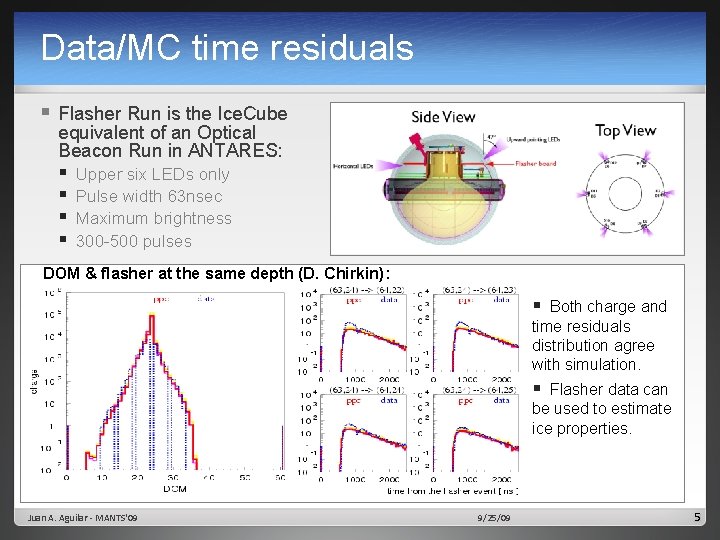
Data/MC time residuals § Flasher Run is the Ice. Cube equivalent of an Optical Beacon Run in ANTARES: § § Upper six LEDs only Pulse width 63 nsec Maximum brightness 300 -500 pulses DOM & flasher at the same depth (D. Chirkin): § Both charge and time residuals distribution agree with simulation. § Flasher data can be used to estimate ice properties. Juan A. Aguilar - MANTS'09 9/25/09 5
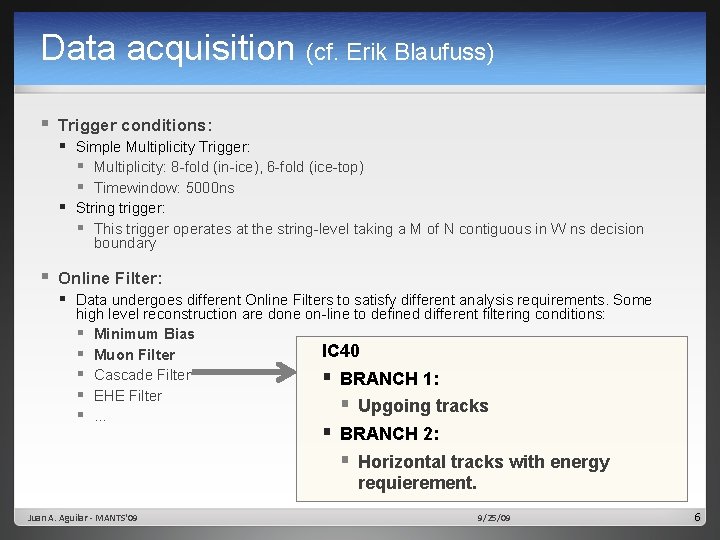
Data acquisition (cf. Erik Blaufuss) § Trigger conditions: § Simple Multiplicity Trigger: § Multiplicity: 8 -fold (in-ice), 6 -fold (ice-top) § Timewindow: 5000 ns § String trigger: § This trigger operates at the string-level taking a M of N contiguous in W ns decision boundary § Online Filter: § Data undergoes different Online Filters to satisfy different analysis requirements. Some high level reconstruction are done on-line to defined different filtering conditions: § Minimum Bias IC 40 § Muon Filter § Cascade Filter § BRANCH 1: § EHE Filter § Upgoing tracks § … § BRANCH 2: § Horizontal tracks with energy requierement. Juan A. Aguilar - MANTS'09 9/25/09 6
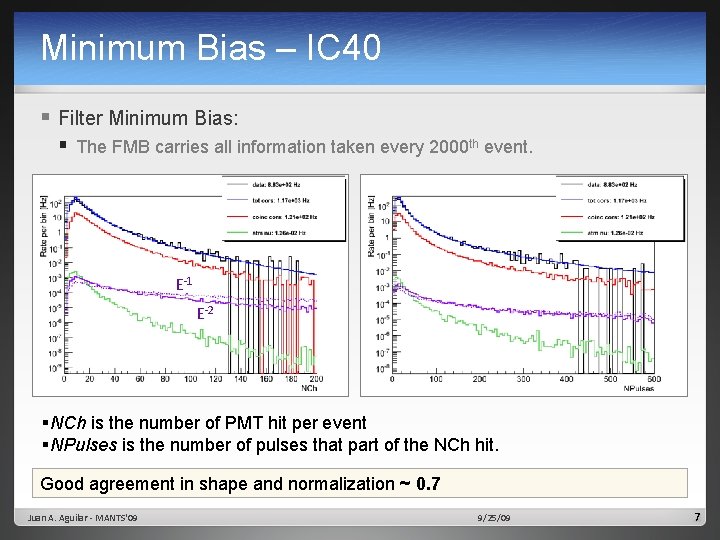
Minimum Bias – IC 40 § Filter Minimum Bias: § The FMB carries all information taken every 2000 th event. E-1 E-2 §NCh is the number of PMT hit per event §NPulses is the number of pulses that part of the NCh hit. Good agreement in shape and normalization ~ 0. 7 Juan A. Aguilar - MANTS'09 9/25/09 7
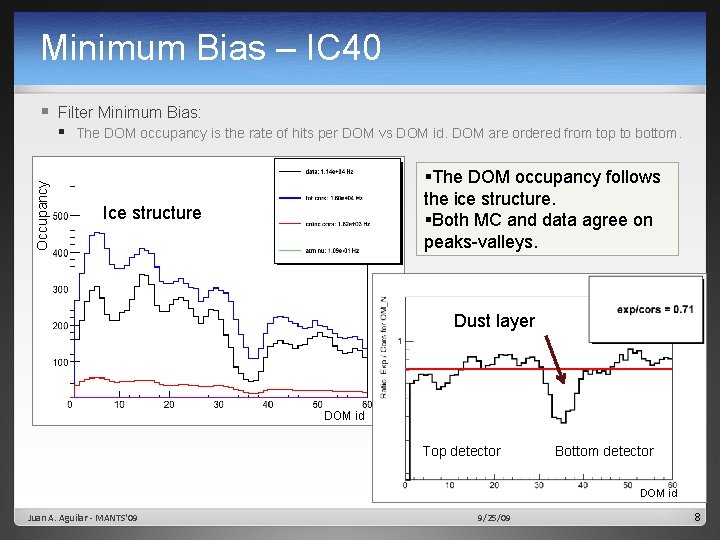
Minimum Bias – IC 40 § Filter Minimum Bias: Occupancy § The DOM occupancy is the rate of hits per DOM vs DOM id. DOM are ordered from top to bottom. §The DOM occupancy follows the ice structure. §Both MC and data agree on peaks-valleys. Ice structure Dust layer DOM id Top detector Bottom detector DOM id Juan A. Aguilar - MANTS'09 9/25/09 8
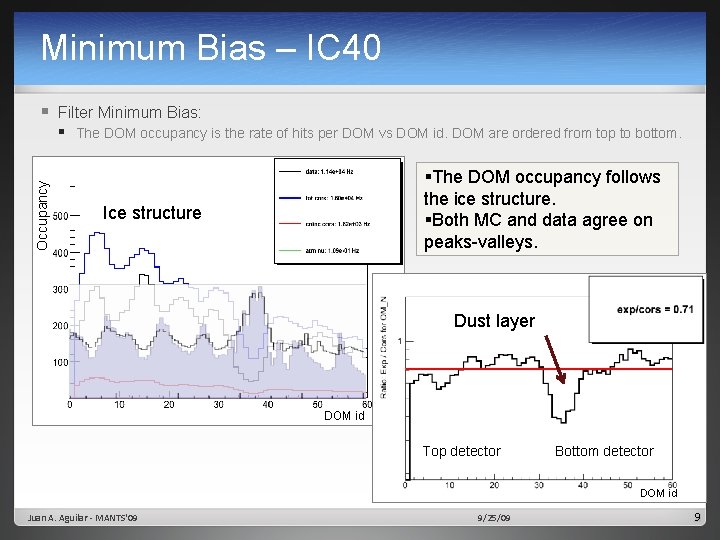
Minimum Bias – IC 40 § Filter Minimum Bias: Occupancy § The DOM occupancy is the rate of hits per DOM vs DOM id. DOM are ordered from top to bottom. §The DOM occupancy follows the ice structure. §Both MC and data agree on peaks-valleys. Ice structure Dust layer DOM id Top detector Bottom detector DOM id Juan A. Aguilar - MANTS'09 9/25/09 9
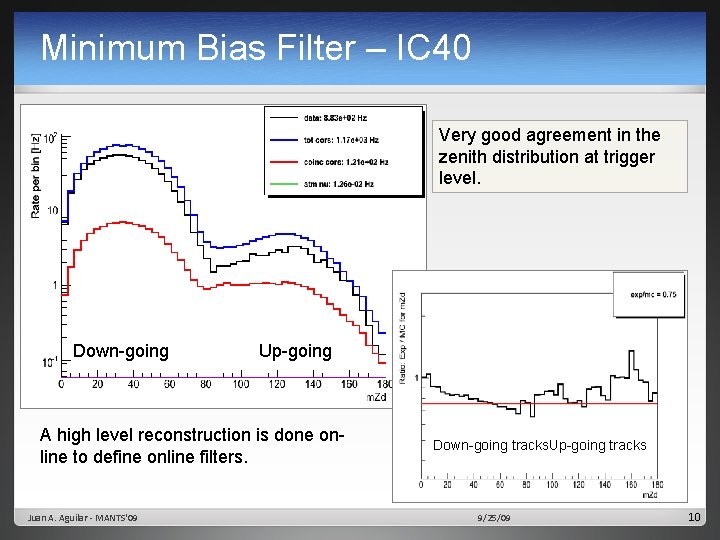
Minimum Bias Filter – IC 40 Very good agreement in the zenith distribution at trigger level. Down-going Up-going A high level reconstruction is done online to define online filters. Juan A. Aguilar - MANTS'09 Down-going tracks. Up-going tracks 9/25/09 10
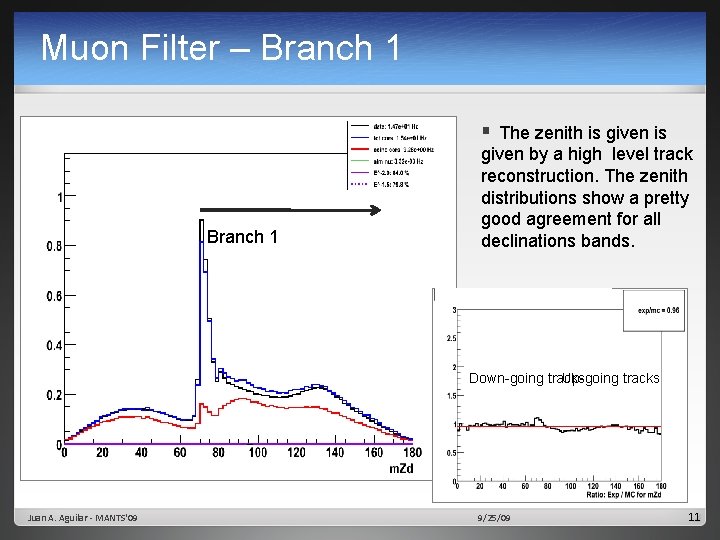
Muon Filter – Branch 1 § The zenith is given is Branch 1 given by a high level track reconstruction. The zenith distributions show a pretty good agreement for all declinations bands. Down-going tracks Up-going tracks Juan A. Aguilar - MANTS'09 9/25/09 11
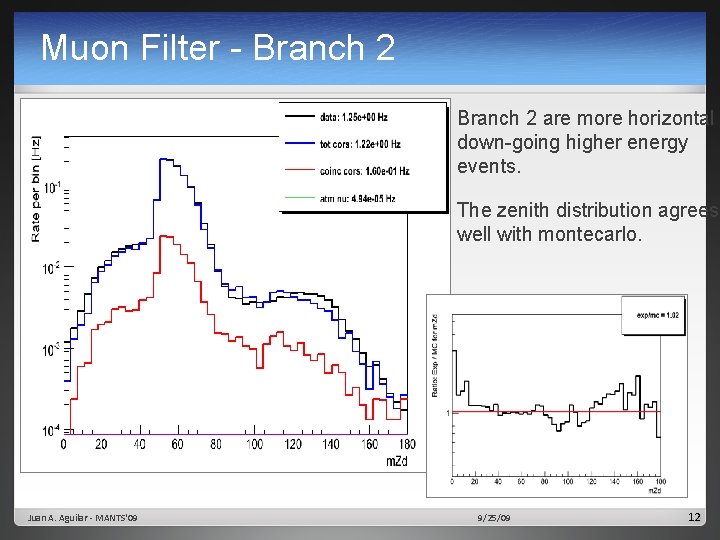
Muon Filter - Branch 2 § Branch 2 are more horizontal down-going higher energy events. § The zenith distribution agrees well with montecarlo. Juan A. Aguilar - MANTS'09 9/25/09 12
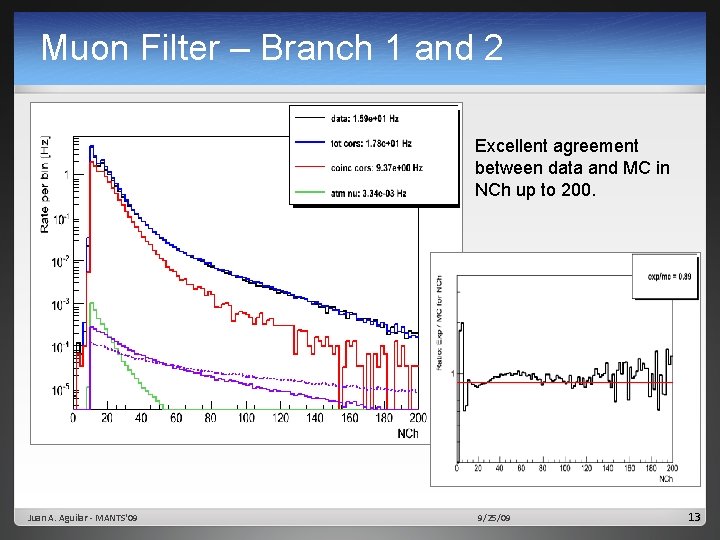
Muon Filter – Branch 1 and 2 Excellent agreement between data and MC in NCh up to 200. Juan A. Aguilar - MANTS'09 9/25/09 13

Offline processing (L 2) § In the offline processing each working groups selects events based in their goals (Point-source, Cascades, Diffuse, …) § Several cuts based in track quality parameters are done (Paraboloid, Direct hits, Likelihood ratio): Good agreement Paraboloid samples the likelihood space around the track and fits it to a paraboloid. Sigma is the circularized width of this paraboloid. L Sigma θ, φ Paraboloid sigma Juan A. Aguilar - MANTS'09 9/25/09 14
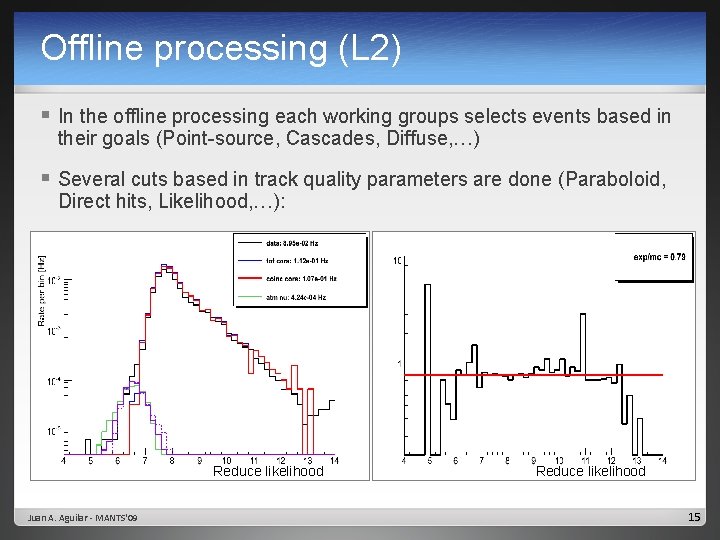
Offline processing (L 2) § In the offline processing each working groups selects events based in their goals (Point-source, Cascades, Diffuse, …) § Several cuts based in track quality parameters are done (Paraboloid, Direct hits, Likelihood, …): Reduce likelihood Juan A. Aguilar - MANTS'09 Reduce likelihood 15
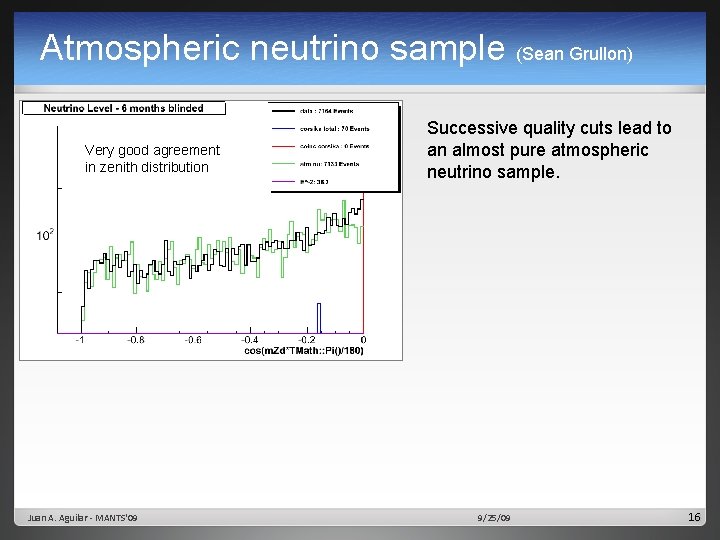
Atmospheric neutrino sample (Sean Grullon) Very good agreement in zenith distribution Juan A. Aguilar - MANTS'09 Successive quality cuts lead to an almost pure atmospheric neutrino sample. 9/25/09 16
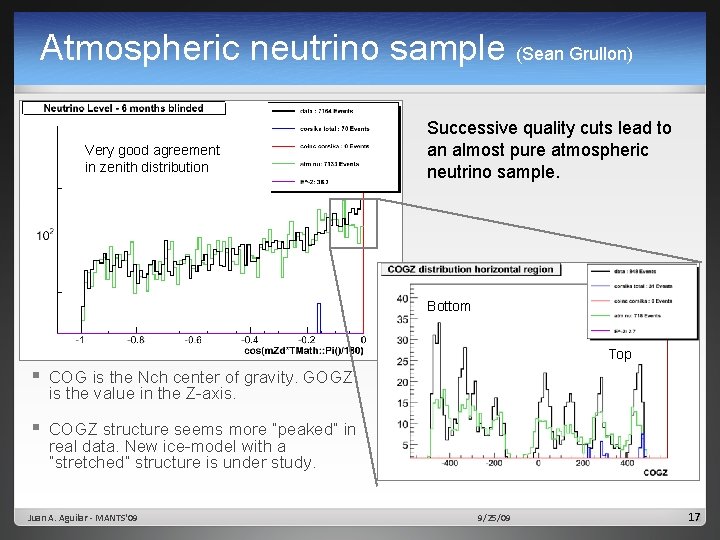
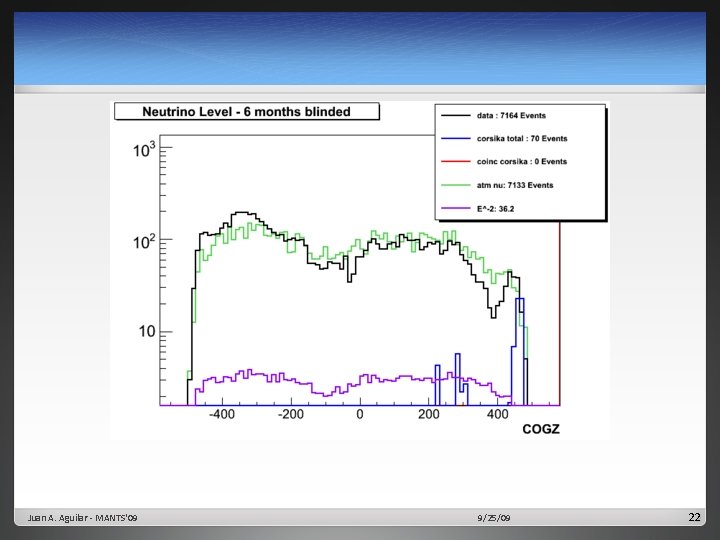
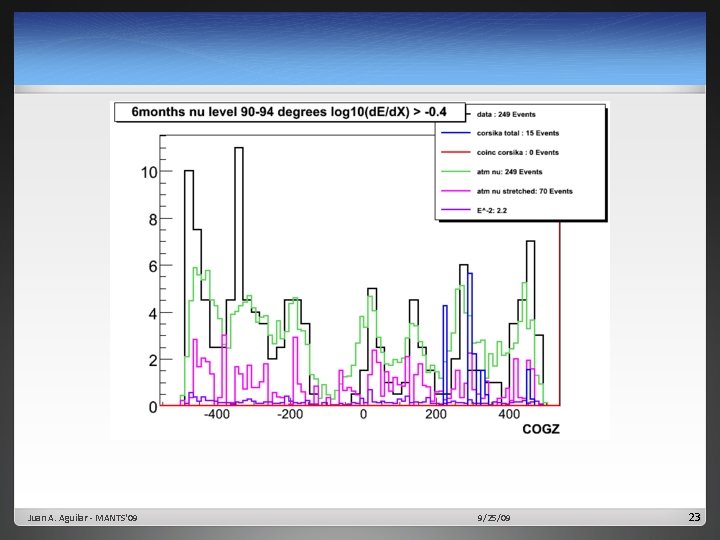
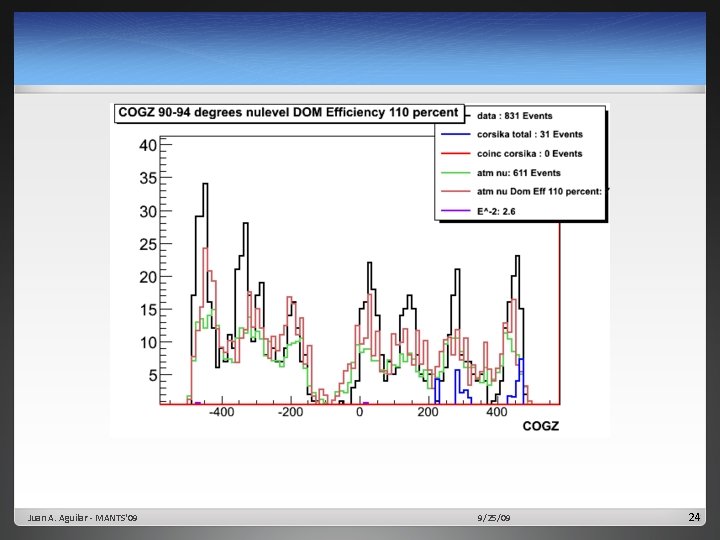
Atmospheric neutrino sample (Sean Grullon) Very good agreement in zenith distribution Successive quality cuts lead to an almost pure atmospheric neutrino sample. Bottom Top § COG is the Nch center of gravity. GOGZ is the value in the Z-axis. § COGZ structure seems more “peaked” in real data. New ice-model with a “stretched” structure is under study. Juan A. Aguilar - MANTS'09 9/25/09 17
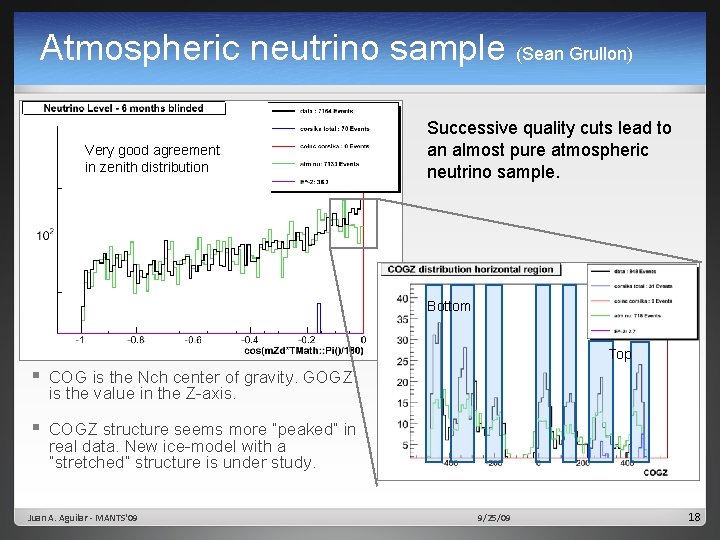
Atmospheric neutrino sample (Sean Grullon) Very good agreement in zenith distribution Successive quality cuts lead to an almost pure atmospheric neutrino sample. Bottom Top § COG is the Nch center of gravity. GOGZ is the value in the Z-axis. § COGZ structure seems more “peaked” in real data. New ice-model with a “stretched” structure is under study. Juan A. Aguilar - MANTS'09 9/25/09 18
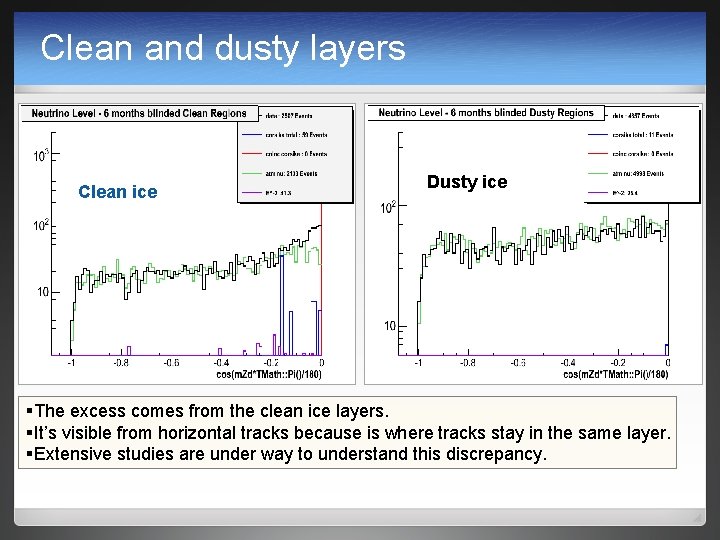
Clean and dusty layers Clean ice Dusty ice §The excess comes from the clean ice layers. §It’s visible from horizontal tracks because is where tracks stay in the same layer. §Extensive studies are under way to understand this discrepancy.
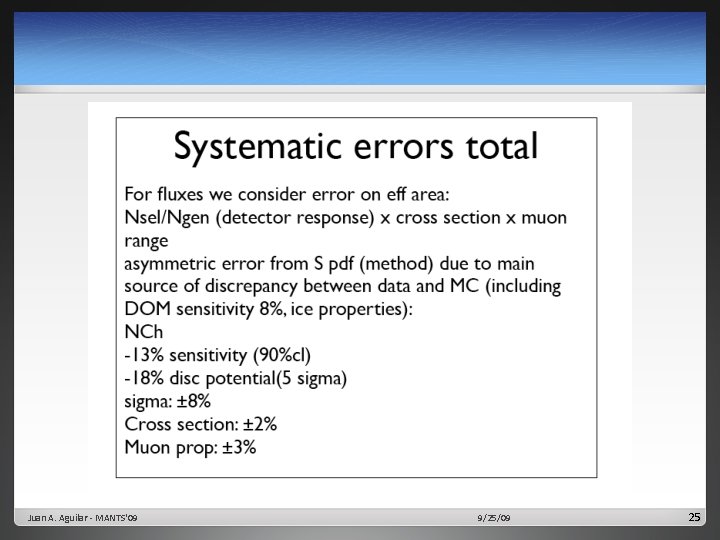
Systematic errors § Systematic error and uncertainties affect differently to different analysis: § Point Source analysis has a great advantage of using scrambled real data as background. The p-values estimations are always a robust results. Flux estimations are however subject of systematic errors. § Other analysis that do not have “off-source” background estimation, like diffuse analysis, suffer more directly the effect of uncertainties in DOM calibration, light propagation, … Juan A. Aguilar - MANTS'09 9/25/09 20
Summary and conclusion § A lot of expertise was gained since AMANDA in order to identify and reduce systematic uncertainties in the detector. § Still, some discrepancies are under study. The two main sources of uncertainty in Ice. Cube are: § Light propagation in the ice: § The rates data/MC agree very well and simulation follows correctly the actual § structure of the ice. Uncertainties in the deep ice model or how the simulation propagates light in clean ice are under study. § DOM efficiency: § Measurements indicates uncertainties of ± 8%. This uncertainties can lead to uncertainties in flux of 4%. § Ice. Cube has a good agreement data and montecarlo on average. Juan A. Aguilar - MANTS'09 9/25/09 21
Juan A. Aguilar - MANTS'09 9/25/09 22
Juan A. Aguilar - MANTS'09 9/25/09 23
Juan A. Aguilar - MANTS'09 9/25/09 24
Juan A. Aguilar - MANTS'09 9/25/09 25
Introduction § Conferences: § Show plots with the best agreement and tell them how great Ice. Cube. § Group meetings: § Show plots with the worst agreement and tell them all the things that need to be done. § I will try show some of both plots. Juan A. Aguilar - MANTS'09 9/25/09 26
- Slides: 26