
Data and Information Architecture Not Just for Enterprise
- Slides: 52
Data and Information Architecture: Not Just for Enterprise Architects! Gartner Enterprise Architecture Conference 13 -15 June 2007, Nashville, TN Gaylord Opryland Resort & Convention Center Brand L. Niemann, Senior Enterprise Architect, U. S. EPA, and Co-Chair, CIO Council's Semantic Interoperability Community of Practice (SICo. P) and SOA Co. P June 14, 2007 1
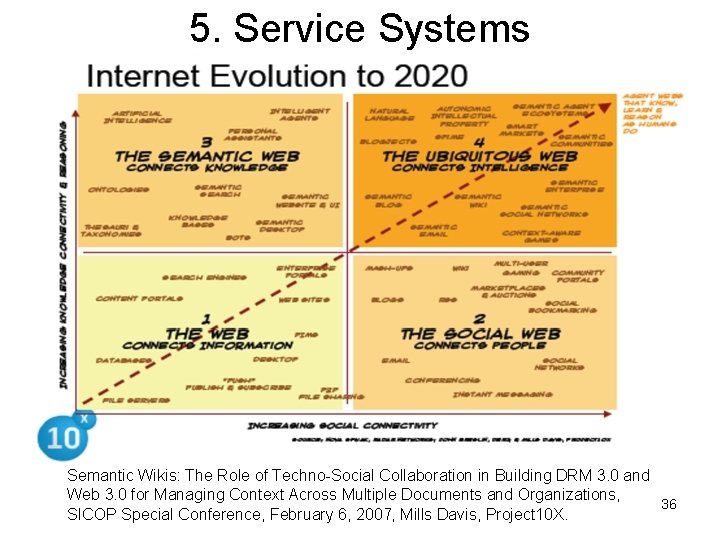
Abstract • Enterprise architecture in the Federal Government is evolving from compliance-driven to value-driven with SOA leading the way. SOA itself is evolving to deal with the semantics of data and information across the distributed enterprise. Service systems (networking communities of practice) are also in play to integrate people, business, information, and information technology in an information sharing environment. • This keynote addresses what these all have in common and explains the evolution of the Federal Enterprise Architecture's Data Reference Model and the Internet itself from (1) the Web, (2) the Social Web, (3) the Semantic Web, and (4) the Ubiquitous Web. A specific example of architecting and implementing an information sharing environment is provided and demonstrated. 2
Overview • What do: – 1. Enterprise Architecture – 2. Semantic Interoperability – 3. Service-Oriented Architecture – 4. Data and Information Architecture – 5. Service Systems, and an – 6. Information Sharing Environment • Have in Common? – The answer later. 3
1. Enterprise Architecture • Parsing the words like we are known for doing in the Nation’s Capital ( ): – Enterprise Architecture • Enterprise: A Star Trek Spaceship • Architecture: Blueprints – So, Blueprints of the Spaceship Enterprise! • Google Word. Net Princeton: – Enterprise: 3 – Architecture: 4 – Combinations: 12 (we will come back to this later in the answer!) Hint: Imagine the words represented different disciplines, cultures, concepts, and domains. 4
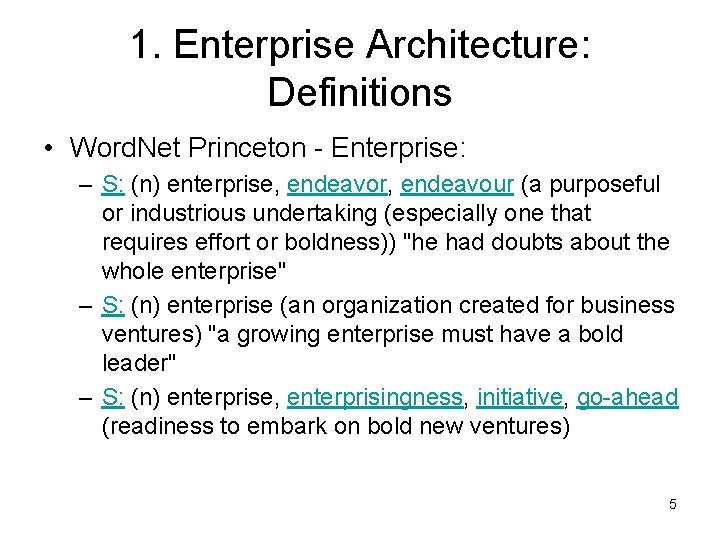
1. Enterprise Architecture: Definitions • Word. Net Princeton - Enterprise: – S: (n) enterprise, endeavor, endeavour (a purposeful or industrious undertaking (especially one that requires effort or boldness)) "he had doubts about the whole enterprise" – S: (n) enterprise (an organization created for business ventures) "a growing enterprise must have a bold leader" – S: (n) enterprise, enterprisingness, initiative, go-ahead (readiness to embark on bold new ventures) 5
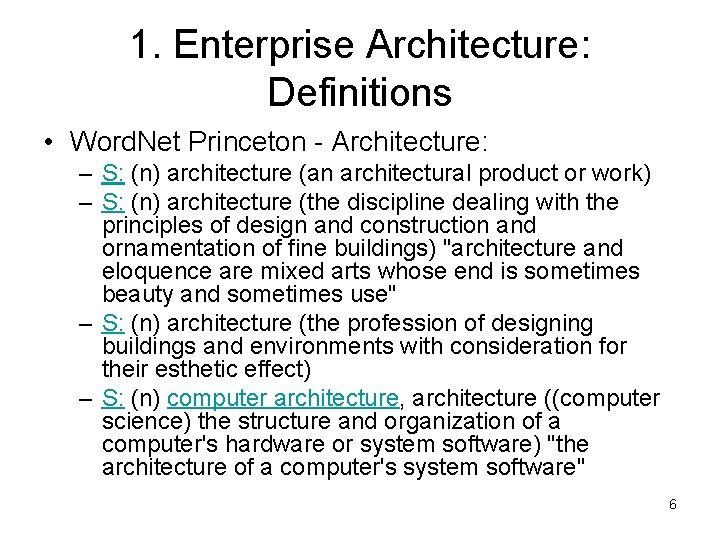
1. Enterprise Architecture: Definitions • Word. Net Princeton - Architecture: – S: (n) architecture (an architectural product or work) – S: (n) architecture (the discipline dealing with the principles of design and construction and ornamentation of fine buildings) "architecture and eloquence are mixed arts whose end is sometimes beauty and sometimes use" – S: (n) architecture (the profession of designing buildings and environments with consideration for their esthetic effect) – S: (n) computer architecture, architecture ((computer science) the structure and organization of a computer's hardware or system software) "the architecture of a computer's system software" 6
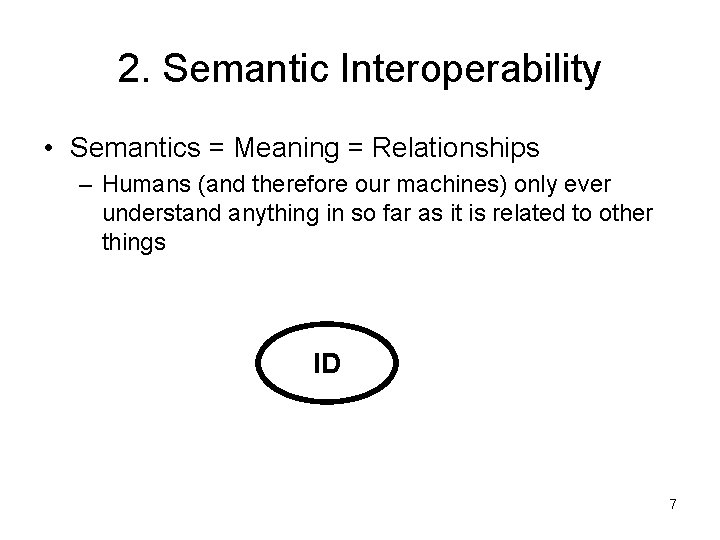
2. Semantic Interoperability • Semantics = Meaning = Relationships – Humans (and therefore our machines) only ever understand anything in so far as it is related to other things ID 7
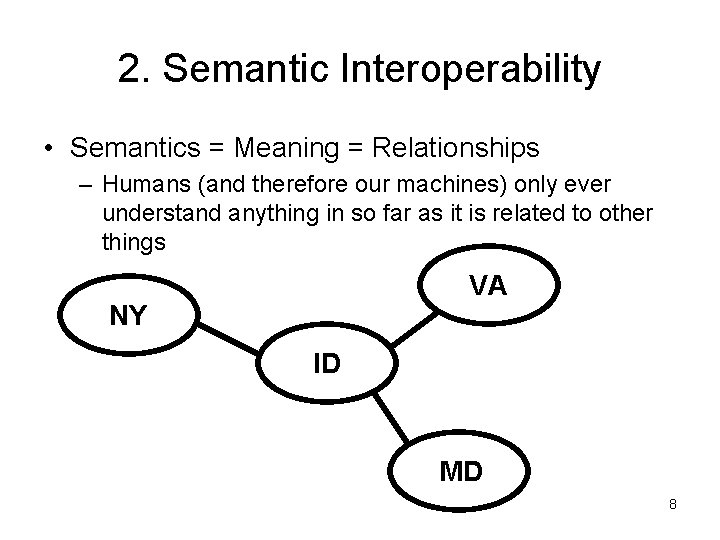
2. Semantic Interoperability • Semantics = Meaning = Relationships – Humans (and therefore our machines) only ever understand anything in so far as it is related to other things VA NY ID MD 8
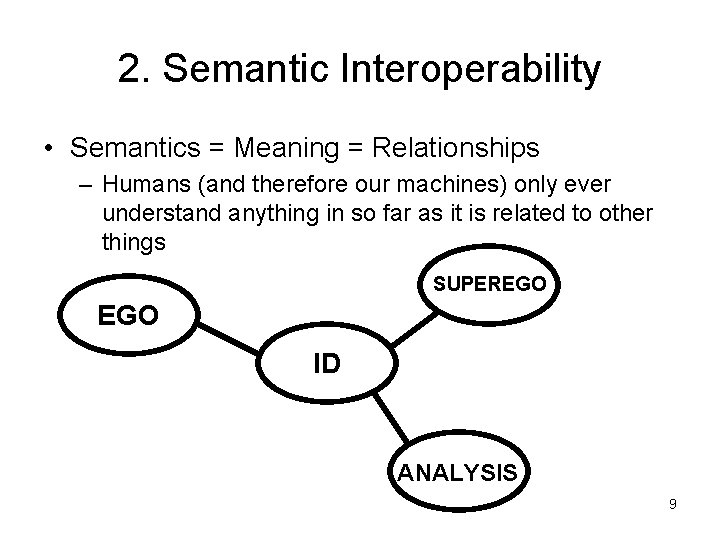
2. Semantic Interoperability • Semantics = Meaning = Relationships – Humans (and therefore our machines) only ever understand anything in so far as it is related to other things SUPEREGO ID ANALYSIS 9
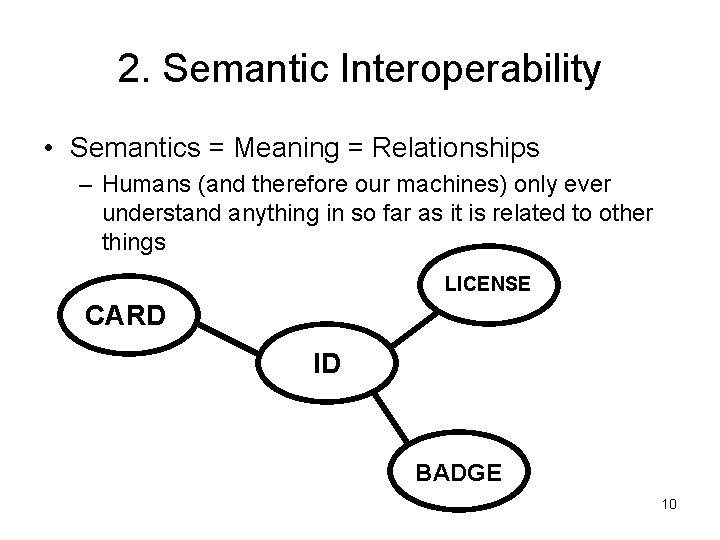
2. Semantic Interoperability • Semantics = Meaning = Relationships – Humans (and therefore our machines) only ever understand anything in so far as it is related to other things LICENSE CARD ID BADGE 10
2. Semantic Interoperability: Community of Practice • Origin: Requested by CIOC’s Best Practices Committee as a solution to doing public-private partnerships without violating FACA. • Charter: Accepted – See http: //colab. cim 3. net/cgi-bin/wiki. pl? SICo. P • CIOC Strategic Plan: Participated in and activities mapped to it (especially Goal 2). – See two most recent conference at http: //colab. cim 3. net/cgibin/wiki. pl? SICo. PSpecial. Conference 2_2007_04_25 • Themes: Building DRM 3. 0 and Web 3. 0 for Managing Context Across Multiple Documents and Organizations and Building Knowledgebases for Cross-Domain Semantic Interoperability • Best Practices Committee's “best practices“ process followed: – See same as above for CIOC Strategic Plan. • Collaborations: NCOIC, DERI, W 3 C, IAC Emerging Technology Committee, CIOC Architecture & Infrastructure Committee, Semantic Technology Community, etc. 11
2. Semantic Interoperability: Community of Practice • Special Recognitions at the SICo. P Special Conference 2, April 25, 2007: – Michael Lang, Revelytix: • Enterprise Data Modeling / SOA in a Semantic Wiki Knoodl. com. See slide 23. – Marguerite Ardito, Information Exchange, and Kevin Lynch, CIA: • Semantic Technologies and Vocabulary Management in the Context of An Overall Enterprise Data Architecture. – Parsa Mirhaji, MD: • Texas Health Center Taps Semantic Web http: //colab. cim 3. net/cgi-bin/wiki. pl? SICo. PSpecial. Conference 2_2007_04_25 12
2. Semantic Interoperability: Community of Practice • What's the purpose? – To develop members' capabilities; to build and exchange knowledge. • Who belongs? – Members who select themselves. • What holds it together? – Passion, commitment, and identification with the group's expertise. • How long does it last? – As long as there is an interest in maintaining the group. William Snyder, Building Communities of Practice. Excerpted from the article "Communities of Practice: The Organizational Frontier" in the Harvard Business Review, January-February 2000. http: //hbswk. hbs. edu/archive/1317. html 13
2. Semantic Interoperability: Community of Practice • SICo. P is chartered to do: – White Papers (3): • Introducing Semantic Technologies and the Vision of the Semantic Web (2005). • Semantic Wave 2006 - Executive Guide to the Business Value of Semantic Technologies. Update in 2007. • Operationalizing the Semantic Web/Semantic Technologies: – A roadmap for agencies on how they can take advantage of semantic technologies and begin to develop Semantic Web implementations (recently released for public review). – Conferences (10): 35 Special Recognitions (see next slide). – Pilots: More than 50 (see Wiki pages). 14
Federal CIO Council’s Service-Oriented Architectures Community of Practice (SOA Co. P) and Semantic Interoperability Community of Practice (SICo. P) Special Recognition Arun Majumdar (Cutter Consortium/Vivo. Mind Intelligence) For Outstanding Contributions to the SICo. P and SOA Co. P at the 2 nd SOA for E-Government Conference, October 30 -31, 2006, at The MITRE Corporation, Mc. Lean, VA. By SOA Co. P Co-Chairs, Greg Lomow, Bearing Point & Brand Niemann, US EPA SOA Co. P Best Practices and Architecture & Infrastructure Committees of the Federal Chief Information Officers Council Produced in Collaboration With 15
3. Service-Oriented Architecture: SOA Community of Practice • Origin: Requested by the CIOC’s Architecture & Infrastructure Committee • Charter: Announcements at the Chief Architects Forum and Industry Advisory Committee SOA Committee – See http: //colab. cim 3. net/cgi-bin/wiki. pl? Announcementof. SOACo. P • CIOC Strategic Plan: Participated in and activities mapped to it (Goals 1 – 4: See next two slides). – See most recent conference at http: //colab. cim 3. net/cgibin/wiki. pl? SOAfor. EGovernment_2007_05_0102 • Theme: Responsibility to Provide Best Practices for An Information Sharing Environment - Bringing Together the Global Information Grid, W 3 C, SOA Consortium, and Shared Services. • Best Practices Committee's “best practices“ process followed: – See same as above for CIOC Strategic Plan. • Collaborations: MITRE, IAC, SOA Consortium, W 3 C, KSG Shared Services, World-Wide Consortium for the Grid and GIGLite Community, etc. 16
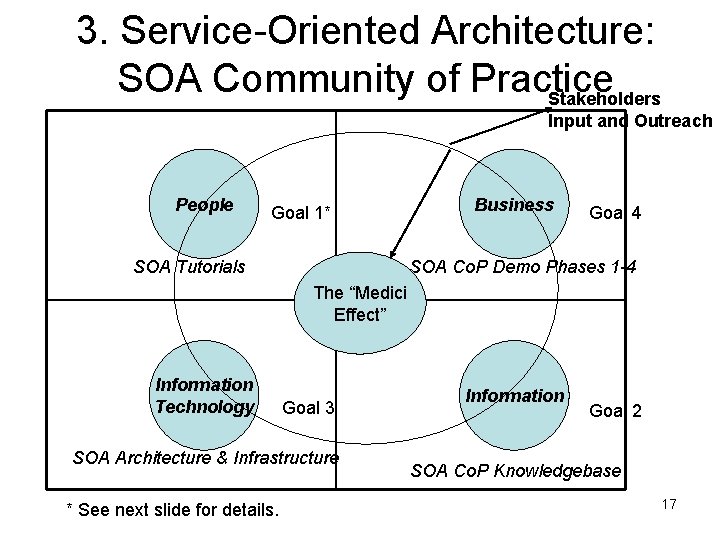
3. Service-Oriented Architecture: SOA Community of Practice Stakeholders Input and Outreach People Goal 1* SOA Tutorials Business Goal 4 SOA Co. P Demo Phases 1 -4 The “Medici Effect” Information Technology Goal 3 SOA Architecture & Infrastructure * See next slide for details. Information Goal 2 SOA Co. P Knowledgebase 17
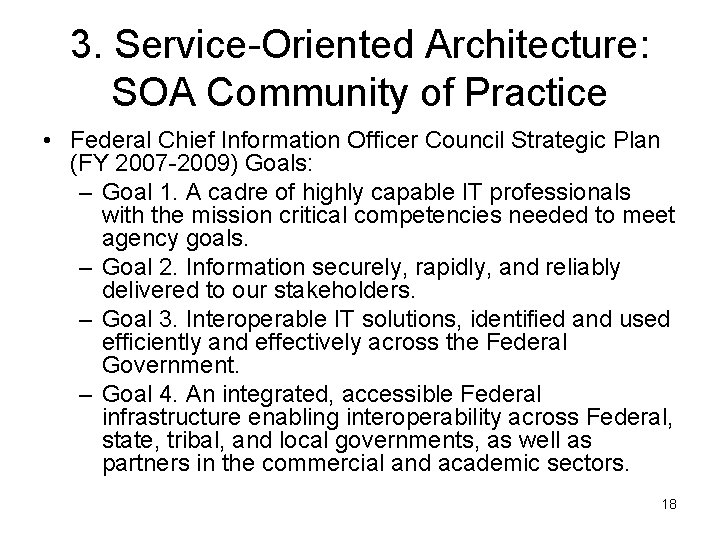
3. Service-Oriented Architecture: SOA Community of Practice • Federal Chief Information Officer Council Strategic Plan (FY 2007 -2009) Goals: – Goal 1. A cadre of highly capable IT professionals with the mission critical competencies needed to meet agency goals. – Goal 2. Information securely, rapidly, and reliably delivered to our stakeholders. – Goal 3. Interoperable IT solutions, identified and used efficiently and effectively across the Federal Government. – Goal 4. An integrated, accessible Federal infrastructure enabling interoperability across Federal, state, tribal, and local governments, as well as partners in the commercial and academic sectors. 18
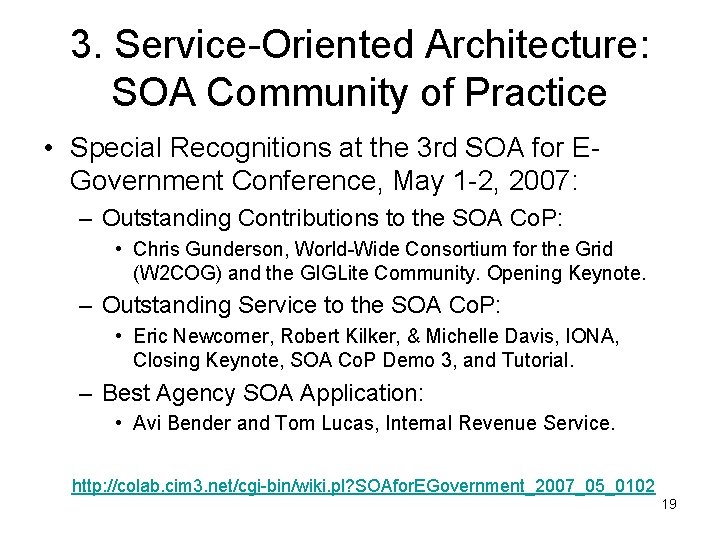
3. Service-Oriented Architecture: SOA Community of Practice • Special Recognitions at the 3 rd SOA for EGovernment Conference, May 1 -2, 2007: – Outstanding Contributions to the SOA Co. P: • Chris Gunderson, World-Wide Consortium for the Grid (W 2 COG) and the GIGLite Community. Opening Keynote. – Outstanding Service to the SOA Co. P: • Eric Newcomer, Robert Kilker, & Michelle Davis, IONA, Closing Keynote, SOA Co. P Demo 3, and Tutorial. – Best Agency SOA Application: • Avi Bender and Tom Lucas, Internal Revenue Service. http: //colab. cim 3. net/cgi-bin/wiki. pl? SOAfor. EGovernment_2007_05_0102 19
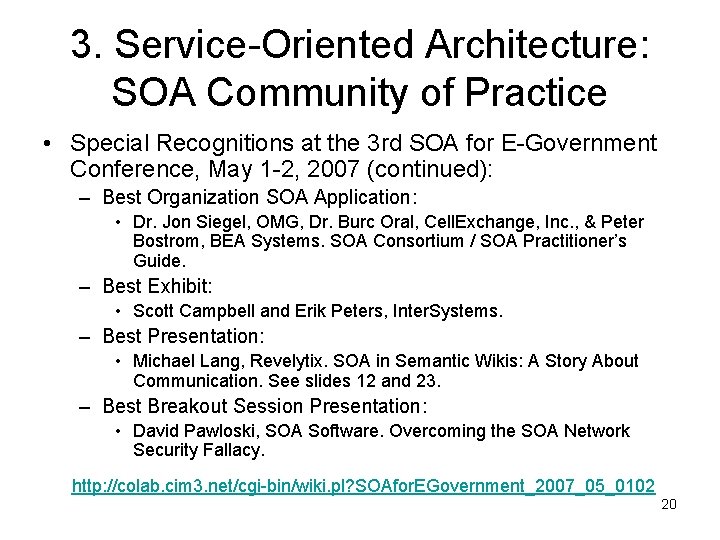
3. Service-Oriented Architecture: SOA Community of Practice • Special Recognitions at the 3 rd SOA for E-Government Conference, May 1 -2, 2007 (continued): – Best Organization SOA Application: • Dr. Jon Siegel, OMG, Dr. Burc Oral, Cell. Exchange, Inc. , & Peter Bostrom, BEA Systems. SOA Consortium / SOA Practitioner’s Guide. – Best Exhibit: • Scott Campbell and Erik Peters, Inter. Systems. – Best Presentation: • Michael Lang, Revelytix. SOA in Semantic Wikis: A Story About Communication. See slides 12 and 23. – Best Breakout Session Presentation: • David Pawloski, SOA Software. Overcoming the SOA Network Security Fallacy. http: //colab. cim 3. net/cgi-bin/wiki. pl? SOAfor. EGovernment_2007_05_0102 20
3. Service-Oriented Architecture: Semantic SOA • SICo. P: – Public Meeting (September 14, 2005): Semantic Interoperability Architecture Pilots, Rex Brooks and Team (Event Ontology) – 4 th SIEGOV Conference (February 8 -9, 2006): Best Co-Papers: Elisa Kendall, Sandpiper, Sam Chance, US Navy, and Michael Seebold, Concurrent Technologies Corporation: • Enables dynamic discovery of new services as they become available and provides resources for enabling semantic descriptions of those services. – 5 th SIEGOV Conference (October 10 -11, 2006): Arun Majumdar, Cutter Consortium, Operationalizing SOA: Lessons Learned (recall slide 15). • http: //www. cutter. com/offers/SOAor. SOS. html 21
3. Service-Oriented Architecture: Semantic SOA • SOA Co. P: – 2 nd Conference (October 30 -31, 2006): Track 4: SOA and Metadata (Ontologies? ) Organized by Chuck Mosher, Meta. Matrix. • At the 4 th SIEGOV Conference: Special Recognition for Best Semantic Harmonization Tool Application to Chuck Mosher, Meta. Matrix (credit for Slides 7 -10). – 3 rd Conference (May 1 -2, 2007): Best Presentation – see next slide. • 2007 Semantic Technology Conference, May 20 -24, 2007: – Semantics and SOA (5): Semantic Arts, BEA Systems, Modus Operandi, Revelytix, Soft. Pro, and Intel. – Data Modeling (see slides 24 -25). 22
3. Service-Oriented Architecture: Semantic SOA • SICo. P and SOA Co. P Special Recognitions: – Outstanding Contributions to the SICo. P Special Conference 2, April 25 th (recall slide 12); and – Best Presentation at the 3 rd SOA for E-Government Conference, May 1 -2 nd: • “Semantic Technology is the first fundamental change in Information Management since the RDBMS was developed in the early 1980’s”: – Michael Lang, Revelytix, Co-Founder and Director, and Co. Chair, SICo. P Vocabulary Management WG. – Demonstration at the June 18 -19, 2007, W 3 C Workshop on e. Government and the Web, National Academy of Sciences. http: //colab. cim 3. net/file/work/SOACo. P/2007_05_0102/MLang 05022007. ppt 23
3. Service-Oriented Architecture: Semantic SOA • Improve Data Quality: – Data Modeling and OWL: Two Ways to Structure Data, David Hay, Essential Strategies, Inc. : • Objectives of a Data Model: – Capture the semantics of an organization. – Communicate these to the business without requiring technical skills. – Provide an architecture to use as the basis for database design and system design. » Now: Provides the basis for designing Service Oriented Architectures. http: //www. semantic-conference. com/2007/sessions/m 5. html http: //www. semantic-conference. com/2007/handouts/2 -Up. BW/Hay_David_2_2 Up. BW. pdf 24
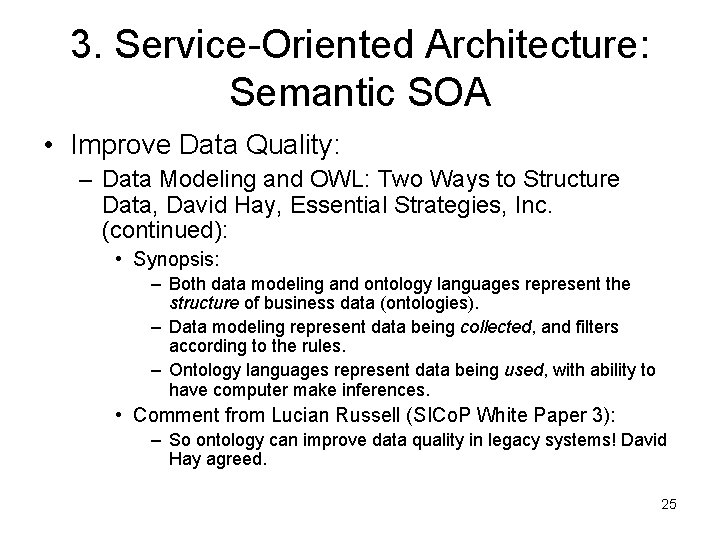
3. Service-Oriented Architecture: Semantic SOA • Improve Data Quality: – Data Modeling and OWL: Two Ways to Structure Data, David Hay, Essential Strategies, Inc. (continued): • Synopsis: – Both data modeling and ontology languages represent the structure of business data (ontologies). – Data modeling represent data being collected, and filters according to the rules. – Ontology languages represent data being used, with ability to have computer make inferences. • Comment from Lucian Russell (SICo. P White Paper 3): – So ontology can improve data quality in legacy systems! David Hay agreed. 25
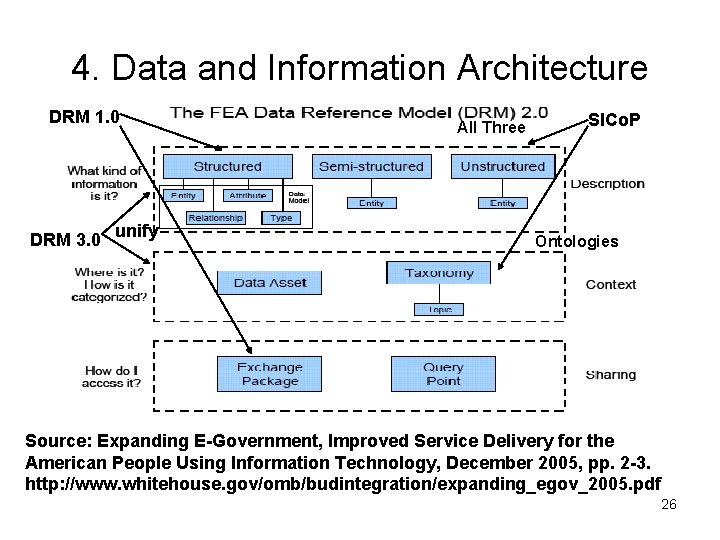
4. Data and Information Architecture DRM 1. 0 DRM 3. 0 unify All Three SICo. P Ontologies Source: Expanding E-Government, Improved Service Delivery for the American People Using Information Technology, December 2005, pp. 2 -3. http: //www. whitehouse. gov/omb/budintegration/expanding_egov_2005. pdf 26
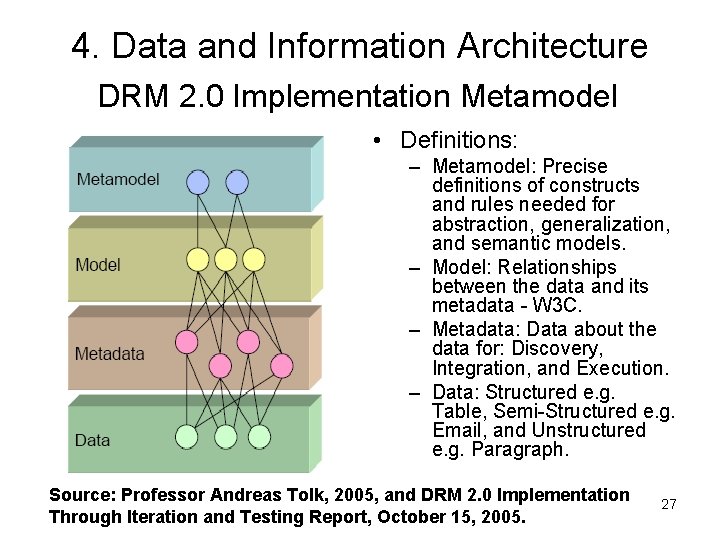
4. Data and Information Architecture DRM 2. 0 Implementation Metamodel • Definitions: – Metamodel: Precise definitions of constructs and rules needed for abstraction, generalization, and semantic models. – Model: Relationships between the data and its metadata - W 3 C. – Metadata: Data about the data for: Discovery, Integration, and Execution. – Data: Structured e. g. Table, Semi-Structured e. g. Email, and Unstructured e. g. Paragraph. Source: Professor Andreas Tolk, 2005, and DRM 2. 0 Implementation Through Iteration and Testing Report, October 15, 2005. 27
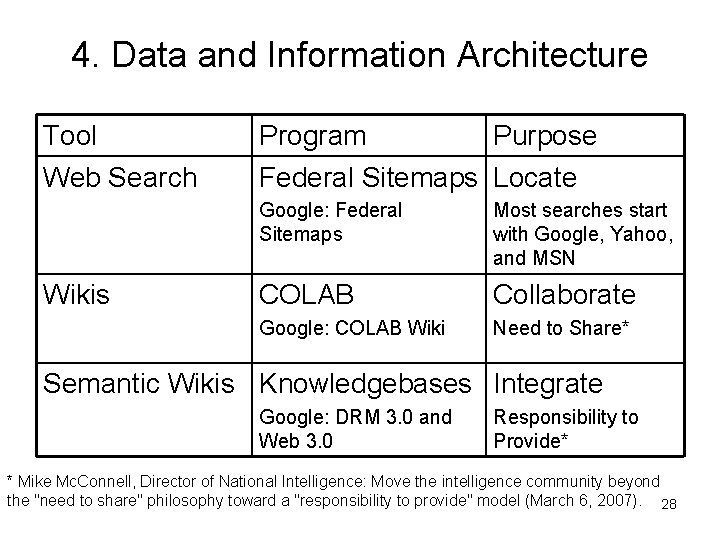
4. Data and Information Architecture Tool Web Search Wikis Program Purpose Federal Sitemaps Locate Google: Federal Sitemaps Most searches start with Google, Yahoo, and MSN COLAB Collaborate Google: COLAB Wiki Need to Share* Semantic Wikis Knowledgebases Integrate Google: DRM 3. 0 and Web 3. 0 Responsibility to Provide* * Mike Mc. Connell, Director of National Intelligence: Move the intelligence community beyond the "need to share" philosophy toward a "responsibility to provide" model (March 6, 2007). 28
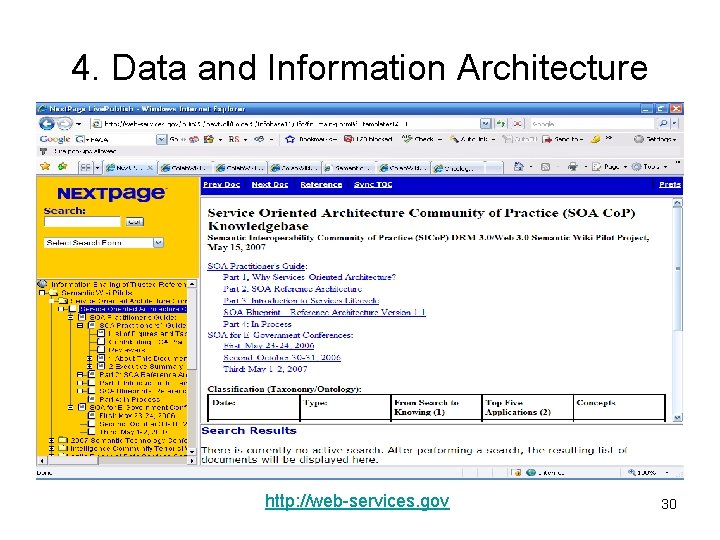
4. Data and Information Architecture • Three-tier Architecture for Goal 2: – Tier 1: Locate (E. g. Google) – Tier 2: Collaborate (Wiki Pages) – Tier 3: Integrate (Trusted Reference Knowledgebases - see next slide): • SOA Practitioner’s Guide (SOA Consortium) and Proceedings of Three SOA for E-Government Conferences! • The Federal Enterprise Architecture Data Reference Model 2. 0 was written in the COLAB Wiki and is being implemented in Semantic Wikis! 29
4. Data and Information Architecture http: //web-services. gov 30
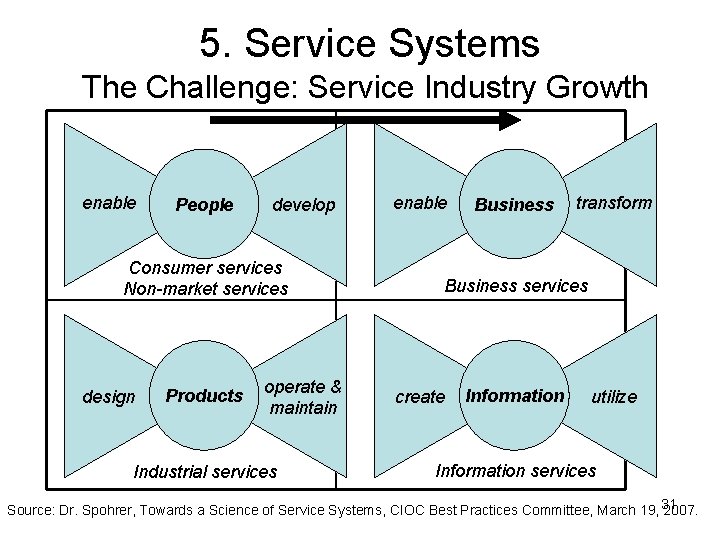
5. Service Systems The Challenge: Service Industry Growth enable People develop Consumer services Non-market services design Products operate & maintain Industrial services enable Business transform Business services create Information utilize Information services Source: Dr. Spohrer, Towards a Science of Service Systems, CIOC Best Practices Committee, March 19, 31 2007.
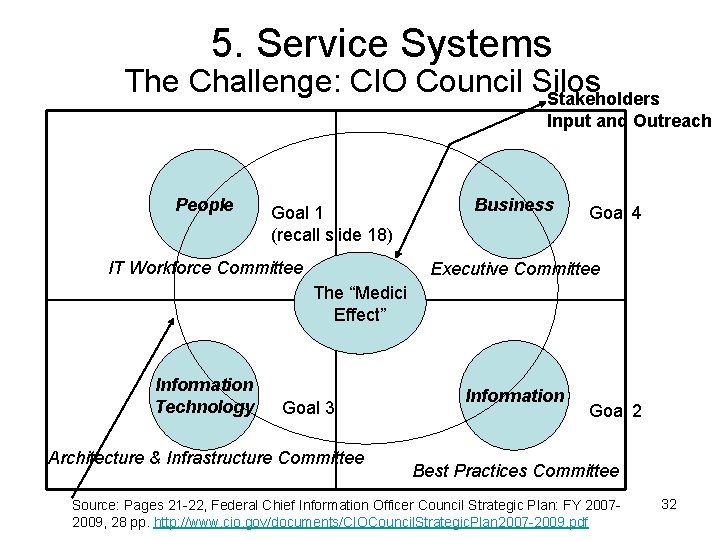
5. Service Systems The Challenge: CIO Council Silos Stakeholders Input and Outreach People Goal 1 (recall slide 18) IT Workforce Committee Business Goal 4 Executive Committee The “Medici Effect” Information Technology Goal 3 Architecture & Infrastructure Committee Information Goal 2 Best Practices Committee Source: Pages 21 -22, Federal Chief Information Officer Council Strategic Plan: FY 20072009, 28 pp. http: //www. cio. gov/documents/CIOCouncil. Strategic. Plan 2007 -2009. pdf 32
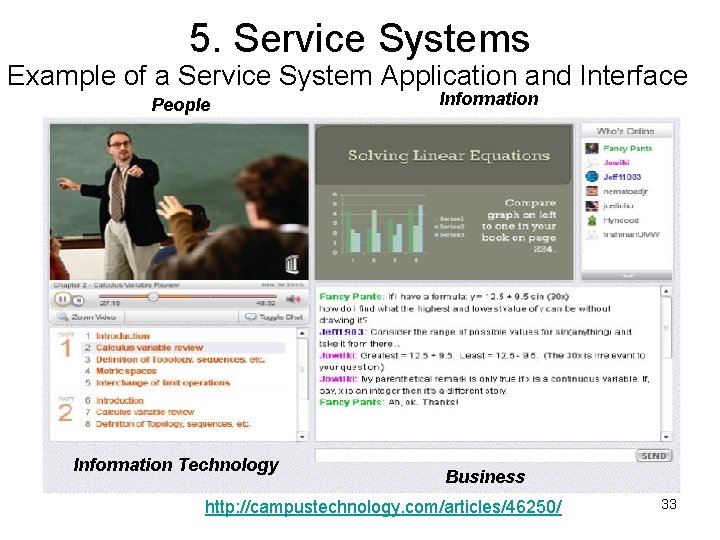
5. Service Systems Example of a Service System Application and Interface People Information Technology Information Business http: //campustechnology. com/articles/46250/ 33
5. Service Systems Case Study for Service Research & Innovation Initiative (SRII) • Technology Services Research & Innovation Symposium, May 30 th, Santa Clara Convention Center, California: – The Federal Chief Information Officer Council (the CIO Council) is used as a case study of the initial effect that the “Science of Service Systems” paradigm can have on enterprise process improvement for people working with information using information technology to accomplish a business purpose. This case study documents that we were actually moving towards it before we were formally introduced to it and have gotten some of the “Medici Effect” after consciously moving towards it. • http: //www. thesrii. org • http: //colab. cim 3. net/file/work/BPC/2007 -0530/BNiemann. SSRI 05262007. doc • http: //hbswk. hbs. edu/archive/4376. html 34
5. Service Systems • Wiki Knowledge Management: What Are We Thinking? : – Technology Can Enable Complex Adaptive Behavior in Human Knowledge Workers: • Together, Google and the Wikipedia manage more knowledge better and faster and cheaper than any other framework we have yet invented. – Source: Dr. Calvin Andrus, CIA. Closing Keynote, Knowledge Management 2007 Conference, April 3 -5. » http: //events. fcw. com/events/2007/KM/downloads/KM 07_K eynote_Andrus_V 1. pdf • SICo. P is trying to enhance this with Trusted Reference Knowledge in Semantic Wikis. 35
5. Service Systems Semantic Wikis: The Role of Techno-Social Collaboration in Building DRM 3. 0 and Web 3. 0 for Managing Context Across Multiple Documents and Organizations, 36 SICOP Special Conference, February 6, 2007, Mills Davis, Project 10 X.
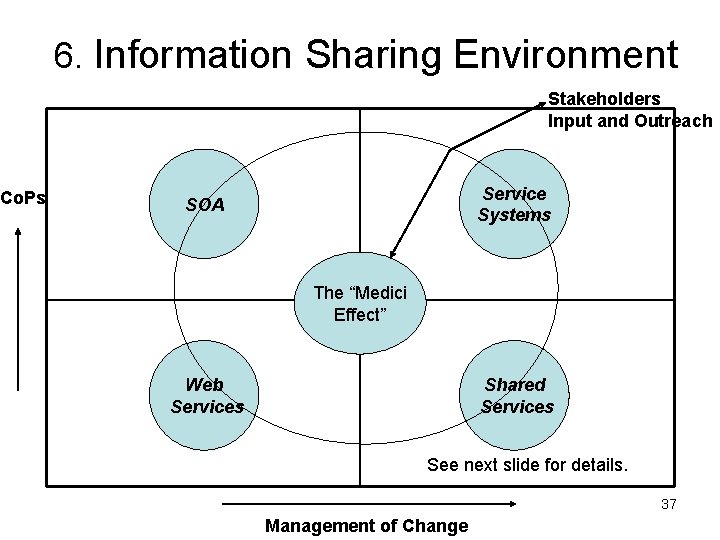
Co. Ps 6. Information Sharing Environment Stakeholders Input and Outreach Service Systems SOA The “Medici Effect” Web Services Shared Services See next slide for details. 37 Management of Change
6. Information Sharing Environment • Shared Services White Paper: Some Key Questions: – 1. What are Shared Services? – 2. Why are They Important to the U. S. Federal Government? – 3. What are Some Best Practice Examples of Shared Services? – 4. What are the Activities Related to Shared Services? – 5. What are Some Suggested Next Steps for Shared Services? http: //colab. cim 3. net/file/work/BPC/SOAJoint. Task. Force/BNiemann 12082006. Doc 38
6. Information Sharing Environment • Shared Services White Paper: Some Key Questions: 1. What are Shared Services? – Shared services is an organizational form in which common functions across a number of departments/agencies are consolidated and undertaken by a specialized agency/service delivery center (1). • (1) EDS Government Journal volume one issue one, Government Transformation: Delivering public value, achieving policy objectives: How transformation can help governments meet the challenges ahead, Shared Services pages 17 -24, by Suparno Banerjee, EDS Global Government http: //www. eds. com/services/whitepapers/downloads/govt_jo urnal_v 1 -1. pdf 39
6. Information Sharing Environment • Shared Services Community of Practice: A Persistent Learning Community of Senior Executive Practitioners, May 29 -31, 2007: – Leadership for a Networked World Program: An Executive Education Program of the John F. Kennedy School of Government. Convening senior most shared services practitioners from the public and private sector to explore these matters. – Case Studies: • California E-Mail (Consolidation of over 200 systems). • Iowa’s Recovery Center (Dealing with diverse recovery standards). • Grant’s. Gov (One-stop to find apply). • Cross-Boundary Governance Through Agreements and Standards: Assuring Compliance and Results, March 2022, 2007, and Making Cross-Boundary Transformation Happen: The Role of Executive Sponsors, June 26 -27, 2007. – Note: Followed different order than NASCIO (see next slide)! http: //colab. cim 3. net/file/work/SOACo. P/2007_05_0102/ZTumin 05022007. ppt http: //www. lnwprogram. org/lnwprogram/workshop_shared_services 40
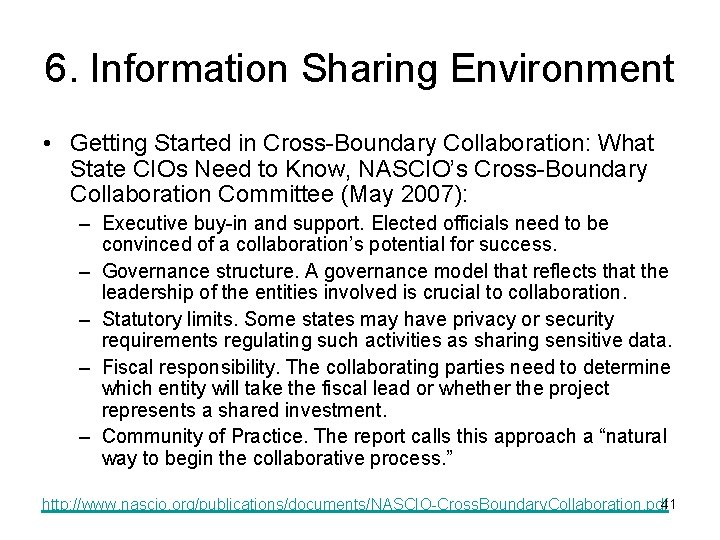
6. Information Sharing Environment • Getting Started in Cross-Boundary Collaboration: What State CIOs Need to Know, NASCIO’s Cross-Boundary Collaboration Committee (May 2007): – Executive buy-in and support. Elected officials need to be convinced of a collaboration’s potential for success. – Governance structure. A governance model that reflects that the leadership of the entities involved is crucial to collaboration. – Statutory limits. Some states may have privacy or security requirements regulating such activities as sharing sensitive data. – Fiscal responsibility. The collaborating parties need to determine which entity will take the fiscal lead or whether the project represents a shared investment. – Community of Practice. The report calls this approach a “natural way to begin the collaborative process. ” http: //www. nascio. org/publications/documents/NASCIO-Cross. Boundary. Collaboration. pdf 41
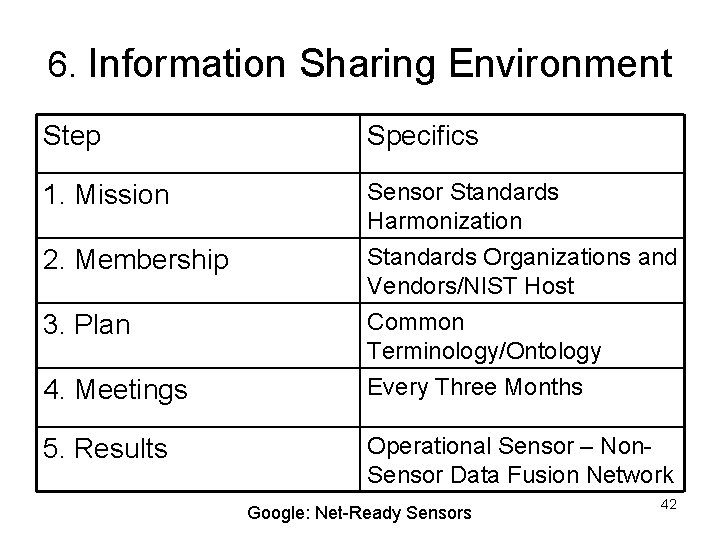
6. Information Sharing Environment Step Specifics 1. Mission Sensor Standards Harmonization 2. Membership Standards Organizations and Vendors/NIST Host 3. Plan Common Terminology/Ontology Every Three Months 4. Meetings 5. Results Operational Sensor – Non. Sensor Data Fusion Network Google: Net-Ready Sensors 42
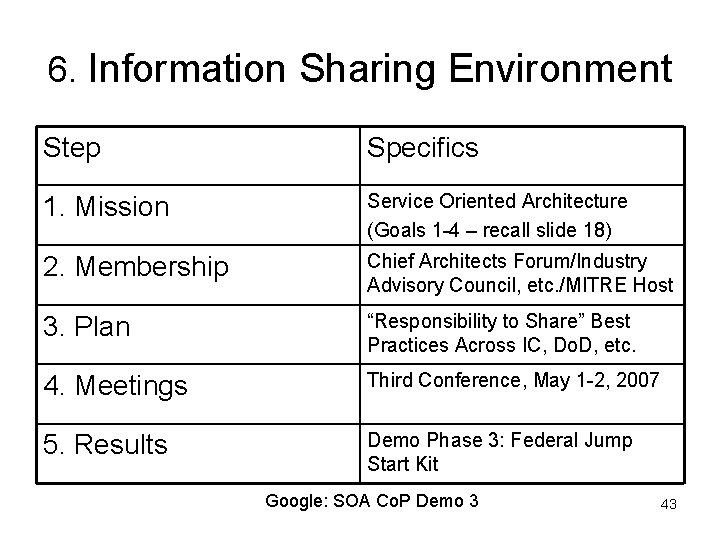
6. Information Sharing Environment Step Specifics 1. Mission Service Oriented Architecture (Goals 1 -4 – recall slide 18) 2. Membership Chief Architects Forum/Industry Advisory Council, etc. /MITRE Host 3. Plan “Responsibility to Share” Best Practices Across IC, Do. D, etc. 4. Meetings Third Conference, May 1 -2, 2007 5. Results Demo Phase 3: Federal Jump Start Kit Google: SOA Co. P Demo 3 43
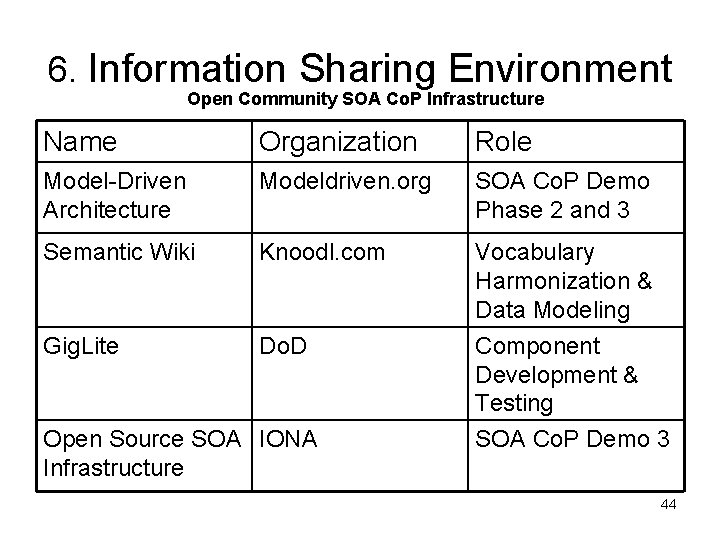
6. Information Sharing Environment Open Community SOA Co. P Infrastructure Name Organization Role Model-Driven Architecture Modeldriven. org SOA Co. P Demo Phase 2 and 3 Semantic Wiki Knoodl. com Vocabulary Harmonization & Data Modeling Gig. Lite Do. D Component Development & Testing SOA Co. P Demo 3 Open Source SOA IONA Infrastructure 44
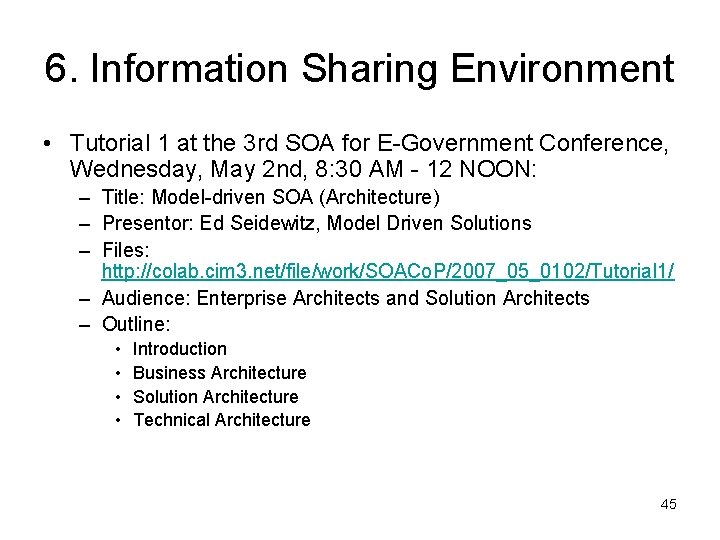
6. Information Sharing Environment • Tutorial 1 at the 3 rd SOA for E-Government Conference, Wednesday, May 2 nd, 8: 30 AM - 12 NOON: – Title: Model-driven SOA (Architecture) – Presentor: Ed Seidewitz, Model Driven Solutions – Files: http: //colab. cim 3. net/file/work/SOACo. P/2007_05_0102/Tutorial 1/ – Audience: Enterprise Architects and Solution Architects – Outline: • • Introduction Business Architecture Solution Architecture Technical Architecture 45
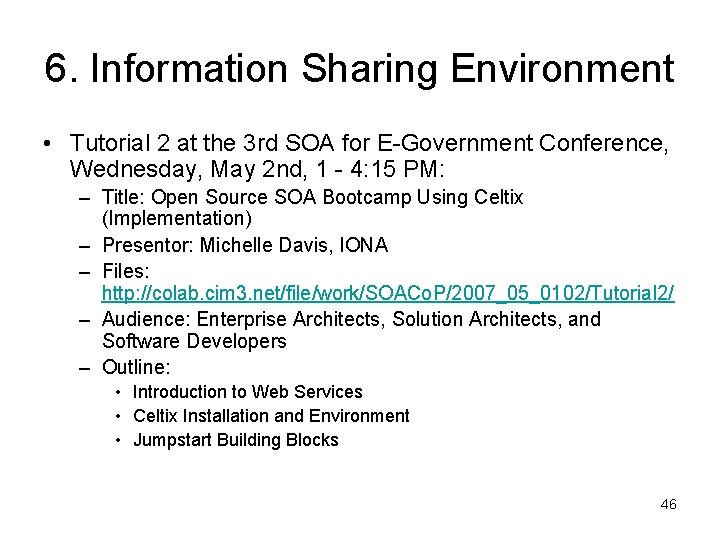
6. Information Sharing Environment • Tutorial 2 at the 3 rd SOA for E-Government Conference, Wednesday, May 2 nd, 1 - 4: 15 PM: – Title: Open Source SOA Bootcamp Using Celtix (Implementation) – Presentor: Michelle Davis, IONA – Files: http: //colab. cim 3. net/file/work/SOACo. P/2007_05_0102/Tutorial 2/ – Audience: Enterprise Architects, Solution Architects, and Software Developers – Outline: • Introduction to Web Services • Celtix Installation and Environment • Jumpstart Building Blocks 46
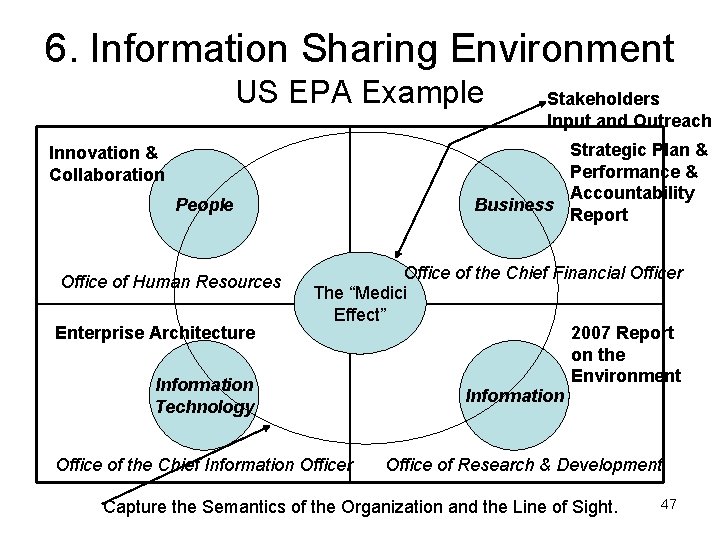
6. Information Sharing Environment US EPA Example Strategic Plan & Performance & Accountability Business Report Innovation & Collaboration People Office of Human Resources Enterprise Architecture Information Technology Stakeholders Input and Outreach Office of the Chief Financial Officer The “Medici Effect” 2007 Report on the Environment Information Office of the Chief Information Officer Office of Research & Development Capture the Semantics of the Organization and the Line of Sight. 47
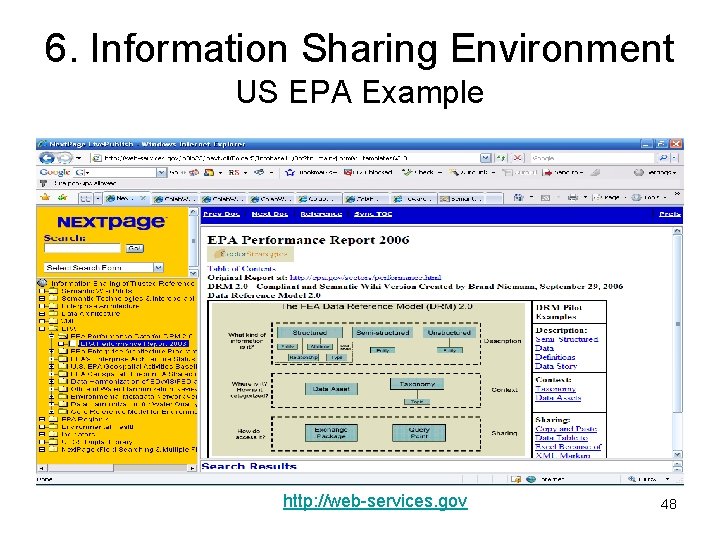
6. Information Sharing Environment US EPA Example http: //web-services. gov 48
The Answer • “The Medicis were a banking family in Florence who funded creators from a wide range of disciplines. Thanks to this family and a few others like it, sculptors, scientists, poets, philosophers, financiers, painters, and architects converged on the city of Florence. There they found each other, learned from one another, and broke down barriers and cultures. Together they forged a new world based on new ideas – what became known as the Renaissance. ” – Frans Johansson, The Medici Effect, Harvard Business School Press, 2006, pages 2 -3. 49
The Answer • The Medici Effect: – “When you step into an intersection of fields, disciplines, or cultures, you can combine existing concepts into a large number of extraordinary ideas. ” (recall slide 4) – “We have met teams and individuals who have searched for, and found, intersections between disciplines, cultures, concepts, and domains. Once there, they have the opportunity to innovate as never before, creating the Medici Effect. ” • Frans Johansson, The Medici Effect, Harvard Business School Press, 2006, page 186. 50
Synopsis • Enterprise Architecture now is really about getting to a common language (Semantic Interoperability) about SOA (Service-Oriented Architecture). • SOA itself is evolving to deal with the semantics of Data and Information Architecture across the distributed enterprise. • Service Systems are about people working with their information using information technology for a business purpose in an Information Sharing Environment. • An Information Sharing Environment produces service innovation (the Medici Effect). – So this is not for just Enterprise Architects, but about involving everybody! Recall slides 17, 32, 37, and 47. 51
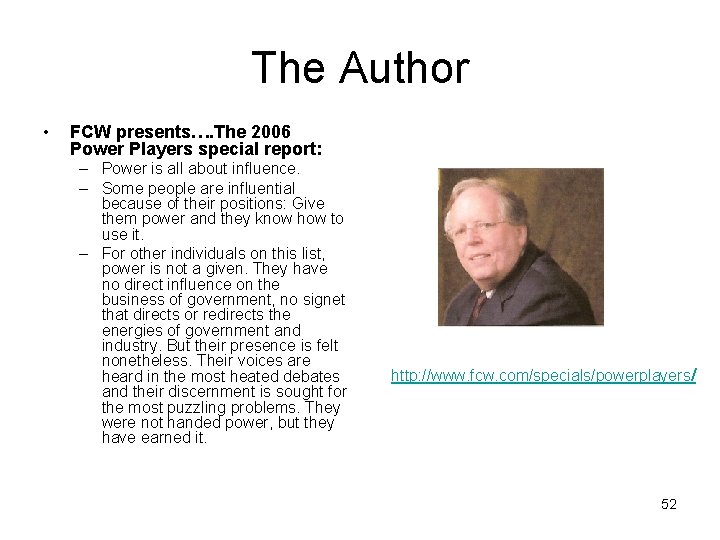
The Author • FCW presents…. The 2006 Power Players special report: – Power is all about influence. – Some people are influential because of their positions: Give them power and they know how to use it. – For other individuals on this list, power is not a given. They have no direct influence on the business of government, no signet that directs or redirects the energies of government and industry. But their presence is felt nonetheless. Their voices are heard in the most heated debates and their discernment is sought for the most puzzling problems. They were not handed power, but they have earned it. http: //www. fcw. com/specials/powerplayers/ 52