
Data Analytics Probability Darryl K Ahner Ph D
Data Analytics: Probability Darryl K. Ahner, Ph. D, P. E. AFIT Education Excellence: Inspiration Imagination Innovation Invention Implementation Impact
Readings for this Lesson • https: //www. dartmouth. edu/~chance/teaching_aids/books_articl es/probability_book/amsbook. mac. pdf (GNU license allow free distribution for educational purposes) Introduction to Probability by Grinstead and Snell, 2006 AFIT Education Excellence: Inspiration Imagination Innovation Invention Implementation Impact

Events and Probabilities • A random experiment is a process that generates well-defined outcomes • By specifying all possible outcomes, we identify the sample space for a random experiment; examples: • A coin toss • Rolling a die • An event is defined as a collection of outcomes AFIT Education Excellence: Inspiration Imagination Innovation Invention Implementation Impact
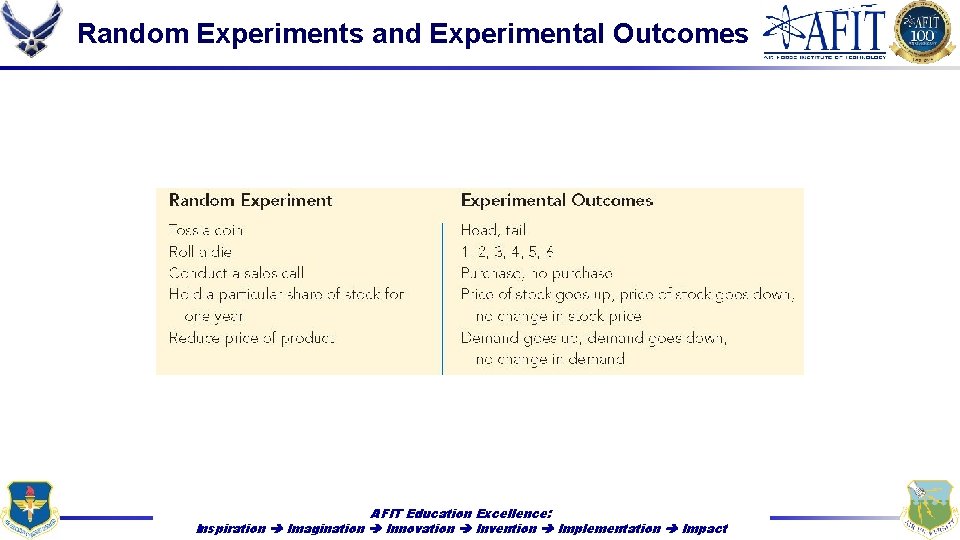
Random Experiments and Experimental Outcomes AFIT Education Excellence: Inspiration Imagination Innovation Invention Implementation Impact
Events and Probabilities • Example: California Power & Light Company (CP&L) • CP&L is starting a project designed to increase the generating capacity of one of its plants in southern California • Analysis of similar construction projects indicates that the possible completion times for the project are 8, 9, 10, 11, and 12 months AFIT Education Excellence: Inspiration Imagination Innovation Invention Implementation Impact
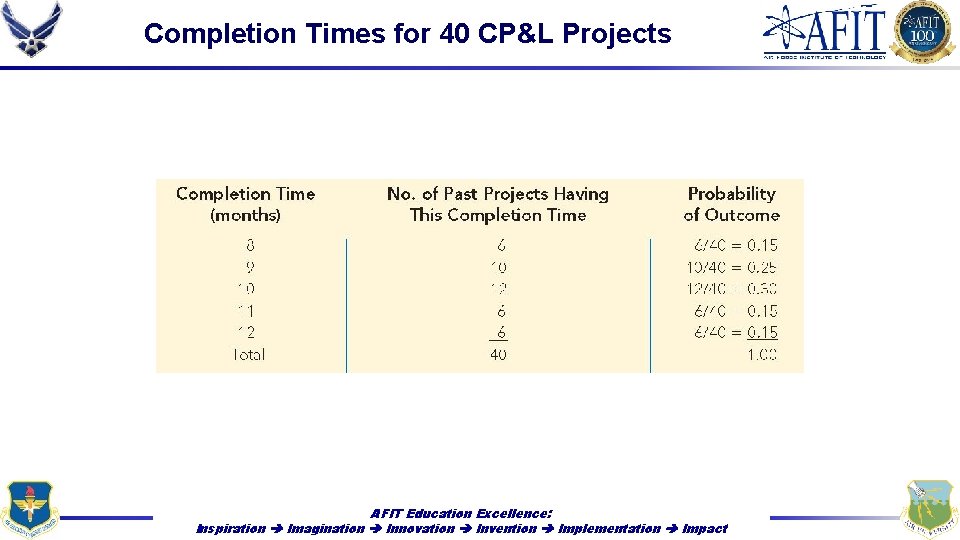
Completion Times for 40 CP&L Projects AFIT Education Excellence: Inspiration Imagination Innovation Invention Implementation Impact
Events and Probabilities • The probability of an event is equal to the sum of probabilities of outcomes for the event • CP&L example: Letting C denote the event that the project is completed in 10 months or less • The probability of event C, denoted P(C), is given by: P(C) = P(8) + P(9) + P(10) = 0. 15 + 0. 25 + 0. 30 = 0. 70 • We can tell CP&L management that there is a 0. 70 probability that the project will be completed in 10 months or less AFIT Education Excellence: Inspiration Imagination Innovation Invention Implementation Impact
Complement of an Event Addition Law SOME BASIC RELATIONSHIPS OF PROBABILITY AFIT Education Excellence: Inspiration Imagination Innovation Invention Implementation Impact
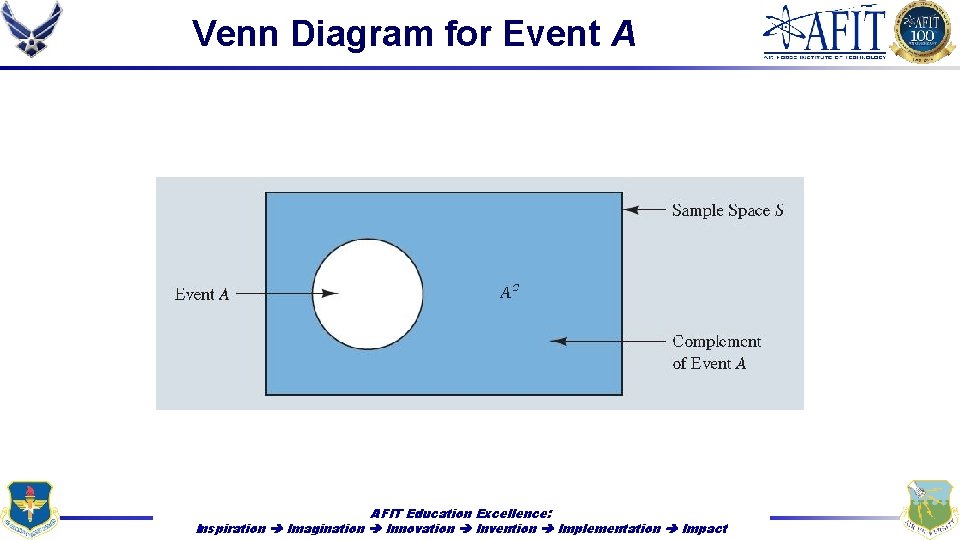
Some Basic Relationships of Probability Completion of an Event • Given an event A, the complement of A is defined to be the event consisting of all outcomes that are not in A • Figure 5. 1 shows what is known as a Venn diagram, which illustrates the concept of a complement • Rectangular area represents the sample space for the random experiment and contains all possible outcomes • Circle represents event A and contains only the outcomes that belong to A • The shaded region of the rectangle contains all outcomes not in event A AFIT Education Excellence: Inspiration Imagination Innovation Invention Implementation Impact
Venn Diagram for Event A AFIT Education Excellence: Inspiration Imagination Innovation Invention Implementation Impact
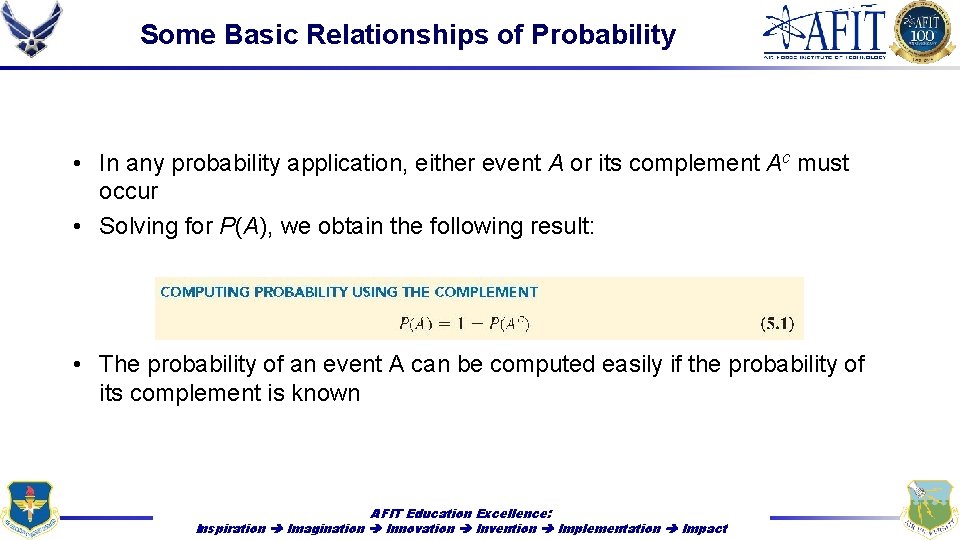
Some Basic Relationships of Probability • In any probability application, either event A or its complement Ac must occur • Solving for P(A), we obtain the following result: • The probability of an event A can be computed easily if the probability of its complement is known AFIT Education Excellence: Inspiration Imagination Innovation Invention Implementation Impact
Some Basic Relationships of Probability Addition Law • The addition law is helpful when we are interested in knowing the probability that at least one of two events will occur • Concepts related to the combination of events: • The union of events • The intersection of events AFIT Education Excellence: Inspiration Imagination Innovation Invention Implementation Impact
Some Basic Relationships of Probability • Given two events A and B, the union of A and B is defined as the event containing all outcomes belonging to A or B or both • The union of A and B is denoted • The Venn diagram in Figure 5. 2 depicts the union of A and B • One circle contains all the outcomes of A • The other contains all the outcomes of B AFIT Education Excellence: Inspiration Imagination Innovation Invention Implementation Impact
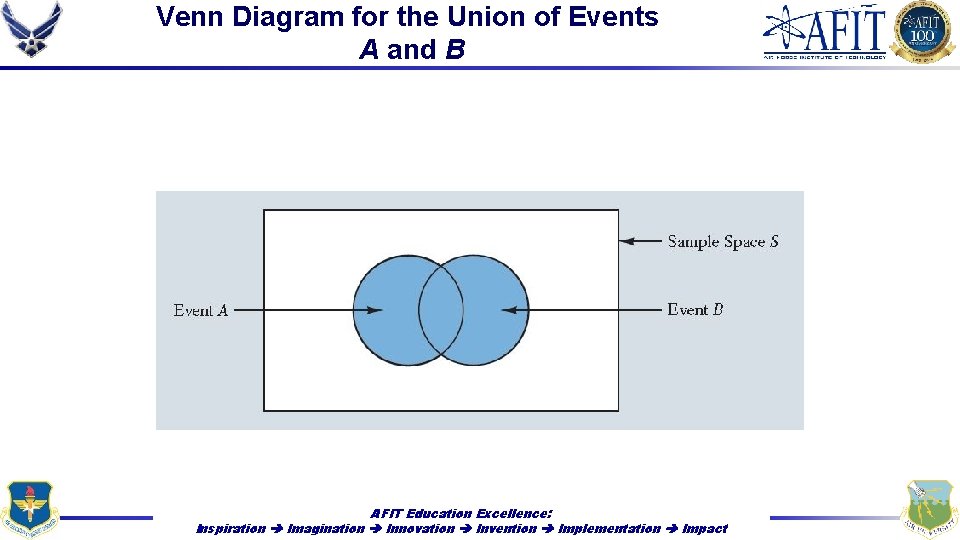
Venn Diagram for the Union of Events A and B AFIT Education Excellence: Inspiration Imagination Innovation Invention Implementation Impact
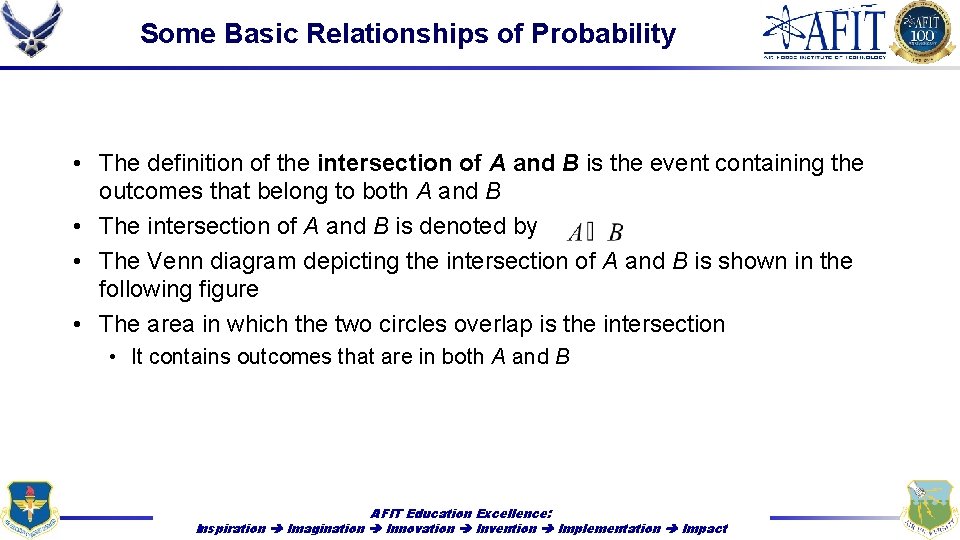
Some Basic Relationships of Probability • The definition of the intersection of A and B is the event containing the outcomes that belong to both A and B • The intersection of A and B is denoted by • The Venn diagram depicting the intersection of A and B is shown in the following figure • The area in which the two circles overlap is the intersection • It contains outcomes that are in both A and B AFIT Education Excellence: Inspiration Imagination Innovation Invention Implementation Impact
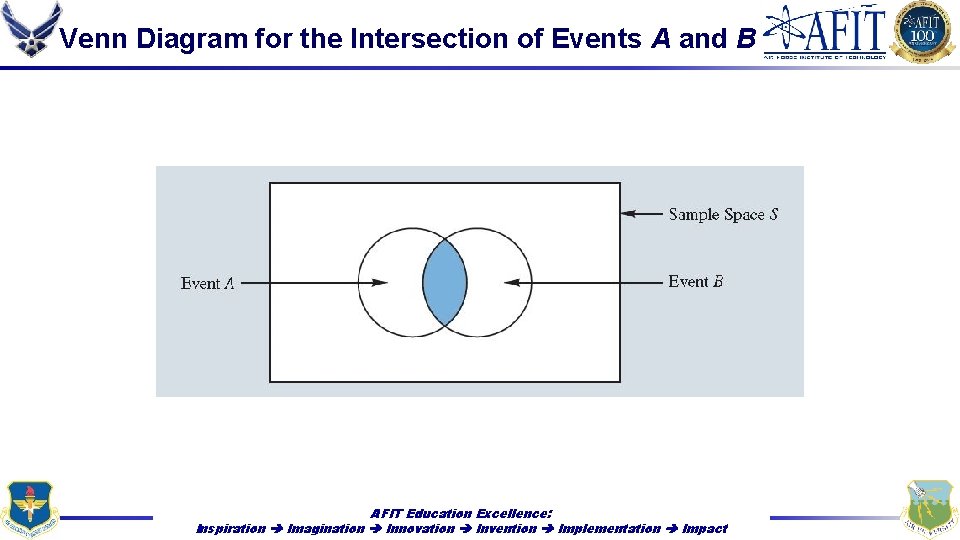
Venn Diagram for the Intersection of Events A and B AFIT Education Excellence: Inspiration Imagination Innovation Invention Implementation Impact
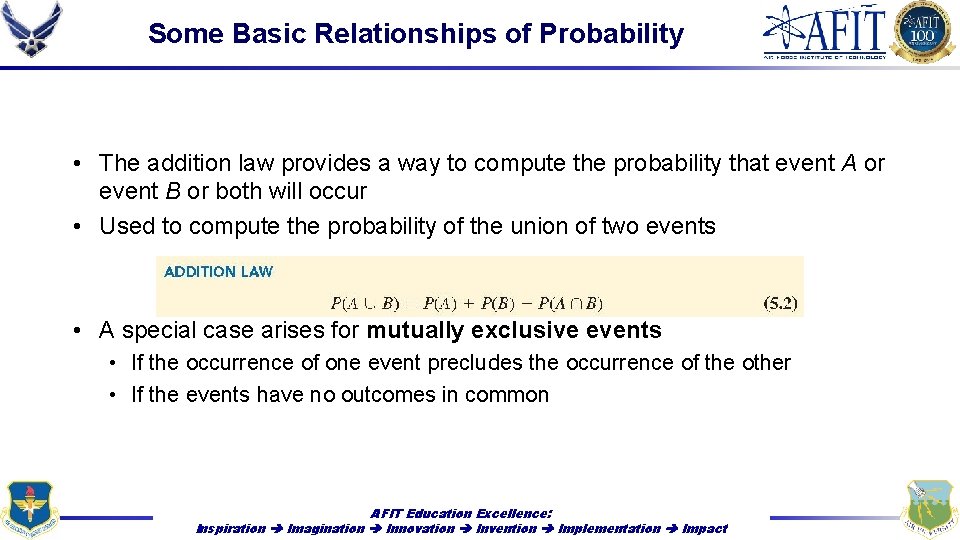
Some Basic Relationships of Probability • The addition law provides a way to compute the probability that event A or event B or both will occur • Used to compute the probability of the union of two events • A special case arises for mutually exclusive events • If the occurrence of one event precludes the occurrence of the other • If the events have no outcomes in common AFIT Education Excellence: Inspiration Imagination Innovation Invention Implementation Impact
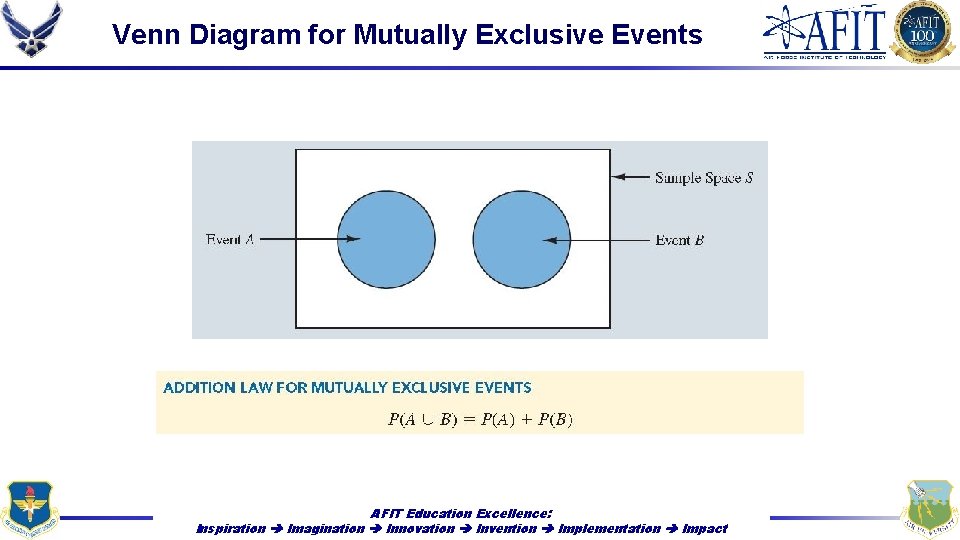
Venn Diagram for Mutually Exclusive Events AFIT Education Excellence: Inspiration Imagination Innovation Invention Implementation Impact
Independent Events Multiplication Law Bayes’ Theorem CONDITIONAL PROBABILITY AFIT Education Excellence: Inspiration Imagination Innovation Invention Implementation Impact
Conditional Probability • Conditional probability: when the probability of one event is dependent on whether some related event has already occurred • Illustration: Lancaster Savings and Loan • Interested in mortgage default risk • Interested in whether the probability of a customer defaulting differs by marital status AFIT Education Excellence: Inspiration Imagination Innovation Invention Implementation Impact
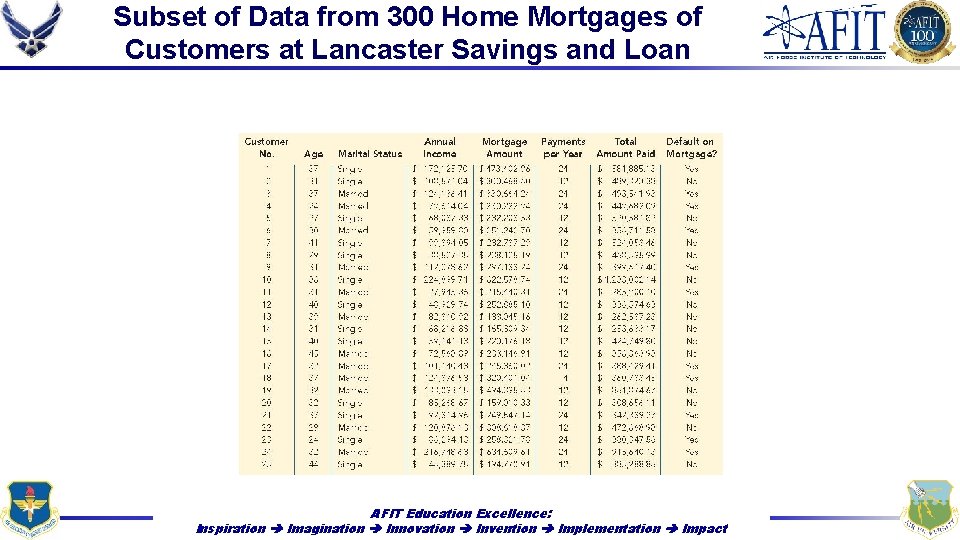
Subset of Data from 300 Home Mortgages of Customers at Lancaster Savings and Loan AFIT Education Excellence: Inspiration Imagination Innovation Invention Implementation Impact
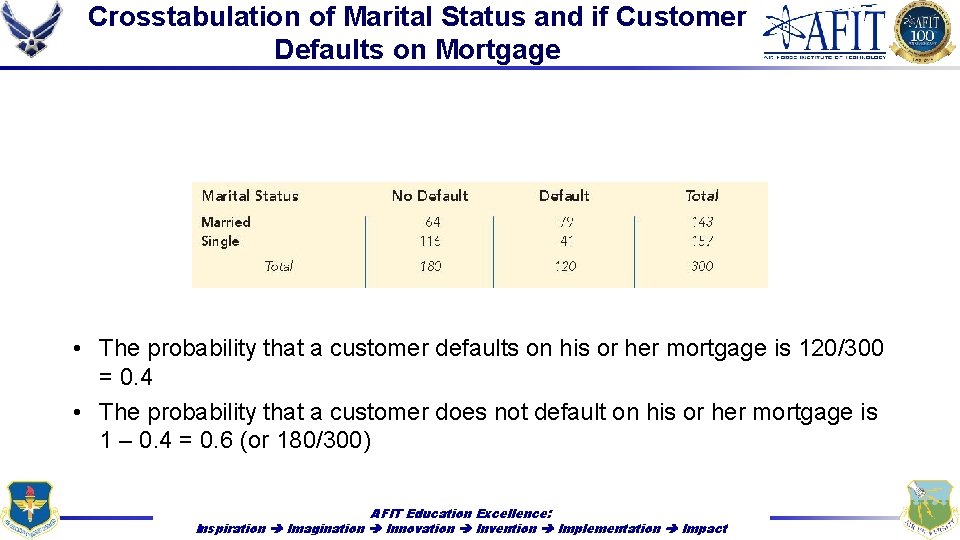
Crosstabulation of Marital Status and if Customer Defaults on Mortgage • The probability that a customer defaults on his or her mortgage is 120/300 = 0. 4 • The probability that a customer does not default on his or her mortgage is 1 – 0. 4 = 0. 6 (or 180/300) AFIT Education Excellence: Inspiration Imagination Innovation Invention Implementation Impact

Pivot. Table for Marital Status and Whether Customer Defaults on Mortgage AFIT Education Excellence: Inspiration Imagination Innovation Invention Implementation Impact
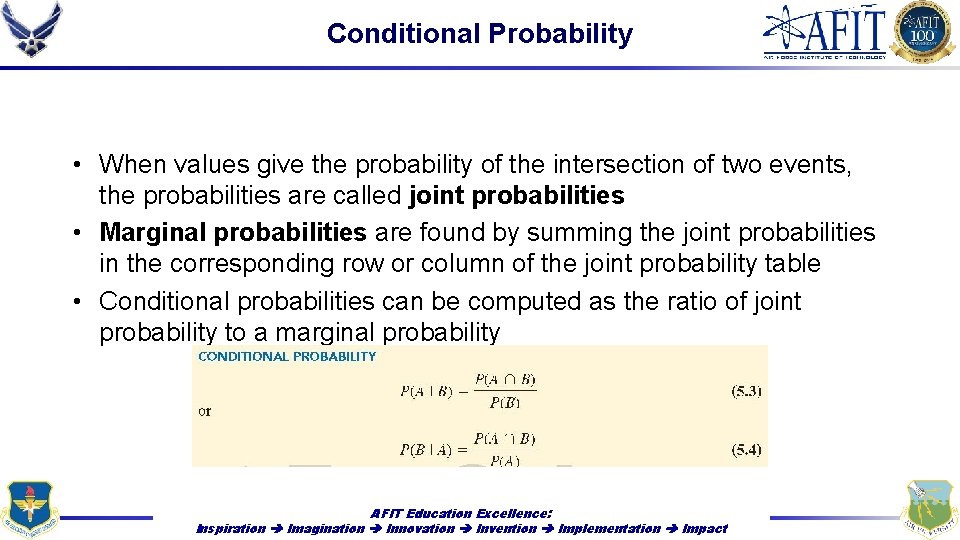
Conditional Probability • When values give the probability of the intersection of two events, the probabilities are called joint probabilities • Marginal probabilities are found by summing the joint probabilities in the corresponding row or column of the joint probability table • Conditional probabilities can be computed as the ratio of joint probability to a marginal probability AFIT Education Excellence: Inspiration Imagination Innovation Invention Implementation Impact
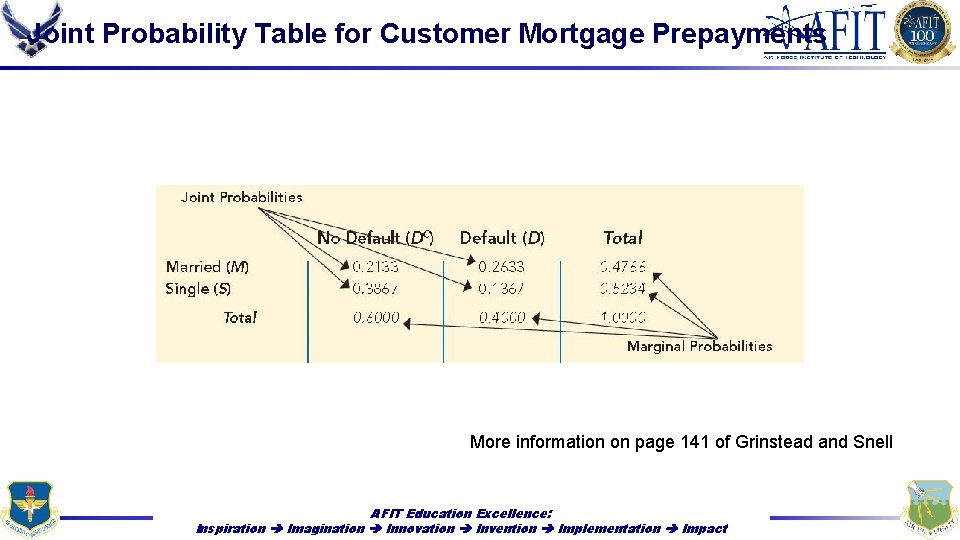
Joint Probability Table for Customer Mortgage Prepayments More information on page 141 of Grinstead and Snell AFIT Education Excellence: Inspiration Imagination Innovation Invention Implementation Impact
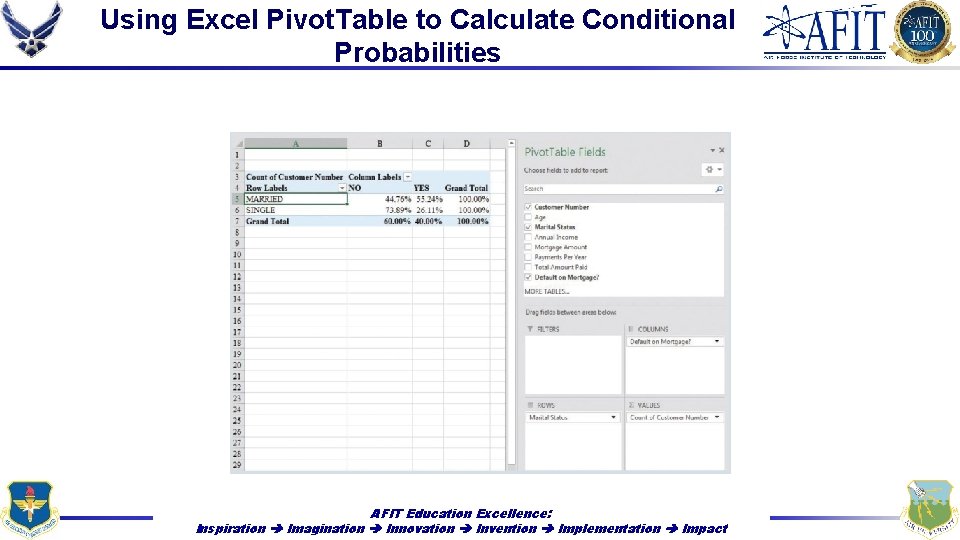
Using Excel Pivot. Table to Calculate Conditional Probabilities AFIT Education Excellence: Inspiration Imagination Innovation Invention Implementation Impact
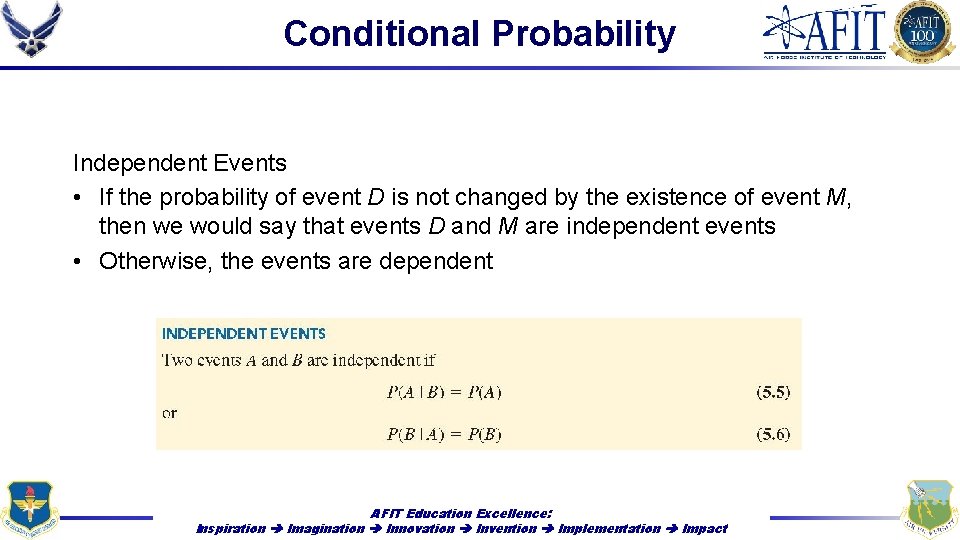
Conditional Probability Independent Events • If the probability of event D is not changed by the existence of event M, then we would say that events D and M are independent events • Otherwise, the events are dependent AFIT Education Excellence: Inspiration Imagination Innovation Invention Implementation Impact
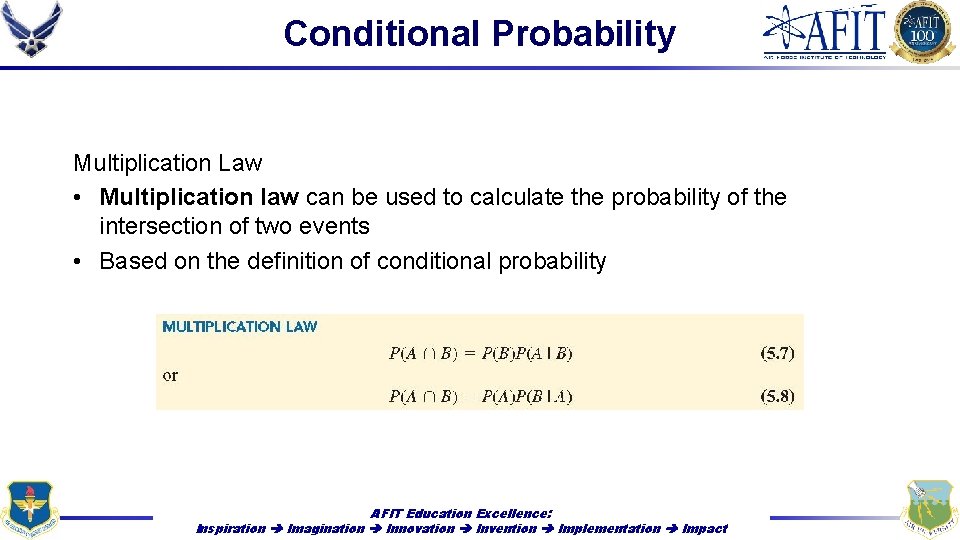
Conditional Probability Multiplication Law • Multiplication law can be used to calculate the probability of the intersection of two events • Based on the definition of conditional probability AFIT Education Excellence: Inspiration Imagination Innovation Invention Implementation Impact
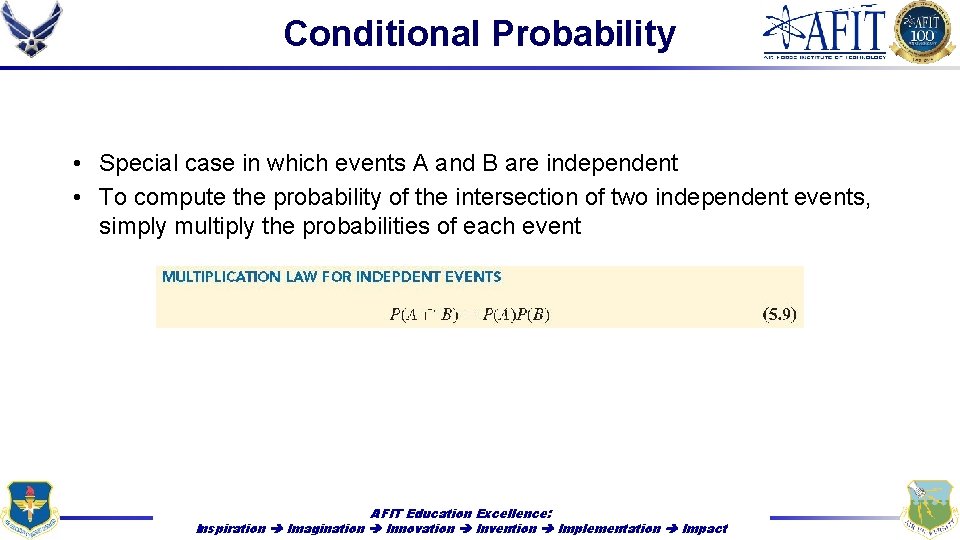
Conditional Probability • Special case in which events A and B are independent • To compute the probability of the intersection of two independent events, simply multiply the probabilities of each event AFIT Education Excellence: Inspiration Imagination Innovation Invention Implementation Impact
Conditional Probability Bayes’ Theorem • Often begin the analysis with initial or prior probability estimates for specific events of interest • Then, obtain additional information about events • Given new information, update the prior probability values by calculating revised probabilities, referred to as posterior probabilities • Bayes’ theorem provides a means for making these probability calculations AFIT Education Excellence: Inspiration Imagination Innovation Invention Implementation Impact
Conditional Probability • Example: A manufacturing firm receives shipments of parts from two different suppliers • 65% of the parts purchased from supplier 1 • 35% of the parts purchased from supplier 2 • Quality of purchased parts varies according to their source AFIT Education Excellence: Inspiration Imagination Innovation Invention Implementation Impact
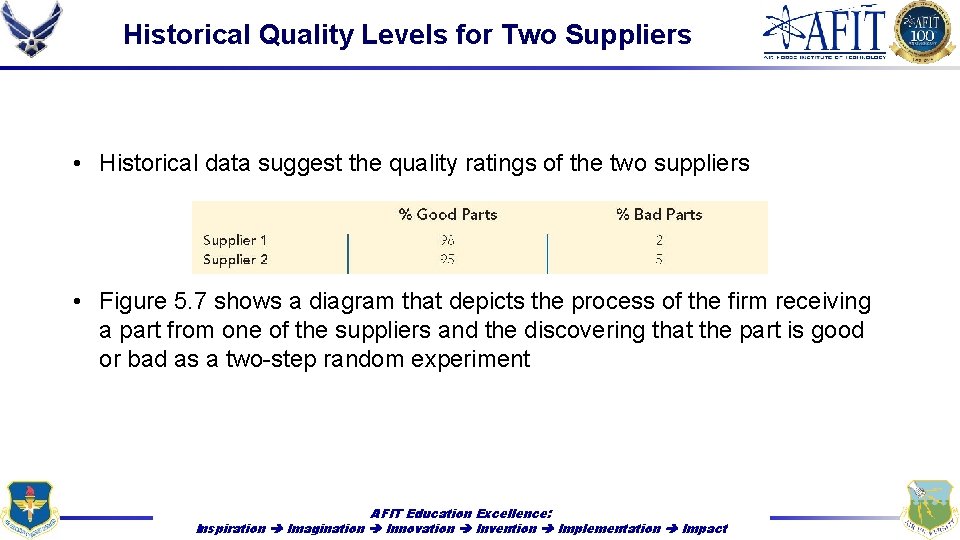
Historical Quality Levels for Two Suppliers • Historical data suggest the quality ratings of the two suppliers • Figure 5. 7 shows a diagram that depicts the process of the firm receiving a part from one of the suppliers and the discovering that the part is good or bad as a two-step random experiment AFIT Education Excellence: Inspiration Imagination Innovation Invention Implementation Impact
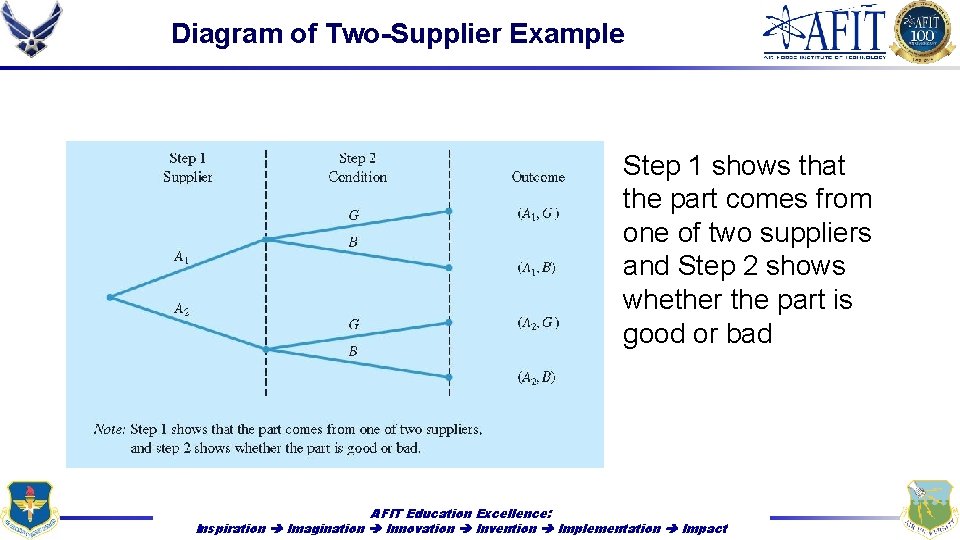
Diagram of Two-Supplier Example Step 1 shows that the part comes from one of two suppliers and Step 2 shows whether the part is good or bad AFIT Education Excellence: Inspiration Imagination Innovation Invention Implementation Impact
Conditional Probability • The process of computing joint probabilities can be depicted in what is called a probability tree • From left to right through the tree: • The probabilities for each branch at step 1 are prior probabilities • The probabilities for each branch at step 2 are conditional probabilities • To find the probability of each experimental outcome, multiply the probabilities on the branches leading to the outcome AFIT Education Excellence: Inspiration Imagination Innovation Invention Implementation Impact
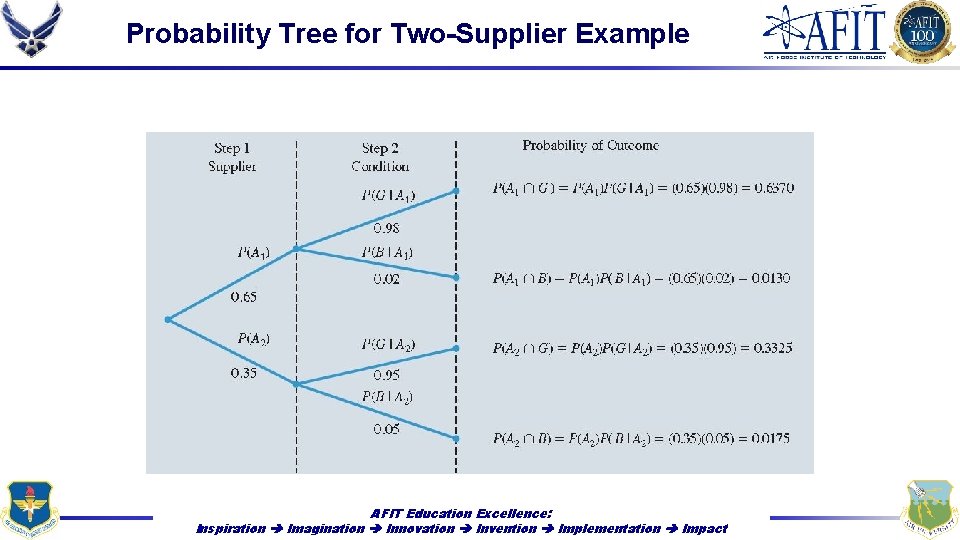
Probability Tree for Two-Supplier Example AFIT Education Excellence: Inspiration Imagination Innovation Invention Implementation Impact
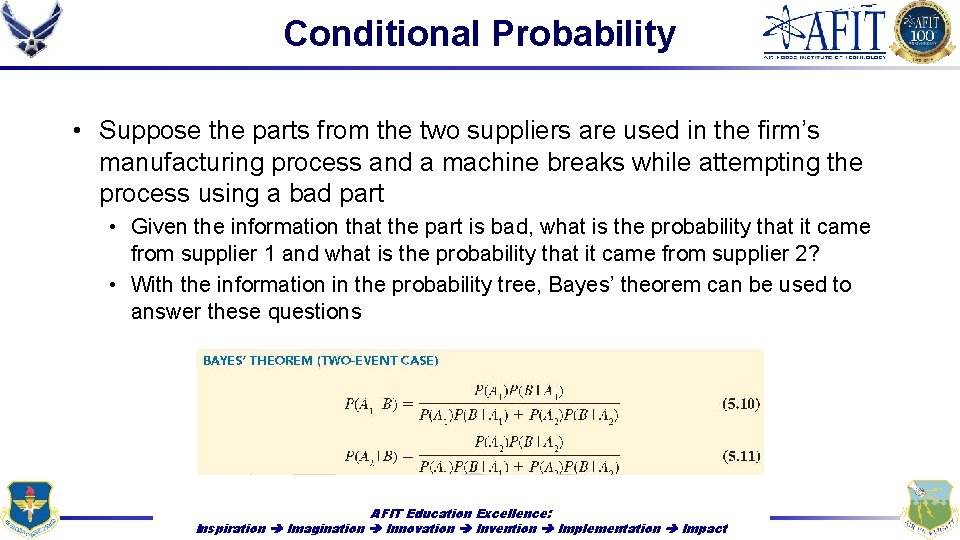
Conditional Probability • Suppose the parts from the two suppliers are used in the firm’s manufacturing process and a machine breaks while attempting the process using a bad part • Given the information that the part is bad, what is the probability that it came from supplier 1 and what is the probability that it came from supplier 2? • With the information in the probability tree, Bayes’ theorem can be used to answer these questions AFIT Education Excellence: Inspiration Imagination Innovation Invention Implementation Impact
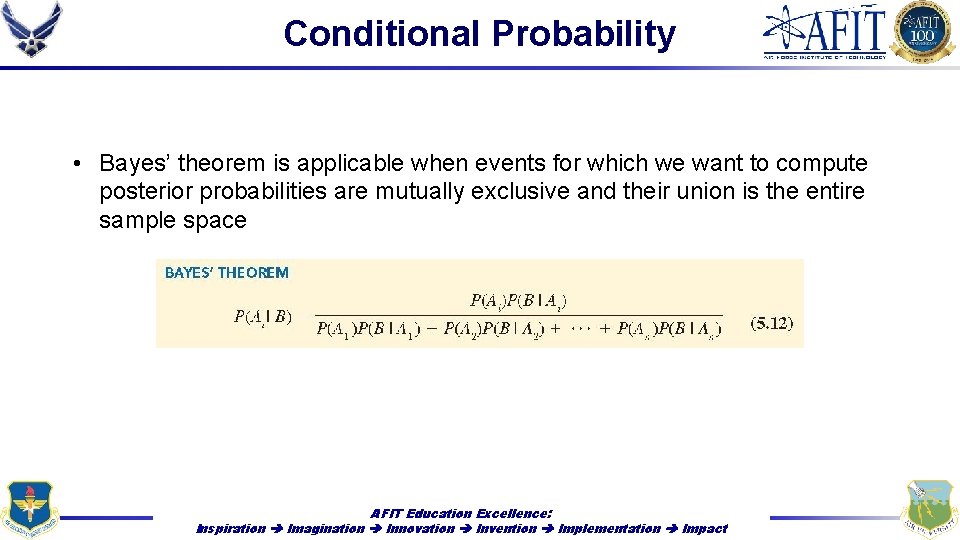
Conditional Probability • Bayes’ theorem is applicable when events for which we want to compute posterior probabilities are mutually exclusive and their union is the entire sample space AFIT Education Excellence: Inspiration Imagination Innovation Invention Implementation Impact

BREAK AFIT Education Excellence: Inspiration Imagination Innovation Invention Implementation Impact
Discrete Random Variables Continuous Random Variables RANDOM VARIABLES AFIT Education Excellence: Inspiration Imagination Innovation Invention Implementation Impact
Random Variables • Random variables are quantities whose values are not known with certainty • In probability terms, a random variable is a numerical description of the outcome of a random experiment • A random variable can be classifies as being either: • Discrete • Continuous AFIT Education Excellence: Inspiration Imagination Innovation Invention Implementation Impact
Random Variables Discrete Random Variables • A random variable that can take on only specified discrete values is referred to as a discrete random variable AFIT Education Excellence: Inspiration Imagination Innovation Invention Implementation Impact
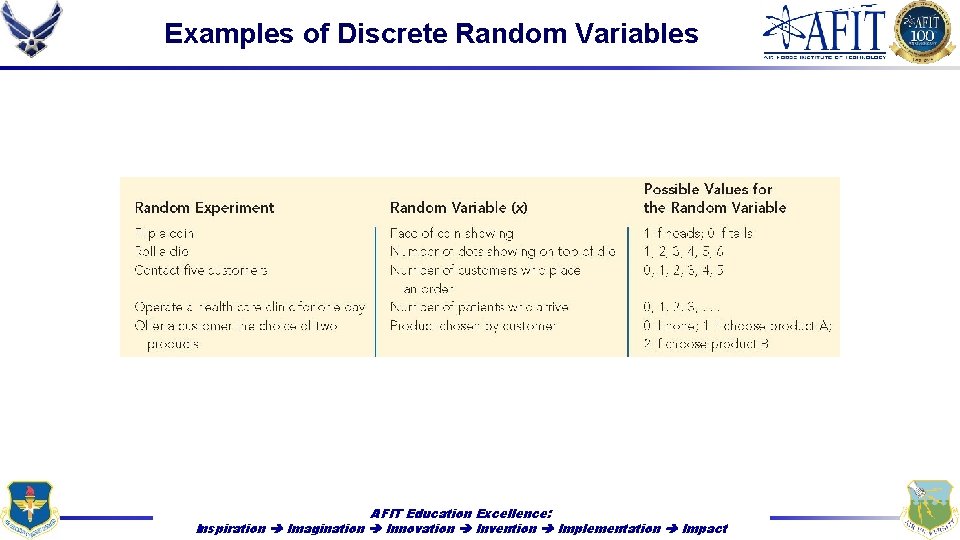
Examples of Discrete Random Variables AFIT Education Excellence: Inspiration Imagination Innovation Invention Implementation Impact
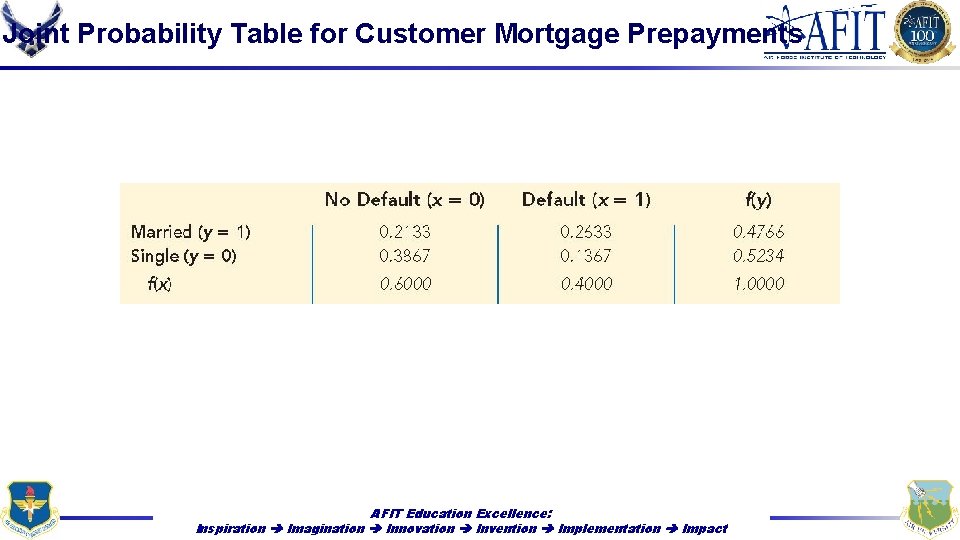
Joint Probability Table for Customer Mortgage Prepayments AFIT Education Excellence: Inspiration Imagination Innovation Invention Implementation Impact
Random Variables Continuous Random Variables • A random variable that may assume any numerical value in an interval or collection of intervals is called a continuous random variable • Technically, relatively few random variables are truly continuous; examples are values related to time, weight, distance, and temperature • Many discrete random variables have a large number of potential outcomes and so can be effectively modeled as continuous random variables AFIT Education Excellence: Inspiration Imagination Innovation Invention Implementation Impact
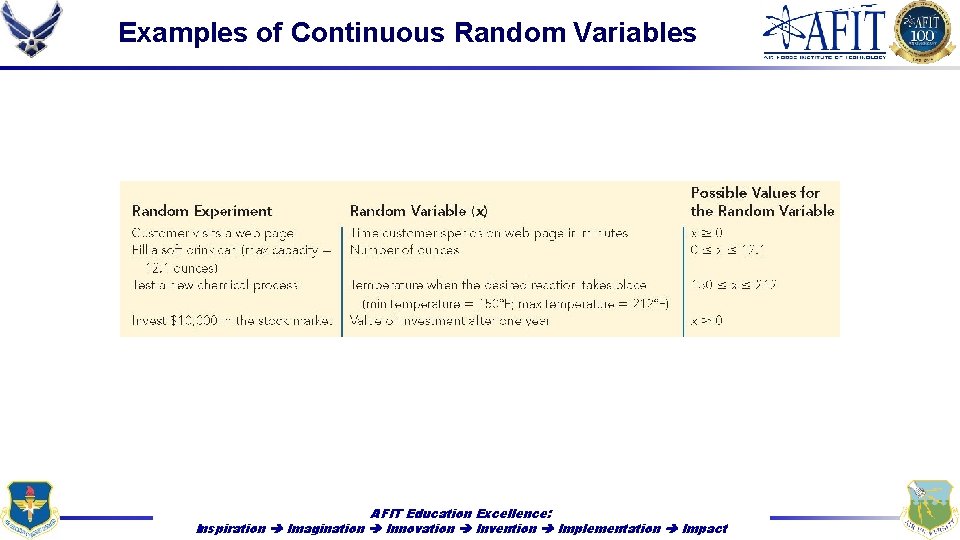
Examples of Continuous Random Variables AFIT Education Excellence: Inspiration Imagination Innovation Invention Implementation Impact
Custom Discrete Probability Distribution Expected Values and Variance Discrete Uniform Probability Distribution Binomial Probability Distribution Poisson Probability Distribution DISCRETE PROBABILITY DISTRIBUTIONS AFIT Education Excellence: Inspiration Imagination Innovation Invention Implementation Impact
Discrete Probability Distributions • The probability distribution for a random variable describes the range and relative likelihood of possible values for a random variable • For a discrete random variable x, the probability distribution is defined by the probability mass function, denoted by f(x) • The probability mass function provides the probability for each value of the random variable • We can present probability distributions graphically AFIT Education Excellence: Inspiration Imagination Innovation Invention Implementation Impact
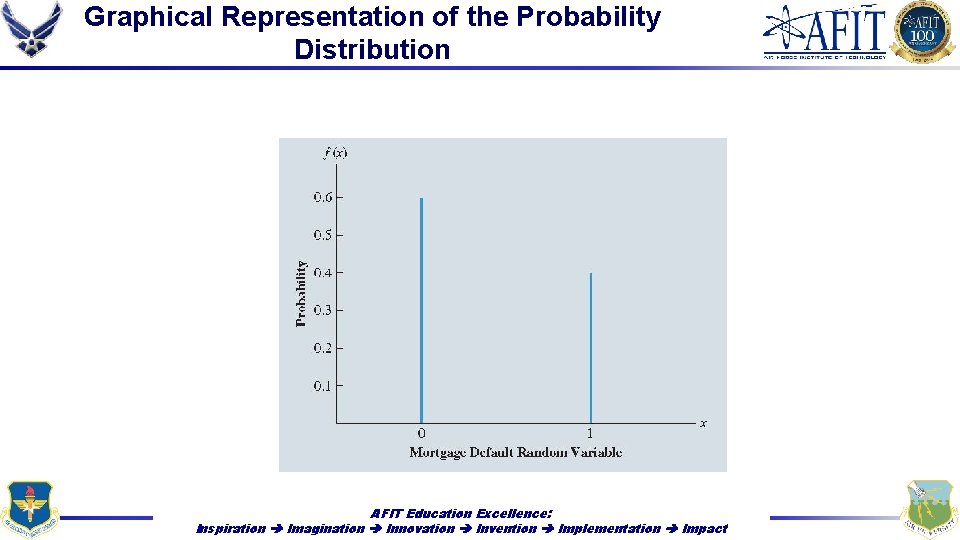
Graphical Representation of the Probability Distribution AFIT Education Excellence: Inspiration Imagination Innovation Invention Implementation Impact
Discrete Probability Distributions Custom Discrete Probability Distribution • A probability that is generated from observations is called an empirical probability distribution • An empirical probability is considered a custom discrete probability distribution if it is discrete and the possible values of the random variable have different values • Useful for describing different possible scenarios that have different probabilities • Probabilities generated using either the subjective method or the relative frequency method AFIT Education Excellence: Inspiration Imagination Innovation Invention Implementation Impact
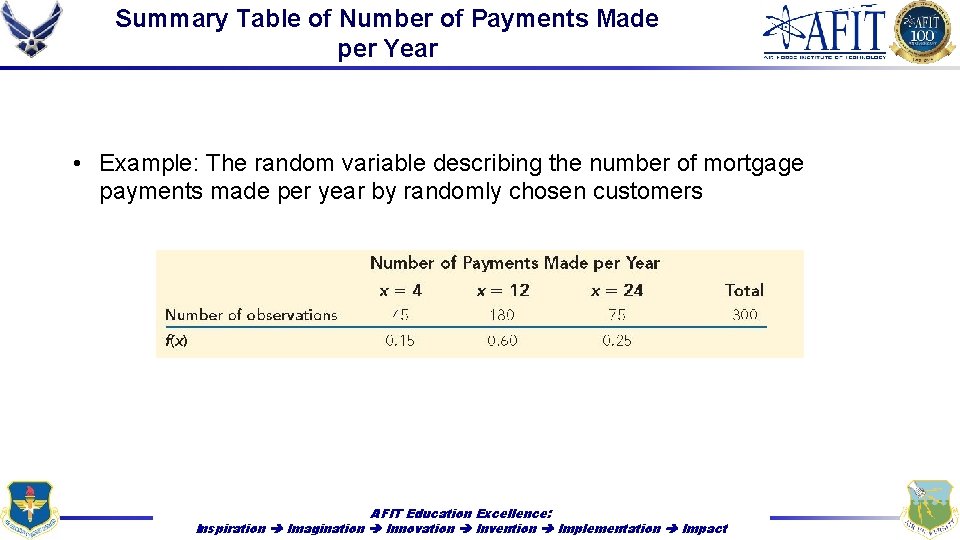
Summary Table of Number of Payments Made per Year • Example: The random variable describing the number of mortgage payments made per year by randomly chosen customers AFIT Education Excellence: Inspiration Imagination Innovation Invention Implementation Impact
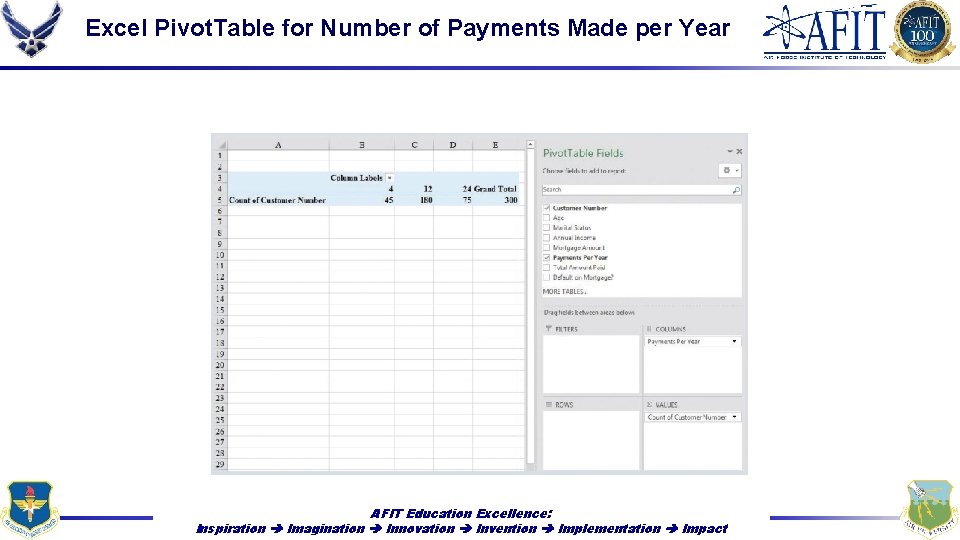
Excel Pivot. Table for Number of Payments Made per Year AFIT Education Excellence: Inspiration Imagination Innovation Invention Implementation Impact
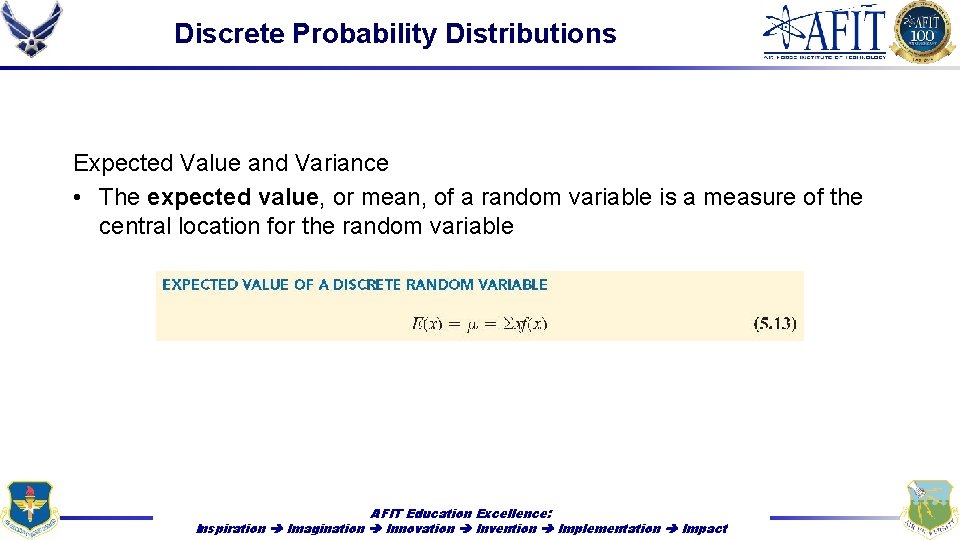
Discrete Probability Distributions Expected Value and Variance • The expected value, or mean, of a random variable is a measure of the central location for the random variable AFIT Education Excellence: Inspiration Imagination Innovation Invention Implementation Impact
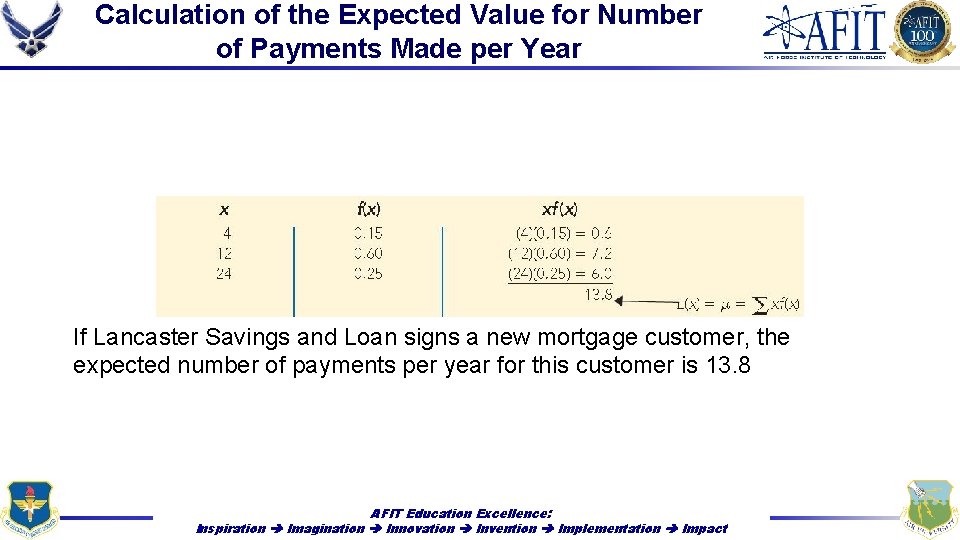
Calculation of the Expected Value for Number of Payments Made per Year If Lancaster Savings and Loan signs a new mortgage customer, the expected number of payments per year for this customer is 13. 8 AFIT Education Excellence: Inspiration Imagination Innovation Invention Implementation Impact
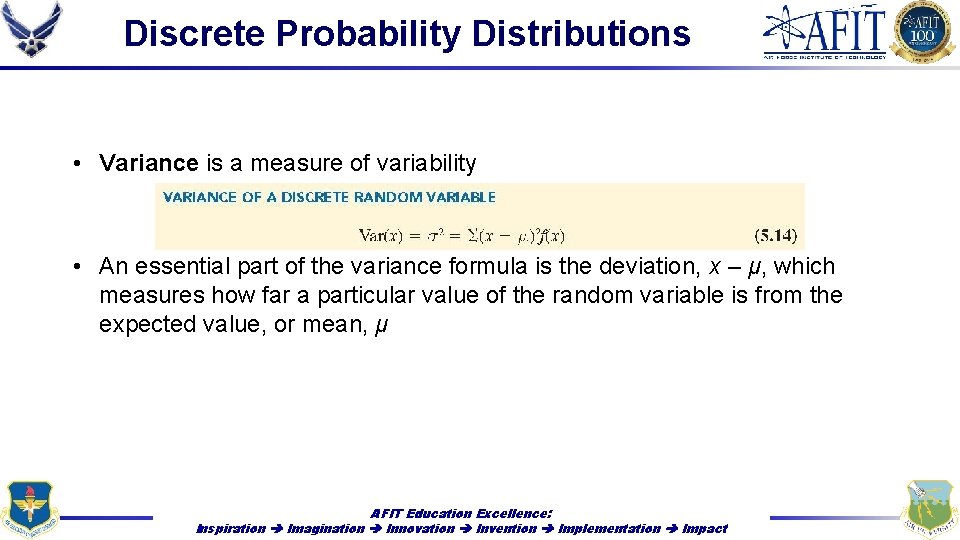
Discrete Probability Distributions • Variance is a measure of variability • An essential part of the variance formula is the deviation, x – μ, which measures how far a particular value of the random variable is from the expected value, or mean, μ AFIT Education Excellence: Inspiration Imagination Innovation Invention Implementation Impact
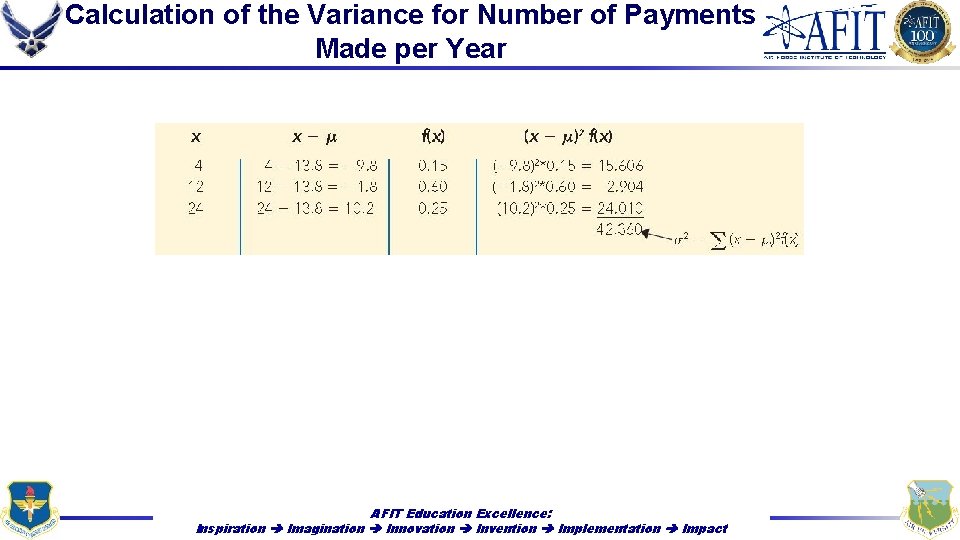
• Calculation of the Variance for Number of Payments Made per Year AFIT Education Excellence: Inspiration Imagination Innovation Invention Implementation Impact
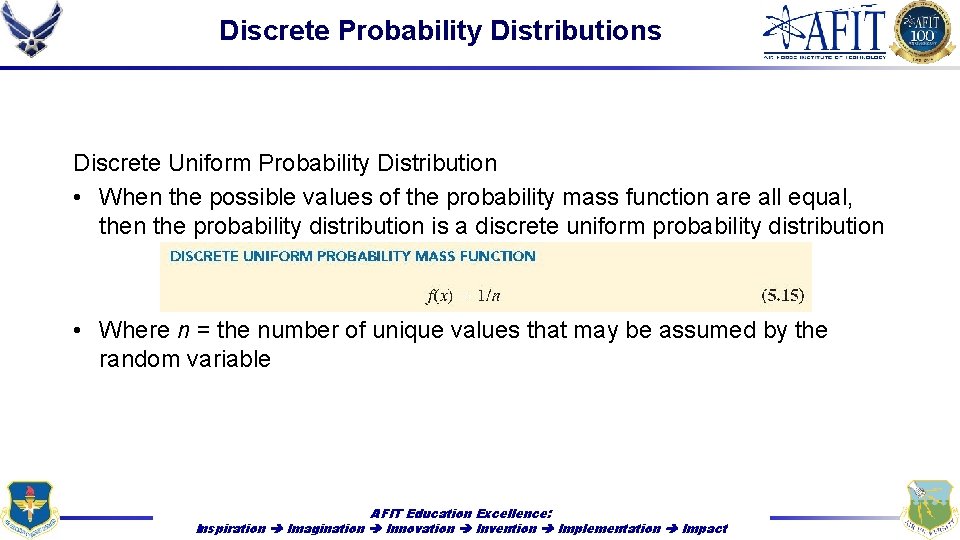
Discrete Probability Distributions Discrete Uniform Probability Distribution • When the possible values of the probability mass function are all equal, then the probability distribution is a discrete uniform probability distribution • Where n = the number of unique values that may be assumed by the random variable AFIT Education Excellence: Inspiration Imagination Innovation Invention Implementation Impact
Discrete Probability Distributions Binomial Probability Distribution • A binomial probability distribution is a discrete probability distribution that can be used to describe many situations in which a fixed number (n) of repeated identical and independent trials has two, and only two, possible outcomes: • Success • Failure AFIT Education Excellence: Inspiration Imagination Innovation Invention Implementation Impact
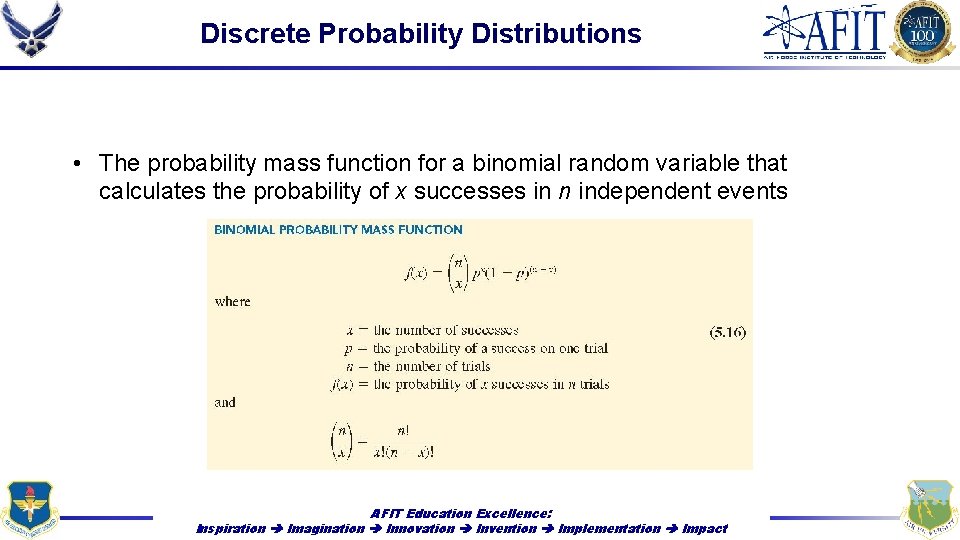
Discrete Probability Distributions • The probability mass function for a binomial random variable that calculates the probability of x successes in n independent events AFIT Education Excellence: Inspiration Imagination Innovation Invention Implementation Impact
Discrete Probability Distributions Poisson Probability Distribution • A discrete random variable that is often useful in estimating the number of occurrences of an event over a specified interval of time and space • Examples: • • Number of patients who arrive at a health care clinic in one hour Number of computer-server failures in a month Number of repairs needed in 10 miles of highway Number of leaks in 100 miles of pipeline AFIT Education Excellence: Inspiration Imagination Innovation Invention Implementation Impact
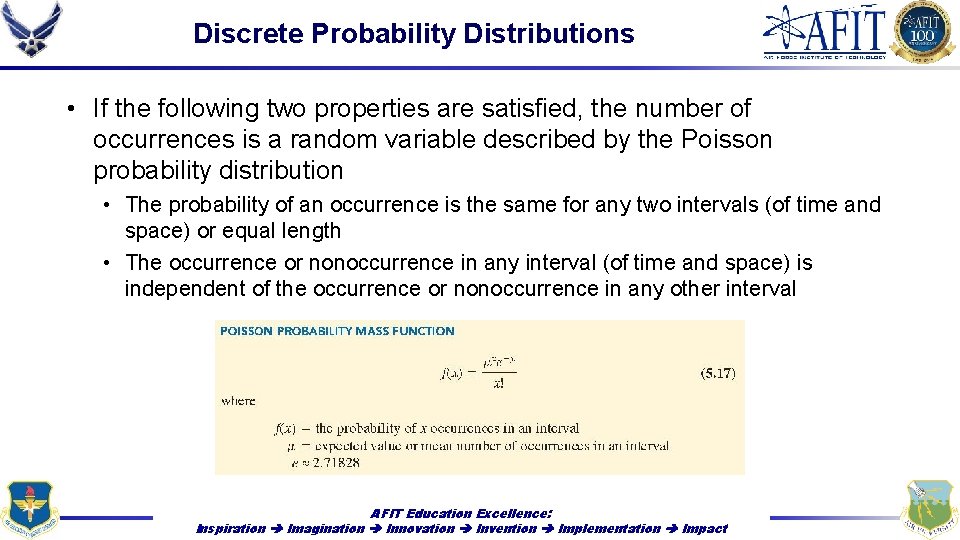
Discrete Probability Distributions • If the following two properties are satisfied, the number of occurrences is a random variable described by the Poisson probability distribution • The probability of an occurrence is the same for any two intervals (of time and space) or equal length • The occurrence or nonoccurrence in any interval (of time and space) is independent of the occurrence or nonoccurrence in any other interval AFIT Education Excellence: Inspiration Imagination Innovation Invention Implementation Impact

SUMMARY AFIT Education Excellence: Inspiration Imagination Innovation Invention Implementation Impact
- Slides: 61