
DATA ANALYSIS QUALITATIVE DR AKPOR DATA ANALYSIS The



- Slides: 27
DATA ANALYSIS QUALITATIVE DR AKPOR
DATA ANALYSIS • The purpose of data analysis is to organised, provide structure to and elicit meaning from the research data • Qualitative analysis is very tasking and requires insight, ingenuity, creativity, conceptual sensitivity and sheer hard work (Polit & Hungler, 2001) • As recognised by Parahoo (2006), data analysis in qualitative research start when the data is being collected and there after the researcher make judgement based on the data that is gotten relating it to the phenomenon that is under study.
DATA ANALYSIS CONTD • Jacelon and O’Dell (2005) said researcher serves as the instrument of data analysis because he explore and reflect on what have been discussed during the interview process • After gathering life world descriptions of personal experience, each account become a ‘text’ that is ready for the analysis of meaning and for the formulation of these meaning into a coherent story of inter-related themes and insight
DATA ANALYSIS CONTD • Analysis of qualitative data (interview) involves transcribing of data verbatim and the researcher should make sure that it is accurately transcribed. • Another step is organising data into classes and indexing them and data gotten is converted into smaller, more manageable unit that can be retrieved and review. • The next step is encoding of schemes i. e placed into themes and categories (Polit & Beck, 2010).
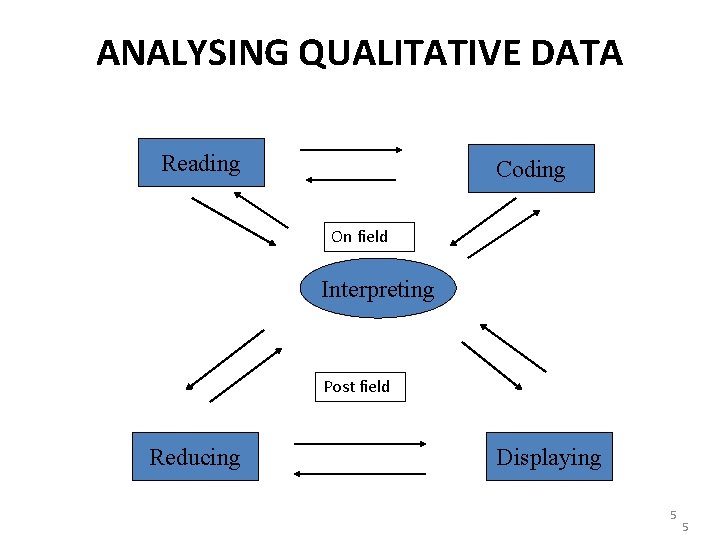
ANALYSING QUALITATIVE DATA Reading Coding On field Interpreting Post field Reducing Displaying 5 5
CONTENT ANALYSIS • Content analysis is an approach used to quantify content in terms of predetermined categories and in a systematic and replicable manner (Bryman, 2012). • Content analysis is an important strategy based on listing, counting and categorising participants’ words into text • In content analysis, the most frequent word spoken or used by the participants is written down and the number of occurrence is noted and put in relevant text
CONTENT ANALYSIS CONTD • Listing is also important in content analysis because it shows not only the frequency of the word but also the position of the frequent words and it is used for data expansion rather than reducing • And it involves replication of data in order to focus on the relevant word
STEPS IN QUALITATIVE DATA ANALYSIS • Reading: Developing intimacy with data – Reading for content • Are you obtaining the kind of data you expected • Are responses full and detailed or they are superficial • Begin to identify emerging themes & explanations – Noting quality • Check quality of transcripts e. g. non verbal interactions etc. – Identify patterns • Identify transcripts from different sources e. g. , different kinds of participants
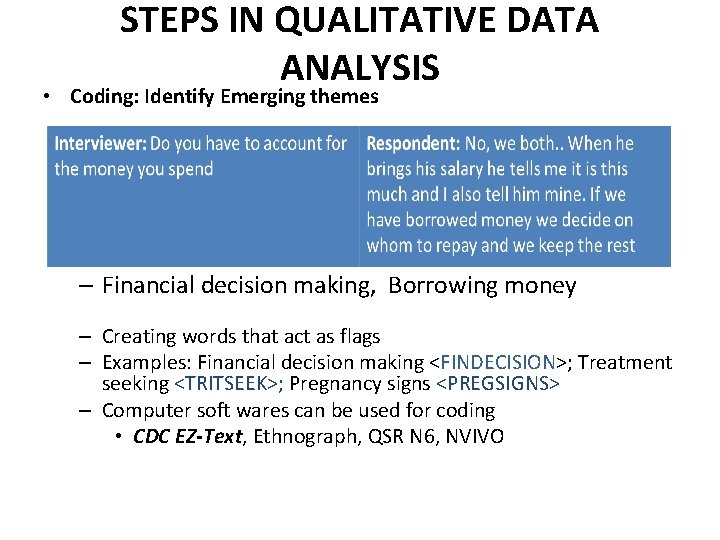
STEPS IN QUALITATIVE DATA ANALYSIS • Coding: Identify Emerging themes – Financial decision making, Borrowing money – Creating words that act as flags – Examples: Financial decision making <FINDECISION>; Treatment seeking <TRITSEEK>; Pregnancy signs <PREGSIGNS> – Computer soft wares can be used for coding • CDC EZ-Text, Ethnograph, QSR N 6, NVIVO
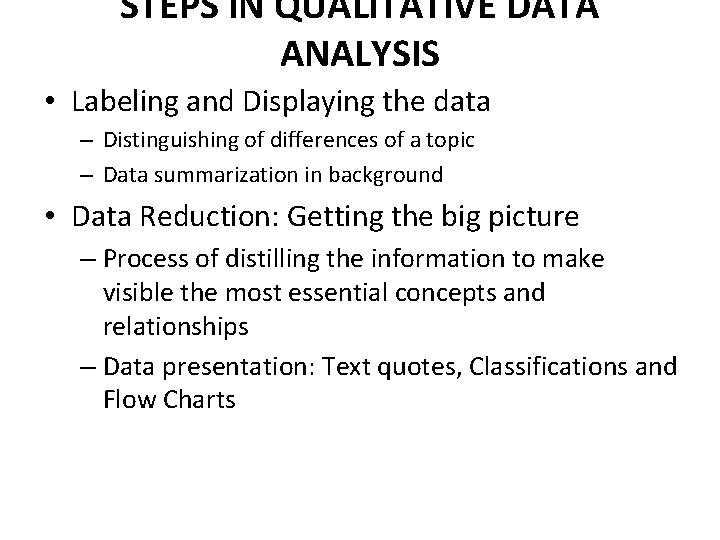
STEPS IN QUALITATIVE DATA ANALYSIS • Labeling and Displaying the data – Distinguishing of differences of a topic – Data summarization in background • Data Reduction: Getting the big picture – Process of distilling the information to make visible the most essential concepts and relationships – Data presentation: Text quotes, Classifications and Flow Charts
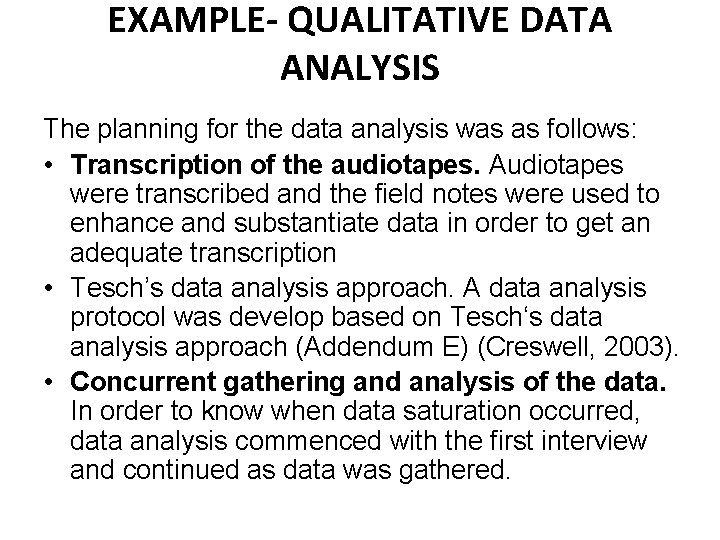
EXAMPLE- QUALITATIVE DATA ANALYSIS The planning for the data analysis was as follows: • Transcription of the audiotapes. Audiotapes were transcribed and the field notes were used to enhance and substantiate data in order to get an adequate transcription • Tesch’s data analysis approach. A data analysis protocol was develop based on Tesch‘s data analysis approach (Addendum E) (Creswell, 2003). • Concurrent gathering and analysis of the data. In order to know when data saturation occurred, data analysis commenced with the first interview and continued as data was gathered.
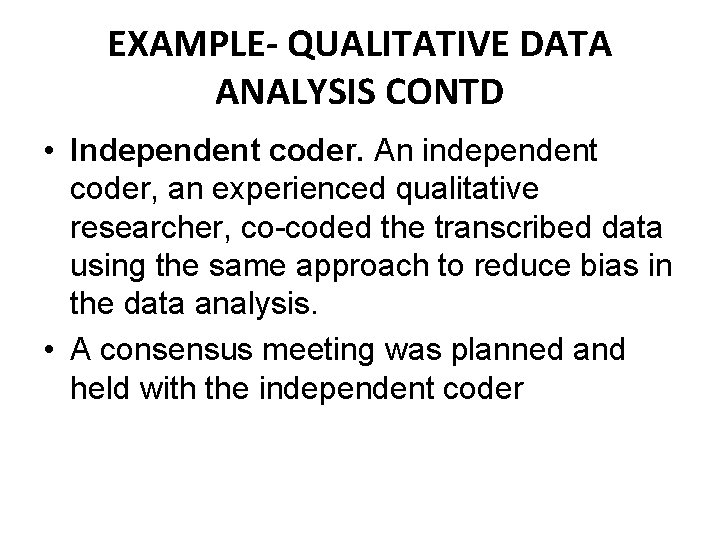
EXAMPLE- QUALITATIVE DATA ANALYSIS CONTD • Independent coder. An independent coder, an experienced qualitative researcher, co-coded the transcribed data using the same approach to reduce bias in the data analysis. • A consensus meeting was planned and held with the independent coder
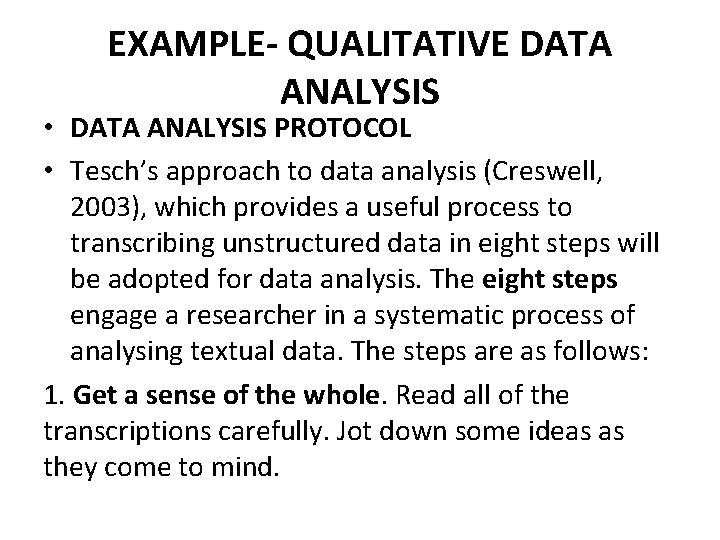
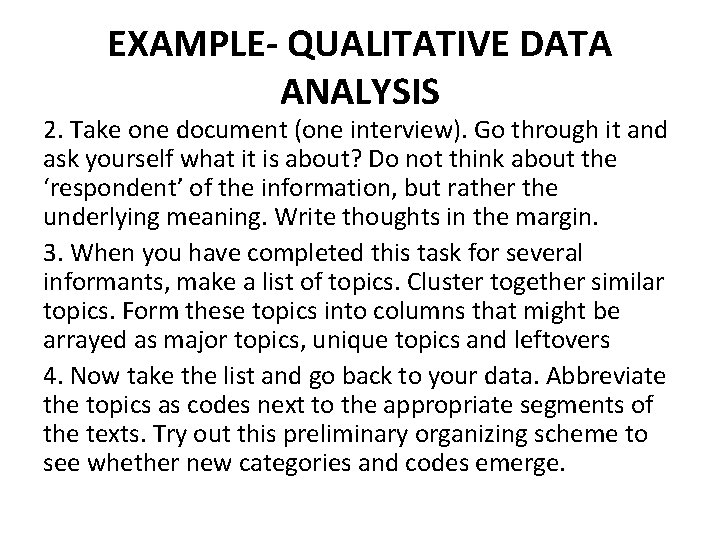
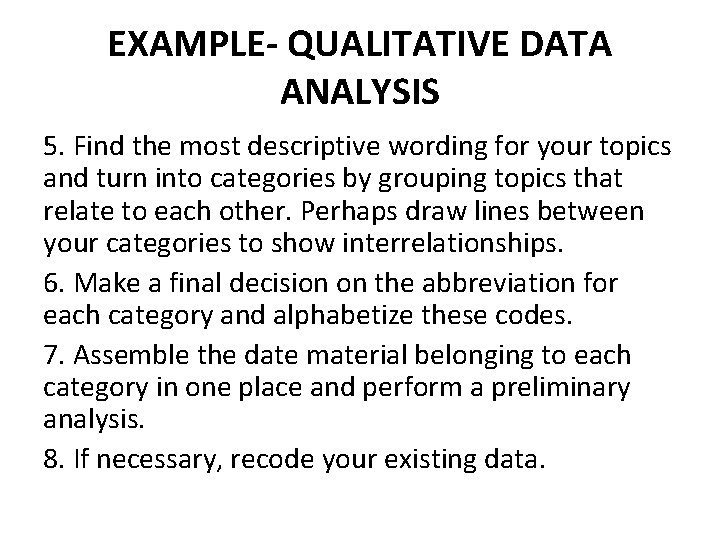
EXAMPLE- QUALITATIVE DATA ANALYSIS • DATA ANALYSIS PROTOCOL • Tesch’s approach to data analysis (Creswell, 2003), which provides a useful process to transcribing unstructured data in eight steps will be adopted for data analysis. The eight steps engage a researcher in a systematic process of analysing textual data. The steps are as follows: 1. Get a sense of the whole. Read all of the transcriptions carefully. Jot down some ideas as they come to mind.
EXAMPLE- QUALITATIVE DATA ANALYSIS 2. Take one document (one interview). Go through it and ask yourself what it is about? Do not think about the ‘respondent’ of the information, but rather the underlying meaning. Write thoughts in the margin. 3. When you have completed this task for several informants, make a list of topics. Cluster together similar topics. Form these topics into columns that might be arrayed as major topics, unique topics and leftovers 4. Now take the list and go back to your data. Abbreviate the topics as codes next to the appropriate segments of the texts. Try out this preliminary organizing scheme to see whether new categories and codes emerge.
EXAMPLE- QUALITATIVE DATA ANALYSIS 5. Find the most descriptive wording for your topics and turn into categories by grouping topics that relate to each other. Perhaps draw lines between your categories to show interrelationships. 6. Make a final decision on the abbreviation for each category and alphabetize these codes. 7. Assemble the date material belonging to each category in one place and perform a preliminary analysis. 8. If necessary, recode your existing data.
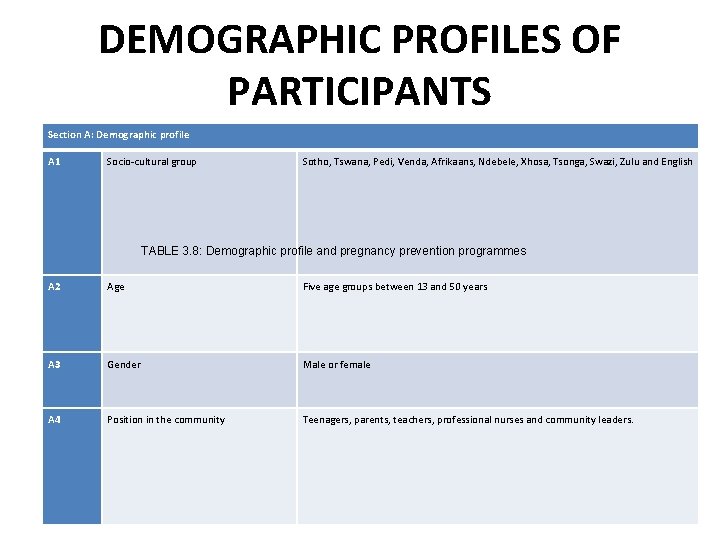
DEMOGRAPHIC PROFILES OF PARTICIPANTS Section A: Demographic profile A 1 Socio-cultural group Sotho, Tswana, Pedi, Venda, Afrikaans, Ndebele, Xhosa, Tsonga, Swazi, Zulu and English TABLE 3. 8: Demographic profile and pregnancy prevention programmes A 2 Age Five age groups between 13 and 50 years A 3 Gender Male or female A 4 Position in the community Teenagers, parents, teachers, professional nurses and community leaders.
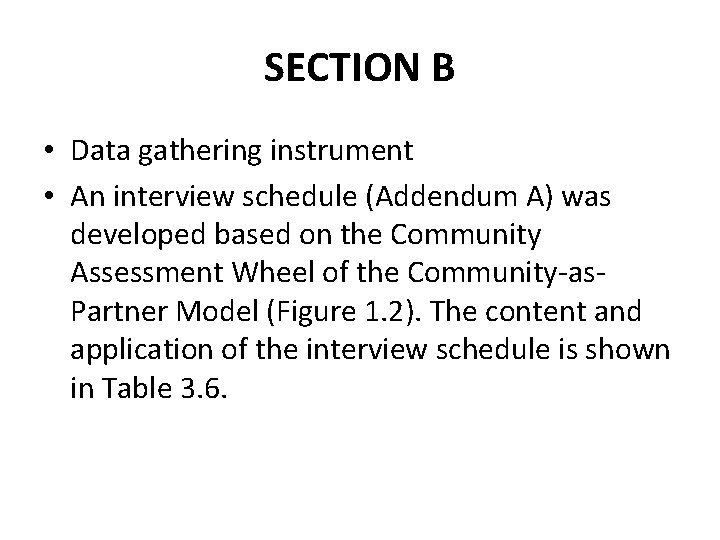
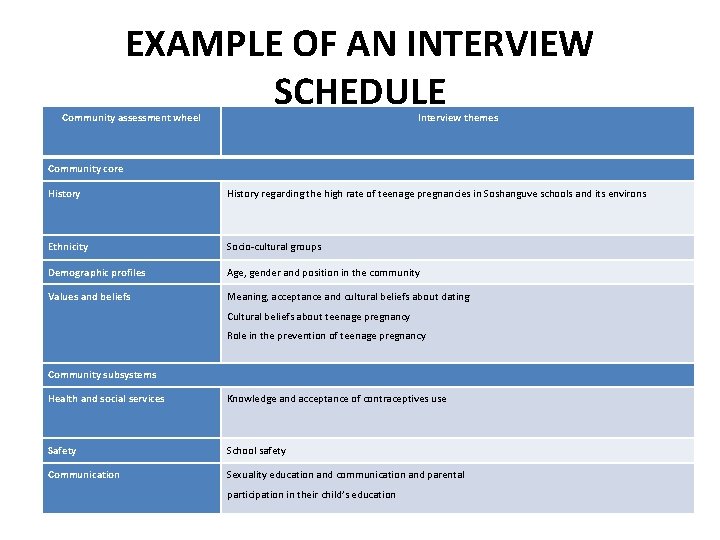
SECTION B • Data gathering instrument • An interview schedule (Addendum A) was developed based on the Community Assessment Wheel of the Community-as. Partner Model (Figure 1. 2). The content and application of the interview schedule is shown in Table 3. 6.
EXAMPLE OF AN INTERVIEW SCHEDULE Community assessment wheel Interview themes Community core History regarding the high rate of teenage pregnancies in Soshanguve schools and its environs Ethnicity Socio-cultural groups Demographic profiles Age, gender and position in the community Values and beliefs Meaning, acceptance and cultural beliefs about dating Cultural beliefs about teenage pregnancy Role in the prevention of teenage pregnancy Community subsystems Health and social services Knowledge and acceptance of contraceptives use Safety School safety Communication Sexuality education and communication and parental participation in their child’s education
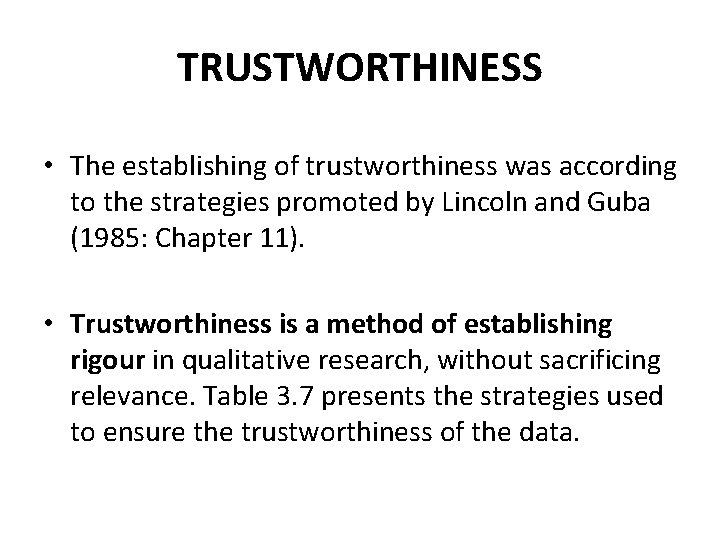
TRUSTWORTHINESS • The establishing of trustworthiness was according to the strategies promoted by Lincoln and Guba (1985: Chapter 11). • Trustworthiness is a method of establishing rigour in qualitative research, without sacrificing relevance. Table 3. 7 presents the strategies used to ensure the trustworthiness of the data.
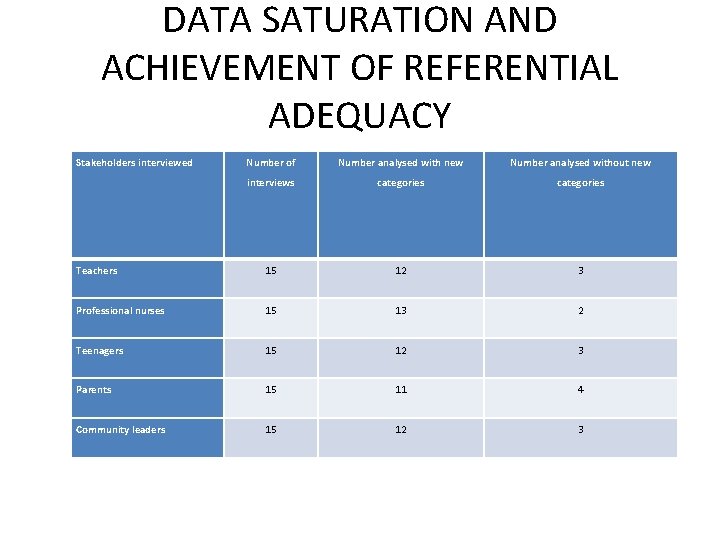
SATURATION AND ACHIEVEMENT OF REFERENTIAL ADEQUACY • Saturation of data determined the sample size due to the qualitative nature of the sample. Table 4. 1 provides the evidence of data saturation and referential adequacy.
DATA SATURATION AND ACHIEVEMENT OF REFERENTIAL ADEQUACY Stakeholders interviewed Number of Number analysed with new Number analysed without new interviews categories Teachers 15 12 3 Professional nurses 15 13 2 Teenagers 15 12 3 Parents 15 11 4 Community leaders 15 12 3
EXAMPLE- QUALITATIVE DATA ANALYSIS • Referential adequacy was attained, partially fulfilling the requirement of trustworthiness (Lincoln & Guba, 1985). • Meaning of dating • The majority (10 of 15) of the teenagers explained that dating is going out to have fun or the connection between two people but does not include a sexual relationship. The following are some of the responses from the participants: • “…is probably a connection between two people that are fond of each other and sometimes it develop into love or lust attraction and all that, no sex involved. ” • “Basically, it is going out with someone just to have fun but not getting too serious like having sex. No intimacy, it’s just having fun. ” • “Is an affection between two people, sharing the passion of love and feelings but it doesn’t include sex. ”
EXAMPLE- QUALITATIVE DATA ANALYSIS • Cultural beliefs about dating • When asked about cultural beliefs regarding dating, more than two thirds (13 of 15) of the teenagers indicated dating is not part of their culture. • Some of their responses are: • “Basically in my culture, dating is seen as a sin. It is unethical because the girl needs to wait until marriage. ” • “My culture does not accept dating yeah, it is seen as an abomination because it is seen as a way for teenagers to have sex. ” • “They think dating is wrong. I think they have this perception that your parents should choose a partner for you and you get married without dating. A woman should only see a man when she is ready to start a family. ” •
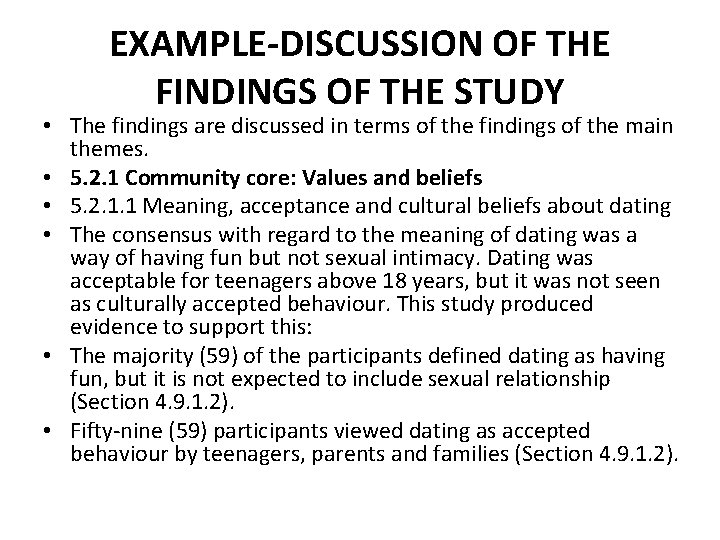
EXAMPLE-DISCUSSION OF THE FINDINGS OF THE STUDY • The findings are discussed in terms of the findings of the main themes. • 5. 2. 1 Community core: Values and beliefs • 5. 2. 1. 1 Meaning, acceptance and cultural beliefs about dating • The consensus with regard to the meaning of dating was a way of having fun but not sexual intimacy. Dating was acceptable for teenagers above 18 years, but it was not seen as culturally accepted behaviour. This study produced evidence to support this: • The majority (59) of the participants defined dating as having fun, but it is not expected to include sexual relationship (Section 4. 9. 1. 2). • Fifty-nine (59) participants viewed dating as accepted behaviour by teenagers, parents and families (Section 4. 9. 1. 2).
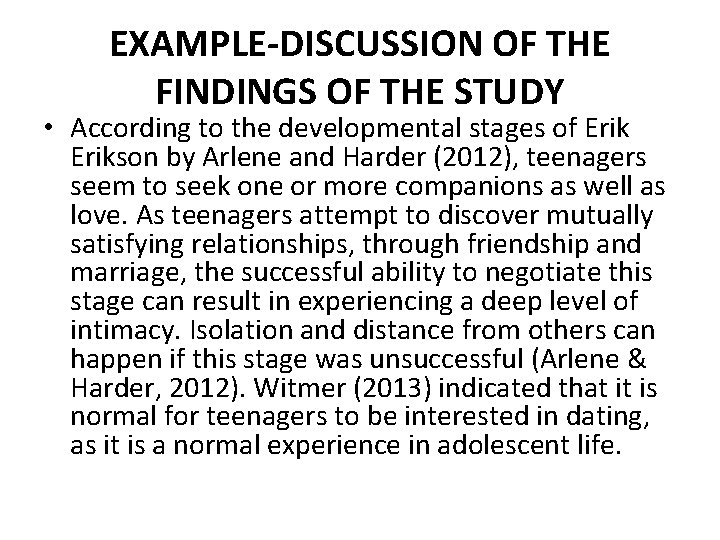
EXAMPLE-DISCUSSION OF THE FINDINGS OF THE STUDY • According to the developmental stages of Erikson by Arlene and Harder (2012), teenagers seem to seek one or more companions as well as love. As teenagers attempt to discover mutually satisfying relationships, through friendship and marriage, the successful ability to negotiate this stage can result in experiencing a deep level of intimacy. Isolation and distance from others can happen if this stage was unsuccessful (Arlene & Harder, 2012). Witmer (2013) indicated that it is normal for teenagers to be interested in dating, as it is a normal experience in adolescent life.
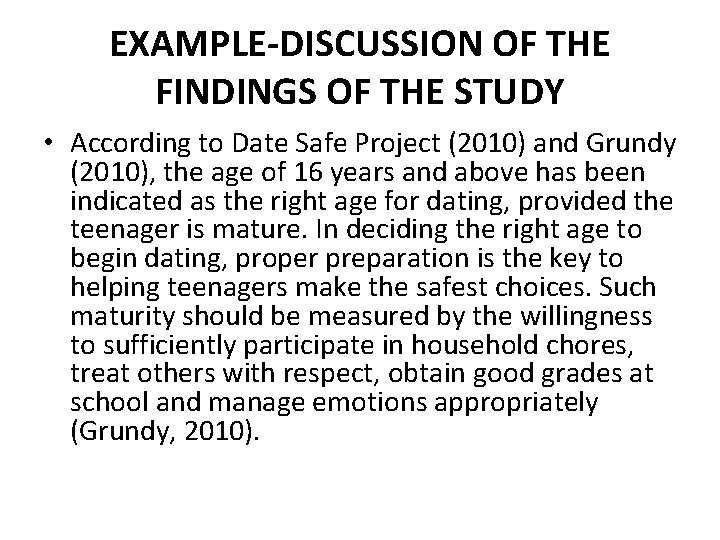
EXAMPLE-DISCUSSION OF THE FINDINGS OF THE STUDY • According to Date Safe Project (2010) and Grundy (2010), the age of 16 years and above has been indicated as the right age for dating, provided the teenager is mature. In deciding the right age to begin dating, proper preparation is the key to helping teenagers make the safest choices. Such maturity should be measured by the willingness to sufficiently participate in household chores, treat others with respect, obtain good grades at school and manage emotions appropriately (Grundy, 2010).
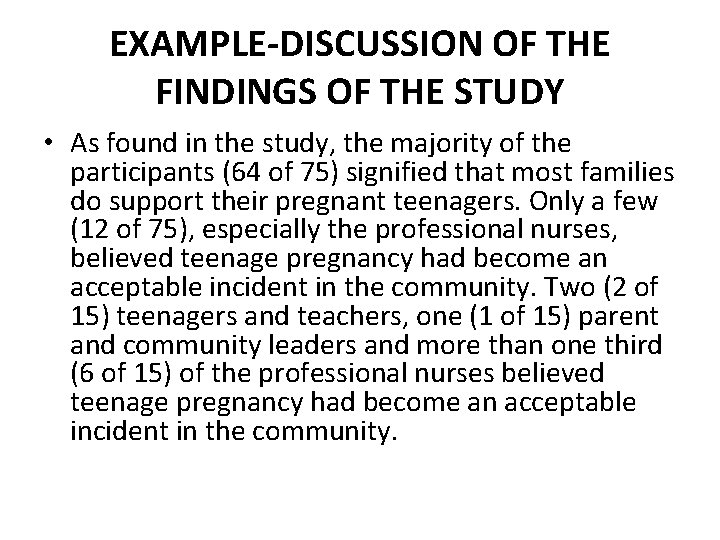
EXAMPLE-DISCUSSION OF THE FINDINGS OF THE STUDY • As found in the study, the majority of the participants (64 of 75) signified that most families do support their pregnant teenagers. Only a few (12 of 75), especially the professional nurses, believed teenage pregnancy had become an acceptable incident in the community. Two (2 of 15) teenagers and teachers, one (1 of 15) parent and community leaders and more than one third (6 of 15) of the professional nurses believed teenage pregnancy had become an acceptable incident in the community.