
Data Analysis Notes 2 Chapter 2 Objectives Distinguish
Data Analysis Notes #2 Chapter 2
Objectives • Distinguish between a quantity, and a unit • Define SI units for length, mass, time, and temperature • You will convert data into scientific notation and from one unit to another using dimensional analysis and the “staircase” • You will round off answers to the correct degree of certainty – significant figures • Perform density calculations
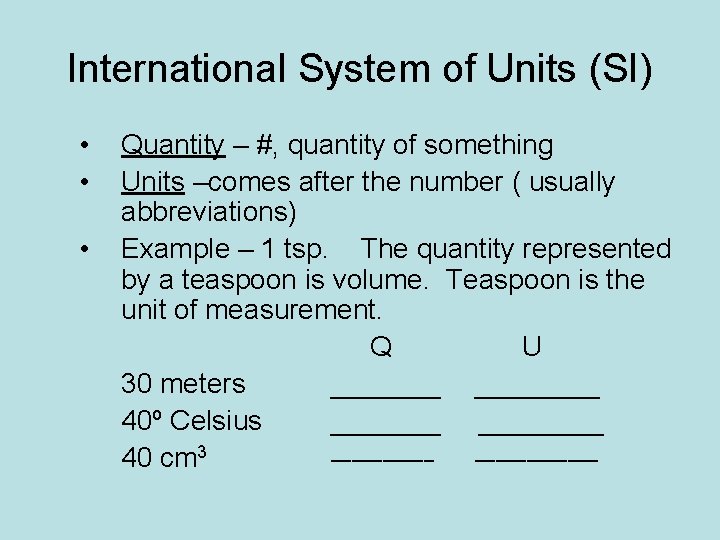
International System of Units (SI) • • • Quantity – #, quantity of something Units –comes after the number ( usually abbreviations) Example – 1 tsp. The quantity represented by a teaspoon is volume. Teaspoon is the unit of measurement. Q U 30 meters ________ 40º Celsius ____________ 40 cm 3
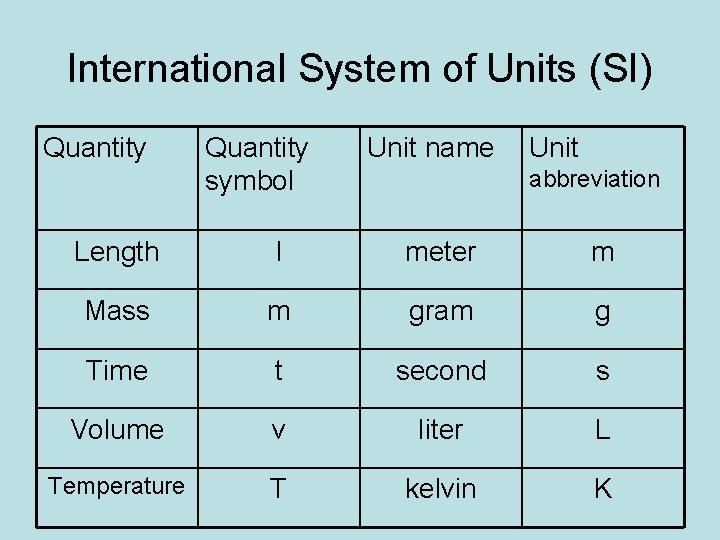
International System of Units (SI) Quantity symbol Unit name Unit abbreviation Length l meter m Mass m gram g Time t second s Volume v liter L Temperature T kelvin K
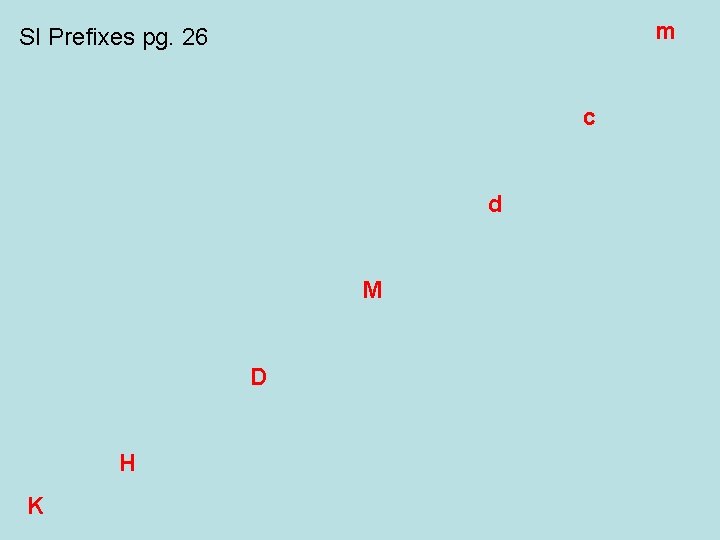
m SI Prefixes pg. 26 c d M D H K
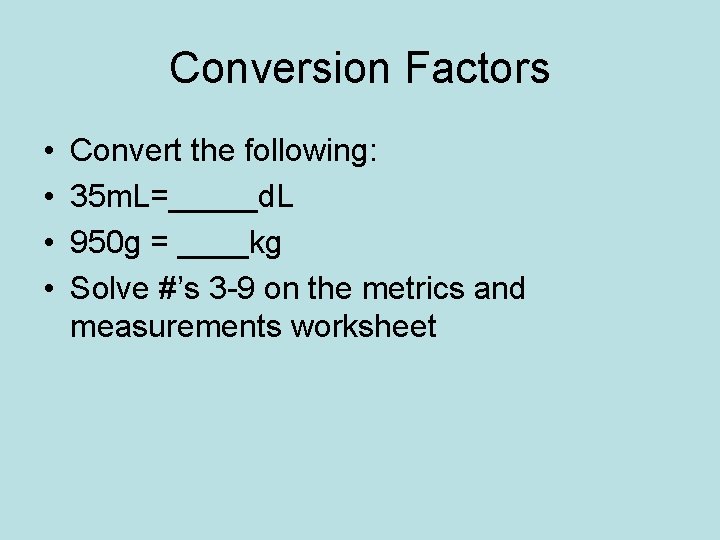
Conversion Factors • • Convert the following: 35 m. L=_____d. L 950 g = ____kg Solve #’s 3 -9 on the metrics and measurements worksheet
Dimensional Analysis • • 1. 2. Bridge method Uses conversion factors Convert 68 years to seconds Convert 5 m to cm.
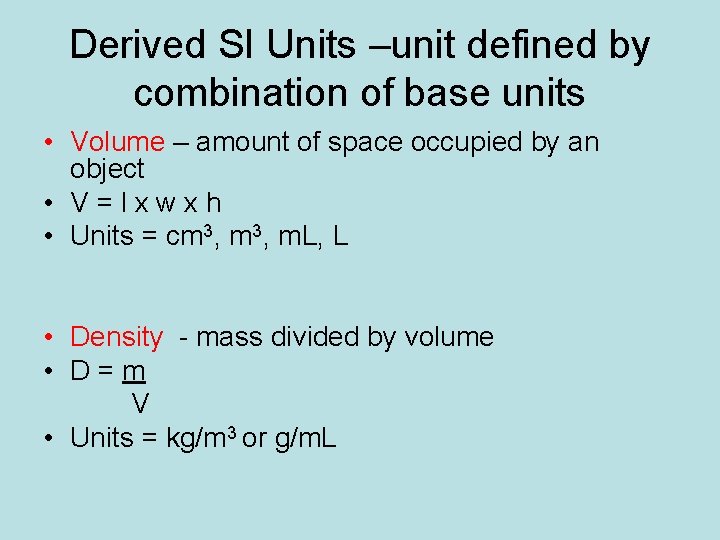
Derived SI Units –unit defined by combination of base units • Volume – amount of space occupied by an object • V=lxwxh • Units = cm 3, m. L, L • Density - mass divided by volume • D=m V • Units = kg/m 3 or g/m. L
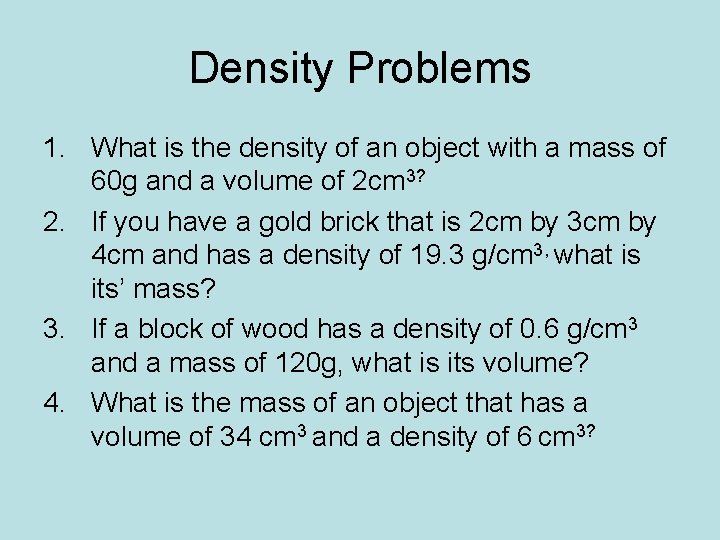
Density Problems 1. What is the density of an object with a mass of 60 g and a volume of 2 cm 3? 2. If you have a gold brick that is 2 cm by 3 cm by 4 cm and has a density of 19. 3 g/cm 3, what is its’ mass? 3. If a block of wood has a density of 0. 6 g/cm 3 and a mass of 120 g, what is its volume? 4. What is the mass of an object that has a volume of 34 cm 3 and a density of 6 cm 3?
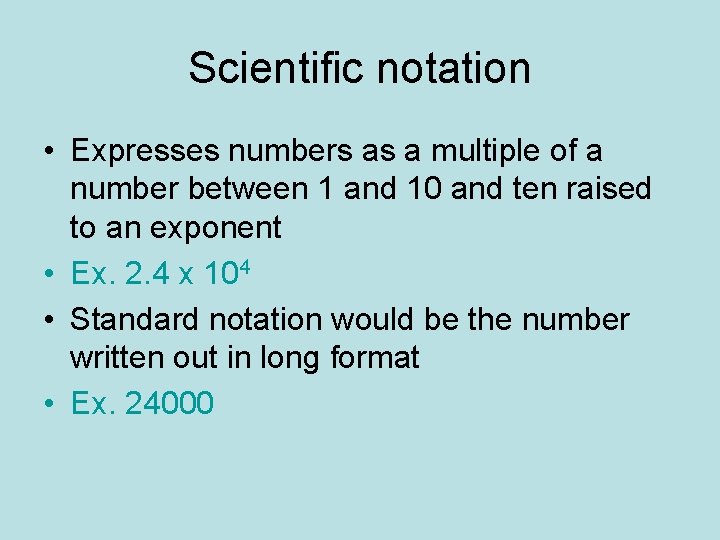
Scientific notation • Expresses numbers as a multiple of a number between 1 and 10 and ten raised to an exponent • Ex. 2. 4 x 10⁴ • Standard notation would be the number written out in long format • Ex. 24000
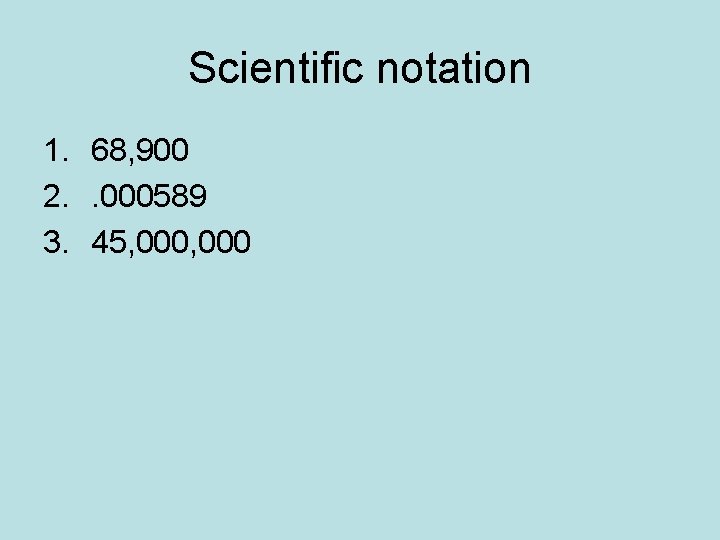
Scientific notation 1. 68, 900 2. . 000589 3. 45, 000
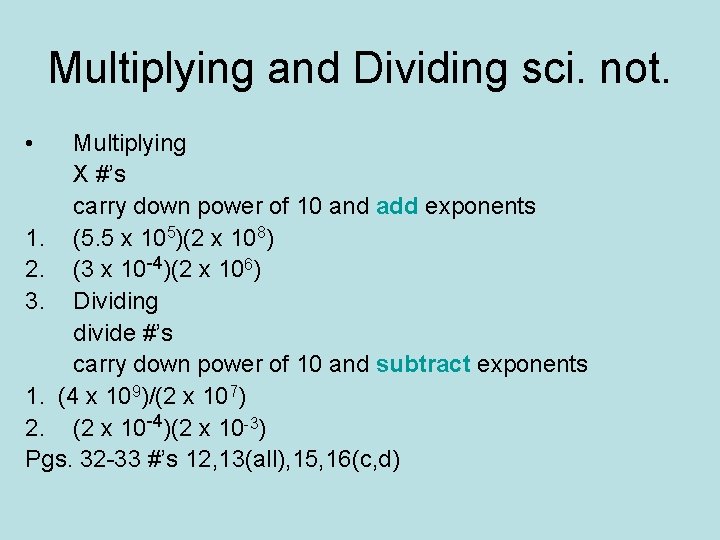
Multiplying and Dividing sci. not. • Multiplying X #’s carry down power of 10 and add exponents 1. (5. 5 x 10⁵)(2 x 10⁸) 2. (3 x 10 -4)(2 x 10⁶) 3. Dividing divide #’s carry down power of 10 and subtract exponents 1. (4 x 10⁹)/(2 x 107) 2. (2 x 10 -4)(2 x 10 -3) Pgs. 32 -33 #’s 12, 13(all), 15, 16(c, d)
Adding & Subtracting -exponents must be the same. If not, change one of the #’s to make same - add or subtract #’s - carry down power of 10 with exponent 1. 1. 26 x 104 kg + 2. 5 x 10³ kg Pg. 32 #14 a, C, G
Accuracy vs. Precision • Accurate – how close #’s are to accepted value • Precision – how repeatable several measurements are
Significant Figures/Rounding Rules • Pg. 39 Know rules • Pr. Pg. 39 31 -32

Measurement Activity • • • Find the mass of Find the weight of Find the volume of the box Find the volume of the rock Find the density of the
- Slides: 17