
Data Analysis and Intelligent Systems Lab Its research
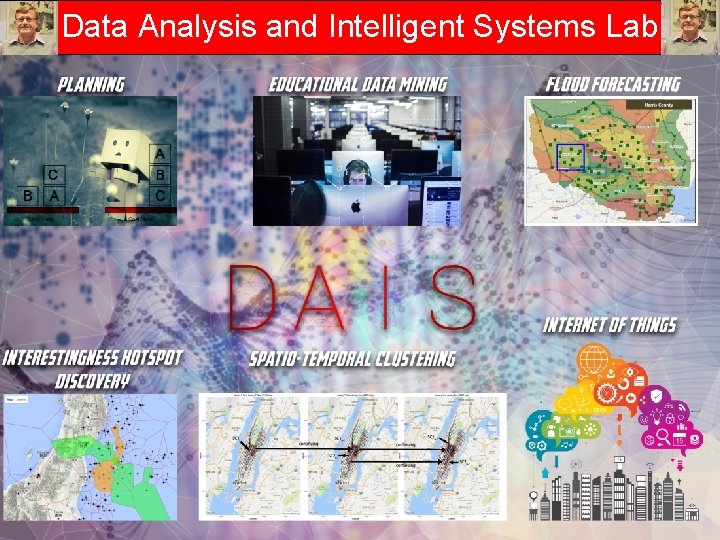
Data Analysis and Intelligent Systems Lab Its research is focusing on: 1. Spatial Data Mining 2. Clustering and Anomaly Detection 3. Classification and Prediction 4. GIS Current Projects 1. 2. 3. 4. 5. 6. Clustering Algorithms with Plug-in Fitness Functions and Other Non-Traditional Clustering Approaches Analyzing and Doing Useful Things with Bio-aerosol Data Interestingness Scoping Algorithms for the Analysis of Spatial and Spatio-temporal Datasets Using Mixture Models for Anomaly Detection and Change Analysis Taxonomy Generation—Learning Class Hierarchies from Training Data Educational Data Mining (lead by Nouhad Rizk) Department of Computer Science UH-DAIS
Research Areas and Projects 1. Data Analysis and Intelligent Systems Lab (UH-DAIS) Its research is focusing on: 1. Data Mining 2. Data Science and Making Sense of Data 3. GIS (Geographical Information Systems) 4. AI (Artificial Intelligence) 2. Current and Planned Projects 1. 2. 3. 4. 5. 6. 7. Clustering Algorithms with Plug-in Fitness Functions, other Non-Traditional Clustering and Hotspot Discovery (HD) Approaches Predicting and Understanding Flooding Educational Data Mining (jointly with Nouhad Rizk) Taxonomy Generation—Learning Class Hierarchies from Training Data Fast Execution Frameworks for Agglomerative Algorithms just starting Critical Infrastructure Resilience More AI-related research projects: particularly Planning, and maybe Internet of Things and Games looking for new students! Department of Computer Science UH-DAIS
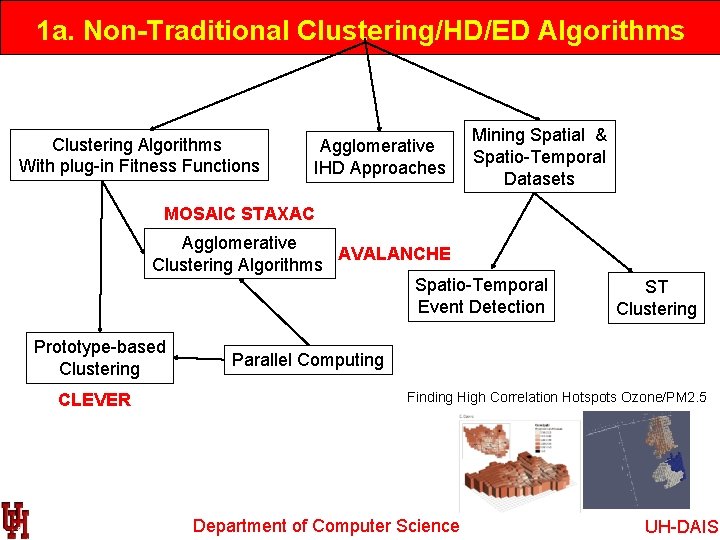
1 a. Non-Traditional Clustering/HD/ED Algorithms Clustering Algorithms With plug-in Fitness Functions Agglomerative IHD Approaches Mining Spatial & Spatio-Temporal Datasets MOSAIC STAXAC Agglomerative AVALANCHE Clustering Algorithms Spatio-Temporal Event Detection Prototype-based Clustering CLEVER ST Clustering Parallel Computing Finding High Correlation Hotspots Ozone/PM 2. 5 Department of Computer Science UH-DAIS
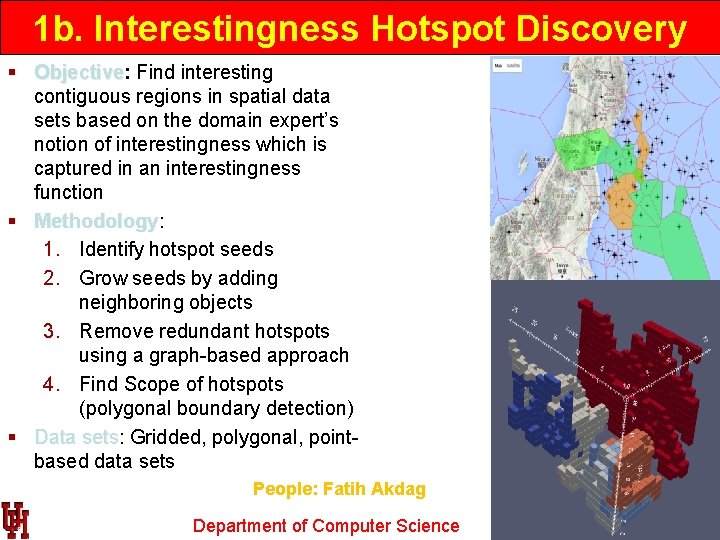
1 b. Interestingness Hotspot Discovery § Objective: Objective Find interesting contiguous regions in spatial data sets based on the domain expert’s notion of interestingness which is captured in an interestingness function § Methodology: Methodology 1. Identify hotspot seeds 2. Grow seeds by adding neighboring objects 3. Remove redundant hotspots using a graph-based approach 4. Find Scope of hotspots (polygonal boundary detection) § Data sets: sets Gridded, polygonal, pointbased data sets People: Fatih Akdag Department of Computer Science
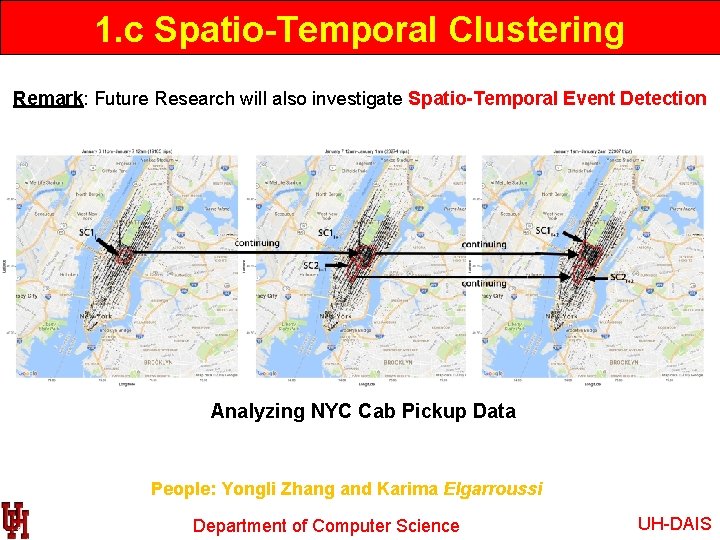
1. c Spatio-Temporal Clustering Remark: Future Research will also investigate Spatio-Temporal Event Detection Analyzing NYC Cab Pickup Data People: Yongli Zhang and Karima Elgarroussi Department of Computer Science UH-DAIS
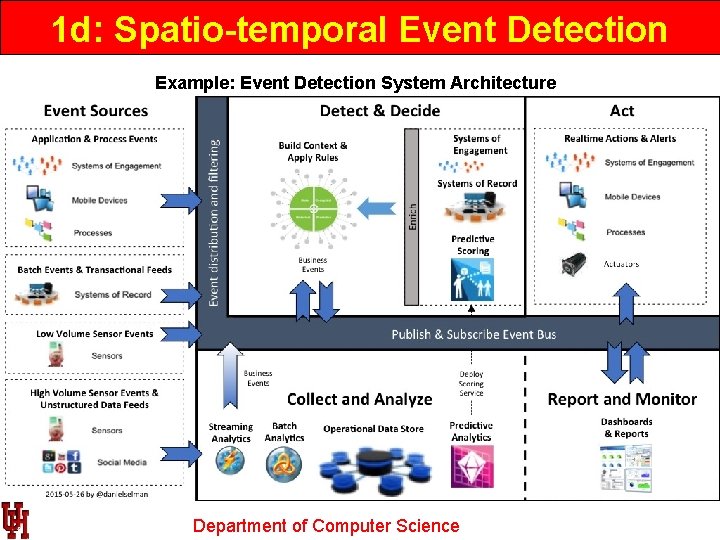
1 d: Spatio-temporal Event Detection Example: Event Detection System Architecture Department of Computer Science
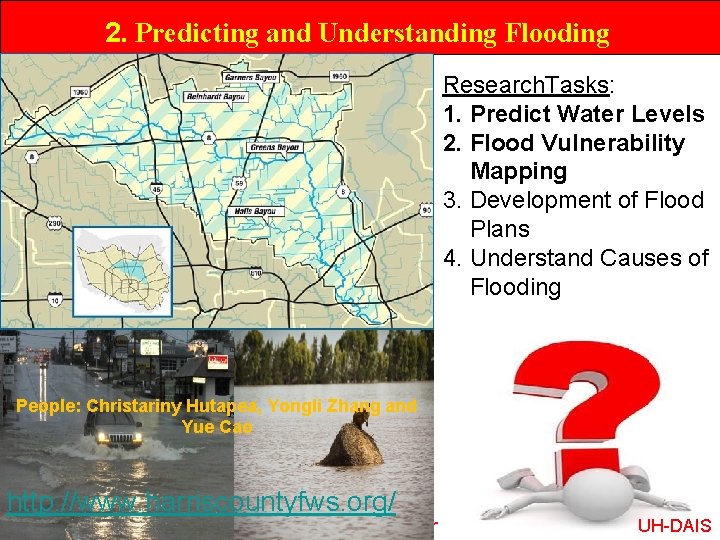
2. Predicting and Understanding Flooding Research. Tasks: 1. Predict Water Levels 2. Flood Vulnerability Mapping 3. Development of Flood Plans 4. Understand Causes of Flooding People: Christariny Hutapea, Yongli Zhang and Yue Cao http: //www. harriscountyfws. org/ Department of Computer Science UH-DAIS
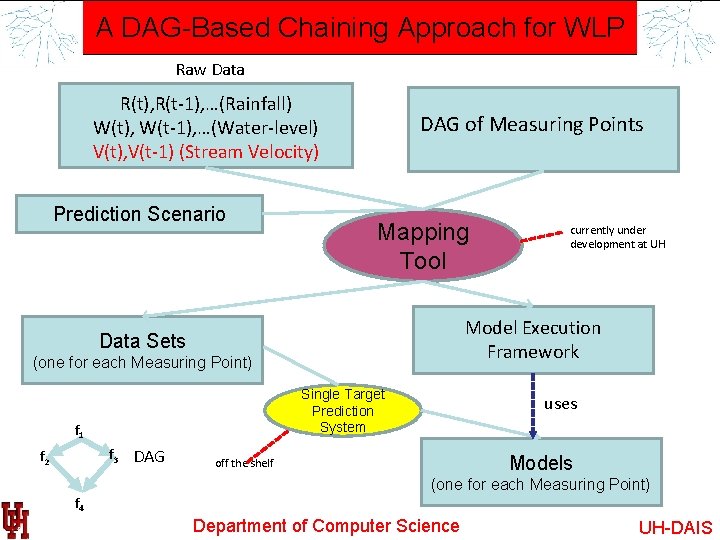
A DAG-Based Chaining Approach for WLP Raw Data R(t), R(t-1), …(Rainfall) W(t), W(t-1), …(Water-level) V(t), V(t-1) (Stream Velocity) Prediction Scenario DAG of Measuring Points Mapping Tool Model Execution Framework Data Sets (one for each Measuring Point) Single Target Prediction System f 1 f 3 f 2 DAG currently under development at UH uses Models off the shelf (one for each Measuring Point) f 4 Department of Computer Science UH-DAIS
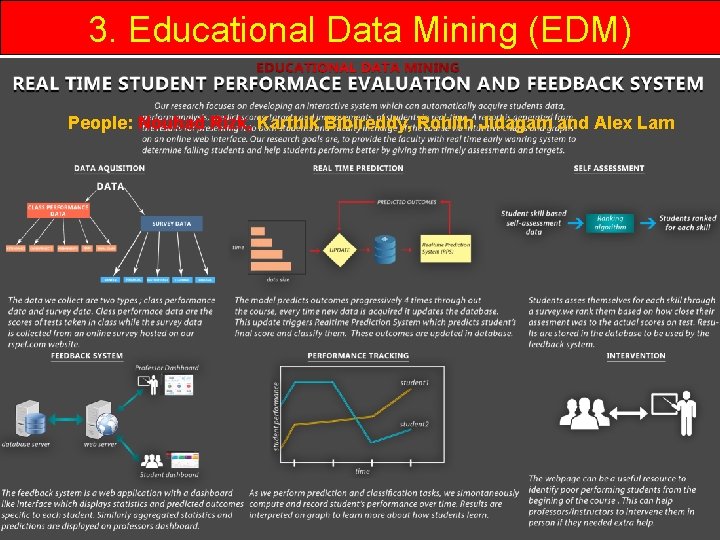
3. Educational Data Mining (EDM) People: Nouhad Rizk, Karthik Bibireddy, Rohith Jidagam and Alex Lam Department of Computer Science UH-DMML
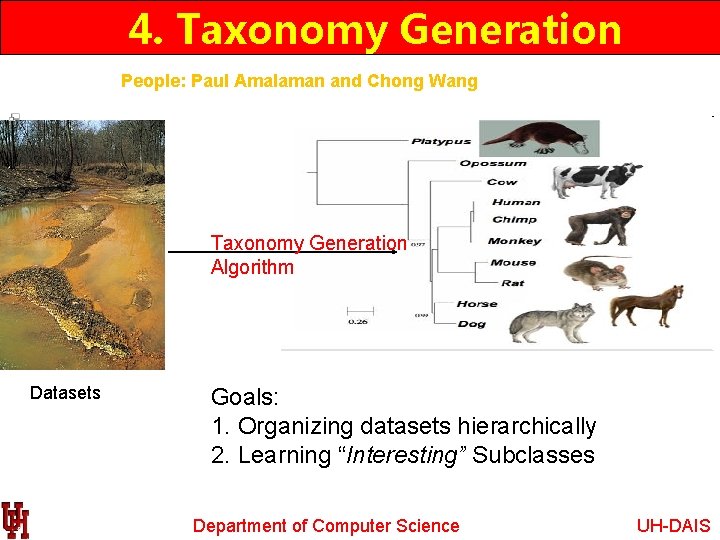
4. Taxonomy Generation People: Paul Amalaman and Chong Wang Taxonomy Generation Algorithm Datasets Goals: 1. Organizing datasets hierarchically 2. Learning “Interesting” Subclasses Department of Computer Science UH-DAIS
6. Dr. Eick’s Resilience Work § In 2015, I was the PI of a large funded DHS project in which we designed an early warning system for bio-threats using “cheap” biosensors. § I am part of a large research group at UH whose research centers on “Making the Houston Harbor Smart and Resilient”. § Disaster analytics and understanding what makes communities resilient to absorb and recover from disasters. § Moreover, my research group is starting new research in critical infrastructure resilience that employs artificial intelligence planning techniques to come up with plans that absorb or recover from failure of critical components. § We also work on “new” recovery-based resilience metrics. Department of Computer Science UH-DAIS
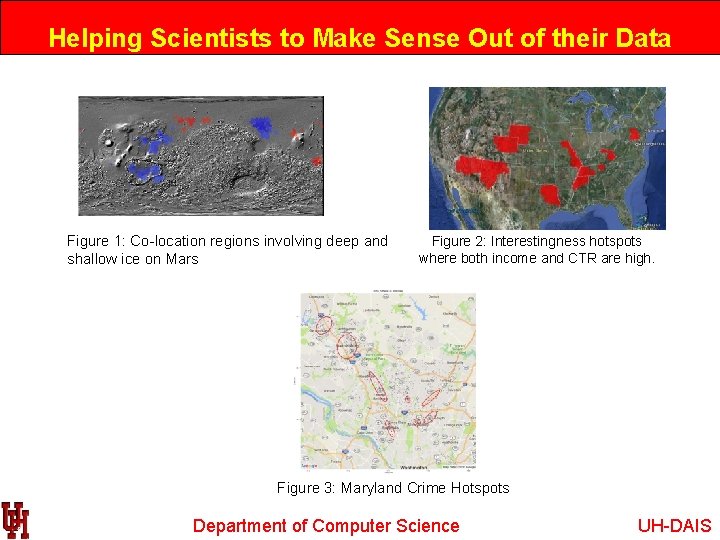
Helping Scientists to Make Sense Out of their Data Figure 1: Co-location regions involving deep and shallow ice on Mars Figure 2: Interestingness hotspots where both income and CTR are high. Figure 3: Maryland Crime Hotspots Department of Computer Science UH-DAIS
Some UH-DAIS Graduates 1 Dr. Wei Ding, Associate Professor, Department of Computer Science, University of Massachusetts, Boston Sharon M. Tuttle, Professor, Department of Computer Science, Humboldt State University, Arcata, California Christopher T. Ryu, Professor, Department of Computer Science, California State University, Fullerton Sujing Wang, Assistant Professor, Department of Computer Science, Lamar University, Beaumont, Texas Department of Computer Science Christoph F. Eick
Some UH-DAIS Graduates 2 Puja Anchlia, MS Ebay, San Jose Chun-sheng Chen, Ebay, Seattle Chong Wang, MS Apple Justin Thomas Johns Hopkins University Applied Physics Laboratory Mei-kang Wu MS Microsoft, Bellevue, Washington Jing Wang MS AOL, California Rachsuda Jiamthapthaksin Ph. D Faculty, Assumption University, Bangkok, Thailand Department of Computer Science Christoph F. Eick
2016/2017 Students in the UH-DAIS Lab Ph. D Students: Yongli Zhang, Fatih Akdag, Romita Banerjee, and Chong Wang Master Students: Riny Hutapea, Yue Cao, and Karthik Bibireddy Undergraduate Students: Alex—Lester Moreira Cruz and Hasnain Bilgrami Visiting and Externally Advised Students: Karima Elgarroussi Contributing Alumni: Paul Amalaman and Sujing Wang Department of Computer Science UH-DAIS
- Slides: 15