
Data Administration and Database Administration University of California
Data Administration and Database Administration University of California, Berkeley School of Information Management and Systems SIMS 257: Database Management IS 257 – Spring 2005. 10. 26 - SLIDE 1
Lecture Outline • Midterm Project Report Requirements • Review – Database Administration: Security • Database Administration: Disasters, Backup and Recovery • Database Administration: Roles IS 257 – Spring 2005. 10. 26 - SLIDE 2
Lecture Outline • Midterm Project Report Requirements • Review – Database Administration: Security • Database Administration: Disasters, Backup and Recovery • Database Administration: Roles IS 257 – Spring 2005. 10. 26 - SLIDE 3
Midterm Project Requirements • See WWW site: – http: //sims. berkeley. edu/courses/is 257/f 05/index. html • Report on personal/group database including: – Expanded and Updated Database description and purpose – Updated Data Dictionary – Updated Relationships Diagram – Plans or prototype examples for interface applications using the database IS 257 – Spring 2005. 10. 26 - SLIDE 4
Lecture Outline • Midterm Project Report Requirements • Review – Database Administration: Data Integrity and Security • Database Administration: Disasters, Backup and Recovery • Database Administration: Roles IS 257 – Spring 2005. 10. 26 - SLIDE 5
Data Integrity • Intrarecord integrity (enforcing constraints on contents of fields, etc. ) • Referential Integrity (enforcing the validity of references between records in the database) • Concurrency control (ensuring the validity of database updates in a shared multiuser environment) IS 257 – Spring 2005. 10. 26 - SLIDE 6
Integrity Constraints (review) • The constraints we wish to impose in order to protect the database from becoming inconsistent. • Five types – Required data – attribute domain constraints – entity integrity – referential integrity – enterprise constraints IS 257 – Spring 2005. 10. 26 - SLIDE 7
Referential Integrity • Ensures that dependent relationships in the data are maintained. In Oracle, for example: • CREATE TABLE table-name ( attr 1 attr-type PRIMARY KEY, attr 2 attr-type NOT NULL, …, attr. M attr-type REFERENCES owner. tablename(attrname) ON DELETE CASCADE, … IS 257 – Spring 2005. 10. 26 - SLIDE 8
Concurrency Control • The goal is to support access by multiple users to the same data, at the same time • It must assure that the transactions are serializable and that they are isolated • It is intended to handle several problems in an uncontrolled system • Specifically: – Lost updates – Inconsistent data states during access – Uncompleted (or committed) changes to data IS 257 – Spring 2005. 10. 26 - SLIDE 9
Concurrency Control: Locking • Locking levels – Database – Table – Block or page – Record – Field • Types – Shared (S locks) – Exclusive (X locks) IS 257 – Spring 2005. 10. 26 - SLIDE 10
Transaction Control in ORACLE • Transactions are sequences of SQL statements that ORACLE treats as a unit – From the user’s point of view a private copy of the database is created for the duration of the transaction • Transactions are started with SET TRANSACTION, followed by the SQL statements • Any changes made by the SQL are made permanent by COMMIT • Part or all of a transaction can be undone using ROLLBACK IS 257 – Spring 2005. 10. 26 - SLIDE 11
Transactions in ORACLE • • COMMIT; (I. e. , confirm previous transaction) SET TRANSACTION READ ONLY; SELECT NAME, ADDRESS FROM WORKERS; SELECT MANAGER, ADDRESS FROM PLACES; • COMMIT; • Freezes the data for the user in both tables before either select retrieves any rows, so that changes that occur concurrently will not show up • Commits before and after ensure any uncompleted transactions are finish, and then release the frozen data when done IS 257 – Spring 2005. 10. 26 - SLIDE 12
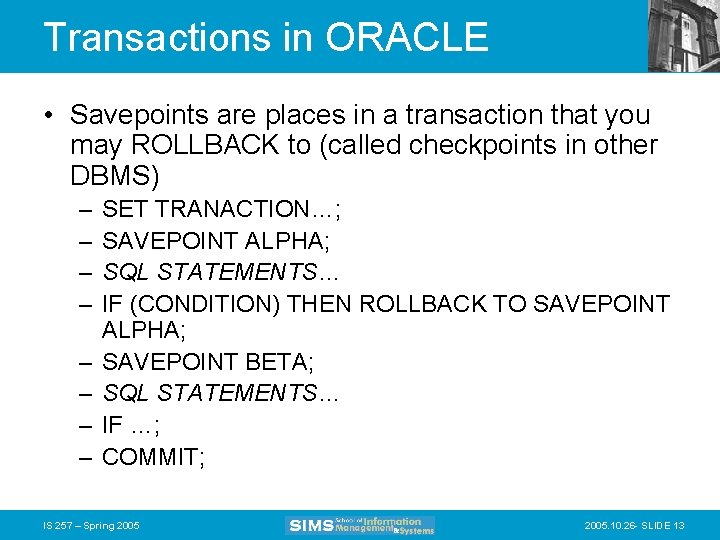
Transactions in ORACLE • Savepoints are places in a transaction that you may ROLLBACK to (called checkpoints in other DBMS) – – – – SET TRANACTION…; SAVEPOINT ALPHA; SQL STATEMENTS… IF (CONDITION) THEN ROLLBACK TO SAVEPOINT ALPHA; SAVEPOINT BETA; SQL STATEMENTS… IF …; COMMIT; IS 257 – Spring 2005. 10. 26 - SLIDE 13
Security and Integrity Functions in Database Administration • Data Integrity • Security Management • Backup and Recovery IS 257 – Spring 2005. 10. 26 - SLIDE 14
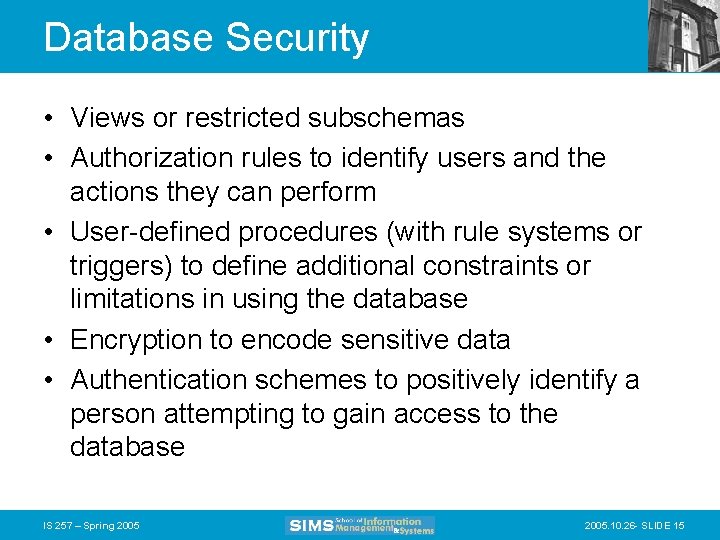
Database Security • Views or restricted subschemas • Authorization rules to identify users and the actions they can perform • User-defined procedures (with rule systems or triggers) to define additional constraints or limitations in using the database • Encryption to encode sensitive data • Authentication schemes to positively identify a person attempting to gain access to the database IS 257 – Spring 2005. 10. 26 - SLIDE 15
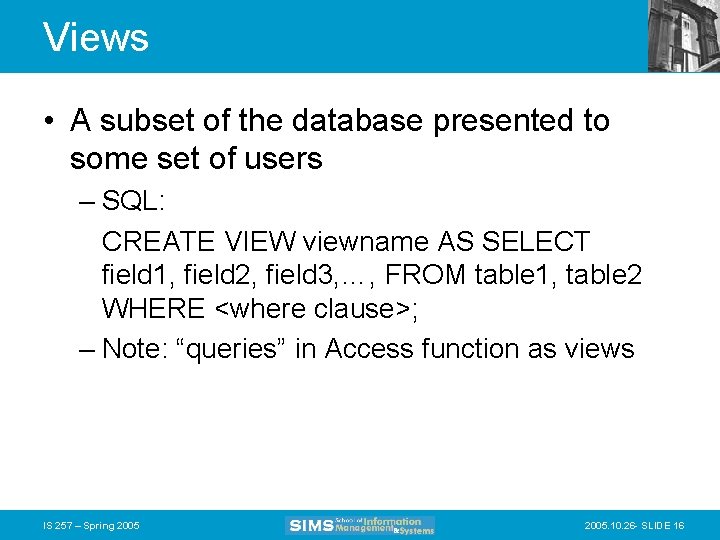
Views • A subset of the database presented to some set of users – SQL: CREATE VIEW viewname AS SELECT field 1, field 2, field 3, …, FROM table 1, table 2 WHERE <where clause>; – Note: “queries” in Access function as views IS 257 – Spring 2005. 10. 26 - SLIDE 16
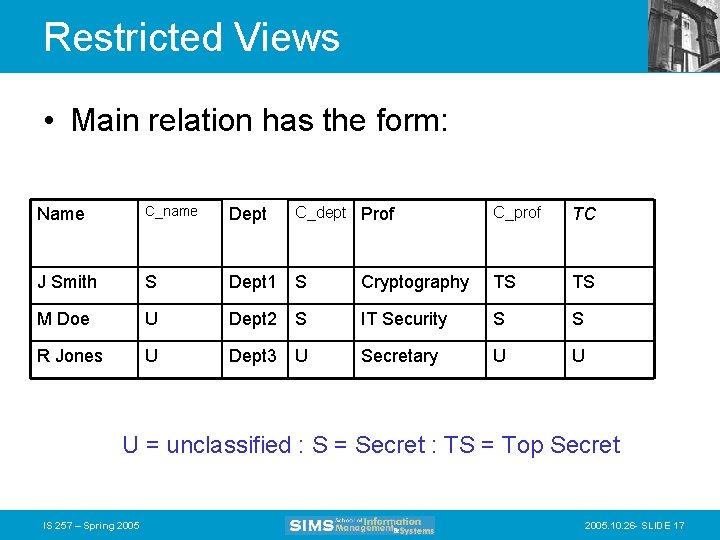
Restricted Views • Main relation has the form: Name C_name Dept J Smith S Dept 1 S M Doe U R Jones U C_dept Prof C_prof TC Cryptography TS TS Dept 2 S IT Security S S Dept 3 U Secretary U U U = unclassified : S = Secret : TS = Top Secret IS 257 – Spring 2005. 10. 26 - SLIDE 17
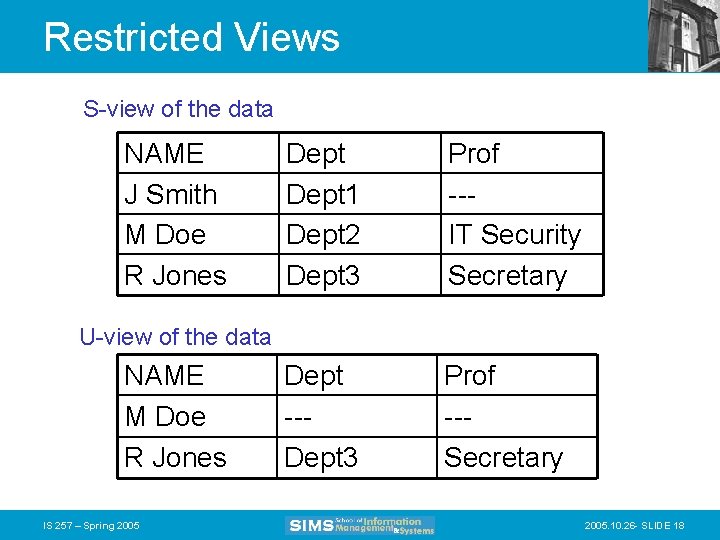
Restricted Views S-view of the data NAME J Smith M Doe R Jones Dept 1 Dept 2 Dept 3 Prof --IT Security Secretary Dept --Dept 3 Prof --Secretary U-view of the data NAME M Doe R Jones IS 257 – Spring 2005. 10. 26 - SLIDE 18
Authorization Rules • Most current DBMS permit the DBA to define “access permissions” on a table by table basis (at least) using the GRANT and REVOKE SQL commands • Some systems permit finer grained authorization (most use GRANT and REVOKE on variant views IS 257 – Spring 2005. 10. 26 - SLIDE 19
Lecture Outline • Midterm Project Report Requirements • Review – Database Administration: Security • Database Administration: Disasters, Backup and Recovery • Database Administration: Roles and Functions IS 257 – Spring 2005. 10. 26 - SLIDE 20
Database Backup and Recovery • • Backup Journaling (audit trail) Checkpoint facility Recovery manager IS 257 – Spring 2005. 10. 26 - SLIDE 21
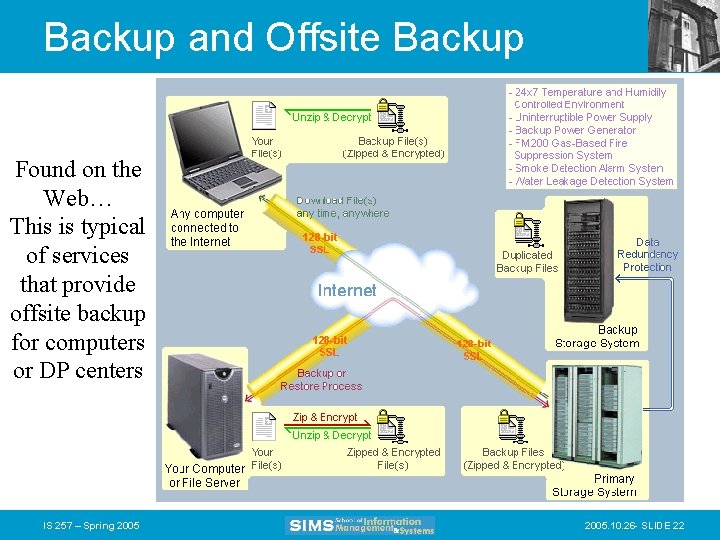
Backup and Offsite Backup Found on the Web… This is typical of services that provide offsite backup for computers or DP centers IS 257 – Spring 2005. 10. 26 - SLIDE 22
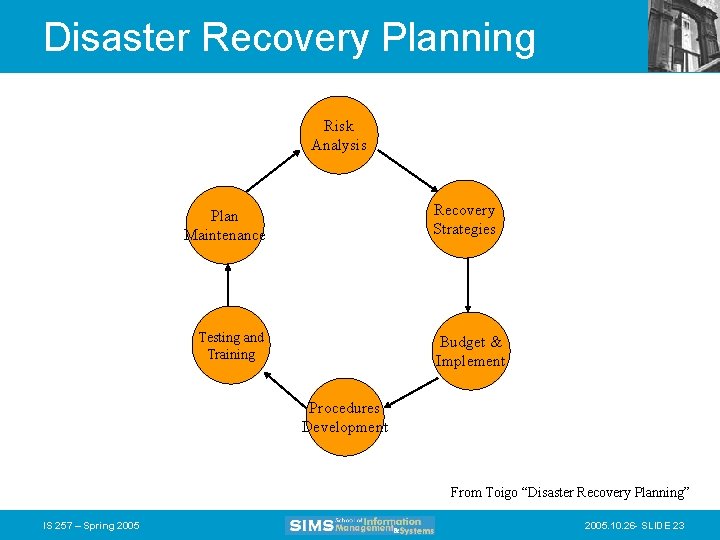
Disaster Recovery Planning Risk Analysis Recovery Strategies Plan Maintenance Testing and Training Budget & Implement Procedures Development From Toigo “Disaster Recovery Planning” IS 257 – Spring 2005. 10. 26 - SLIDE 23
IS 257 – Spring 2005. 10. 26 - SLIDE 24
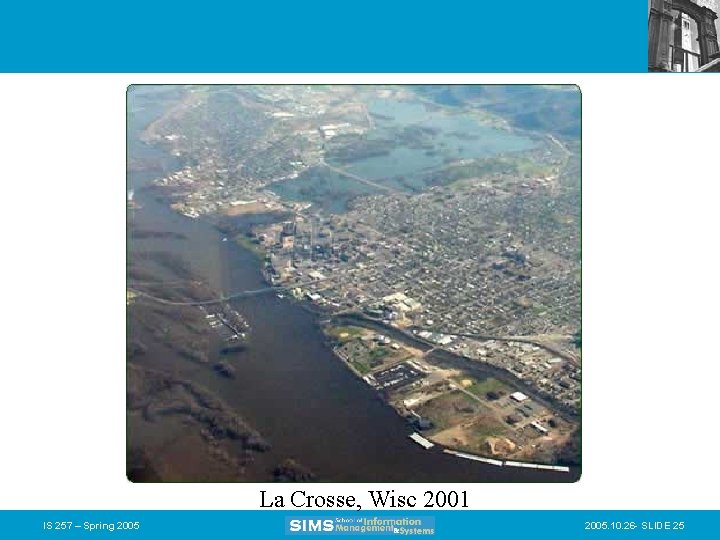
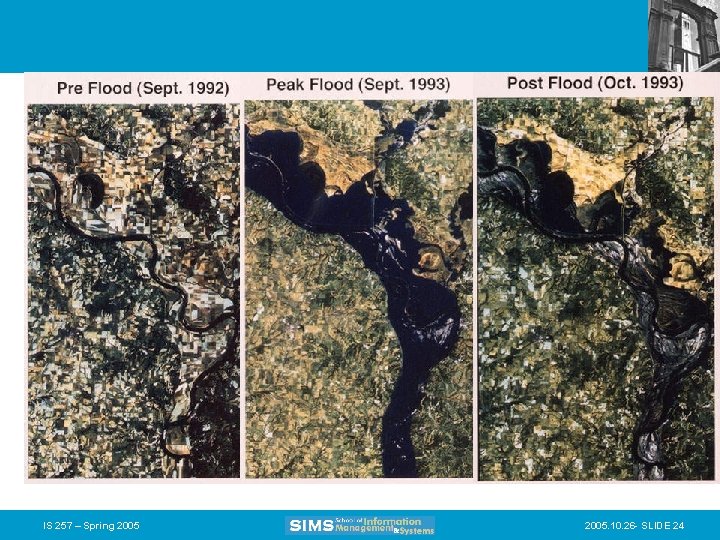
La Crosse, Wisc 2001 IS 257 – Spring 2005. 10. 26 - SLIDE 25
Threats to Assets and Functions • • • Water Fire Power Failure Mechanical breakdown or software failure Accidental or deliberate destruction of hardware or software – By hackers, disgruntled employees, industrial saboteurs, terrorists, or others IS 257 – Spring 2005. 10. 26 - SLIDE 26
Threats • Between 1967 and 1978 fire and water damage accounted for 62% of all data processing disasters in the U. S. • The water damage was sometimes caused by fighting fires • More recently improvements in fire suppression (e. g. , Halon) for DP centers has meant that water is the primary danger to DP centers IS 257 – Spring 2005. 10. 26 - SLIDE 27
Kinds of Records • Class I: VITAL – Essential, irreplaceable or necessary to recovery • Class II: IMPORTANT – Essential or important, but reproducible with difficulty or at extra expense • Class III: USEFUL – Records whose loss would be inconvenient, but which are replaceable • Class IV: NONESSENTIAL – Records which upon examination are found to be no longer necessary IS 257 – Spring 2005. 10. 26 - SLIDE 28
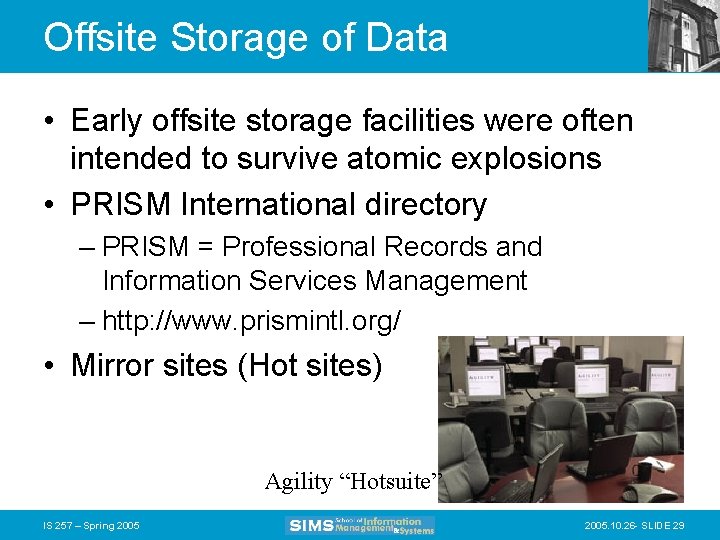
Offsite Storage of Data • Early offsite storage facilities were often intended to survive atomic explosions • PRISM International directory – PRISM = Professional Records and Information Services Management – http: //www. prismintl. org/ • Mirror sites (Hot sites) Agility “Hotsuite” IS 257 – Spring 2005. 10. 26 - SLIDE 29
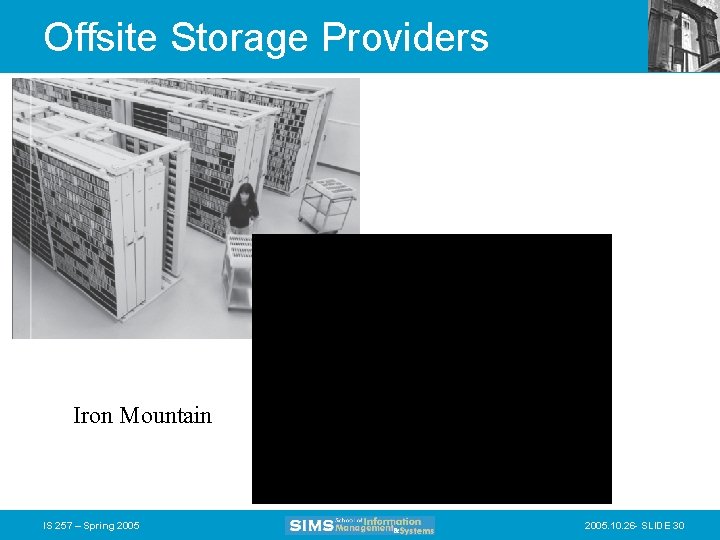
Offsite Storage Providers Iron Mountain IS 257 – Spring 2005. 10. 26 - SLIDE 30
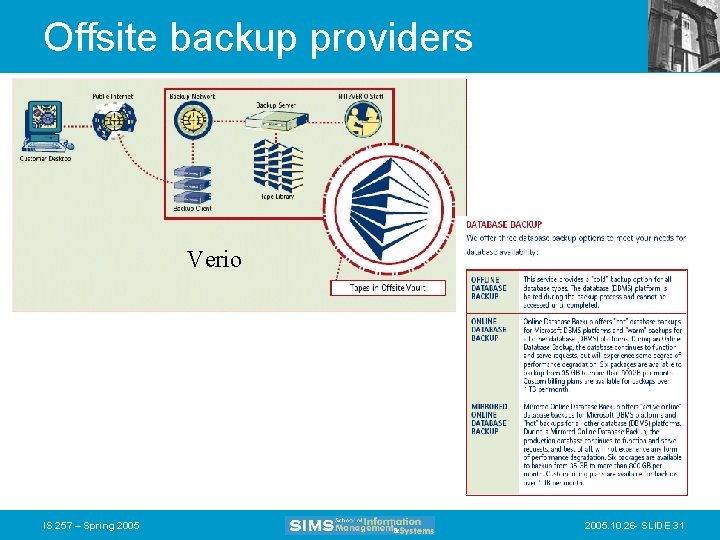
Offsite backup providers Verio IS 257 – Spring 2005. 10. 26 - SLIDE 31
Lecture Outline • Midterm Project Report Requirements • Review – Database Administration: Security • Database Administration: Disasters, Backup and Recovery • Database Administration: Roles IS 257 – Spring 2005. 10. 26 - SLIDE 32
Today • Traditional and Current Data Administration • Traditional and Current Database Administration • Review of Security, Integrity, etc. IS 257 – Spring 2005. 10. 26 - SLIDE 33
Changes in Traditional Roles • This is being driven by rapid changes in – Technology – Platforms (e. g. , Micro vs. Mainframe vs. Server) – Organizational Structure • We will focus on the core functions and tasks of these roles (traditional or current) IS 257 – Spring 2005. 10. 26 - SLIDE 34
Terms and Concepts (trad) • Data Administration – Responsibility for the overall management of data resources within an organization • Database Administration – Responsibility for physical database design and technical issues in database management • These roles are often combined or overlapping in some organizations IS 257 – Spring 2005. 10. 26 - SLIDE 35
Terms and Concepts (trad) • DA – Data adminstrator - person responsible for the Data Administration function in an organization – Sometimes may be the CIO -- Chief Information Officer • DBA – Database Administrator - person responsible for the Database Administration Function IS 257 – Spring 2005. 10. 26 - SLIDE 36
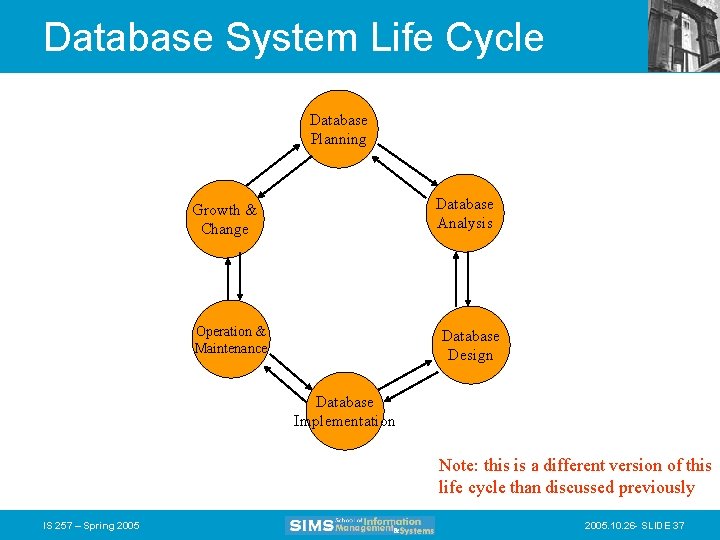
Database System Life Cycle Database Planning Database Analysis Growth & Change Operation & Maintenance Database Design Database Implementation Note: this is a different version of this life cycle than discussed previously IS 257 – Spring 2005. 10. 26 - SLIDE 37
Database Planning • Development of a strategic plan for database development that supports the overall organization’s business plan • DA supports top management in development of this plan • The result of this stage is an enterprise data model IS 257 – Spring 2005. 10. 26 - SLIDE 38
Database Planning: DA & DBA functions • • • Develop corporate database strategy (DA) Develop enterprise model (DA) Develop cost/benefit models (DA) Design database environment (DA) Develop data administration plan (DA) IS 257 – Spring 2005. 10. 26 - SLIDE 39
Database Analysis • This is the process (discussed previously) of identifying data entities currently used by the organization, precisely defining those entities and their relationships, and documenting the results in a form that can support the follow-on design phase • Must also identify new data elements or changes to data elements that will be required in the future • The result of this phase is the Conceptual Data Model -- usually represented as an ER diagram IS 257 – Spring 2005. 10. 26 - SLIDE 40
Database Analysis: DA & DBA functions • • Define and model data requirements (DA) Define and model business rules (DA) Define operational requirements (DA) Maintain corporate Data Dictionary (DA) IS 257 – Spring 2005. 10. 26 - SLIDE 41
Database Design • Purpose of the design phase is the development of the logical database design that will serve the needs of the organization and the physical design implementing the logical design • In relational systems the outcome is normalized relations, and the data definition for a particular database systems (including indexes, etc. ) IS 257 – Spring 2005. 10. 26 - SLIDE 42
Design 2: Physical Creation • Development of the Physical Model of the Database – data formats and types – determination of indexes, etc. • Load a prototype database and test • Determine and implement security, privacy and access controls • Determine and implement integrity constraints IS 257 – Spring 2005. 10. 26 - SLIDE 43
Database Design: DA &DBA functions • Perform logical database design (DA) • Design external models (subschemas) (DBA) • Design internal model (Physical design) (DBA) • Design integrity controls (DBA) IS 257 – Spring 2005. 10. 26 - SLIDE 44
Database Implementation • Database design gives you an empty database • Load data into the database structure • Convert existing data sets and applications to use the new database – May need programs, conversion utilities to convert old data to new formats. • Outcome is the actual database with its data IS 257 – Spring 2005. 10. 26 - SLIDE 45
Database Implementation DA & DBA functions • • • Specify database access policies (DA & DBA) Establish Security controls (DBA) Supervise Database loading (DBA) Specify test procedures (DBA) Develop application programming standards (DBA) • Establish procedures for backup and recovery (DBA) • Conduct User training (DA & DBA) IS 257 – Spring 2005. 10. 26 - SLIDE 46
Operation and Maintenance 1: Operations • Users are responsible for updating the database, DA and DBA are responsible for developing procedures that ensure the integrity and security of the database during the update process. • Specific responsibility for data collection, editing and verification must be assigned • Quality assurance must be practiced to protect and audit the database quality. IS 257 – Spring 2005. 10. 26 - SLIDE 47
Operation and Maintenance 2: Maintenance • The ongoing process of updating the database to keep it current – – adding new records deleting obsolete records changing data values in particular records modifying relation structures (e. g. adding new fields) • Privacy, security, access control must be in place. • Recovery and Backup procedures must be established and used IS 257 – Spring 2005. 10. 26 - SLIDE 48
Operation and Maintenance: DA & DBA functions • • Monitor database performance (DBA) Tune and reorganize databases (DBA) Enforce standards and procedures (DBA) Support users (DA & DBA) IS 257 – Spring 2005. 10. 26 - SLIDE 49
Growth & Change • Change is a way of life – Applications, data requirements, reports, etc. will all change as new needs and requirements are found – The Database and applications and will need to be modified to meet the needs of changes to the organization and the environment – Database performance should be monitored to maintain a high level of system performance IS 257 – Spring 2005. 10. 26 - SLIDE 50
Growth & Change: DA & DBA functions • Implement change control procedures (DA & DBA) • Plan for growth and change (DA & DBA) • Evaluate new technology (DA & DBA) IS 257 – Spring 2005. 10. 26 - SLIDE 51
- Slides: 51