
Data Acquisition and Trigger of the CBM Experiment
Data Acquisition and Trigger of the CBM Experiment Volker Friese GSI Darmstadt International Conference on Triggering Discoveries in High Energy Physics 11 September 2013, Jammu, India
A very short talk • Overview of CBM – see my presentation of yesterday‘s • CBM Trigger – there will be none • Thanks for your attention V. Friese ICTDHEP, Jammu, 11 September 2013 2

Reminder: experimental setup Electron + Hadron setup TOF ECAL TRD RICH STS+MVD PSD Measurement of hadrons (including open charm) and electrons Core tracker: STS (silicon strip detectors) Micro-vertex detector for precision measurement of displaced vertices V. Friese ICTDHEP, Jammu, 11 September 2013 3
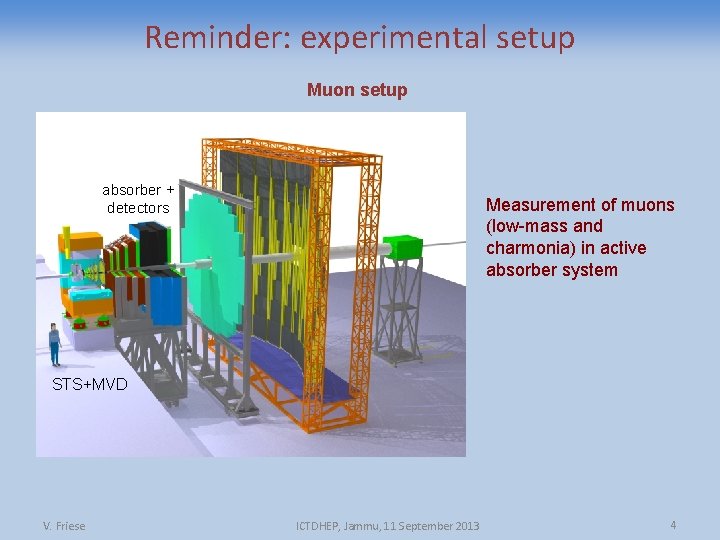
Reminder: experimental setup Muon setup absorber + detectors Measurement of muons (low-mass and charmonia) in active absorber system STS+MVD V. Friese ICTDHEP, Jammu, 11 September 2013 4
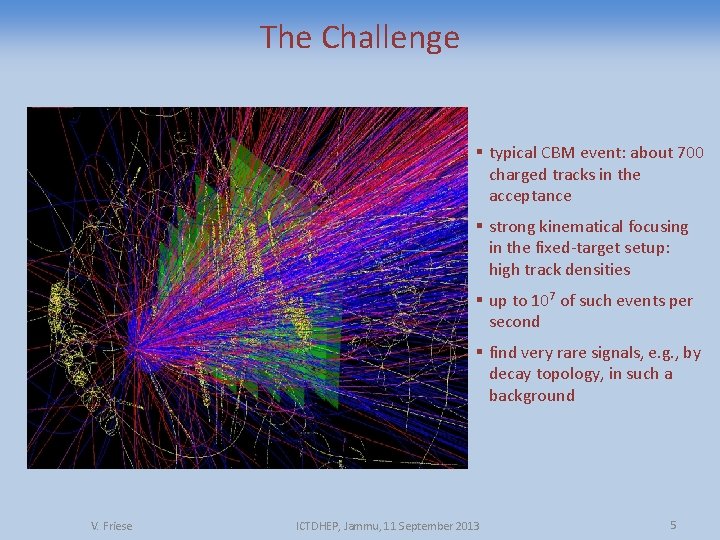
The Challenge § typical CBM event: about 700 charged tracks in the acceptance § strong kinematical focusing in the fixed-target setup: high track densities § up to 107 of such events per second § find very rare signals, e. g. , by decay topology, in such a background V. Friese ICTDHEP, Jammu, 11 September 2013 5
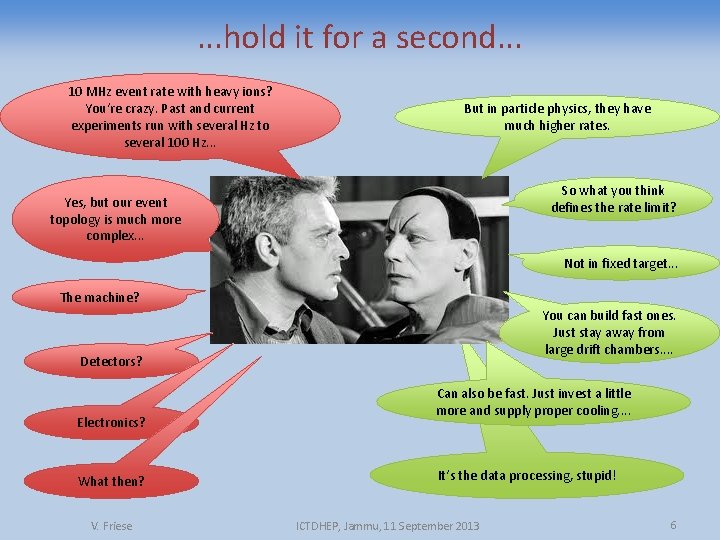
. . . hold it for a second. . . 10 MHz event rate with heavy ions? You‘re crazy. Past and current experiments run with several Hz to several 100 Hz. . . But in particle physics, they have much higher rates. So what you think defines the rate limit? Yes, but our event topology is much more complex. . . Not in fixed target. . . The machine? You can build fast ones. Just stay away from large drift chambers. . Detectors? Electronics? What then? V. Friese Can also be fast. Just invest a little more and supply proper cooling. . It‘s the data processing, stupid! ICTDHEP, Jammu, 11 September 2013 6
Trigger Considerations • Signatures vary qualitatively: – local and simple: J/ψ->μ+μ– non-local and simple: J/ψ -> e+e– non-local and complex: D, Ω->charged hadrons • For maximal interaction rate, reconstruction in STS is always required (momentum information), but not necessarily of all tracks in STS. • Trigger architecture must enable – variety of trigger patterns (J/ψ: 1% of data, D mesons: 50% of data) – multiple triggers at a time – multiple trigger steps with subsequent data reduction • Complex signatures involve secondary decay vertices; difficult to implement in hardware. • Extreme event rates set strong limits to trigger latency. V. Friese ICTDHEP, Jammu, 11 September 2013 7
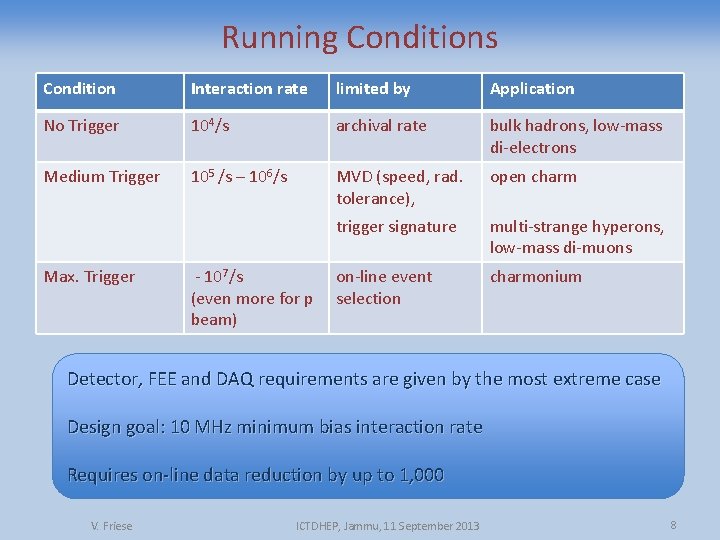
Running Conditions Condition Interaction rate limited by Application No Trigger 104/s archival rate bulk hadrons, low-mass di-electrons Medium Trigger 105 /s – 106/s MVD (speed, rad. tolerance), open charm trigger signature multi-strange hyperons, low-mass di-muons on-line event selection charmonium Max. Trigger - 107/s (even more for p beam) Detector, FEE and DAQ requirements are given by the most extreme case Design goal: 10 MHz minimum bias interaction rate Requires on-line data reduction by up to 1, 000 V. Friese ICTDHEP, Jammu, 11 September 2013 8
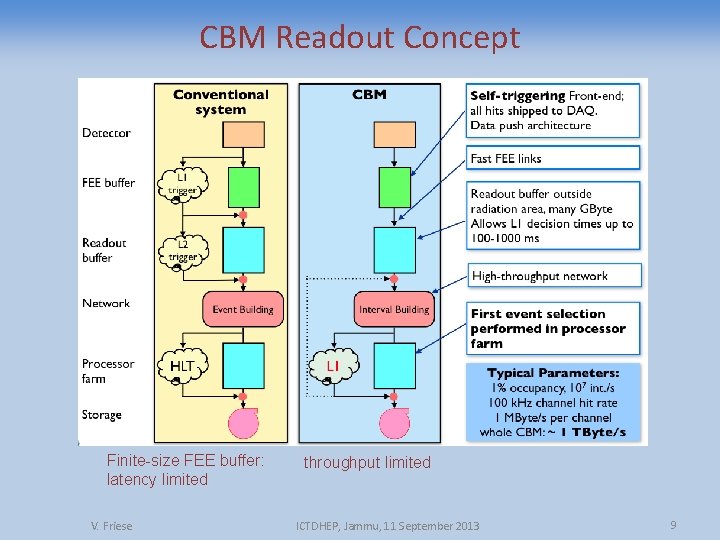
CBM Readout Concept Finite-size FEE buffer: latency limited V. Friese throughput limited ICTDHEP, Jammu, 11 September 2013 9
Consequences • The system is limited only by the throughput capacity and by the rejection power of the online computing farm. • There is no a-priori event definition: data from all detectors come asynchroneously; events may overlap in time. • The classical DAQ task of „event building“ is now rather a „time-slice building“. Physical events are defined later in software. • Data reduction is shifted entirely to software: maximum flexibility w. r. t. physics V. Friese ICTDHEP, Jammu, 11 September 2013 10
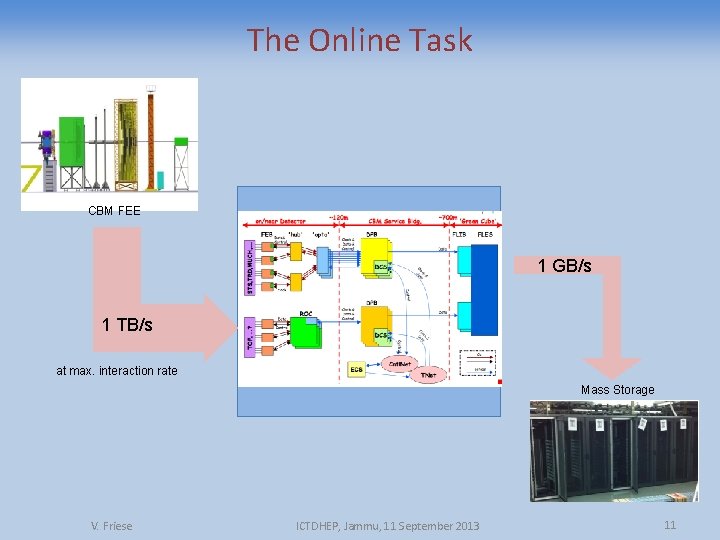
The Online Task CBM FEE 1 GB/s 1 TB/s Online Data Processing at max. interaction rate Mass Storage V. Friese ICTDHEP, Jammu, 11 September 2013 11
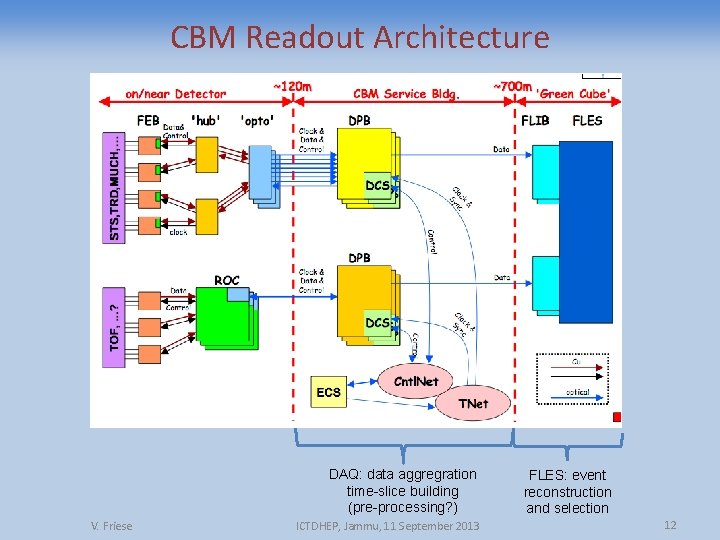
CBM Readout Architecture DAQ: data aggregration time-slice building (pre-processing? ) V. Friese ICTDHEP, Jammu, 11 September 2013 FLES: event reconstruction and selection 12
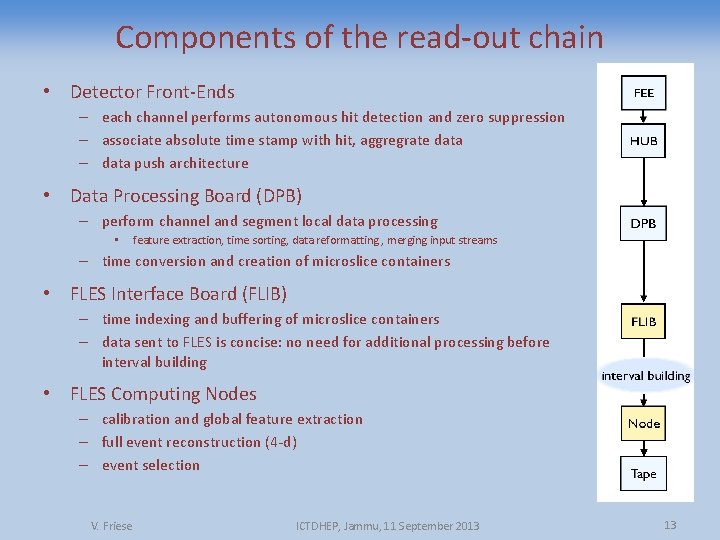
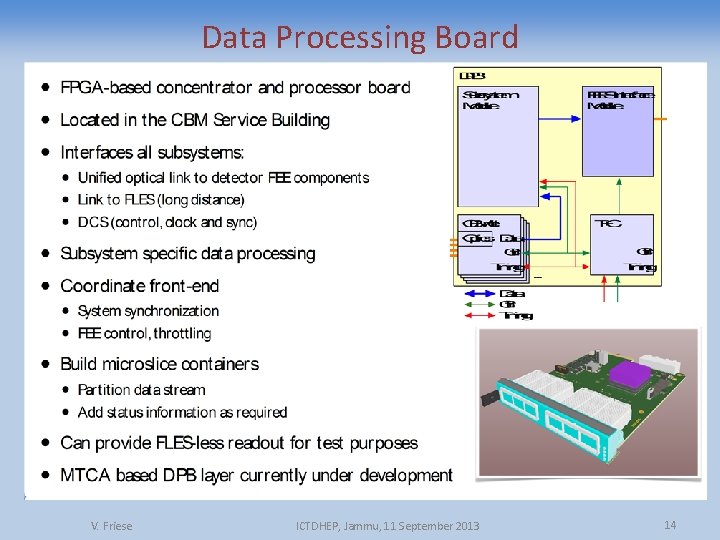
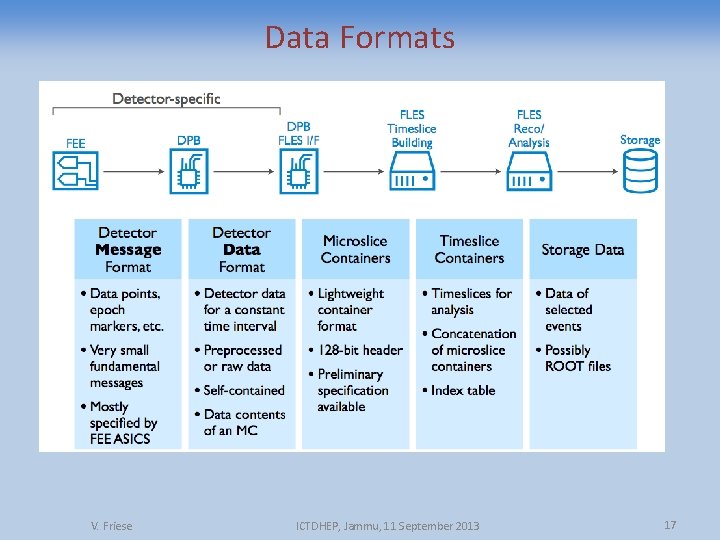
Components of the read-out chain • Detector Front-Ends – each channel performs autonomous hit detection and zero suppression – associate absolute time stamp with hit, aggregrate data – data push architecture • Data Processing Board (DPB) – perform channel and segment local data processing • feature extraction, time sorting, data reformatting , merging input streams – time conversion and creation of microslice containers • FLES Interface Board (FLIB) – time indexing and buffering of microslice containers – data sent to FLES is concise: no need for additional processing before interval building • FLES Computing Nodes – calibration and global feature extraction – full event reconstruction (4 -d) – event selection V. Friese ICTDHEP, Jammu, 11 September 2013 13
Data Processing Board V. Friese ICTDHEP, Jammu, 11 September 2013 14
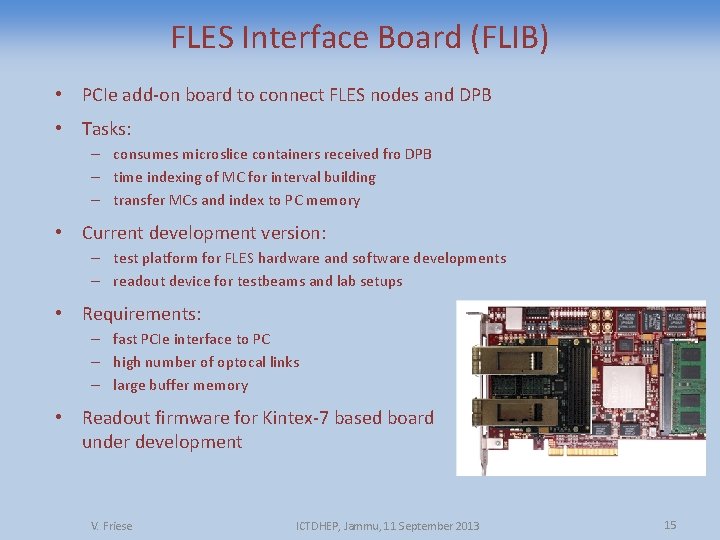
FLES Interface Board (FLIB) • PCIe add-on board to connect FLES nodes and DPB • Tasks: – consumes microslice containers received fro DPB – time indexing of MC for interval building – transfer MCs and index to PC memory • Current development version: – test platform for FLES hardware and software developments – readout device for testbeams and lab setups • Requirements: – fast PCIe interface to PC – high number of optocal links – large buffer memory • Readout firmware for Kintex-7 based board under development V. Friese ICTDHEP, Jammu, 11 September 2013 15
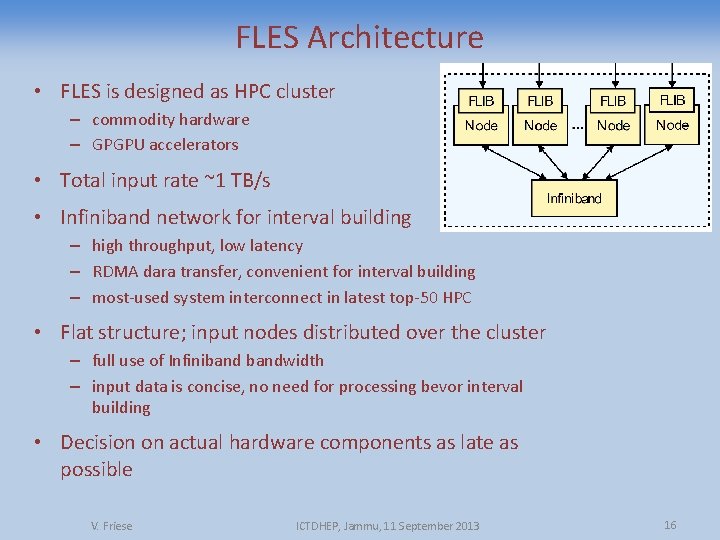
FLES Architecture • FLES is designed as HPC cluster – commodity hardware – GPGPU accelerators • Total input rate ~1 TB/s • Infiniband network for interval building – high throughput, low latency – RDMA dara transfer, convenient for interval building – most-used system interconnect in latest top-50 HPC • Flat structure; input nodes distributed over the cluster – full use of Infinibandwidth – input data is concise, no need for processing bevor interval building • Decision on actual hardware components as late as possible V. Friese ICTDHEP, Jammu, 11 September 2013 16
Data Formats V. Friese ICTDHEP, Jammu, 11 September 2013 17
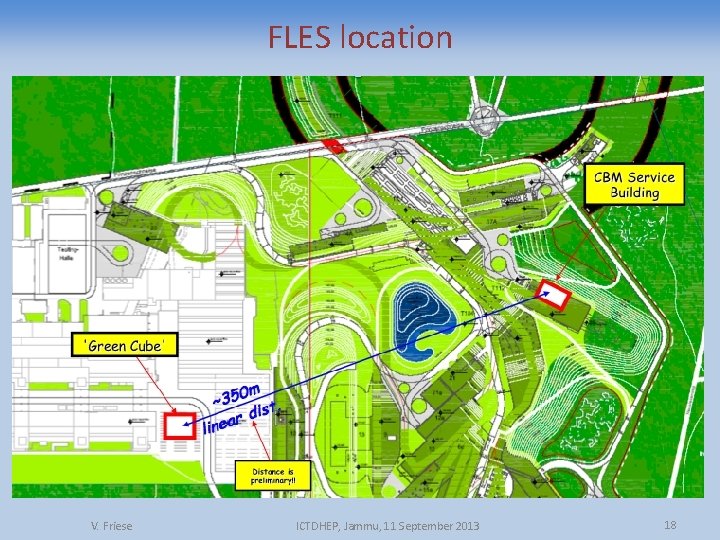
FLES location V. Friese ICTDHEP, Jammu, 11 September 2013 18
Online reconstruction and data selection • Decision on interesting data requires (partial) reconstruction of events: – track finding – secondary vertex finding – further reduction by PID • Throughput depends on – capacity of online computing cluster – performance of algorithms • Algorithms must be fully optimised w. r. t. speed, which includes full parallelisation – tailored to specific hardware (many-core CPU, GPU) – beyond scope of common physicist; requires software experts V. Friese ICTDHEP, Jammu, 11 September 2013 19
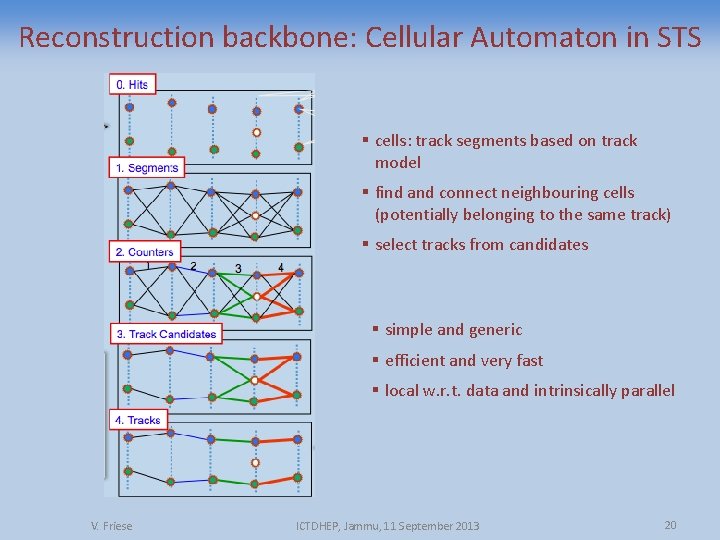
Reconstruction backbone: Cellular Automaton in STS § cells: track segments based on track model § find and connect neighbouring cells (potentially belonging to the same track) § select tracks from candidates § simple and generic § efficient and very fast § local w. r. t. data and intrinsically parallel V. Friese ICTDHEP, Jammu, 11 September 2013 20
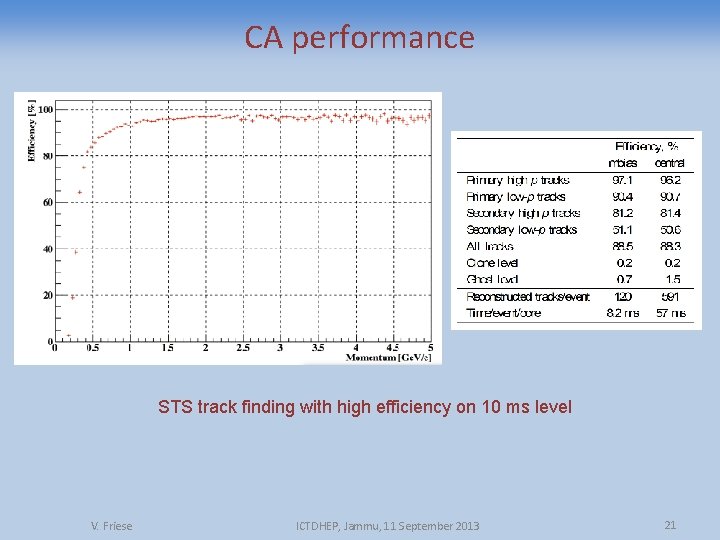
CA performance STS track finding with high efficiency on 10 ms level V. Friese ICTDHEP, Jammu, 11 September 2013 21
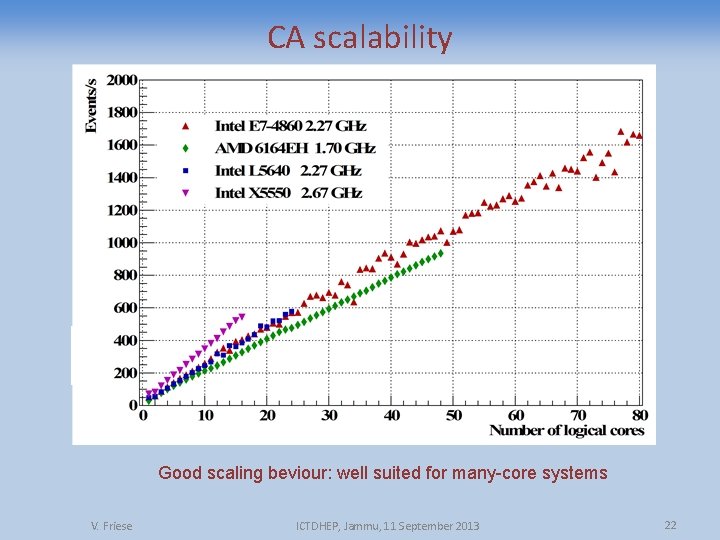
CA scalability Good scaling beviour: well suited for many-core systems V. Friese ICTDHEP, Jammu, 11 September 2013 22
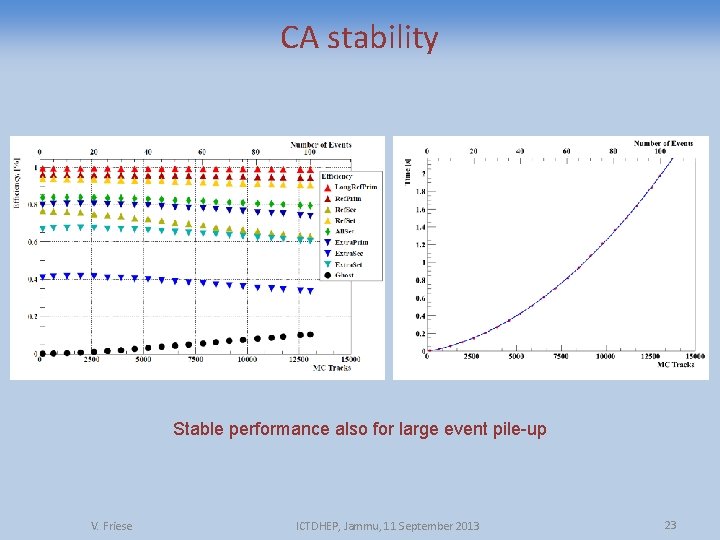
CA stability Stable performance also for large event pile-up V. Friese ICTDHEP, Jammu, 11 September 2013 23
Many more tasks for online computing • • Track finding in STS Track fit Track finding in TRD Track finding in Muon System Ring finding in RICH Matching RICH ring, TOF hit and ECAL cluster to tracks Vertexing Analysis and data selection V. Friese ICTDHEP, Jammu, 11 September 2013 24
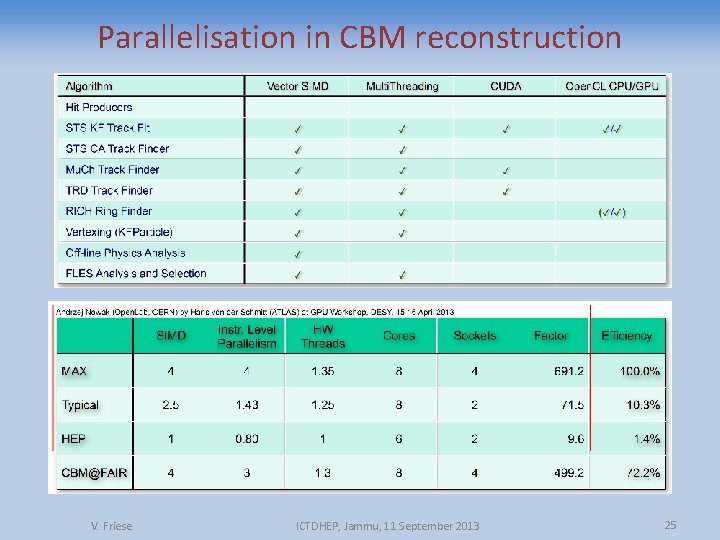
Parallelisation in CBM reconstruction V. Friese ICTDHEP, Jammu, 11 September 2013 25
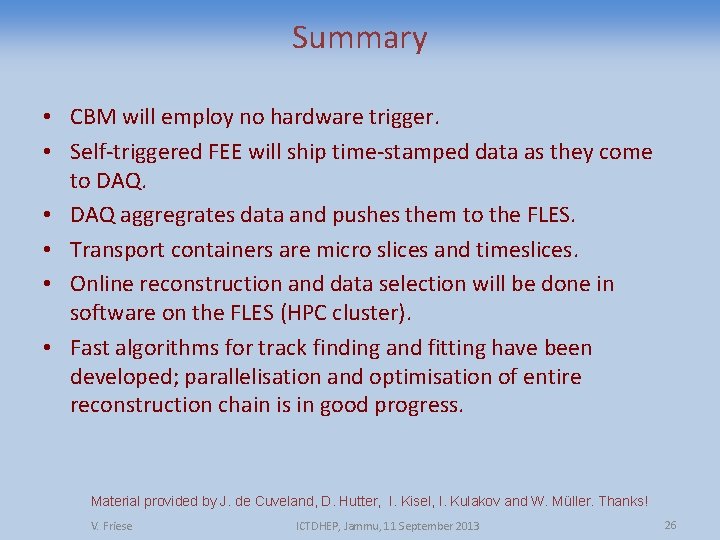
Summary • CBM will employ no hardware trigger. • Self-triggered FEE will ship time-stamped data as they come to DAQ. • DAQ aggregrates data and pushes them to the FLES. • Transport containers are micro slices and timeslices. • Online reconstruction and data selection will be done in software on the FLES (HPC cluster). • Fast algorithms for track finding and fitting have been developed; parallelisation and optimisation of entire reconstruction chain is in good progress. Material provided by J. de Cuveland, D. Hutter, I. Kisel, I. Kulakov and W. Müller. Thanks! V. Friese ICTDHEP, Jammu, 11 September 2013 26
Backup V. Friese ICTDHEP, Jammu, 11 September 2013 27
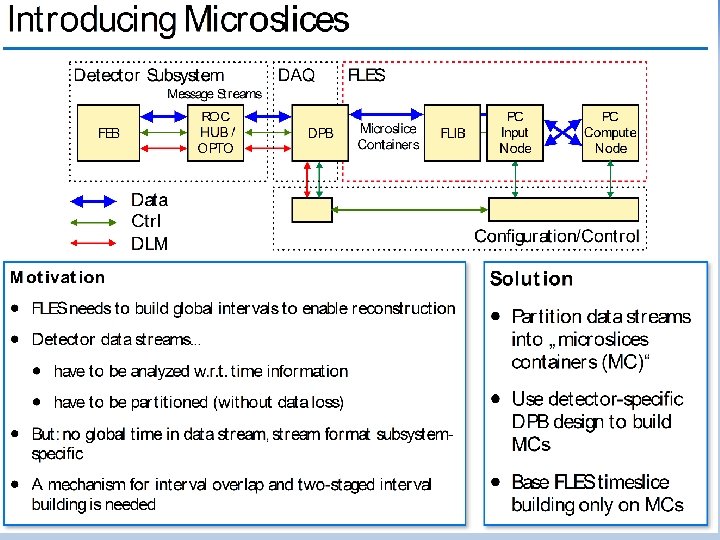
Microslices V. Friese ICTDHEP, Jammu, 11 September 2013 28
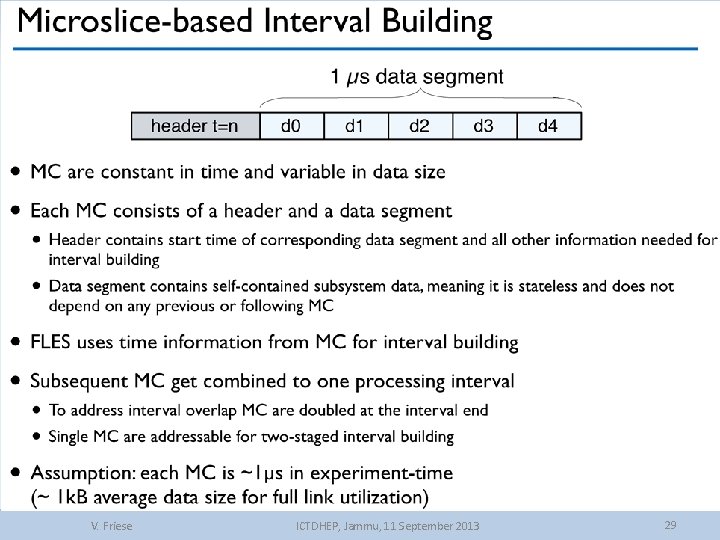
Microslices V. Friese ICTDHEP, Jammu, 11 September 2013 29
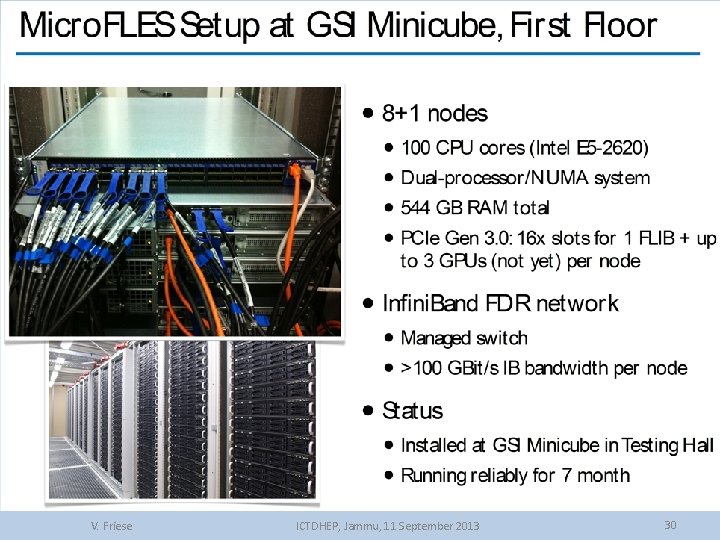
FLES test setup V. Friese ICTDHEP, Jammu, 11 September 2013 30
- Slides: 30