
DASH Debriefing Assessment for Simulation in Healthcare Introduction
DASH Debriefing Assessment for Simulation in Healthcare
Introduction • Simulations have become an integral part of the curriculum for health care professionals • The advantages of practicing critical infrequent events and also practicing procedures in a safe environment are invaluable • Simulations are being used to provide formative and summative competencies
Debriefing • Facilitated conversations • Participants analyze: • Their actions • Thought processes • Emotional states
Debriefing • Adult Learning principles • • Reflection Feedback (clear, honest) Psychologically safe environment Future experimentation
WHY DASH • Only debriefing tool that assesses debriefing in a wide variety of health care contexts • Uses BARS (behaviorally anchored rating scale)
DASH ELEMENTS • Establishes an engaging environment • • Clarifies course objectives Environment Confidentiality Roles Establish “fiction contract” Attends to logistic details Conveys a commitment to respecting learners and understanding their perspective
DASH ELEMENTS • Maintains an engaging learning environment • Clarifies debriefing objectives, roles, and expectations • Helps participants engage in a limited-realism context • Structures the debriefing in an organized way • Encourages trainees to express their reactions and, if needed, orients them to what happened in the simulation, near the beginning • Guides analysis of the trainees’ performance during the middle of the session • Collaborates with participants to summarize learning from the session near the end • Clarifies debriefing objectives, roles, and expectations • Helps participants engage in a limited-realism context
DASH ELEMENTS • Provokes engaging discussions • • • Uses concrete examples and outcomes as the basis for inquiry and discussion Reveals own reasoning and judgments Facilitates discussion through verbal and nonverbal techniques Uses video, replay, and review devices (if available) Recognizes and manages the upset participant • Identifies and explores performance gaps • Provides feedback on performance • Explores the source of the performance gap
DASH ELEMENTS • Helps trainees achieve or sustain good future performance • Helps close the performance gap through discussion and teaching • Demonstrates firm grasp of the subject • Meets the important objectives of the session
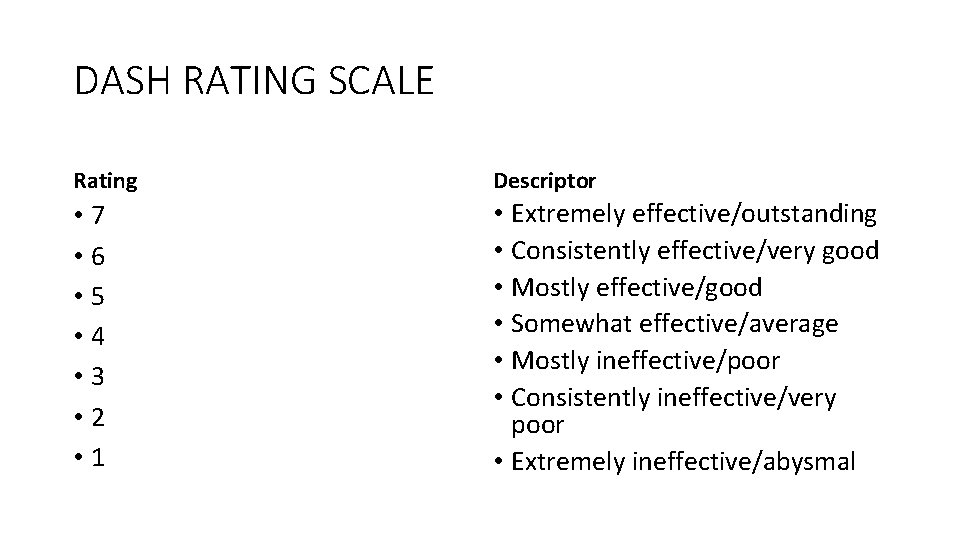
DASH RATING SCALE Rating Descriptor • 7 • 6 • 5 • 4 • 3 • 2 • 1 • Extremely effective/outstanding • Consistently effective/very good • Mostly effective/good • Somewhat effective/average • Mostly ineffective/poor • Consistently ineffective/very poor • Extremely ineffective/abysmal
CONCLUSIONS • Evidence suggests that simulation • Accompanied by high-quality debriefings • Facilitates transfer of new knowledge, skills, and attitudes • Primarily through enactment of the reflection stage of experiential learning • Opportunity for the experimentation aspect • DASH can provide valuable feedback to facilitate the educational processes within debriefing
- Slides: 11