
DARPA TRADES Challenge Problems Overview Jan Vandenbrande Ph
DARPA TRADES Challenge Problems Overview Jan Vandenbrande, Ph. D. Program Manager, Defense Sciences Office Defense Advanced Research Projects Agency 6/3/2020 Distribution Statement “A” (Approved for Public Release, Distribution Unlimited)

Transformative Design (TRADES) Program Goal Objective: Develop and exploit new mathematics and algorithms to incorporate advanced materials and manufacturing in design Model Requirements HPC Explore: make computers a collaborative partner to enhance human designers to synthesize designs Analyze Synthesize TRADES Empower designers to explore new performance envelopes and synthesize designs unimagined today Distribution Statement “A” (Approved for Public Release, Distribution Unlimited) 2

SOA limitations & challenges SOA Design Process: Test and iterate Modeling Analysis Geometric & Material Model >50% of total human effort Synthesis Triangles Geodesics Conversion Tetrahedra Boundary Representation Faces Aero Heating Loads Radar Even within the same print, the material structure changes due to thermal history How would you compensate for this? How would you take advantage of this? How do you deal with uncertainty? And many more Iterate design based on results Challenge: Current computational methods cannot represent shape and material at relevant scales and levels of complexity Challenge: Limited interoperability between design and analysis systems prevents automated design exploration Distribution Statement “A” (Approved for Public Release, Distribution Unlimited) Challenge: Inability to effectively trade material architectures and properties with shaping limits ultimate performance 3
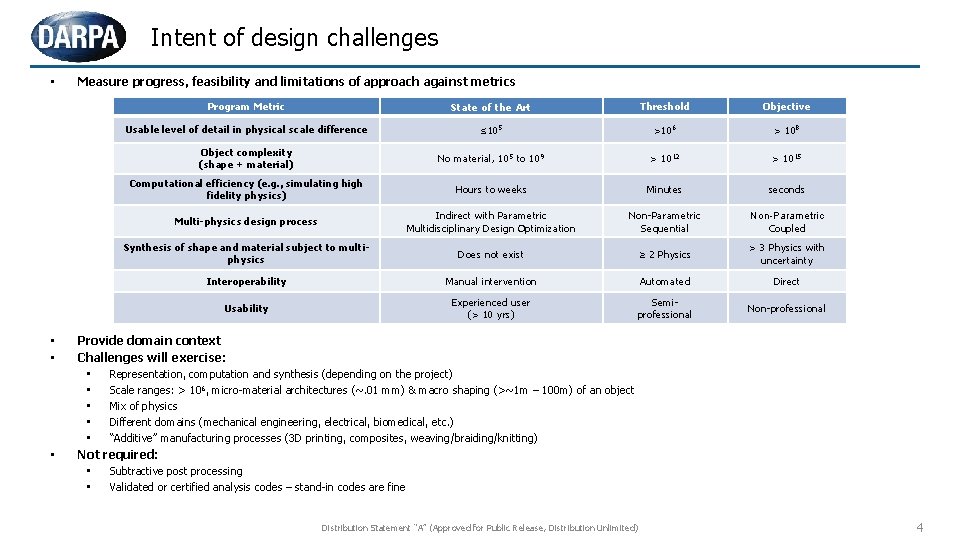
Intent of design challenges • • Measure progress, feasibility and limitations of approach against metrics Program Metric State of the Art Threshold Objective Usable level of detail in physical scale difference ≤ 105 >106 > 108 Object complexity (shape + material) No material, 105 to 109 > 1012 > 1015 Computational efficiency (e. g. , simulating high fidelity physics) Hours to weeks Minutes seconds Multi-physics design process Indirect with Parametric Multidisciplinary Design Optimization Non-Parametric Sequential Non-Parametric Coupled Synthesis of shape and material subject to multiphysics Does not exist ≥ 2 Physics > 3 Physics with uncertainty Interoperability Manual intervention Automated Direct Usability Experienced user (> 10 yrs) Semiprofessional Non-professional Provide domain context Challenges will exercise: • Representation, computation and synthesis (depending on the project) • Scale ranges: > 106, micro-material architectures (~. 01 mm) & macro shaping (>~1 m – 100 m) of an object • Mix of physics • Different domains (mechanical engineering, electrical, biomedical, etc. ) • “Additive” manufacturing processes (3 D printing, composites, weaving/braiding/knitting) Not required: • Subtractive post processing • Validated or certified analysis codes – stand-in codes are fine Distribution Statement “A” (Approved for Public Release, Distribution Unlimited) 4
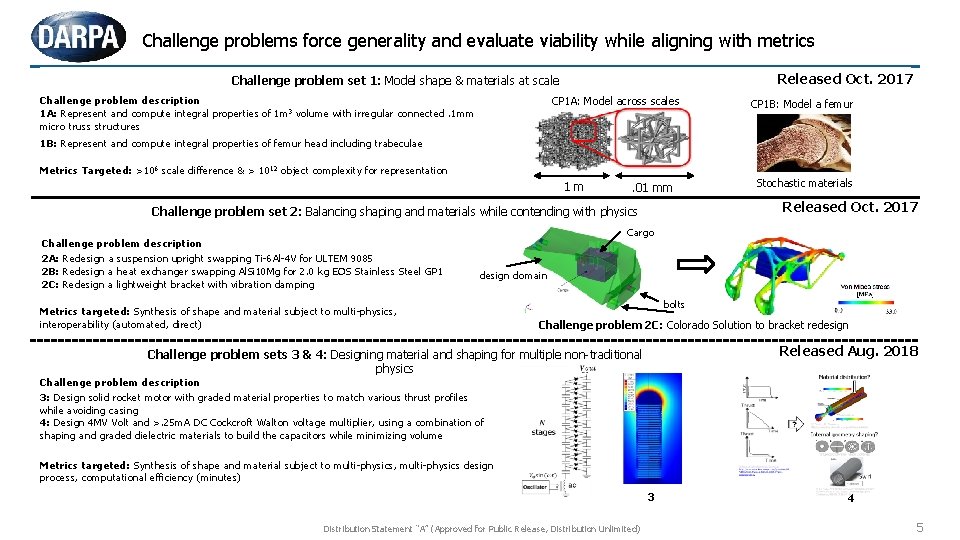
Challenge problems force generality and evaluate viability while aligning with metrics Released Oct. 2017 Challenge problem set 1: Model shape & materials at scale Challenge problem description 1 A: Represent and compute integral properties of 1 m 3 volume with irregular connected. 1 mm micro truss structures CP 1 A: Model across scales CP 1 B: Model a femur 1 B: Represent and compute integral properties of femur head including trabeculae Metrics Targeted: >106 scale difference & > 1012 object complexity for representation 1 m . 01 mm Released Oct. 2017 Challenge problem set 2: Balancing shaping and materials while contending with physics Challenge problem description 2 A: Redesign a suspension upright swapping Ti-6 Al-4 V for ULTEM 9085 2 B: Redesign a heat exchanger swapping Al. Si 10 Mg for 2. 0 kg EOS Stainless Steel GP 1 2 C: Redesign a lightweight bracket with vibration damping Stochastic materials Cargo design domain Metrics targeted: Synthesis of shape and material subject to multi-physics, interoperability (automated, direct) bolts Challenge problem 2 C: Colorado Solution to bracket redesign Released Aug. 2018 Challenge problem sets 3 & 4: Designing material and shaping for multiple non-traditional physics Challenge problem description 3: Design solid rocket motor with graded material properties to match various thrust profiles while avoiding casing 4: Design 4 MV Volt and >. 25 m. A DC Cockcroft Walton voltage multiplier, using a combination of shaping and graded dielectric materials to build the capacitors while minimizing volume Metrics targeted: Synthesis of shape and material subject to multi-physics, multi-physics design process, computational efficiency (minutes) 3 Distribution Statement “A” (Approved for Public Release, Distribution Unlimited) 4 5
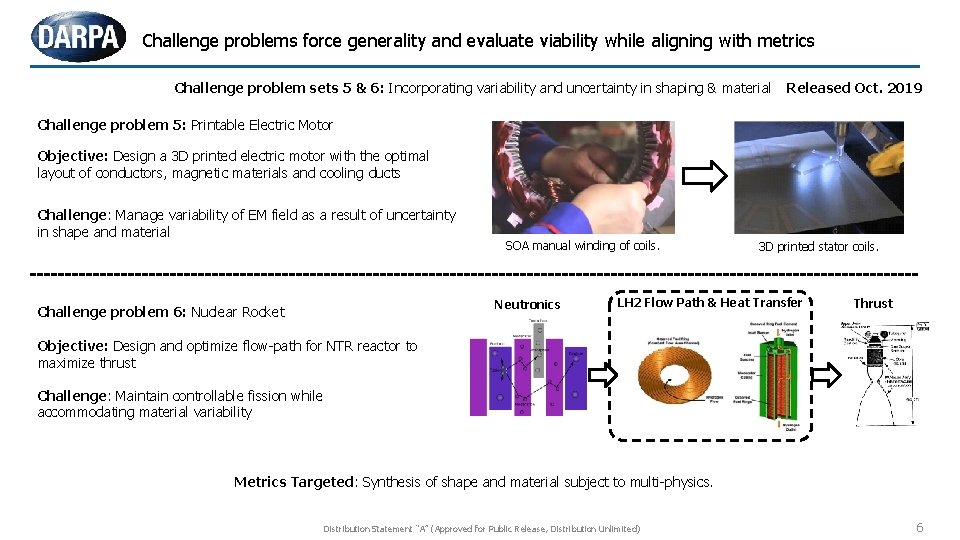
Challenge problems force generality and evaluate viability while aligning with metrics Challenge problem sets 5 & 6: Incorporating variability and uncertainty in shaping & material Released Oct. 2019 Challenge problem 5: Printable Electric Motor Objective: Design a 3 D printed electric motor with the optimal layout of conductors, magnetic materials and cooling ducts Challenge: Manage variability of EM field as a result of uncertainty in shape and material SOA manual winding of coils. Neutronics Challenge problem 6: Nuclear Rocket 3 D printed stator coils. LH 2 Flow Path & Heat Transfer Thrust Objective: Design and optimize flow-path for NTR reactor to maximize thrust Challenge: Maintain controllable fission while accommodating material variability Metrics Targeted: Synthesis of shape and material subject to multi-physics. Distribution Statement “A” (Approved for Public Release, Distribution Unlimited) 6
- Slides: 6