
DARPA MTO MEMS SMART DUST K Pister J
- Slides: 30
DARPA MTO MEMS SMART DUST K. Pister, J. Kahn, B. Boser (UCB) S. Morris (MLB) SMART DUST
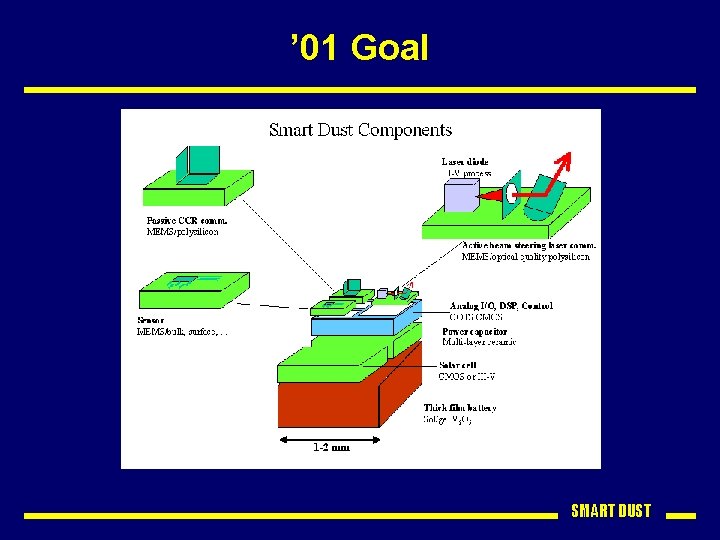
Goals • Autonomous sensor node (mote) in 1 mm 3 • MAV delivery • Thousands of motes • Many interrogators • Demonstrate useful/complex integration in 1 mm 3 SMART DUST
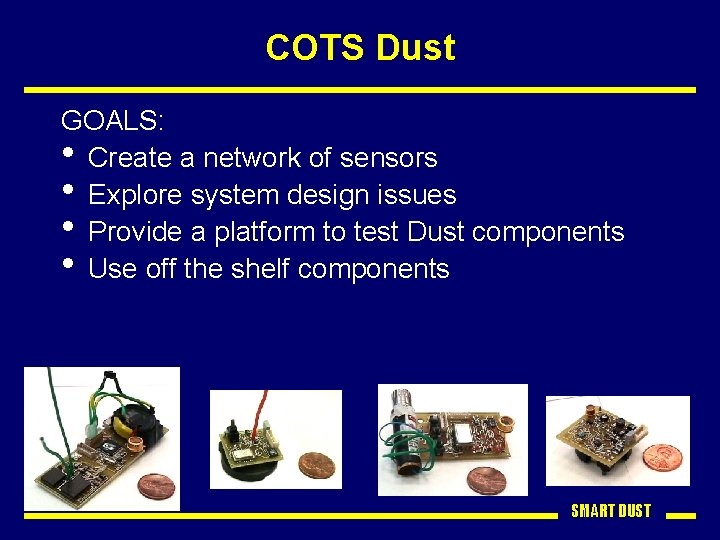
COTS Dust GOALS: • Create a network of sensors • Explore system design issues • Provide a platform to test Dust components • Use off the shelf components SMART DUST
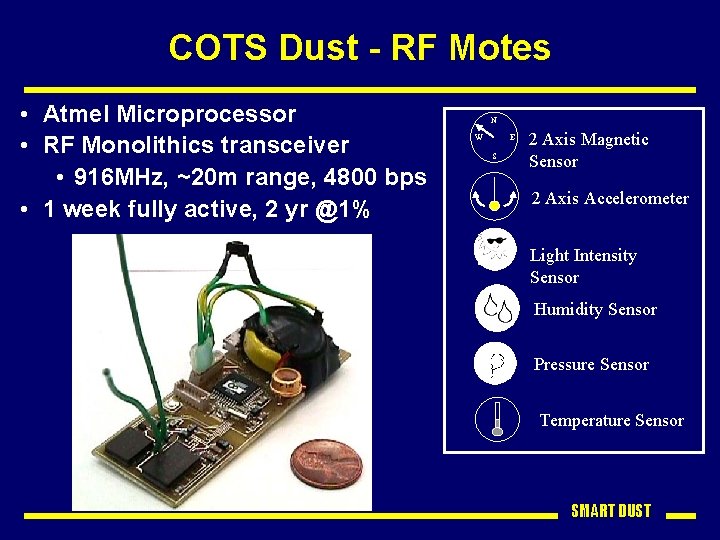
COTS Dust - RF Motes • Atmel Microprocessor • RF Monolithics transceiver • 916 MHz, ~20 m range, 4800 bps • 1 week fully active, 2 yr @1% N W E S 2 Axis Magnetic Sensor 2 Axis Accelerometer Light Intensity Sensor Humidity Sensor Pressure Sensor Temperature Sensor SMART DUST
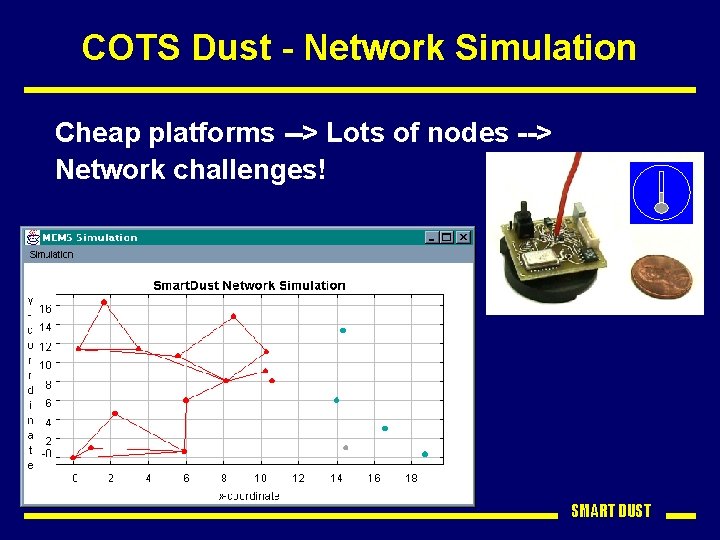
COTS Dust - Network Simulation Cheap platforms --> Lots of nodes --> Network challenges! SMART DUST
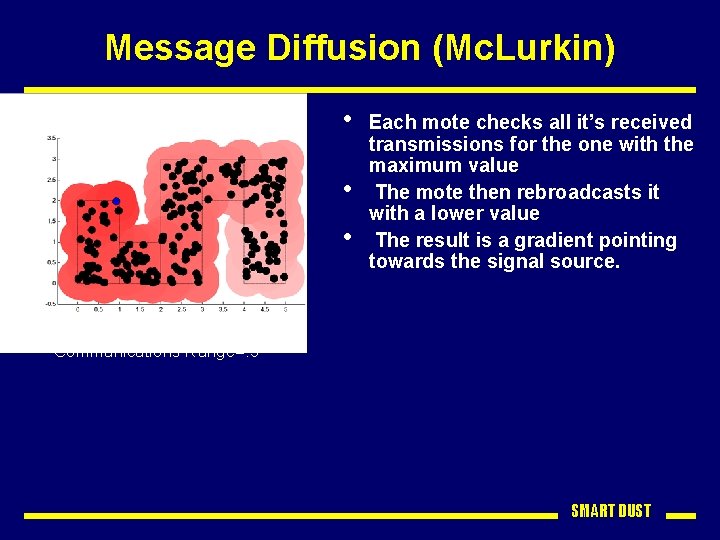
Message Diffusion (Mc. Lurkin) • • • Each mote checks all it’s received transmissions for the one with the maximum value The mote then rebroadcasts it with a lower value The result is a gradient pointing towards the signal source. Number Of Motes=200 Communications Range=. 5 SMART DUST
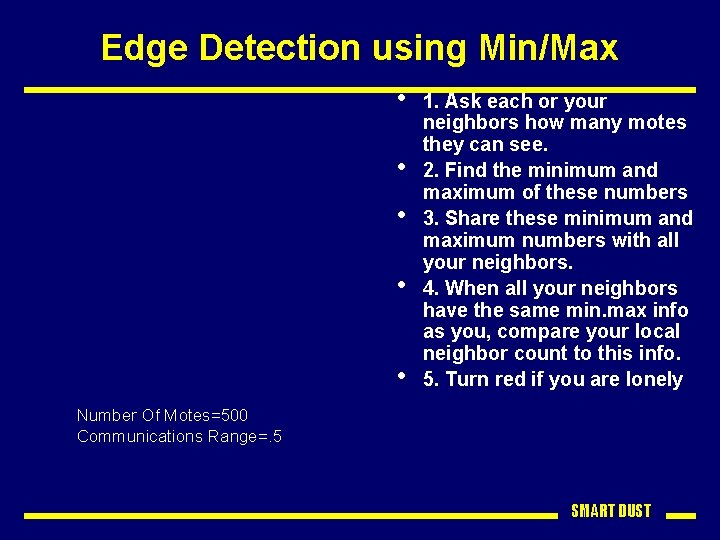
Edge Detection using Min/Max • • • 1. Ask each or your neighbors how many motes they can see. 2. Find the minimum and maximum of these numbers 3. Share these minimum and maximum numbers with all your neighbors. 4. When all your neighbors have the same min. max info as you, compare your local neighbor count to this info. 5. Turn red if you are lonely Number Of Motes=500 Communications Range=. 5 SMART DUST
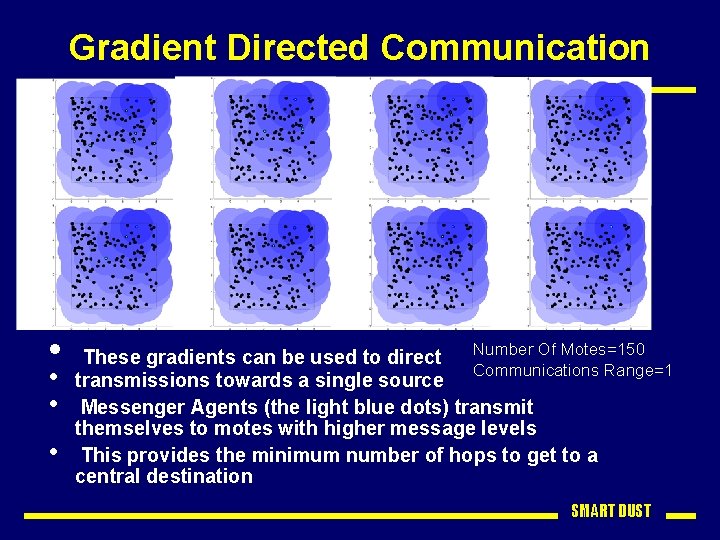
Gradient Directed Communication • • Number Of Motes=150 These gradients can be used to direct Communications Range=1 transmissions towards a single source Messenger Agents (the light blue dots) transmit themselves to motes with higher message levels This provides the minimum number of hops to get to a central destination SMART DUST
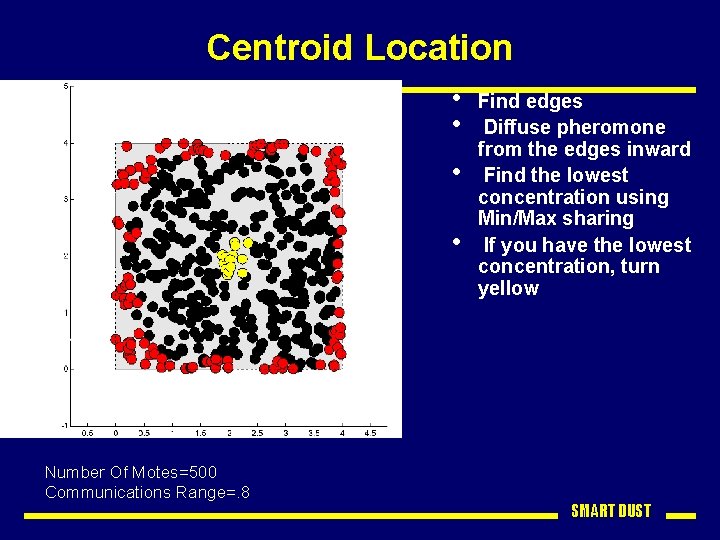
Centroid Location • • Number Of Motes=500 Communications Range=. 8 Find edges Diffuse pheromone from the edges inward Find the lowest concentration using Min/Max sharing If you have the lowest concentration, turn yellow SMART DUST
Mote Position Estimation • • • Give GPS receivers to some motes and callthem “Basis. Motes”. Ask them to turn gray. Each Basis. Mote diffuses it’s own pheromone throughout the group The position of any other mote can be estimated from the levels of basis pheromones present. SMART DUST
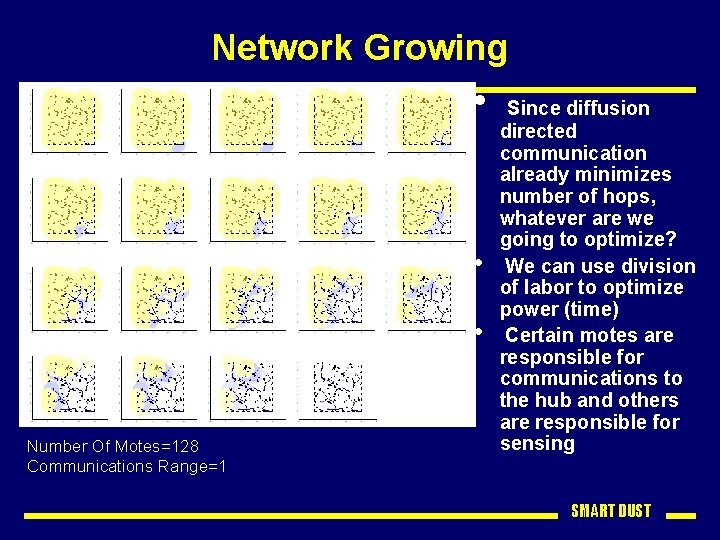
Network Growing • • • Number Of Motes=128 Communications Range=1 Since diffusion directed communication already minimizes number of hops, whatever are we going to optimize? We can use division of labor to optimize power (time) Certain motes are responsible for communications to the hub and others are responsible for sensing SMART DUST
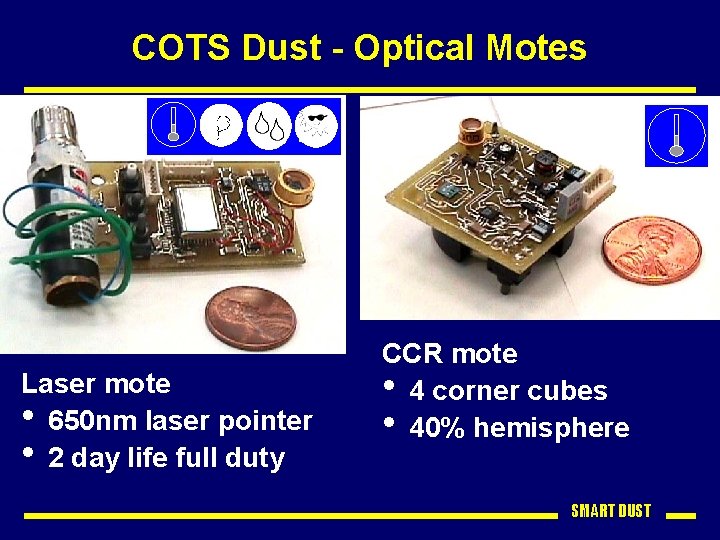
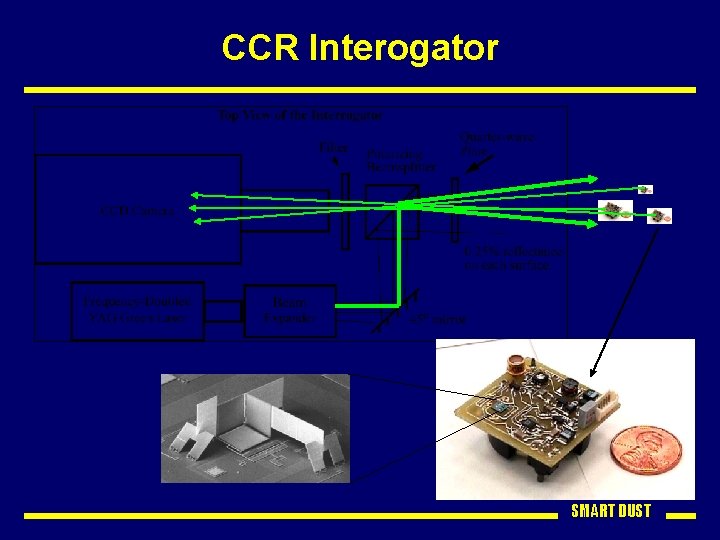
COTS Dust - Optical Motes Laser mote • 650 nm laser pointer • 2 day life full duty CCR mote • 4 corner cubes • 40% hemisphere SMART DUST
CCR Interogator SMART DUST
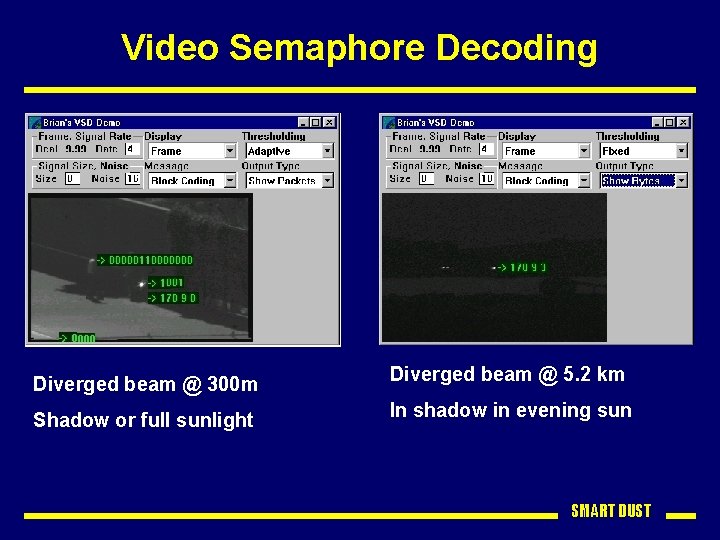
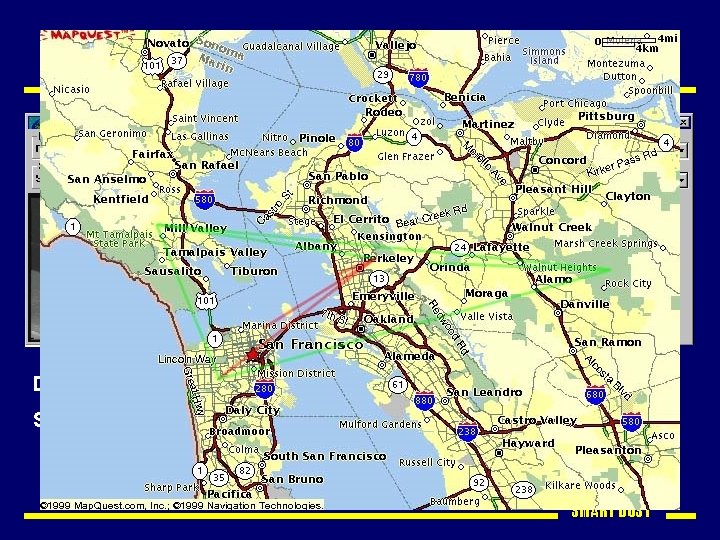
Video Semaphore Decoding Diverged beam @ 300 m Shadow or full sunlight Diverged beam @ 5. 2 km In shadow in evening sun SMART DUST
Video Semaphore Decoding Diverged beam @ 300 m Shadow or full sunlight Diverged beam @ 5. 2 km In shadow in evening sun SMART DUST
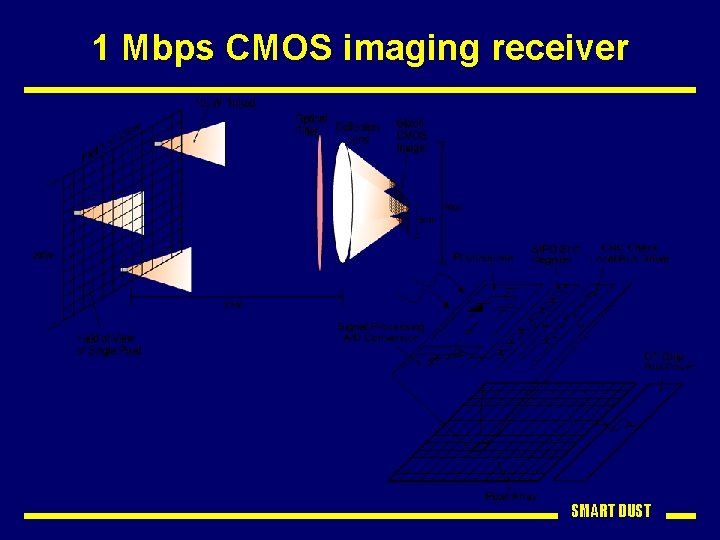
1 Mbps CMOS imaging receiver SMART DUST
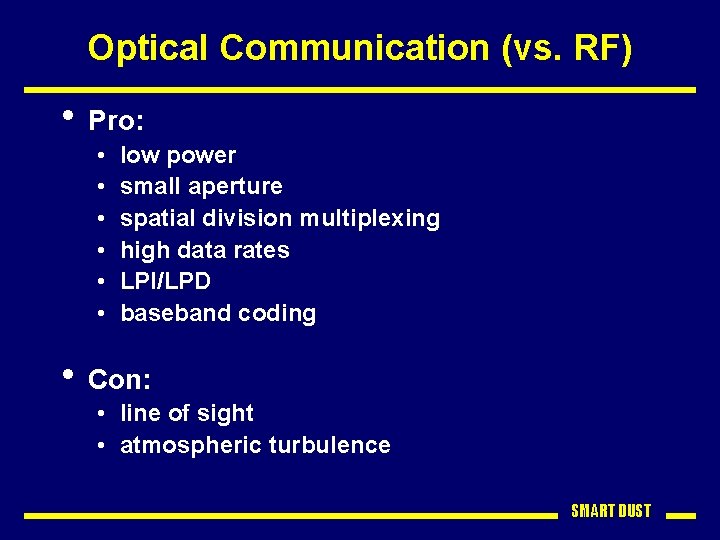
Optical Communication (vs. RF) • Pro: • • • low power small aperture spatial division multiplexing high data rates LPI/LPD baseband coding • Con: • line of sight • atmospheric turbulence SMART DUST
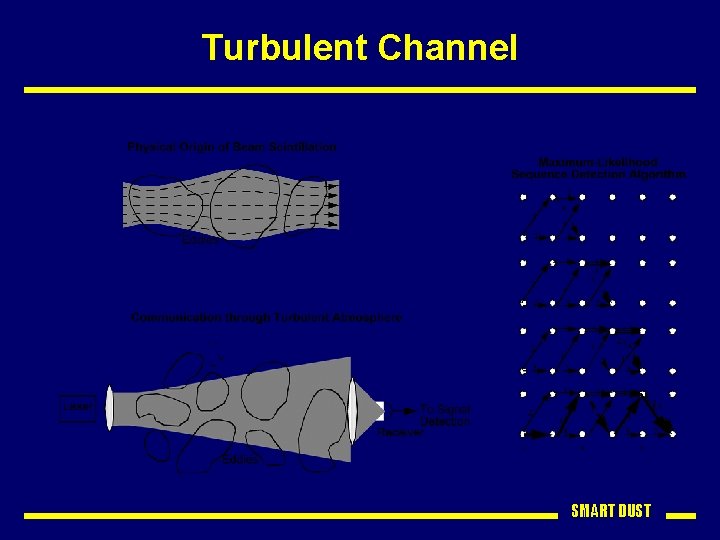
Turbulent Channel SMART DUST
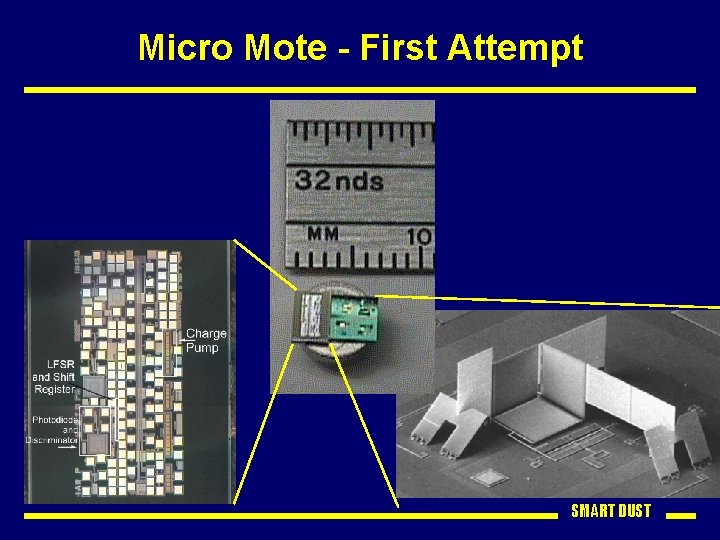
Micro Mote - First Attempt SMART DUST
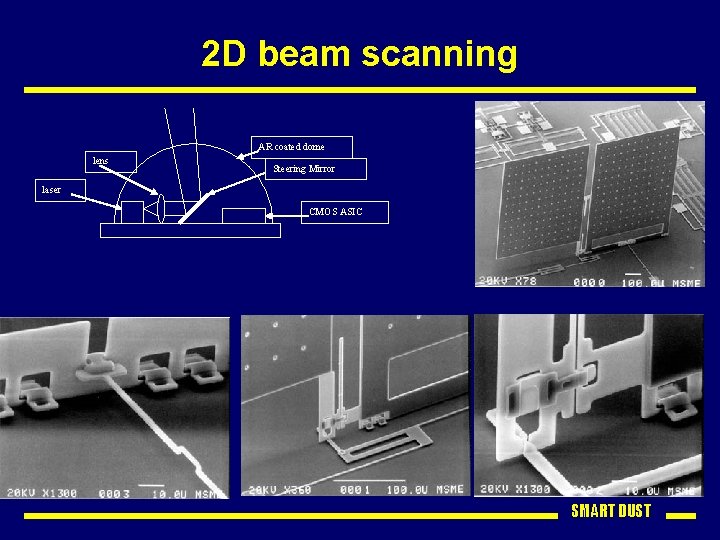
2 D beam scanning AR coated dome lens Steering Mirror laser CMOS ASIC SMART DUST
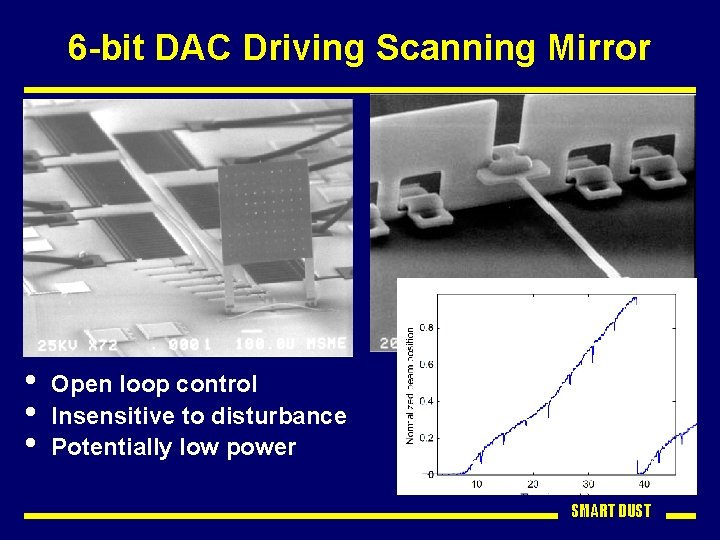
6 -bit DAC Driving Scanning Mirror • • • Open loop control Insensitive to disturbance Potentially low power SMART DUST
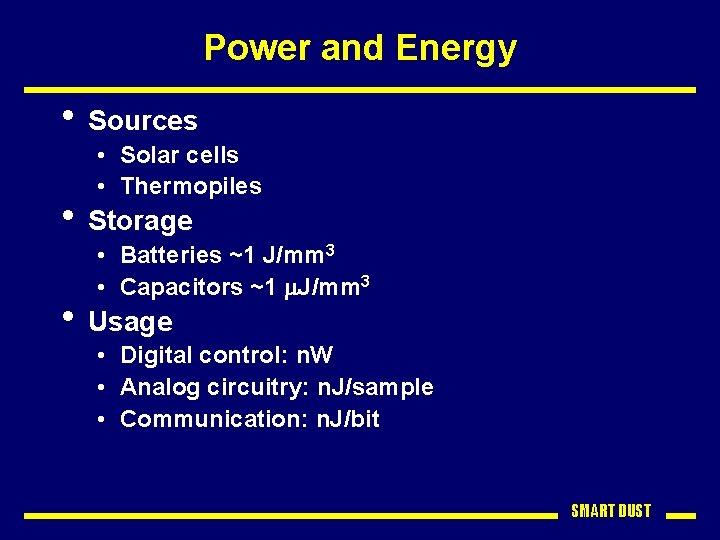
Power and Energy • Sources • Solar cells • Thermopiles • Storage • Batteries ~1 J/mm 3 • Capacitors ~1 m. J/mm 3 • Usage • Digital control: n. W • Analog circuitry: n. J/sample • Communication: n. J/bit SMART DUST
’ 01 Goal SMART DUST
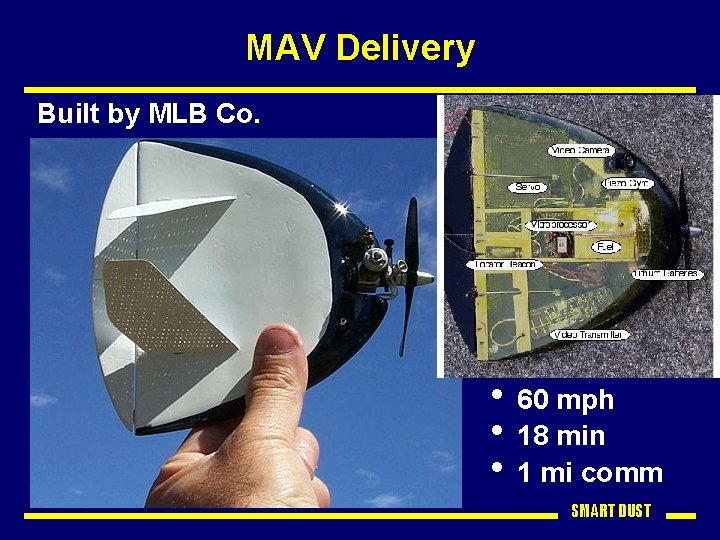
MAV Delivery Built by MLB Co. • 60 mph • 18 min • 1 mi comm SMART DUST
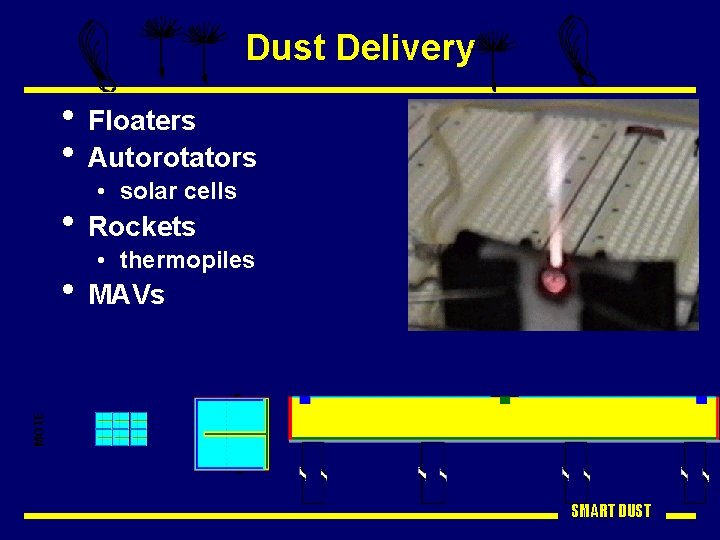
Dust Delivery • Floaters • Autorotators • solar cells • Rockets • thermopiles MOTE • MAVs SMART DUST
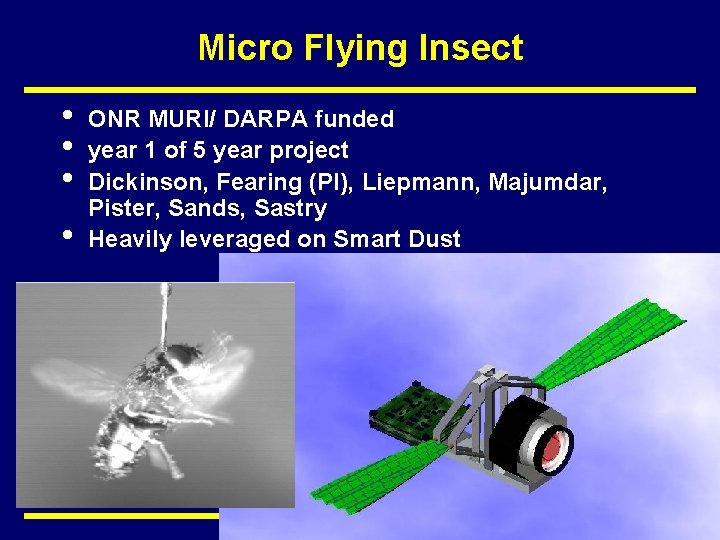
Micro Flying Insect • • ONR MURI/ DARPA funded year 1 of 5 year project Dickinson, Fearing (PI), Liepmann, Majumdar, Pister, Sands, Sastry Heavily leveraged on Smart Dust SMART DUST
Applications • Do. D • • • Battlefield sensor networks Sensor mine-fields, burrs and fleas Traffic mapping Captured terrain surveillance Bunker mapping. . . • Civilian • High speed/low power IRDA • Interactive virtual ballet • . . . SMART DUST
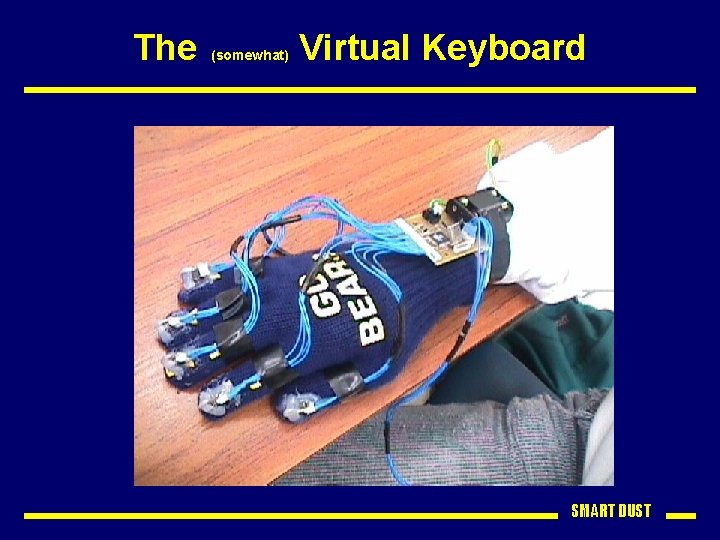
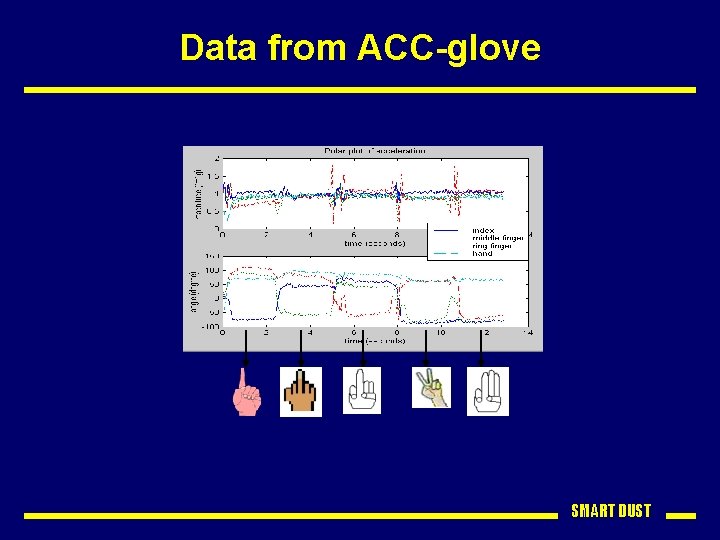
The (somewhat) Virtual Keyboard SMART DUST
Data from ACC-glove SMART DUST
Conclusion • Cubic inch motes off-the-shelf, ~$100 • Dec ’ 99: 100 node network in Soda/Cory • Desperately need intelligent software • Millimeter-scale motes • Dec ’ 00: first working prototypes • Don’t have a clue what we need in software SMART DUST