
Darlington Pair ac is a major factor in
- Slides: 10
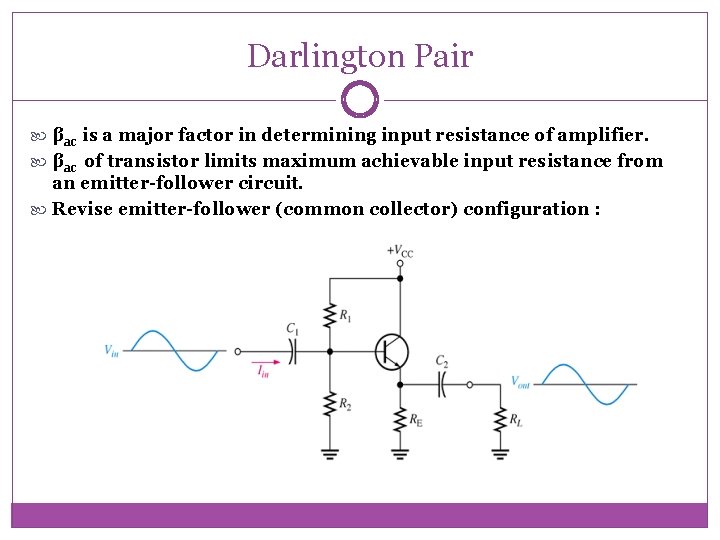
Darlington Pair βac is a major factor in determining input resistance of amplifier. βac of transistor limits maximum achievable input resistance from an emitter-follower circuit. Revise emitter-follower (common collector) configuration :
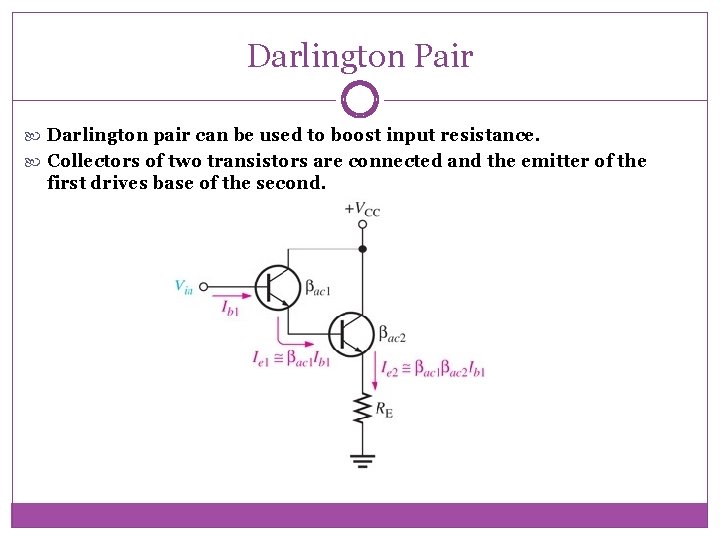
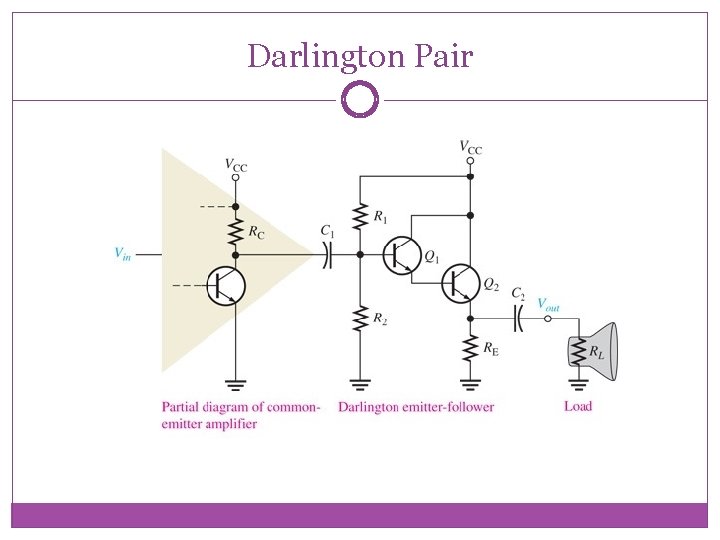
Darlington Pair Darlington pair can be used to boost input resistance. Collectors of two transistors are connected and the emitter of the first drives base of the second.
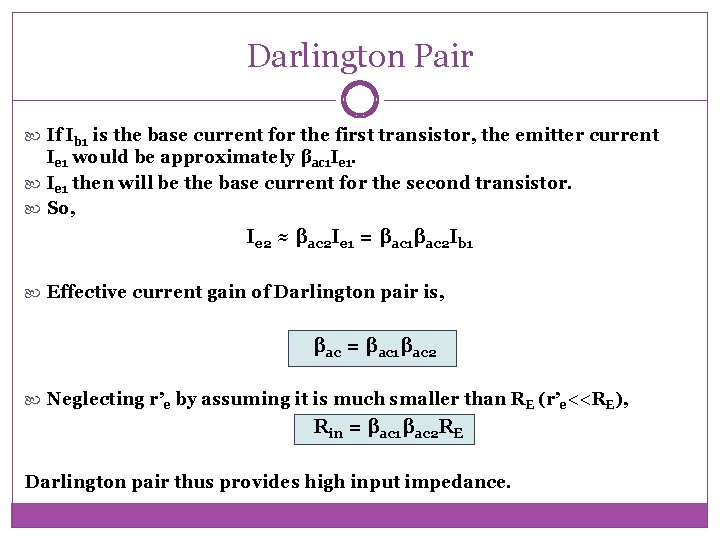
Darlington Pair If Ib 1 is the base current for the first transistor, the emitter current Ie 1 would be approximately βac 1 Ie 1. Ie 1 then will be the base current for the second transistor. So, Ie 2 ≈ βac 2 Ie 1 = βac 1βac 2 Ib 1 Effective current gain of Darlington pair is, βac = βac 1βac 2 Neglecting r’e by assuming it is much smaller than RE (r’e<<RE), Rin = βac 1βac 2 RE Darlington pair thus provides high input impedance.
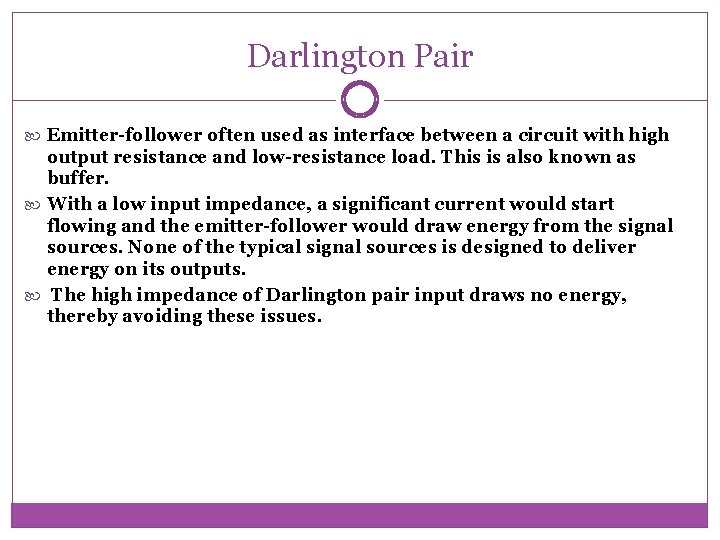
Darlington Pair Emitter-follower often used as interface between a circuit with high output resistance and low-resistance load. This is also known as buffer. With a low input impedance, a significant current would start flowing and the emitter-follower would draw energy from the signal sources. None of the typical signal sources is designed to deliver energy on its outputs. The high impedance of Darlington pair input draws no energy, thereby avoiding these issues.
Darlington Pair
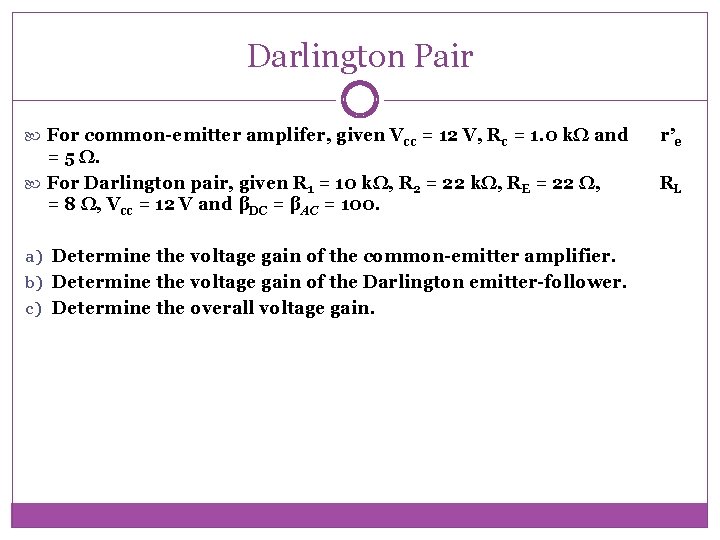
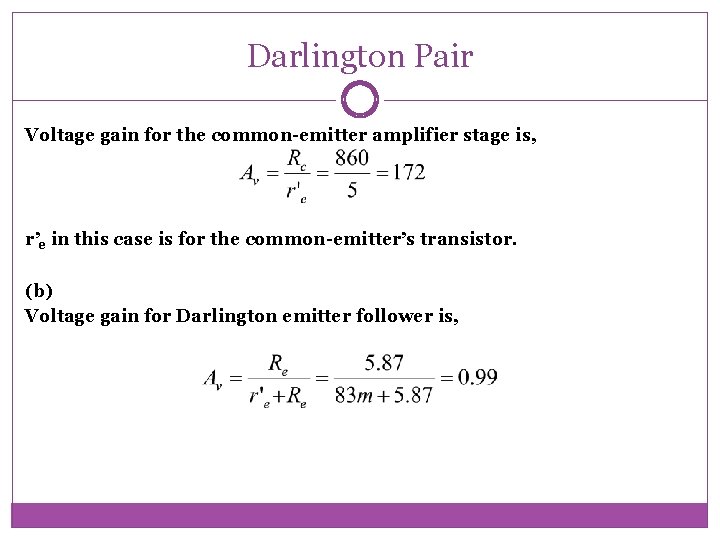
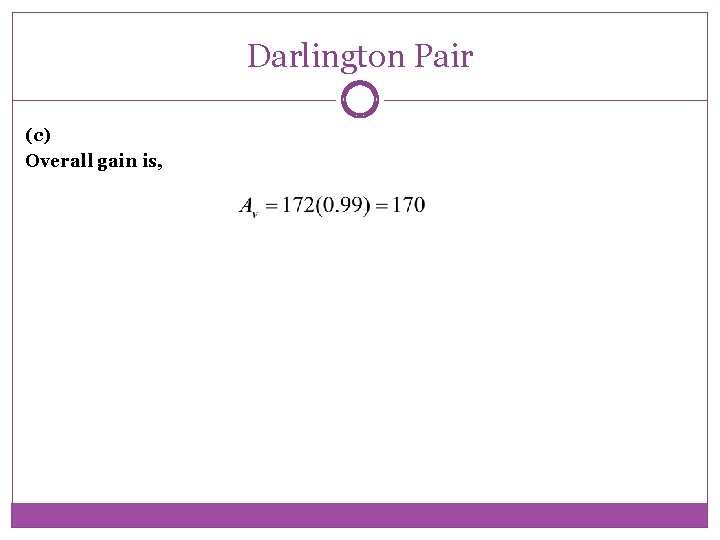
Darlington Pair For common-emitter amplifer, given Vcc = 12 V, Rc = 1. 0 kΩ and = 5 Ω. For Darlington pair, given R 1 = 10 kΩ, R 2 = 22 kΩ, RE = 22 Ω, = 8 Ω, Vcc = 12 V and βDC = βAC = 100. a) Determine the voltage gain of the common-emitter amplifier. b) Determine the voltage gain of the Darlington emitter-follower. c) Determine the overall voltage gain. r’e RL
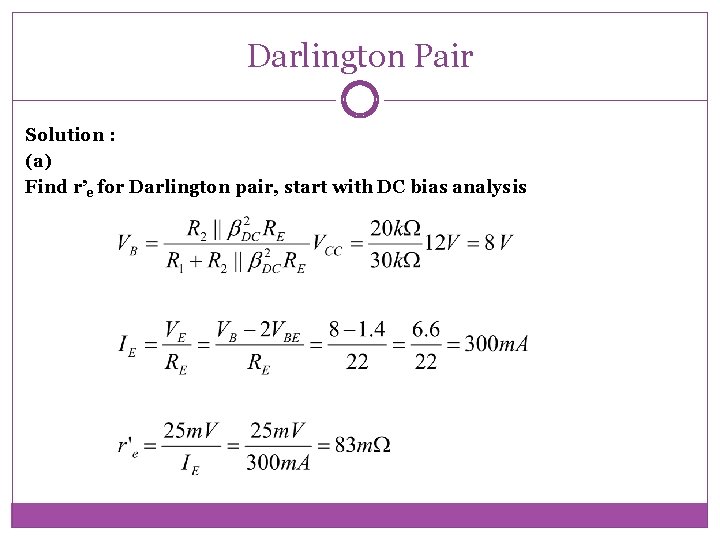
Darlington Pair Solution : (a) Find r’e for Darlington pair, start with DC bias analysis
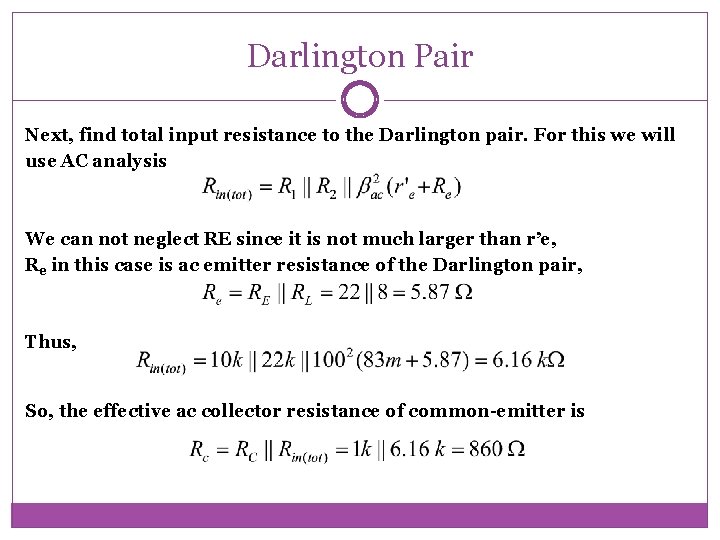
Darlington Pair Next, find total input resistance to the Darlington pair. For this we will use AC analysis We can not neglect RE since it is not much larger than r’e, Re in this case is ac emitter resistance of the Darlington pair, Thus, So, the effective ac collector resistance of common-emitter is
Darlington Pair Voltage gain for the common-emitter amplifier stage is, r’e in this case is for the common-emitter’s transistor. (b) Voltage gain for Darlington emitter follower is,
Darlington Pair (c) Overall gain is,