
Dark Universe or twisted Universe EinsteinCartan theory Thomas
- Slides: 30
Dark Universe or twisted Universe? Einstein-Cartan theory. Thomas Schucker : CPT Marseille France Andre Tilquin : CPPM Marseille France THCA Tsinghua China
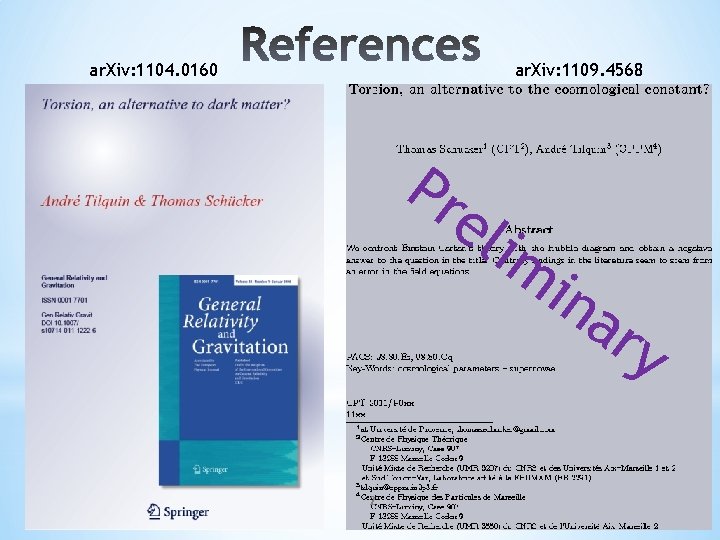
ar. Xiv: 1104. 0160 ar. Xiv: 1109. 4568 Pr el im ina ry 2
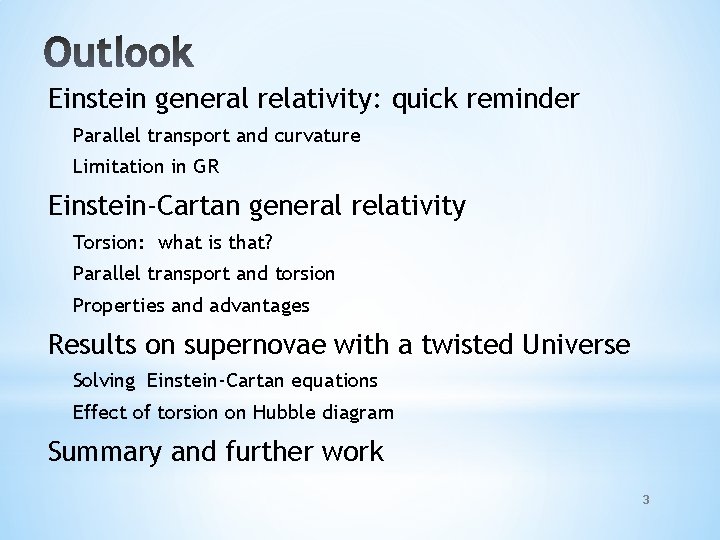
Einstein general relativity: quick reminder Parallel transport and curvature Limitation in GR Einstein-Cartan general relativity Torsion: what is that? Parallel transport and torsion Properties and advantages Results on supernovae with a twisted Universe Solving Einstein-Cartan equations Effect of torsion on Hubble diagram Summary and further work 3
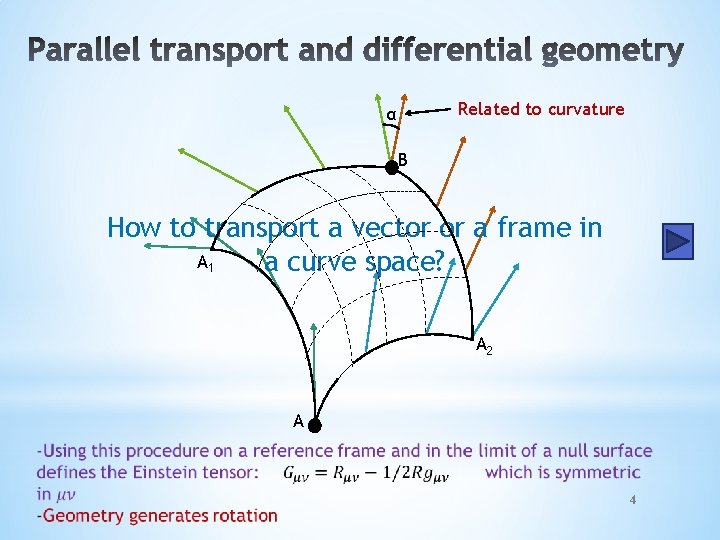
Related to curvature α B How to transport a vector or a frame in A 1 a curve space? A 2 A 4
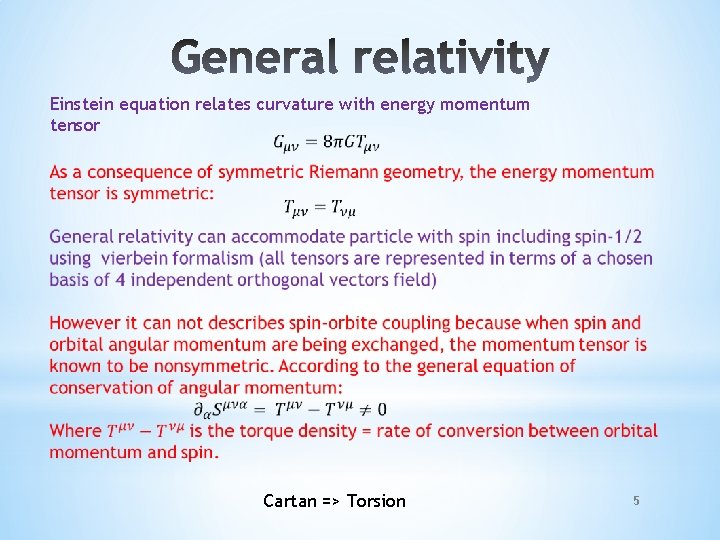
Einstein equation relates curvature with energy momentum tensor Cartan => Torsion 5
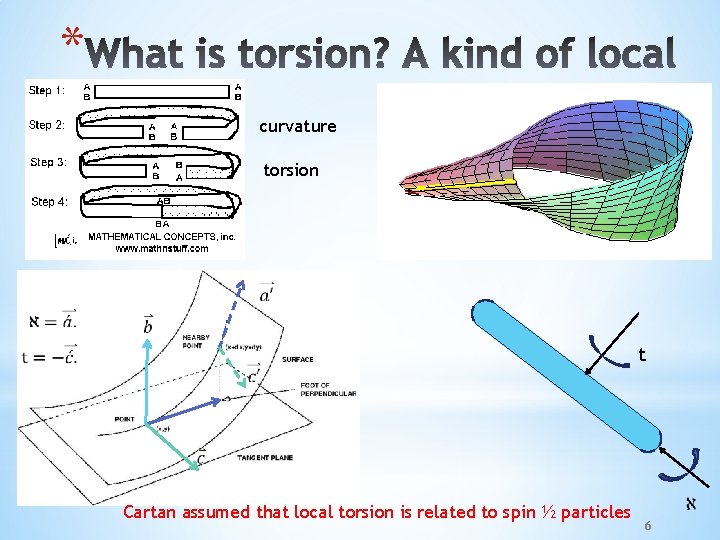
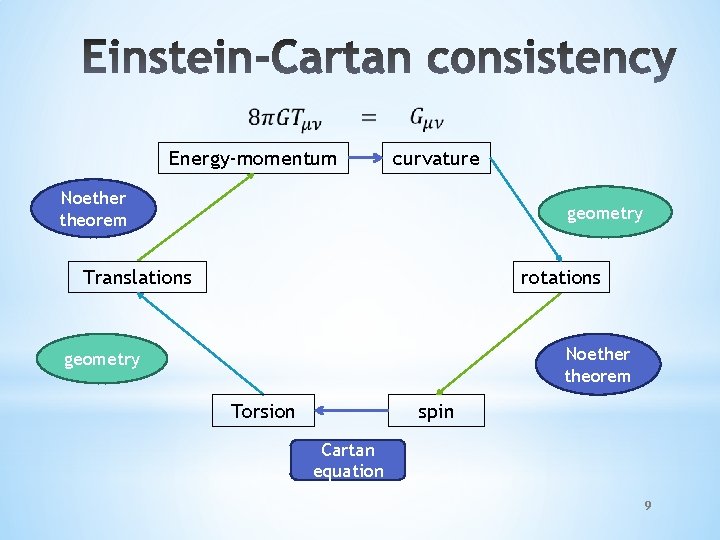
* curvature torsion t Cartan assumed that local torsion is related to spin ½ particles 6
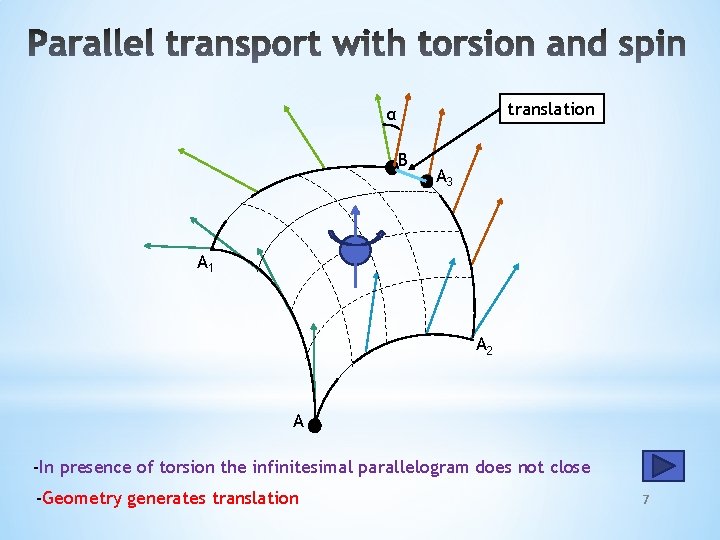
translation α B A 3 A 1 A 2 A -In presence of torsion the infinitesimal parallelogram does not close -Geometry generates translation 7
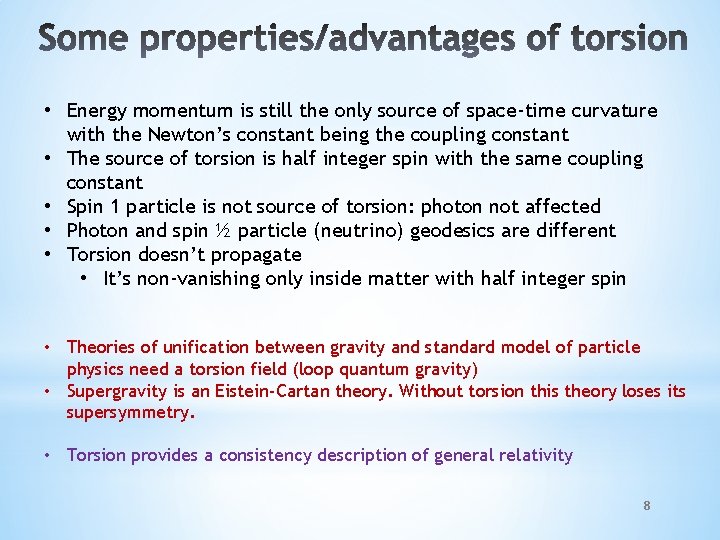
• Energy momentum is still the only source of space-time curvature with the Newton’s constant being the coupling constant • The source of torsion is half integer spin with the same coupling constant • Spin 1 particle is not source of torsion: photon not affected • Photon and spin ½ particle (neutrino) geodesics are different • Torsion doesn’t propagate • It’s non-vanishing only inside matter with half integer spin • Theories of unification between gravity and standard model of particle physics need a torsion field (loop quantum gravity) • Supergravity is an Eistein-Cartan theory. Without torsion this theory loses its supersymmetry. • Torsion provides a consistency description of general relativity 8
Energy-momentum curvature Noether theorem geometry Translations rotations Noether theorem geometry Torsion spin Cartan equation 9
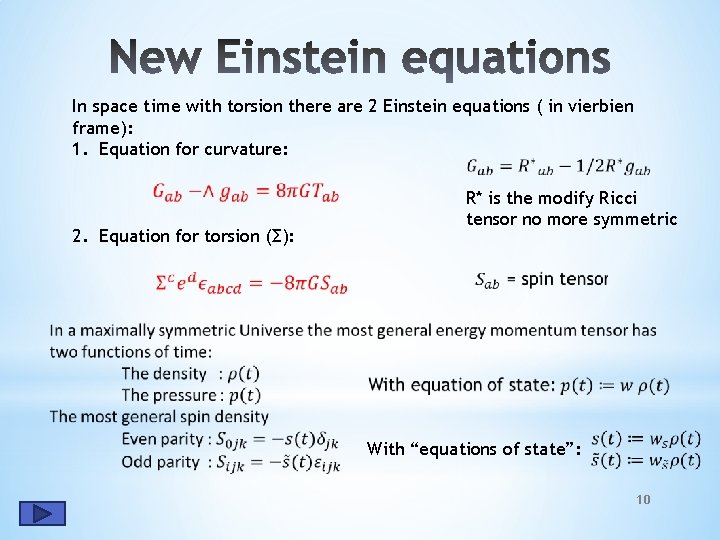
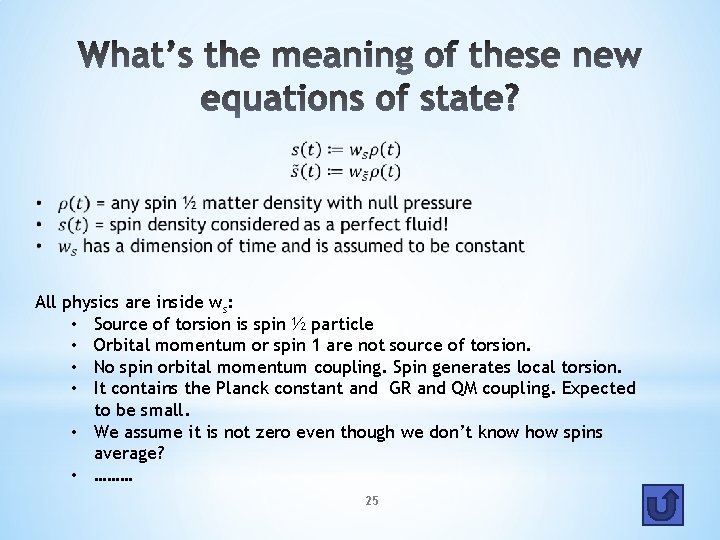
In space time with torsion there are 2 Einstein equations ( in vierbien frame): 1. Equation for curvature: R* is the modify Ricci tensor no more symmetric 2. Equation for torsion (Σ): With “equations of state”: 10
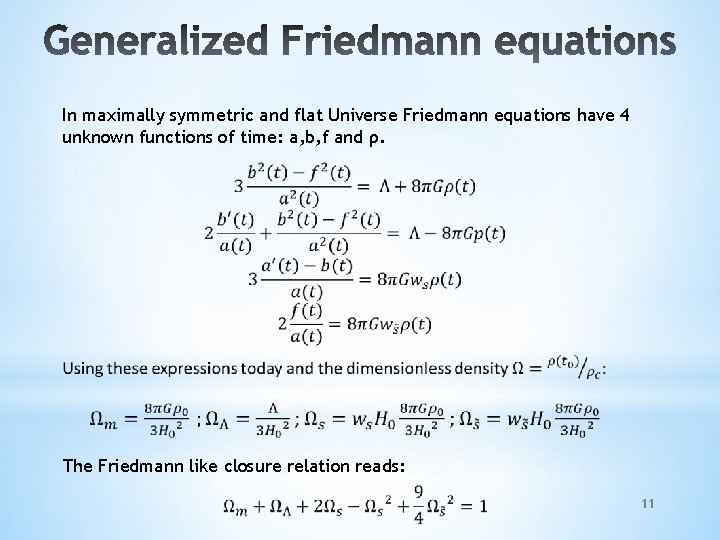
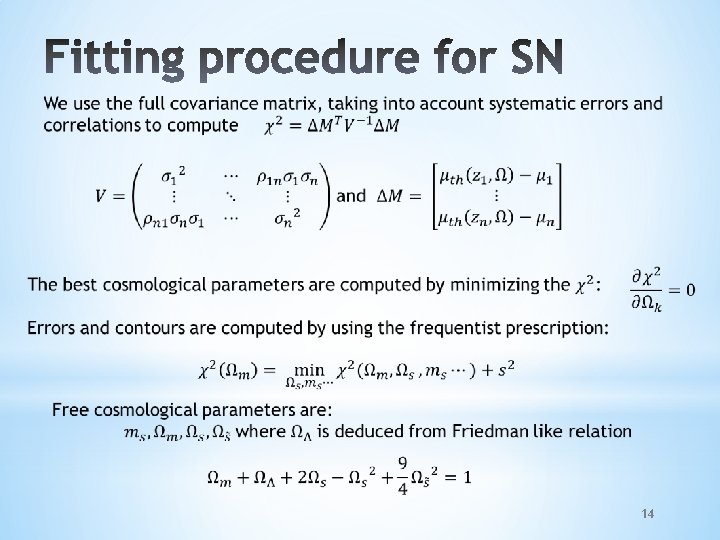
In maximally symmetric and flat Universe Friedmann equations have 4 unknown functions of time: a, b, f and ρ. The Friedmann like closure relation reads: 11
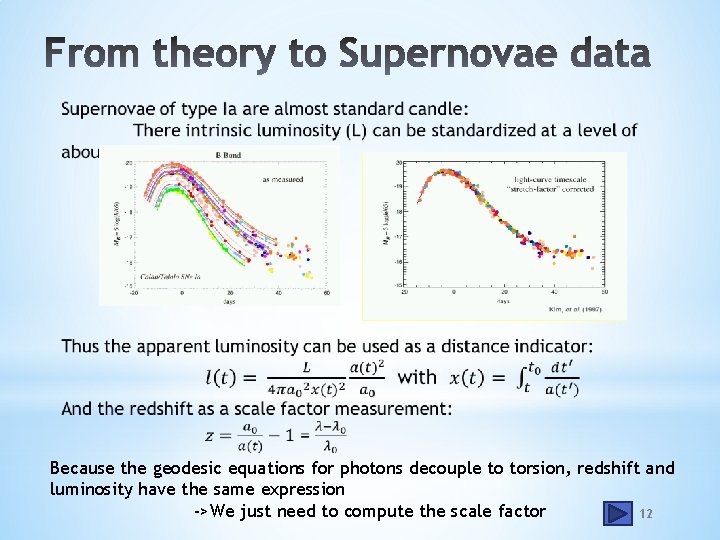
Because the geodesic equations for photons decouple to torsion, redshift and luminosity have the same expression ->We just need to compute the scale factor 12
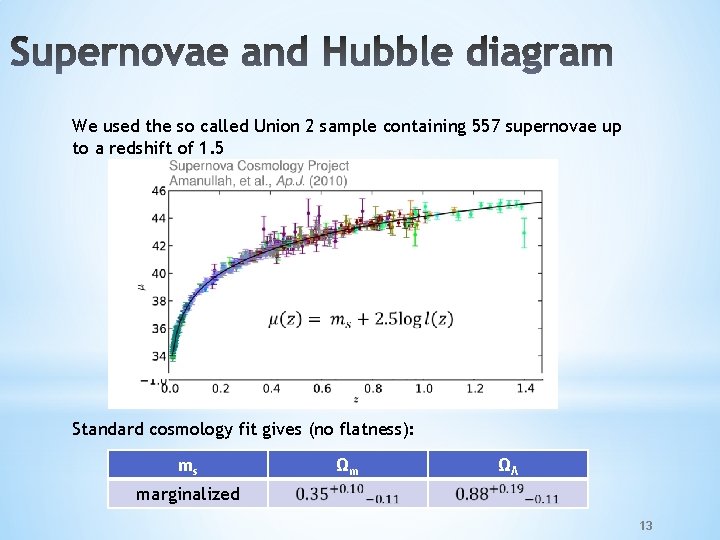
We used the so called Union 2 sample containing 557 supernovae up to a redshift of 1. 5 Standard cosmology fit gives (no flatness): ms Ωm ΩΛ marginalized 13
14
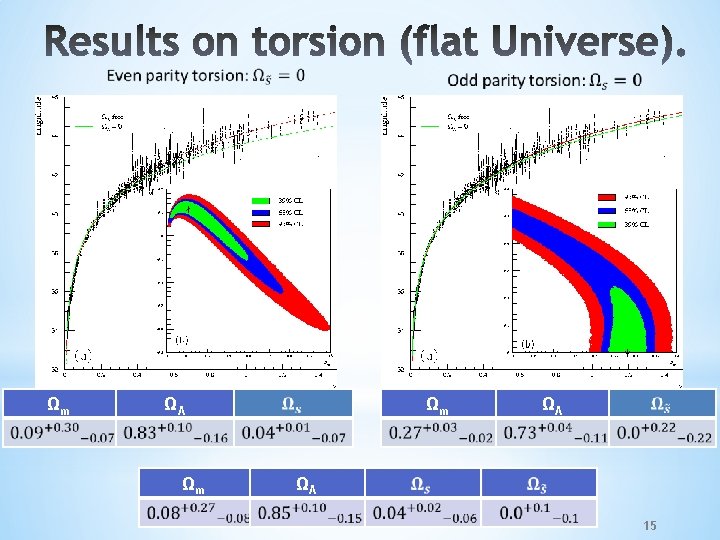
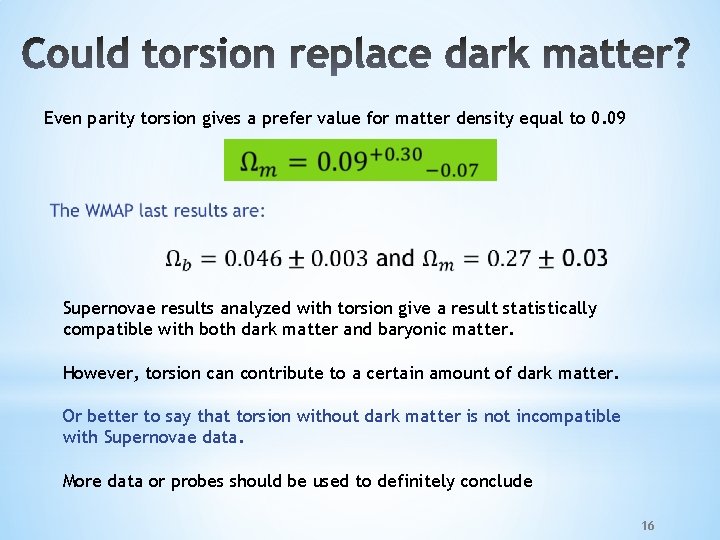
Even parity torsion gives a prefer value for matter density equal to 0. 09 Supernovae results analyzed with torsion give a result statistically compatible with both dark matter and baryonic matter. However, torsion can contribute to a certain amount of dark matter. Or better to say that torsion without dark matter is not incompatible with Supernovae data. More data or probes should be used to definitely conclude 16
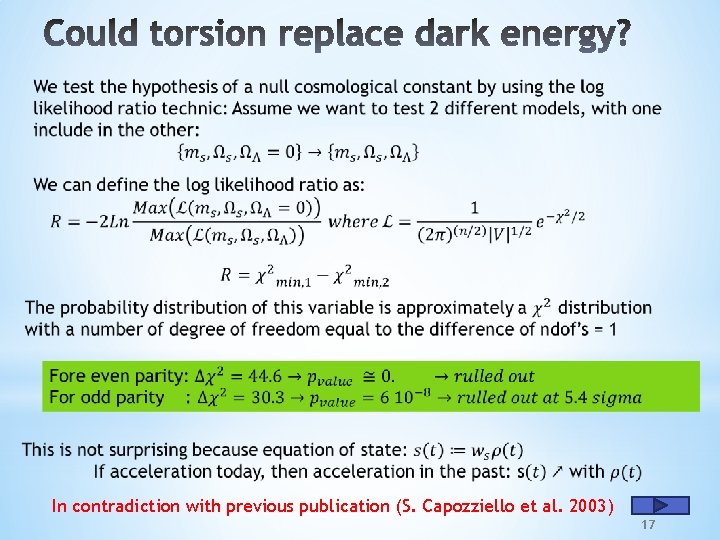
In contradiction with previous publication (S. Capozziello et al. 2003) 17
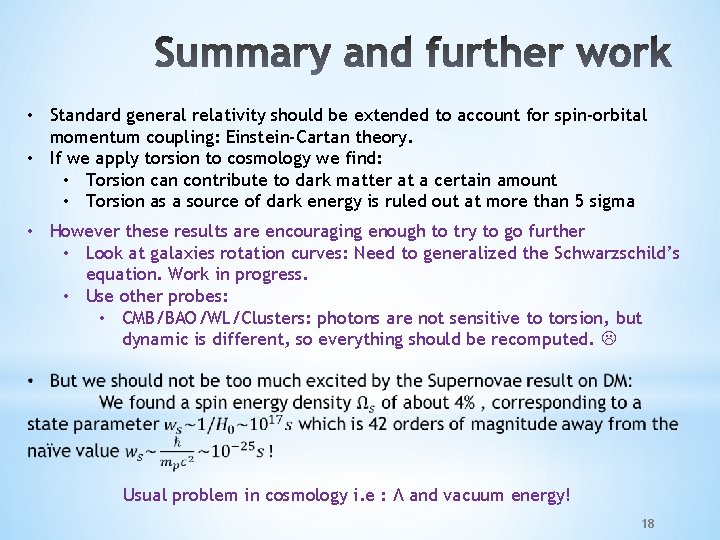
• Standard general relativity should be extended to account for spin-orbital momentum coupling: Einstein-Cartan theory. • If we apply torsion to cosmology we find: • Torsion can contribute to dark matter at a certain amount • Torsion as a source of dark energy is ruled out at more than 5 sigma • However these results are encouraging enough to try to go further • Look at galaxies rotation curves: Need to generalized the Schwarzschild’s equation. Work in progress. • Use other probes: • CMB/BAO/WL/Clusters: photons are not sensitive to torsion, but dynamic is different, so everything should be recomputed. Usual problem in cosmology i. e : Λ and vacuum energy! 18
1) Torsion and curvature ? 2) Torsion and vacuum ? 19
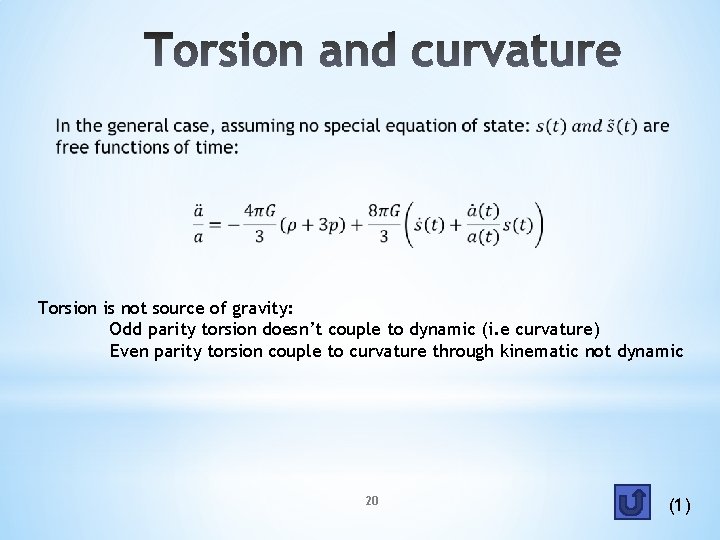
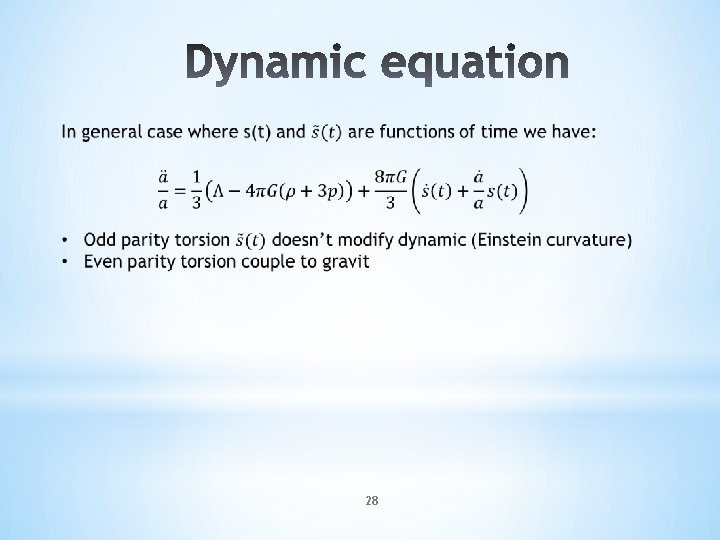
Torsion is not source of gravity: Odd parity torsion doesn’t couple to dynamic (i. e curvature) Even parity torsion couple to curvature through kinematic not dynamic 20 (1)
* 1. Because geodesics are different for photons and spin ½ particles (neutrino) • Timing difference between photons and neutrinos in supernovae explosion 1987 A Supernovae • Neutrino oscillation experiment OPERA. Time delay and supra luminal neutrino 2. Rotation curve of galaxies or the modify Schwartsfield solution • What is the effect of torsion on rotation curve of galaxy 3. Galaxies and cluster formation 4. The cosmological probes: • Supernovae 1 a • CMB: effect of torsion in initial plasma (very high matter density) • Weak lensing should not be affected Lensing is gravitational coupling between curvature and photon • Baryonic acoustic oscillation Depends on the initial power spectrum 21
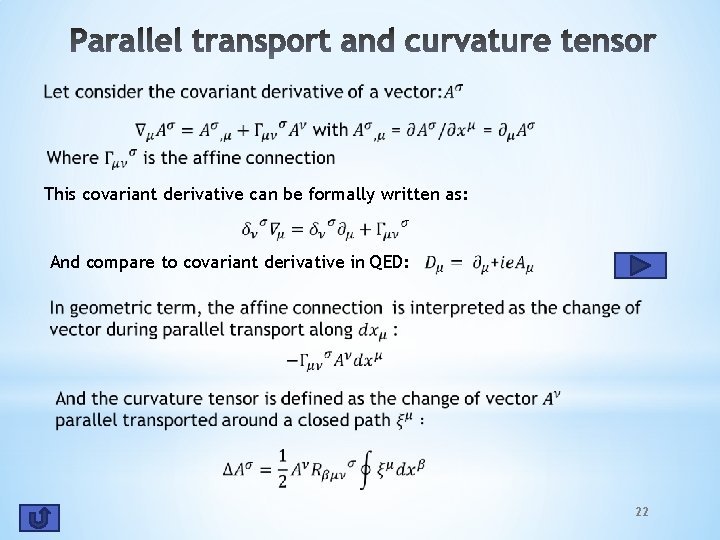
This covariant derivative can be formally written as: And compare to covariant derivative in QED: 22
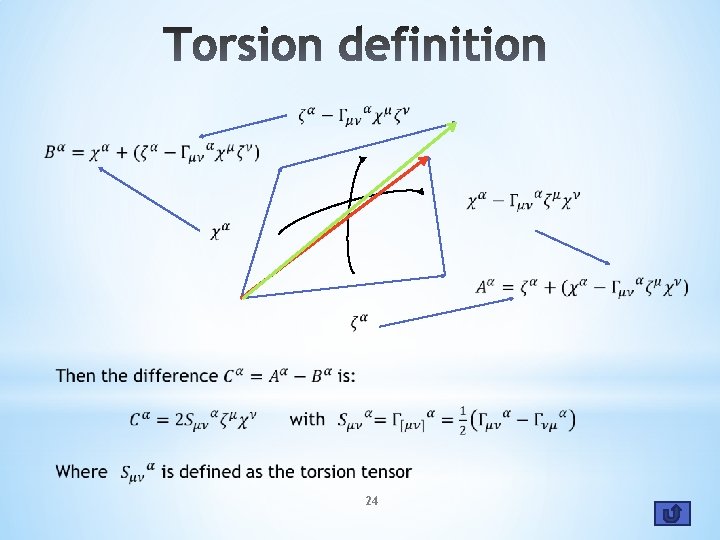
24
All physics are inside ws: • Source of torsion is spin ½ particle • Orbital momentum or spin 1 are not source of torsion. • No spin orbital momentum coupling. Spin generates local torsion. • It contains the Planck constant and GR and QM coupling. Expected to be small. • We assume it is not zero even though we don’t know how spins average? • ……… 25
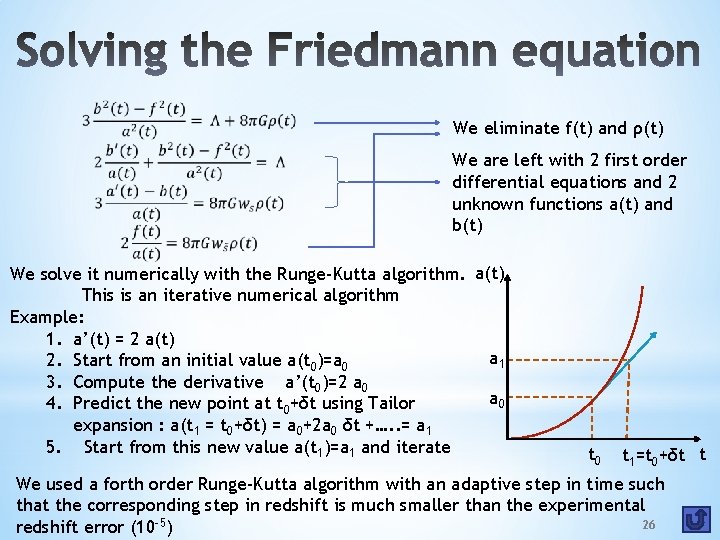
We eliminate f(t) and ρ(t) We are left with 2 first order differential equations and 2 unknown functions a(t) and b(t) We solve it numerically with the Runge-Kutta algorithm. a(t) This is an iterative numerical algorithm Example: 1. a’(t) = 2 a(t) a 1 2. Start from an initial value a(t 0)=a 0 3. Compute the derivative a’(t 0)=2 a 0 4. Predict the new point at t 0+δt using Tailor expansion : a(t 1 = t 0+δt) = a 0+2 a 0 δt +…. . = a 1 5. Start from this new value a(t 1)=a 1 and iterate t 0 t 1=t 0+δt t We used a forth order Runge-Kutta algorithm with an adaptive step in time such that the corresponding step in redshift is much smaller than the experimental 26 redshift error (10 -5)
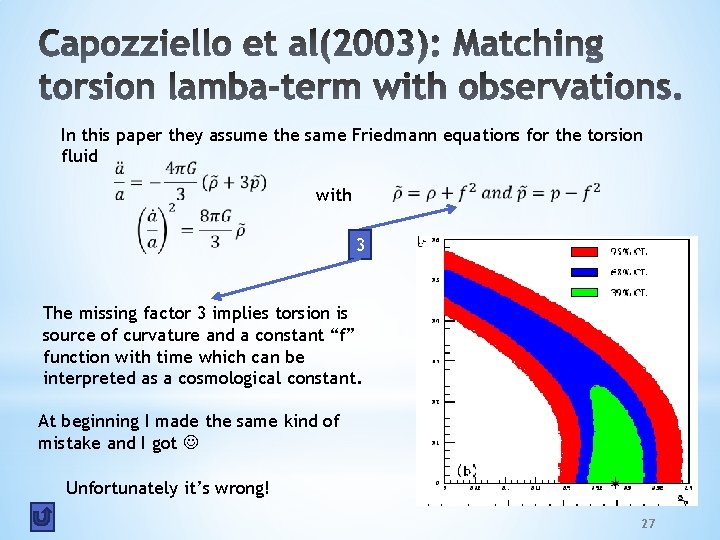
In this paper they assume the same Friedmann equations for the torsion fluid with 3 The missing factor 3 implies torsion is source of curvature and a constant “f” function with time which can be interpreted as a cosmological constant. At beginning I made the same kind of mistake and I got Unfortunately it’s wrong! 27
28
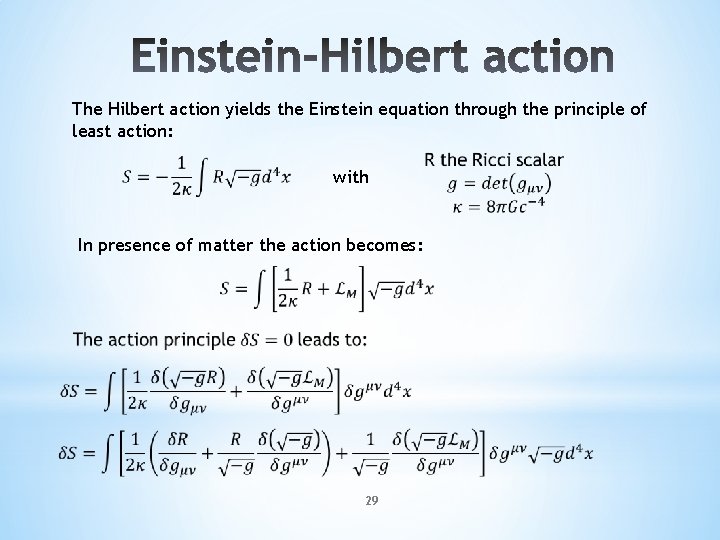
The Hilbert action yields the Einstein equation through the principle of least action: with In presence of matter the action becomes: 29
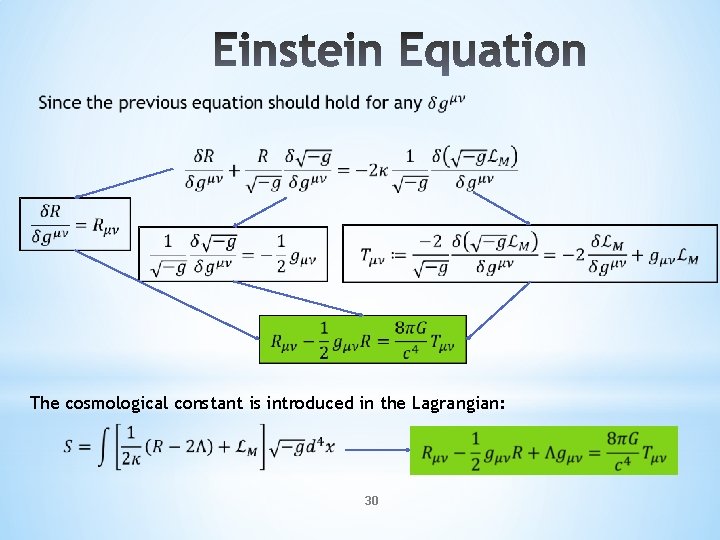
The cosmological constant is introduced in the Lagrangian: 30