
Dark Romanticism and the Gothic Literature Movement Romanticism



- Slides: 22
Dark Romanticism and the Gothic Literature Movement
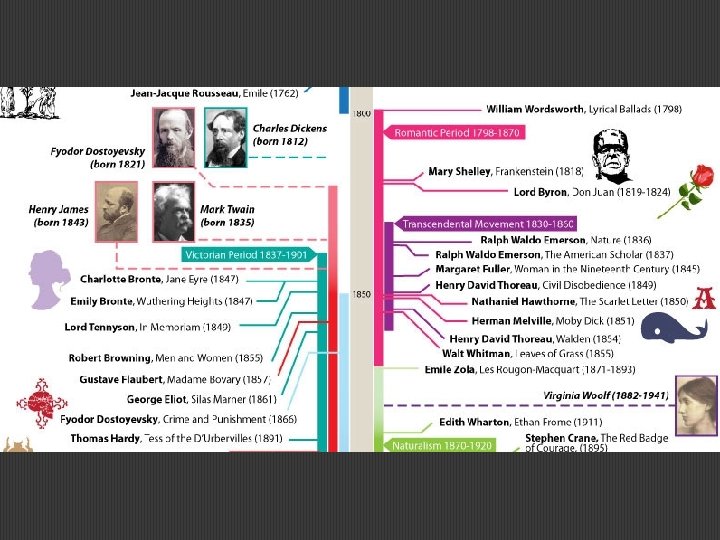
Romanticism � • Movement that originated in Europe in the 18 th century involving literature, art, and philosophy �Largely a rebellion against the Age of Enlightenment and Neoclassicism (logic, reason, rationality) �Stressed the importance of the individual, the imaginative, the emotional, and the irrational �Characteristics generally include: pursuing emotion and imagination to find spiritual truth; relying on intuition over intellect; examining humanity’s connection to nature
Transcendentalism �Divinity is within all nature and humanity. �Beliefs: Transcendental Knowledge (emotion, individualism, glorification of the past & nature) Individuality Personal freedom Indian Religions Idealism �Closely connected to the beliefs of the Romantics, but tried to embrace the empiricism of science.
Dark Romanticism �A literary subgenre of Romantic Literature that emerged from the transcendental philosophical movement popular in nineteenth-century America. �Works in the dark romantic spirit were influenced by Transcendentalism, but did not entirely embrace the ideas of Transcendentalism.
Dark Romanticism ►The writers write in styles similar to Romanticism ►Excess in nature ►Lots of emotion ►Symbols aplenty ►But there were some differences…
Transcendentalism vs. Dark Romanticism �transcendental movement = optimistic, divinity, the sublime, power of individual �Dark Romantic less optimistic about mankind, nature, and divinity. �The Romantic era was characterized by flair, extravagance, emotion and imagination
Transcendentalism vs. Dark Romanticism �For Dark Romantics, nature = sinister power �For Transcendentalists, nature = divine and universal mediator. �Some, including Poe, Hawthorne and Melville, found Transcendental beliefs too optimistic and egotistical—reaction against this seen in their texts
The Dark Side of Nature ► Dark Romantics explore the dark side of nature ► Natural world = dark, decaying, and mysterious; when it does reveal truth to man, its revelations are evil and hellish. ► Not about religion…rather, more science led
The Dark Side of Humanity �Individuals prone to sin and self- destruction �Murder, sin, corruption, supernatural �Main characters are deeply troubled…or will deeply trouble another �Often shows individuals failing in their attempts to make changes for the better.
Themes of Dark Romanticism �Themes of horror, tragedy, the macabre and the supernatural �Relies on human psyche’s attraction to fear, pain, and tragedy �Led to the birth of the Gothic style and greatly influenced music, film, and art.
Gothic Literary Movement �A subcategory of Romanticism �Literature and art that reflects the supernatural, exotic, mysterious, and even satanic in some cases �Often included medieval or gloomy settings, violent incidents, and/or macabre material �Includes works such as Dracula, Frankenstein, and Dr. Jekyll and Mr. Hyde
Gothic Literary Movement �Work to inspire terror, including through accounts of the macabre and supernatural, haunted structures, and the search for identity �Skeptics find Gothic Literature melodramatic and predictable �More about sheer terror than Dark Romanticism's themes of dark mystery and skepticism regarding man.
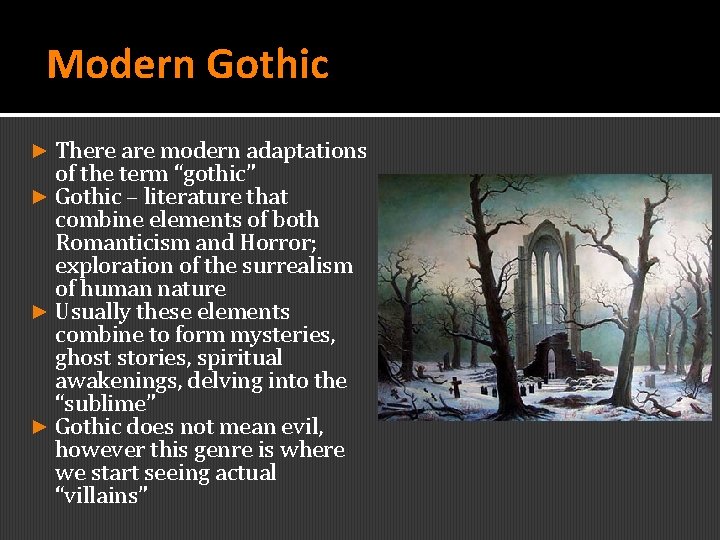
Modern Gothic ► There are modern adaptations of the term “gothic” ► Gothic – literature that combine elements of both Romanticism and Horror; exploration of the surrealism of human nature ► Usually these elements combine to form mysteries, ghost stories, spiritual awakenings, delving into the “sublime” ► Gothic does not mean evil, however this genre is where we start seeing actual “villains”
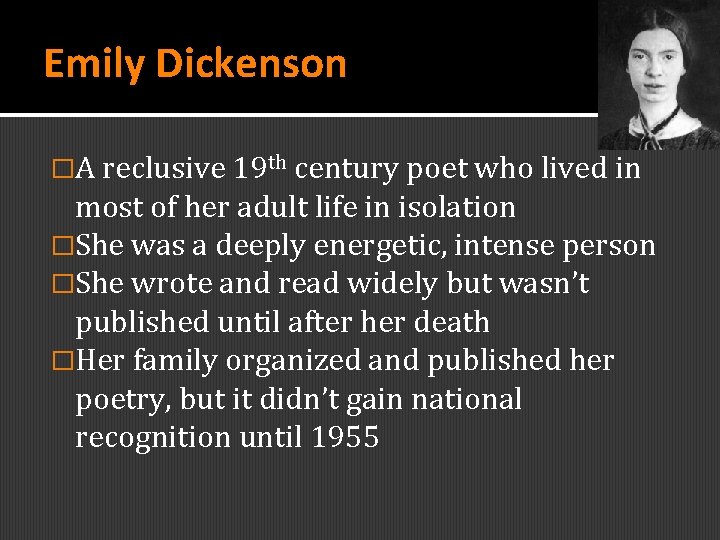
Emily Dickenson �A reclusive 19 th century poet who lived in most of her adult life in isolation �She was a deeply energetic, intense person �She wrote and read widely but wasn’t published until after her death �Her family organized and published her poetry, but it didn’t gain national recognition until 1955
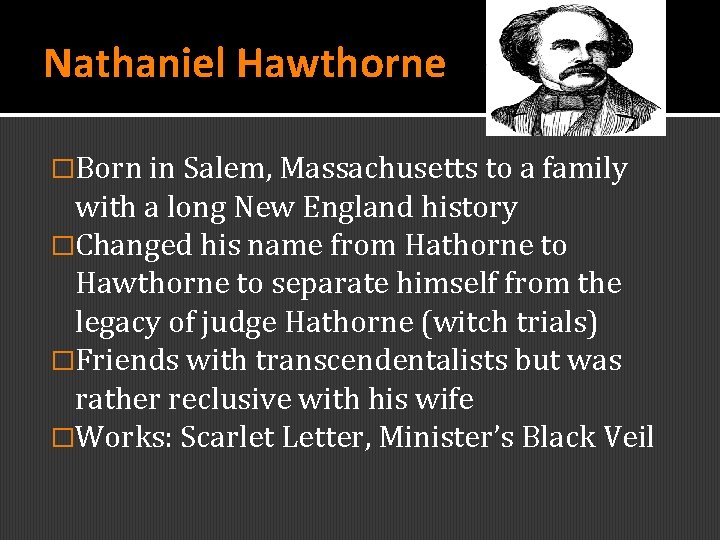
Nathaniel Hawthorne �Born in Salem, Massachusetts to a family with a long New England history �Changed his name from Hathorne to Hawthorne to separate himself from the legacy of judge Hathorne (witch trials) �Friends with transcendentalists but was rather reclusive with his wife �Works: Scarlet Letter, Minister’s Black Veil
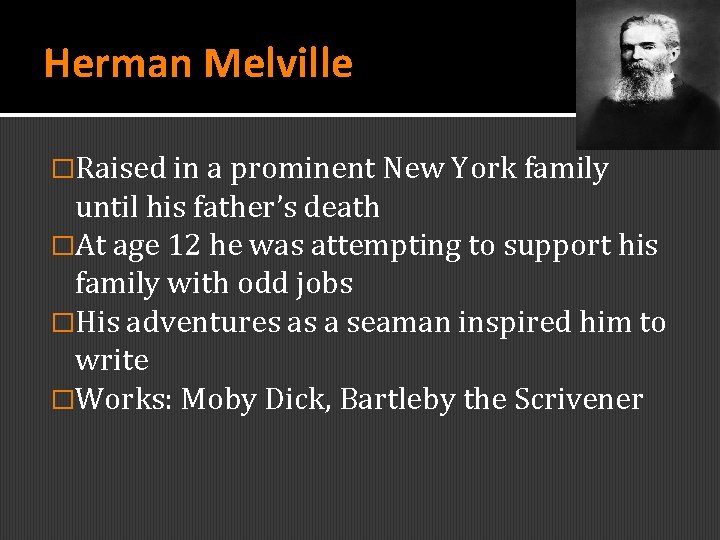
Herman Melville �Raised in a prominent New York family until his father’s death �At age 12 he was attempting to support his family with odd jobs �His adventures as a seaman inspired him to write �Works: Moby Dick, Bartleby the Scrivener
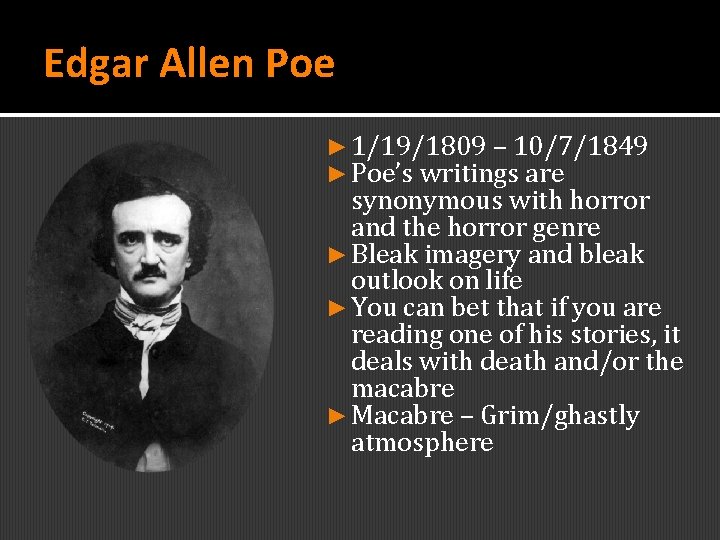
Edgar Allen Poe ► 1/19/1809 – 10/7/1849 ► Poe’s writings are synonymous with horror and the horror genre ► Bleak imagery and bleak outlook on life ► You can bet that if you are reading one of his stories, it deals with death and/or the macabre ► Macabre – Grim/ghastly atmosphere
Impact of Life on Literature �Events in Poe’s stories and poems often reflect the horrors of his own life. They include: – The death and burial of a beautiful woman – The idea of undying love – Deification of a dead woman’s memory – The portrayal of women as angelic creatures – Fascination with death and a desperate need to make sense of the afterlife
Literary Features to Analyze � Point of View (1 st person, 3 rd person omniscient, limited, and objective) � use of setting � function of the narrator � mood � tone � classical allusions � symbolism � creation and resolution of suspense � diction � theme � personification � motifs