
DARK REACTION OF PHOTOSYNTHESIS CALVIN CYCLE CAM METABOLISM
DARK REACTION OF PHOTOSYNTHESIS CALVIN CYCLE CAM METABOLISM C 4 CARBON FIXATION
DARK REACTION • That type of reaction which do not require sunlight and can take place in dark are called dark reaction of photosynthesis. • Blackman was the first to discover dark reactions in 1905. • Co 2 is allowed to react and energy rich simple compounds are formed. • Calvin first predicted path of this carbon and noble prize was awarded to him in 1961.

MECHANISMS OF DARK REACTION • Three types of mechanisms about dark reaction has been predicted. • Calvin Cycle • Crassulacean Acid Metabolism Cycle • C 4 Carbon Fixation also known as Hatch and Slack Cycle
CALVIN CYCLE • Calvin cycle was discovered by Melvin Calvin and his colleagues at University of California to predict the path of carbon in photosynthetic dark reactions. • The free energy from ATP cleavage and NADPH , is used to reduce CO 2 and carbohydrates are formed. • Enzymes are present in the stroma of chloroplast.

PHASES OF CALVIN CYCLE • • There are three phases of Calvin cycle. Carbon fixation Reduction phase Regeneration of original Ru. BP ( 1, 5 bisphosphate)
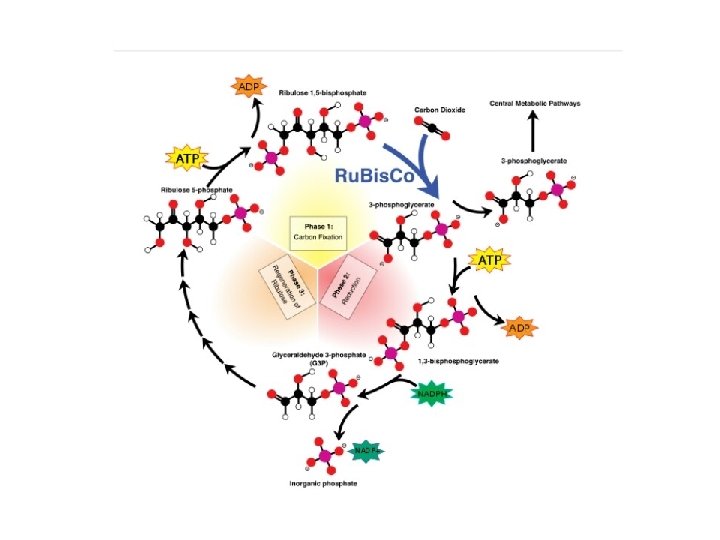
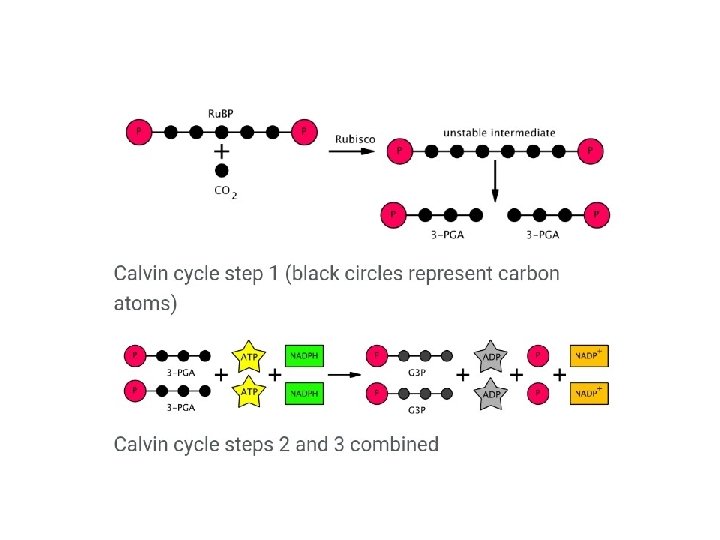
CARBON FIXATION • In this process CO 2 is incorporated into 3 carbon intermediate G 3 P and ATP, NADPH are also involved. • Carboxylation of original 5 carbon compound takes place in the presence of Ru. Bis. CO and this 6 - carbon compound will be immediately broken down into 3 -carbon compounds named as PGA or 3 PGA.
• Phosphorylation of PGA occurs in the presence of phosphoglycerate kinase and phosphate from ATP is added to PGA forming 1, 3 BPGA. • Two molecules of ATP taken from the light phase of photosynthesis are involved for the fixation of one molecule of CO 2. • This is because two phosphate groups are attached with 3 -carbon compound.
REDUCTION PHASE • NADPH and G 3 P dehydrogenase , both help in the reduction of 1, 3 BPGA. • NADPH oxidation will give us NADP+, along with this oxidation product , PGAL is also formed. • Just like two ATP, two NADPH are utilized in this process.
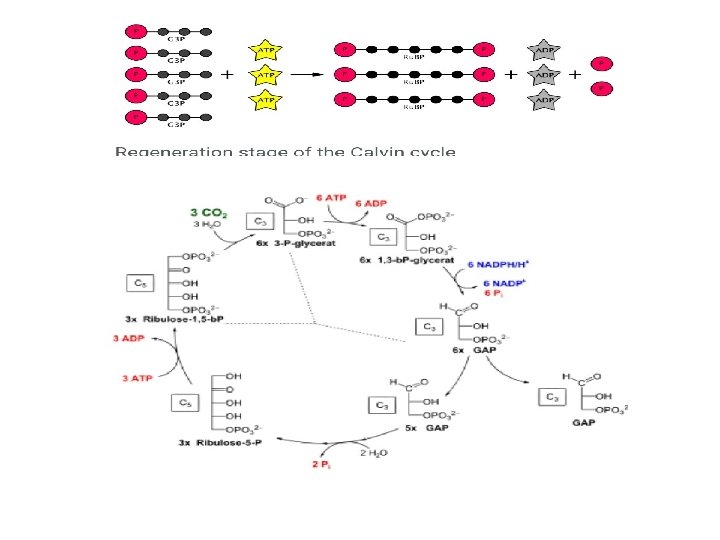
REGENERATION PHASE • Regeneration phase of Calvin cycle will result in the formation of original 5 -carbon compound which entered the cycle. • 3 molecules of ATP and 5 G 3 P molecules will react to form 3 Ru. BP molecules. • 6 G 3 P are formed and out of this only 1 will be consumed by plants • 5 G 3 P will be regerated.
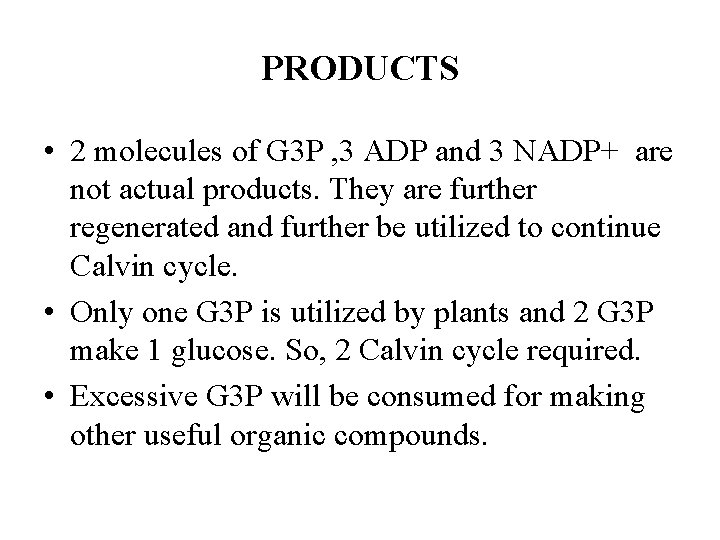
PRODUCTS • 2 molecules of G 3 P , 3 ADP and 3 NADP+ are not actual products. They are further regenerated and further be utilized to continue Calvin cycle. • Only one G 3 P is utilized by plants and 2 G 3 P make 1 glucose. So, 2 Calvin cycle required. • Excessive G 3 P will be consumed for making other useful organic compounds.
CAM CYCLE • Crassulacean acid metabolism is pathway of carbon in those plants which live in harsh environmental conditions. • In these plants , stomata remain closed during daytime. • During night time stomata are opened and thus CAM cycle will occur • Then these plants can survive in desert due this metabolic adaptation.
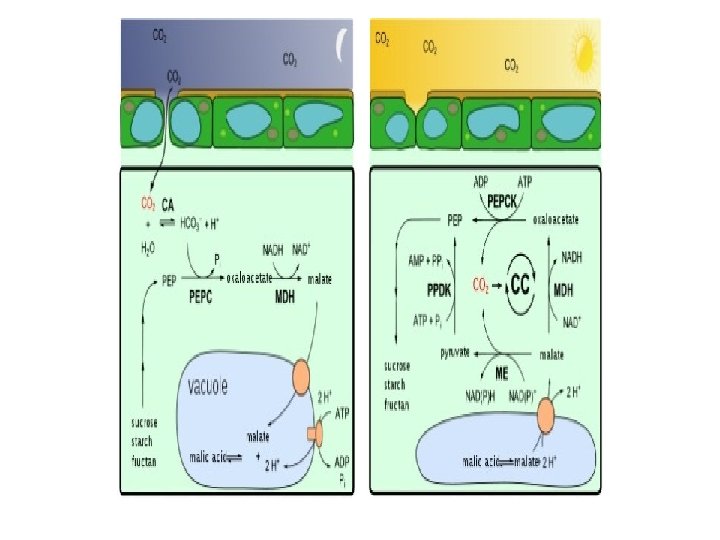
• During night times , Co 2 will move inside with the help of open stomata. • Then this CO 2 will diffuse into mesophyll cells. There CO 2 will be changed into 4 -carbon compound Malate. • It is converted to Malic acid , which can be stored into vacuoles. Due to malic acid formation , called acid metabolism. • Initially discovered in 1804, then observed in 1812 , 1892 and in 1915 by many scientists. • Ranson and Thomas gave name CAM cycle.
Two part Cycle • Night Time : In desert plants , where stomata open at night only. CO 2 will be fixed and malic acid formation occur. This acid is stored in vacuoles. • DAY TIME: CO 2 formed during night will be utilized in Calvin cycle to form glucose.
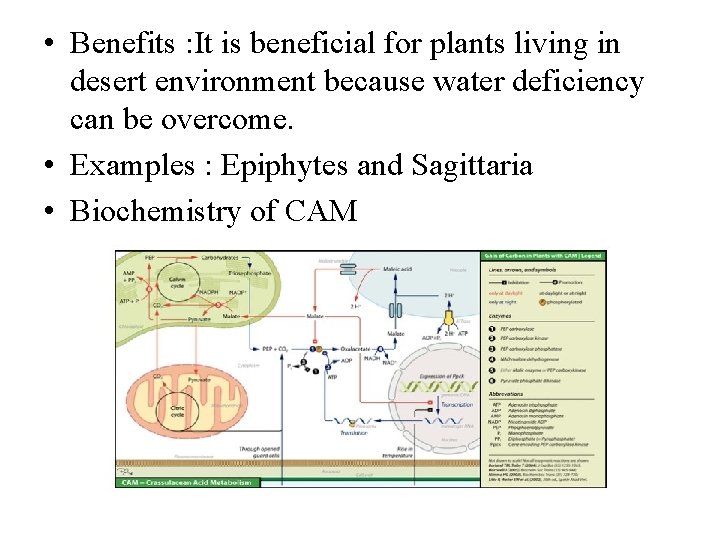
• Benefits : It is beneficial for plants living in desert environment because water deficiency can be overcome. • Examples : Epiphytes and Sagittaria • Biochemistry of CAM
C 4 CARBON FIXATION • A type of photosynthetic reaction , which results in the formation of 4 carbon compound. • Process was given by Hatch and Slack in 1966 , so named as Hatch AND Slack cycle also. • As oxygenase and carboxylase work both at the same time , so called as photorespiration also.
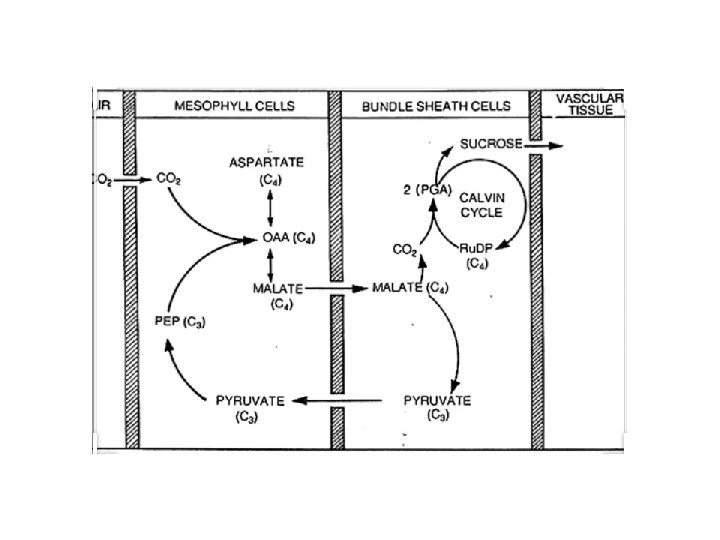
C 4 Pathways • As stomata are both in upper and lower leaves , So CO 2 will not be fixed by Ru. Bis. CO. • Co 2 incorporated , which will form malate, this will enter bundle sheet cells. • Here malate converted into pyruvate and CO 2 by using various kinds of enzymes. • CO 2 will then be utilized in Calvin cycle.
• Efficiency : this process is efficient because CO 2 fixed two times i. e. in bundle sheath cells and in mesophyll cells. • Examples : Occurs in sugarcane , millet , maize and grass family. • Comparison of CAM and C 4 • C 4 seems to be more proficient because it occurs both day and night time. • Otherwise both of these are similar mechanisms.
- Slides: 22