
Dark MatterBaryon segregation in the nonlinear evolution of
Dark Matter-Baryon segregation in the non-linear evolution of coupled Dark Energy models Roberto Mainini Università di Milano Bicocca Mainini 2005, Phys. Rev. D 72, 083514
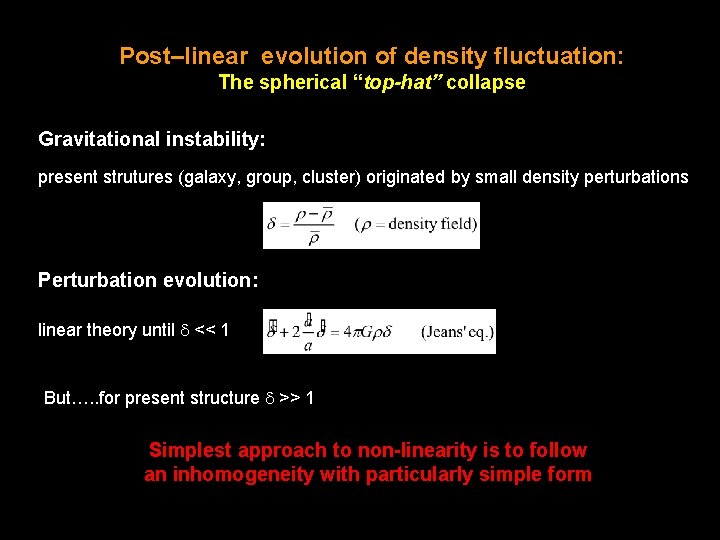
Post–linear evolution of density fluctuation: The spherical “top-hat” collapse Gravitational instability: present strutures (galaxy, group, cluster) originated by small density perturbations Perturbation evolution: linear theory until << 1 But…. . for present structure >> 1 Simplest approach to non-linearity is to follow an inhomogeneity with particularly simple form
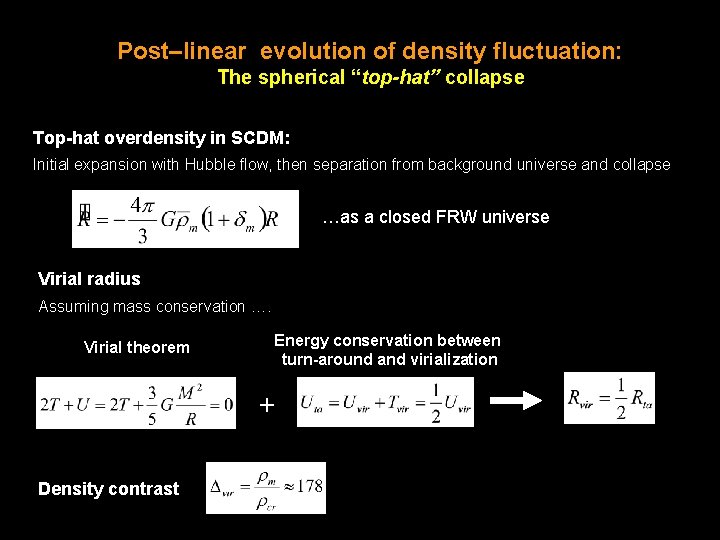
Post–linear evolution of density fluctuation: The spherical “top-hat” collapse Top-hat overdensity in SCDM: Initial expansion with Hubble flow, then separation from background universe and collapse …as a closed FRW universe Virial radius Assuming mass conservation …. Virial theorem Energy conservation between turn-around and virialization + Density contrast
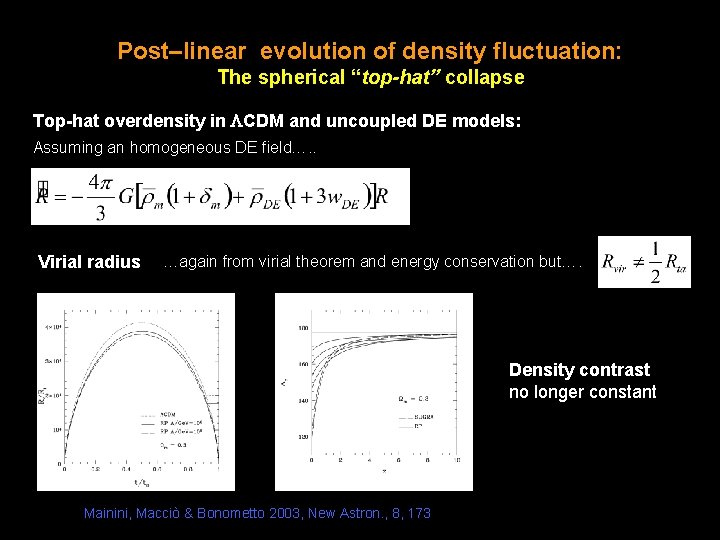
Post–linear evolution of density fluctuation: The spherical “top-hat” collapse Top-hat overdensity in CDM and uncoupled DE models: Assuming an homogeneous DE field…. . Virial radius …again from virial theorem and energy conservation but…. Density contrast no longer constant Mainini, Macciò & Bonometto 2003, New Astron. , 8, 173
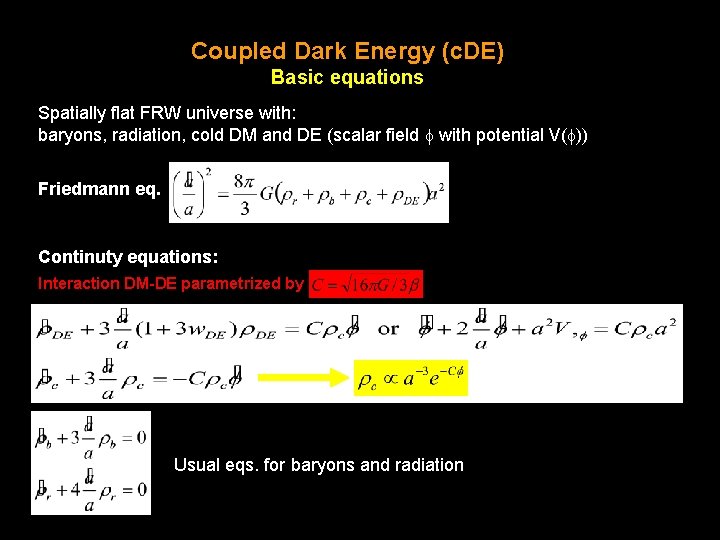
Coupled Dark Energy (c. DE) Basic equations Spatially flat FRW universe with: baryons, radiation, cold DM and DE (scalar field with potential V( )) Friedmann eq. Continuty equations: Interaction DM-DE parametrized by Usual eqs. for baryons and radiation
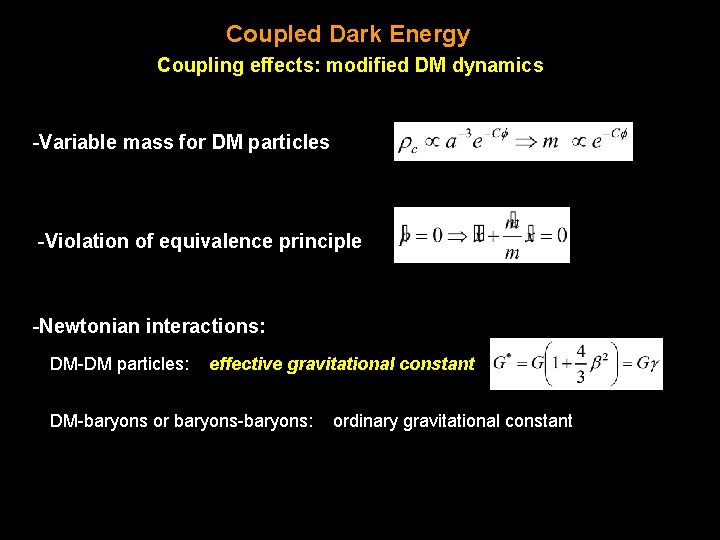
Coupled Dark Energy Coupling effects: modified DM dynamics -Variable mass for DM particles -Violation of equivalence principle -Newtonian interactions: DM-DM particles: effective gravitational constant DM-baryons or baryons-baryons: ordinary gravitational constant
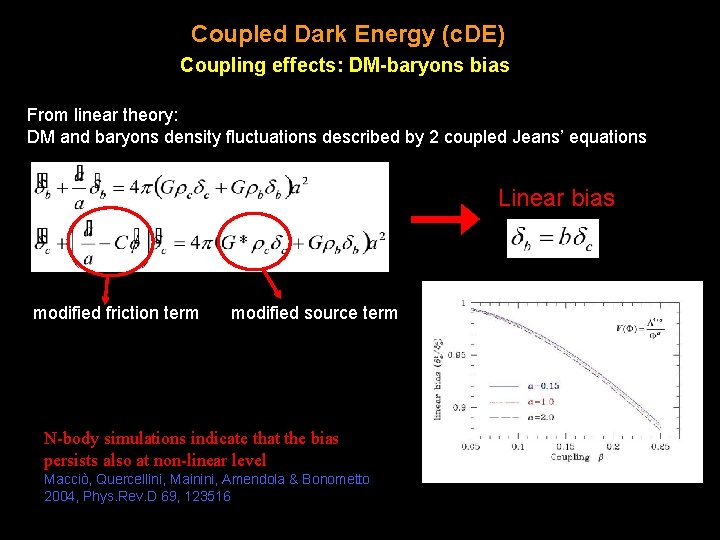
Coupled Dark Energy (c. DE) Coupling effects: DM-baryons bias From linear theory: DM and baryons density fluctuations described by 2 coupled Jeans’ equations: Linear bias modified friction term modified source term N-body simulations indicate that the bias persists also at non-linear level Macciò, Quercellini, Mainini, Amendola & Bonometto 2004, Phys. Rev. D 69, 123516
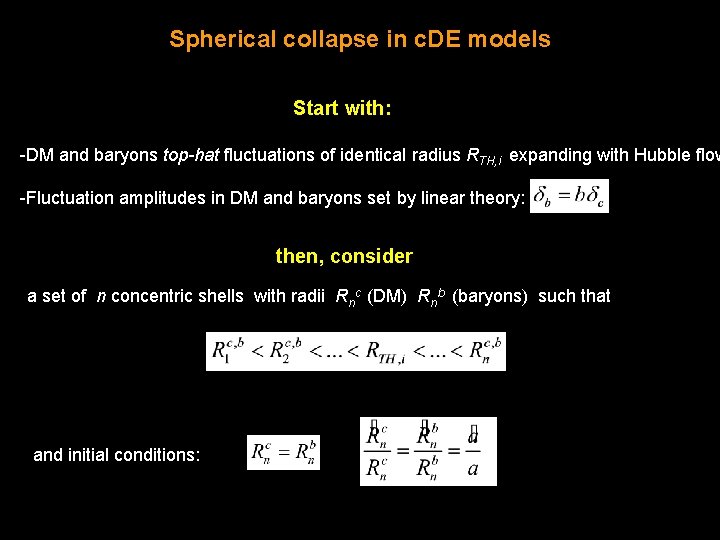
Spherical collapse in c. DE models Start with: -DM and baryons top-hat fluctuations of identical radius RTH, i expanding with Hubble flow -Fluctuation amplitudes in DM and baryons set by linear theory: then, consider a set of n concentric shells with radii Rnc (DM) Rnb (baryons) such that and initial conditions:
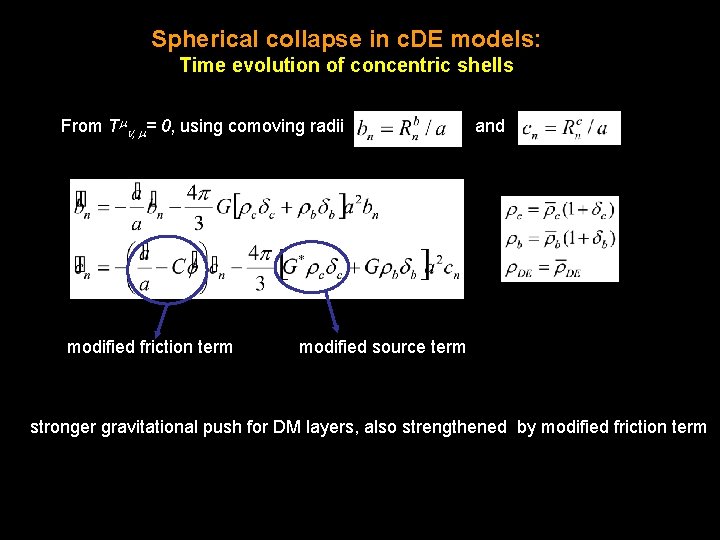
Spherical collapse in c. DE models: Time evolution of concentric shells From T ; = 0, using comoving radii modified friction term and modified source term stronger gravitational push for DM layers, also strengthened by modified friction term
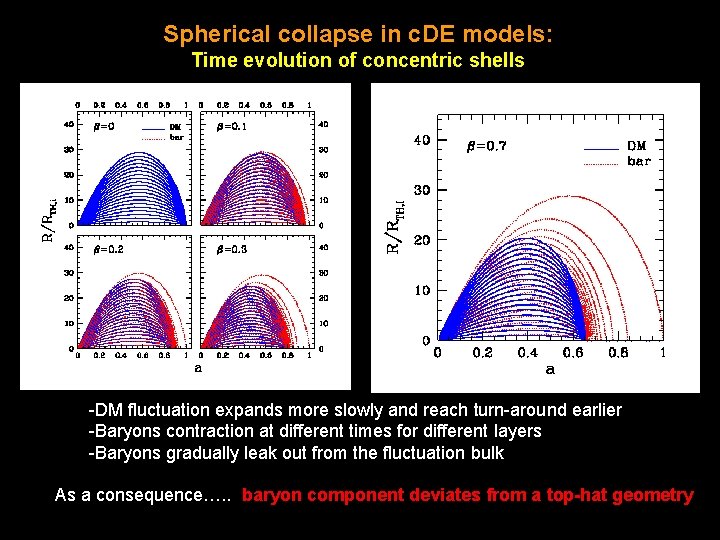
Spherical collapse in c. DE models: Time evolution of concentric shells -DM fluctuation expands more slowly and reach turn-around earlier -Baryons contraction at different times for different layers -Baryons gradually leak out from the fluctuation bulk As a consequence…. . baryon component deviates from a top-hat geometry
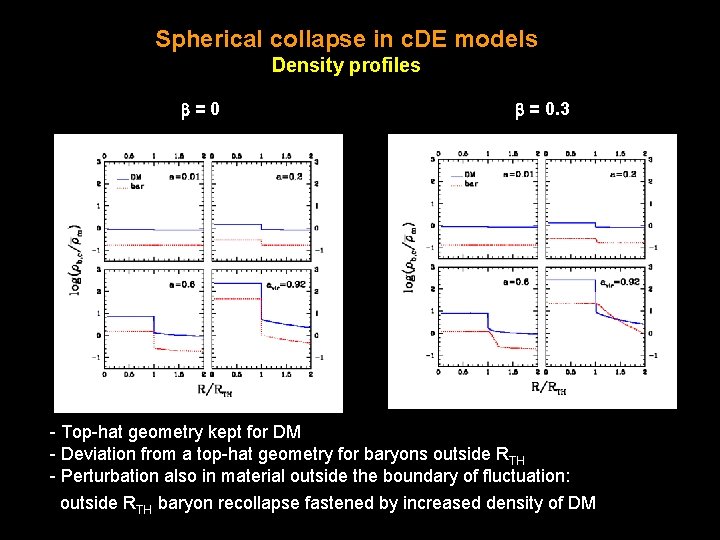
Spherical collapse in c. DE models Density profiles =0 = 0. 3 - Top-hat geometry kept for DM - Deviation from a top-hat geometry for baryons outside RTH - Perturbation also in material outside the boundary of fluctuation: outside RTH baryon recollapse fastened by increased density of DM
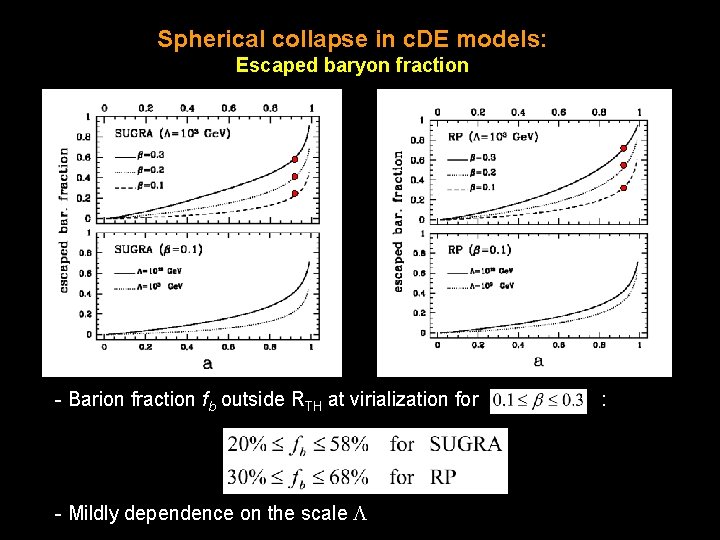
Spherical collapse in c. DE models: Escaped baryon fraction - Barion fraction fb outside RTH at virialization for - Mildly dependence on the scale :
Virialization in c. DE models - Slower gravitational infall for baryons: outer layers of halo rich of baryons - Gradually recollapse of external baryons onto the DM-richer core: DM materials outside the original fluctuation carried with them - Original DM / baryons ratio increased No virialization with all the materials of original fluctuation – and only them How to define virialization in c. DE models? 1 - Only materials within top-hat considered: escaped baryon fraction neglected 2 - All materials inside original fluctuation plus intruder DM considered but……. . any intermediate choice also alloweded
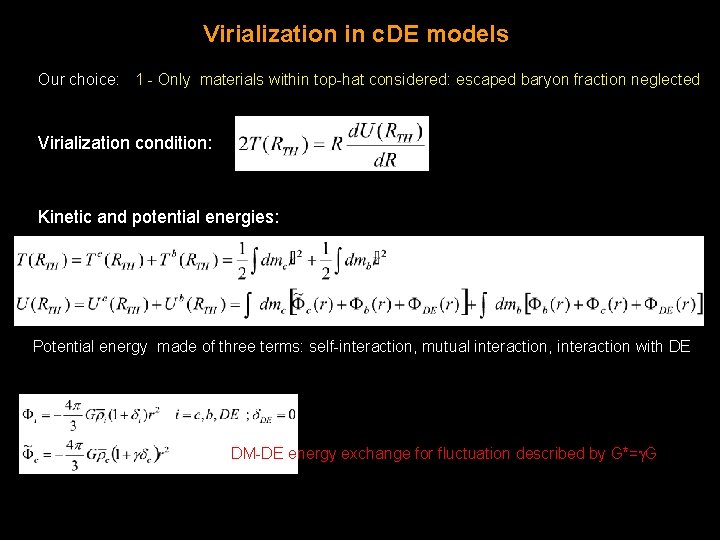
Virialization in c. DE models Our choice: 1 - Only materials within top-hat considered: escaped baryon fraction neglected Virialization condition: Kinetic and potential energies: Potential energy made of three terms: self-interaction, mutual interaction, interaction with DE DM-DE energy exchange for fluctuation described by G*= G
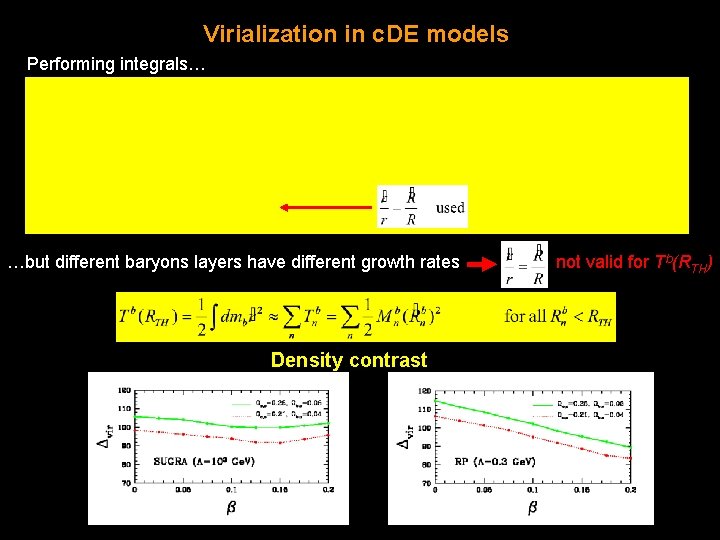
Virialization in c. DE models Performing integrals… …but different baryons layers have different growth rates Density contrast not valid for Tb(RTH)
Conclusions Spherical top-hat collapse model in c. DE theories: Ambiguity of definition of halo virialization: difficulty in comparing simulations outputs or data with PS or similar prediction But…indipendently of the way how virialization is defined: 1 - Only materials within top-hat considered: escaped baryon fraction neglected 2 - All the materials inside the original fluctuation plus intruder DM considered (or any intermediate choice) Final virialized system is richer of DM
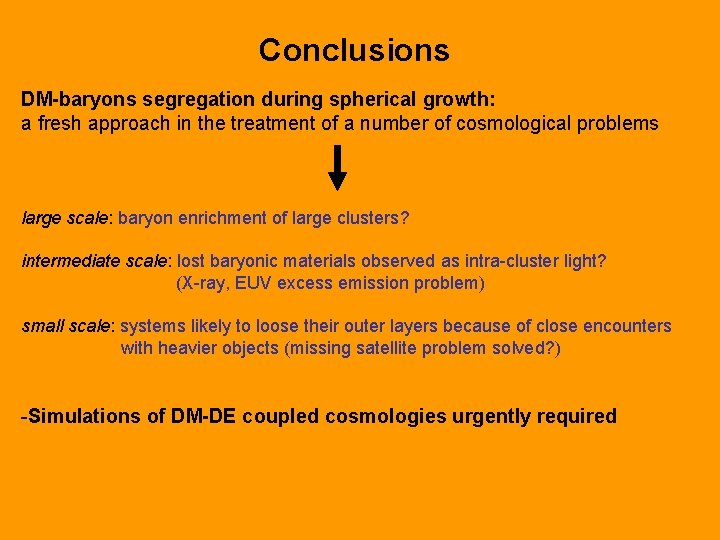
Conclusions DM-baryons segregation during spherical growth: a fresh approach in the treatment of a number of cosmological problems large scale: baryon enrichment of large clusters? intermediate scale: lost baryonic materials observed as intra-cluster light? (X-ray, EUV excess emission problem) small scale: systems likely to loose their outer layers because of close encounters with heavier objects (missing satellite problem solved? ) -Simulations of DM-DE coupled cosmologies urgently required
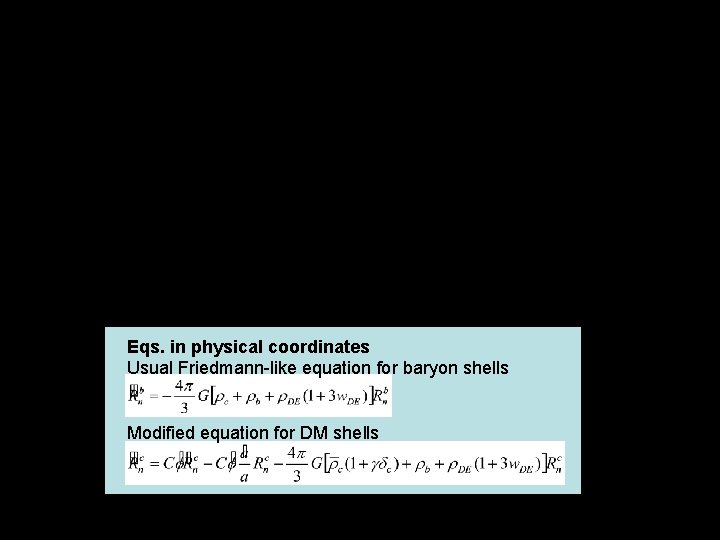
Eqs. in physical coordinates Usual Friedmann-like equation for baryon shells Modified equation for DM shells
- Slides: 18