
Dark matter visible by hard gamma rays Cosmology
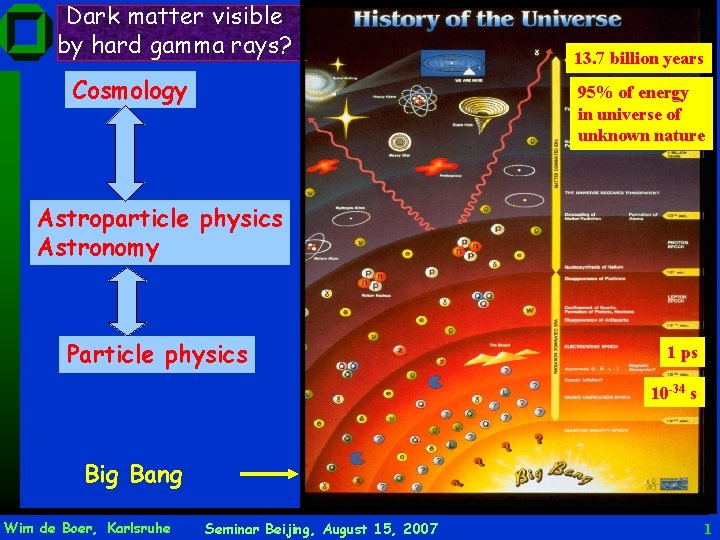
Dark matter visible by hard gamma rays? Cosmology 13. 7 billion years 95% of energy in universe of unknown nature Astroparticle physics Astronomy Particle physics 1 ps 10 -34 s Big Bang Wim de Boer, Karlsruhe Seminar Beijing, August 15, 2007 1

Discovery of DM in 1933 Zwicky, Fritz (1898 -1974 Center of the Coma Cluster by Hubble space telescope ©Dubinski Zwicky notes in 1933 that outlying galaxies in Coma cluster moving much faster than mass calculated for the visible galaxies would indicate Wim de Boer, Karlsruhe Seminar Beijing, August 15, 2007 DM attracts galaxies with more force-> higher speed. But still bound! 2
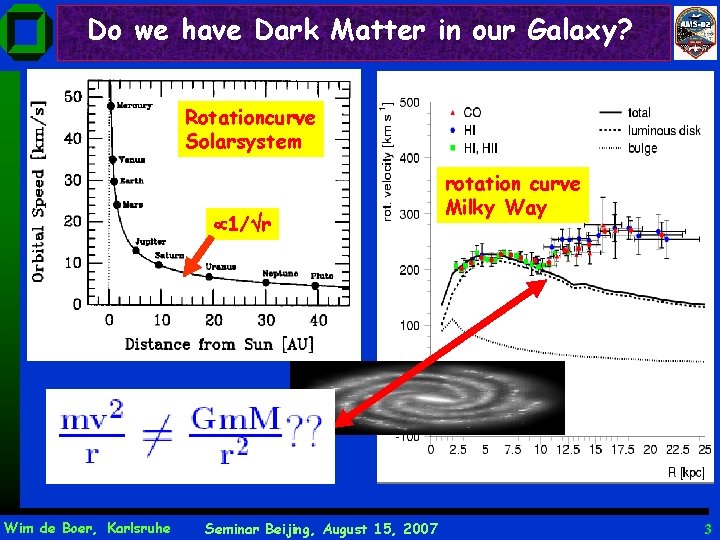
Do we have Dark Matter in our Galaxy? Rotationcurve Solarsystem 1/ r Wim de Boer, Karlsruhe Seminar Beijing, August 15, 2007 rotation curve Milky Way 3
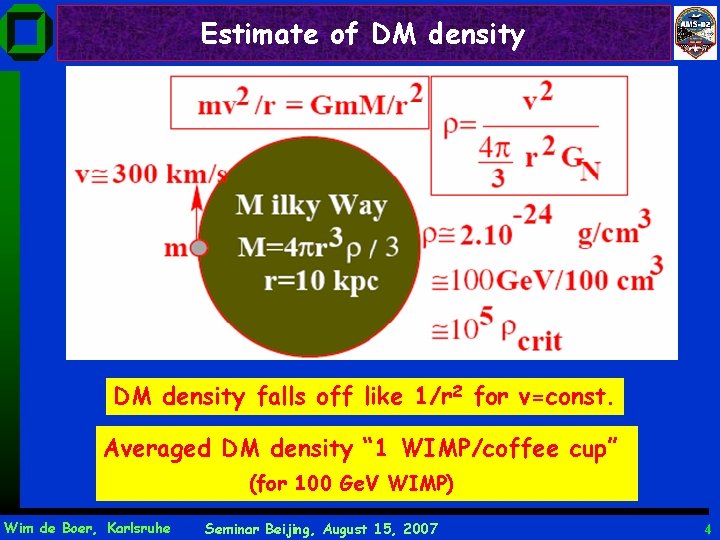
Estimate of DM density falls off like 1/r 2 for v=const. Averaged DM density “ 1 WIMP/coffee cup” (for 100 Ge. V WIMP) Wim de Boer, Karlsruhe Seminar Beijing, August 15, 2007 4
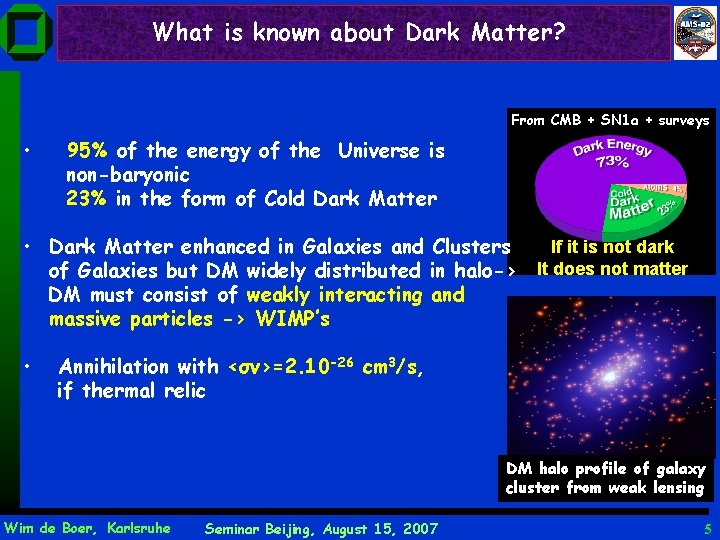
What is known about Dark Matter? From CMB + SN 1 a + surveys • 95% of the energy of the Universe is non-baryonic 23% in the form of Cold Dark Matter • Dark Matter enhanced in Galaxies and Clusters If it is not dark of Galaxies but DM widely distributed in halo-> It does not matter DM must consist of weakly interacting and massive particles -> WIMP’s • Annihilation with <σv>=2. 10 -26 cm 3/s, if thermal relic DM halo profile of galaxy cluster from weak lensing Wim de Boer, Karlsruhe Seminar Beijing, August 15, 2007 5
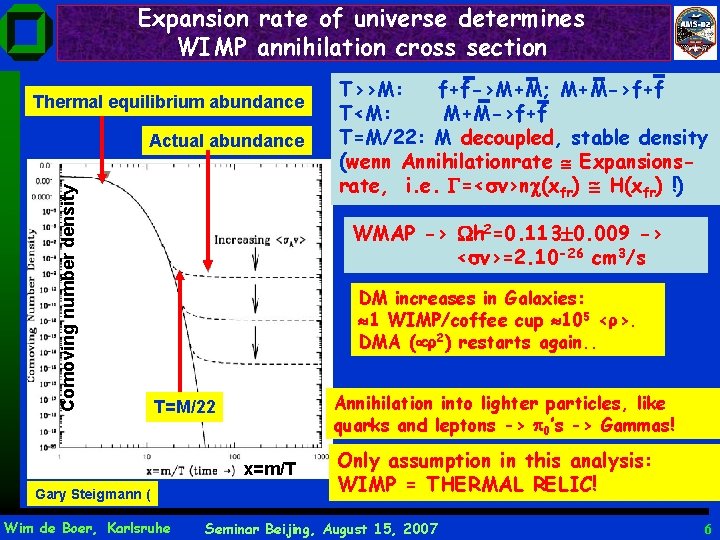
Expansion rate of universe determines WIMP annihilation cross section Thermal equilibrium abundance Comoving number density Actual abundance T>>M: f+f->M+M; M+M->f+f T<M: M+M->f+f T=M/22: M decoupled, stable density (wenn Annihilationrate Expansionsrate, i. e. =< v>n (xfr) H(xfr) !) WMAP -> h 2=0. 113 0. 009 -> < v>=2. 10 -26 cm 3/s DM increases in Galaxies: 1 WIMP/coffee cup 105 <ρ>. DMA ( ρ2) restarts again. . Annihilation into lighter particles, like quarks and leptons -> 0’s -> Gammas! T=M/22 x=m/T Gary Steigmann ( Wim de Boer, Karlsruhe Only assumption in this analysis: WIMP = THERMAL RELIC! Seminar Beijing, August 15, 2007 6
Conclusion sofar IF DM particles are thermal relics from early universe they can annihilate with cross section as large as < v>=2. 10 -26 cm 3/s which implies an enormous rate of gamma rays from π0 decays (produced in quark fragmentation) (Galaxy=1040 higher rate than any accelerator) Expect large fraction of energetic Galactic gamma rays to come from DMA in this case. Remaining ones from p. CR+p. GAS-> π0+X , π0 ->2γ (+some IC+brems) This means: Galactic gamma rays have 2 components with a shape KNOWN from the 2 BEST studied reactions in accelerators: background known from fixed target exp. DMA known from e+e- annihilation (LEP) Wim de Boer, Karlsruhe Seminar Beijing, August 15, 2007 7
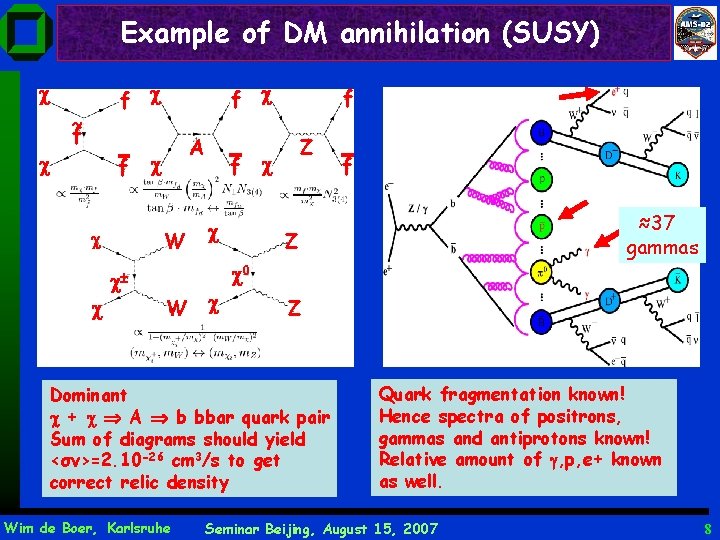
Example of DM annihilation (SUSY) f ~ f f f W A f f Z f ≈37 gammas Z 0 W Z Dominant + A b bbar quark pair Sum of diagrams should yield <σv>=2. 10 -26 cm 3/s to get correct relic density Wim de Boer, Karlsruhe Quark fragmentation known! Hence spectra of positrons, gammas and antiprotons known! Relative amount of , p, e+ known as well. Seminar Beijing, August 15, 2007 8
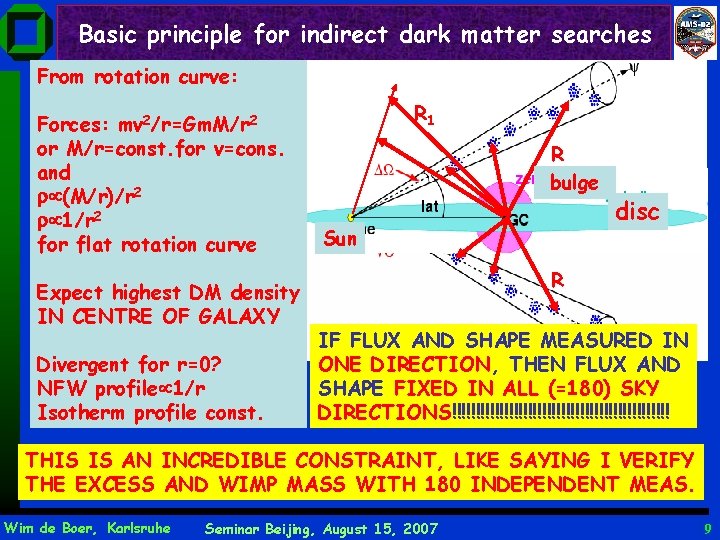
Basic principle for indirect dark matter searches From rotation curve: Divergent for r=0? NFW profile 1/r Isotherm profile const. R bulge disc Expect highest DM density IN CENTRE OF GALAXY R 1 Sun Forces: mv 2/r=Gm. M/r 2 or M/r=const. for v=cons. and (M/r)/r 2 1/r 2 for flat rotation curve Sun R IF FLUX AND SHAPE MEASURED IN ONE DIRECTION, THEN FLUX AND SHAPE FIXED IN ALL (=180) SKY DIRECTIONS!!!!!!!!!!!!!!!!!!!!!!! THIS IS AN INCREDIBLE CONSTRAINT, LIKE SAYING I VERIFY THE EXCESS AND WIMP MASS WITH 180 INDEPENDENT MEAS. Wim de Boer, Karlsruhe Seminar Beijing, August 15, 2007 9
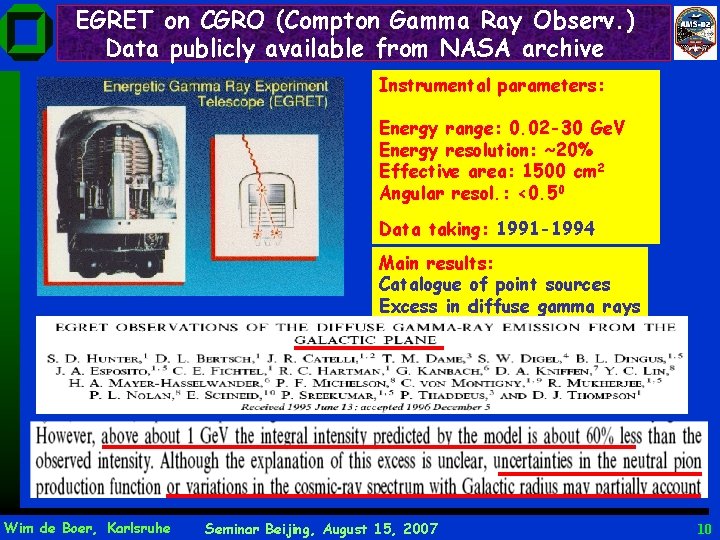
EGRET on CGRO (Compton Gamma Ray Observ. ) Data publicly available from NASA archive Instrumental parameters: Energy range: 0. 02 -30 Ge. V Energy resolution: ~20% Effective area: 1500 cm 2 Angular resol. : <0. 50 Data taking: 1991 -1994 Main results: Catalogue of point sources Excess in diffuse gamma rays Wim de Boer, Karlsruhe Seminar Beijing, August 15, 2007 10
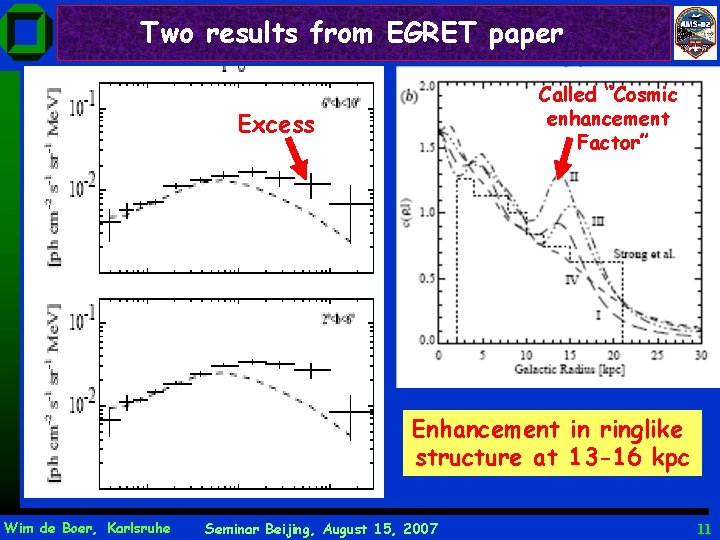
Two results from EGRET paper Called “Cosmic enhancement Factor” Excess Enhancement in ringlike structure at 13 -16 kpc Wim de Boer, Karlsruhe Seminar Beijing, August 15, 2007 11
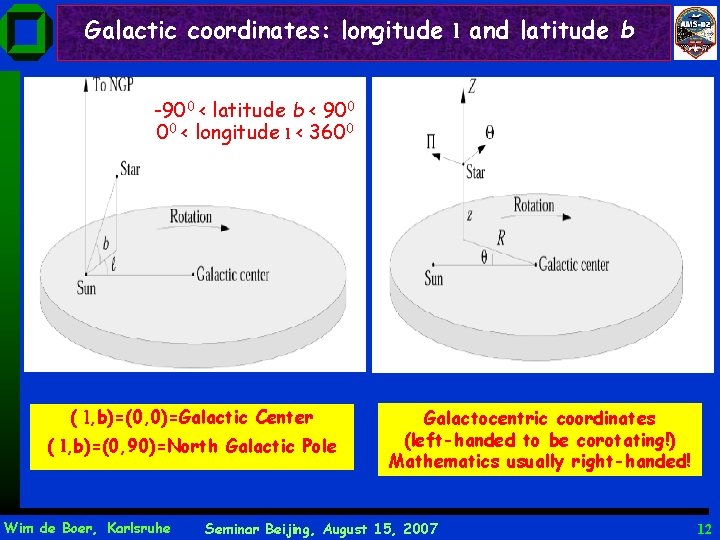
Galactic coordinates: longitude l and latitude b -900 < latitude b < 900 00 < longitude l < 3600 ( l, b)=(0, 0)=Galactic Center ( l, b)=(0, 90)=North Galactic Pole Wim de Boer, Karlsruhe Galactocentric coordinates (left-handed to be corotating!) Mathematics usually right-handed! Seminar Beijing, August 15, 2007 12
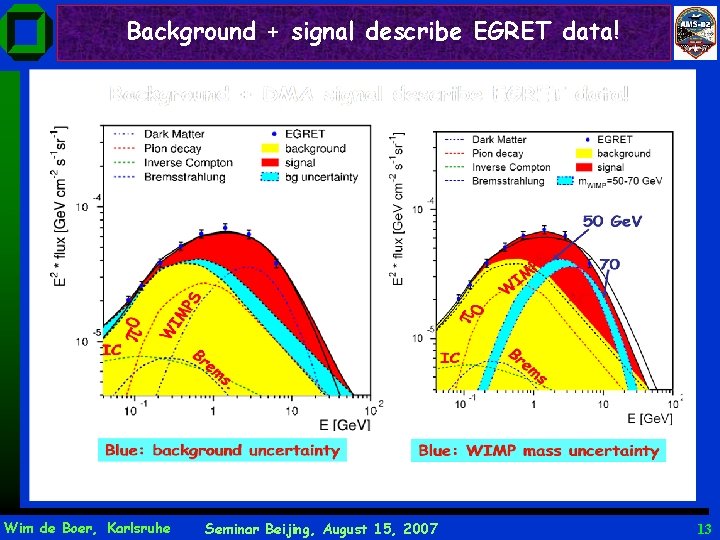
Background + signal describe EGRET data! Wim de Boer, Karlsruhe Seminar Beijing, August 15, 2007 13
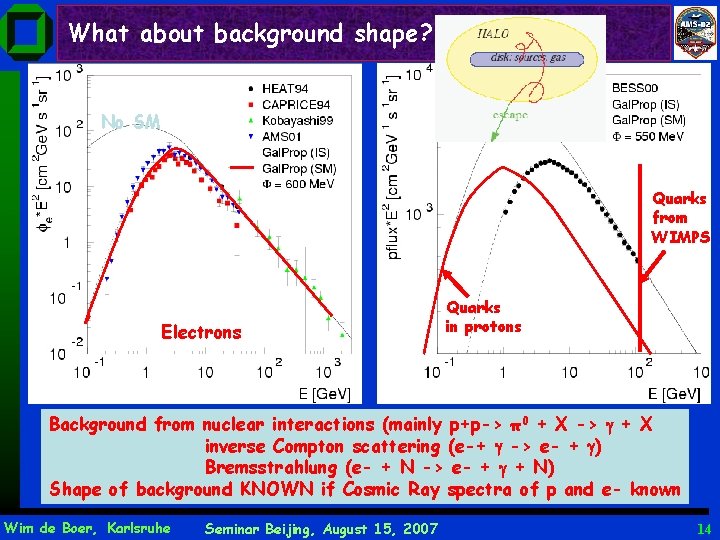
What about background shape? No SM Quarks from WIMPS Protons Electrons Quarks in protons Background from nuclear interactions (mainly p+p-> π0 + X -> + X inverse Compton scattering (e-+ -> e- + ) Bremsstrahlung (e- + N -> e- + + N) Shape of background KNOWN if Cosmic Ray spectra of p and e- known Wim de Boer, Karlsruhe Seminar Beijing, August 15, 2007 14
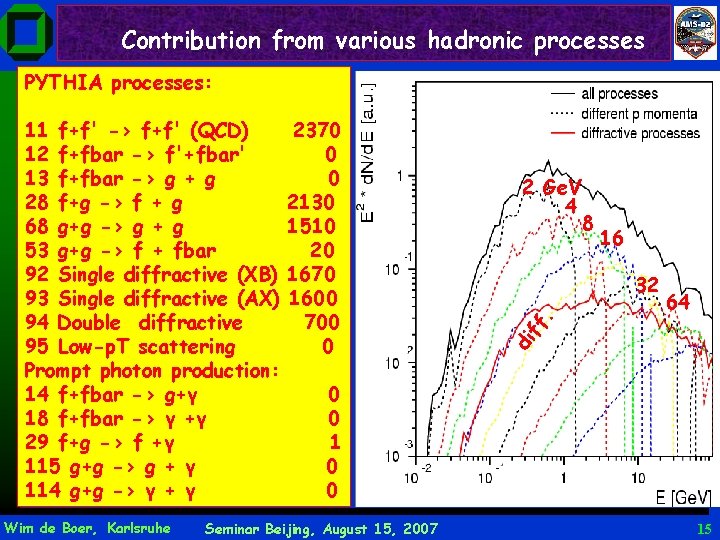
Contribution from various hadronic processes PYTHIA processes: Wim de Boer, Karlsruhe 2 Ge. V 4 8 16 32 ff. 2370 0 0 2130 1510 20 1670 1600 700 0 64 di 11 f+f' -> f+f' (QCD) 12 f+fbar -> f'+fbar' 13 f+fbar -> g + g 28 f+g -> f + g 68 g+g -> g + g 53 g+g -> f + fbar 92 Single diffractive (XB) 93 Single diffractive (AX) 94 Double diffractive 95 Low-p. T scattering Prompt photon production: 14 f+fbar -> g+γ 18 f+fbar -> γ +γ 29 f+g -> f +γ 115 g+g -> g + γ 114 g+g -> γ + γ 0 0 1 0 0 Seminar Beijing, August 15, 2007 15
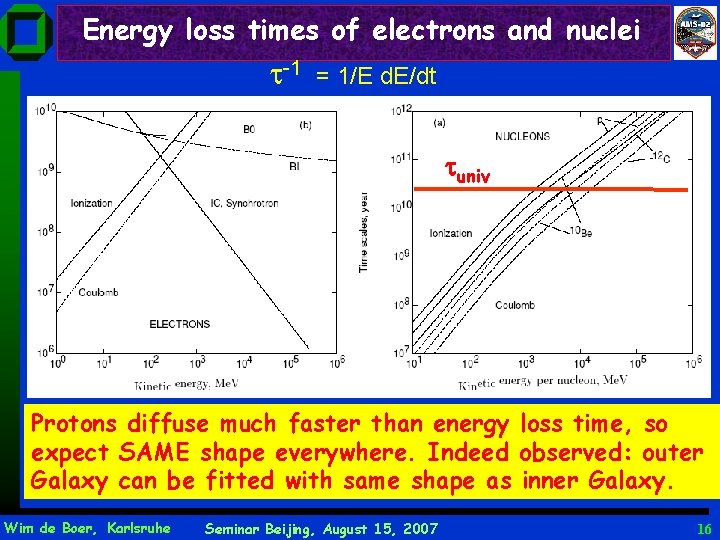
Energy loss times of electrons and nuclei t-1 = 1/E d. E/dt univ Protons diffuse much faster than energy loss time, so expect SAME shape everywhere. Indeed observed: outer Galaxy can be fitted with same shape as inner Galaxy. Wim de Boer, Karlsruhe Seminar Beijing, August 15, 2007 16
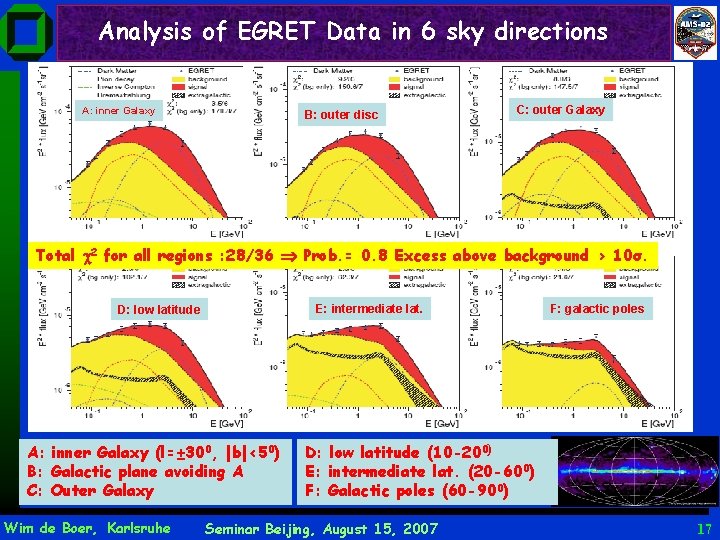
Analysis of EGRET Data in 6 sky directions A: inner Galaxy B: outer disc C: outer Galaxy Total 2 for all regions : 28/36 Prob. = 0. 8 Excess above background > 10σ. E: intermediate lat. D: low latitude A: inner Galaxy (l=± 300, |b|<50) B: Galactic plane avoiding A C: Outer Galaxy Wim de Boer, Karlsruhe F: galactic poles D: low latitude (10 -200) E: intermediate lat. (20 -600) F: Galactic poles (60 -900) Seminar Beijing, August 15, 2007 17
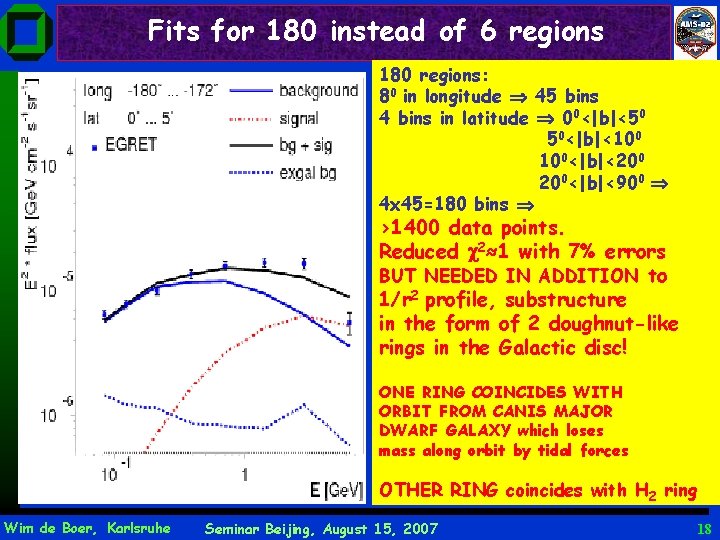
Fits for 180 instead of 6 regions 180 regions: 80 in longitude 45 bins 4 bins in latitude 00<|b|<50 50<|b|<100 100<|b|<200 200<|b|<900 4 x 45=180 bins >1400 data points. Reduced 2≈1 with 7% errors BUT NEEDED IN ADDITION to 1/r 2 profile, substructure in the form of 2 doughnut-like rings in the Galactic disc! ONE RING COINCIDES WITH ORBIT FROM CANIS MAJOR DWARF GALAXY which loses mass along orbit by tidal forces OTHER RING coincides with H 2 ring Wim de Boer, Karlsruhe Seminar Beijing, August 15, 2007 18
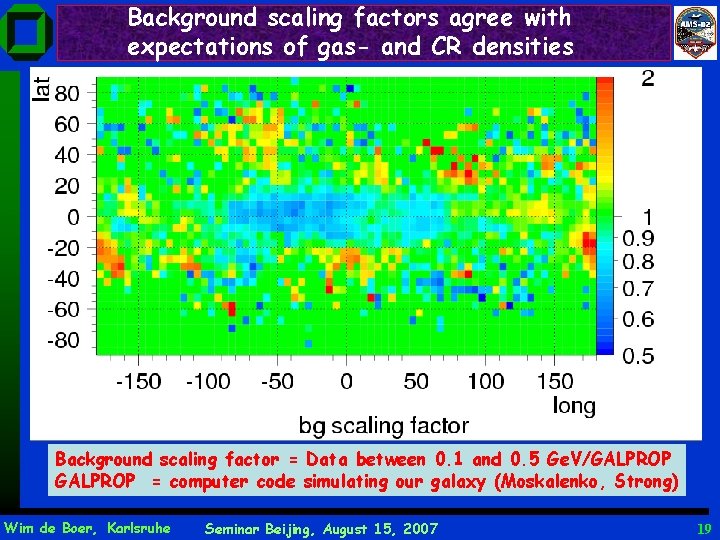
Background scaling factors agree with expectations of gas- and CR densities Background scaling factor = Data between 0. 1 and 0. 5 Ge. V/GALPROP = computer code simulating our galaxy (Moskalenko, Strong) Wim de Boer, Karlsruhe Seminar Beijing, August 15, 2007 19
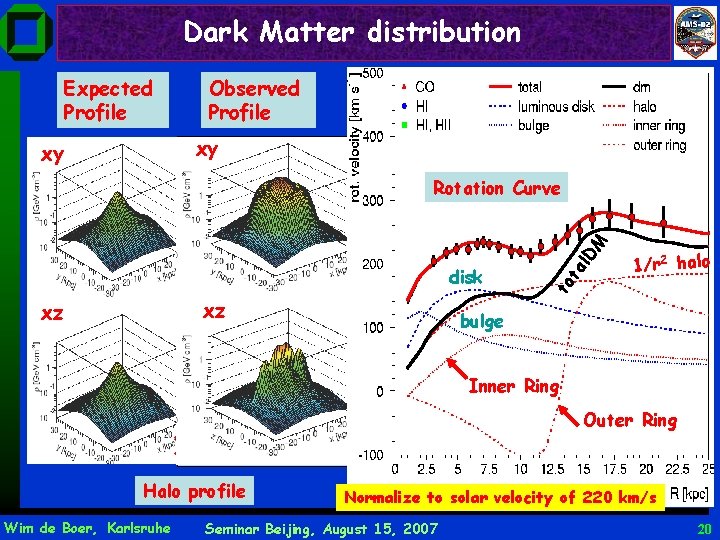
Dark Matter distribution Observed Profile z xz Halo profile Wim de Boer, Karlsruhe Rotation Curve M x y 2002, Newberg et al. Ibata et al, Crane et al. Yanny et al. r 2 halo 1/ disk l. D 2 M/r=cons. vxy and (M/r)/r 2 1/r 2 for const. xzrotation curve Divergent for r=0? NFW 1/r Isotherm const. xy to ta Expected Profile bulge Inner Ring Outer Ring 1/r 2 profile and rings determined from independent directions Normalize to solar velocity of 220 km/s Seminar Beijing, August 15, 2007 20
How does DM substructure form from tidal disruption of dwarf galaxies? Wim de Boer, Karlsruhe Seminar Beijing, August 15, 2007 21
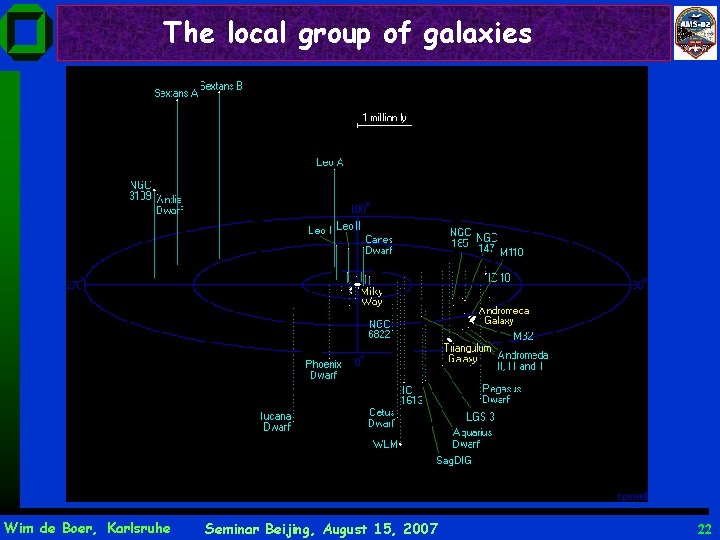
The local group of galaxies Wim de Boer, Karlsruhe Seminar Beijing, August 15, 2007 22
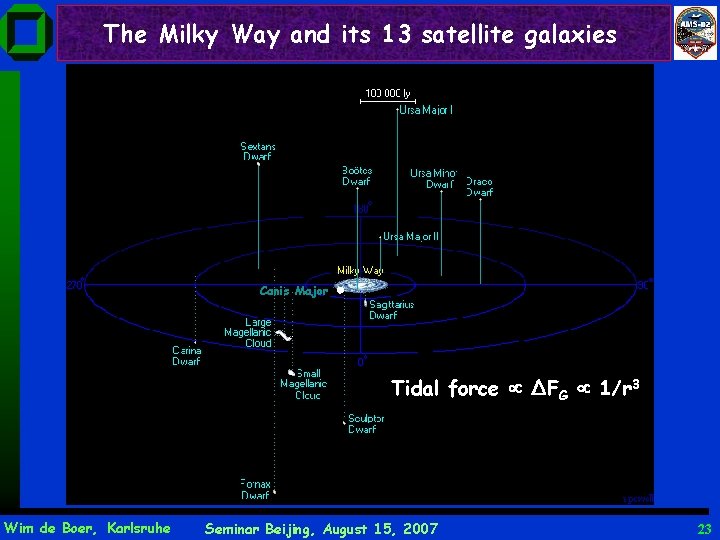
The Milky Way and its 13 satellite galaxies Canis Major Tidal force ΔFG 1/r 3 Wim de Boer, Karlsruhe Seminar Beijing, August 15, 2007 23
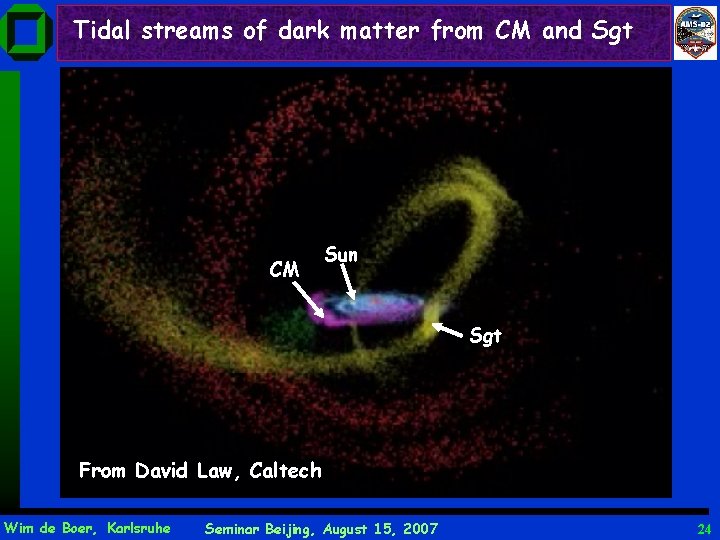
Tidal streams of dark matter from CM and Sgt CM Sun Sgt From David Law, Caltech Wim de Boer, Karlsruhe Seminar Beijing, August 15, 2007 24
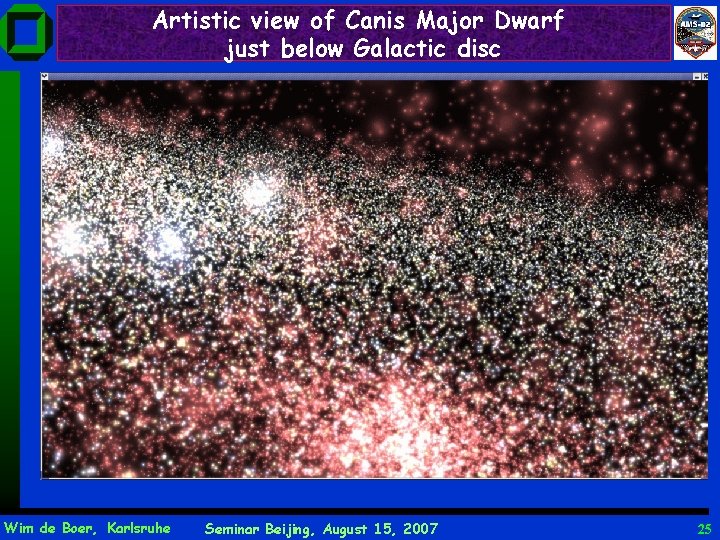
Artistic view of Canis Major Dwarf just below Galactic disc Wim de Boer, Karlsruhe Seminar Beijing, August 15, 2007 25
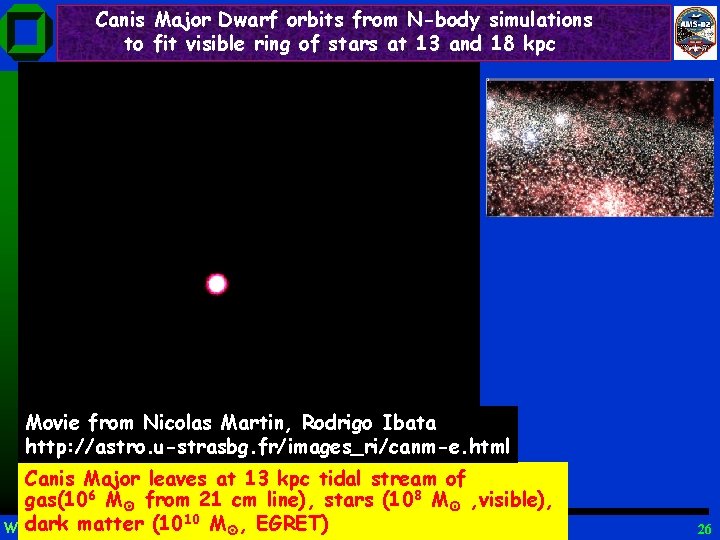
Canis Major Dwarf orbits from N-body simulations to fit visible ring of stars at 13 and 18 kpc Movie from Nicolas Martin, Rodrigo Ibata http: //astro. u-strasbg. fr/images_ri/canm-e. html Canis Major leaves at 13 kpc tidal stream of gas(106 M☉ from 21 cm line), stars (108 M☉ , visible), dark matter (1010 Seminar M☉, EGRET) Wim de Boer, Karlsruhe Beijing, August 15, 2007 26
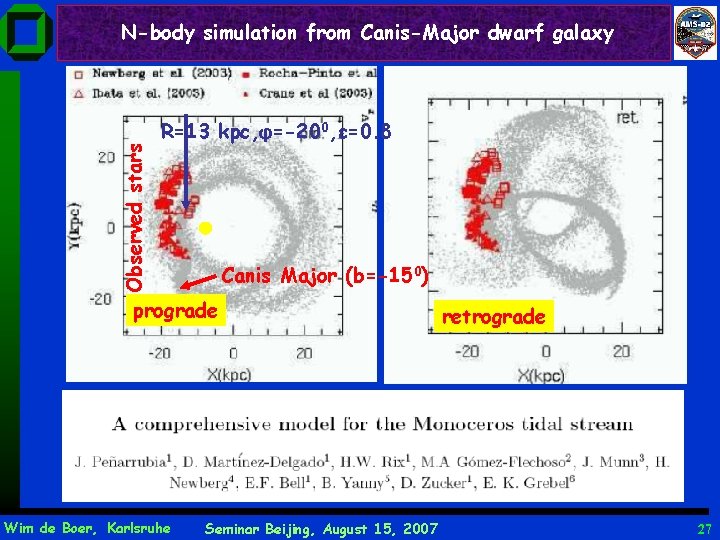
Observed stars N-body simulation from Canis-Major dwarf galaxy R=13 kpc, φ=-200, ε=0. 8 Canis Major (b=-150) prograde Wim de Boer, Karlsruhe Seminar Beijing, August 15, 2007 retrograde 27
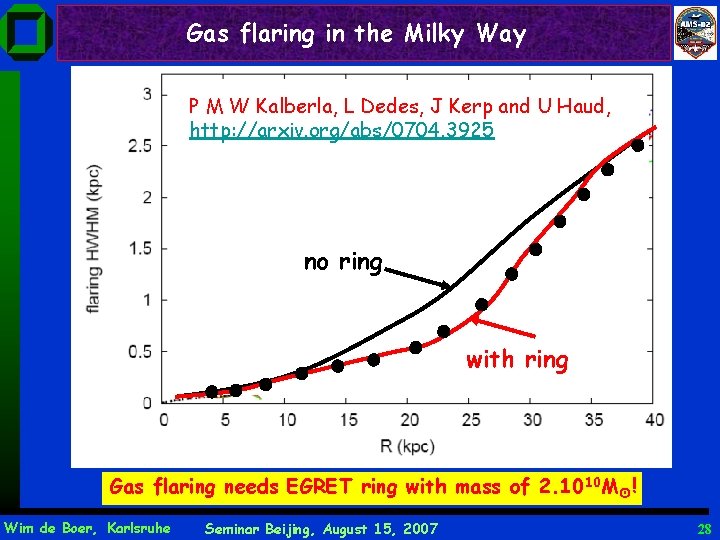
Gas flaring in the Milky Way P M W Kalberla, L Dedes, J Kerp and U Haud, http: //arxiv. org/abs/0704. 3925 no ring with ring Gas flaring needs EGRET ring with mass of 2. 1010 M☉! Wim de Boer, Karlsruhe Seminar Beijing, August 15, 2007 28
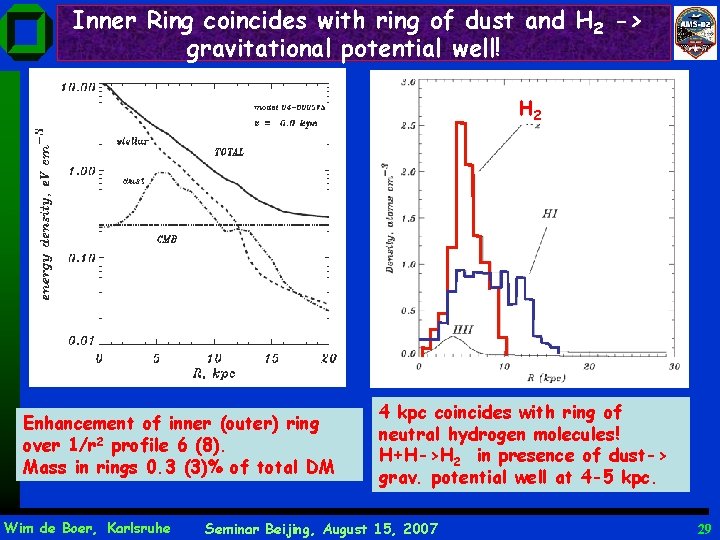
Inner Ring coincides with ring of dust and H 2 -> gravitational potential well! H 2 Enhancement of inner (outer) ring over 1/r 2 profile 6 (8). Mass in rings 0. 3 (3)% of total DM Wim de Boer, Karlsruhe 4 kpc coincides with ring of neutral hydrogen molecules! H+H->H 2 in presence of dust-> grav. potential well at 4 -5 kpc. Seminar Beijing, August 15, 2007 29
Do antiproton data exclude interpretation of EGRET data? Bergstrom et al. astro-ph/0603632, Abstract: we investigate the viability of the model using the Dark. SUSY package to compute the gamma-ray and antiproton fluxes. We are able to show that their (=Wd. B et al) model is excluded by a wide margin from the measured flux of antiprotons. Problem with Dark. SUSY (DS): 1) Flux of antiprotons/gamma in Dark. SUSY: O(1) from DMA. 2) However, O(10 -2) from LEP data 3) Reason: DS has diffusion box with isotropic diffusion -> 4) DMA fills up box with high density of antiprotons 5) 2) Priors of DARKSUSY. (and other propagation models as well): 6) a) static galactic magnetic fields are negligible 7) b) gas is smoothly distributed 8) c) propagation in halo and disk are the same 9) ALL priors likely wrong and can change predictions for DM seaches 10)by ORDER OF MAGNITUDE (and still ok with all observations!) Wim de Boer, Karlsruhe Seminar Beijing, August 15, 2007 30
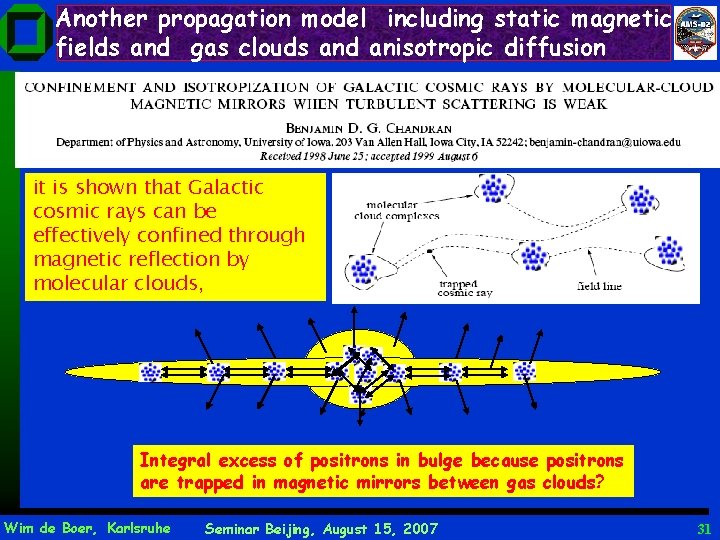
Another propagation model including static magnetic fields and gas clouds and anisotropic diffusion it is shown that Galactic cosmic rays can be effectively confined through magnetic reflection by molecular clouds, Integral excess of positrons in bulge because positrons are trapped in magnetic mirrors between gas clouds? Wim de Boer, Karlsruhe Seminar Beijing, August 15, 2007 31
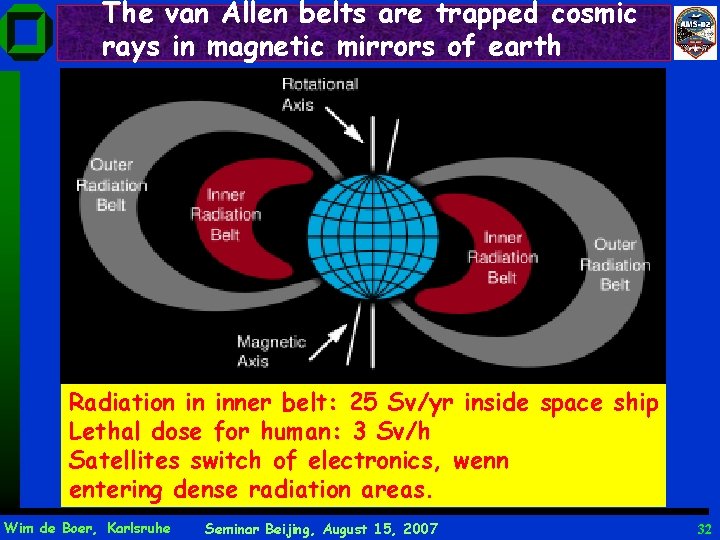
The van Allen belts are trapped cosmic rays in magnetic mirrors of earth Radiation in inner belt: 25 Sv/yr inside space ship Lethal dose for human: 3 Sv/h Satellites switch of electronics, wenn entering dense radiation areas. Wim de Boer, Karlsruhe Seminar Beijing, August 15, 2007 32
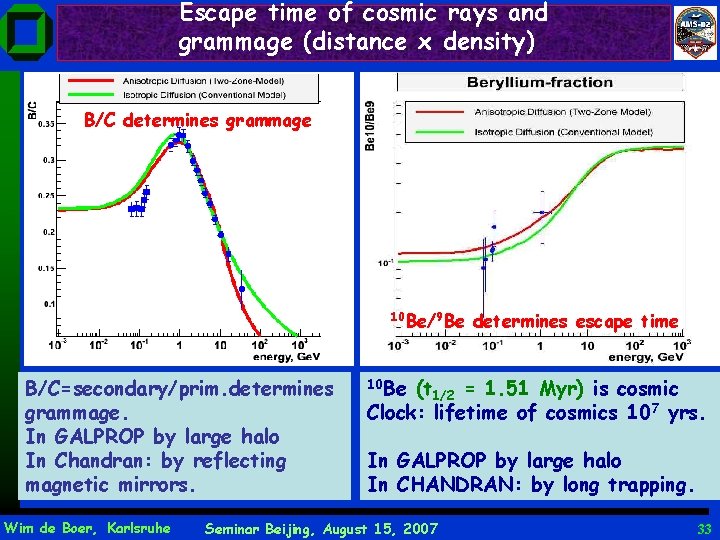
Escape time of cosmic rays and grammage (distance x density) B/C determines grammage 10 Be/9 Be B/C=secondary/prim. determines grammage. In GALPROP by large halo In Chandran: by reflecting magnetic mirrors. Wim de Boer, Karlsruhe determines escape time 10 Be (t 1/2 = 1. 51 Myr) is cosmic Clock: lifetime of cosmics 107 yrs. In GALPROP by large halo In CHANDRAN: by long trapping. Seminar Beijing, August 15, 2007 33
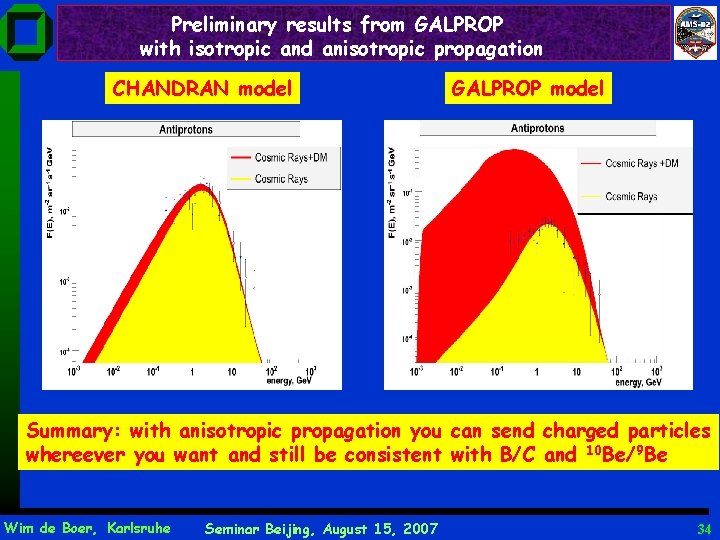
Preliminary results from GALPROP with isotropic and anisotropic propagation CHANDRAN model GALPROP model Summary: with anisotropic propagation you can send charged particles whereever you want and still be consistent with B/C and 10 Be/9 Be Wim de Boer, Karlsruhe Seminar Beijing, August 15, 2007 34
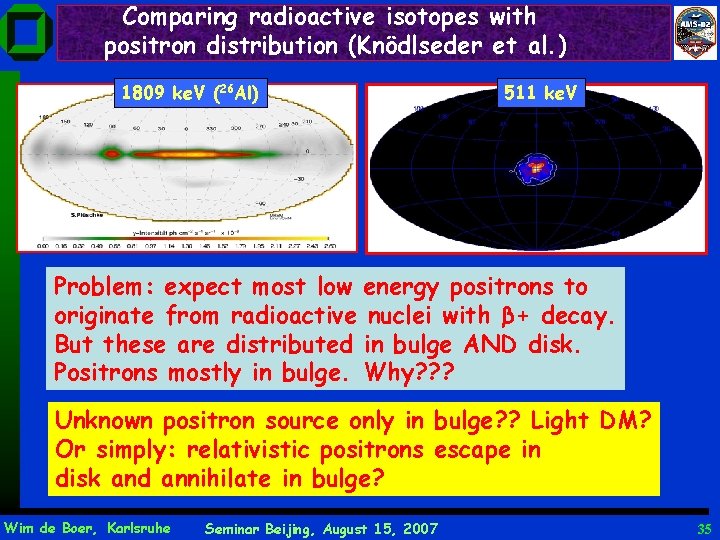
Comparing radioactive isotopes with positron distribution (Knödlseder et al. ) 1809 ke. V (26 Al) 511 ke. V Problem: expect most low energy positrons to originate from radioactive nuclei with β+ decay. But these are distributed in bulge AND disk. Positrons mostly in bulge. Why? ? ? Unknown positron source only in bulge? ? Light DM? Or simply: relativistic positrons escape in disk and annihilate in bulge? Wim de Boer, Karlsruhe Seminar Beijing, August 15, 2007 35
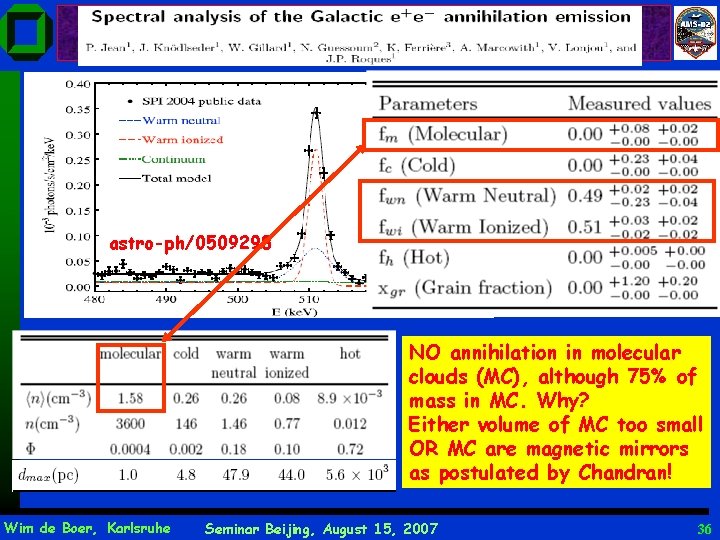
astro-ph/0509298 NO annihilation in molecular clouds (MC), although 75% of mass in MC. Why? Either volume of MC too small OR MC are magnetic mirrors as postulated by Chandran! Wim de Boer, Karlsruhe Seminar Beijing, August 15, 2007 36

What about Supersymmetry? Assume m. SUGRA 5 parameters: m 0, m 1/2, tanb, A, sign μ Wim de Boer, Karlsruhe Seminar Beijing, August 15, 2007 37
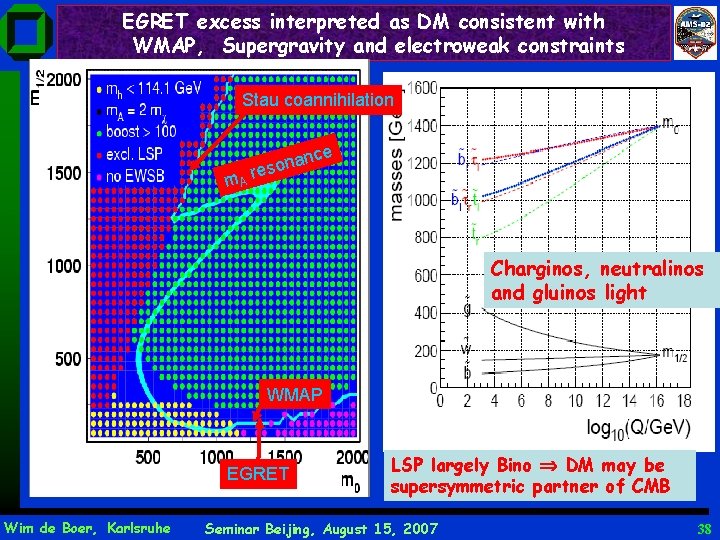
EGRET excess interpreted as DM consistent with WMAP, Supergravity and electroweak constraints Stau coannihilation e anc n o s e m. A r Stau LSP Charginos, neutralinos and gluinos light Too large boostfactor for EGRET data WMAP h<114 Bulk Wim de Boer, Karlsruhe EGRET LSP largely Bino DM may be supersymmetric partner of CMB Seminar Beijing, August 15, 2007 38
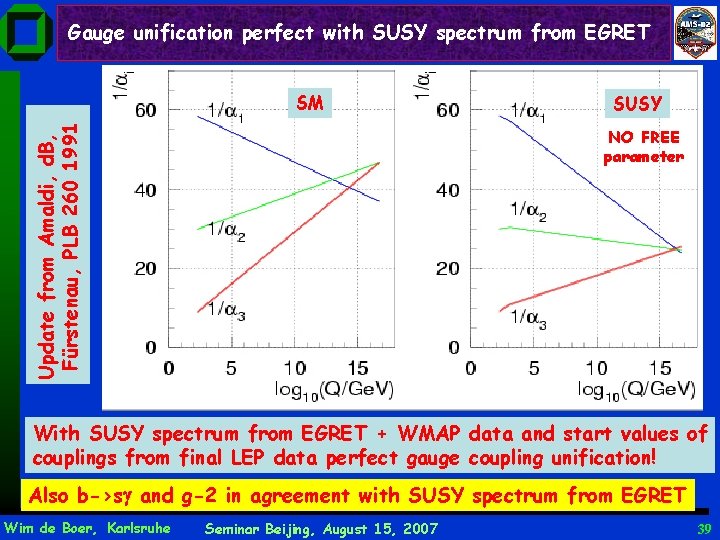
Gauge unification perfect with SUSY spectrum from EGRET Update from Amaldi, d. B, Fürstenau, PLB 260 1991 SM SUSY NO FREE parameter With SUSY spectrum from EGRET + WMAP data and start values of couplings from final LEP data perfect gauge coupling unification! Also b->s and g-2 in agreement with SUSY spectrum from EGRET Wim de Boer, Karlsruhe Seminar Beijing, August 15, 2007 39
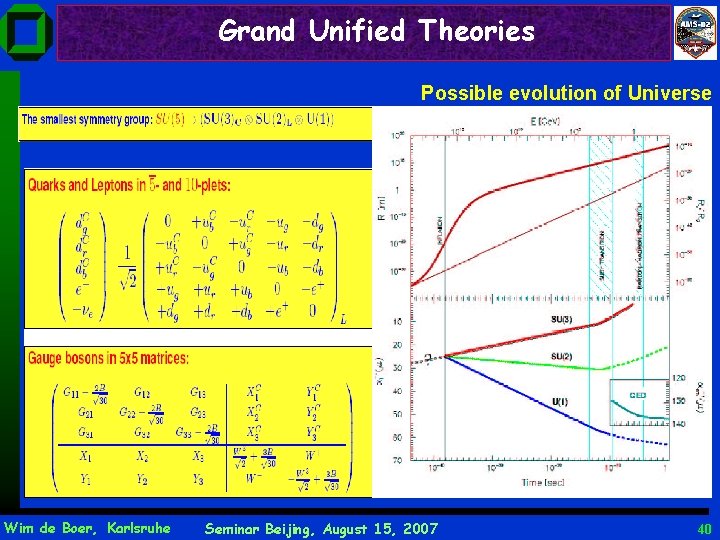
Grand Unified Theories Possible evolution of Universe Wim de Boer, Karlsruhe Seminar Beijing, August 15, 2007 40
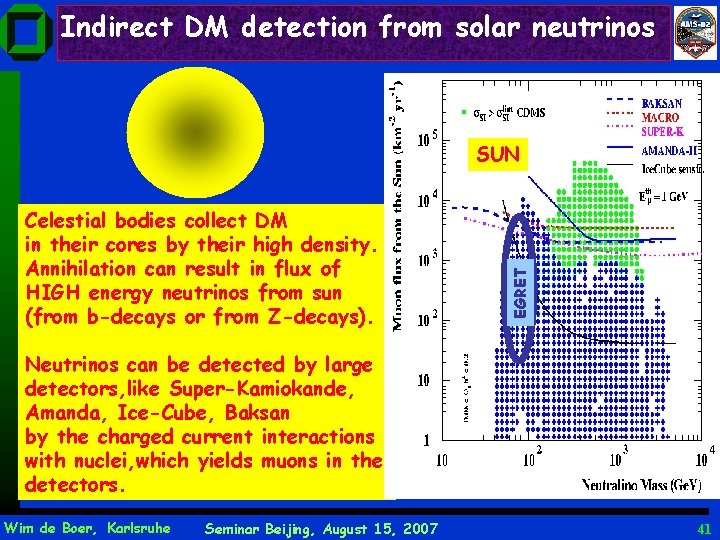
Indirect DM detection from solar neutrinos Celestial bodies collect DM in their cores by their high density. Annihilation can result in flux of HIGH energy neutrinos from sun (from b-decays or from Z-decays). EGRET SUN Neutrinos can be detected by large detectors, like Super-Kamiokande, Amanda, Ice-Cube, Baksan by the charged current interactions with nuclei, which yields muons in the detectors. Wim de Boer, Karlsruhe Seminar Beijing, August 15, 2007 41
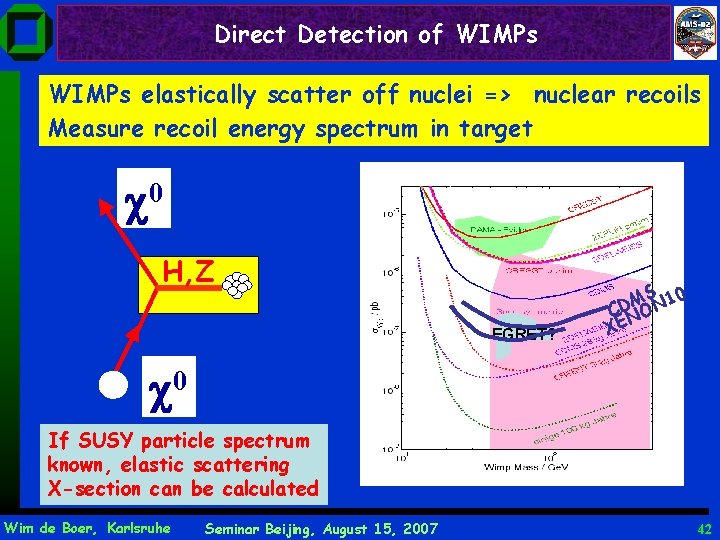
Direct Detection of WIMPs elastically scatter off nuclei => nuclear recoils Measure recoil energy spectrum in target 0 H, Z EGRET? MSN 10 D C NO XE 0 If SUSY particle spectrum known, elastic scattering X-section can be calculated Wim de Boer, Karlsruhe Seminar Beijing, August 15, 2007 42
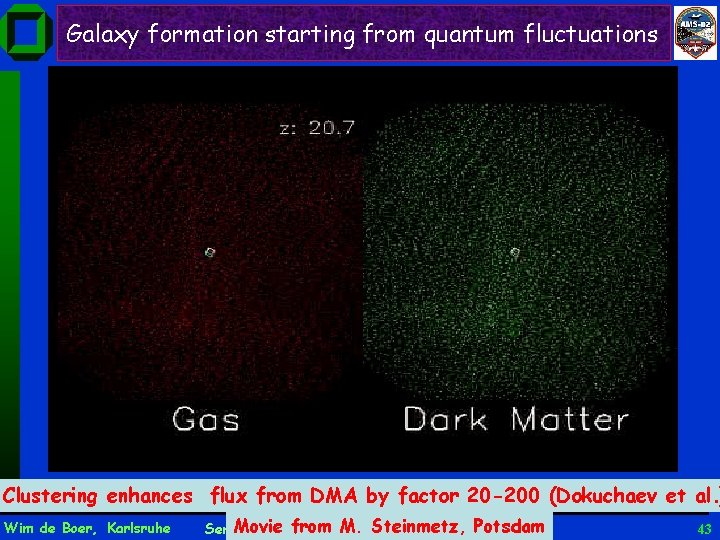
Galaxy formation starting from quantum fluctuations Clustering enhances flux from DMA by factor 20 -200 (Dokuchaev et al. Wim de Boer, Karlsruhe Movie from M. Steinmetz, Seminar Beijing, August 15, 2007 Potsdam 43
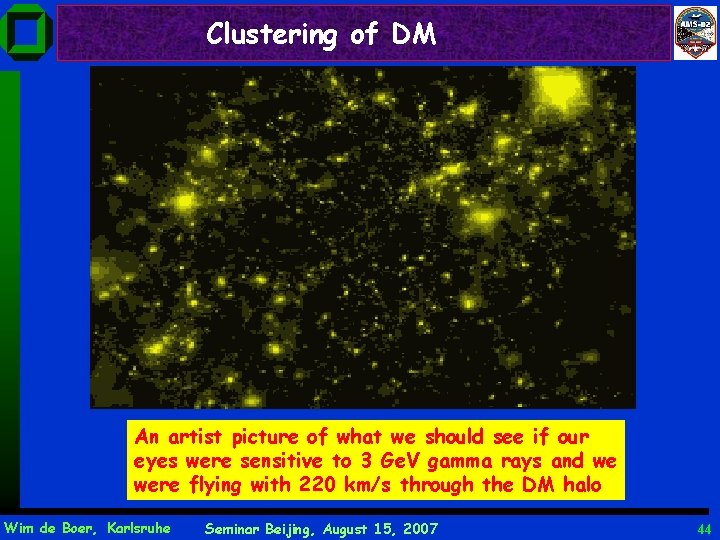
Clustering of DM An artist picture of what we should see if our eyes were sensitive to 3 Ge. V gamma rays and we were flying with 220 km/s through the DM halo Wim de Boer, Karlsruhe Seminar Beijing, August 15, 2007 44
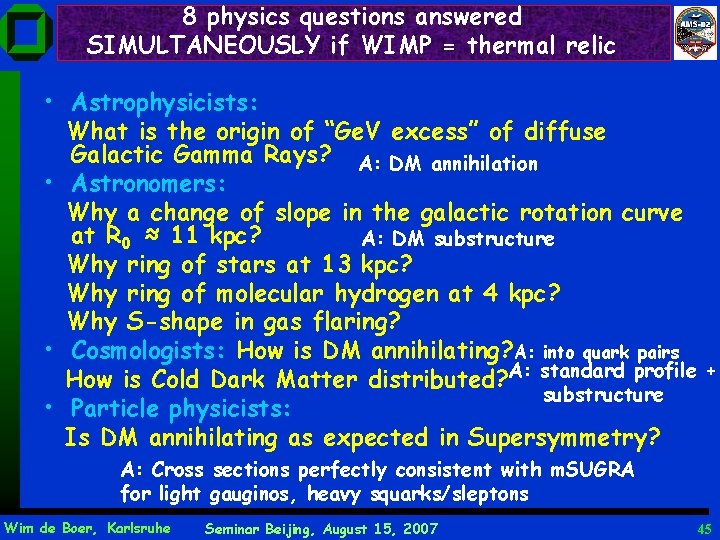
8 physics questions answered SIMULTANEOUSLY if WIMP = thermal relic • Astrophysicists: What is the origin of “Ge. V excess” of diffuse Galactic Gamma Rays? A: DM annihilation • Astronomers: Why a change of slope in the galactic rotation curve at R 0 ≈ 11 kpc? A: DM substructure Why ring of stars at 13 kpc? Why ring of molecular hydrogen at 4 kpc? Why S-shape in gas flaring? • Cosmologists: How is DM annihilating? A: into quark pairs How is Cold Dark Matter distributed? A: standard profile + substructure • Particle physicists: Is DM annihilating as expected in Supersymmetry? A: Cross sections perfectly consistent with m. SUGRA for light gauginos, heavy squarks/sleptons Wim de Boer, Karlsruhe Seminar Beijing, August 15, 2007 45
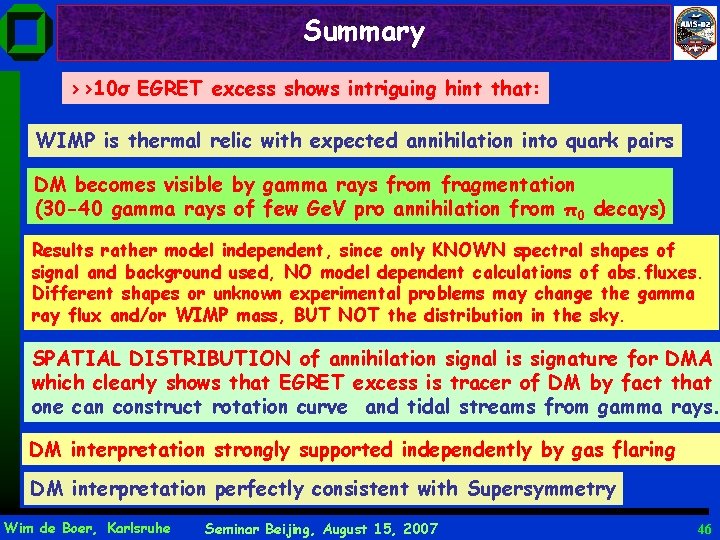
Summary >>10σ EGRET excess shows intriguing hint that: WIMP is thermal relic with expected annihilation into quark pairs DM becomes visible by gamma rays from fragmentation (30 -40 gamma rays of few Ge. V pro annihilation from π0 decays) Results rather model independent, since only KNOWN spectral shapes of signal and background used, NO model dependent calculations of abs. fluxes. Different shapes or unknown experimental problems may change the gamma ray flux and/or WIMP mass, BUT NOT the distribution in the sky. SPATIAL DISTRIBUTION of annihilation signal is signature for DMA which clearly shows that EGRET excess is tracer of DM by fact that one can construct rotation curve and tidal streams from gamma rays. DM interpretation strongly supported independently by gas flaring DM interpretation perfectly consistent with Supersymmetry Wim de Boer, Karlsruhe Seminar Beijing, August 15, 2007 46
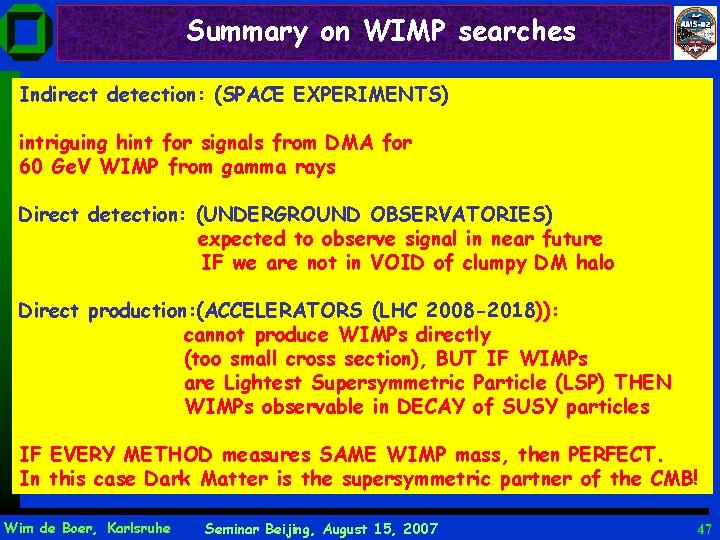
Summary on WIMP searches Indirect detection: (SPACE EXPERIMENTS) intriguing hint for signals from DMA for 60 Ge. V WIMP from gamma rays Direct detection: (UNDERGROUND OBSERVATORIES) expected to observe signal in near future IF we are not in VOID of clumpy DM halo Direct production: (ACCELERATORS (LHC 2008 -2018)): cannot produce WIMPs directly (too small cross section), BUT IF WIMPs are Lightest Supersymmetric Particle (LSP) THEN WIMPs observable in DECAY of SUSY particles IF EVERY METHOD measures SAME WIMP mass, then PERFECT. In this case Dark Matter is the supersymmetric partner of the CMB! Wim de Boer, Karlsruhe Seminar Beijing, August 15, 2007 47
- Slides: 47