
DARK MATTER SEARCH WITH CDMS EXPERIMENT Gensheng Wang
- Slides: 1
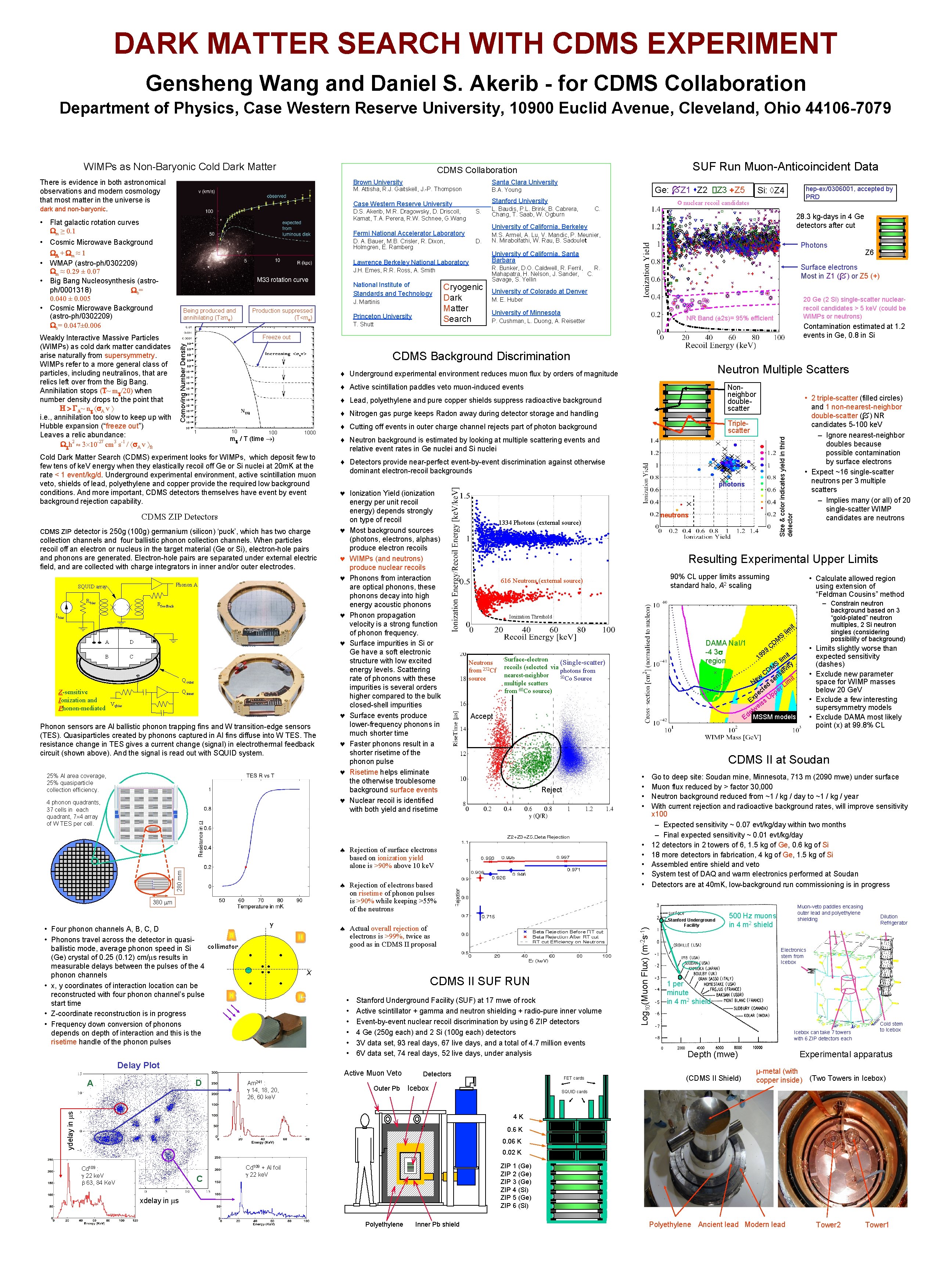
DARK MATTER SEARCH WITH CDMS EXPERIMENT Gensheng Wang and Daniel S. Akerib - for CDMS Collaboration Department of Physics, Case Western Reserve University, 10900 Euclid Avenue, Cleveland, Ohio 44106 -7079 WIMPs as Non-Baryonic Cold Dark Matter There is evidence in both astronomical observations and modern cosmology that most matter in the universe is dark and non-baryonic. M. Attisha, R. J. Gaitskell, J. -P. Thompson Being produced annihilating (T≥mc) Production suppressed (T<mc) Princeton University T. Shutt nuclear recoil candidates C. 28. 3 kg-days in 4 Ge detectors after cut M. S. Armel, A. Lu, V. Mandic, P. Meunier, N. Mirabolfathi, W. Rau, B. Sadoulet Photons University of California, Santa Barbara J. H. Emes, R. R. Ross, A. Smith Cryogenic Dark Matter Search University of Colorado at Denver 20 Ge (2 Si) single-scatter nuclearrecoil candidates > 5 ke. V (could be WIMPs or neutrons) M. E. Huber University of Minnesota NR Band (± 2 s)= 95% efficient P. Cushman, L. Duong, A. Reisetter Contamination estimated at 1. 2 events in Ge, 0. 8 in Si Comoving Number Density CDMS Background Discrimination ¨ Active scintillation paddles veto muon-induced events Nonneighbor doublescatter ¨ Lead, polyethylene and pure copper shields suppress radioactive background ¨ Nitrogen gas purge keeps Radon away during detector storage and handling m / T (time ) 1000 collection channels and four ballistic phonon collection channels. When particles recoil off an electron or nucleus in the target material (Ge or Si), electron-hole pairs and phonons are generated. Electron-hole pairs are separated under external electric field, and are collected with charge integrators in inner and/or outer electrodes. Phonon A Rfeedback I bias D C Q outer Q inner Phonon sensors are Al ballistic phonon trapping fins and W transition-edge sensors (TES). Quasiparticles created by phonons captured in Al fins diffuse into W TES. The resistance change in TES gives a current change (signal) in electrothermal feedback circuit (shown above). And the signal is read out with SQUID system. 25% Al area coverage, 25% quasiparticle collection efficiency. 4 phonon quadrants, 37 cells in each quadrant, 7 4 array of W TES per cell. ¨ Neutron background is estimated by looking at multiple scattering events and relative event rates in Ge nuclei and Si nuclei ¨ Detectors provide near-perfect event-by-event discrimination against otherwise dominant electron-recoil backgrounds photons © Ionization Yield (ionization energy per unit recoil energy) depends strongly on type of recoil © Most background sources (photons, electrons, alphas) produce electron recoils © WIMPs (and neutrons) produce nuclear recoils © Phonons from interaction are optical phonons, these phonons decay into high energy acoustic phonons © Phonon propagation velocity is a strong function of phonon frequency. © Surface impurities in Si or Ge have a soft electronic structure with low excited energy levels. Scattering rate of phonons with these impurities is several orders higher compared to the bulk closed-shell impurities © Surface events produce lower-frequency phonons in much shorter time © Faster phonons result in a shorter risetime of the phonon pulse © Risetime helps eliminate the otherwise troublesome background surface events © Nuclear recoil is identified with both yield and risetime Resulting Experimental Upper Limits 280 mm y Delay Plot Neutrons from 252 Cf source D : 14, 18, 20, 26, 60 ke. V Outer Pb 19 N ew 99 DM C • Limits slightly worse than expected sensitivity (dashes) • Exclude new parameter space for WIMP masses below 20 Ge. V • Exclude a few interesting supersymmetry models • Exclude DAMA most likely point (x) at 99. 8% CL it lim S DM C lim ty i v iti s n se Lim it ed er t ec pp p Ex iss U e w l e Ed MSSM models Accept CDMS II at Soudan • • Reject Go to deep site: Soudan mine, Minnesota, 713 m (2090 mwe) under surface Muon flux reduced by > factor 30, 000 Neutron background reduced from ~1 / kg / day to ~1 / kg / year With current rejection and radioactive background rates, will improve sensitivity x 100 – Expected sensitivity ~ 0. 07 evt/kg/day within two months – Final expected sensitivity ~ 0. 01 evt/kg/day 12 detectors in 2 towers of 6, 1. 5 kg of Ge, 0. 6 kg of Si 18 more detectors in fabrication, 4 kg of Ge, 1. 5 kg of Si Assembled entire shield and veto System test of DAQ and warm electronics performed at Soudan Detectors are at 40 m. K, low-background run commissioning is in progress • • • Detectors FET cards Icebox ydelay in s Am 241 S DAMA Na. I/1 -4 3 region Surface-electron (Single-scatter) recoils (selected via photons from nearest-neighbor 60 Co Source multiple scatters from 60 Co source) Stanford Underground Facility (SUF) at 17 mwe of rock Active scintillator + gamma and neutron shielding + radio-pure inner volume Event-by-event nuclear recoil discrimination by using 6 ZIP detectors 4 Ge (250 g each) and 2 Si (100 g each) detectors 3 V data set, 93 real days, 67 live days, and a total of 4. 7 million events 6 V data set, 74 real days, 52 live days, under analysis Active Muon Veto – Constrain neutron background based on 3 “gold-plated” neutron multiples, 2 Si neutron singles (considering possibility of background) it CDMS II SUF RUN • • Calculate allowed region using extension of “Feldman Cousins” method Ionization Threshold ª Actual overall rejection of electrons is >99%, twice as good as in CDMS II proposal X 90% CL upper limits assuming standard halo, A 2 scaling 616 Neutrons (external source) ª Rejection of electrons based on risetime of phonon pulses is >90% while keeping >55% of the neutrons • Four phonon channels A, B, C, D • Phonons travel across the detector in quasicollimator ballistic mode, average phonon speed in Si (Ge) crystal of 0. 25 (0. 12) cm/ s results in measurable delays between the pulses of the 4 phonon channels • x, y coordinates of interaction location can be reconstructed with four phonon channel’s pulse start time • Z-coordinate reconstruction is in progress • Frequency down conversion of phonons depends on depth of interaction and this is the risetime handle of the phonon pulses neutrons 1334 Photons (external source) ª Rejection of surface electrons based on ionization yield alone is >90% above 10 ke. V 380 m Size & color indicates yield in third detector 100 • 2 triple-scatter (filled circles) and 1 non-nearest-neighbor double-scatter ( ) NR candidates 5 -100 ke. V – Ignore nearest-neighbor doubles because possible contamination by surface electrons • Expect ~16 single-scatter neutrons per 3 multiple scatters – Implies many (or all) of 20 single-scatter WIMP candidates are neutrons Triplescatter ¨ Cutting off events in outer charge channel rejects part of photon background Log 10(Muon Flux) (m-2 s-1) 10 CDMS ZIP detector is 250 g (100 g) germanium (silicon) ‘puck’, which has two charge A Neutron Multiple Scatters ¨ Underground experimental environment reduces muon flux by orders of magnitude 1 Z-sensitive Ionization and V Phonon-mediated qbias Z 6 Surface electrons Most in Z 1 ( ) or Z 5 (+) R. Bunker, D. O. Caldwell, R. Ferril, R. Mahapatra, H. Nelson, J. Sander, C. Savage, S. Yellin Freeze out CDMS ZIP Detectors SQUID array D. Lawrence Berkeley National Laboratory J. Martinis L. Baudis, P. L. Brink, B. Cabrera, Chang, T. Saab, W. Ogburn hep-ex/0306001, accepted by PRD Si: ◊Z 4 University of California, Berkeley D. A. Bauer, M. B. Crisler, R. Dixon, Holmgren, E. Ramberg Cold Dark Matter Search (CDMS) experiment looks for WIMPs, which deposit few to few tens of ke. V energy when they elastically recoil off Ge or Si nuclei at 20 m. K at the rate < 1 event/kg/d. Underground experimental environment, active scintillation muon veto, shields of lead, polyethylene and copper provide the required low background conditions. And more important, CDMS detectors themselves have event by event background rejection capability. B S. Fermi National Accelerator Laboratory Weakly Interactive Massive Particles (WIMPs) as cold dark matter candidates arise naturally from supersymmetry. WIMPs refer to a more general class of particles, including neutralinos, that are relics left over from the Big Bang. Annihilation stops (T~ m 20) when number density drops to the point that H > GA~ n A v i. e. , annihilation too slow to keep up with Hubble expansion (“freeze out”) Leaves a relic abundance: h 2 3 10 -27 cm 3 s-1 A v fr A Stanford University D. S. Akerib, M. R. Dragowsky, D. Driscoll, Kamat, T. A. Perera, R. W. Schnee, G. Wang National Institute of Standards and Technology Ge: Z 1 Z 2 Z 3 +Z 5 B. A. Young Case Western Reserve University • Flat galactic rotation curves m ≥ 0. 1 R bias Santa Clara University Brown University • Cosmic Microwave Background L + m ≈ 1 • WMAP (astro-ph/0302209) m ≈ 0. 29 ± 0. 07 • Big Bang Nucleosynthesis (astroph/0001318) b = 0. 040 ± 0. 005 • Cosmic Microwave Background (astro-ph/0302209) b= 0. 047± 0. 006 SUF Run Muon-Anticoincident Data CDMS Collaboration Stanford Underground Facility Muon-veto paddles encasing outer lead and polyethylene shielding 500 Hz muons in 4 m 2 shield Dilution Refrigerator Electronics stem from Icebox 1 per minute in 4 m 2 shield Icebox can take 7 towers with 6 ZIP detectors each Experimental apparatus Depth (mwe) (CDMS II Shield) Cold stem to Icebox µ-metal (with copper inside) (Two Towers in Icebox) SQUID cards 4 K 0. 6 K 0. 02 K Cd 109 : B 22 ke. V 63, 84 Ke. V C ZIP 1 (Ge) ZIP 2 (Ge) ZIP 3 (Ge) ZIP 4 (Si) ZIP 5 (Ge) ZIP 6 (Si) Cd 109 + Al foil 22 ke. V xdelay in s Polyethylene Inner Pb shield Polyethylene Ancient lead Modern lead Tower 2 Tower 1