
Dark Matter Results from CDMS Joel Sander Blois
Dark Matter Results from CDMS Joel Sander Blois 2012
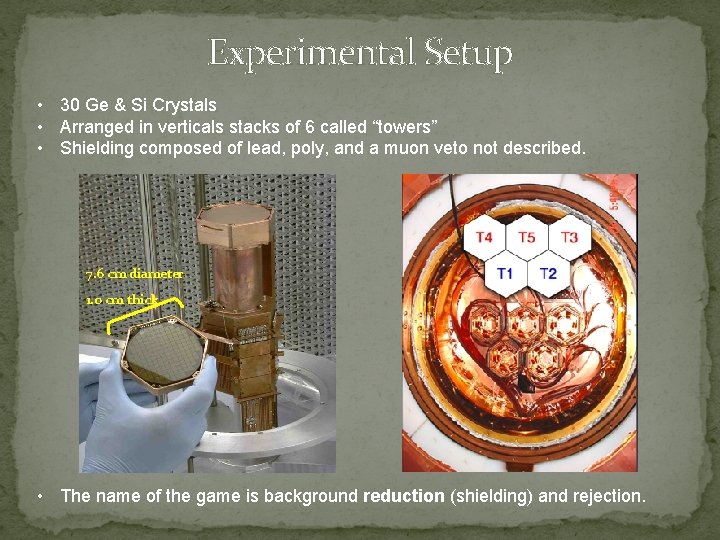
Experimental Setup • 30 Ge & Si Crystals • Arranged in verticals stacks of 6 called “towers” • Shielding composed of lead, poly, and a muon veto not described. 7. 6 cm diameter 1. 0 cm thick • The name of the game is background reduction (shielding) and rejection.
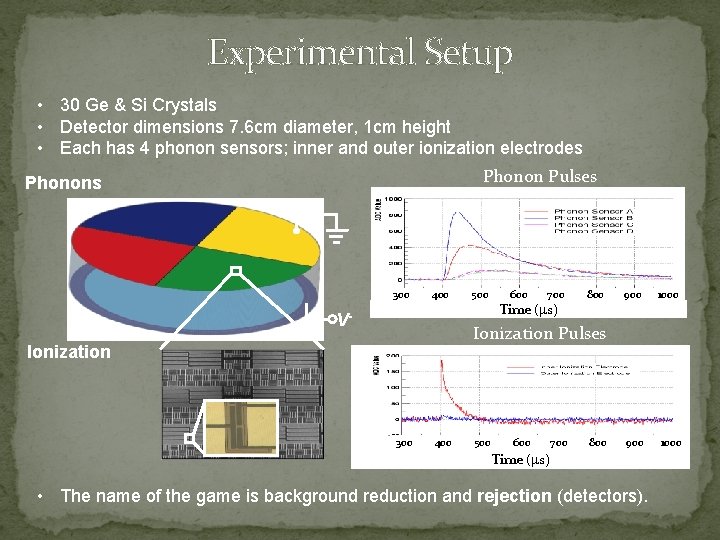
Experimental Setup • 30 Ge & Si Crystals • Detector dimensions 7. 6 cm diameter, 1 cm height • Each has 4 phonon sensors; inner and outer ionization electrodes Phonon Pulses Phonons 300 400 V- 500 600 700 Time (ms) 800 900 1000 Ionization Pulses Ionization 300 400 500 600 700 800 Time (ms) • The name of the game is background reduction and rejection (detectors).
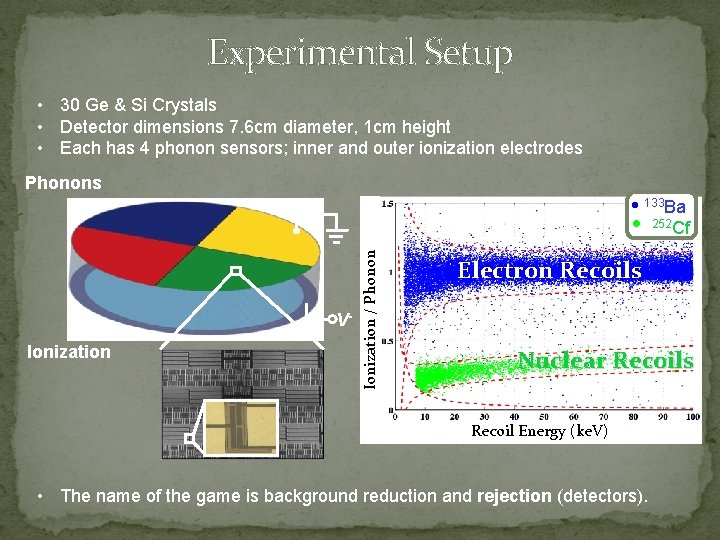
Experimental Setup • 30 Ge & Si Crystals • Detector dimensions 7. 6 cm diameter, 1 cm height • Each has 4 phonon sensors; inner and outer ionization electrodes Phonons • 133 Ba VIonization / Phonon • 252 Cf Electron Recoils Nuclear Recoils Recoil Energy (ke. V) • The name of the game is background reduction and rejection (detectors).
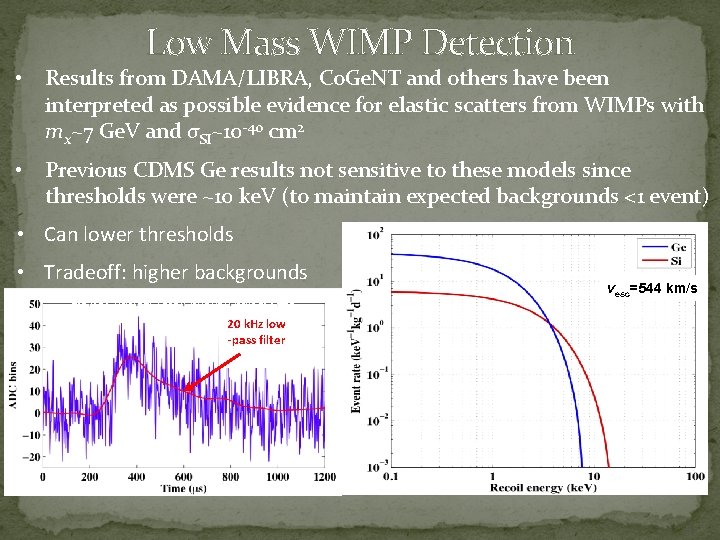
Low Mass WIMP Detection • Results from DAMA/LIBRA, Co. Ge. NT and others have been interpreted as possible evidence for elastic scatters from WIMPs with mx~7 Ge. V and σSI~10 -40 cm 2 • Previous CDMS Ge results not sensitive to these models since thresholds were ~10 ke. V (to maintain expected backgrounds <1 event) • Can lower thresholds • Tradeoff: higher backgrounds 6 2. 0 ke. V nuclear recoil phonon pulse, T 1 Z 5 i=1 vesc=544 km/s 20 k. Hz low -pass filter 5
Low Threshold Analysis • Soudan data from Oct. 2006 -Sept. 2008 reanalyzed with 2 ke. V recoil energy threshold • Used 8 Ge detectors with lowest trigger thresholds (1. 5 -2. 5 ke. V) • Small subset (1/4 of the data) used to study backgrounds at low energy • Limits calculated from remaining 241 kg-day raw exposure • Results driven by detector with best resolution (T 1 Z 5)
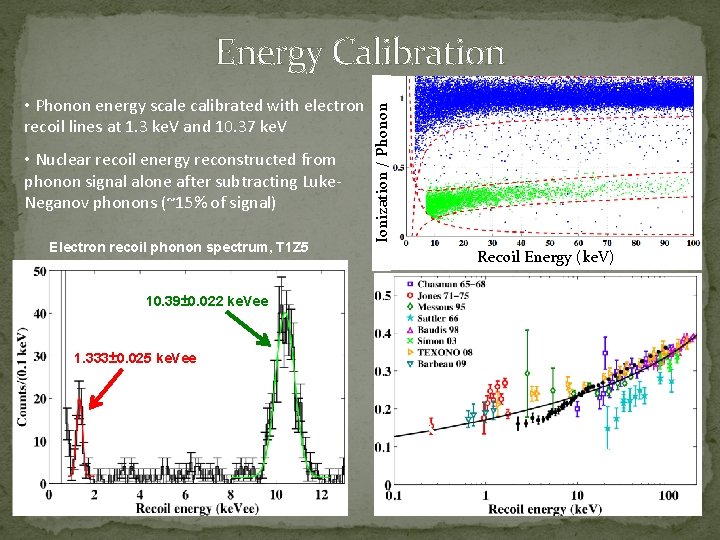
• Phonon energy scale calibrated with electron recoil lines at 1. 3 ke. V and 10. 37 ke. V • Nuclear recoil energy reconstructed from phonon signal alone after subtracting Luke. Neganov phonons (~15% of signal) Electron recoil phonon spectrum, T 1 Z 5 Ionization / Phonon Energy Calibration Nuclear recoil ionization yield: Recoil Energy (ke. V) 10. 39± 0. 022 ke. Vee 1. 333± 0. 025 ke. Vee Lindhard (k=0. 157) CDMS
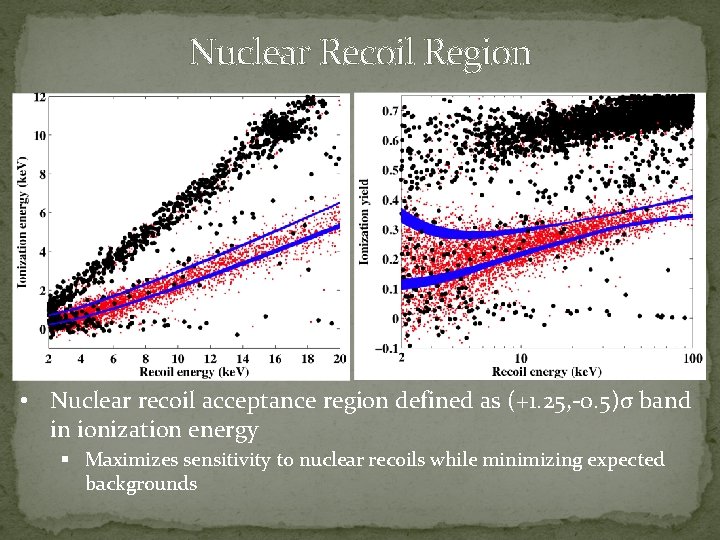
Nuclear Recoil Region • Nuclear recoil acceptance region defined as (+1. 25, -0. 5)σ band in ionization energy § Maximizes sensitivity to nuclear recoils while minimizing expected backgrounds
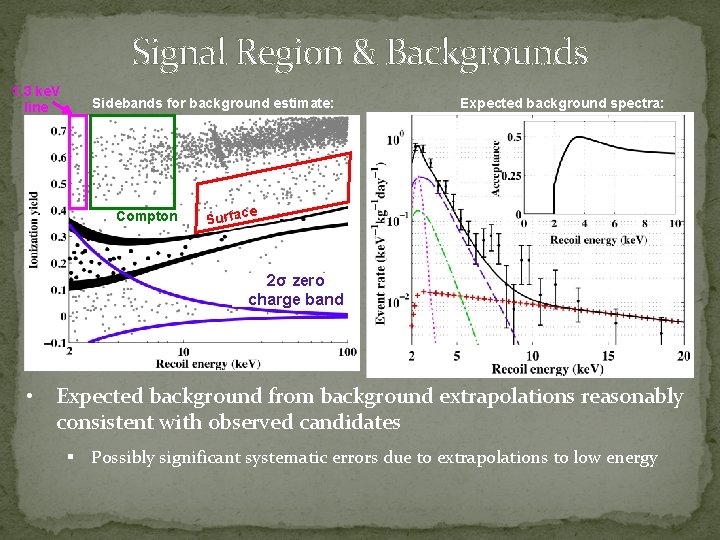
Signal Region & Backgrounds 1. 3 ke. V line Sidebands for background estimate: Compton Expected background spectra: ce Surfa 2σ zero charge band • Expected background from background extrapolations reasonably consistent with observed candidates § Possibly significant systematic errors due to extrapolations to low energy
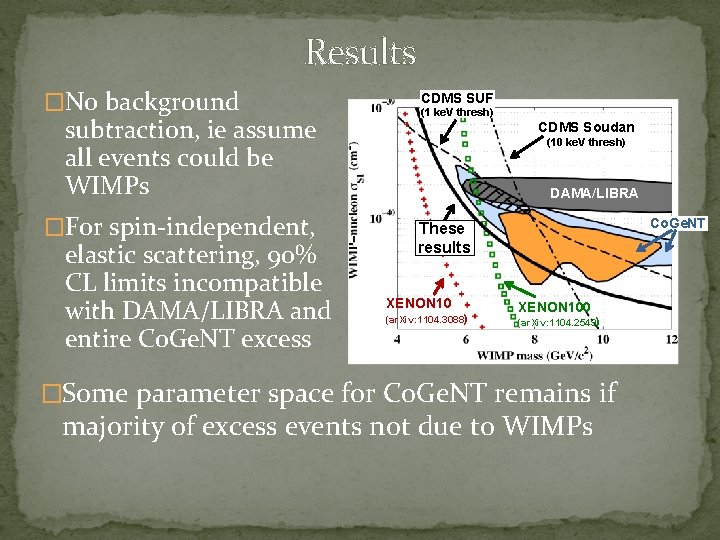
Results �No background subtraction, ie assume all events could be WIMPs �For spin-independent, elastic scattering, 90% CL limits incompatible with DAMA/LIBRA and entire Co. Ge. NT excess CDMS SUF (1 ke. V thresh) CDMS Soudan (10 ke. V thresh) DAMA/LIBRA Co. Ge. NT These results XENON 10 (ar. Xiv: 1104. 3088) XENON 100 (ar. Xiv: 1104. 2549) �Some parameter space for Co. Ge. NT remains if majority of excess events not due to WIMPs
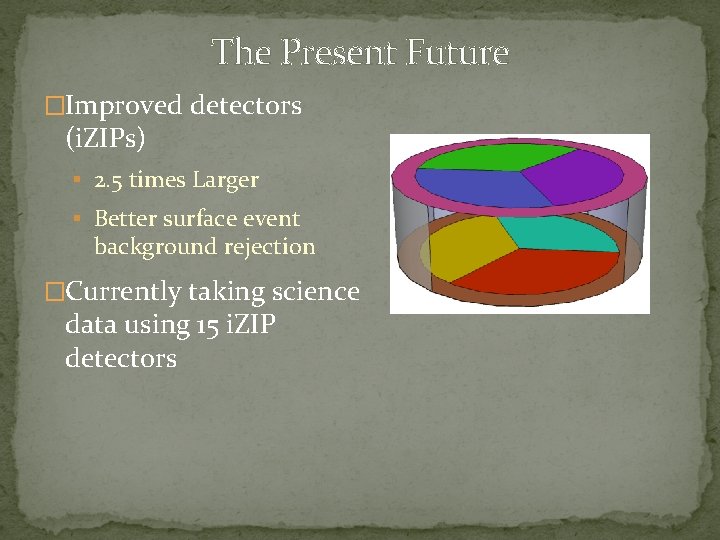
The Present Future �Improved detectors (i. ZIPs) § 2. 5 times Larger § Better surface event background rejection �Currently taking science data using 15 i. ZIP detectors
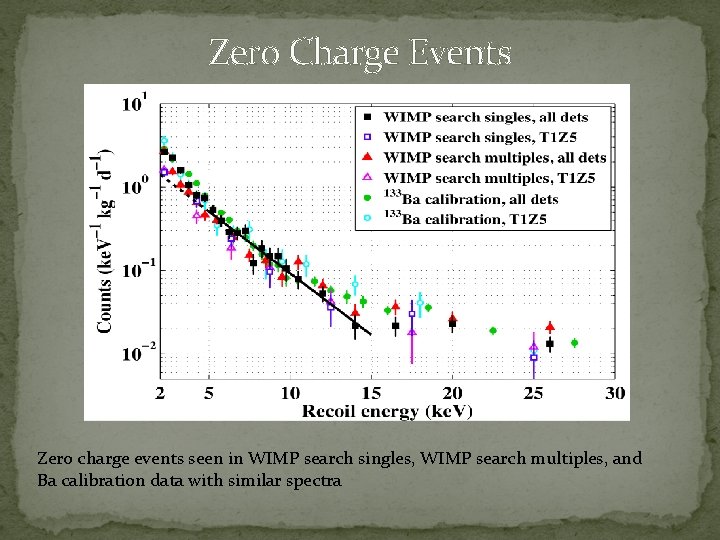
Zero Charge Events Zero charge events seen in WIMP search singles, WIMP search multiples, and Ba calibration data with similar spectra
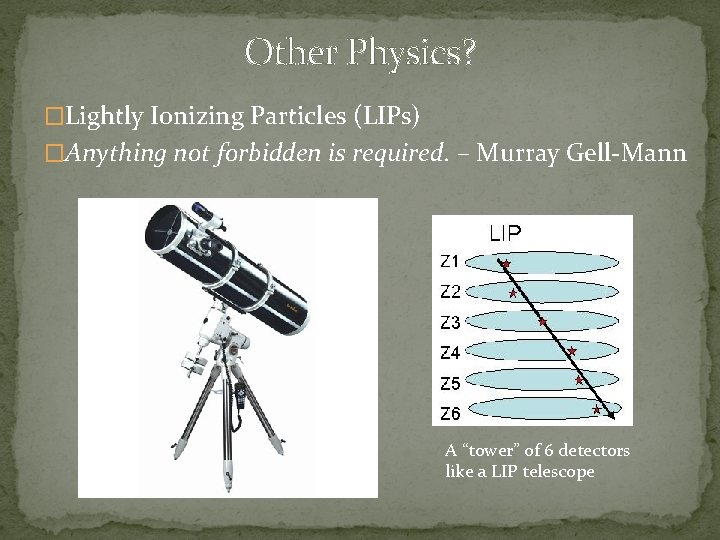
Other Physics? �Lightly Ionizing Particles (LIPs) �Anything not forbidden is required. – Murray Gell-Mann A “tower” of 6 detectors like a LIP telescope
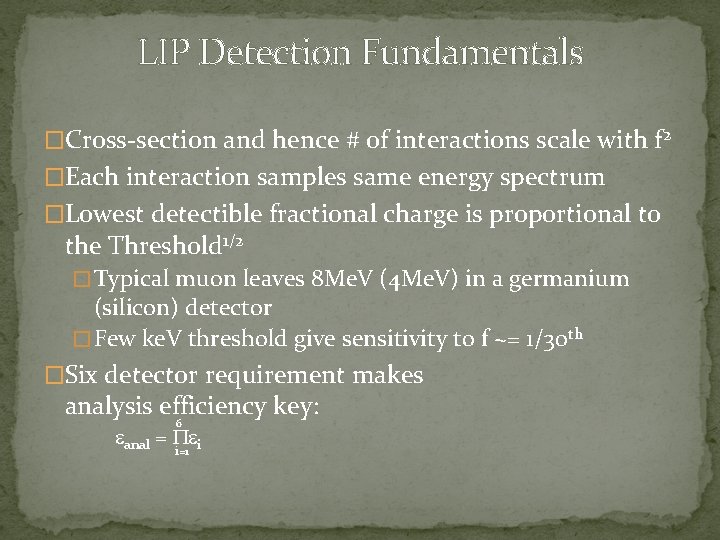
LIP Detection Fundamentals �Cross-section and hence # of interactions scale with f 2 �Each interaction samples same energy spectrum �Lowest detectible fractional charge is proportional to the Threshold 1/2 � Typical muon leaves 8 Me. V (4 Me. V) in a germanium (silicon) detector � Few ke. V threshold give sensitivity to f ~= 1/30 th �Six detector requirement makes analysis efficiency key: 6 eanal = Pei i=1
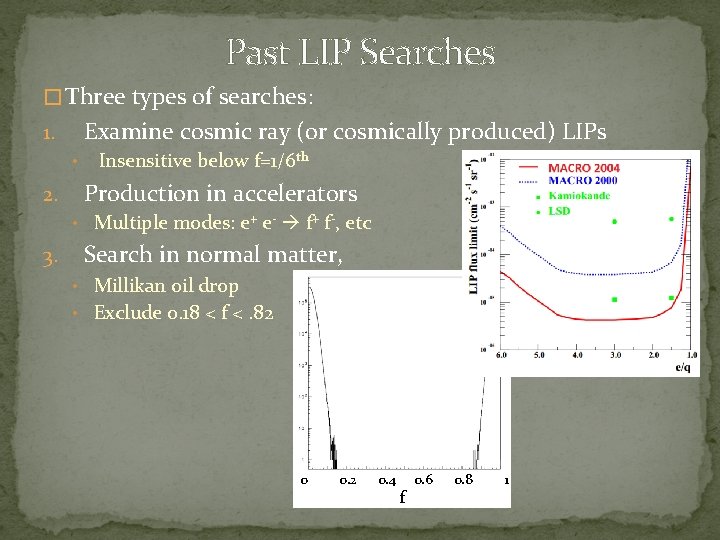
Past LIP Searches � Three types of searches: Examine cosmic ray (or cosmically produced) LIPs 1. • 2. Insensitive below f=1/6 th Production in accelerators • Multiple modes: e+ e- f+ f-, etc 3. Search in normal matter, • Millikan oil drop • Exclude 0. 18 < f <. 82 0 0. 2 0. 4 f 0. 6 0. 8 1
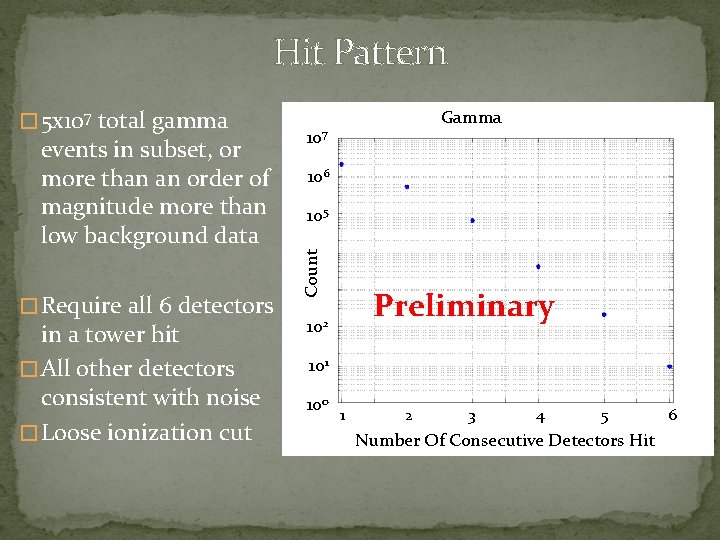
Hit Pattern events in subset, or more than an order of magnitude more than low background data � Require all 6 detectors in a tower hit � All other detectors consistent with noise � Loose ionization cut Subset Of Gamma Calibration Data 107 106 105 Count � 5 x 10⁷ total gamma Preliminary 102 101 100 1 2 3 4 5 Number Of Consecutive Detectors Hit 6
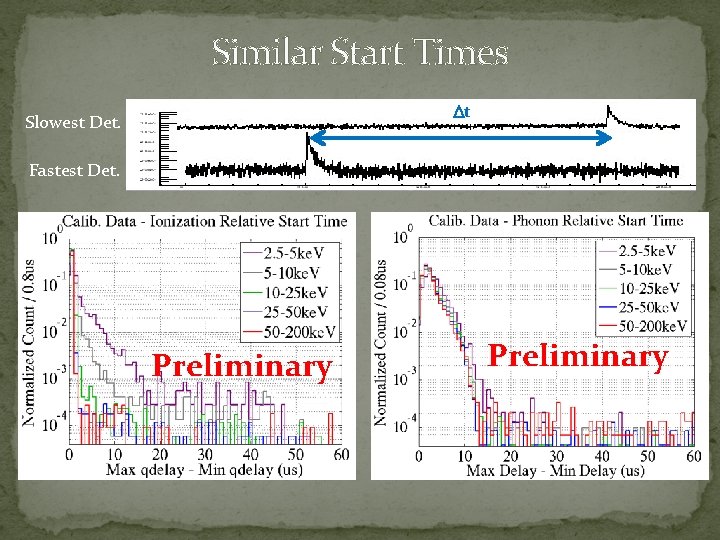
Similar Start Times Dt Slowest Det. Fastest Det. Preliminary
Energy Consistency �Assume LIPs to be minimum ionizing �Model interactions using the Photo-Absorption- Ionization (PAI) model § Compute single-interaction spectrum § Estimate the probability of n interactions given a fractional charge and incident angle q § Convolute, convolute § Compare any observed events to the expected energy distribution
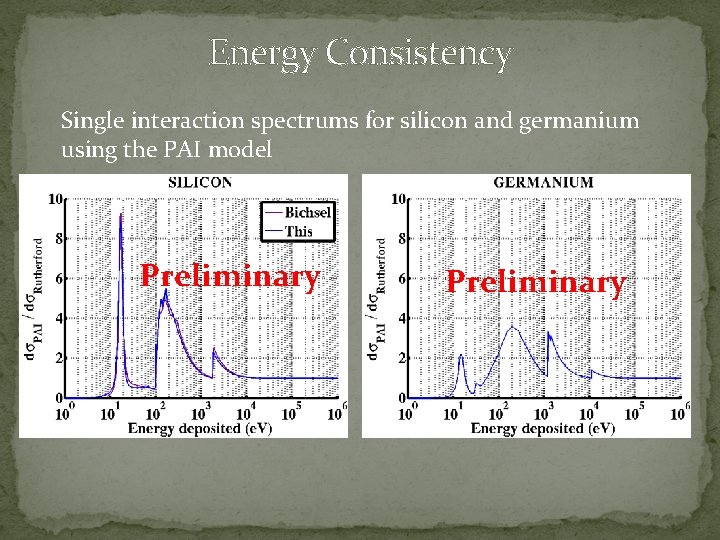
Energy Consistency Single interaction spectrums for silicon and germanium using the PAI model Preliminary
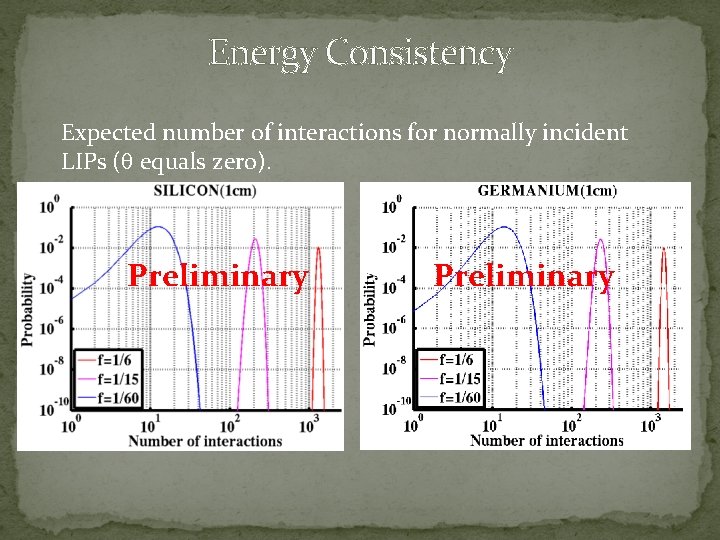
Energy Consistency Expected number of interactions for normally incident LIPs (q equals zero). Preliminary
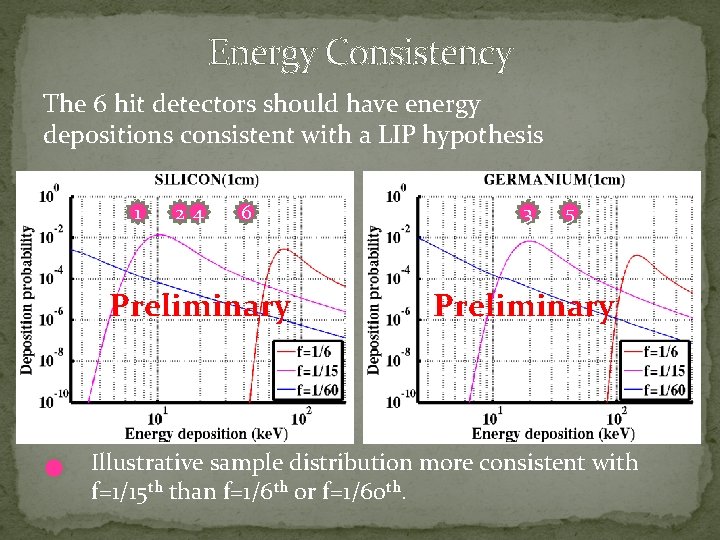
Energy Consistency The 6 hit detectors should have energy depositions consistent with a LIP hypothesis 1 24 6 Preliminary 3 5 Preliminary Illustrative sample distribution more consistent with f=1/15 th than f=1/6 th or f=1/60 th.
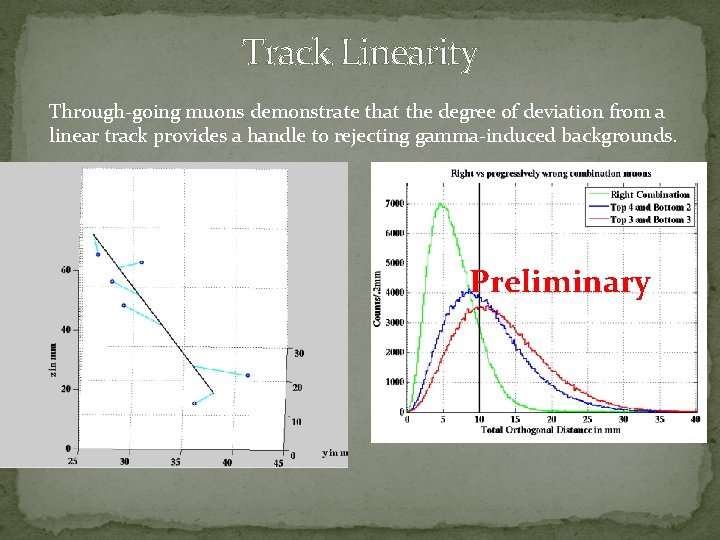
Track Linearity Through-going muons demonstrate that the degree of deviation from a linear track provides a handle to rejecting gamma-induced backgrounds. Preliminary

That’s all folks….
- Slides: 23