
Dark matter capture in compact stars stellar on

- Slides: 25
Dark matter capture in compact stars -stellar on dark matterin constraints neutron stars with exotic phases Motoi Tachibana (Saga Univ. ) Oct. 20, 2014 @ QCS 2014, KIAA, Beijin
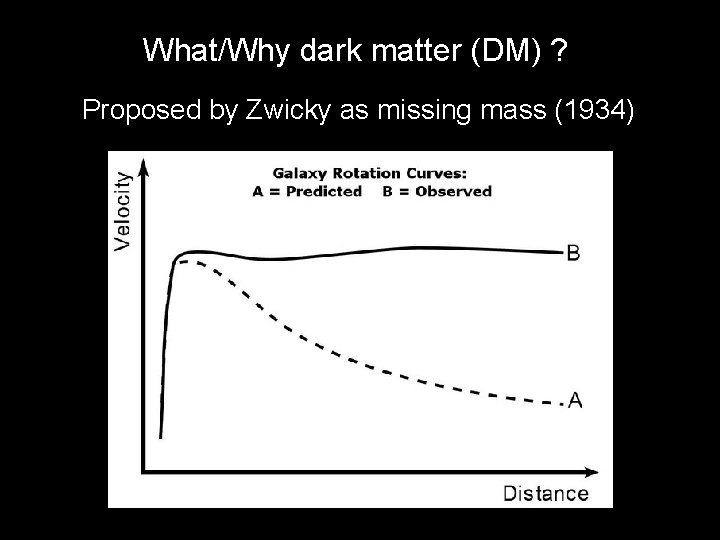
What/Why dark matter (DM) ? Undoubtedly exists, but properties unknown Proposed by Zwicky as missing mass (1934) Interacting with other particles very weakly
What/Why neutron star (NS) ? Landau’s gigantic nucleus Proposed by Baade and Zwicky Good market selling ultimate environments as a remnant after supernova explosion (1934)
Why the connection between DM and NS?
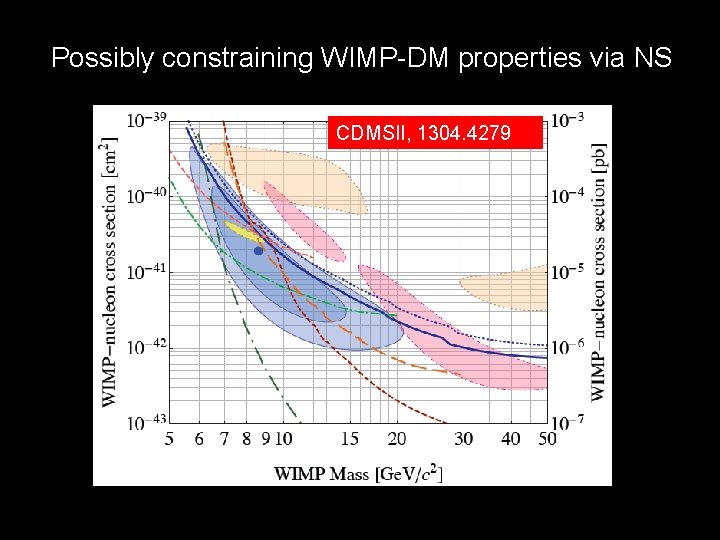
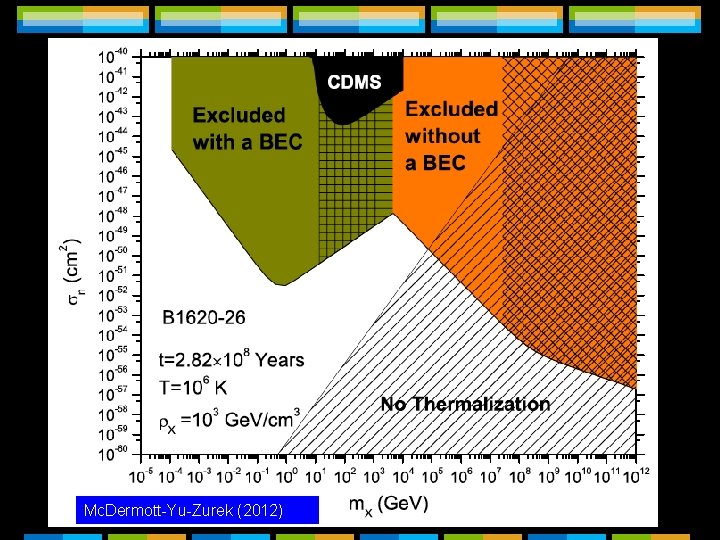
Possibly constraining WIMP-DM properties via NS CDMSII, 1304. 4279 Way below the CDMS limit! For a typical neutron star,
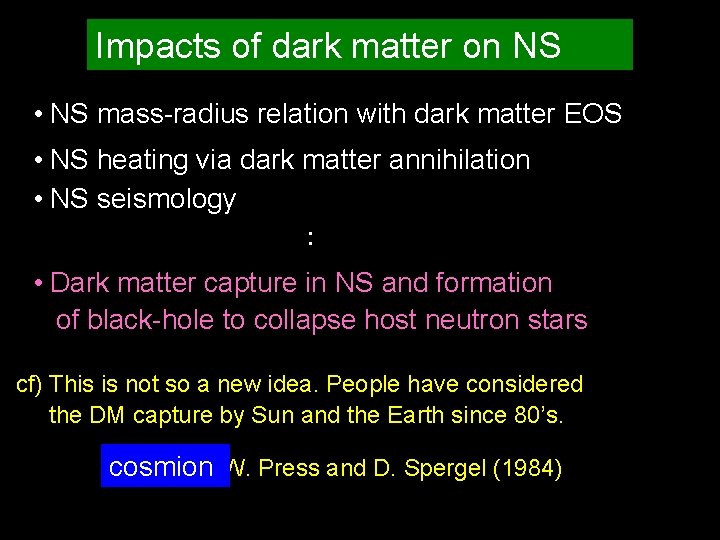
Impacts of dark matter on NS • NS mass-radius relation with dark matter EOS • NS heating via dark matter annihilation • NS seismology : • Dark matter capture in NS and formation of black-hole to collapse host neutron stars cf) This is not so a new idea. People have considered the DM capture by Sun and the Earth since 80’s. cosmion W. Press and D. Spergel (1984)
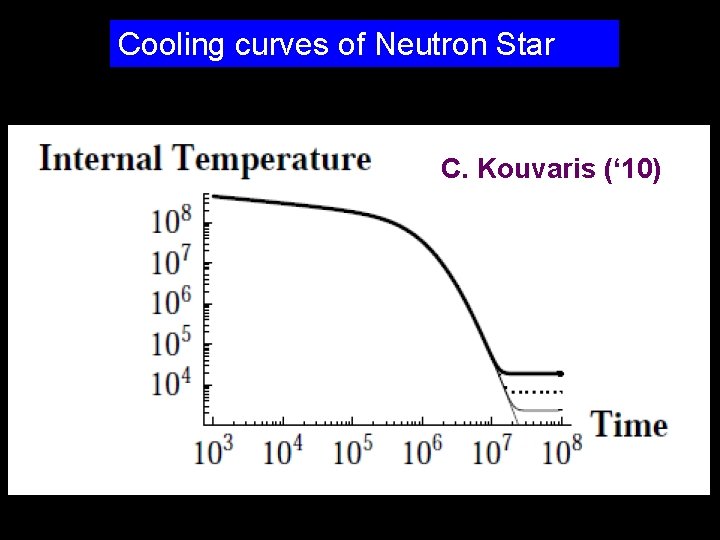
Cooling curves of Neutron Star T C. Kouvaris (‘ 10) t
DM capture in NS *based on paper by Mc. Dermott-Yu-Zurek (2012) *
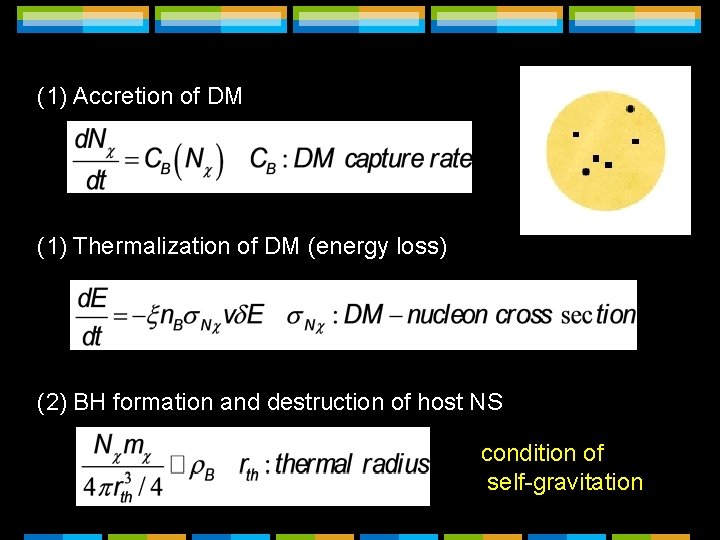
(1) Accretion of DM (1) Thermalization of DM (energy loss) (2) BH formation and destruction of host NS condition of self-gravitation
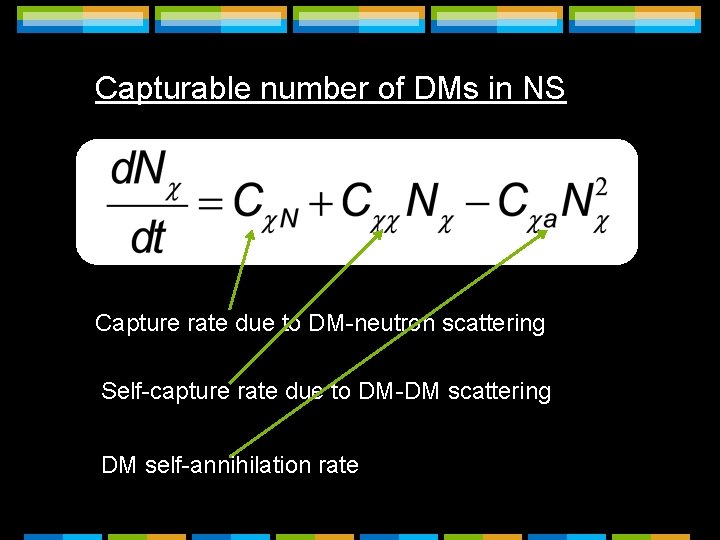
Capturable number of DMs in NS Capture rate due to DM-neutron scattering Self-capture rate due to DM-DM scattering DM self-annihilation rate
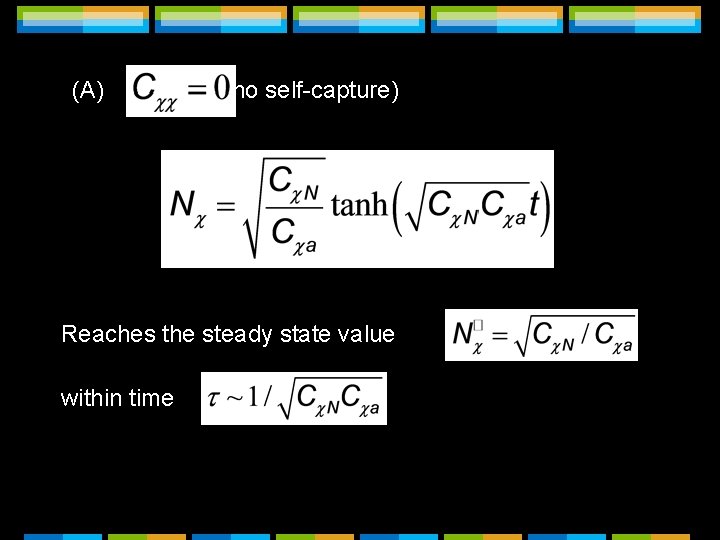
(A) (no self-capture) Reaches the steady state value within time . ,
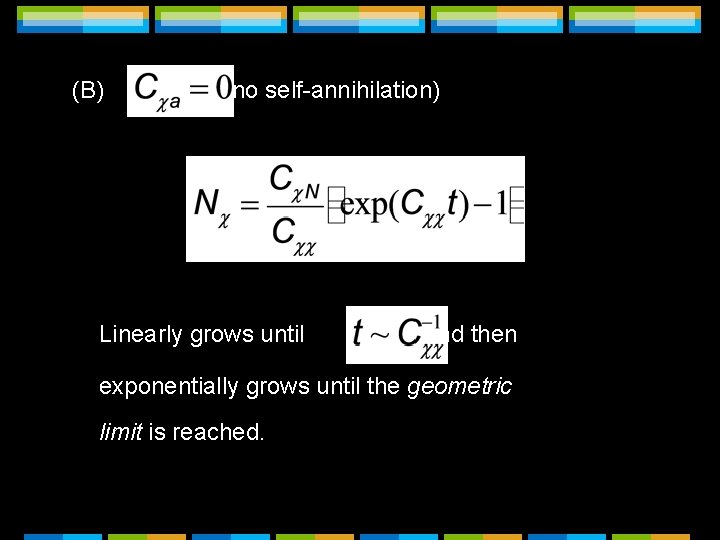
(B) (no self-annihilation) Linearly grows until , and then exponentially grows until the geometric limit is reached.
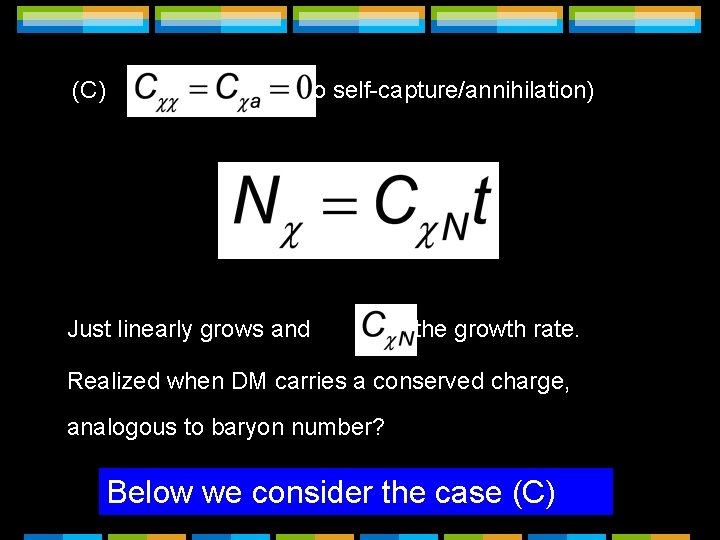
(C) (no self-capture/annihilation) Just linearly grows and is the growth rate. Realized when DM carries a conserved charge, analogous to baryon number? Below we consider the case (C)
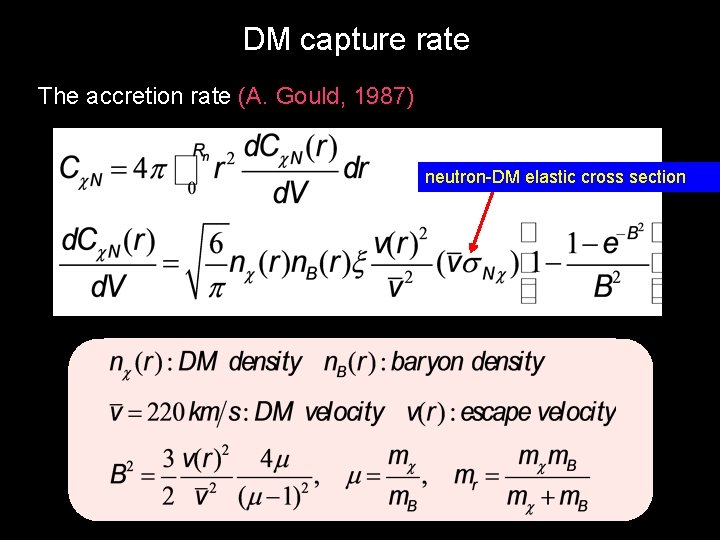
DM capture rate The accretion rate (A. Gould, 1987) neutron-DM elastic cross section
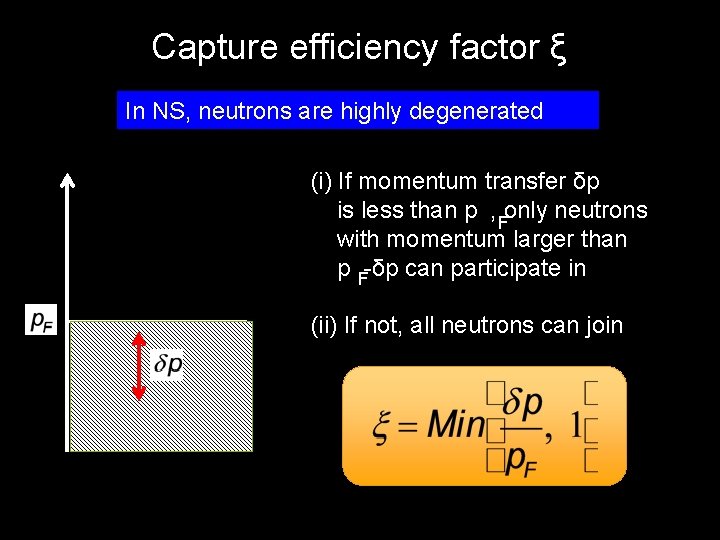
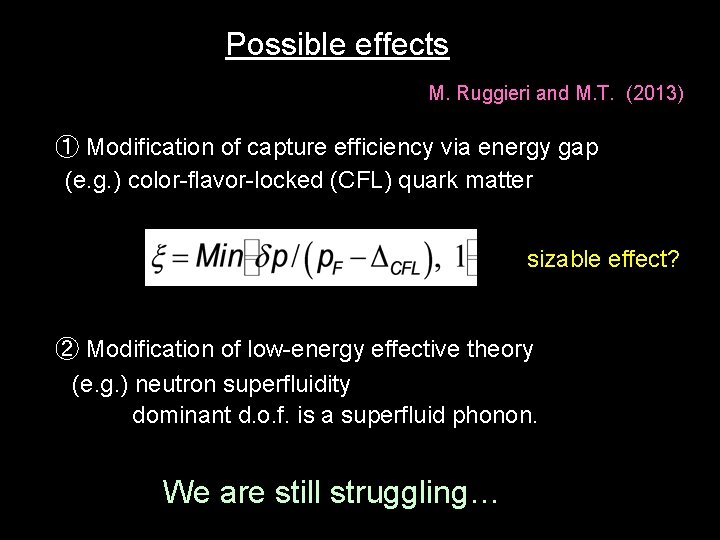
Capture efficiency factor ξ In NS, neutrons are highly degenerated (i) If momentum transfer δp is less than p , Fonly neutrons with momentum larger than p F-δp can participate in (ii) If not, all neutrons can join
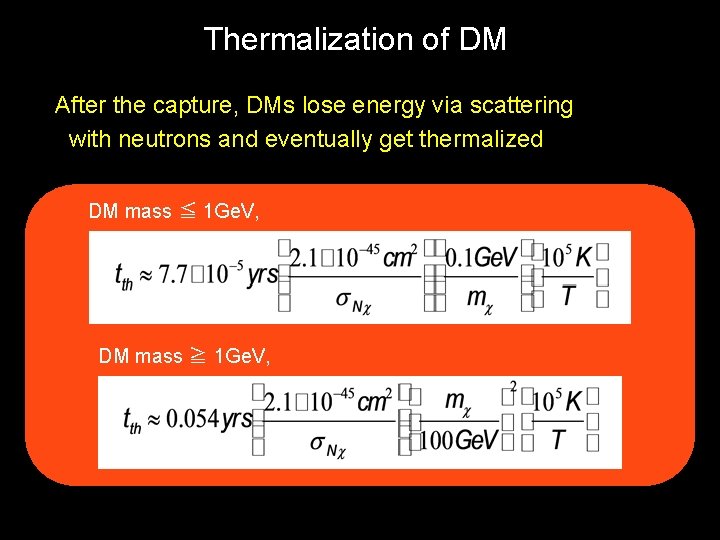
Thermalization of DM After the capture, DMs lose energy via scattering with neutrons and eventually get thermalized DM mass ≦ 1 Ge. V, DM mass ≧ 1 Ge. V,
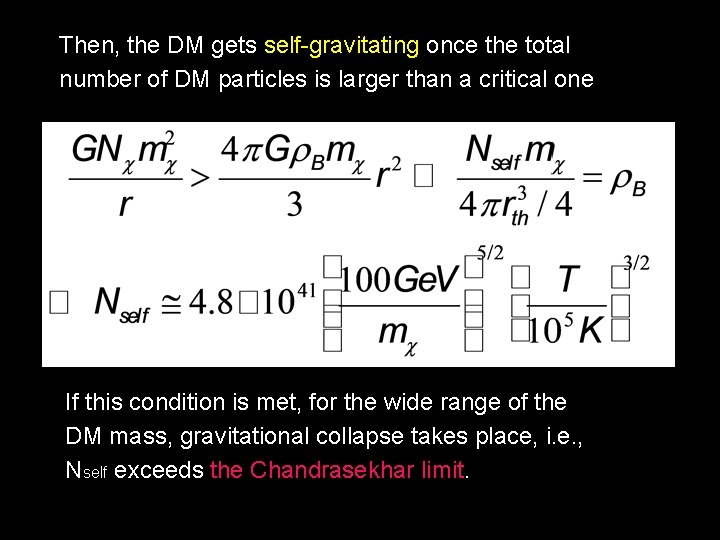
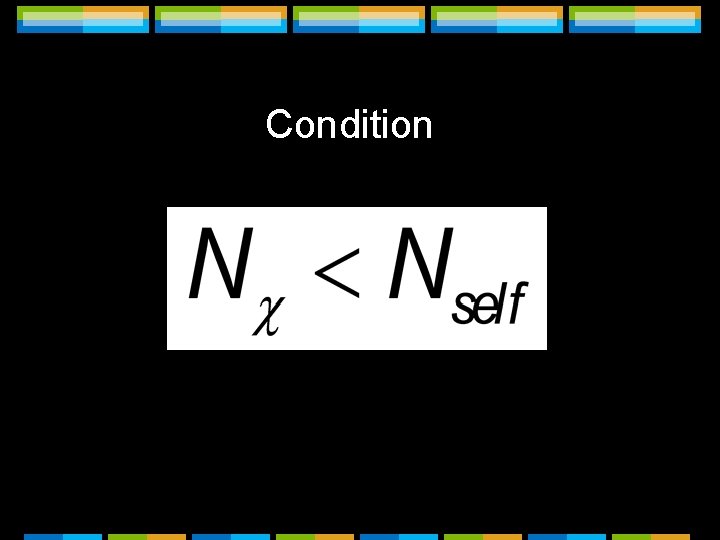
Then, the DM gets self-gravitating once the total number of DM particles is larger than a critical one If this condition is met, for the wide range of the DM mass, gravitational collapse takes place, i. e. , Nself exceeds the Chandrasekhar limit.
Condition
Observational constraints For the case of the pulsar B 1620 -26: Mc. Dermott-Yu-Zurek (2012)
Neutron star is But… Landau’s gigantic nucleus!
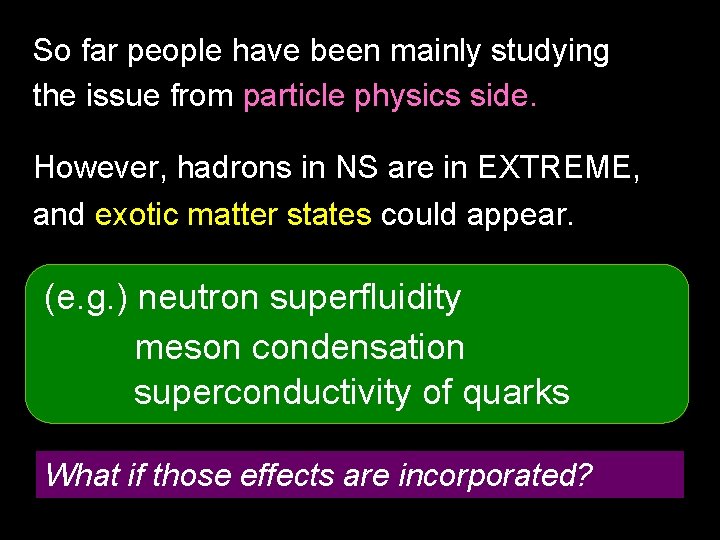
So far people have been mainly studying the issue from particle physics side. However, hadrons in NS are in EXTREME, and exotic matter states could appear. (e. g. ) neutron superfluidity meson condensation superconductivity of quarks What if those effects are incorporated?
Possible effects M. Ruggieri and M. T. (2013) ① Modification of capture efficiency via energy gap (e. g. ) color-flavor-locked (CFL) quark matter sizable effect? ② Modification of low-energy effective theory (e. g. ) neutron superfluidity dominant d. o. f. is a superfluid phonon. We are still struggling…
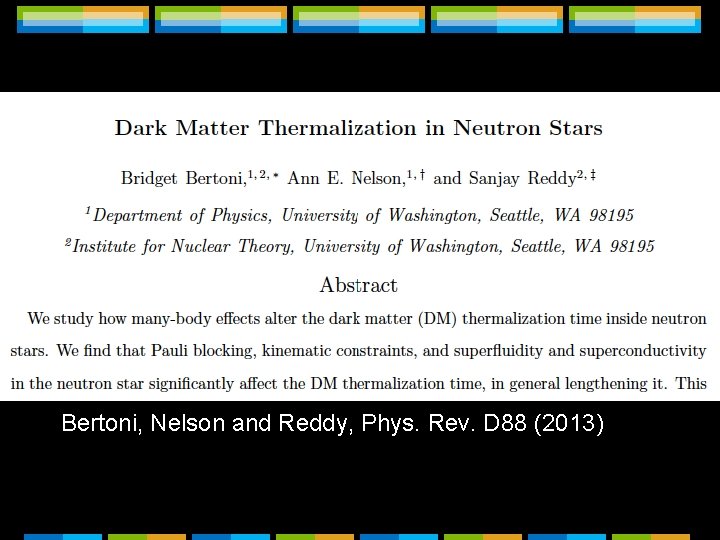
Bertoni, Nelson and Reddy, Phys. Rev. D 88 (2013)
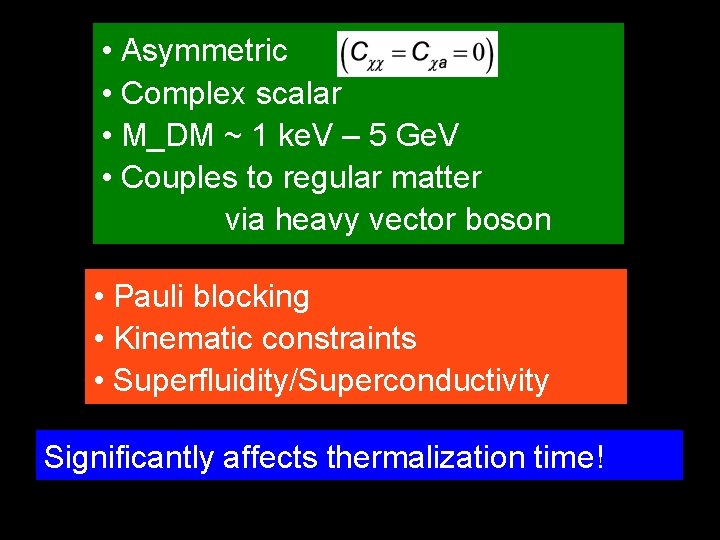
• Asymmetric • Complex scalar • M_DM ~ 1 ke. V – 5 Ge. V • Couples to regular matter via heavy vector boson • Pauli blocking • Kinematic constraints • Superfluidity/Superconductivity Significantly affects thermalization time!
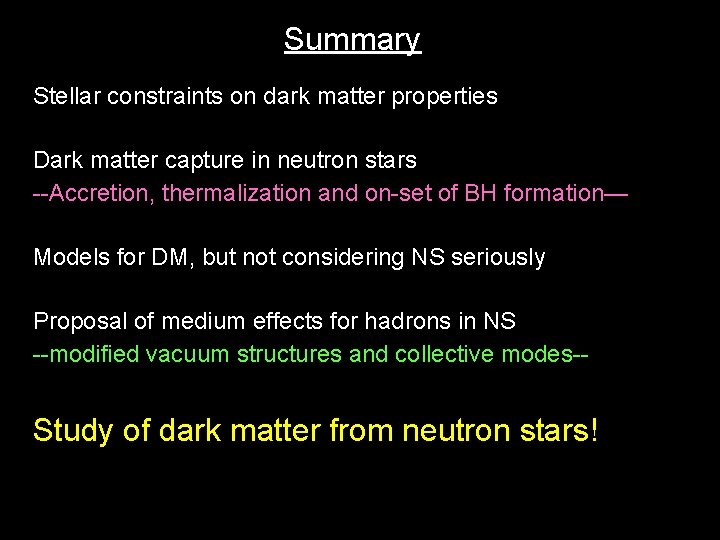
Summary Stellar constraints on dark matter properties Dark matter capture in neutron stars --Accretion, thermalization and on-set of BH formation— Models for DM, but not considering NS seriously Proposal of medium effects for hadrons in NS --modified vacuum structures and collective modes-- Study of dark matter from neutron stars!